FLUID VOLVO 850 1996 Owners Manual
[x] Cancel search | Manufacturer: VOLVO, Model Year: 1996, Model line: 850, Model: VOLVO 850 1996Pages: 265, PDF Size: 4.57 MB
Page 6 of 265

1996 Volvo 850
Used for measuring shorter distances. The last digit indicates 1/10 mile\
/kilometer. A black number on a white background =
original speedometer. A red number on a white background = replacement s\
peedometer.
9 Tachometer
Reads thousands of engine rpm. Engine should not be operated in red rang\
e. The highest permitted constant engine speed is
6,300 rpm (turbo: 6,200 rpm, B 5252 S: 6,000 rpm). pg. 1:3 Indicator and warning lights
1 Turn signal, left
2 Turn signal , right
3 (Not in use)
4 Low washer fluid level
If the lamp glows continuously when the engine is running, there is only\
about 1/2 - 1 US qt. remaining in the washer fluid
reservoir.
5 Low fuel level
When the lamp glows, only about 1.8 US gals. (8 liters) of fuel remain\
6 Rear fog light
7 High beams
8 (Not in use)
9 Bulb failure warning sensor
10 (Not in use)
11 (Not in use)
12 SRS
13 Generator not charging
14 Low engine oil pressure
15 Brake warning light
16 Parking brake applied
17 ABS-system
18 Ambient temperature warning light* (certain models)
(see pp. 1:11 or 1:14 for more information)
19 Transmission mode "W", or gear positions 3 or L engaged (automatic t\
ransmissions)
20 Low coolant level
file:///K|/ownersdocs/1996/1996_850/96850_101.htm (4 of 7)12/30/2006 9\
:58:55 AMClassic Cars & Cycles www.ClassicCycles.org
Page 8 of 265

1996 Volvo 850
Brake fluid warning light
If the light comes on while driving or braking, this indicates that the \
brake fluid level is too low.
Stop immediately, open the hood and check the brake fluid level in the r\
eservoir (see section "Engine compartment" for reservoir
position)!
Canadian models are equipped with this warning light:
WARNING! If the level is below the MIN mark in either section of the res\
ervoir: DO NOT DRIVE. Tow the car to a Volvo
retailer and have the brake system checked and any leakage repaired.
pg. 1:5 Warning lights
If the TRACS (TRaction Control System) is manually disengaged with the\
switch on the dashboard, the warning light will come
on. This will also come on to indicate a TRAC's malfunction, and when th\
e brakes overheat, although it goes out again at the
normal temperature level. If the lamp remains on, the system should be c\
hecked by an authorized Volvo retailer. This lamp
should not be confused with the ON/OFF indicator lamp above the switch. \
See page 1:9 for additional information.
Anti-lock Brake System (ABS)
If the warning lamp lights up there is a malfunction of the ABS system (\
the standard braking system will however function). The
vehicle should be driven to a Volvo retailer for inspection.
See page 4:16 for additional information.
Canadian models are equipped with this warning light:
Coolant level sensor
If the light comes on while driving, the coolant level is low. The coola\
nt level in the expansion tank should be checked
immediately and topped off if necessary. The cooling system should be in\
spected by an authorized Volvo retailer.
Mode "W" engaged
The lamp will light up when the Winter/Wet mode is engaged or if gears "\
3" or "L" are selected.
If the warning lamp begins to flash , this means that there is a fault i\
n the automatic gearbox.
Contact your Volvo retailer.
Supplemental Restraint System (SRS)
If the light comes on (or stays on after the vehicle has started), the\
SRS diagnostic system has detected a fault. Drive to an
file:///K|/ownersdocs/1996/1996_850/96850_101.htm (6 of 7)12/30/2006 9\
:58:55 AMClassic Cars & Cycles www.ClassicCycles.org
Page 180 of 265

1996 Volvo 850
WARNING!
l To reduce the possibility of explosion, never expose battery to open fla\
me or electric spark.
l Do not smoke near battery.
l Batteries generate hydrogen gas which is flammable and explosive.
l Battery fluid contains sulfuric acid. Do not allow battery fluid to cont\
act eyes, skin, fabrics or
painted surfaces. If contact occurs, flush affected area immediately wit\
h water. Obtain medical
attention immediately if eyes are affected.
Failure to follow the instructions for jump starting can lead to persona\
l injury.
pg. 4:15 Three-way catalytic converter
Three-way catalytic converter cautions
l Keep your engine properly tuned. Certain engine malfunctions, particular\
ly involving the electrical,
fuel or distributor ignition systems, may cause unusually high three-way\
catalytic converter
temperatures. Do not continue to operate your vehicle if you detect engi\
ne misfire, noticeable loss of
power or other unusual operating conditions, such as engine overheating \
or backfiring. A properly tuned
engine will help avoid malfunction that could damage the three-way catal\
ytic converter.
l Do not park your car over combustible materials, such as grass or leaves\
, which can come into contact
with the hot exhaust system and cause such materials to ignite under cer\
tain wind and weather
conditions.
l Excessive starter cranking (in excess of one minute), with an intermit\
tently firing or flooded engine,
file:///K|/ownersdocs/1996/1996_850/96850_412.htm (4 of 10)12/30/2006 \
9:59:35 AMClassic Cars & Cycles www.ClassicCycles.org
Page 182 of 265

1996 Volvo 850
Brake circuit malfunction
If one of the brake circuits should malfunction, the red warning light w\
ill come on, the pedal stroke
increases slightly, the pedal feels softer and extra pressure is require\
d for normal braking. If the light
comes on while driving or braking, stop immediately and check the brake \
fluid level in the reservoir.
WARNING! If the fluid level is below the MIN mark in either section of t\
he reservoir: DO NOT
DRIVE. Tow the car to a Volvo retailer and have the brake system checked\
and repaired.
Moisture on brake discs and brake pads affects braking.
Driving in rain and slush or passing through an automatic car wash can c\
ause water to collect on the
brake discs and pads. This will cause a delay in braking effect when the\
pedal is depressed. To avoid
such a delay when the brakes are needed, depress the pedal occasionally \
when driving through rain,
slush etc. This will remove the water from the brakes. Check that brake \
application feels normal! This
should also be done after washing or starting in very damp weather.
Severe strain on the brake system
The brakes will be subject to severe strain when driving in mountains or\
hilly areas or towing. The speed
is usually low which means that the cooling of the brakes is less effici\
ent than when driving on level
roads. To reduce the strain on the brakes it is advisable not to use the\
brakes excessively. Instead, shift
into a lower gear, position 3 or in some cases, L(automatic transmissio\
n) and let the engine help with the
braking. Do not forget that, if you are towing a trailer, the brakes wil\
l be subjected to greater load than is
normal.
If the brake power-assist does function
The power assist to the brakes functions only when the engine is running\
. When the car is moving
without the engine running, the brake pedal pressure required to stop th\
e car is increased by 3-4 times
and the brake pedal feels stiff.
file:///K|/ownersdocs/1996/1996_850/96850_412.htm (6 of 10)12/30/2006 \
9:59:35 AMClassic Cars & Cycles www.ClassicCycles.org
Page 185 of 265
. This is important sin\
ce the dirt is often splashed on
the windshield during winter driving, thus requiring frequent use of the\")
1996 Volvo 850
8:15 for the location of the washer fluid reservoir). This is important sin\
ce the dirt is often splashed on
the windshield during winter driving, thus requiring frequent use of the\
washers and wipers. The Volvo
Washer Solvent should be diluted as follows:
Down to 14°F (-10°C): 1 part anti-freeze and 4 parts water
Down to 5°F (-15°C): 1 part anti-freeze and 3 parts water
Down to 0°F (-18°C): 1 part anti-freeze and 2 parts water
Down to -18°F (-28°): 1 part anti-freeze and 1 part water
l When driving in temperatures below 15 F (-10 C), we recommend the use \
of Volvo's radiator guard to
help the engine reach normal operating temperature as quickly as possibl\
e. This guard should not be
used when towing a trailer.
l Use Volvo Teflon Lock Spray in the locks.
NOTE: Avoid the use of de-icing spray as they can cause damage to the lo\
cks.
Winter/Wet mode
Enhanced Vehicle Traction
This mode may be selected for starting/moving off on slippery roads. In \
this mode:
* In position D, the gearbox starts in 3rd gear and changes up to 4th ge\
ar.
* In position 3, 2nd gear is locked and there is no change up to 3rd gea\
r.
In position L, first gear is locked.
* These positions always offer the kick-down feature.
pg. 4:19 Long distance trips, City driving
Before a long distance trip
It is always worthwhile to have your car checked at a Volvo retailer bef\
ore driving long distances. Your
retailer will also be able to supply you with bulbs, fuses, spark plugs \
and wiper blades for your use in the
event that problems occur.
If you prefer to check the car yourself, please note the following:
l Check that the engine runs smoothly and that fuel consumption is normal.\
l Check engine oil, coolant levels, and for possible fuel leakage.
l Check transmission oil level.
file:///K|/ownersdocs/1996/1996_850/96850_412.htm (9 of 10)12/30/2006 \
9:59:35 AMClassic Cars & Cycles www.ClassicCycles.org
Page 226 of 265

1996 Volvo 850
Volvo service
pg. 8:1 Volvo Service
Service - an investment!
An investment which will pay dividends in the form of improved reliabili\
ty, durability, and resale value.
8:2 Label Information
8:3Maintenance service, Warranty
8:4Maintenance schedule
8:6Servicing
8:9Lubrication
8:10Engine oil
8:12Power steering fluid, Brake/clutch system fluid reservoir
8:13Automatic transmission fluid
8:14Drive belt, Air pump system
8:15Windshield washer nozzle, Washer fluid reservoir
8:16Coolant
8:17Engine compartment
pg. 8:2 Label information
1 Vehicle Emission Control Information
Your Volvo is designed to meet all applicable emission standards, as evi\
denced by the certification label
on the underside of the hood. For further information regarding these re\
gulations, please consult your
Volvo retailer.
2 Vacuum hose routing
(underside of hood)
3 Loads and Tire Pressures
(on inside of fuel tank cover)
4 Model plate
Vehicle Identification Number (VIN). Codes for color and upholstery et\
c. This plate is located on panel
file:///K|/ownersdocs/1996/1996_850/96850_801.htm (1 of 6)12/30/2006 9\
:59:50 AMClassic Cars & Cycles www.ClassicCycles.org
Page 229 of 265
1996 Volvo 850
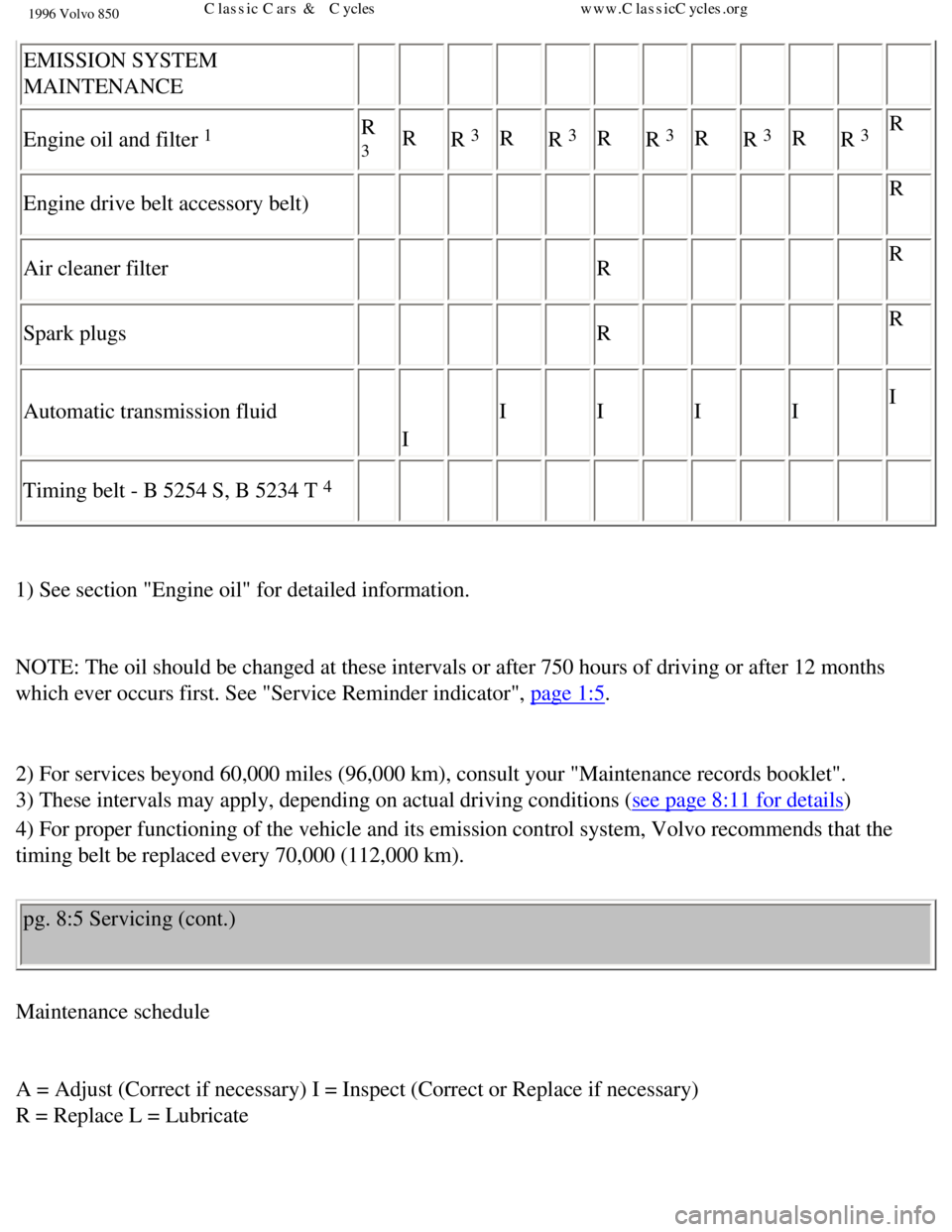
EMISSION SYSTEM
MAINTENANCE
Engine oil and filter
1 R
3 R R 3 R R 3 R R 3 R R 3 R R 3 R
Engine drive belt accessory belt) R
Air cleaner filter R R
Spark plugs R R
Automatic transmission fluid
I
I I I I I
Timing belt - B 5254 S, B 5234 T
4
1) See section "Engine oil" for detailed information.
NOTE: The oil should be changed at these intervals or after 750 hours of\
driving or after 12 months
which ever occurs first. See "Service Reminder indicator",
page 1:5.
2) For services beyond 60,000 miles (96,000 km), consult your "Mainte\
nance records booklet".
3) These intervals may apply, depending on actual driving conditions (\
see page 8:11 for details)
4) For proper functioning of the vehicle and its emission control syste\
m, Volvo recommends that the
timing belt be replaced every 70,000 (112,000 km).
pg. 8:5 Servicing (cont.)
Maintenance schedule
A = Adjust (Correct if necessary) I = Inspect (Correct or Replace if \
necessary)
R = Replace L = Lubricate
file:///K|/ownersdocs/1996/1996_850/96850_801.htm (4 of 6)12/30/2006 9\
:59:50 AMClassic Cars & Cycles www.ClassicCycles.org
Page 230 of 265
1996 Volvo 850
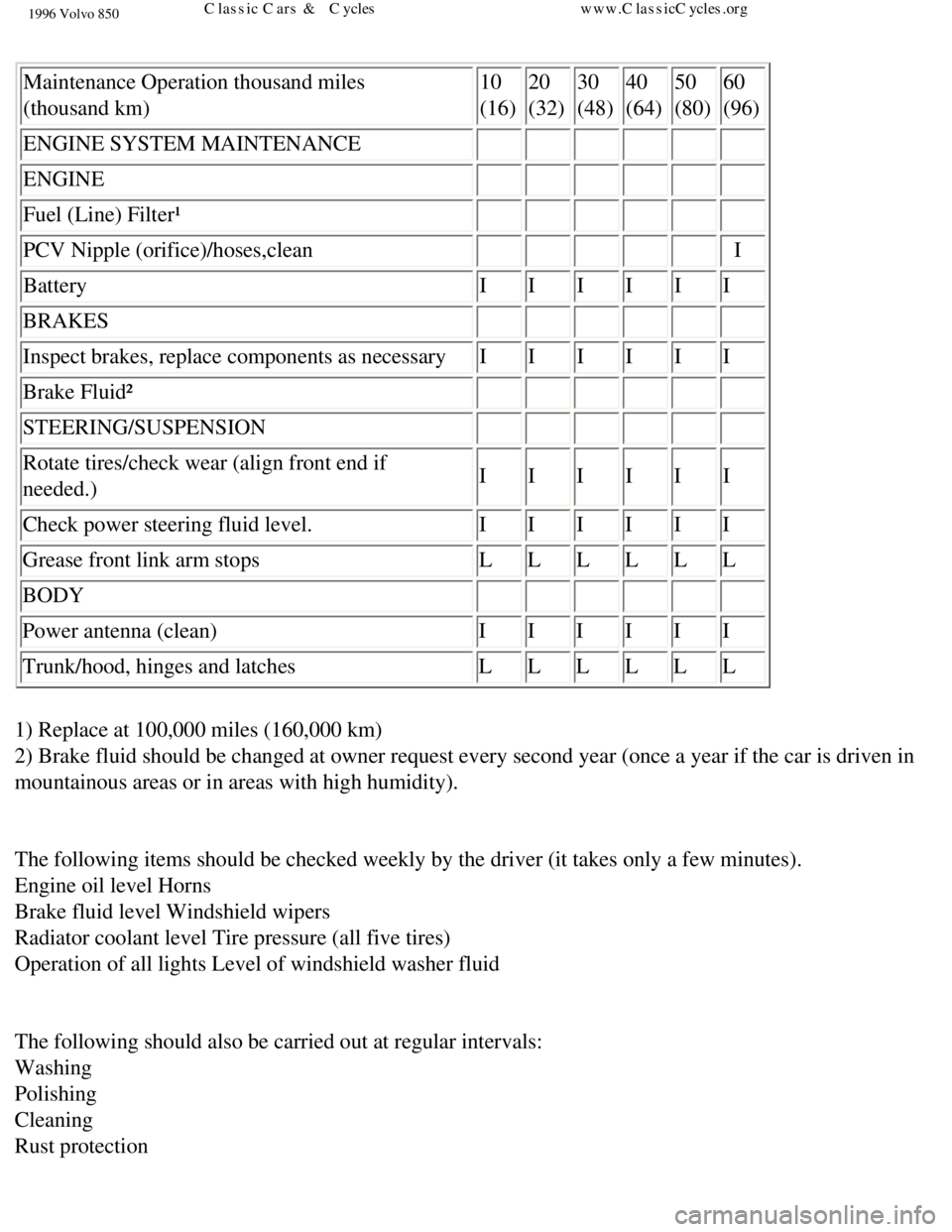
Maintenance Operation thousand miles
(thousand km) 10
(16) 20
(32) 30
(48) 40
(64) 50
(80) 60
(96)
ENGINE SYSTEM MAINTENANCE
ENGINE
Fuel (Line) Filter¹
PCV Nipple (orifice)/hoses,clean I
Battery I I I I I I
BRAKES
Inspect brakes, replace components as necessary I I I I I I
Brake Fluid²
STEERING/SUSPENSION
Rotate tires/check wear (align front end if
needed.) I
I I I I I
Check power steering fluid level. I I I I I I
Grease front link arm stops L L L L L L
BODY
Power antenna (clean) I I I I I I
Trunk/hood, hinges and latches L L L L L L
1) Replace at 100,000 miles (160,000 km)
2) Brake fluid should be changed at owner request every second year (o\
nce a year if the car is driven in
mountainous areas or in areas with high humidity).
The following items should be checked weekly by the driver (it takes on\
ly a few minutes).
Engine oil level Horns
Brake fluid level Windshield wipers
Radiator coolant level Tire pressure (all five tires)
Operation of all lights Level of windshield washer fluid
The following should also be carried out at regular intervals:
Washing
Polishing
Cleaning
Rust protection
file:///K|/ownersdocs/1996/1996_850/96850_801.htm (5 of 6)12/30/2006 9\
:59:50 AMClassic Cars & Cycles www.ClassicCycles.org
Page 241 of 265
 labels. These labels certify the oi\
l conforms to the
applicable standards and specifications of the API.
pg. 8:12 Power steering fluid, Br")
1996 Volvo 850
American Petroleum Institute (API) labels. These labels certify the oi\
l conforms to the
applicable standards and specifications of the API.
pg. 8:12 Power steering fluid, Brake/clutch fluid reservoir
Power steering fluid
The dipstick has marks for checking hot and cold oil. The oil level when\
the engine is cold must never
be higher than the COLD mark. After the engine has reached normal operat\
ing temperature, the level
may not be higher than the HOT mark. Top up when the level is at the ADD\
mark.
Check the level at every service.
Fluid type: ATF
Replace: no fluid change required.
Brake and clutch systems
The brake and clutch systems share the same fluid reservoir. The fluid l\
evel should be between the MIN
file:///K|/ownersdocs/1996/1996_850/96850_806.htm (10 of 11)12/30/2006\
9:59:52 AMClassic Cars & Cycles www.ClassicCycles.org
Page 242 of 265
. The fluid shou\
ld be replaced once a year or
every 15,000 miles (25,000 km) when drivin")
1996 Volvo 850
and MAX marks.
Fluid type: DOT 4+
Replace: Every second year or 30,000 miles (48,000 km). The fluid shou\
ld be replaced once a year or
every 15,000 miles (25,000 km) when driving under extremely hard condi\
tions (mountain driving, etc.)
Check, without removing the cap, that the level is above the " MIN " mar\
k of the fluid reservoir.
Always entrust brake/clutch fluid changing to an authorized Volvo retail\
er.
*At owner request
Contents | Top of Page
file:///K|/ownersdocs/1996/1996_850/96850_806.htm (11 of 11)12/30/2006\
9:59:52 AMClassic Cars & Cycles www.ClassicCycles.org