oil VOLVO C30 2009 Owner´s Manual
[x] Cancel search | Manufacturer: VOLVO, Model Year: 2009, Model line: C30, Model: VOLVO C30 2009Pages: 274, PDF Size: 6.82 MB
Page 142 of 274
06 Starting and drivingStarting the vehicle
06142
To start the engine
WARNING
Before starting, check that the seat, steering
wheel and mirrors are adjusted properly.
Make sure the brake pedal can be
depressed completely. Adjust the seat if
necessary.1. Fasten the seat belt.
2. Apply the parking brake if not already set.
The gear selector should be locked in the
Park (P) position (Shiftlock). See also page
148.
Manual transmission: The clutch must be
fully depressed.
NOTE
After a cold start, idle speed may be notice-
ably higher than normal for a short period.
This is done to help bring components in the
emission control system to their normal
operating temperature as quickly as possi-
ble, which enables them to control emis-
sions and help reduce the vehicle's impact
on the environment.3. The vehicle is equipped with an autostart
feature. Without touching the throttlepedal, turn the key to position III and
release it. The starter motor will then oper-
ate automatically (for up to ten seconds)
until the engine starts. If the engine fails to
start, repeat this step.
4. To release the gear selector from the Park
(P) position, the engine must be running (or
the ignition key must be in position II) and
the brake pedal must be depressed.
5. Select the desired gear. On models with an
automatic transmission, the gear engages
after a very slight delay which is especially
noticeable when selecting R.
NOTE
•
Immobilizer: If two of the keys to your
vehicle are close together, e.g., on the
same key ring when you try to start the
vehicle, this could cause interference in
the immobilizer system and result in the
vehicle not starting. If this should occur,
remove one of the keys from the key
ring before trying to start the vehicle
again.
•
Keylock: Models equipped an auto-
matic transmission have a keylock sys-
tem. When the engine is switched off,
the gear selector must be in the Park
(P) position before the key can be
removed from the ignition switch
1.
•
When starting in cold weather, the
transmission may shift up at slightly
higher engine speeds than normal until
the automatic transmission fluid rea-
ches normal operating temperature.
•
Do not race a cold engine immediately
after starting. Oil flow may not reach
some lubrication points fast enough to
prevent engine damage.
1The optional keyless drive start control does not need to be removed from the ignition switch.
Page 166 of 274
07 Wheels and tiresGeneral information
07166
Your vehicle is equipped with tires according
to the vehicle's tire information placard on the
B-pillar (the structural member at the side of
the vehicle, at the rear of the driver's door
opening), or on the inside of the fuel filler door
on Canadian models.
CAUTION
Some Volvo models are equipped with an
Ultra High Performance tire and wheel com-
bination designed to provide maximum dry
pavement performance with consideration
for hydroplaning resistance. As such, they
may be more susceptible to road hazard
damage and, depending on driving condi-
tions, may achieve a tread life of less than
20,000 miles (30,000 km). Even if this vehi-
cle is equipped with Volvo’s advanced AWD
or DSTC system, these tires are not
designed for winter driving, and should be
replaced with winter tires when weather
conditions dictate.The tires have good road holding characteris-
tics and offer good handling on dry and wet
surfaces. It should be noted however that the
tires have been developed to give these fea-
tures on snow/ice-free surfaces.
Certain models are equipped with "all-season"
tires, which provide a somewhat higher degree
of road holding on slippery surfaces than tires
without the "all-season" rating. However, foroptimum road holding on icy or snow-covered
roads, we recommend suitable winter tires on
all four wheels.
When replacing tires, be sure that the new tires
are the same size designation, type (radial) and
preferably from the same manufacturer, on all
four wheels. Otherwise there is a risk of altering
the car's roadholding and handling characte-
ristics.
Storing wheels and tiresWhen storing complete wheels (tires mounted
on rims), they should be suspended off the
floor or placed on their sides on the floor.
Tires not mounted on rims should be stored on
their sides or standing upright, but should not
be suspended.
CAUTION
Tires should preferably be stored in a cool,
dry, dark place, and should never be stored
in close proximity to solvents, gasoline, oils,
etc.
WARNING
•
The wheel and tire sizes for your Volvo
are specified to meet stringent stability
and handling requirements. Unap-
proved wheel/tire size combinations
can negatively affect your vehicle's sta-
bility and handling. Approved tire sizes
are shown in the Tire inflation pressure
tables, see page 170.
•
Any damage caused by installation of
unapproved wheel/tire size combina-
tions will not be covered by your new
vehicle warranty. Volvo assumes no
responsibility for death, injury, or
expenses that may result from such
installations.
Page 192 of 274
08 Car careWashing and cleaning the car
08192
Washing the carThe following points should be kept in mind
when washing and cleaning the car:•
The car should be washed at regular inter-
vals since dirt, dust, insects and tar spots
adhere to the paint and may cause dam-
age. To help prevent corrosion, it is partic-
ularly important to wash the car frequently
in the wintertime when salt has been used
on the roads.
•
Avoid washing your car in direct sunlight.
Doing so may cause detergents and wax
to dry out and become abrasive. To avoid
scratching, use lukewarm water to soften
the dirt before you wash with a soft
sponge, and plenty of sudsy water.
•
Bird droppings: Remove from paintwork
as soon as possible. Otherwise the finish
may be permanently damaged.
•
A detergent can be used to facilitate the
softening of dirt and oil.
•
A water-soluble grease solvent may be
used in cases of sticky dirt. However, use
a wash place equipped with a drainage
separator.
•
Dry the car with a clean chamois and
remember to clean the drain holes in the
doors and rocker panels.
•
Tar spots can be removed with kerosene
or tar remover after the car has been
washed.
•
A stiff-bristle brush and lukewarm soapy
water can be used to clean the wiper
blades. Frequent cleaning of the wind-
shield and wiper blades improves visibility
considerably and also helps prolong the
service life of the wiper blades.
•
Wash off the dirt from the underside (wheel
housings, fenders, etc).
•
In areas of high industrial fallout, more fre-
quent washing is recommended.
•
After cleaning the engine, the spark plug
wells should be inspected for water and
blown dry if necessary.NOTE
When washing the car, remember to remove
dirt from the drain holes in the doors and
sills.Exterior componentsVolvo recommends the use of special cleaning
products, available at your Volvo retailer, for
cleaning colored plastic, rubber, or ornamental
components such as chromed strips on the
exterior of your vehicle. The instructions for
using these products should be followed care-fully.Solvents or stain removers should not be
used.
CAUTION
•
Avoid waxing or polishing plastic or rub-
ber components
•
Polishing chromed strips can wear
away or damage the surface
•
Polishes containing abrasive sub-
stances should not be used
Page 194 of 274
08 Car careWashing and cleaning the car
08194
CAUTION
Volvo does not recommend the use of long-
life or durable paint protection coatings,
some of which may claim to prevent pitting,
fading, oxidation, etc. These coatings have
not been tested by Volvo for compatibility
with your vehicle's clear coat. Some of them
may cause the clear coat to soften, crack,
or cloud. Damage caused by application of
paint protection coatings may not be cov-
ered under your vehicle's paint warranty.Upholstery careFabricClean with soapy water or a detergent. For
more difficult spots caused by oil, ice cream,
shoe polish, grease, etc., use a clothing/fabric
stain remover. Consult your Volvo retailer.Interior plastic componentsCleaning interior plastic components should
be done with a cleaning agent specially
designed for this purpose. Consult your Volvo
retailer.Alcantera™ suede-like materialSuede-like upholstery can be cleaned with a
soft cloth and mild soap solution.
Leather careVolvo's leather upholstery is manufactured
with a protectant to repel soiling. Over time,
sunlight, grease and dirt can break down the
protection. Staining, cracking, scuffing, and
fading can result.
Volvo offers an easy-to-use, non-greasy
leather care kit formulated to clean and beau-
tify your vehicle's leather, and to renew the
protective qualities of its finish. The cleaner
removes dirt and oil buildup. The light cream
protectant restores a barrier against soil and
sunlight.
Volvo also offers a special leather softener that
should be applied after the cleaner and pro-
tectant. It leaves leather soft and smooth, and
reduces friction between leather and other fin-
ishes in the vehicle.
Volvo recommends cleaning, protecting and
conditioning your vehicle's leather two to four
times a year. Ask your Volvo retailer about
Leather Care Kit 951 0251 and Leather Soft-
ener 943 7429.Cleaning leather upholstery1. Pour leather cleaner on a damp sponge
and squeeze it until the cleaner foams.
2. Apply the foam to the stain by moving the
sponge with circular movements.3. Dampen the stain thoroughly with the
sponge. Let the sponge absorb the stain,
do not rub.
4. Dry the stain with soft paper towels or a
towel, and allow the leather to dry com-
pletely.
Protecting leather upholstery1. Put a small amount of protectant cream on
a cloth and apply a thin coating of cream
to the upholstery with light circular move-
ments.
2. Allow the leather to dry for 20 minutes.
This will help the leather resist staining and
protect against sunlight's harmful UV rays.
Page 198 of 274
G020922
198
Volvo maintenance................................................................................ 200
Maintaining your car.............................................................................. 202
Hood.....................................................................................................204
Engine compartment............................................................................. 205
Engine oil............................................................................................... 206
Fluids..................................................................................................... 208
Wiper blades......................................................................................... 210
Battery................................................................................................... 211
Replacing bulbs.................................................................................... 213
Fuses..................................................................................................... 221
Page 202 of 274
09 Maintenance and servicingMaintaining your car
09202
Owner maintenancePeriodic maintenance requirements and inter-
vals are described in your vehicle's Warranty
and Service Records Information booklet.
The following points can be carried out
between the normally scheduled maintenance
services.Each time the car is refueled:•
Check the engine oil level.
•
Clean the windshield, windshield wipers,
headlights, and taillights.
Monthly:•
Check cold tire pressure in all tires. Inspect
the tires for wear.
•
Check that engine coolant and other fluid
levels are between the indicated "min" and
"max" markings.
•
Clean interior glass surfaces with a glass
cleaner and soft paper towels.
•
Wipe driver information displays with a soft
cloth.
•
Visually inspect battery terminals for cor-
rosion. Corrosion may indicate a loose ter-
minal connector, or a battery near the end
of its useful service life. Consult a trained
and qualified Volvo service technician for
additional information.
As needed:•
Wash the car, including the undercarriage,
to reduce wear that can be caused by a
buildup of dirt, and corrosion that can be
caused by salt residues.
•
Clean leaves and twigs from air intake
vents at the base of the windshield, and
from other places where they may collect.NOTE
Complete service information for qualified
technicians is available online for purchase
or subscription at www.volvotechinfo.com.Emission inspection readinessWhat is an Onboard Diagnostic System
(OBD II)?OBD II is part of your vehicle's computerized
engine management system. It stores diagnos-
tic information about your vehicle's emission
controls. It can light the Check Engine light
(MIL) if it detects an emission control "fault." A
"fault" is a component or system that is not
performing within an expected range. A fault
may be permanent or temporary. OBD II will
store a message about any fault.
How Do States Use OBD II for Emission
Inspections?Many states connect a computer directly to a
vehicle's OBD II system. The inspector can
then read "faults." In some states, this type of
inspection has replaced the tailpipe emission
test.How Can My Vehicle Fail OBD II Emission
Inspection?Your vehicle can fail OBD II emission inspec-
tion for any of the following reasons.•
If your Check Engine (MIL) light is lit, your
vehicle may fail inspection.
•
If your vehicle's Check Engine light was lit,
but went out without any action on your
part, OBD II will still have a recorded fault.
Your vehicle may pass or fail, depending
on the inspection practices in your area.
•
If you had recent service that required dis-
connecting the battery, OBD II diagnostic
information may be incomplete and "not
ready" for inspection. A vehicle that is not
ready may fail inspection.
How Can I Prepare for My Next OBD II
Emission Inspection?•
If your Check Engine (MIL) light is lit – or
was lit but went out without service, have
Page 205 of 274
09 Maintenance and servicing
Engine compartment
09
205
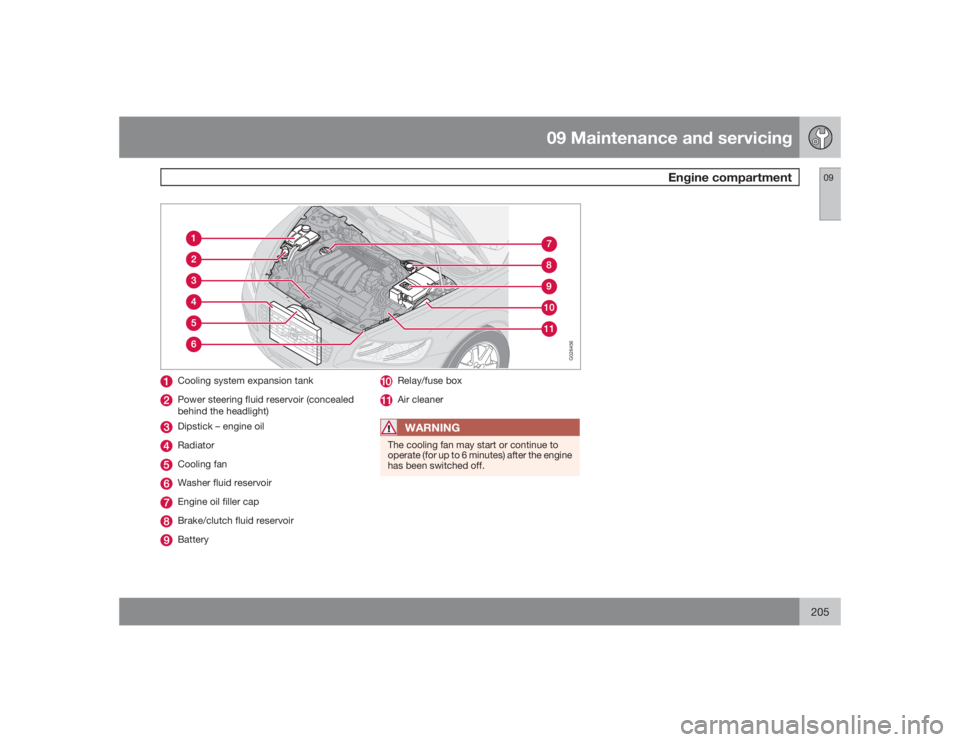
G026456
Cooling system expansion tankPower steering fluid reservoir (concealed
behind the headlight)Dipstick – engine oilRadiatorCooling fanWasher fluid reservoirEngine oil filler capBrake/clutch fluid reservoirBattery
Relay/fuse boxAir cleanerWARNING
The cooling fan may start or continue to
operate (for up to 6 minutes) after the engine
has been switched off.
Page 206 of 274
09 Maintenance and servicingEngine oil
09206
Changing engine oil and oil filterSee page 259 for oil specifications. Refer to
the Warranty and Service Records Information
booklet for information on the oil change inter-
vals.
Volvo recommends Castrol.
NOTE
•
Volvo does not recommend the use of
oil additives.
•
Synthetic oil is not used when the oil is
changed at the normal maintenance
intervals except at owner request and at
additional charge. Please consult a
trained and qualified Volvo service tech-
nician.
Checking and adding oilThe oil level should be checked every time the
vehicle is refueled. This is especially important
during the period up to the first scheduled
maintenance service•
The car should be parked on a level surface
when the oil is checked.
•
If the engine is warm, wait for at least 10–
15 minutes after the engine has been
switched off before checking the oil.
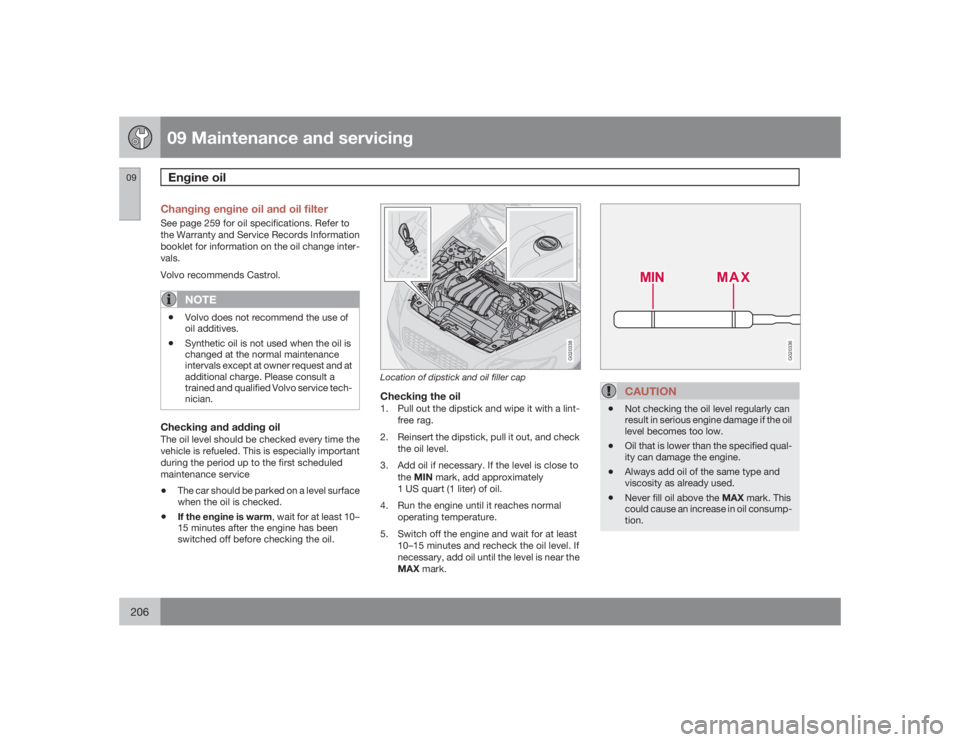
G020338
Location of dipstick and oil filler capChecking the oil1. Pull out the dipstick and wipe it with a lint-
free rag.
2. Reinsert the dipstick, pull it out, and check
the oil level.
3. Add oil if necessary. If the level is close to
theMIN mark, add approximately
1 US quart (1 liter) of oil.
4. Run the engine until it reaches normal
operating temperature.
5. Switch off the engine and wait for at least
10–15 minutes and recheck the oil level. If
necessary, add oil until the level is near the
MAX mark.
G020336
CAUTION
•
Not checking the oil level regularly can
result in serious engine damage if the oil
level becomes too low.
•
Oil that is lower than the specified qual-
ity can damage the engine.
•
Always add oil of the same type and
viscosity as already used.
•
Never fill oil above the MAX mark. This
could cause an increase in oil consump-
tion.
Page 207 of 274
09 Maintenance and servicing
Engine oil
09
207
WARNING
Do not allow oil to spill onto or come into
contact with hot exhaust pipe surfaces
NOTE
Volvo uses different systems to indicate a
low oil level or pressure. Some models have
an oil pressure sensor, in which case a
warning symbol (see page 57) is used to
indicate low oil pressure. Other models have
an oil level sensor, in which case the driver
is alerted by the warning symbol in the cen-
ter of the instrument panel and a text in the
information display. Some models use both
systems. Contact an authorized Volvo
retailer for more information.
Page 208 of 274
09 Maintenance and servicingFluids
09208
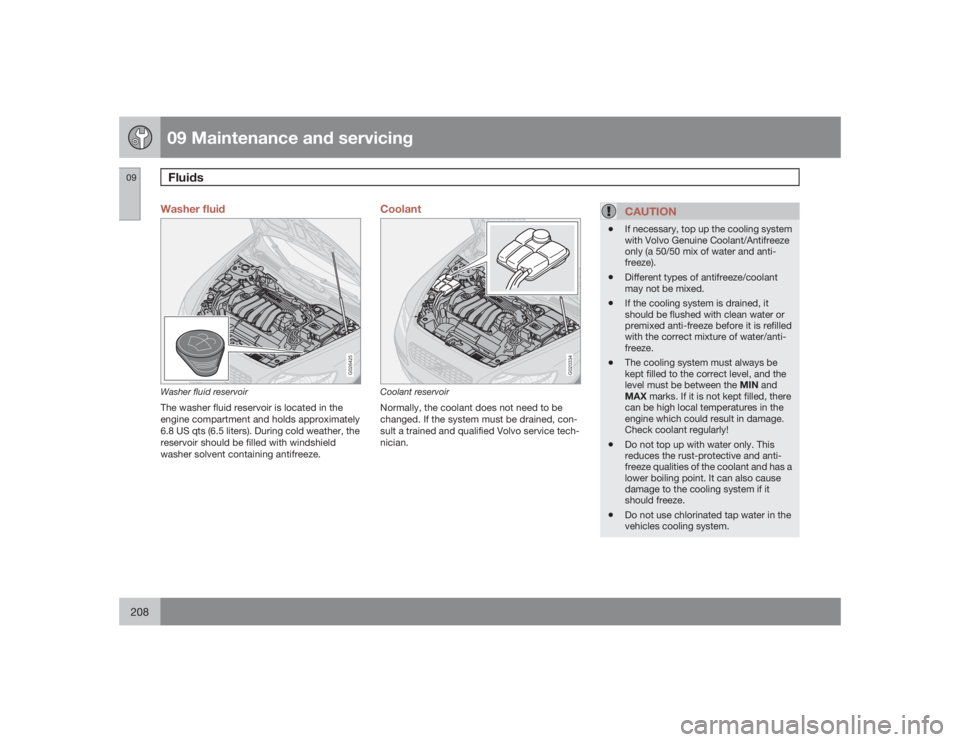
Washer fluid
G026425
Washer fluid reservoirThe washer fluid reservoir is located in the
engine compartment and holds approximately
6.8 US qts (6.5 liters). During cold weather, the
reservoir should be filled with windshield
washer solvent containing antifreeze.
Coolant
G020334
Coolant reservoirNormally, the coolant does not need to be
changed. If the system must be drained, con-
sult a trained and qualified Volvo service tech-
nician.
CAUTION
•
If necessary, top up the cooling system
with Volvo Genuine Coolant/Antifreeze
only (a 50/50 mix of water and anti-
freeze).
•
Different types of antifreeze/coolant
may not be mixed.
•
If the cooling system is drained, it
should be flushed with clean water or
premixed anti-freeze before it is refilled
with the correct mixture of water/anti-
freeze.
•
The cooling system must always be
kept filled to the correct level, and the
level must be between the MIN and
MAX marks. If it is not kept filled, there
can be high local temperatures in the
engine which could result in damage.
Check coolant regularly!
•
Do not top up with water only. This
reduces the rust-protective and anti-
freeze qualities of the coolant and has a
lower boiling point. It can also cause
damage to the cooling system if it
should freeze.
•
Do not use chlorinated tap water in the
vehicles cooling system.