tow VOLVO C30 2009 Owner´s Manual
[x] Cancel search | Manufacturer: VOLVO, Model Year: 2009, Model line: C30, Model: VOLVO C30 2009Pages: 274, PDF Size: 6.82 MB
Page 195 of 274
08 Car care
Washing and cleaning the car
08
195
CAUTION
•
Under no circumstances should gaso-
line, naphtha or similar cleaning agents
be used on the plastic or the leather
since these can cause damage.
•
Take extra care when removing stains
such as ink or lipstick since the coloring
can spread.
•
Use solvents sparingly. Too much sol-
vent can damage the seat padding.
•
Start from the outside of the stain and
work toward the center.
•
Sharp objects (e.g. pencils or pens in a
pocket) or Velcro fasteners on clothing
may damage the textile upholstery.
•
Clothing that is not colorfast, such as
new jeans or suede garments, may stain
the upholstery.
Cleaning the seat beltsClean only with lukewarm water and a mild
soap solution.
Cleaning floor matsThe floor mats should be vacuumed or brushed
clean regularly, especially during winter when
they should be taken out for drying. Spots on
textile mats can be removed with a mild deter-
gent. For best protection in winter, Volvo rec-
ommends the use of Volvo rubber floor mats.
Consult your Volvo retailer.
Page 202 of 274
09 Maintenance and servicingMaintaining your car
09202
Owner maintenancePeriodic maintenance requirements and inter-
vals are described in your vehicle's Warranty
and Service Records Information booklet.
The following points can be carried out
between the normally scheduled maintenance
services.Each time the car is refueled:•
Check the engine oil level.
•
Clean the windshield, windshield wipers,
headlights, and taillights.
Monthly:•
Check cold tire pressure in all tires. Inspect
the tires for wear.
•
Check that engine coolant and other fluid
levels are between the indicated "min" and
"max" markings.
•
Clean interior glass surfaces with a glass
cleaner and soft paper towels.
•
Wipe driver information displays with a soft
cloth.
•
Visually inspect battery terminals for cor-
rosion. Corrosion may indicate a loose ter-
minal connector, or a battery near the end
of its useful service life. Consult a trained
and qualified Volvo service technician for
additional information.
As needed:•
Wash the car, including the undercarriage,
to reduce wear that can be caused by a
buildup of dirt, and corrosion that can be
caused by salt residues.
•
Clean leaves and twigs from air intake
vents at the base of the windshield, and
from other places where they may collect.NOTE
Complete service information for qualified
technicians is available online for purchase
or subscription at www.volvotechinfo.com.Emission inspection readinessWhat is an Onboard Diagnostic System
(OBD II)?OBD II is part of your vehicle's computerized
engine management system. It stores diagnos-
tic information about your vehicle's emission
controls. It can light the Check Engine light
(MIL) if it detects an emission control "fault." A
"fault" is a component or system that is not
performing within an expected range. A fault
may be permanent or temporary. OBD II will
store a message about any fault.
How Do States Use OBD II for Emission
Inspections?Many states connect a computer directly to a
vehicle's OBD II system. The inspector can
then read "faults." In some states, this type of
inspection has replaced the tailpipe emission
test.How Can My Vehicle Fail OBD II Emission
Inspection?Your vehicle can fail OBD II emission inspec-
tion for any of the following reasons.•
If your Check Engine (MIL) light is lit, your
vehicle may fail inspection.
•
If your vehicle's Check Engine light was lit,
but went out without any action on your
part, OBD II will still have a recorded fault.
Your vehicle may pass or fail, depending
on the inspection practices in your area.
•
If you had recent service that required dis-
connecting the battery, OBD II diagnostic
information may be incomplete and "not
ready" for inspection. A vehicle that is not
ready may fail inspection.
How Can I Prepare for My Next OBD II
Emission Inspection?•
If your Check Engine (MIL) light is lit – or
was lit but went out without service, have
Page 209 of 274
09 Maintenance and servicing
Fluids
09
209
WARNING
Never remove the radiator cap while the
engine is warm. Wait until the vehicle cools.
If it is necessary to top off the coolant when
the engine is warm, unscrew the expansion
tank cap slowly so that the overpressure
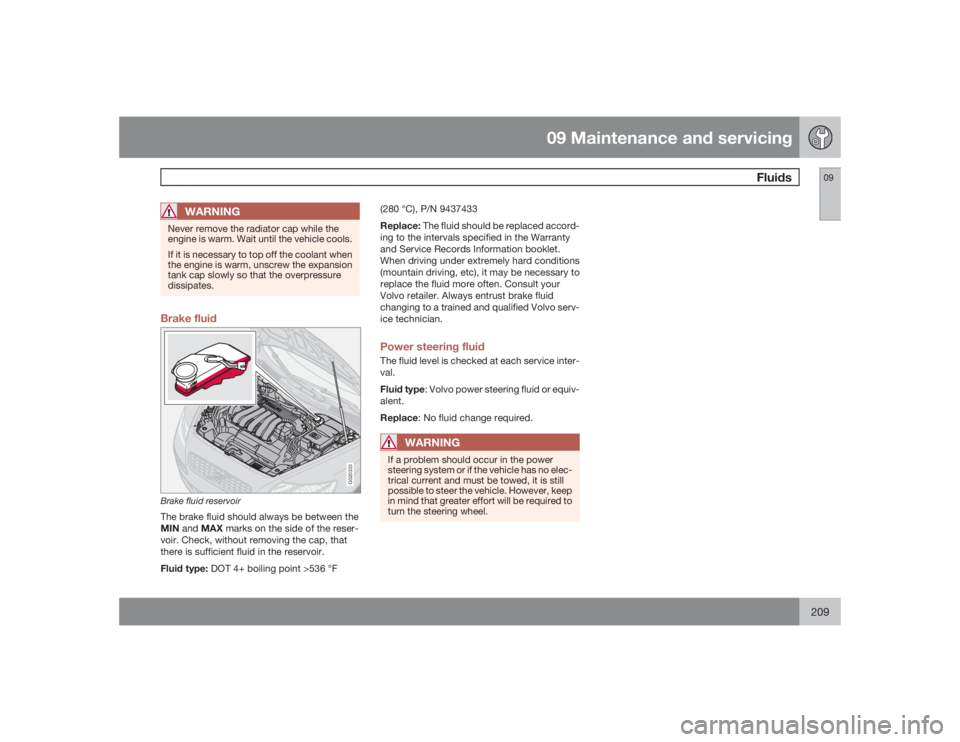
dissipates.Brake fluid
G020333
Brake fluid reservoirThe brake fluid should always be between the
MIN and MAX marks on the side of the reser-
voir. Check, without removing the cap, that
there is sufficient fluid in the reservoir.
Fluid type: DOT 4+ boiling point >536 °F(280 °C), P/N 9437433
Replace: The fluid should be replaced accord-
ing to the intervals specified in the Warranty
and Service Records Information booklet.
When driving under extremely hard conditions
(mountain driving, etc), it may be necessary to
replace the fluid more often. Consult your
Volvo retailer. Always entrust brake fluid
changing to a trained and qualified Volvo serv-
ice technician.
Power steering fluidThe fluid level is checked at each service inter-
val.
Fluid type: Volvo power steering fluid or equiv-
alent.
Replace: No fluid change required.
WARNING
If a problem should occur in the power
steering system or if the vehicle has no elec-
trical current and must be towed, it is still
possible to steer the vehicle. However, keep
in mind that greater effort will be required to
turn the steering wheel.
Page 225 of 274
09 Maintenance and servicing
Fuses
09``225 Fuse box in the passenger compartment
G020601
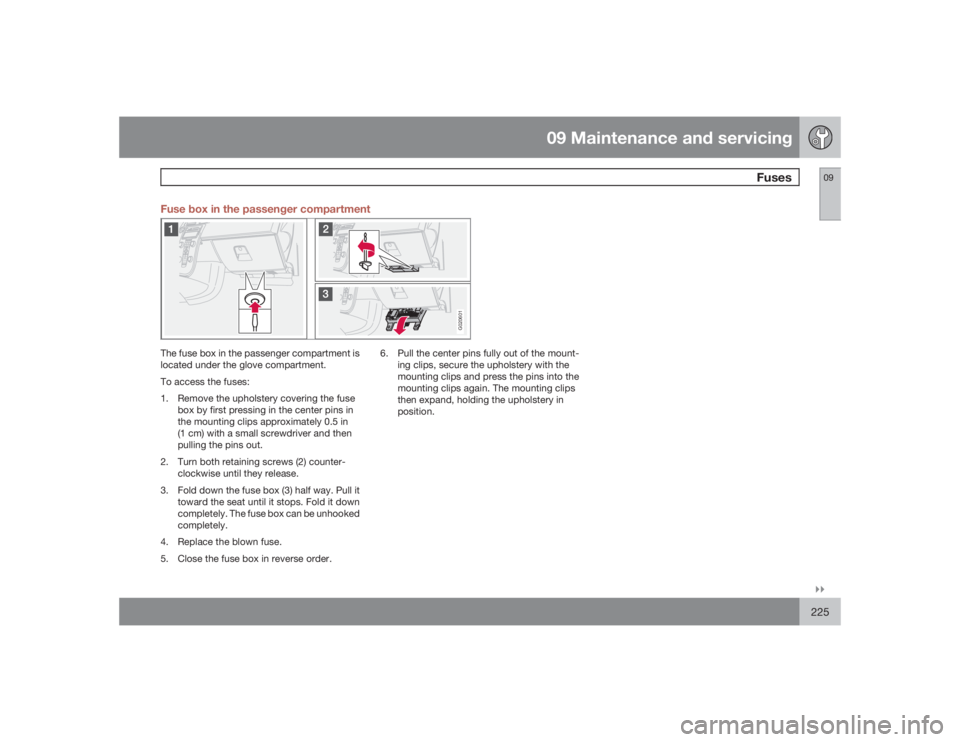
The fuse box in the passenger compartment is
located under the glove compartment.
To access the fuses:
1. Remove the upholstery covering the fuse
box by first pressing in the center pins in
the mounting clips approximately 0.5 in
(1 cm) with a small screwdriver and then
pulling the pins out.
2. Turn both retaining screws (2) counter-
clockwise until they release.
3. Fold down the fuse box (3) half way. Pull it
toward the seat until it stops. Fold it down
completely. The fuse box can be unhooked
completely.
4. Replace the blown fuse.
5. Close the fuse box in reverse order.6. Pull the center pins fully out of the mount-
ing clips, secure the upholstery with the
mounting clips and press the pins into the
mounting clips again. The mounting clips
then expand, holding the upholstery in
position.
Page 258 of 274
11 SpecificationsFuel, oils, and fluids
11258
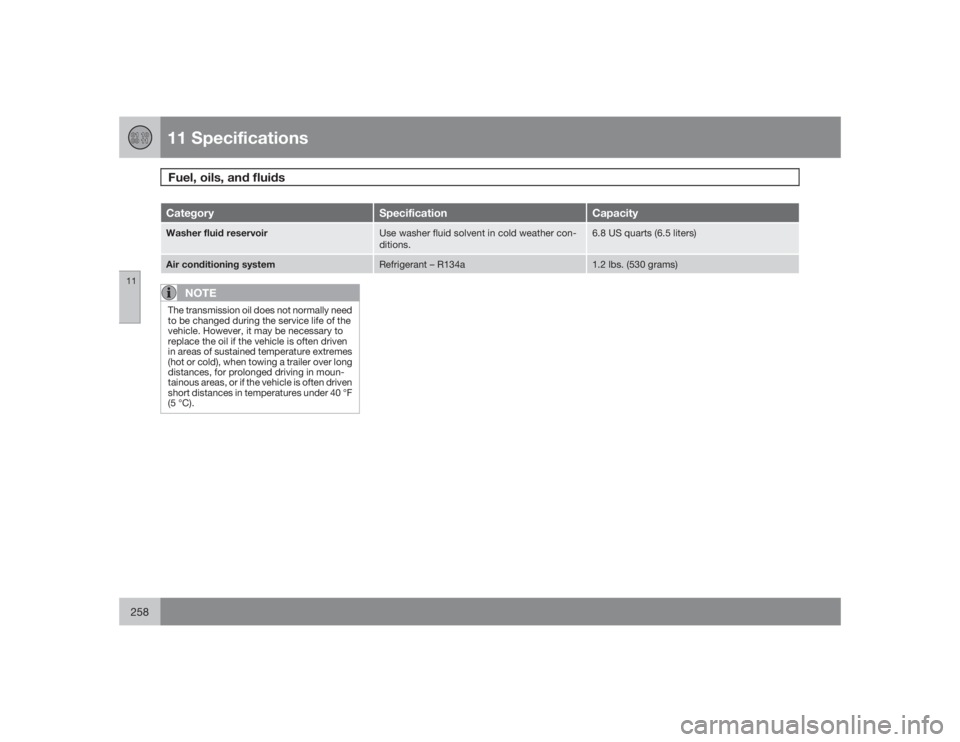
Category
Specification
Capacity
Washer fluid reservoir
Use washer fluid solvent in cold weather con-
ditions.
6.8 US quarts (6.5 liters)
Air conditioning system
Refrigerant – R134a
1.2 lbs. (530 grams)
NOTE
The transmission oil does not normally need
to be changed during the service life of the
vehicle. However, it may be necessary to
replace the oil if the vehicle is often driven
in areas of sustained temperature extremes
(hot or cold), when towing a trailer over long
distances, for prolonged driving in moun-
tainous areas, or if the vehicle is often driven
short distances in temperatures under 40 °F
(5 °C).
Page 259 of 274
11 Specifications
Engine oil
11
259 Oil specifications
Engine oil must meet the minimum ILSAC
specification GF-4, API SL, or ACEA A1/B1.
Lower quality oils may not offer the same fuel
economy, engine performance, or engine pro-
tection.
Volume: 6.1 US qts (5.8 liters).
Volume between the MIN and Max marks on
the dipstick: approximately 1.4 US qts (1.3 lit-
ers).
Volvo recommends Castrol.
Depending on your driving habits, premium or
synthetic oils may provide superior fuel econ-
omy and engine protection. Consult your Volvo
retailer or a trained and qualified Volvo service
technician for recommendations on premium
or synthetic oils.
Oil additives must not be used.
NOTE
Synthetic oil is not used when the oil is
changed at the normal service intervals.
This oil is only used at customer request, at
additional charge. Please consult a trained
and qualified Volvo service technician.
Oil viscosity (stable ambient
temperatures)
G023491
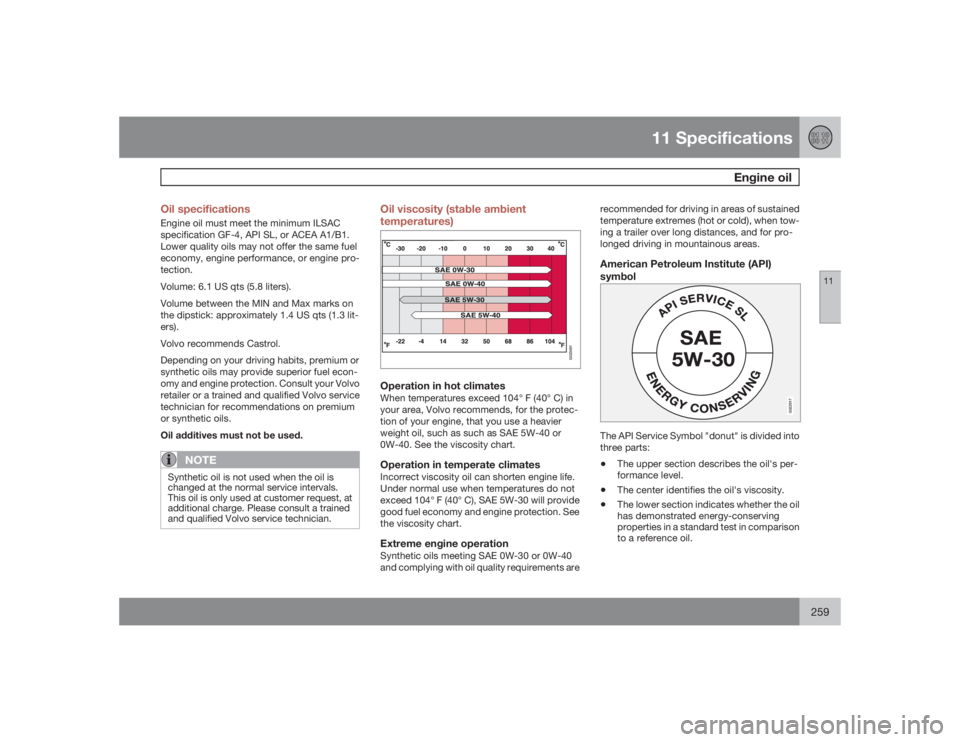
Operation in hot climatesWhen temperatures exceed 104° F (40° C) in
your area, Volvo recommends, for the protec-
tion of your engine, that you use a heavier
weight oil, such as such as SAE 5W-40 or
0W-40. See the viscosity chart.Operation in temperate climatesIncorrect viscosity oil can shorten engine life.
Under normal use when temperatures do not
exceed 104° F (40° C), SAE 5W-30 will provide
good fuel economy and engine protection. See
the viscosity chart.Extreme engine operationSynthetic oils meeting SAE 0W-30 or 0W-40
and complying with oil quality requirements arerecommended for driving in areas of sustained
temperature extremes (hot or cold), when tow-
ing a trailer over long distances, and for pro-
longed driving in mountainous areas.
American Petroleum Institute (API)
symbol
G022917
The API Service Symbol "donut" is divided into
three parts:•
The upper section describes the oil's per-
formance level.
•
The center identifies the oil's viscosity.
•
The lower section indicates whether the oil
has demonstrated energy-conserving
properties in a standard test in comparison
to a reference oil.
Page 268 of 274
12 Index
12268
Electronic Climate Control (ECC) - option. 96
Emergency brake....................................... 75
Emergency locking retractor...................... 36
Emergency starting.................................. 155
Emergency towing................................... 153
Emission inspection readiness................ 202
Engine
specifications...................................... 260
starting................................................ 142
starting with keyless drive.................. 144
Engine compartment overview................ 205
Engine oil................................................. 206
changing............................................. 206
checking............................................. 206
specifications...................................... 259
volumes.............................................. 257
Equalizer, audio system........................... 233
Eyelets for anchoring loads..................... 113
FFederal Clean Air Act............................... 200
Flat tires
changing............................................. 181
repairing with tire sealing system....... 183
Fluids and oils.......................................... 257
FM1/FM2 menu....................................... 234
Fog lights
front...................................................... 63
rear........................................................ 64
Front airbags.............................................. 22
disconnecting passenger’s side airbag 26
Front fog lights........................................... 63
Front park assist...................................... 161
Front seats............................................... 102
accessing the rear seat...................... 102
manually operated.............................. 102
power.................................................. 103
Fuel filler door
unlocking.............................................. 64
Fuel gauge................................................. 53
Fuel requirements.................................... 138
Fuel tank volume...................................... 257
Fuses, replacing....................................... 221
GGasoline requirements............................. 138
Geartronic................................................ 147
Generator................................................. 262
Glossary of tire terminology..................... 174
Glove compartment................................. 108
locking................................................ 127
Gross vehicle weight (GVW)............175, 255HHand brake (parking brake)....................... 75
Hands-free connection (cell phone) (Cell
phone, hands-free connection)................ 244
Hazard warning flashers............................ 74
Headlights.................................................. 63
changing bulbs................................... 213
high and low beams............................. 65
high beam flash.................................... 65
Headlight washers..................................... 71
High beam flash......................................... 65
High beams................................................ 65
Home safe lighting............................... 65, 83
Page 272 of 274
12 Index
12272
uniform tire quality grading................. 176
winter driving...................................... 177
Tire sealing system.................................. 183
Top tether anchors (child restraint sys-
tems).......................................................... 45
Towing the vehicle................................... 153
Transmission
Geartronic........................................... 147
manual................................................145
shiftlock override................................ 148
Tread wear indicator................................ 167
Treble....................................................... 232
Trip computer............................................ 67
Trips, long distance................................. 136
Turn signals............................................... 65
indicator lights...................................... 53
UUniform Tire Quality Grading................... 176
VVehicle dimensions.................................. 254
Vehicle Event Data................................... 200
Vehicle loading......................................... 175
roof loads............................................ 156
Vehicle maintenance
performed by the owner.....................202
Vehicle towing.......................................... 153
Vehicle weights........................................ 255
VIN (Vehicle Identification Number)......... 253
Volvo Inflatable Curtain.............................. 30
Volvo On Call Roadside Assistance........ 265WWarning flashers, hazard........................... 74
Warning symbol......................................... 55
Warranties................................................ 200
Washer fluid..................................... 208, 257
Washer fluid reservoir......................205, 208
Water, driving through............................. 135
Weights.................................................... 255Wheel nuts............................................... 179
Wheels.....................................................166
changing............................................. 181
storing................................................. 166
Whiplash Protection System (WHIPS)....... 32
Windows
power.................................................... 76
Windshield washer fluid reservoir............205
Windshield wiper blades.......................... 210
Windshield wipers...................................... 71
rains sensor.......................................... 72
Winter tires............................................... 177
Wiper blades
replacing liftgate wiper....................... 210
replacing windshield wipers............... 210