lock VOLVO C30 2009 Owner´s Manual
[x] Cancel search | Manufacturer: VOLVO, Model Year: 2009, Model line: C30, Model: VOLVO C30 2009Pages: 274, PDF Size: 6.82 MB
Page 182 of 274
07 Wheels and tiresChanging a wheel
07182
WARNING
•
The jack must correctly engage the jack
attachment.
•
Be sure the jack is on a firm, level, non-
slippery surface.
•
Never allow any part of your body to be
extended under a car supported by a
jack.
•
Use the jack intended for the car when
changing a tire. For any other job, use
stands to support the car.
•
Apply the parking brake and put the
gear selector in the Park (P) position or
reverse on models with a manual trans-
mission.
•
Block the wheels standing on the
ground, use rigid wooden blocks or
large stones.
•
The jack should be kept well-greased
and clean, and should not be damaged.
•
No objects should be placed between
the base of jack and the ground, or
between the jack and the attachment
bar on the vehicle.
Installing the wheel1. Clean the contact surfaces on the wheel
and hub.
2. Lift the wheel and place it on the hub.
3. Install the wheel nuts and tighten hand-
tight. Using the lug wrench, tighten cross-
wise until all nuts are snug.
4. Lower the vehicle to the ground and alter-
nately tighten the bolts crosswise to
81 ft. lbs. (110 Nm).
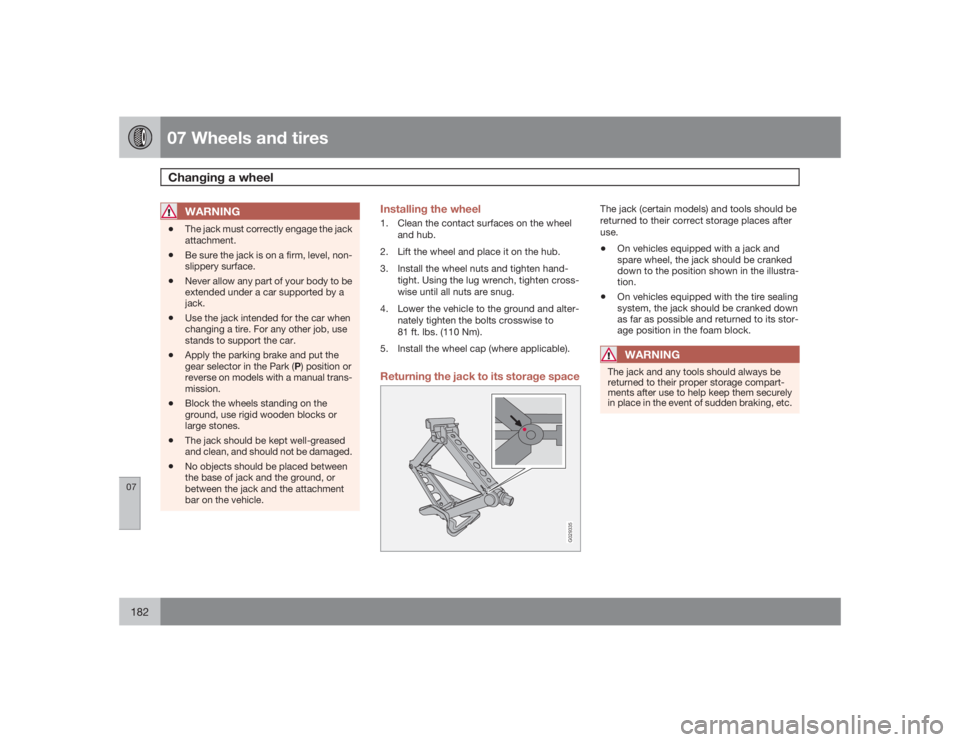
5. Install the wheel cap (where applicable).Returning the jack to its storage space
G029335
The jack (certain models) and tools should be
returned to their correct storage places after
use.•
On vehicles equipped with a jack and
spare wheel, the jack should be cranked
down to the position shown in the illustra-
tion.
•
On vehicles equipped with the tire sealing
system, the jack should be cranked down
as far as possible and returned to its stor-
age position in the foam block.WARNING
The jack and any tools should always be
returned to their proper storage compart-
ments after use to help keep them securely
in place in the event of sudden braking, etc.
Page 186 of 274
07 Wheels and tiresTire Sealing System
07186
CAUTION
The compressor should not be used for
more than 10 minutes at a time to avoid
overheating.
WARNING
If the pressure remains below 22 psi (1.8
bar) after approximately seven minutes, turn
off the compressor. In this case, the hole is
too large to be sealed and the vehicle should
not be driven.12. Switch off the compressor and disconnect
the electrical wire from the 12-volt socket.
13. Unscrew the hose from the tire’s inflation
valve and reinstall the valve cap.
14. Immediately drive the vehicle for approxi-
mately 2 miles (3 km) at a maximum speed
of 50 mph (80 km/h) to distribute the seal-
ing compound in the tire.
NOTE
•
Safely stow the tire sealing system in a
convenient place as it will soon be used
again to check the tire’s inflation pres-
sure.
•
The empty bottle of sealing compound
cannot be removed from the bottle
holder. Consult a trained and qualified
Volvo service technician to have the
bottle removed and properly disposed
of.WARNING
If heavy vibrations, unsteady steering
behavior, or noises should occur while driv-
ing, reduce speed and park the vehicle in a
safe place. Recheck the tire for bumps,
cracks, or other visible damage, and
recheck its inflation pressure. If the pressure
is below 19 psi (1.3 bar), do not continue
driving. Have the vehicle towed to a trained
and qualified Volvo service technician.Stage 2: Checking inflation pressure1. Connect the tire sealing system as descri-
bed in stage 1.
2. Refer to the inflation pressure tablesfor the
correct inflation pressure. If the tire needs
to be inflated, start the tire sealing system’s
compressor. If necessary, release air fromthe tire by turning the air release knob
counterclockwise.
CAUTION
The compressor should not be used for
more than 10 minutes at a time to avoid
overheating.
WARNING
If you interrupt your trip for more than 1
hour, check the inflation pressure in the
damaged tire again before continuing.Replacing the sealing compound
containerThe sealing compound container must be
replaced if:•
the tire sealing system has been used to
repair a tire
•
the container’s expiration date has passed
(see the date on decal).
Page 187 of 274
07 Wheels and tires
Tire Sealing System
07
187
NOTE
•
After use, the sealing compound bottle,
the hose, and certain other system
components must be replaced. Please
consult your Volvo retailer for replace-
ment parts.
•
If the sealing compound bottle’s expi-
ration date has passed, please take it to
a Volvo retailer or a recycling station
that can properly dispose of harmful
substances.
Inflating tiresThe tire sealing system can be used to inflate
the tires. To do so:
1. Park the car in a safe place.
2. The compressor should be switched off.
Ensure that the on/off switch is in posi-
tion0 (the 0 side of the switch should be
pressed down).
3. Take out the electrical wire and hose.
4. Remove the valve cap from the tire’s infla-
tion valve and screw the hose connector
onto the valve as tightly as possible by
hand.
5. Connect the electrical wire to the nearest
12-volt socket in the vehicle.6. Start the vehicle’s engine.
WARNING
•The vehicle’s engine should be running
when the tire sealing system is used to
avoid battery drain. Therefore, be sure
the vehicle is parked in a well ventilated
place, or outdoors, before using the sys-
tem.•Children should never be left unattended
in the vehicle when the engine is running.
7. Check the tire’s inflation pressure on the
gauge. Switch off the compressor briefly to
get a clear reading from the pressure
gauge.
8. Refer to the tire inflation tables for the cor-
rect inflation pressure. If the tire needs to
be inflated, start the tire sealing system’s
compressor (press the on/off switch to
position I). If necessary, release air from the
tire by turning the air release knob coun-
terclockwise.
CAUTION
The compressor should not be used for
more than 10 minutes at a time to avoid
overheating.
9. Turn off the compressor (press the on/off
switch to position 0) when the correct infla-
tion pressure has been reached.
10. Unscrew the hose from the tire’s inflation
valve and reinstall the valve cap.
11. Disconnect the electrical wire from the
12-volt socket.
Page 193 of 274

08 Car care
Washing and cleaning the car
08``193
CAUTION
•
During high pressure washing, the
spray mouthpiece must never be closer
to the vehicle than 13" (30 cm). Do not
spray into the locks.
•
Dirt, snow, etc., on the headlights can
reduce lighting capacity considerably.
Clean the headlights regularly, for
example when refueling.
•
When washing or steam cleaning the
engine, avoid spraying water or steam
directly on the electrical components or
toward the rear side of the engine.
•
Always close the moonroof (option) and
sun shade before washing your vehicle.
•
Never use abrasive cleaning agents on
the moonroof.
•
Never use wax on the rubber seals
around the moonroof.
Automatic washing – simple and quickWe do NOT recommend washing your car in an
automatic wash during the first six months
(because the paint will not have hardened suf-
ficiently).
An automatic wash is a simple and quick way
to clean your car, but it is worth remembering
that it may not be as thorough as when you
yourself go over the car with sponge and water.Keeping the underbody clean is most impor-
tant, especially in the winter. Some automatic
washers do not have facilities for washing the
underbody.
CAUTION
•
Before driving into an automatic car
wash, turn off the optional rain sensor
to avoid damaging the windshield wip-
ers.
•
Make sure that side view mirrors, auxil-
iary lamps, etc, are secure, and that any
antenna(s) are retracted or removed.
Otherwise there is risk of the machine
dislodging them
•
Chromed wheels: Clean chrome-
plated wheels using the same deter-
gents used for the body of the vehicle.
Aggressive wheel-cleaning agents can
permanently stain chrome-plated
wheels.WARNING
•
When the car is driven immediately after
being washed, apply the brakes several
times in order to remove any moisture
from the brake linings.
•
Engine cleaning agents should not be
used when the engine is warm. This
constitutes a fire risk.
Exterior lightingCondensation may form temporarily on the
inside of the lenses of exterior lights such as
headlights, fog lights, or taillights. This is nor-
mal and the lights are designed to withstand
moisture. Normally, condensation will dissi-
pate after the lights have been on for a short
time.Polishing and Waxing•
Normally, polishing is not required during
the first year after delivery, however, wax-
ing may be beneficial.
•
Before applying polish or wax the vehicle
must be washed and dried. Tar spots can
be removed with kerosene or tar remover.
Difficult spots may require a fine rubbing
compound.
•
After polishing use liquid or paste wax.
•
Several commercially available products
contain both polish and wax.
•
Waxing alone does not substitute for pol-
ishing a dull surface.
•
A wide range of polymer-based waxes can
be purchased today. These waxes are easy
to use and produce a long-lasting, high-
gloss finish that protects the bodywork
against oxidation, road dirt and fading.
•
Do not polish or wax your vehicle in direct
sunlight (the surface of the vehicle should
not be warmer than 113 °F (45 °C).
Page 204 of 274
09 Maintenance and servicingHood
09204
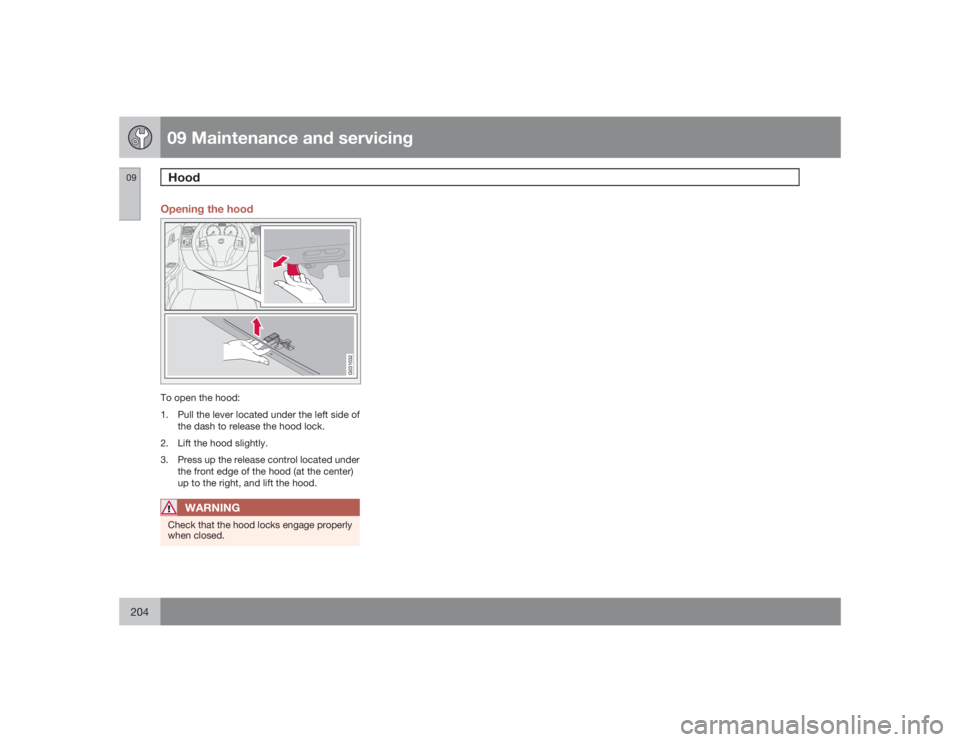
Opening the hood
G031032
To open the hood:
1. Pull the lever located under the left side of
the dash to release the hood lock.
2. Lift the hood slightly.
3. Press up the release control located under
the front edge of the hood (at the center)
up to the right, and lift the hood.
WARNING
Check that the hood locks engage properly
when closed.
Page 215 of 274
09 Maintenance and servicing
Replacing bulbs
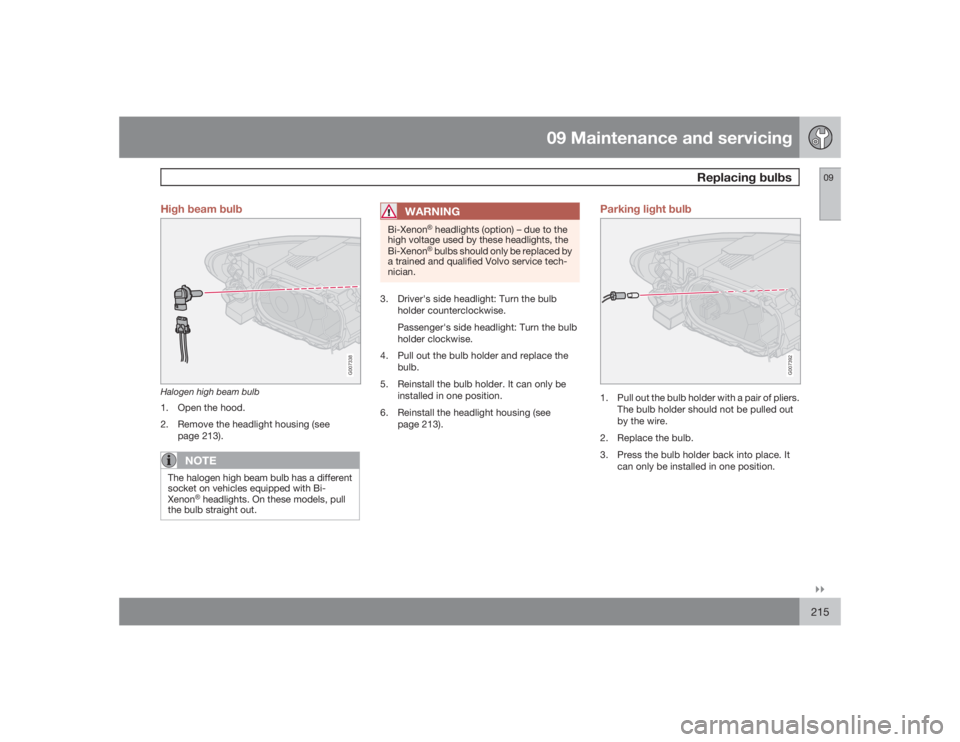
09``215 High beam bulb
G007338
Halogen high beam bulb1. Open the hood.
2. Remove the headlight housing (see
page 213).
NOTE
The halogen high beam bulb has a different
socket on vehicles equipped with Bi-
Xenon
Ÿ headlights. On these models, pull
the bulb straight out.
WARNING
Bi-Xenon
Ÿ headlights (option) – due to the
high voltage used by these headlights, the
Bi-XenonŸ bulbs should only be replaced by
a trained and qualified Volvo service tech-
nician.
3. Driver's side headlight: Turn the bulb
holder counterclockwise.
Passenger's side headlight: Turn the bulb
holder clockwise.
4. Pull out the bulb holder and replace the
bulb.
5. Reinstall the bulb holder. It can only be
installed in one position.
6. Reinstall the headlight housing (see
page 213).
Parking light bulb
G007392
1. Pull out the bulb holder with a pair of pliers.
The bulb holder should not be pulled out
by the wire.
2. Replace the bulb.
3. Press the bulb holder back into place. It
can only be installed in one position.
Page 216 of 274
09 Maintenance and servicingReplacing bulbs
09216
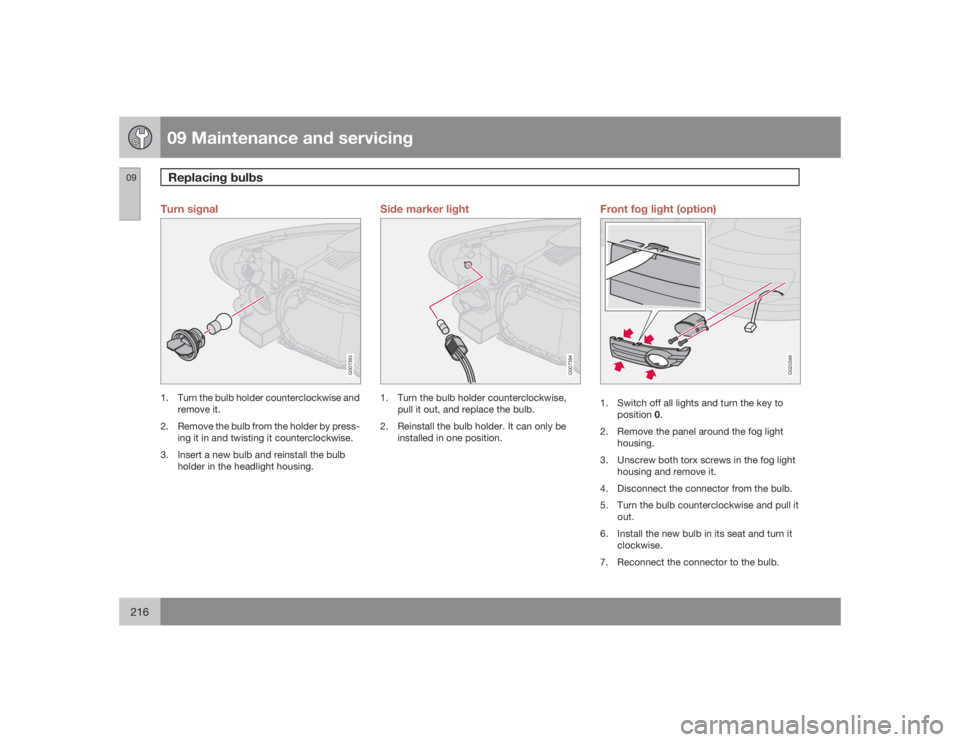
Turn signal
G007393
1. Turn the bulb holder counterclockwise and
remove it.
2. Remove the bulb from the holder by press-
ing it in and twisting it counterclockwise.
3. Insert a new bulb and reinstall the bulb
holder in the headlight housing.
Side marker light
G007394
1. Turn the bulb holder counterclockwise,
pull it out, and replace the bulb.
2. Reinstall the bulb holder. It can only be
installed in one position.
Front fog light (option)
G020348
1. Switch off all lights and turn the key to
position0.
2. Remove the panel around the fog light
housing.
3. Unscrew both torx screws in the fog light
housing and remove it.
4. Disconnect the connector from the bulb.
5. Turn the bulb counterclockwise and pull it
out.
6. Install the new bulb in its seat and turn it
clockwise.
7. Reconnect the connector to the bulb.
Page 225 of 274
09 Maintenance and servicing
Fuses
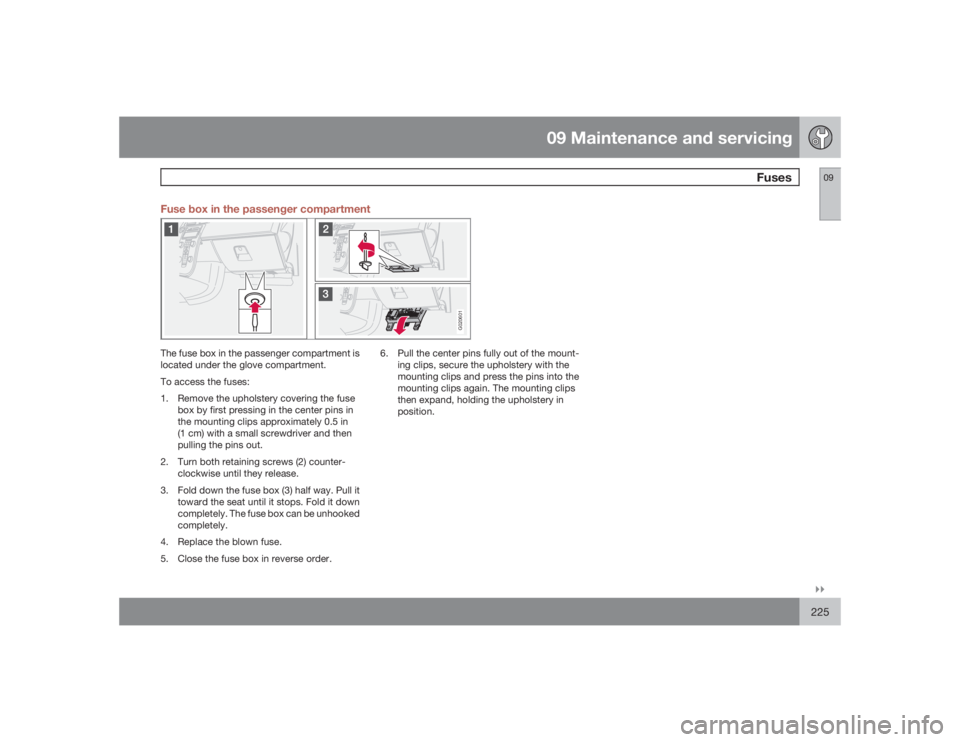
09``225 Fuse box in the passenger compartment
G020601
The fuse box in the passenger compartment is
located under the glove compartment.
To access the fuses:
1. Remove the upholstery covering the fuse
box by first pressing in the center pins in
the mounting clips approximately 0.5 in
(1 cm) with a small screwdriver and then
pulling the pins out.
2. Turn both retaining screws (2) counter-
clockwise until they release.
3. Fold down the fuse box (3) half way. Pull it
toward the seat until it stops. Fold it down
completely. The fuse box can be unhooked
completely.
4. Replace the blown fuse.
5. Close the fuse box in reverse order.6. Pull the center pins fully out of the mount-
ing clips, secure the upholstery with the
mounting clips and press the pins into the
mounting clips again. The mounting clips
then expand, holding the upholstery in
position.
Page 227 of 274
09 Maintenance and servicing
Fuses
09
227
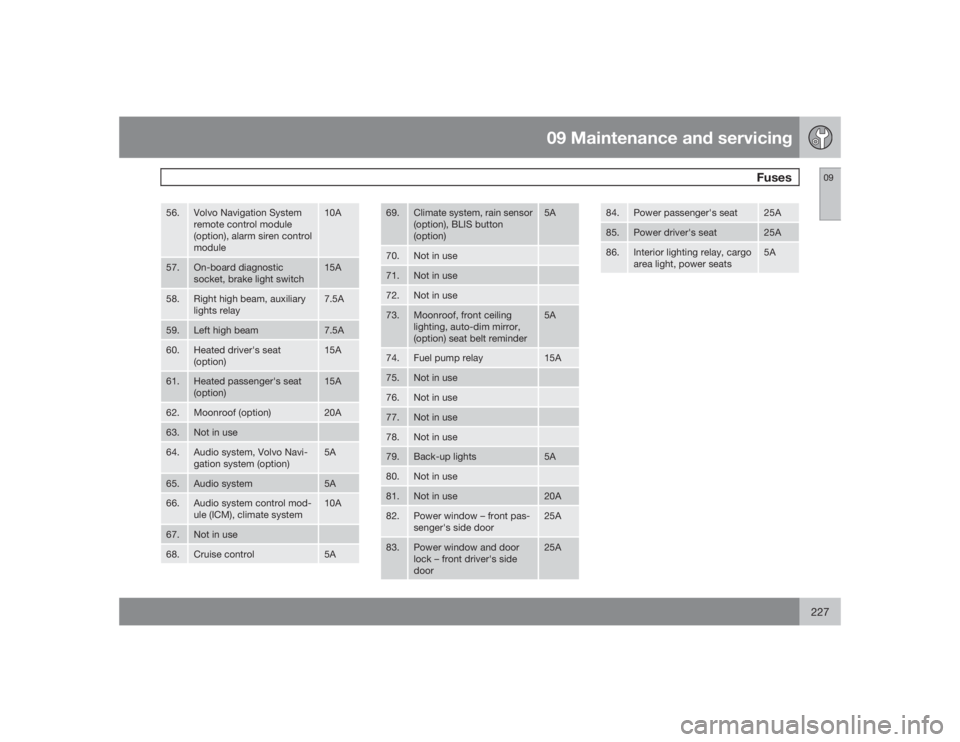
56.
Volvo Navigation System
remote control module
(option), alarm siren control
module
10A
57.
On-board diagnostic
socket, brake light switch
15A
58.
Right high beam, auxiliary
lights relay
7.5A
59.
Left high beam
7.5A
60.
Heated driver's seat
(option)
15A
61.
Heated passenger's seat
(option)
15A
62.
Moonroof (option)
20A
63.
Not in use
64.
Audio system, Volvo Navi-
gation system (option)
5A
65.
Audio system
5A
66.
Audio system control mod-
ule (ICM), climate system
10A
67.
Not in use
68.
Cruise control
5A
69.
Climate system, rain sensor
(option), BLIS button
(option)
5A
70.
Not in use
71.
Not in use
72.
Not in use
73.
Moonroof, front ceiling
lighting, auto-dim mirror,
(option) seat belt reminder
5A
74.
Fuel pump relay
15A
75.
Not in use
76.
Not in use
77.
Not in use
78.
Not in use
79.
Back-up lights
5A
80.
Not in use
81.
Not in use
20A
82.
Power window – front pas-
senger's side door
25A
83.
Power window and door
lock – front driver's side
door
25A
84.
Power passenger's seat
25A
85.
Power driver's seat
25A
86.
Interior lighting relay, cargo
area light, power seats
5A
Page 232 of 274
10 AudioAudio functions
10232
Tracks can be selected in two ways:•
Turn the Tuning knob (no. 4 in the illustra-
tion on page 234) clockwise or counter-
clockwise
•
Use the right or left arrow keys on the nav-
igation control (no. 5 in the illustration on
page 234) to select the desired track. The
arrow keys on the steering wheel keypad
can also be used in the same way.NOTE
The system supports playback of files in the
most common versions of formats such as
mp3, wma, and wav. However, there may be
versions of these formats that the system
does not support.USB flash driveTo simplify the use of a USB flash drive, it is
advisable to only store music files on the drive.
It will take considerably longer for the system
to index the files on the drive if it contains any-
thing other than compatible music files.MP3 playerMany mp3 players have a file indexing system
that is not supported by the vehicle's audio
system. In order to use an mp3 player, the sys-
tem must be set to USB Removable device/
Mass Storage Device.
iPodAn iPod receives current and its battery is
charged through the connecting cord. How-
ever, if the iPod's battery is completely
drained, it should be recharged before the iPod
is connected to the audio system.
NOTE
When an iPOD is used as a sound source,
the vehicle's audio system has a menu
structure similar to the one in the iPOD. See
the iPOD's manual for detailed information.For further information, refer to the accessory
manual USB/iPod Music Interface.Sound settingsOptimal sound reproductionThe audio system is calibrated for optimal
sound reproduction through the use of digital
signal processing. This calibration takes into
account the speakers, amplifier, cabin acous-
tics, the seating position of the listener, etc., for
each combination of vehicle and audio system.
There is also dynamic calibration that takes
into account the setting of the volume control,
radio reception, and the vehicle's speed. The
sound settings described in this manual, such
as
BASS
,TREBLE
, and
EQUALIZER
are onlyintended to enable the user to adapt sound
reproduction to his/her personal preferences.
1.
PressSOUND (5). Press this button
repeatedly until you come to the setting
that you wish to change.
2.
Turn the TUNING dial (4) to make the
desired setting.
The following settings can be made:
BASS
–set the bass level
TREBLE
–set the treble level
BALANCE
–set the left/right sound balance
FADER
–set the front/rear sound balance
CENTER
–make settings for the center speaker
SURROUND
–make settings for surround
sound
Surround sound
Surround sound settings are used to
balance sound levels throughout the
vehicle. Surround settings for the var-
ious sound sources are made sepa-
rately.G021216