parking brake VOLVO C30 2013 Owner´s Manual
[x] Cancel search | Manufacturer: VOLVO, Model Year: 2013, Model line: C30, Model: VOLVO C30 2013Pages: 300, PDF Size: 6.58 MB
Page 161 of 300
06 Starting and driving
Brake system
06
* Option/accessory, for more information, see Introduction.159 Brake lights
The brake lights come on automatically when
the brakes are applied.
Adaptive brake lightsThe adaptive brake lights activate in the event
of sudden braking or if the ABS system is acti-
vated. This function causes an additional tail-
light on each side of the vehicle to illuminate to
help alert vehicles traveling behind.
The adaptive brake lights activate if:
•The ABS system activates for more than
approximately a half second
•In the event of sudden braking while the
vehicle is moving at speeds above approx-
imately 6 mph (10 km/h)
When the vehicle has come to a stop, the brake
lights and additional taillights remain on for as
long as the brake pedal is depressed or until
braking force on the vehicle is reduced.
Brake pad inspection
On vehicles equipped with a jack*, the condi-
tion of the brake pads can be checked by rais-
ing the vehicle (see page 200 for information
about using the jack and removing a wheel)
and performing a visual inspection of the brake
pads.
WARNING
•If the vehicle has been driven immedi-
ately prior to a brake pad inspection, the
wheel hub, brake components, etc., will
be very hot. Allow time for these com-
ponents to cool before carrying out the
inspection.
•Apply the parking brake and put the
gear selector in the Park (P) position.
•Block the wheels standing on the
ground, use rigid wooden blocks or
large stones.
WARNING
•Use the jack intended for the vehicle
when changing a tire. For any other job,
use stands to support the vehicle.
•The jack should be kept well-greased
and clean, and should not be damaged.
•Be sure the jack is on a firm, level, non-
slippery surface.
•No objects should be placed between
the base of jack and the ground, or
between the jack and the attachment
bar on the vehicle.
•The jack must correctly engage the jack
attachment.
•Never allow any part of your body to be
extended under a vehicle supported by
a jack.
Brake circuit malfunction
The brake system is a hydraulic system con-
sisting of two separate brake circuits. If a prob-
lem should occur in one of these circuits, it is
still possible to stop the vehicle with the other
brake circuit.
If the brake pedal must be depressed farther
than normal and requires greater foot pressure,
the stopping distance will be longer.
Page 164 of 300
06 Starting and driving
Parking brake
06
162
Parking brake (hand brake)
G026348
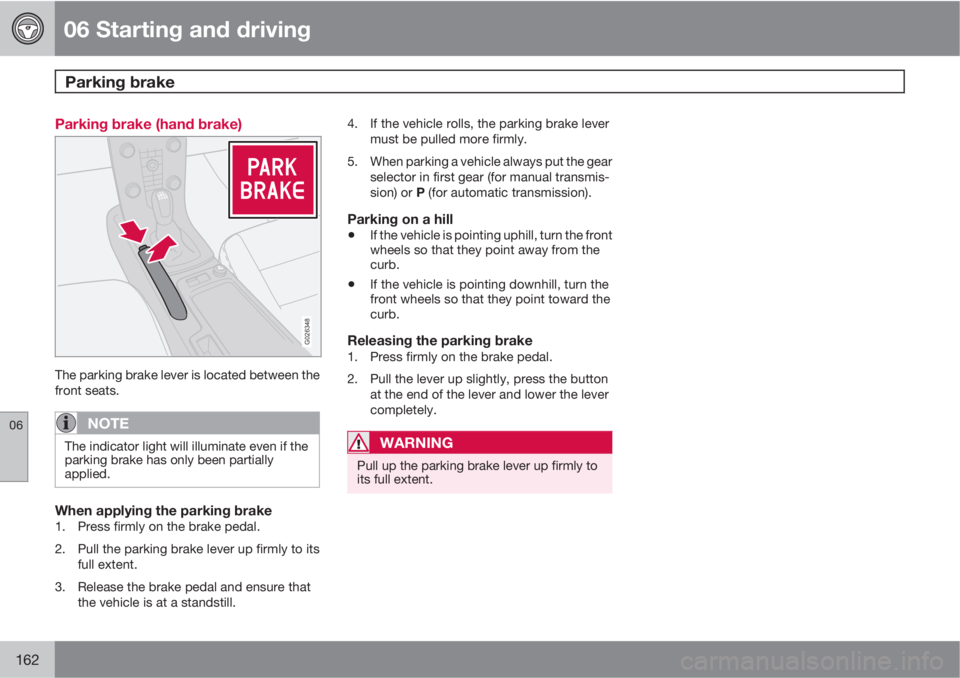
The parking brake lever is located between the
front seats.
NOTE
The indicator light will illuminate even if the
parking brake has only been partially
applied.
When applying the parking brake1. Press firmly on the brake pedal.
2. Pull the parking brake lever up firmly to its
full extent.
3. Release the brake pedal and ensure that
the vehicle is at a standstill.4. If the vehicle rolls, the parking brake lever
must be pulled more firmly.
5. When parking a vehicle always put the gear
selector in first gear (for manual transmis-
sion) or P (for automatic transmission).
Parking on a hill
•If the vehicle is pointing uphill, turn the front
wheels so that they point away from the
curb.
•If the vehicle is pointing downhill, turn the
front wheels so that they point toward the
curb.
Releasing the parking brake1. Press firmly on the brake pedal.
2. Pull the lever up slightly, press the button
at the end of the lever and lower the lever
completely.
WARNING
Pull up the parking brake lever up firmly to
its full extent.
Page 167 of 300
06 Starting and driving
Towing
06
165 Towing the vehicle
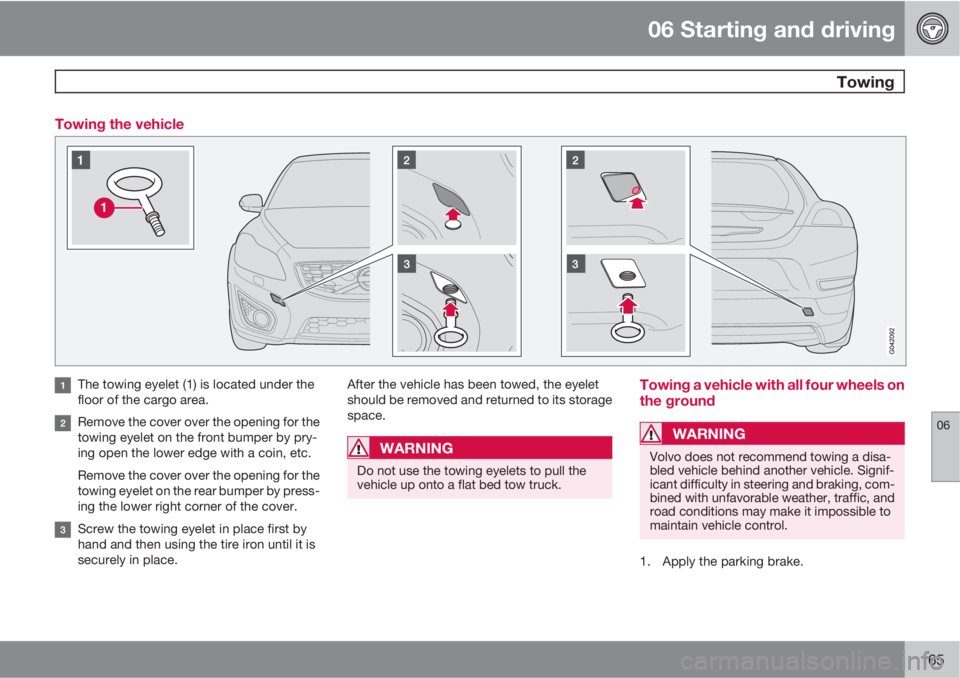
The towing eyelet (1) is located under the
floor of the cargo area.
Remove the cover over the opening for the
towing eyelet on the front bumper by pry-
ing open the lower edge with a coin, etc.
Remove the cover over the opening for the
towing eyelet on the rear bumper by press-
ing the lower right corner of the cover.
Screw the towing eyelet in place first by
hand and then using the tire iron until it is
securely in place.After the vehicle has been towed, the eyelet
should be removed and returned to its storage
space.
WARNING
Do not use the towing eyelets to pull the
vehicle up onto a flat bed tow truck.
Towing a vehicle with all four wheels on
the ground
WARNING
Volvo does not recommend towing a disa-
bled vehicle behind another vehicle. Signif-
icant difficulty in steering and braking, com-
bined with unfavorable weather, traffic, and
road conditions may make it impossible to
maintain vehicle control.
1. Apply the parking brake.
Page 168 of 300
06 Starting and driving
Towing
06
166
2. Insert the key into the ignition to unlock the
steering wheel. With the engine off and the
vehicle at a standstill, great effort will be
required to turn the steering wheel.
3.
Turn the ignition key to position II.
4. Place the gear selector in neutral. For vehi-
cles with automatic transmissions, follow
instruction on page 158, "Shiftlock over-
ride" to allow the gear selector to be moved
from the Park position.
5. Keep firm pressure on the brake pedal
while releasing the parking brake.
6. When towing has been completed, return
the gear selector to Park (automatic) or
Reverse (manual) and apply the parking
brake.
The following points should also be
observed:
•Never exceed 50 mph (80 km/h). Never
exceed local towing speed limits and heed
all local towing restrictions.
•Never tow farther than 50 miles (80 km).
•Keep the tow rope taut at all times while the
vehicle is in motion.
•The disabled vehicle should be towed in
the forward direction only.
WARNING
•Never allow a vehicle to be towed with-
out a driver behind the wheel of the dis-
abled vehicle.
•When the engine is not running, steering
resistance and the effort needed to
apply the brakes will be great.
•Never attempt to tow a vehicle with a
dead battery at night.
CAUTION
•Check with state and local authorities
before attempting this type of towing,
as vehicles being towed are subject to
regulations regarding maximum towing
speed, length and type of towing
device, lighting, marker flags, etc.
•Never attempt to push- or tow-start a
vehicle with a dead battery. This would
inject unburned fuel into the three-way
catalytic converter(s), causing over-
heating, backfiring, and damage, see
page 168 for instructions on jump star-
ting the vehicle.
Towing vehicles with front wheel drive
Volvo recommends the use of flat bed equip-
ment for towing vehicles with front wheel drive.
If wheel lift equipment must be used, please
use extreme caution to help avoid damage to
the vehicle.
In this case, the vehicle should be towed with
the rear wheels on the ground if at all possible.
If it is absolutely necessary to tow the vehicle
with the front wheels on the ground, please
refer to the towing information on the previous
page.
•Sling-type equipment applied at the front
will damage radiator and air conditioning
lines.
•It is equally important not to use sling-type
equipment at the rear or apply lifting equip-
ment inside the rear wheels; serious dam-
age to the rear axle may result.
•If the vehicle is being towed on a flat bed
truck, the towing eyelets must not be used
to secure the vehicle on the flat bed. Con-
sult the tow truck operator.
Page 171 of 300
06 Starting and driving
Transporting loads
06
169 Loading the vehicle
Your vehicle's load-carrying capacity is affec-
ted by factors such as:
•the number of passengers
•tire inflation
•the amount of optional or accessory equip-
ment installed
•the amount of cargo.
See the chapter "Wheels and tires" for more
detailed information.
Before loading the car, turn off the engine, and
apply the parking brake when loading or
unloading long objects. The gear selector can
be inadvertently knocked out of position by
long cargo, causing the car to move.
Keep the following in mind when
loading the vehicle:
•Load objects in the cargo area against the
rear seat backrest.
•Load heavy cargo as low as possible.
•Center wide loads.
•Secure all cargo with restraining straps
anchored to the load securing eyelets.
•Cover sharp edges on the load.
•The rear seats can be folded down to
extend the cargo compartment, see
page 117.
WARNING
•Remember that an object weighing
44 lbs (20 kg) produces a force of
2,200 lbs (1,000 kg) in a head-on colli-
sion at 30 mph (50 km/h)!
•When the rear backrest(s) are folded
down, the vehicle should not be loaded
to a level higher than 2 in. (5 cm) below
the upper edge of the rear side win-
dows. Objects placed higher than this
level could impede the function of the
Inflatable Curtain.
Load carriers (accessory)
Load carriers are available as Volvo accesso-
ries. Follow the installation instructions sup-
plied with the load carriers.
Observe the following points when using load
carriers:
•To avoid damaging your car and to achieve
maximum safety when driving, we recom-
mend using the load carriers that Volvo has
developed especially for your car.
•Volvo-approved removable roof racks are
designed to carry the maximum allowable
roof load for this vehicle: 165 lbs (75 kg).
For Non-Volvo roof racks, check the man-
ufacturer's weight limits for the rack.
•Never exceed the rack manufacturer's
weigh limits and never exceed the maxi-
mum rated roof load of 165 lbs (75 kg).
•Avoid single-point loads. Distribute loads
evenly.
•Place heavier cargo at the bottom of the
load.
•Secure the cargo correctly with appropri-
ate tie-down equipment.
•Check periodically that the load carriers
and load are properly secured.
•Remember that the car's center of gravity
and handling change when you carry a
load on the roof.
•The car's wind resistance and fuel con-
sumption will increase with the size of the
load.
•Drive smoothly. Avoid rapid starts, fast
cornering and hard braking.
Page 194 of 300
07 Wheels and tires
Tire Sealing System*
07
192* Option/accessory, for more information, see Introduction.
•Inhalation: Move the exposed person to
fresh air. If irritation persists, get medi-
cal attention.
•Ingestion: Do NOT induce vomiting
unless directed to do so by medical per-
sonnel. Get medical attention.
•Disposal: Dispose of this material and
its container to a hazardous or special
waste collection point.
NOTE
Do not break the seal on the bottle. This
occurs automatically when the bottle is
screwed into the holder.
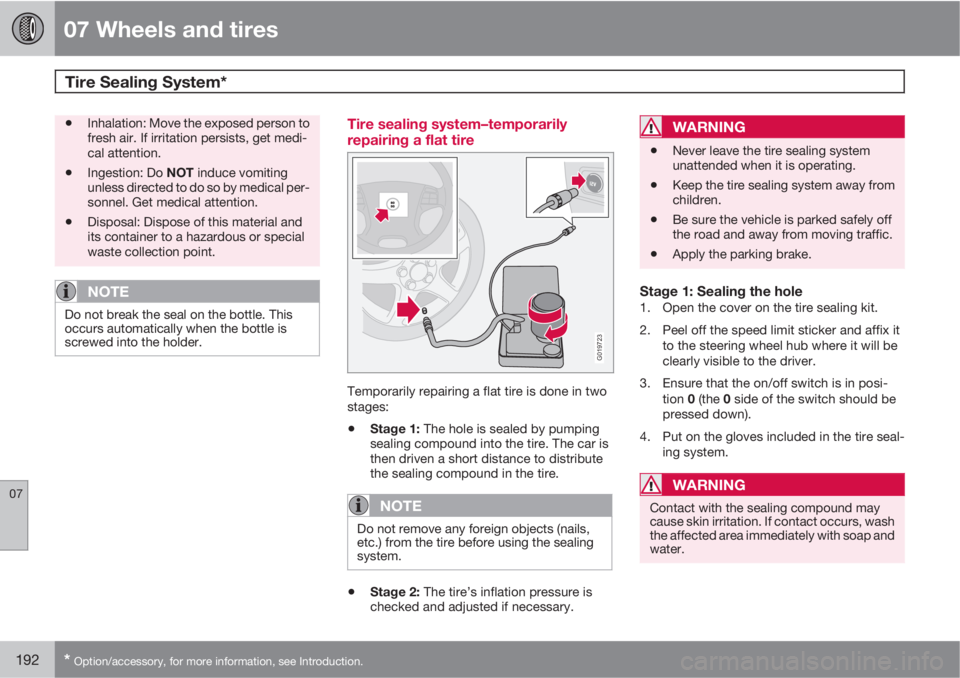
Tire sealing system–temporarily
repairing a flat tire
G019723
Temporarily repairing a flat tire is done in two
stages:
•Stage 1: The hole is sealed by pumping
sealing compound into the tire. The car is
then driven a short distance to distribute
the sealing compound in the tire.
NOTE
Do not remove any foreign objects (nails,
etc.) from the tire before using the sealing
system.
•Stage 2: The tire’s inflation pressure is
checked and adjusted if necessary.
WARNING
•Never leave the tire sealing system
unattended when it is operating.
•Keep the tire sealing system away from
children.
•Be sure the vehicle is parked safely off
the road and away from moving traffic.
•Apply the parking brake.
Stage 1: Sealing the hole1. Open the cover on the tire sealing kit.
2. Peel off the speed limit sticker and affix it
to the steering wheel hub where it will be
clearly visible to the driver.
3. Ensure that the on/off switch is in posi-
tion 0 (the 0 side of the switch should be
pressed down).
4. Put on the gloves included in the tire seal-
ing system.
WARNING
Contact with the sealing compound may
cause skin irritation. If contact occurs, wash
the affected area immediately with soap and
water.
Page 197 of 300
07 Wheels and tires
Tire Sealing System*
07
* Option/accessory, for more information, see Introduction.195 Inflating tires
The tire sealing system can be used to inflate
the tires. To do so:
1. Park the car in a safe place.
2. The compressor should be switched off.
Ensure that the on/off switch is in posi-
tion 0 (the 0 side of the switch should be
pressed down).
3. Take out the electrical wire and hose.
4. Remove the valve cap from the tire’s infla-
tion valve and screw the hose connector
onto the valve as tightly as possible by
hand.
5. Connect the electrical wire to the nearest
12-volt socket in the vehicle.
6. Start the vehicle’s engine.WARNING
•The vehicle’s engine should be running
when the tire sealing system is used to
avoid battery drain. Therefore, be sure
the vehicle is parked in a well ventilated
place, or outdoors, before using the sys-
tem. The parking brake should be
securely applied and on models with an
automatic transmission, the gear selec-
tor should be in the P (park) position.
•Children should never be left unattended
in the vehicle when the engine is running.
7. Check the tire’s inflation pressure on the
gauge. Switch off the compressor briefly to
get a clear reading from the pressure
gauge.
8. Refer to the tire inflation table for the cor-
rect inflation pressure. If the tire needs to
be inflated, start the tire sealing system’s
compressor (press the on/off switch to
position I). If necessary, release air from the
tire by turning the air release knob coun-
terclockwise.
CAUTION
The compressor should not be used for
more than 10 minutes at a time to avoid
overheating.
9. Turn off the compressor (press the on/off
switch to position 0) when the correct infla-
tion pressure has been reached.
10. Unscrew the hose from the tire’s inflation
valve and reinstall the valve cap.
11. Disconnect the electrical wire from the
12-volt socket.
Page 202 of 300
07 Wheels and tires
Changing a wheel
07
200
Removing the wheel
See page 197 for information on accessing the
jack and tools for changing a wheel.
1. Apply the parking brake.
2.
Put the gear selector in Park (P) or reverse
on models with a manual transmission.
3. Block the wheels that are on the ground
with wooden blocks or large stones.
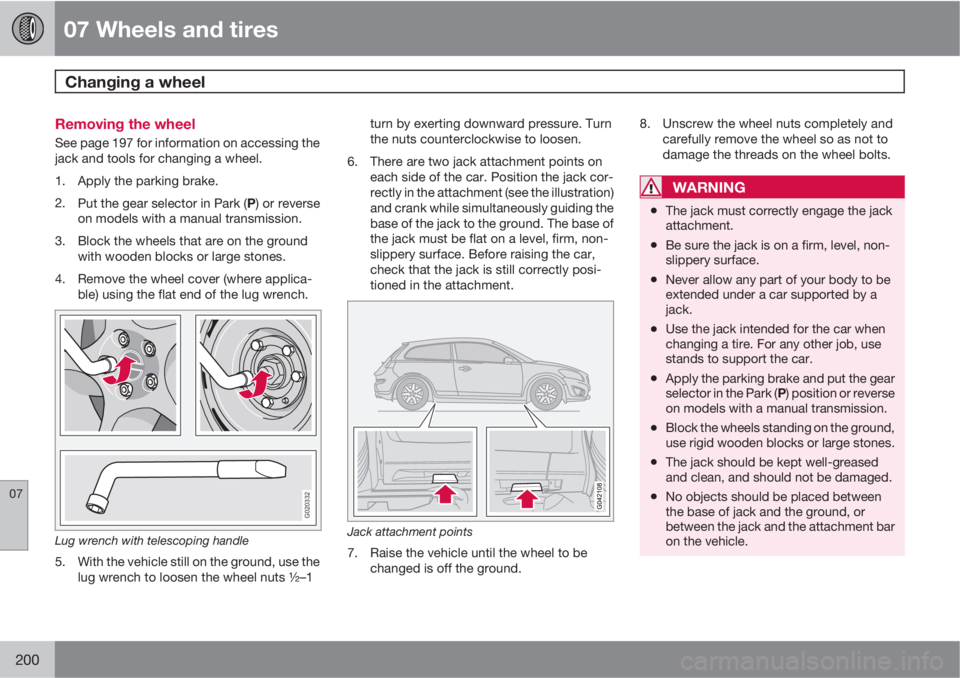
4. Remove the wheel cover (where applica-
ble) using the flat end of the lug wrench.
G020332
Lug wrench with telescoping handle
5. With the vehicle still on the ground, use the
lug wrench to loosen the wheel nuts ½–1turn by exerting downward pressure. Turn
the nuts counterclockwise to loosen.
6. There are two jack attachment points on
each side of the car. Position the jack cor-
rectly in the attachment (see the illustration)
and crank while simultaneously guiding the
base of the jack to the ground. The base of
the jack must be flat on a level, firm, non-
slippery surface. Before raising the car,
check that the jack is still correctly posi-
tioned in the attachment.
Jack attachment points
7. Raise the vehicle until the wheel to be
changed is off the ground.8. Unscrew the wheel nuts completely and
carefully remove the wheel so as not to
damage the threads on the wheel bolts.
WARNING
•The jack must correctly engage the jack
attachment.
•Be sure the jack is on a firm, level, non-
slippery surface.
•Never allow any part of your body to be
extended under a car supported by a
jack.
•Use the jack intended for the car when
changing a tire. For any other job, use
stands to support the car.
•Apply the parking brake and put the gear
selector in the Park (P) position or reverse
on models with a manual transmission.
•Block the wheels standing on the ground,
use rigid wooden blocks or large stones.
•The jack should be kept well-greased
and clean, and should not be damaged.
•No objects should be placed between
the base of jack and the ground, or
between the jack and the attachment bar
on the vehicle.
Page 230 of 300
09 Maintenance and servicing
Replacing bulbs 09
228* Option/accessory, for more information, see Introduction.
Introduction
Before replacing bulbs in your vehicle, please
keep the following points in mind:
NOTE
Never touch the glass of bulbs with your fin-
gers. Grease and oils from your fingers
vaporize in the heat and will leave a deposit
on the reflector, which will damage it.
The optional Active Bending Light bulbs
contain trace amounts of mercury. These
bulbs should always be disposed of by a
trained and qualified Volvo service techni-
cian.
Certain bulbs should only be replaced by a
trained and qualified Volvo service techni-
cian:
•Courtesy lighting
•Reading lights
•Glove compartment lights
•Turn signals and courtesy lights in the
side door mirrors
•High-mounted brake lights
•Active Bending Lights, Brake lights
See page 234 for a list of bulb specifications.
Removing the headlight housing
WARNING
•The engine should not be running when
changing bulbs.
•If the engine has been running just prior
to replacing bulbs in the headlight hous-
ing, please keep in mind that compo-
nents in the engine compartment will be
hot.
WARNING
Active Bending Lights* – due to the high
voltage used by these headlights, these
bulbs should only be replaced by a trained
and qualified Volvo service technician.
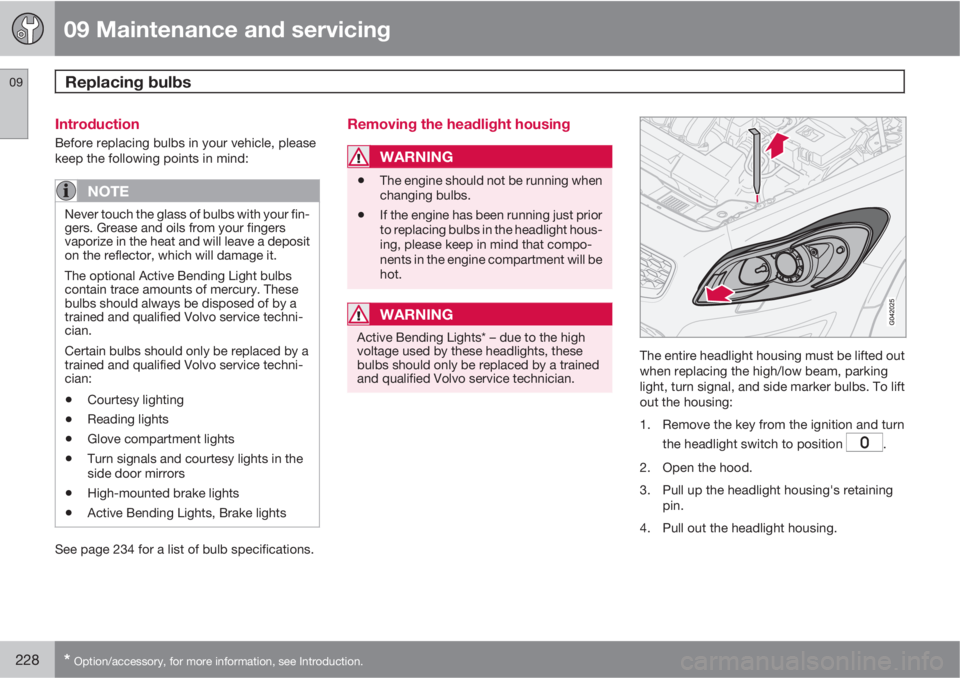
The entire headlight housing must be lifted out
when replacing the high/low beam, parking
light, turn signal, and side marker bulbs. To lift
out the housing:
1. Remove the key from the ignition and turn
the headlight switch to position
.
2. Open the hood.
3. Pull up the headlight housing's retaining
pin.
4. Pull out the headlight housing.
Page 234 of 300
09 Maintenance and servicing
Replacing bulbs 09
232
6. Press a new bulb into place and turn it
clockwise.
7.
Reinsert the bulb holder. The mark TOP
should be upward.
8. Secure the fog light housing with the
retaining screw and press the panel back
into place.
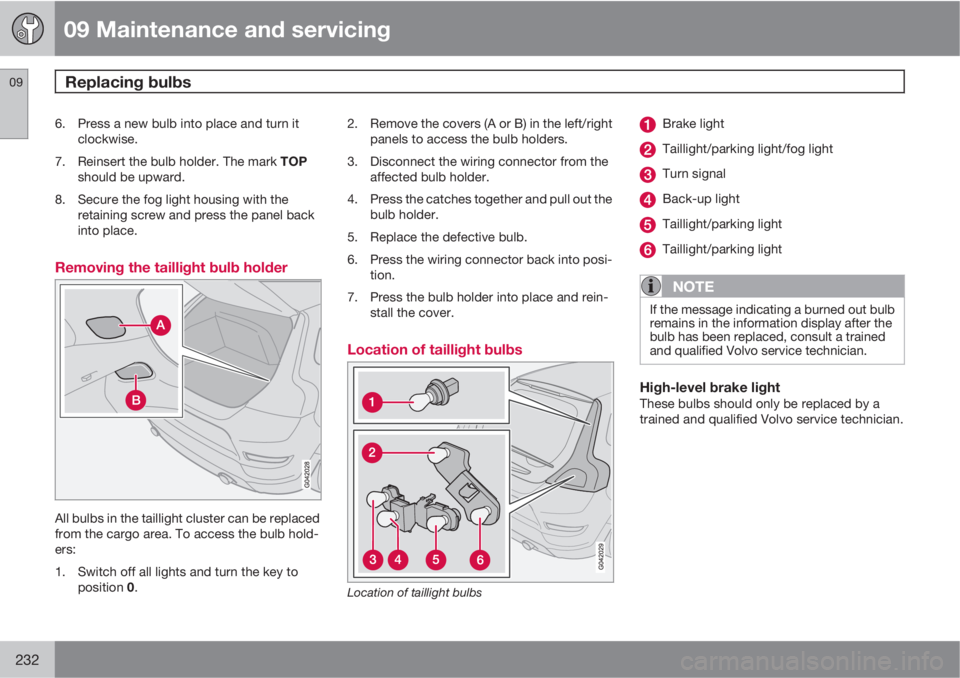
Removing the taillight bulb holder
All bulbs in the taillight cluster can be replaced
from the cargo area. To access the bulb hold-
ers:
1. Switch off all lights and turn the key to
position 0.2. Remove the covers (A or B) in the left/right
panels to access the bulb holders.
3. Disconnect the wiring connector from the
affected bulb holder.
4. Press the catches together and pull out the
bulb holder.
5. Replace the defective bulb.
6. Press the wiring connector back into posi-
tion.
7. Press the bulb holder into place and rein-
stall the cover.
Location of taillight bulbs
Location of taillight bulbs
Brake light
Taillight/parking light/fog light
Turn signal
Back-up light
Taillight/parking light
Taillight/parking light
NOTE
If the message indicating a burned out bulb
remains in the information display after the
bulb has been replaced, consult a trained
and qualified Volvo service technician.
High-level brake lightThese bulbs should only be replaced by a
trained and qualified Volvo service technician.