brake light VOLVO C30 2013 Owner´s Manual
[x] Cancel search | Manufacturer: VOLVO, Model Year: 2013, Model line: C30, Model: VOLVO C30 2013Pages: 300, PDF Size: 6.58 MB
Page 13 of 300

Introduction
Important information
11
Shiftlock (automatic transmission)When your vehicle is parked, the gear selector
is locked in the P (Park) position. To release the
selector from this position, turn the ignition key
to position II (or start the engine), depress the
brake pedal, press the button on the front side
of the gear selector and move the selector from
P (Park).
Keylock (automatic transmission)When you switch off the ignition, the gear
selector must be in the P (Park) position before
the remote key can be removed from the igni-
tion switch.
Anti-lock Brake System (ABS)The ABS system in your vehicle performs a
self-diagnostic test when the vehicle first rea-
ches the speed of approximately 12 mph
(20 km/h). The brake pedal will pulsate several
times and a sound may be audible from the
ABS control module. This is normal.
Fuel filler doorPress the button on the light switch panel (see
the illustration on page 67) when the vehicle
is at a standstill to unlock the fuel filler door.
Please note that the fuel filler door will remain
unlocked until the vehicle begins to move for-
ward. An audible click will be heard when the
fuel filler door relocks.
Points to keep in mind
•Do not export your Volvo to another coun-
try before investigating that country's
applicable safety and exhaust emission
requirements. In some cases it may be dif-
ficult or impossible to comply with these
requirements. Modifications to the emis-
sion control system(s) may render your
Volvo not certifiable for legal operation in
the U.S., Canada and other countries.
•All information, illustrations and specifica-
tions contained in this manual are based on
the latest product information available at
the time of publication. Please note that
some vehicles may be equipped differ-
ently, depending on special legal require-
ments. Optional equipment described in
this manual may not be available in all mar-
kets.
•Volvo reserves the right to make model
changes at any time, or to change specifi-
cations or design without notice and with-
out incurring obligation.
Volvo Structural Parts Statement
Volvo has always been and continues to be a
leader in automotive safety. Volvo engineers
and manufactures vehicles designed to help
protect vehicle occupants in the event of a col-
lision.
Volvos are designed to absorb the impact of a
collision. This energy absorption system
including, but not limited to, structural compo-
nents such as bumper reinforcement bars,
bumper energy absorbers, frames, rails, fender
aprons, A-pillars, B-pillars and body panels
must work together to maintain cabin integrity
and protect the vehicle occupants.
The supplemental restraint system including
but not limited to air bags, side curtain air bags,
and deployment sensors work together with
the above components to provide proper tim-
ing for air bag deployment.
Due to the above, Volvo Cars of North America
does not support the use of aftermarket, alter-
native or anything other than original Volvo
parts for collision repair.
In addition Volvo does not support the use or
re-use of structural components from an exist-
ing vehicle that has been previously damaged.
Although these parts may appear equivalent, it
is difficult to tell if the parts have been previ-
ously replaced with non-OE parts or if the part
has been damaged as a result of a prior colli-
Page 15 of 300
Introduction
Environment
13 Volvo and the environment
Volvo is committed to the well being of its cus-
tomers. As a natural part of this commitment,
we care about the environment in which we all
live. Caring for the environment means an
everyday involvement in reducing our environ-
mental impact. Volvo's environmental activities
are based on a holistic view, which means we
consider the overall environmental impact of a
product throughout its complete life cycle. In
this context, design, production, product use,
and recycling are all important considerations.
In production, Volvo has partly or completely
phased out several chemicals including CFCs,
lead chromates, asbestos, and cadmium; and
reduced the number of chemicals used in our
plants 50% since 1991.
Volvo was the first in the world to introduce into
production a three-way catalytic converter with
a Lambda sond, now called the heated oxygen
sensor, in 1976. The current version of this
highly efficient system reduces emissions of
harmful substances (CO, HC, NOx) from the
exhaust pipe by approximately 95 – 99% and
the search to eliminate the remaining emis-
sions continues. Volvo is the only automobile
manufacturer to offer CFC-free retrofit kits for
the air conditioning system of all models as far
back as the 1975 model 240. Advanced elec-
tronic engine controls and cleaner fuels are
bringing us closer to our goal. In addition tocontinuous environmental refinement of con-
ventional gasoline-powered internal combus-
tion engines, Volvo is actively looking at
advanced technology alternative-fuel vehicles.
When you drive a Volvo, you become our part-
ner in the work to lessen the car's impact on
the environment. To reduce your vehicle's
environmental impact, you can:
•Maintain proper air pressure in your tires.
Tests have shown decreased fuel econ-
omy with improperly inflated tires.
•Follow the recommended maintenance
schedule in your Warranty and Service
Records Information booklet.
•Drive at a constant speed whenever pos-
sible.
•See a trained and qualified Volvo service
technician as soon as possible for inspec-
tion if the check engine (malfunction indi-
cator) light illuminates, or stays on after the
vehicle has started.
•Properly dispose of any vehicle-related
waste such as used motor oil, used batter-
ies, brake pads, etc.
•When cleaning your vehicle, please use
genuine Volvo car care products. All Volvo
car care products are formulated to be
environmentally friendly.
RecyclingAs part of Volvo’s commitment to the environ-
ment, it is essential for the vehicle to be recy-
cled in an environmentally sound way. Almost
the entire vehicle can be recycled and for that
reason, the vehicle’s final owner is requested
to contact a Volvo retailer for information about
approved and certified recycling facilities.
FSCŸŸ
The FSCŸ (Forest Stewardship CouncilŸ) sym-
bol indicates that the wood pulp used in this
publication comes from FSC
Ÿ certified forests
and other responsible sources.
Page 25 of 300
01 Safety
Supplemental Restraint System01
23 Supplemental Restraint System (SRS)
G026330
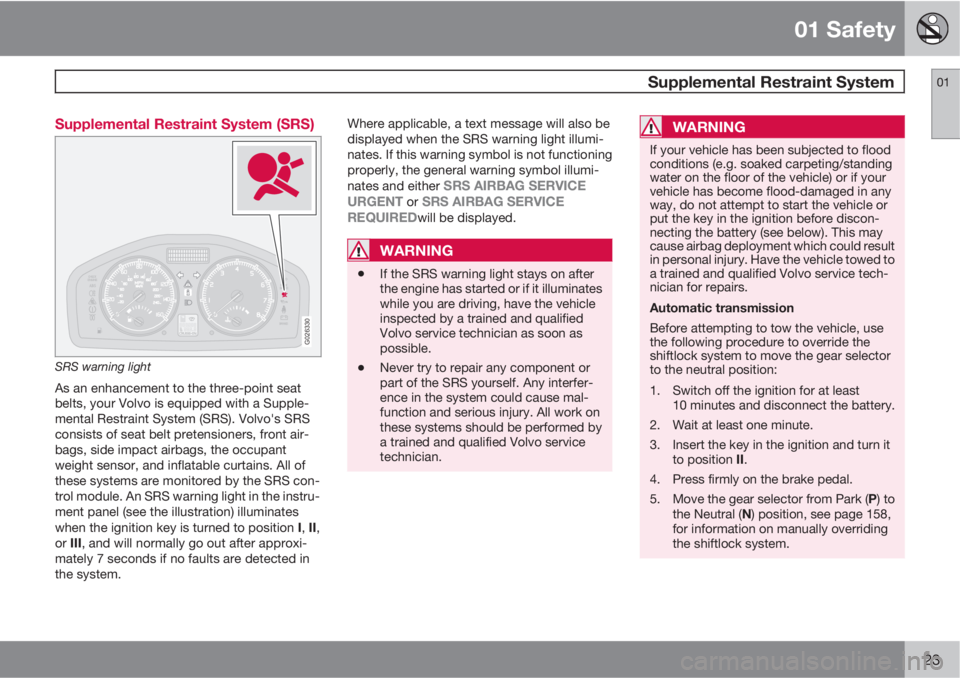
SRS warning light
As an enhancement to the three-point seat
belts, your Volvo is equipped with a Supple-
mental Restraint System (SRS). Volvo's SRS
consists of seat belt pretensioners, front air-
bags, side impact airbags, the occupant
weight sensor, and inflatable curtains. All of
these systems are monitored by the SRS con-
trol module. An SRS warning light in the instru-
ment panel (see the illustration) illuminates
when the ignition key is turned to position I, II,
or III, and will normally go out after approxi-
mately 7 seconds if no faults are detected in
the system.Where applicable, a text message will also be
displayed when the SRS warning light illumi-
nates. If this warning symbol is not functioning
properly, the general warning symbol illumi-
nates and either
SRS AIRBAG SERVICE
URGENT or SRS AIRBAG SERVICE
REQUIREDwill be displayed.
WARNING
•If the SRS warning light stays on after
the engine has started or if it illuminates
while you are driving, have the vehicle
inspected by a trained and qualified
Volvo service technician as soon as
possible.
•Never try to repair any component or
part of the SRS yourself. Any interfer-
ence in the system could cause mal-
function and serious injury. All work on
these systems should be performed by
a trained and qualified Volvo service
technician.
WARNING
If your vehicle has been subjected to flood
conditions (e.g. soaked carpeting/standing
water on the floor of the vehicle) or if your
vehicle has become flood-damaged in any
way, do not attempt to start the vehicle or
put the key in the ignition before discon-
necting the battery (see below). This may
cause airbag deployment which could result
in personal injury. Have the vehicle towed to
a trained and qualified Volvo service tech-
nician for repairs.
Automatic transmission
Before attempting to tow the vehicle, use
the following procedure to override the
shiftlock system to move the gear selector
to the neutral position:
1. Switch off the ignition for at least
10 minutes and disconnect the battery.
2. Wait at least one minute.
3. Insert the key in the ignition and turn it
to position II.
4. Press firmly on the brake pedal.
5.
Move the gear selector from Park (P) to
the Neutral (N) position, see page 158,
for information on manually overriding
the shiftlock system.
Page 55 of 300

02 Instruments and controls
Instrument overview
02
* Option/accessory, for more information, see Introduction.53
Steering wheel adjustment
Hood opener
Controls in front doors
Left steering wheel lever
Lighting panel, fuel filler door opener
Door open handle and locking button
Climate system air vent
Side window air vent
Cruise control
Horn, airbag
Main instrument panel
Audio controls
Right steering wheel lever
Ignition switch
Moonroof control*
Not in use
Not is use
Courtesy lighting switch
Driver's side reading light
Passenger's side reading light
Seat belt reminder and Occupant
Weight Sensor indicator
Rear-view mirror
Display for climate control, personal
settings, and audio system
Audio system
Controls for personal settings and
audio system
Controls for climate system
Gear selector
Hazard warning flashers
Door open handle
Glove compartment
Parking brake
12-volt socket
Position for optional equipment
Position for optional equipment
Control panel in driver's door
Power windows
Door mirror button, driver's side
Door mirror adjustment control
Door mirror button, passenger's side
Page 58 of 300
02 Instruments and controls
Indicator and warning symbols
02
56
Function check
The indicator and warning symbols1 light up
when you turn the ignition key or the optional
keyless drive start control to the driving posi-
tion (position II) before starting. This shows that
the symbols are functioning.
When the engine starts, all sym-
bols go out. If the engine is not
started within 5 seconds, all of the
symbols except the malfunction
indicator light (CHECK ENGINE)
and the oil pressure warning light
will go out. Certain symbols may
not have their functions illustrated, depending
on the car's equipment.
The PARK BRAKE symbol will not go out until
the parking brake has been released.
Symbols in the center of the instrument
panel
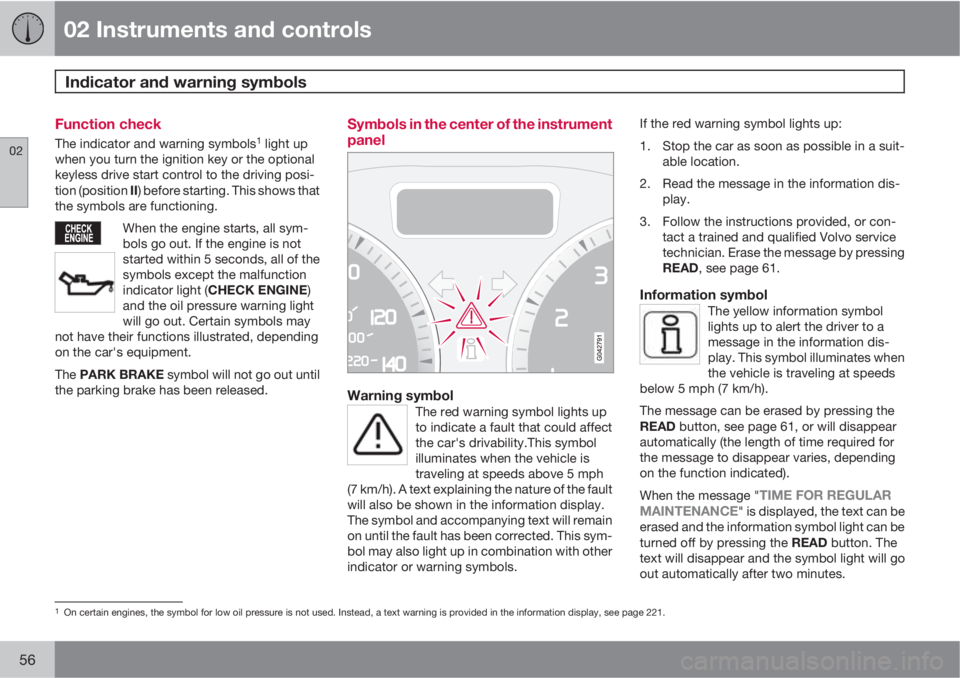
Warning symbolThe red warning symbol lights up
to indicate a fault that could affect
the car's drivability.This symbol
illuminates when the vehicle is
traveling at speeds above 5 mph
(7 km/h). A text explaining the nature of the fault
will also be shown in the information display.
The symbol and accompanying text will remain
on until the fault has been corrected. This sym-
bol may also light up in combination with other
indicator or warning symbols.
If the red warning symbol lights up:
1. Stop the car as soon as possible in a suit-
able location.
2. Read the message in the information dis-
play.
3. Follow the instructions provided, or con-
tact a trained and qualified Volvo service
technician. Erase the message by pressing
READ, see page 61.
Information symbolThe yellow information symbol
lights up to alert the driver to a
message in the information dis-
play. This symbol illuminates when
the vehicle is traveling at speeds
below 5 mph (7 km/h).
The message can be erased by pressing the
READ button, see page 61, or will disappear
automatically (the length of time required for
the message to disappear varies, depending
on the function indicated).
When the message "
TIME FOR REGULAR
MAINTENANCE" is displayed, the text can be
erased and the information symbol light can be
turned off by pressing the READ button. The
text will disappear and the symbol light will go
out automatically after two minutes.
1On certain engines, the symbol for low oil pressure is not used. Instead, a text warning is provided in the information display, see page 221.
Page 60 of 300
02 Instruments and controls
Symbols – instrument panel
02
58
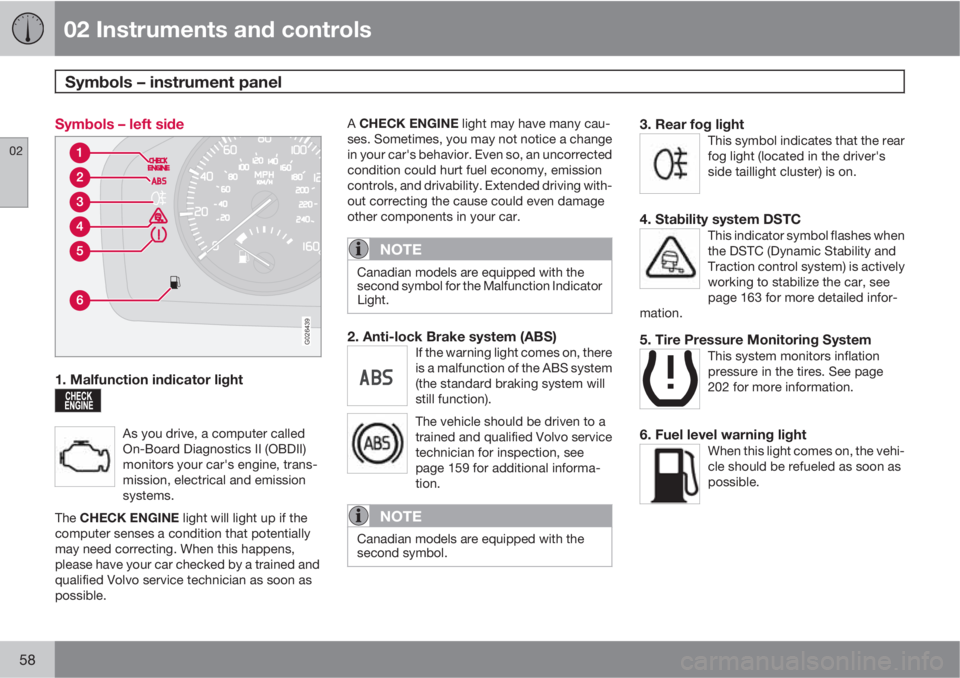
Symbols – left side
G026439
1. Malfunction indicator light
As you drive, a computer called
On-Board Diagnostics II (OBDII)
monitors your car's engine, trans-
mission, electrical and emission
systems.
The CHECK ENGINE light will light up if the
computer senses a condition that potentially
may need correcting. When this happens,
please have your car checked by a trained and
qualified Volvo service technician as soon as
possible.
A CHECK ENGINE light may have many cau-
ses. Sometimes, you may not notice a change
in your car's behavior. Even so, an uncorrected
condition could hurt fuel economy, emission
controls, and drivability. Extended driving with-
out correcting the cause could even damage
other components in your car.
NOTE
Canadian models are equipped with the
second symbol for the Malfunction Indicator
Light.
2. Anti-lock Brake system (ABS)If the warning light comes on, there
is a malfunction of the ABS system
(the standard braking system will
still function).
The vehicle should be driven to a
trained and qualified Volvo service
technician for inspection, see
page 159 for additional informa-
tion.
NOTE
Canadian models are equipped with the
second symbol.
3. Rear fog lightThis symbol indicates that the rear
fog light (located in the driver's
side taillight cluster) is on.
4. Stability system DSTCThis indicator symbol flashes when
the DSTC (Dynamic Stability and
Traction control system) is actively
working to stabilize the car, see
page 163 for more detailed infor-
mation.
5. Tire Pressure Monitoring SystemThis system monitors inflation
pressure in the tires. See page
202 for more information.
6. Fuel level warning lightWhen this light comes on, the vehi-
cle should be refueled as soon as
possible.
Page 61 of 300
02 Instruments and controls
Symbols – instrument panel
02
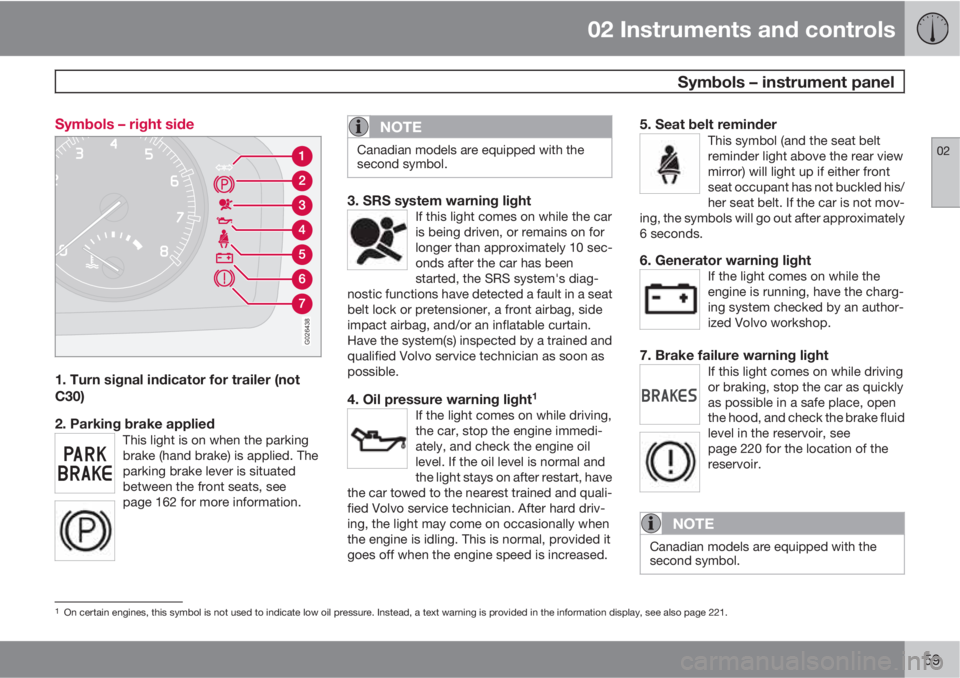
59 Symbols – right side
G026438
1. Turn signal indicator for trailer (not
C30)
2. Parking brake applied
This light is on when the parking
brake (hand brake) is applied. The
parking brake lever is situated
between the front seats, see
page 162 for more information.
NOTE
Canadian models are equipped with the
second symbol.
3. SRS system warning lightIf this light comes on while the car
is being driven, or remains on for
longer than approximately 10 sec-
onds after the car has been
started, the SRS system's diag-
nostic functions have detected a fault in a seat
belt lock or pretensioner, a front airbag, side
impact airbag, and/or an inflatable curtain.
Have the system(s) inspected by a trained and
qualified Volvo service technician as soon as
possible.
4. Oil pressure warning light1
If the light comes on while driving,
the car, stop the engine immedi-
ately, and check the engine oil
level. If the oil level is normal and
the light stays on after restart, have
the car towed to the nearest trained and quali-
fied Volvo service technician. After hard driv-
ing, the light may come on occasionally when
the engine is idling. This is normal, provided it
goes off when the engine speed is increased.
5. Seat belt reminderThis symbol (and the seat belt
reminder light above the rear view
mirror) will light up if either front
seat occupant has not buckled his/
her seat belt. If the car is not mov-
ing, the symbols will go out after approximately
6 seconds.
6. Generator warning lightIf the light comes on while the
engine is running, have the charg-
ing system checked by an author-
ized Volvo workshop.
7. Brake failure warning lightIf this light comes on while driving
or braking, stop the car as quickly
as possible in a safe place, open
the hood, and check the brake fluid
level in the reservoir, see
page 220 for the location of the
reservoir.
NOTE
Canadian models are equipped with the
second symbol.
1On certain engines, this symbol is not used to indicate low oil pressure. Instead, a text warning is provided in the information display, see also page 221.
Page 62 of 300
02 Instruments and controls
Symbols – instrument panel
02
60
WARNING
If the fluid level is below the MIN mark in the
reservoir or if a BRAKE FAILURE STOP
SAFELY message is displayed in the infor-
mation display: DO NOT DRIVE. Have the
car towed to a trained and qualified Volvo
service technician and have the brake sys-
tem inspected.
If the BRAKES and ABS warning lights come
on at the same time, this could indicate a fault
in the brake system.
In this case:
1. Stop the car in a suitable place and switch
off the engine.
2. Restart the engine.
3. If both warning lights go off, no further
action is required and the car can be
driven.
4. If both lights remain on after the engine has
been restarted, switch off the engine again
and check the brake fluid level, see
page 220 for the location of the reservoir.
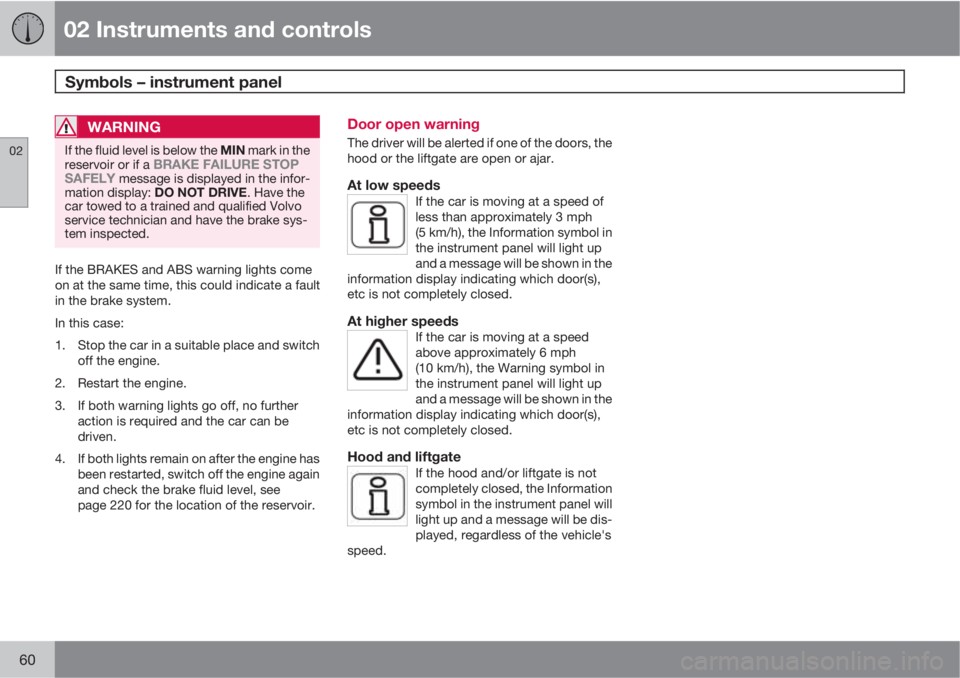
Door open warning
The driver will be alerted if one of the doors, the
hood or the liftgate are open or ajar.
At low speedsIf the car is moving at a speed of
less than approximately 3 mph
(5 km/h), the Information symbol in
the instrument panel will light up
and a message will be shown in the
information display indicating which door(s),
etc is not completely closed.
At higher speedsIf the car is moving at a speed
above approximately 6 mph
(10 km/h), the Warning symbol in
the instrument panel will light up
and a message will be shown in the
information display indicating which door(s),
etc is not completely closed.
Hood and liftgateIf the hood and/or liftgate is not
completely closed, the Information
symbol in the instrument panel will
light up and a message will be dis-
played, regardless of the vehicle's
speed.
Page 68 of 300

02 Instruments and controls
Lighting panel
02
66* Option/accessory, for more information, see Introduction.
tions. A light sensor then monitors the ambient
lighting conditions and automatically switches
from LED DRL to the low beam headlights in
weaker ambient light (and will switch back to
DRL when the ambient light becomes brighter).
The LED DRLs will also switch off automatically
(and the low beams will switch on) if:
•The rear fog light is switched on
•The windshield wipers are switched on for
more than 10 seconds
WARNING
•DRL is a driving aid designed to help
conserve electrical current. This system
cannot always determine if the ambient
lighting conditions are sufficient for
switching from low beams to DRL (or
vice versa). It is always the driver's
responsibility to visually determine if the
low beam headlights should be used.
•As the driver, you have full responsibility
for operating the vehicle in a safe man-
ner.
Parking lights
The front and rear parking lights can be turned
on even when the ignition is switched off.
–Turn the light switch (1) to the parking light
position.
The license plate lights also illuminate when the
parking lights are switched on.
Brake lights
The brake lights come on automatically when
the brakes are applied.
Fog lights
Front fog lights*2
The front fog lights can be used in combination
with either the headlights or the parking lights.
1.
Turn the ignition key to position II.
2. Press button (3) to turn on the front fog
lights.
An indicator light in the button illuminates when
the front fog lights are on.
Rear fog lightsThe rear fog lights are located in both taillight
clusters.The rear fogs light will only function in combi-
nation with the high/low beam headlights or the
optional front fog lights.
1.
Turn the ignition key to position II.
2. Press button (5) to turn on the rear fog
lights.
An indicator light in the button illuminates when
the rear fog lights are on.
NOTE
The rear fog lights are considerably brighter
than the normal taillights and should be
used only when conditions such as fog, rain,
snow, smoke or dust reduce visibility for
other vehicles to less than 500 ft.
(150 meters).
Instrument panel lighting
The instrument panel lighting illuminates when
the ignition is in position II and the light
switch (1) is in either position
or .
2Not available on models equipped with the optional LED Daytime Running LIGHTS
Page 144 of 300
06 Starting and driving
General information
06
142
Economical driving conserves natural
resources
Better driving economy may be obtained by
thinking ahead, avoiding rapid starts and stops
and adjusting the speed of your vehicle to
immediate traffic conditions.
Observe the following rules:
•Bring the engine to normal operating tem-
perature as soon as possible by driving
with a light foot on the accelerator pedal for
the first few minutes of operation. A cold
engine uses more fuel and is subject to
increased wear.
•Whenever possible, avoid using the vehicle
for driving short distances. This does not
allow the engine to reach normal operating
temperature.
•Drive carefully and avoid rapid acceleration
and hard braking.
•Use the transmission's Drive (D) position
as often as possible and avoid using kick-
down.
•On models with a manual transmission,
use the highest gear possible, depending
on the vehicle's speed.
•Do not exceed posted speed limits.
•Avoid carrying unnecessary items (extra
load) in the vehicle.
•Maintain correct tire pressure. Check tire
pressure regularly (when tires are cold).
•Remove snow tires when threat of snow or
ice has ended.
•Note that roof racks, ski racks, etc,
increase air resistance and also fuel con-
sumption.
•At highway driving speeds, fuel consump-
tion will be lower with the air conditioning
on and the windows closed than with the
air conditioning off and the windows open.
•Using the onboard trip computer's fuel
consumption modes can help you learn
how to drive more economically.
Other factors that decrease gas mileage
are:
•Dirty air cleaner
•Dirty engine oil and clogged oil filter
•Dragging brakes
•Incorrect front end alignment
Some of the above mentioned items and others
are checked at the standard maintenance
intervals.
WARNING
Driving with the liftgate open: Driving with
the liftgate open could lead to poisonous
exhaust gases entering the passenger com-
partment. If the liftgate must be kept open
for any reason, proceed as follows:
1. Close the windows.
2. Set the ventilation system control to air
flow to floor, windshield and side win-
dows and the blower control to its high-
est setting.
Weight distribution affects handling
At the specified curb weight your vehicle has a
tendency to understeer, which means that the
steering wheel has to be turned more than
might seem appropriate for the curvature of a
bend. This ensures good stability and reduces
the risk of rear wheel skid. Remember that
these properties can alter with the vehicle load.
The heavier the load in the cargo area, the less
the tendency to understeer.