brake VOLVO C30 2013 Owner´s Manual
[x] Cancel search | Manufacturer: VOLVO, Model Year: 2013, Model line: C30, Model: VOLVO C30 2013Pages: 300, PDF Size: 6.58 MB
Page 167 of 300
06 Starting and driving
Towing
06
165 Towing the vehicle
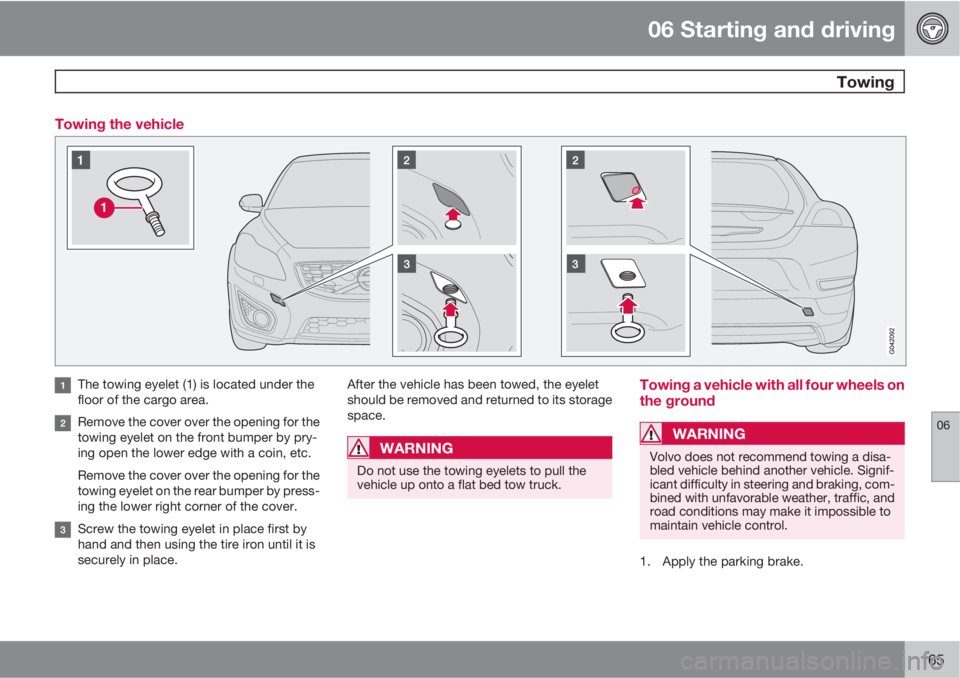
The towing eyelet (1) is located under the
floor of the cargo area.
Remove the cover over the opening for the
towing eyelet on the front bumper by pry-
ing open the lower edge with a coin, etc.
Remove the cover over the opening for the
towing eyelet on the rear bumper by press-
ing the lower right corner of the cover.
Screw the towing eyelet in place first by
hand and then using the tire iron until it is
securely in place.After the vehicle has been towed, the eyelet
should be removed and returned to its storage
space.
WARNING
Do not use the towing eyelets to pull the
vehicle up onto a flat bed tow truck.
Towing a vehicle with all four wheels on
the ground
WARNING
Volvo does not recommend towing a disa-
bled vehicle behind another vehicle. Signif-
icant difficulty in steering and braking, com-
bined with unfavorable weather, traffic, and
road conditions may make it impossible to
maintain vehicle control.
1. Apply the parking brake.
Page 168 of 300
06 Starting and driving
Towing
06
166
2. Insert the key into the ignition to unlock the
steering wheel. With the engine off and the
vehicle at a standstill, great effort will be
required to turn the steering wheel.
3.
Turn the ignition key to position II.
4. Place the gear selector in neutral. For vehi-
cles with automatic transmissions, follow
instruction on page 158, "Shiftlock over-
ride" to allow the gear selector to be moved
from the Park position.
5. Keep firm pressure on the brake pedal
while releasing the parking brake.
6. When towing has been completed, return
the gear selector to Park (automatic) or
Reverse (manual) and apply the parking
brake.
The following points should also be
observed:
•Never exceed 50 mph (80 km/h). Never
exceed local towing speed limits and heed
all local towing restrictions.
•Never tow farther than 50 miles (80 km).
•Keep the tow rope taut at all times while the
vehicle is in motion.
•The disabled vehicle should be towed in
the forward direction only.
WARNING
•Never allow a vehicle to be towed with-
out a driver behind the wheel of the dis-
abled vehicle.
•When the engine is not running, steering
resistance and the effort needed to
apply the brakes will be great.
•Never attempt to tow a vehicle with a
dead battery at night.
CAUTION
•Check with state and local authorities
before attempting this type of towing,
as vehicles being towed are subject to
regulations regarding maximum towing
speed, length and type of towing
device, lighting, marker flags, etc.
•Never attempt to push- or tow-start a
vehicle with a dead battery. This would
inject unburned fuel into the three-way
catalytic converter(s), causing over-
heating, backfiring, and damage, see
page 168 for instructions on jump star-
ting the vehicle.
Towing vehicles with front wheel drive
Volvo recommends the use of flat bed equip-
ment for towing vehicles with front wheel drive.
If wheel lift equipment must be used, please
use extreme caution to help avoid damage to
the vehicle.
In this case, the vehicle should be towed with
the rear wheels on the ground if at all possible.
If it is absolutely necessary to tow the vehicle
with the front wheels on the ground, please
refer to the towing information on the previous
page.
•Sling-type equipment applied at the front
will damage radiator and air conditioning
lines.
•It is equally important not to use sling-type
equipment at the rear or apply lifting equip-
ment inside the rear wheels; serious dam-
age to the rear axle may result.
•If the vehicle is being towed on a flat bed
truck, the towing eyelets must not be used
to secure the vehicle on the flat bed. Con-
sult the tow truck operator.
Page 169 of 300
06 Starting and driving
Towing
06
167
WARNING
•The power brakes and power steering
will not function when the engine is not
running. Approximately 5 times more
pressure will be required on the brake
pedal and the steering wheel will be
considerably harder to turn.
•The towing eyelets must not be used for
pulling the vehicle out of a ditch or for
any similar purpose involving severe
strain. Do not use the towing eyelets to
pull the vehicle up onto a flat bed tow
truck.
Page 171 of 300
06 Starting and driving
Transporting loads
06
169 Loading the vehicle
Your vehicle's load-carrying capacity is affec-
ted by factors such as:
•the number of passengers
•tire inflation
•the amount of optional or accessory equip-
ment installed
•the amount of cargo.
See the chapter "Wheels and tires" for more
detailed information.
Before loading the car, turn off the engine, and
apply the parking brake when loading or
unloading long objects. The gear selector can
be inadvertently knocked out of position by
long cargo, causing the car to move.
Keep the following in mind when
loading the vehicle:
•Load objects in the cargo area against the
rear seat backrest.
•Load heavy cargo as low as possible.
•Center wide loads.
•Secure all cargo with restraining straps
anchored to the load securing eyelets.
•Cover sharp edges on the load.
•The rear seats can be folded down to
extend the cargo compartment, see
page 117.
WARNING
•Remember that an object weighing
44 lbs (20 kg) produces a force of
2,200 lbs (1,000 kg) in a head-on colli-
sion at 30 mph (50 km/h)!
•When the rear backrest(s) are folded
down, the vehicle should not be loaded
to a level higher than 2 in. (5 cm) below
the upper edge of the rear side win-
dows. Objects placed higher than this
level could impede the function of the
Inflatable Curtain.
Load carriers (accessory)
Load carriers are available as Volvo accesso-
ries. Follow the installation instructions sup-
plied with the load carriers.
Observe the following points when using load
carriers:
•To avoid damaging your car and to achieve
maximum safety when driving, we recom-
mend using the load carriers that Volvo has
developed especially for your car.
•Volvo-approved removable roof racks are
designed to carry the maximum allowable
roof load for this vehicle: 165 lbs (75 kg).
For Non-Volvo roof racks, check the man-
ufacturer's weight limits for the rack.
•Never exceed the rack manufacturer's
weigh limits and never exceed the maxi-
mum rated roof load of 165 lbs (75 kg).
•Avoid single-point loads. Distribute loads
evenly.
•Place heavier cargo at the bottom of the
load.
•Secure the cargo correctly with appropri-
ate tie-down equipment.
•Check periodically that the load carriers
and load are properly secured.
•Remember that the car's center of gravity
and handling change when you carry a
load on the roof.
•The car's wind resistance and fuel con-
sumption will increase with the size of the
load.
•Drive smoothly. Avoid rapid starts, fast
cornering and hard braking.
Page 177 of 300

06 Starting and driving
Rear park assist*
06
* Option/accessory, for more information, see Introduction.175 Audible signals from the park assist
system
The Park Assist system uses an intermittent
tone that pulses faster as you come close to an
object, and becomes constant when you are
within approximately 1 ft (30 cm) of an object
behind the vehicle. If the volume of another
source from the audio system is high, this will
be automatically lowered.
Faults in the system
If the information symbol illumi-
nates and PARK ASSIST
SERVICE REQUIRED is shown
on the information display, this
indicates that the system is not
functioning properly and has been disengaged.
Consult a Volvo retailer or authorized Volvo
service technician.
CAUTION
In certain circumstances, the park assist
system may give unexpected warning sig-
nals that can be caused by external sound
sources that use the same ultrasound fre-
quencies as the system. This may include
such things as the horns of other vehicles,
wet tires on asphalt, pneumatic brakes,
motorcycle exhaust pipes, etc. This does
not indicate a fault in the system.
Cleaning the sensors
Park assist sensors
The sensors must be cleaned regularly to
ensure that they work properly. Clean them
with water and a suitable car washing deter-
gent.
Ice and snow covering the sensors may cause
incorrect warning signals.
NOTE
If the sensors are obstructed by e.g., dirt,
snow, or ice, this could result in false warn-
ing signals from the park assist system.
Page 191 of 300
07 Wheels and tires
Snow chains, snow tires, studded tires
07
189 Snow chains
Snow chains can be used on your Volvo with
the following restrictions:
•Snow chains should be installed on front
wheels only. Use only Volvo approved
snow chains.
•If accessory, aftermarket or "custom" tires
and wheels are installed and are of a size
different than the original tires and wheels,
chains in some cases CANNOT be used.
Sufficient clearances between chains and
brakes, suspension and body components
must be maintained.
•Some strap-on type chains will interfere
with brake components and therefore
CANNOT be used.
•Certain size tires may not allow the assem-
bly of snow chains/traction devices.
Consult your Volvo retailer for additional snow
chain information.
CAUTION
•Check local regulations regarding the
use of snow chains before installing.
•Always follow the chain manufacturer's
installation instructions carefully. Install
chains as tightly as possible and
retighten periodically.
•Never exceed the chain manufacturer's
specified maximum speed limit. (Under
no circumstances should you exceed
31 mph (50 km/h).
•Avoid bumps, holes or sharp turns
when driving with snow chains.
•The handling of the vehicle can be
adversely affected when driving with
chains. Avoid fast or sharp turns as well
as locked wheel braking.
Snow tires, studded tires
Tires for winter use:
•Owners who live in or regularly commute
through areas with sustained periods of
snow or icy driving conditions are strongly
advised to fit suitable winter tires to help
retain the highest degree of traction.
•It is important to install winter tires on all
four wheels to help retain traction during
cornering, braking, and accelerating. Fail-ure to do so could reduce traction to an
unsafe level or adversely affect handling.
•Do not mix tires of different design as this
could also negatively affect overall tire road
grip.
•Winter tires wear more quickly on dry roads
in warm weather. They should be removed
when the winter driving season has ended.
•Studded tires should be run-in
300–600 miles (500–1000 km) during
which the car should be driven as smoothly
as possible to give the studs the opportu-
nity to seat properly in the tires. The tires
should have the same rotational direction
throughout their entire lifetime.
NOTE
Please consult state or provincial regula-
tions restricting the use of studded winter
tires before installing such tires.
Page 194 of 300
07 Wheels and tires
Tire Sealing System*
07
192* Option/accessory, for more information, see Introduction.
•Inhalation: Move the exposed person to
fresh air. If irritation persists, get medi-
cal attention.
•Ingestion: Do NOT induce vomiting
unless directed to do so by medical per-
sonnel. Get medical attention.
•Disposal: Dispose of this material and
its container to a hazardous or special
waste collection point.
NOTE
Do not break the seal on the bottle. This
occurs automatically when the bottle is
screwed into the holder.
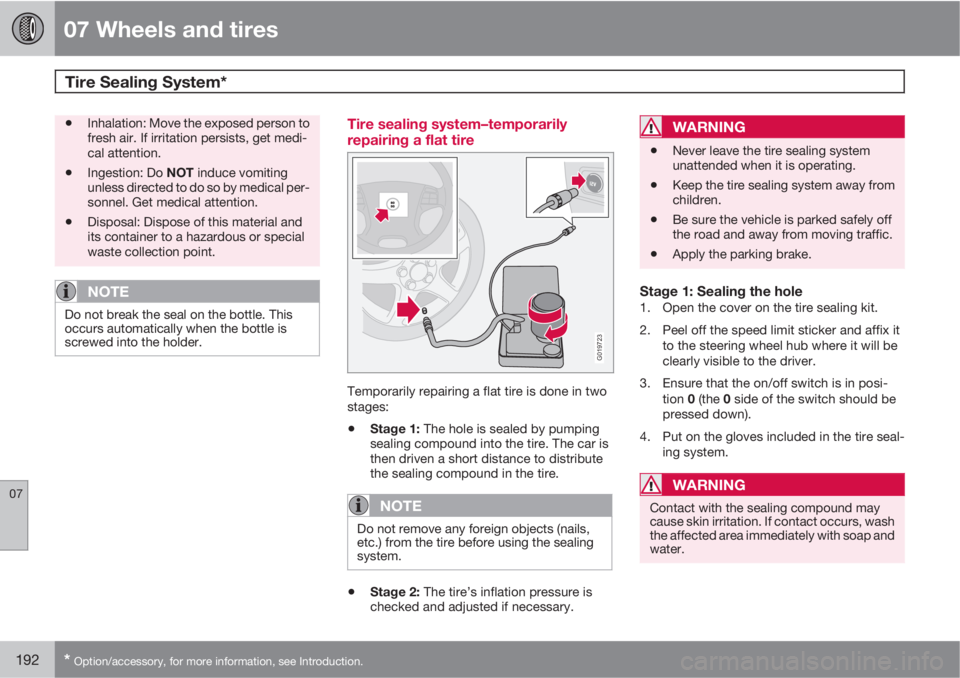
Tire sealing system–temporarily
repairing a flat tire
G019723
Temporarily repairing a flat tire is done in two
stages:
•Stage 1: The hole is sealed by pumping
sealing compound into the tire. The car is
then driven a short distance to distribute
the sealing compound in the tire.
NOTE
Do not remove any foreign objects (nails,
etc.) from the tire before using the sealing
system.
•Stage 2: The tire’s inflation pressure is
checked and adjusted if necessary.
WARNING
•Never leave the tire sealing system
unattended when it is operating.
•Keep the tire sealing system away from
children.
•Be sure the vehicle is parked safely off
the road and away from moving traffic.
•Apply the parking brake.
Stage 1: Sealing the hole1. Open the cover on the tire sealing kit.
2. Peel off the speed limit sticker and affix it
to the steering wheel hub where it will be
clearly visible to the driver.
3. Ensure that the on/off switch is in posi-
tion 0 (the 0 side of the switch should be
pressed down).
4. Put on the gloves included in the tire seal-
ing system.
WARNING
Contact with the sealing compound may
cause skin irritation. If contact occurs, wash
the affected area immediately with soap and
water.
Page 197 of 300
07 Wheels and tires
Tire Sealing System*
07
* Option/accessory, for more information, see Introduction.195 Inflating tires
The tire sealing system can be used to inflate
the tires. To do so:
1. Park the car in a safe place.
2. The compressor should be switched off.
Ensure that the on/off switch is in posi-
tion 0 (the 0 side of the switch should be
pressed down).
3. Take out the electrical wire and hose.
4. Remove the valve cap from the tire’s infla-
tion valve and screw the hose connector
onto the valve as tightly as possible by
hand.
5. Connect the electrical wire to the nearest
12-volt socket in the vehicle.
6. Start the vehicle’s engine.WARNING
•The vehicle’s engine should be running
when the tire sealing system is used to
avoid battery drain. Therefore, be sure
the vehicle is parked in a well ventilated
place, or outdoors, before using the sys-
tem. The parking brake should be
securely applied and on models with an
automatic transmission, the gear selec-
tor should be in the P (park) position.
•Children should never be left unattended
in the vehicle when the engine is running.
7. Check the tire’s inflation pressure on the
gauge. Switch off the compressor briefly to
get a clear reading from the pressure
gauge.
8. Refer to the tire inflation table for the cor-
rect inflation pressure. If the tire needs to
be inflated, start the tire sealing system’s
compressor (press the on/off switch to
position I). If necessary, release air from the
tire by turning the air release knob coun-
terclockwise.
CAUTION
The compressor should not be used for
more than 10 minutes at a time to avoid
overheating.
9. Turn off the compressor (press the on/off
switch to position 0) when the correct infla-
tion pressure has been reached.
10. Unscrew the hose from the tire’s inflation
valve and reinstall the valve cap.
11. Disconnect the electrical wire from the
12-volt socket.
Page 202 of 300
07 Wheels and tires
Changing a wheel
07
200
Removing the wheel
See page 197 for information on accessing the
jack and tools for changing a wheel.
1. Apply the parking brake.
2.
Put the gear selector in Park (P) or reverse
on models with a manual transmission.
3. Block the wheels that are on the ground
with wooden blocks or large stones.
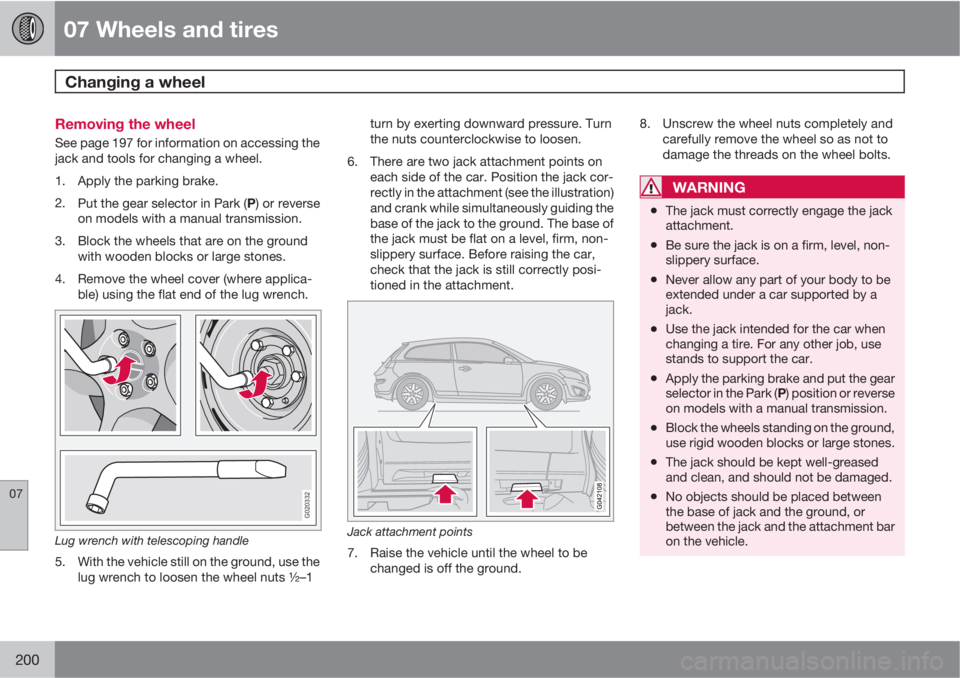
4. Remove the wheel cover (where applica-
ble) using the flat end of the lug wrench.
G020332
Lug wrench with telescoping handle
5. With the vehicle still on the ground, use the
lug wrench to loosen the wheel nuts ½–1turn by exerting downward pressure. Turn
the nuts counterclockwise to loosen.
6. There are two jack attachment points on
each side of the car. Position the jack cor-
rectly in the attachment (see the illustration)
and crank while simultaneously guiding the
base of the jack to the ground. The base of
the jack must be flat on a level, firm, non-
slippery surface. Before raising the car,
check that the jack is still correctly posi-
tioned in the attachment.
Jack attachment points
7. Raise the vehicle until the wheel to be
changed is off the ground.8. Unscrew the wheel nuts completely and
carefully remove the wheel so as not to
damage the threads on the wheel bolts.
WARNING
•The jack must correctly engage the jack
attachment.
•Be sure the jack is on a firm, level, non-
slippery surface.
•Never allow any part of your body to be
extended under a car supported by a
jack.
•Use the jack intended for the car when
changing a tire. For any other job, use
stands to support the car.
•Apply the parking brake and put the gear
selector in the Park (P) position or reverse
on models with a manual transmission.
•Block the wheels standing on the ground,
use rigid wooden blocks or large stones.
•The jack should be kept well-greased
and clean, and should not be damaged.
•No objects should be placed between
the base of jack and the ground, or
between the jack and the attachment bar
on the vehicle.
Page 211 of 300

08 Car care
Washing and cleaning the car
08
209
(because the paint will not have hardened suf-
ficiently).
An automatic wash is a simple and quick way
to clean your car, but it is worth remembering
that it may not be as thorough as when you
yourself go over the car with sponge and water.
Keeping the underbody clean is most impor-
tant, especially in the winter. Some automatic
washers do not have facilities for washing the
underbody.
CAUTION
•Before driving into an automatic car
wash, turn off the optional rain sensor to
avoid damaging the windshield wipers.
•Make sure that side view mirrors, auxil-
iary lamps, etc, are secure, and that any
antenna(s) are retracted or removed.
Otherwise there is risk of the machine
dislodging them
•Chromed wheels: Clean chrome-
plated wheels using the same deter-
gents used for the body of the vehicle.
Aggressive wheel-cleaning agents can
permanently stain chrome-plated
wheels.
WARNING
•When the car is driven immediately after
being washed, apply the brakes several
times in order to remove any moisture
from the brake linings.
•Engine cleaning agents should not be
used when the engine is warm. This
constitutes a fire risk.
Exterior lightingCondensation may form temporarily on the
inside of the lenses of exterior lights such as
headlights, fog lights, or taillights. This is nor-
mal and the lights are designed to withstand
moisture. Normally, condensation will dissi-
pate after the lights have been on for a short
time.
Polishing and Waxing
•Normally, polishing is not required during
the first year after delivery, however, wax-
ing may be beneficial.
•Before applying polish or wax the vehicle
must be washed and dried. Tar spots can
be removed with kerosene or tar remover.
Difficult spots may require a fine rubbing
compound.
•After polishing use liquid or paste wax.
•Several commercially available products
contain both polish and wax.
•Waxing alone does not substitute for pol-
ishing a dull surface.
•A wide range of polymer-based waxes can
be purchased today. These waxes are easy
to use and produce a long-lasting, high-
gloss finish that protects the bodywork
against oxidation, road dirt and fading.
•Do not polish or wax your vehicle in direct
sunlight (the surface of the vehicle should
not be warmer than 113 °F (45 °C).
CAUTION
Volvo does not recommend the use of long-
life or durable paint protection coatings,
some of which may claim to prevent pitting,
fading, oxidation, etc. These coatings have
not been tested by Volvo for compatibility
with your vehicle's clear coat. Some of them
may cause the clear coat to soften, crack,
or cloud. Damage caused by application of
paint protection coatings may not be cov-
ered under your vehicle's paint warranty.