wheel VOLVO C70 2003 Owners Manual
[x] Cancel search | Manufacturer: VOLVO, Model Year: 2003, Model line: C70, Model: VOLVO C70 2003Pages: 98, PDF Size: 1.64 MB
Page 1 of 98
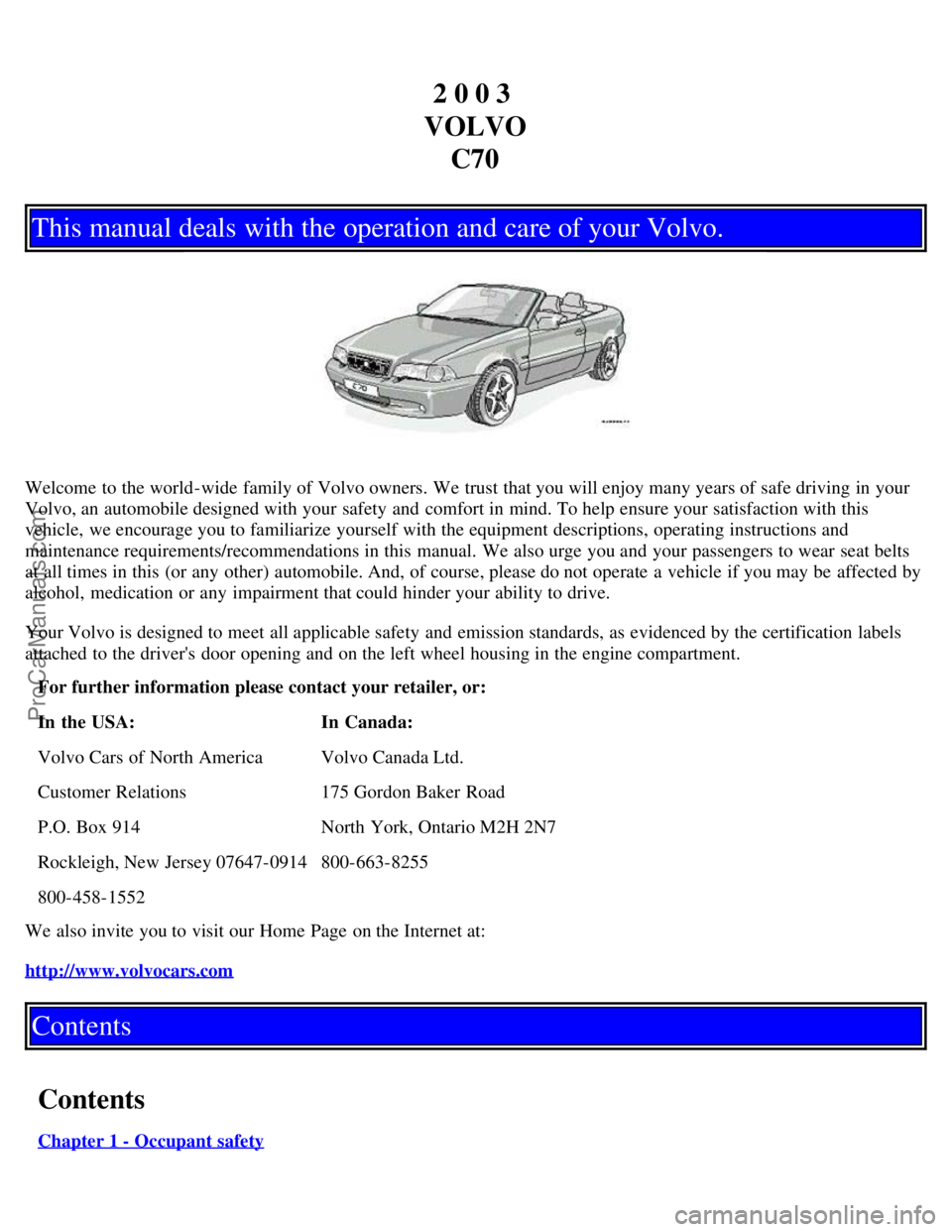
2 0 0 3
VOLVO C70
This manual deals with the operation and care of your Volvo.
Welcome to the world-wide family of Volvo owners. We trust that you will enjoy many years of safe driving in your
Volvo, an automobile designed with your safety and comfort in mind. To help ensure your satisfaction with this
vehicle, we encourage you to familiarize yourself with the equipment descriptions, operating instructions and
maintenance requirements/recommendations in this manual. We also urge you and your passengers to wear seat belts
at all times in this (or any other) automobile. And, of course, please do not operate a vehicle if you may be affected by
alcohol, medication or any impairment that could hinder your ability to drive.
Your Volvo is designed to meet all applicable safety and emission standards, as evidenced by the certification labels
attached to the driver's door opening and on the left wheel housing in the engine compartment. For further information please contact your retailer, or:
In the USA: In Canada:
Volvo Cars of North America Volvo Canada Ltd.
Customer Relations 175 Gordon Baker Road
P.O. Box 914 North York, Ontario M2H 2N7
Rockleigh, New Jersey 07647-0914 800-663-8255
800-458-1552
We also invite you to visit our Home Page on the Internet at:
http://www.volvocars.com
Contents
Contents
Chapter 1 - Occupant safety
ProCarManuals.com
Page 2 of 98
Chapter 2 - Instruments, switches and controls
Chapter 3 - Body and interior
Chapter 4 - Starting and driving
Chapter 5 - Wheels and tires
Chapter 6 - In case of an emergency
Chapter 7 - Car care
Chapter 8 - Volvo Service
Chapter 9 - Specifications
Chapter 10 - Audio systems
Homelink® Universal Transceiver (option)
Index
Back Cover
General information
Important
Before you operate your car for the first time, please familiarize yourself with the BREAK-IN information on
page 60.
You should also be familiar with the information in the first three chapters of this manual.
Information contained in the balance of the manual is extremely useful and should be read after operating the
vehicle for the first time.
The manual is structured so that it can be used for reference. For this reason, it should be kept in the car for
ready access.
Do not export your Volvo to another country before investigating that country's applicable safety and exhaust
emission requirements. In some cases it may be difficult or impossible to comply with these requirements.
Modifications to the emission control system(s) may render your Volvo not certifiable for legal operation in the
U.S., Canada and other countries.
All information, illustrations and specifications contained in this manual are based on the latest product
information available at the time of publication. Please note that some vehicles may be equipped differently,
depending on special legal requirements and that optional equipment described in this manual may not be
available in all markets.
Volvo reserves the right to make model changes at any time, or to change specifications or design, without
notice and without incurring obligation.
CAUTION : Certain models have reduced ground clearance due to the design of the front spoiler. Please observe
caution when e.g., driving onto garage hoists, through drifted snow or when other road debris is encountered, or when
parking near curbs.
ProCarManuals.com
Page 8 of 98
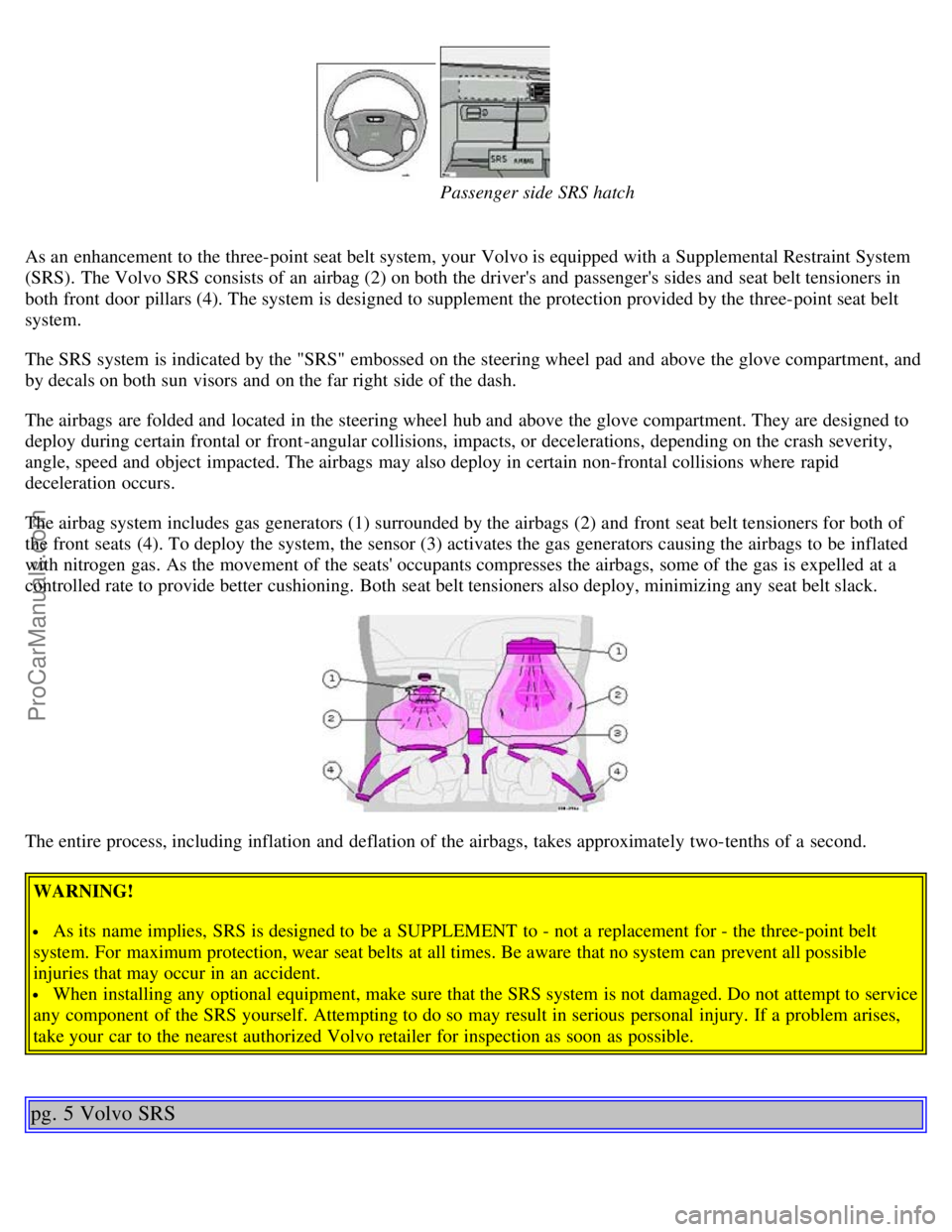
Passenger side SRS hatch
As an enhancement to the three-point seat belt system, your Volvo is equipped with a Supplemental Restraint System
(SRS). The Volvo SRS consists of an airbag (2) on both the driver's and passenger's sides and seat belt tensioners in
both front door pillars (4). The system is designed to supplement the protection provided by the three-point seat belt
system.
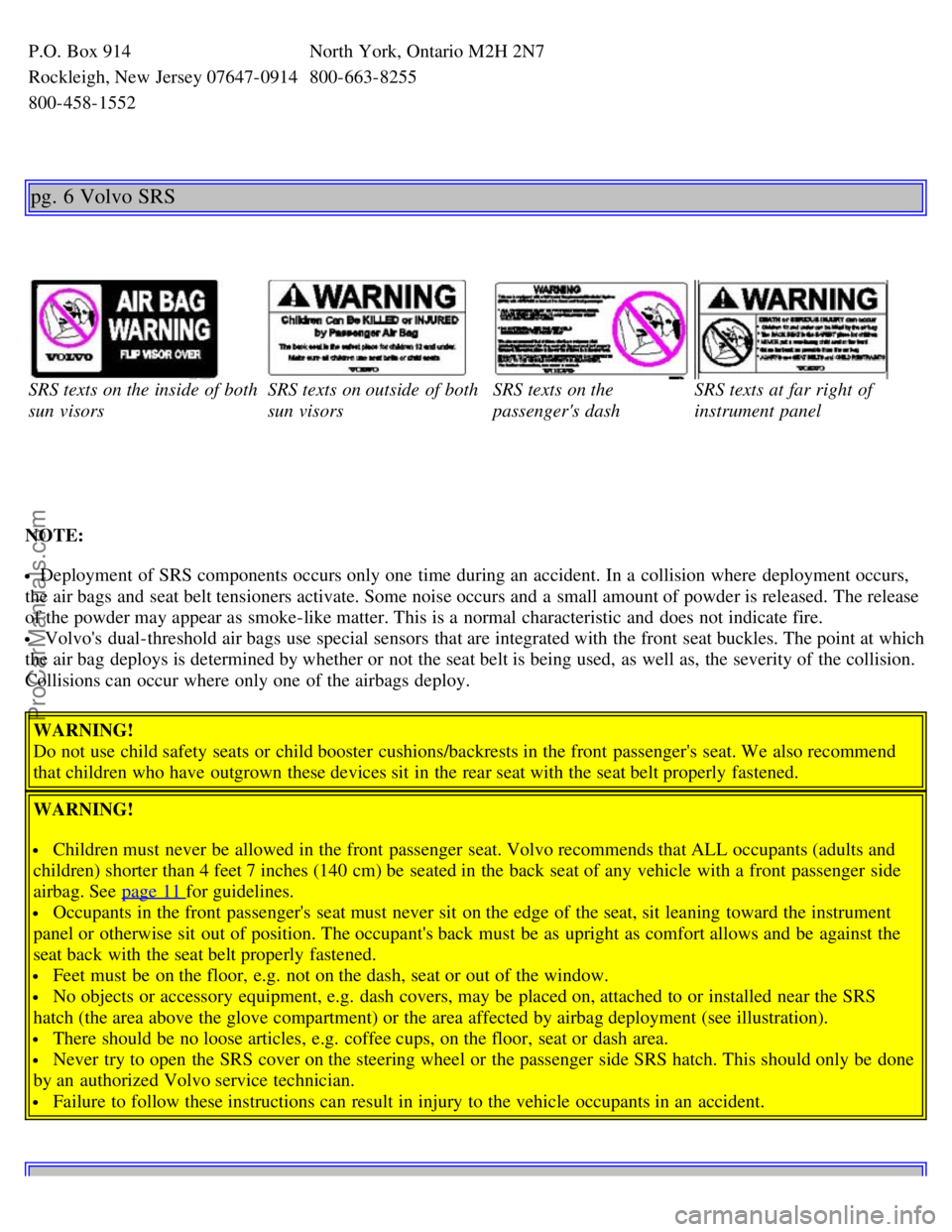
The SRS system is indicated by the "SRS" embossed on the steering wheel pad and above the glove compartment, and
by decals on both sun visors and on the far right side of the dash.
The airbags are folded and located in the steering wheel hub and above the glove compartment. They are designed to
deploy during certain frontal or front -angular collisions, impacts, or decelerations, depending on the crash severity,
angle, speed and object impacted. The airbags may also deploy in certain non-frontal collisions where rapid
deceleration occurs.
The airbag system includes gas generators (1) surrounded by the airbags (2) and front seat belt tensioners for both of
the front seats (4). To deploy the system, the sensor (3) activates the gas generators causing the airbags to be inflated
with nitrogen gas. As the movement of the seats' occupants compresses the airbags, some of the gas is expelled at a
controlled rate to provide better cushioning. Both seat belt tensioners also deploy, minimizing any seat belt slack.
The entire process, including inflation and deflation of the airbags, takes approximately two-tenths of a second. WARNING!
As its name implies, SRS is designed to be a SUPPLEMENT to - not a replacement for - the three-point belt
system. For maximum protection, wear seat belts at all times. Be aware that no system can prevent all possible
injuries that may occur in an accident.
When installing any optional equipment, make sure that the SRS system is not damaged. Do not attempt to service
any component of the SRS yourself. Attempting to do so may result in serious personal injury. If a problem arises,
take your car to the nearest authorized Volvo retailer for inspection as soon as possible.
pg. 5 Volvo SRS
ProCarManuals.com
Page 9 of 98
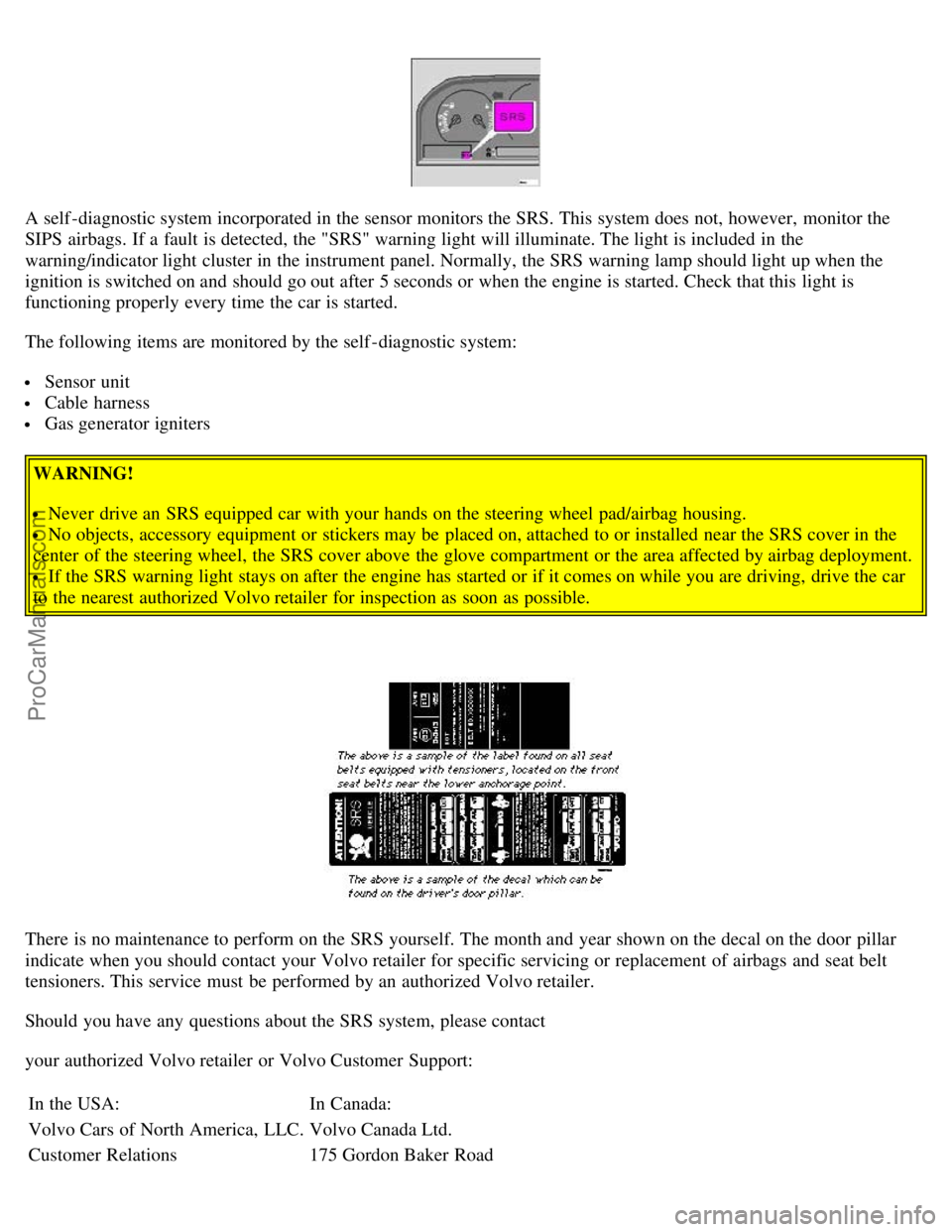
A self -diagnostic system incorporated in the sensor monitors the SRS. This system does not, however, monitor the
SIPS airbags. If a fault is detected, the "SRS" warning light will illuminate. The light is included in the
warning/indicator light cluster in the instrument panel. Normally, the SRS warning lamp should light up when the
ignition is switched on and should go out after 5 seconds or when the engine is started. Check that this light is
functioning properly every time the car is started.
The following items are monitored by the self -diagnostic system:
Sensor unit
Cable harness
Gas generator igniters
WARNING!
Never drive an SRS equipped car with your hands on the steering wheel pad/airbag housing.
No objects, accessory equipment or stickers may be placed on, attached to or installed near the SRS cover in the
center of the steering wheel, the SRS cover above the glove compartment or the area affected by airbag deployment.
If the SRS warning light stays on after the engine has started or if it comes on while you are driving, drive the car
to the nearest authorized Volvo retailer for inspection as soon as possible.
There is no maintenance to perform on the SRS yourself. The month and year shown on the decal on the door pillar
indicate when you should contact your Volvo retailer for specific servicing or replacement of airbags and seat belt
tensioners. This service must be performed by an authorized Volvo retailer.
Should you have any questions about the SRS system, please contact
your authorized Volvo retailer or Volvo Customer Support:
In the USA: In Canada:
Volvo Cars of North America, LLC. Volvo Canada Ltd.
Customer Relations 175 Gordon Baker Road
ProCarManuals.com
Page 10 of 98
P.O. Box 914North York, Ontario M2H 2N7
Rockleigh, New Jersey 07647-0914800-663-8255
800-458-1552
pg. 6 Volvo SRS
SRS texts on the inside of both
sun visorsSRS texts on outside of both
sun visorsSRS texts on the
passenger's dashSRS texts at far right of
instrument panel
NOTE:
Deployment of SRS components occurs only one time during an accident. In a collision where deployment occurs,
the air bags and seat belt tensioners activate. Some noise occurs and a small amount of powder is released. The release
of the powder may appear as smoke-like matter. This is a normal characteristic and does not indicate fire.
Volvo's dual-threshold air bags use special sensors that are integrated with the front seat buckles. The point at which
the air bag deploys is determined by whether or not the seat belt is being used, as well as, the severity of the collision.
Collisions can occur where only one of the airbags deploy.
WARNING!
Do not use child safety seats or child booster cushions/backrests in the front passenger's seat. We also recommend
that children who have outgrown these devices sit in the rear seat with the seat belt properly fastened.
WARNING!
Children must never be allowed in the front passenger seat. Volvo recommends that ALL occupants (adults and
children) shorter than 4 feet 7 inches (140 cm) be seated in the back seat of any vehicle with a front passenger side
airbag. See page 11
for guidelines.
Occupants in the front passenger's seat must never sit on the edge of the seat, sit leaning toward the instrument
panel or otherwise sit out of position. The occupant's back must be as upright as comfort allows and be against the
seat back with the seat belt properly fastened.
Feet must be on the floor, e.g. not on the dash, seat or out of the window.
No objects or accessory equipment, e.g. dash covers, may be placed on, attached to or installed near the SRS
hatch (the area above the glove compartment) or the area affected by airbag deployment (see illustration).
There should be no loose articles, e.g. coffee cups, on the floor, seat or dash area.
Never try to open the SRS cover on the steering wheel or the passenger side SRS hatch. This should only be done
by an authorized Volvo service technician.
Failure to follow these instructions can result in injury to the vehicle occupants in an accident.
ProCarManuals.com
Page 14 of 98

6Space for additional equipment
7Space for additional equipment
8 Instruments 14-15
9Stability Control System - STC 23
10Trip computer (optional) 26-28
11Electrically operated convertible top 40
12Rear window demister/heated door mirrors 23
13Air mix 33
14Air vents 33
15Passenger side air bag (SRS) hatch 4-6
16Air vents 33
17Hood release 54
18Turn signals, high/low beams, exterior courtesy lights 20
18Cruise control 29
19Adjustable steering wheel 32
20Windshield wiper/washer 21
21Heated front seats (optional) 30
22Auxiliary socket 31
23Audio systems 133
24Heating and ventilation controls 33-35
25Hazard warning flashers 23
26Ashtray 31
27Coin holder 42
28Shiftlock release button (automatic transmission only) 101
29Gear selector shift positions 65-67
30Winter mode selector 67
31Parking brake 30
32Horn/SRS 4-6
33Trunk open control 55
34Power window controls 36
35Power mirror controls 51
36Fuel tank open control 37
37Central locking button 36
Some of the items above are available on certain models only.
pg. 16 Instruments
ProCarManuals.com
Page 18 of 98

in the reservoir. See page 118 for reservoir position.
Canadian models are equipped with this warning light:
WARNING!
If the fluid level is below the MIN mark in either section of the reservoir: DO NOT DRIVE. Tow the car to a Volvo
retailer and have the brake system checked and any leakage repaired.
Parking brake reminder light
This light will be on when the parking brake (hand brake) is applied. The parking brake lever is situated between the
front seats.
Canadian models are equipped with this warning light:
pg. 19 Warning lights
STC disengaged
The indicator light (
) in the instrument panel will be ON when you have switched the Stability and Traction Control
system (STC) OFF using the button on the dashboard (see page 23
). The light will also come on if there is a fault in the
STC system or to indicate that the brakes have overheated. The light will go out when the brake temperature returns to
normal.
The
symbol will flash when STC is actively regulating power to the drive wheels. Normal power may be reduced at
this time. This is normal as power is momentarily reduced to help keep the drive wheels from losing traction and
spinning.
Anti-lock Brake system (ABS)
If the warning lamp lights up there is a malfunction of the ABS system (the standard braking system will however
function). The vehicle should be driven to a Volvo retailer for inspection.
See page 74
for additional information.
Canadian models are equipped with this warning light:
Coolant level sensor
If this light comes on while driving, the coolant level is low. The coolant level in the expansion tank should be
checked immediately and topped up if necessary. The cooling system should be inspected by an authorized Volvo
retailer.
Mode "W" engaged
The lamp will light up when the Winter/Wet starting mode is engaged or if gears "3" or "L" are selected.
If the warning lamp begins to flash , this means that there is a fault in the automatic gearbox. Contact Your Volvo
retailer.
Supplemental Restraint System (SRS)
If the light comes on (or stays on after the vehicle has started), the SRS diagnostic system has detected a fault. Drive to
an authorized Volvo retailer for an inspection of the system. See the SRS section for more information.
Generator warning light
If the light comes on while the engine is running, have the charging system checked.
ProCarManuals.com
Page 20 of 98

With the headlight switch in position the parking lights will stay on (headlights off) with the daytime running light
screw (A) in position
.
The high beams can only be switched on if the headlight switch is in position
.
Switch from high to low beams and vice versa by moving the turn signal switch lever on the left side of steering
column towards the steering wheel.
* See page 26
for information on Daytime running lights.
Exterior courtesy lights
When you leave your car at night, you can make use of the exterior courtesy lighting function:
Remove the key from the ignition switch.
Pull the direction indicator lever towards the steering wheel (as when using the headlight flasher function).
The low beam headlights will now remain on for 30 seconds to light your way.
Turn signals
1 Lane change position. In maneuvers such as lane changing, the driver can flash the turn signals by moving the turn
signal lever to the first stop and holding it there. The lever will return to the neutral position when released.
2 Signal lever engaged for normal turns.
3 High beam/low beam switch (headlights on).
Move the lever towards the steering wheel and release it.
Headlight flasher (headlights off).
Move the lever towards the steering wheel. The headlight high beam will be on until the lever is released.
NOTE: A defective turn signal bulb will cause the turn signal indicator and remaining signal lights to flash more
rapidly than normal.
pg. 21 Windshield wipers/washers, Ignition switch
ProCarManuals.com
Page 21 of 98
Windshield wipers/washers
1 Intermittent wiper
With the switch in this position, the wipers will sweep approximately every seventh second.
2 "Single sweep" position:
The switch returns automatically when released.
3 Wipers, normal speed
4 Wipers, high speed
5 Windshield wiper/washer, headlight wiper/washer
The wipers will make 23 sweeps across the windshield and headlights (certain models) after the lever is released.
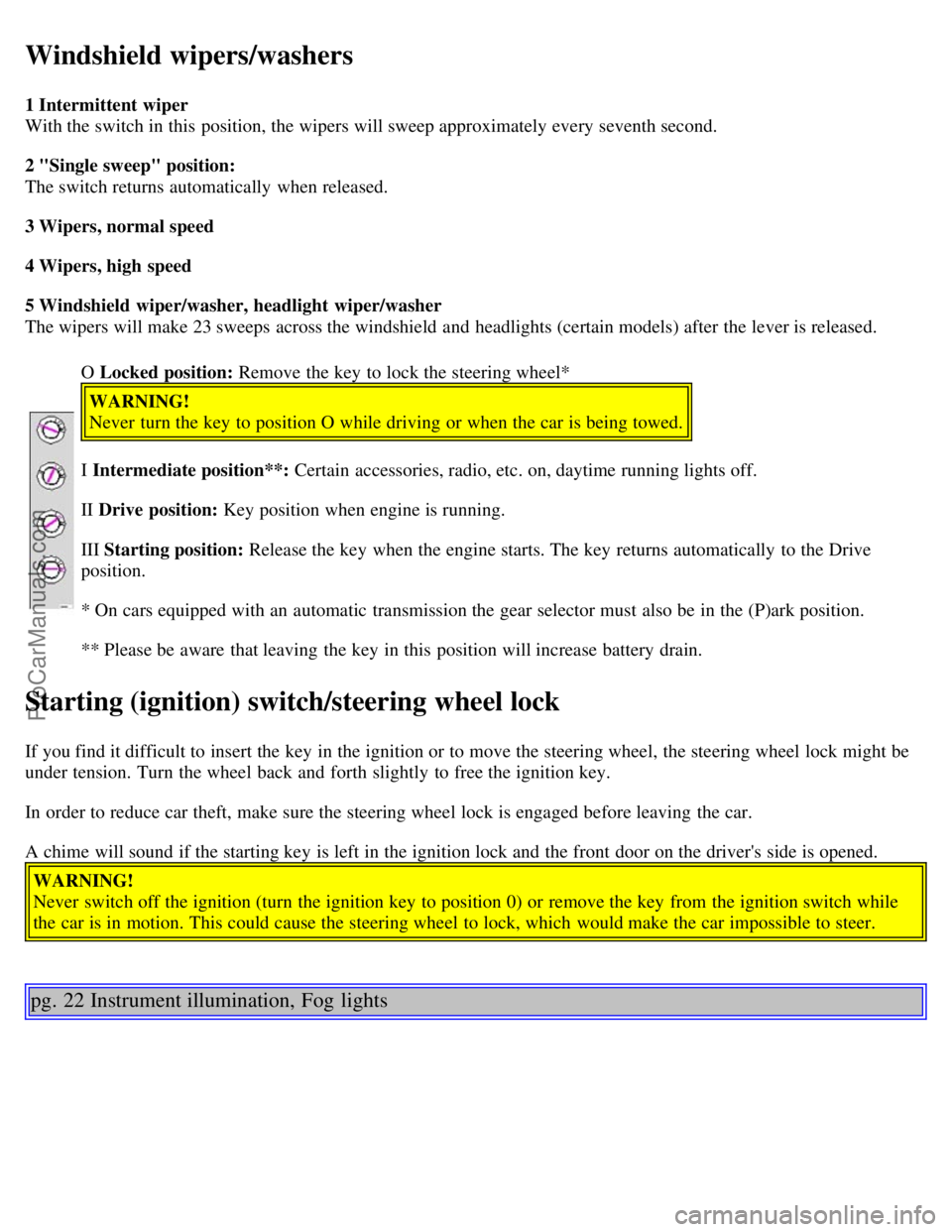
O Locked position: Remove the key to lock the steering wheel*
WARNING!
Never turn the key to position O while driving or when the car is being towed.
I Intermediate position**: Certain accessories, radio, etc. on, daytime running lights off.
II Drive position: Key position when engine is running.
III Starting position: Release the key when the engine starts. The key returns automatically to the Drive
position.
* On cars equipped with an automatic transmission the gear selector must also be in the (P)ark position.
** Please be aware that leaving the key in this position will increase battery drain.
Starting (ignition) switch/steering wheel lock
If you find it difficult to insert the key in the ignition or to move the steering wheel, the steering wheel lock might be
under tension. Turn the wheel back and forth slightly to free the ignition key.
In order to reduce car theft, make sure the steering wheel lock is engaged before leaving the car.
A chime will sound if the starting key is left in the ignition lock and the front door on the driver's side is opened.
WARNING!
Never switch off the ignition (turn the ignition key to position 0) or remove the key from the ignition switch while
the car is in motion. This could cause the steering wheel to lock, which would make the car impossible to steer.
pg. 22 Instrument illumination, Fog lights
ProCarManuals.com
Page 22 of 98

1 - Instrument illumination
To increase the brightness: move the thumbwheel up.
To decrease the brightness: move the thumbwheel down.
2 - Rear fog light *
The rear fog light (located in the driver's side tail light cluster) is considerably brighter than the normal tail lights and
should be used only when the atmospheric conditions, such as fog, rain, snow, smoke or dust reduce the daytime or
night-time visibility of other vehicles to less than 500 ft (150 meters).
For the rear fog light to function, the low beam headlights must be switched on.
* By design, there is one rear fog light only, located in the driver's side tail light cluster.
3 - Front fog lights
The front fog lights, located in the front spoiler, will only function in combination with the low beam headlights.
4 - Space for optional equipment
5 - Space for optional equipment
Contents | Top of Page
ProCarManuals.com