light VOLVO C70 2008 Owners Manual
[x] Cancel search | Manufacturer: VOLVO, Model Year: 2008, Model line: C70, Model: VOLVO C70 2008Pages: 246, PDF Size: 5.14 MB
Page 2 of 246
In Canada: Volvo Cars of Canada Corp.
National Customer Service
175 Gordon Baker Road
North York, Ontario M2H 2N7
1-800-663-8255
www.volvocanada.com
2007 © Volvo Car Corporation. All rights reserved.
2 Contents
00 Introduction
General information 6
Volvo and the environment7
Important warnings8
01 Safety
Occupant safety 12
Seat belts14
Supplemental Restraint System17
Front airbags18
Occupant Weight Sensor21
Side impact protection airbags24
Door mounted inflatable curtains25
Whiplash Protection System26
Roll-over Protection System28
Crash mode29
Child safety30
Child restraint systems33
Infant seats35
Convertible seats37
Booster cushions39
ISOFIX lower anchors40
Child restraint registration and
recalls41
02 Instruments and controls
Instrument overview
44
Instrument panel47
Symbols - instrument panel50
Information display53
Lighting panel55
Left-side steering wheel lever57
Trip computer58
Right-side steering wheel lever60
Cruise control62
Steering wheel adjustment, Hazard
warning flashers64
Parking brake
65
12-volt sockets66
Power windows67
Mirrors68
Personal settings71
HomeLink® Universal Transceiver
(option)73
ProCarManuals.com
Page 3 of 246
3 Contents
03 Climate
General information80
Air vents81
Electronic Climate Control (ECC)82
Air distribution86
04 Interior
Front seats90
Power retractable hard top94
Interior lighting100
Storage compartments102
Trunk107
05 Locks and alarm
Remote control and key blade 112
Valet locking117
Keyless drive (option as
available)119
Locking and unlocking
123
Glove compartment and trunk124
Opening the trunk from the inside125
Alarm126
4 Contents
06 Starting and driving
General information132
Fuel requirements136
Ignition switch/Steering wheel
lock139
Starting the vehicle
140
Starting the car with keyless drive
(option)142
Manual transmission
143
Automatic transmission144
Shiftlock override146
Brake system147
Stability system149
Towing151
Jump starting154
Towing a trailer155
Detachable trailer hitch157
Transporting loads158
Blind Spot Information System
(BLIS)-option159
Park assist (Option/accessory)
163
07 Wheels and tires
General information168
Tire inflation170
Tire designations174
Glossary of tire terminology176
Vehicle loading177
Uniform tire quality gradings179
Snow chains, snow tires, studded
tires180
Wheel nuts
181
Tire rotation182
Temporary spare183
Changing a wheel184
Tire sealing system185
Tire Pressure Monitoring System
(TPMS)192
08 Car care
Washing and cleaning the vehicle
196
Paint touch up200
5 Contents
ProCarManuals.com
Page 4 of 246
09 Maintenance and servicing
Volvo maintenance204
Maintaining your vehicle205
Hood207
Engine compartment208
Engine oil209
Fluids211
Wiper blades213
Battery214
Bulbs216
Replacing bulbs217
Fuses224
10 Audio
Audio functions 234
Radio functions239
Sirius satellite radio (option)241
CD player/CD changer (option)245
Audio menu249
11 Specifications
Label information252
Dimensions and weights254
Fluids256
Engine oil257
Engine specifications259
Electrical system260
Three-way catalytic converter262
Volvo programs263
5 -
cont. Contents
12 Index
Index 264
6 Introduction
General information
Shiftlock (automatic transmission)
When your car is parked, the gear selector is locked in the Park ( P) position. To release the selector from this position,
turn the ignition key to position II (or start the engine), depress the brake pedal, press the button on the front side of the
gear selector and move the selector from Park ( P).
Keylock (automatic transmission)
When the ignition is switched off, the gear selector must be in the Park ( P) position before the key can be removed
from the ignition switch.
Anti-lock Brake System (ABS)
The ABS system in your car performs a self -diagnostic test when the vehicle first reaches the speed of approximately
12 mph (20 km/h). The brake pedal will pulsate several times and a sound may be audible from the ABS control
module. This is normal.
Fuel filler door
Press the button on the light switch panel when the car is at a standstill to open the fuel filler door.
Fuel filler cap
After refueling, close the fuel filler cap by turning it clockwise until it clicks into place. If this cap is not closed tightly
or if the engine is running when the car is refueled, the Malfunction Indicator Lamp ("Check Engine" light) may
indicate a fault.
ProCarManuals.com
Page 6 of 246
than 3.4 oz. (100 grams) are marked with international symbols that indicate how the component is to be sorted for
recycling. In addition to continuous environmental refinement of conventional gasoline-powered internal combustion
engines, Volvo is actively looking at advanced technology alternative-fuel vehicles.
When you drive a Volvo, you become our partner in the work to lessen the car's impact on the environment. To reduce
your vehicle's environmental impact, you can:
Maintain proper air pressure in your tires. Tests have shown decreased fuel economy with improperly inflated tires.
Follow the recommended maintenance schedule in your Warranty and Service Records Information booklet.
Drive at a constant speed whenever possible.
See a trained and qualified Volvo service technician as soon as possible for inspection if the check engine (
malfunction indicator) light illuminates, or stays on after the vehicle has started.
Properly dispose of any vehicle-related waste such as used motor oil, used batteries, brake pads, etc.
When cleaning your vehicle, please use genuine Volvo car care products. All Volvo car care products are
formulated to be environmentally friendly.
For additional information regarding the environmental activities in which Volvo Cars of North America, LLC and
Volvo Car Corporation are involved, visit our Internet home page at: http://www.volvocars.us
.
WARNING
Certain components of this vehicle such as air bag modules, seat belt pretensioners, adaptive steering columns,
rollover protection system, and button cell batteries may contain Perchlorate material. Special handling may apply for
service or vehicle end of life disposal.
See www.dtsc.ca.gov/hazardouswaste/perchlorate
.
8 Introduction
Important warnings
Accessory Installation
We strongly recommend that Volvo owners install only genuine, Volvo-approved accessories, and that accessory
installations be performed only by a trained and qualified Volvo service technician.
Genuine Volvo accessories are tested to ensure compatibility with the performance, safety, and emission systems in
your car. Additionally, a trained and qualified Volvo service technician knows where accessories may and may not be
safely installed in your Volvo. In all cases, please consult a trained and qualified Volvo service technician before
installing any accessory in or on your car.
Accessories that have not been approved by Volvo may or may not be specifically tested for compatibility with your
car. Additionally, an inexperienced installer may not be familiar with some of your car's systems.
Any of your car's performance and safety systems could be adversely affected if you install accessories that Volvo
has not tested, or if you allow accessories to be installed by someone unfamiliar with your car.
Damage caused by unapproved or improperly installed accessories may not be covered by your new car warranty.
See your Warranty and Service Records Information booklet for more warranty information. Volvo assumes no
responsibility for death, injury, or expenses that may result from the installation of non-genuine accessories.
Driver distraction
Driver distraction results from driver activities that are not directly related to controlling the car in the driving
environment. Your new Volvo is, or can be, equipped with many feature-rich entertainment and communication
systems. These include hands-free cellular telephones, navigation systems, and multipurpose audio systems. You may
also own other portable electronic devices for your own convenience. When used properly and safely, they enrich the
ProCarManuals.com
Page 9 of 246
cars long before it was fashionable or required by government regulation.
We will not compromise our commitment to safety. We continue to seek out new safety features and to refine those
already in our cars. You can help. We would appreciate hearing your suggestions about improving automobile safety.
We also want to know if you ever have a safety concern with your car. Call us in the U.S. at: 1-800-458-1552 or in
Canada at: 1-800-663-8255.
Occupant safety reminders
How safely you drive doesn't depend on how old you are but rather on:
How well you see.
Your ability to concentrate.
How quickly you make decisions under stress to avoid an accident.
The following suggestions are intended to help you cope with the ever changing traffic -environment.
Never drink and drive.
If you are taking any medication, consult your physician about its potential effects on your driving abilities.
Take a driver-retraining course.
Have your eyes checked regularly.
Keep your windshield and headlights clean.
Replace wiper blades when they start to leave streaks.
Take into account the traffic, road, and weather conditions, particularly with regard to stopping distance.
Reporting safety defects in the U.S.
If you believe that your vehicle has a defect which could cause a crash or could cause injury or death, you should
immediately inform the National Highway Traffic Safety Administration (NHTSA) in addition to notifying Volvo Cars
of North America, LLC. If NHTSA receives similar complaints, it may open an investigation, and if it finds that a
safety defect exists in a group of vehicles, it may order a recall and remedy campaign. However, NHTSA cannot
become involved in individual problems between you, your retailer, or Volvo Cars of North America, LLC.
To contact NHTSA, you may either call the Auto Safety Hotline toll-free at 1-888-327-4236 (TTY: 1-800-424-9153)
or write to: NHTSA, U.S. Department of Transportation, Washington D.C. 20590.
You can also obtain other information about motor vehicle safety from:
http://www.safercar.gov
Volvo strongly recommends that if your vehicle is covered under a service campaign, safety or emission recall or
similar action, it should be completed as soon as possible. Please check with your local retailer or Volvo Cars of North
America, LLC if your vehicle is covered under these conditions.
NHTSA can be reached at:
13 01 Safety
Occupant safety
Internet:
http://www.nhtsa.gov
Telephone:
ProCarManuals.com
Page 12 of 246

The seat belt should always be worn during pregnancy. But it is crucial that it be worn in the correct way. The diagonal
section should wrap over the shoulder then be routed between the breasts and to the side of the belly. The lap section
should lay flat over the thighs and as low as possible under the belly. It must never be allowed to ride upward. Remove
all slack from the belt and insure that it fits close to the body without any twists.
As a pregnancy progresses, pregnant drivers should adjust their seats and steering wheel such that they can easily
maintain control of the vehicle as they drive (which means they
16 01 Safety
Seat belts
must be able to easily operate the foot pedals and steering wheel). Within this context, they should strive to position
the seat with as large a distance as possible between their belly and the steering wheel.
Child seats
Please refer to page 33
for information on securing child seats with the seat belts.
Seat belt reminder
The seat belt reminder consists of an audible signal, an indicator light above the rearview mirror, and a symbol in the
instrument panel (see page 51
) that alert the driver and front seat passenger if their seat belts are not fastened.
NOTE
The function is active for a total of 6 minutes from the time the ignition is switched on.
ProCarManuals.com
Page 13 of 246

During the first minute:
The seat belt reminder function only reacts if the driver has not fastened his/her seat belt.
The indicator light above the mirror and the symbol in the instrument panel will light up and stay lit until the seat
belt has been fastened.
A chime will sound for 6 seconds. The frequency of the chiming increases with the speed of the car.
After one minute has elapsed:
The seat belt reminder reacts if the driver and/or the front seat passenger have not fastened their seat belts.
The indicator light above the mirror and the symbol in the instrument panel will light up and stay lit until the seat
belt(s) have been fastened, or until the remaining 5 minutes of the 6-minute cycle have elapsed.
The chime will sound for 6 seconds, at 30-second intervals. The frequency of the chiming increases with the speed
of the car.
After 6 minutes, the chime will no longer sound and the indicator lights will go out.
Seat belt maintenance
Check periodically that the seat belts are in good condition. Use water and a mild detergent for cleaning. Check seat
belt mechanism function as follows: attach the seat belt and pull rapidly on the strap.
17 01 Safety
Supplemental Restraint System
Supplemental Restraint System (SRS)
As an enhancement to the three-point seat belts, your Volvo is equipped with a Supplemental Restraint System (SRS).
Volvo's SRS consists of seat belt pretensioners, front airbags, side impact airbags, the occupant weight sensor, and
inflatable curtains. All of these systems are monitored by the SRS control module. An SRS warning light in the
instrument panel (see the illustration) illuminates when the ignition key is turned to position I, II, or III, and will
normally go out after approximately 7 seconds if no faults are detected in the system.
Where applicable, a text message will also be displayed when the SRS warning light illuminates. If this warning
symbol is not functioning properly, the general warning symbol
illuminates and either SRS AIRBAG SERVICE
URGENT or SRS AIRBAG SERVICE REQUIRED will be displayed.
ProCarManuals.com
Page 14 of 246

WARNING
If the SRS warning light stays on after the engine has started or if it illuminates while you are driving, have the
vehicle inspected by a trained and qualified Volvo service technician as soon as possible.
Never try to repair any component or part of the SRS yourself. Any interference in the system could cause
malfunction and serious injury. All work on these systems should be performed by a trained and qualified Volvo
service technician.
WARNING
If your vehicle has been subjected to flood conditions (e.g. soaked carpeting/standing water on the floor of the
vehicle) or if your vehicle has become flood-damaged in any way, do not attempt to start the vehicle or put the key
in the ignition before disconnecting the battery (see below). This may cause airbag deployment which could result in
personal injury. Have the vehicle towed to a trained and qualified Volvo service technician for repairs.
Automatic transmission:
Before attempting to tow the vehicle, use the following procedure to override the shiftlock system to move the
gear selector to the neutral position:
- Switch off the ignition for at least 10 minutes and disconnect the battery
- Wait at least one minute. - Insert the key in the ignition and turn it to position II.
- Press firmly on the brake pedal.
- Move the gear selector from Park ( P) to the Neutral ( N) position. See page 146
for information on manually
overriding the shiftlock system.
18 01 Safety
Front airbags
The front airbag system
The front airbags supplement the three-point seat belts. For these airbags to provide the protection intended, seat belts
must be worn at all times.
The front airbag system includes gas generators surrounded by the airbags, and deceleration sensors that activate the
gas generators, causing the airbags to be inflated with nitrogen gas.
ProCarManuals.com
Page 19 of 246

NOTE
When the ignition is switched on, the OWS indicator light will go on for up to 10 seconds while the system performs
a self -diagnostic test.
However, if a fault is detected in the system:
The OWS indicator light will stay on
The SRS warning light (see page 17) will come on and stay on
The message PASS. AIRBAG OFF SERVICE URGENT will be displayed in the information display.
22 01 Safety
Occupant Weight Sensor
WARNING
If a fault in the system is detected and indicated as explained on the preceding page, be aware that the passenger's
side front airbag will not deploy in the event of a collision. In this case, the SRS system and Occupant Weight
Sensor should be inspected by a trained and qualified Volvo service technician as soon as possible.
Never try to open, remove, or repair any components in the OWS system. This could result in system malfunction.
Maintenance or repairs should only be carried out by an a trained and qualified Volvo service technician.
The front passenger's seat should not be modified in any way. This could reduce pressure on the seat cushion,
which might interfere with the OWS system's function.
The OWS is designed to disable (will not inflate) the passenger's side front airbag when a rear facing infant seat, a
forward-facing child restraint, or a booster seat is detected. The PASSENGER AIRBAG OFF indicator lamp will
illuminate and stay on to remind you that the passenger's side front airbag is disabled (see the following table).
1Volvo recommends that children always be properly restrained in appropriate child restraints in the rear seats. Do not assume that the passenger's
side front airbag is disabled unless the PASSENGER AIRBAG OFF indicator lamp is lit. Make sure the child restraint is properly installed. If there
is any doubt as to the status of the passenger's side front airbag, move the child restraint to the rear seat.
The OWS is designed to enable (may inflate) the passenger's side front airbag anytime the system senses that a person
of adult size is sitting properly in the front passenger's seat. The PASSENGER AIRBAG OFF indicator lamp will be
off and remain off.
ProCarManuals.com
Page 23 of 246
Never try to open or repair any components of the DMIC system. This should be done only by a trained and
qualified Volvo service technician.
WARNING
In order for the DMIC to provide its best protection, both front seat occupants should sit in an upright position with
the seat belt properly fastened; adults using the seat belt and children using the proper child restraint system. Only
adults should sit in the front seats. Children must never be allowed in the front passenger seat. See page 32
for
guidelines. Failure to follow these instructions can result in injury to the vehicle occupants in an accident.
26 01 Safety
Whiplash Protection System
Whiplash Protection System (WHIPS) - front seats only
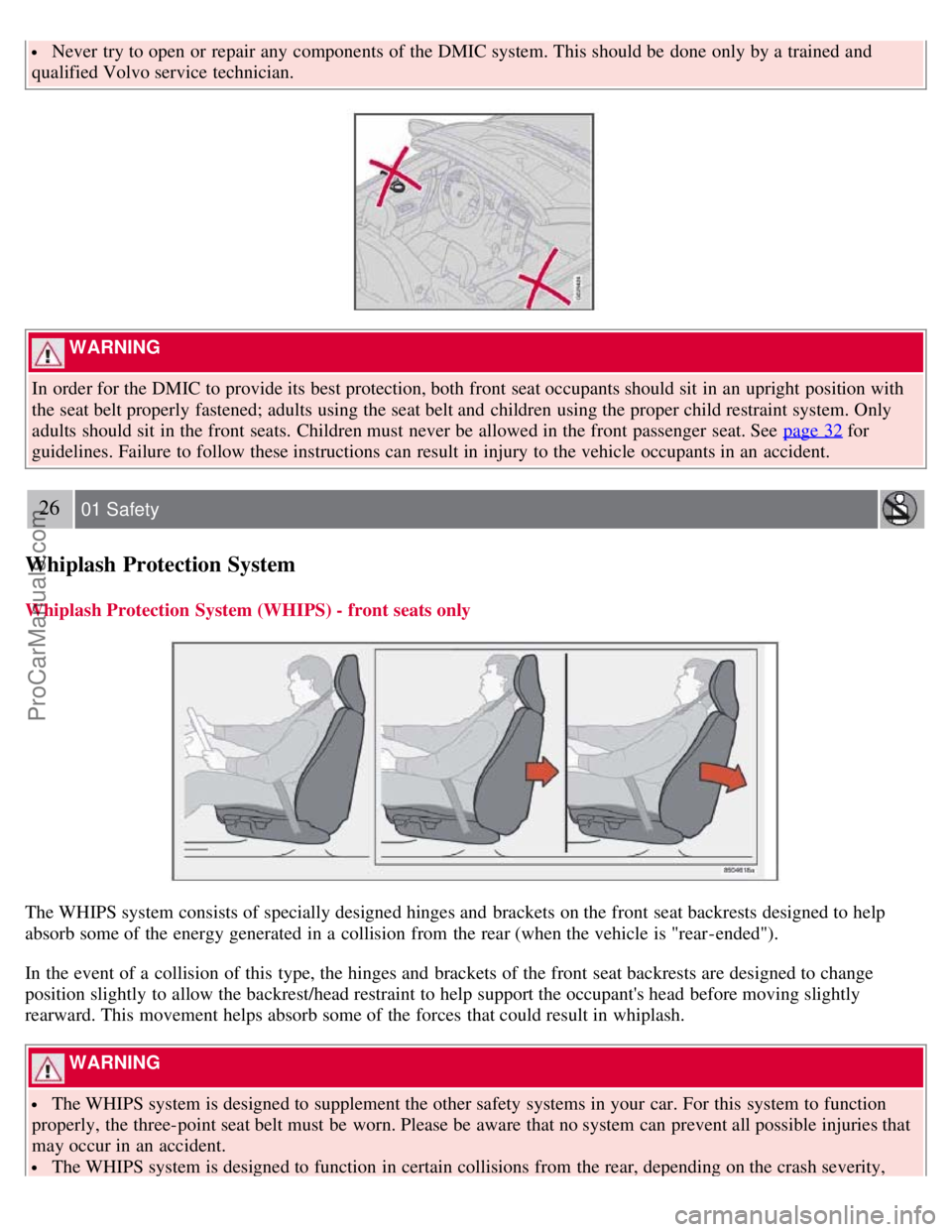
The WHIPS system consists of specially designed hinges and brackets on the front seat backrests designed to help
absorb some of the energy generated in a collision from the rear (when the vehicle is "rear-ended").
In the event of a collision of this type, the hinges and brackets of the front seat backrests are designed to change
position slightly to allow the backrest/head restraint to help support the occupant's head before moving slightly
rearward. This movement helps absorb some of the forces that could result in whiplash.
WARNING
The WHIPS system is designed to supplement the other safety systems in your car. For this system to function
properly, the three-point seat belt must be worn. Please be aware that no system can prevent all possible injuries that
may occur in an accident.
The WHIPS system is designed to function in certain collisions from the rear, depending on the crash severity,
ProCarManuals.com