lock VOLVO C70 2013 Owner´s Manual
[x] Cancel search | Manufacturer: VOLVO, Model Year: 2013, Model line: C70, Model: VOLVO C70 2013Pages: 296, PDF Size: 7.18 MB
Page 143 of 296
06 Starting and driving
General information
06
141
WARNING
After driving through water, press lightly on
the brake pedal to ensure that the brakes
are functioning normally. Water or mud can
make the brake linings slippery, resulting in
delayed braking effect.
CAUTION
•Engine damage will occur if water is
drawn into the air cleaner.
•If the vehicle is driven through water
deeper than 9 in. (25 cm), water may
enter the differential and the transmis-
sion. This reduces the oil's lubricating
capacity and may shorten the service
life of these components.
•Do not allow the vehicle to stand in
water up to the door sills longer than
absolutely necessary. This could result
in electrical malfunctions.
•If the engine has been stopped while the
car is in water, do not attempt to restart
the engine. Have the car towed out of
the water.
Cold weather precautions
If you wish to check your vehicle before the
approach of cold weather, the following advice
is worth noting:
•Make sure that the engine coolant contains
50 percent antifreeze. Any other mixture
will reduce freeze protection. This gives
protection against freezing down to –31 °F
(–35 °C). See section "Coolant". The use of
"recycled" antifreeze is not approved by
Volvo. Different types of antifreeze must
not be mixed.
•Volvo recommends using only genuine
Volvo antifreeze in your vehicle's radiator.
Your Volvo retailer stocks plenty of Volvo
engine coolant to help protect your vehicle
during cold weather.
•Try to keep the fuel tank well filled – this
prevents the formation of condensation in
the tank. In addition, in extremely cold
weather conditions it is worthwhile to add
fuel line de-icer before refueling.
•The viscosity of the engine oil is important.
Oil with low viscosity (thinner oil) improves
cold-weather starting as well as decreas-
ing fuel consumption while the engine is
warming up. 0W-30 oil is recommended for
driving in areas with sustained low temper-
atures.
•The load placed on the battery is greater
during the winter since the windshield wip-ers, lighting, etc. are used more often.
Moreover, the capacity of the battery
decreases as the temperature drops. In
very cold weather, a poorly charged bat-
tery can freeze and be damaged. It is there-
fore advisable to check the state of charge
more frequently and spray an anti-rust oil
on the battery posts.
•Volvo recommends the use of snow tires
on all four wheels for winter driving – see
the chapter "Wheels and tires."
•To prevent the washer fluid reservoir from
freezing, add washer solvents containing
antifreeze (see page 218 for the location of
the washer fluid reservoir). This is impor-
tant since dirt is often splashed on the
windshield during winter driving, requiring
the frequent use of the washers and wip-
ers. Volvo Washer Solvent should be dilu-
ted as follows: Down to 14 °F (–10 °C):
1 part washer solvent and 4 parts water
Down to 5 °F (–15 °C): 1 part washer sol-
vent and 3 parts water Down to 0 °F
(–18 °C): 1 part washer solvent and 2 parts
water Down to –18 °F (–28 °C): 1 part
washer solvent and 1 part water.
•Use Volvo Teflon Lock Spray in the locks.
NOTE
Avoid using de-icing sprays as they can
cause damage to the locks.
Page 146 of 296
06 Starting and driving
Fuel requirements
06
144
Deposit control gasoline (detergent
additives)
Volvo recommends the use of detergent gas-
oline to control engine deposits. Detergent
gasoline is effective in keeping injectors and
intake valves clean. Consistent use of deposit
control gasolines will help ensure good driva-
bility and fuel economy. If you are not sure
whether the gasoline contains deposit control
additives, check with the service station oper-
ator.
NOTE
Volvo does not recommend the use of
store-bought fuel injector cleaning addi-
tives.
Unleaded fuel
Each Volvo has a three-way catalytic converter
and must use only unleaded gasoline. U.S. and
Canadian regulations require that pumps deliv-
ering unleaded gasoline be labelled "UNLEA-
DED". Only these pumps have nozzles which
fit your vehicle's filler inlet. It is unlawful to dis-
pense leaded fuel into a vehicle labelled
"unleaded gasoline only". Leaded gasoline
damages the three-way catalytic converter and
the heated oxygen sensor system. Repeated
use of leaded gasoline will lessen the effective-ness of the emission control system and could
result in loss of emission warranty coverage.
State and local vehicle inspection programs
will make detection of misfueling easier, pos-
sibly resulting in emission test failure for mis-
fueled vehicles.
NOTE
Some U.S. and Canadian gasolines contain
an octane enhancing additive called methyl-
cyclopentadienyl manganese tricarbonyl
(MMT). If such fuels are used, your Emission
Control System performance may be affec-
ted, and the Check Engine Light (malfunc-
tion indicator lamp) located on your instru-
ment panel may light. If this occurs, please
return your vehicle to a trained and qualified
Volvo service technician for maintenance.
Gasoline containing alcohol and ethers
Some fuel suppliers sell gasoline containing
"oxygenates" which are usually alcohols or
ethers. In some areas, state or local laws
require that the service pump be marked indi-
cating use of alcohols or ethers. However,
there are areas in which the pumps are
unmarked. If you are not sure whether there is
alcohol or ethers in the gasoline you buy, check
with the service station operator. To meet sea-
sonal air quality standards, some areas require
the use of "oxygenated" fuel. Volvo allows theuse of the following "oxygenated" fuels; how-
ever, the octane ratings listed on this page
must still be met.
Alcohol – Ethanol: Fuels containing up to 10%
ethanol by volume may be used. Ethanol may
also be referred to as Ethyl alcohol, or "Gaso-
hol".
Ethers – MTBE: Fuels containing up to 15%
MTBE may be used.
MethanolDo not use gasolines containing methanol
(methyl alcohol, wood alcohol). This practice
can result in vehicle performance deterioration
and can damage critical parts in the fuel sys-
tem. Such damage may not be covered under
the New Vehicle Limited Warranty.
Fuel filler door
Press the button on the light switch panel (see
the illustration on page 66) with the ignition
switched off to unlock the fuel filler door.
Please note that the fuel filler door will remain
unlocked until the vehicle begins to move for-
ward. An audible click will be heard when the
fuel filler door relocks.
If you intend to leave your vehicle while it is
being refueled, this feature enables you to lock
the doors/trunk while leaving the fuel filler door
unlocked.
Page 147 of 296
06 Starting and driving
Fuel requirements
06
145
You can also keep the vehicle locked if you
remain inside it during refueling. The central
locking button does not lock the fuel filler door.
Be sure the fuel filler door is not obstructed and
is completely closed after refueling. Open the
fuel filler cap slowly during hot weather.
Refueling
The fuel tank is designed to accommodate
possible expansion of the fuel in hot weather,
see page 275 for fuel tank volume. Be aware
that the "usable" tank capacity will be some-
what less than the specified maximum. When
the fuel level is low, such factors as ambient
temperature, the fuel's "Reid vapor pressure"
characteristics, and terrain can affect the fuel
pump's ability to supply the engine with an
adequate supply of fuel. Therefore, it is advis-
able to refuel as soon as possible when the
needle nears the red zone, or when the fuel
warning light comes on.
CAUTION
•Do not refuel with the engine running2.
Turn the ignition off or to position I. If the
ignition is on, an incorrect reading could
occur in the fuel gauge
•After refueling, close the fuel filler cap
by turning it clockwise until it clicks into
place.
•Avoid overfilling the fuel tank. Do not
press the handle on the filler nozzle
more than one extra time. Too much fuel
in the tank in hot weather conditions can
cause the fuel to overflow. Overfilling
could also cause damage to the emis-
sion control systems.
•Avoid spilling gasoline during refueling.
In addition to causing damage to the
environment, gasolines containing
alcohol can cause damage to painted
surfaces, which may not be covered
under the New Vehicle Limited War-
ranty.
•Do not use gasolines containing meth-
anol (methyl alcohol, wood alcohol).
This practice can result in vehicle per-
formance deterioration and can dam-
age critical parts in the fuel system.
Such damage may not be covered
under the New Vehicle Limited War-
ranty.
2If the fuel filler cap is not closed tightly or if the engine is running when the vehicle is refueled, the Check Engine Light (malfunction indicator lamp) may indicate a fault. However, your vehicle’s
performance will not be affected. Use only Volvo original or approved fuel filler caps.
Page 148 of 296
06 Starting and driving
Ignition switch
06
146
Ignition switch positions
0 – Locked positionRemove the key to lock the
steering wheel1. Never turn
the key to position 0 while
driving or when the vehicle is
being towed.
NOTE
A ticking sound may be audible if the key is
turned to a position between 0 and I. To
stop this sound, turn the key to position II
and back to position 0.
I – Intermediate position2
Certain accessories, radio,
etc. on, daytime running lights
off.
II – Drive positionThe key's position when driv-
ing. The vehicle's entire elec-
trical system is activated.
III – Start positionTurn the key to this position
and release it immediately.
The key returns automatically
to the Drive position.
A chime will sound if the key
is left in the ignition and the
driver's door is opened (does not apply to vehi-
cles with the optional keyless drive).
1Automatic transmission: the gear selector must be in the Park position. The optional keyless drive start control does not need to be removed.2Please be aware that leaving the key in positions I or II will increase battery drain.
Page 149 of 296
06 Starting and driving
Starting the vehicle
06
147 To start the engine
WARNING
Before starting, check that the seat, steering
wheel and mirrors are adjusted properly.
Make sure the brake pedal can be
depressed completely. Adjust the seat if
necessary.
1. Fasten the seat belt.
2. Apply the parking brake if not already set.
The gear selector should be locked in the
Park (P) position (Shiftlock). See also page
153.
NOTE
After a cold start, idle speed may be notice-
ably higher than normal for a short period.
This is done to help bring components in the
emission control system to their normal
operating temperature as quickly as possi-
ble, which enables them to control emis-
sions and help reduce the vehicle's impact
on the environment.
3. The vehicle is equipped with an autostart
feature. Without touching the throttle
pedal, turn the key to position III andrelease it. The starter motor will then oper-
ate automatically (for up to ten seconds)
until the engine starts. If the engine fails to
start, repeat this step.
CAUTION
If the engine does not start after the third try,
wait for approximately 3 minutes before try-
ing to start it again to give the battery time
to recover its starting capacity.
4. To release the gear selector from the Park
(P) position, the engine must be running (or
the ignition key must be in position II) and
the brake pedal must be depressed.
5. Select the desired gear. The gear engages
after a very slight delay, which is especially
noticeable when selecting R.
WARNING
•Never use more than one floor mat at a
time on the driver's floor. An extra mat
on the driver's floor can cause the
accelerator and/or brake pedal to
catch. Check that the movement of
these pedals is not impeded.
•Volvo's floor mats are specially manu-
factured for your car. They must be
firmly secured in the clips on the floor so
that they cannot slide and become trap-
ped under the pedals on the driver's
side.
Page 150 of 296
06 Starting and driving
Starting the vehicle
06
148
NOTE
•Immobilizer: If two of the keys to your
vehicle are close together, e.g., on the
same key ring when you try to start the
vehicle, this could cause interference in
the immobilizer system and result in the
vehicle not starting. If this should occur,
remove one of the keys from the key
ring before trying to start the vehicle
again.
•Keylock: The automatic transmission
has a keylock system. When the engine
is switched off, the gear selector must
be in the Park (P) position before the key
can be removed from the ignition
switch
1.
•When starting in cold weather, an auto-
matic transmission may shift up at
slightly higher engine speeds than nor-
mal until the automatic transmission
fluid reaches normal operating tem-
perature.
•Do not race a cold engine immediately
after starting. Oil flow may not reach
some lubrication points fast enough to
prevent engine damage.
WARNING
•Always place the gear selector in Park
(P) and apply the parking brake before
leaving the vehicle. Never leave the
vehicle unattended with the engine run-
ning.
•Always open garage doors fully before
starting the engine inside a garage to
ensure adequate ventilation. The
exhaust gases contain carbon monox-
ide, which is invisible and odorless but
very poisonous.
CAUTION
Automatic transmission: The engine
should be idling when you move the gear
selector. Never accelerate until after you
feel the transmission engage! Accelerating
immediately after selecting a gear will cause
harsh engagement and premature trans-
mission wear. Selecting P or N when idling
at a standstill for prolonged periods of time
will help prevent overheating of the auto-
matic transmission fluid.
1The optional keyless drive start control does not need to be removed from the ignition switch.
Page 151 of 296
06 Starting and driving
Starting the vehicle with keyless drive*
06
* Option/accessory, for more information, see Introduction.149 Starting a vehicle with keyless drive
G019410
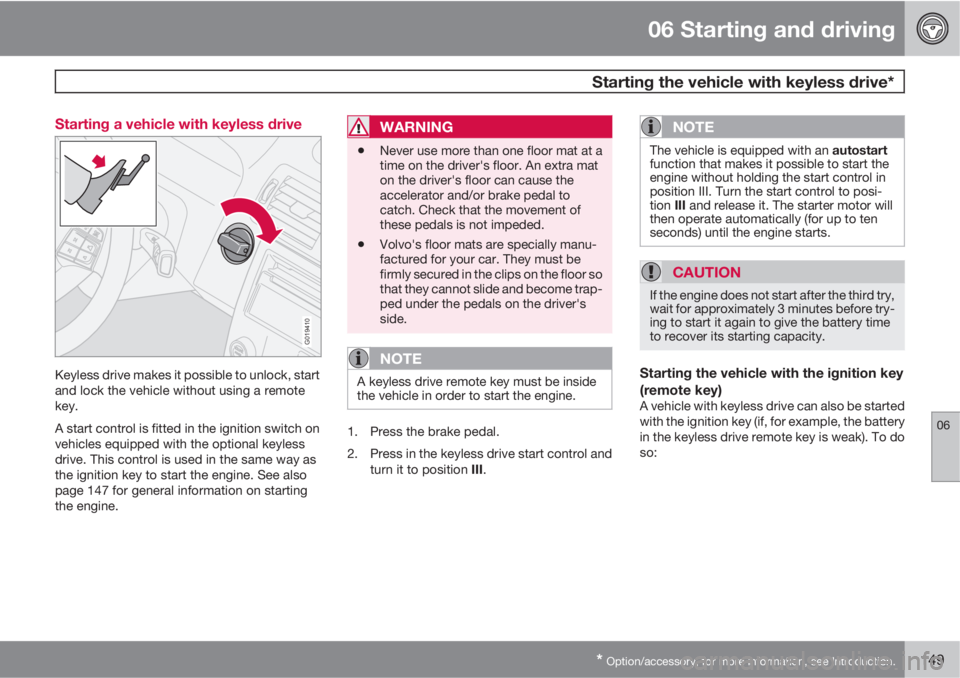
Keyless drive makes it possible to unlock, start
and lock the vehicle without using a remote
key.
A start control is fitted in the ignition switch on
vehicles equipped with the optional keyless
drive. This control is used in the same way as
the ignition key to start the engine. See also
page 147 for general information on starting
the engine.
WARNING
•Never use more than one floor mat at a
time on the driver's floor. An extra mat
on the driver's floor can cause the
accelerator and/or brake pedal to
catch. Check that the movement of
these pedals is not impeded.
•Volvo's floor mats are specially manu-
factured for your car. They must be
firmly secured in the clips on the floor so
that they cannot slide and become trap-
ped under the pedals on the driver's
side.
NOTE
A keyless drive remote key must be inside
the vehicle in order to start the engine.
1. Press the brake pedal.
2. Press in the keyless drive start control and
turn it to position III.
NOTE
The vehicle is equipped with an autostart
function that makes it possible to start the
engine without holding the start control in
position III. Turn the start control to posi-
tion III and release it. The starter motor will
then operate automatically (for up to ten
seconds) until the engine starts.
CAUTION
If the engine does not start after the third try,
wait for approximately 3 minutes before try-
ing to start it again to give the battery time
to recover its starting capacity.
Starting the vehicle with the ignition key
(remote key)
A vehicle with keyless drive can also be started
with the ignition key (if, for example, the battery
in the keyless drive remote key is weak). To do
so:
Page 153 of 296
06 Starting and driving
Automatic transmission
06
151 Shiftgate positions
G020237
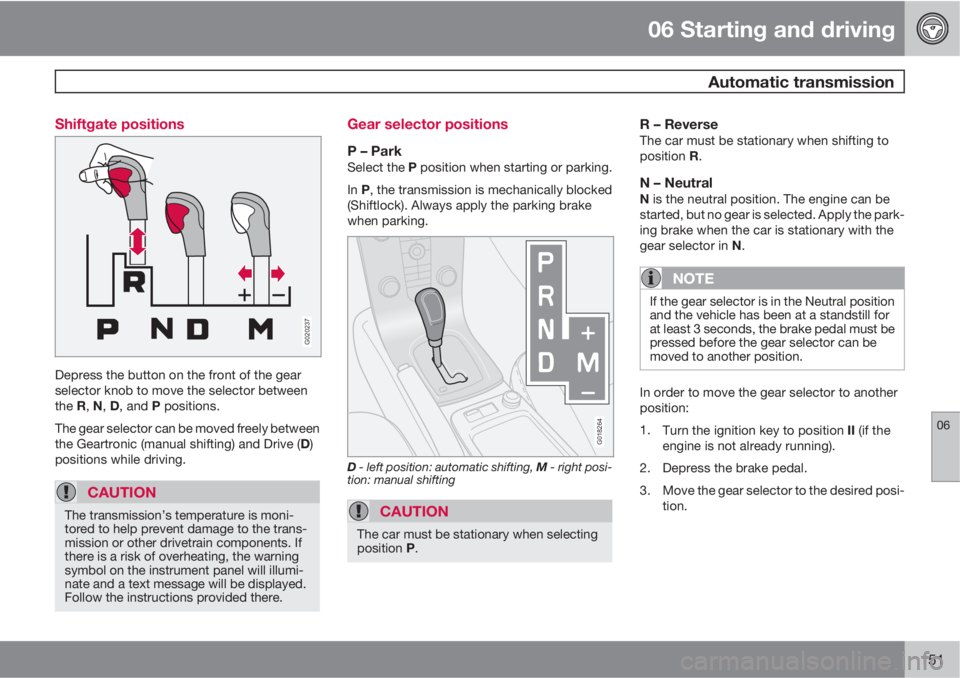
Depress the button on the front of the gear
selector knob to move the selector between
the R, N, D, and P positions.
The gear selector can be moved freely between
the Geartronic (manual shifting) and Drive (D)
positions while driving.
CAUTION
The transmission’s temperature is moni-
tored to help prevent damage to the trans-
mission or other drivetrain components. If
there is a risk of overheating, the warning
symbol on the instrument panel will illumi-
nate and a text message will be displayed.
Follow the instructions provided there.
Gear selector positions
P – ParkSelect the P position when starting or parking.
In P, the transmission is mechanically blocked
(Shiftlock). Always apply the parking brake
when parking.
G018264
D - left position: automatic shifting, M - right posi-
tion: manual shifting
CAUTION
The car must be stationary when selecting
position P.
R – ReverseThe car must be stationary when shifting to
position R.
N – NeutralN is the neutral position. The engine can be
started, but no gear is selected. Apply the park-
ing brake when the car is stationary with the
gear selector in N.
NOTE
If the gear selector is in the Neutral position
and the vehicle has been at a standstill for
at least 3 seconds, the brake pedal must be
pressed before the gear selector can be
moved to another position.
In order to move the gear selector to another
position:
1.
Turn the ignition key to position II (if the
engine is not already running).
2. Depress the brake pedal.
3. Move the gear selector to the desired posi-
tion.
Page 155 of 296
06 Starting and driving
Shiftlock override
06
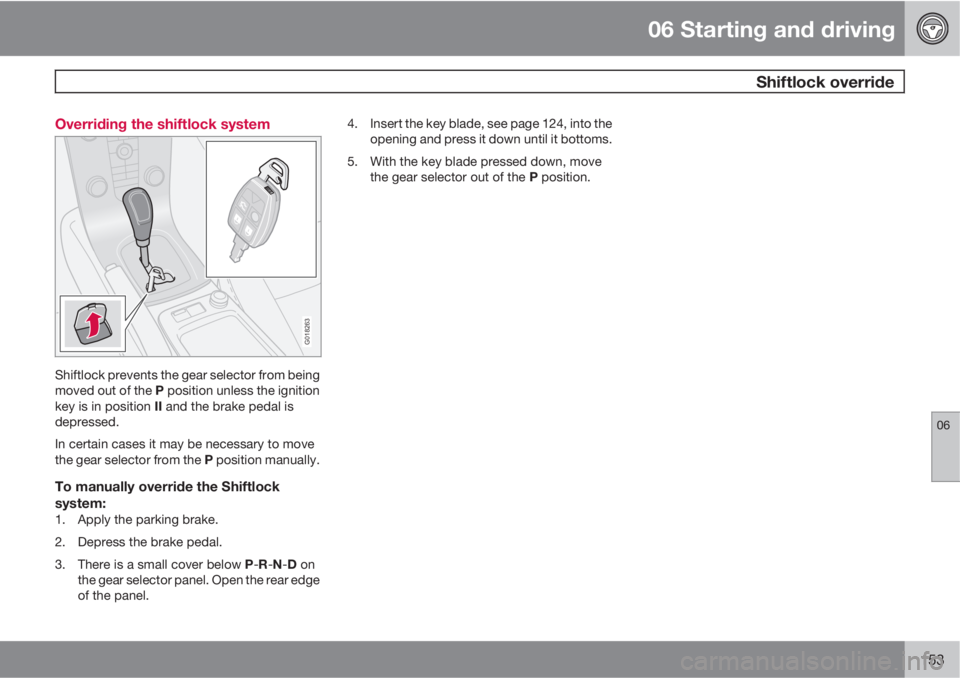
153 Overriding the shiftlock system
G018263
Shiftlock prevents the gear selector from being
moved out of the P position unless the ignition
key is in position II and the brake pedal is
depressed.
In certain cases it may be necessary to move
the gear selector from the P position manually.
To manually override the Shiftlock
system:
1. Apply the parking brake.
2. Depress the brake pedal.
3.
There is a small cover below P-R-N-D on
the gear selector panel. Open the rear edge
of the panel.4. Insert the key blade, see page 124, into the
opening and press it down until it bottoms.
5. With the key blade pressed down, move
the gear selector out of the P position.
Page 156 of 296
06 Starting and driving
Brake system
06
154* Option/accessory, for more information, see Introduction.
Brake lights
The brake lights come on automatically when
the brakes are applied.
Adaptive brake lightsThe adaptive brake lights activate in the event
of sudden braking or if the ABS system is acti-
vated. This function causes an additional tail-
light on each side of the vehicle to illuminate to
help alert vehicles traveling behind.
The adaptive brake lights activate if:
•The ABS system activates for more than
approximately a half second
•In the event of sudden braking while the
vehicle is moving at speeds above approx-
imately 6 mph (10 km/h)
When the vehicle has come to a stop, the brake
lights and additional taillights remain on for as
long as the brake pedal is depressed or until
braking force on the vehicle is reduced.
Brake pad inspection
On vehicles equipped with a jack*, the condi-
tion of the brake pads can be checked by rais-
ing the vehicle (see page 199 for information
about using the jack and removing a wheel)
and performing a visual inspection of the brake
pads.
WARNING
•If the vehicle has been driven immedi-
ately prior to a brake pad inspection, the
wheel hub, brake components, etc., will
be very hot. Allow time for these com-
ponents to cool before carrying out the
inspection.
•Apply the parking brake and put the
gear selector in the Park (P) position.
•Block the wheels standing on the
ground, use rigid wooden blocks or
large stones.
WARNING
•Use the jack intended for the vehicle
when changing a tire. For any other job,
use stands to support the vehicle.
•The jack should be kept well-greased
and clean, and should not be damaged.
•Be sure the jack is on a firm, level, non-
slippery surface.
•No objects should be placed between
the base of jack and the ground, or
between the jack and the attachment
bar on the vehicle.
•The jack must correctly engage the jack
attachment.
•Never allow any part of your body to be
extended under a vehicle supported by
a jack.
Brake circuit malfunction
The brake system is a hydraulic system con-
sisting of two separate brake circuits. If a prob-
lem should occur in one of these circuits, it is
still possible to stop the vehicle with the other
brake circuit.
If the brake pedal must be depressed farther
than normal and requires greater foot pressure,
the stopping distance will be longer.