battery VOLVO C70 CONVERTIBLE 2007 Owner´s Manual
[x] Cancel search | Manufacturer: VOLVO, Model Year: 2007, Model line: C70 CONVERTIBLE, Model: VOLVO C70 CONVERTIBLE 2007Pages: 276, PDF Size: 9.81 MB
Page 146 of 276
. This is importan")
2007 Volvo C70
l To prevent the washer fluid reservoir from freezing, add washer solvents\
containing antifreeze (see
page 193 for the location of the washer fluid reservoir). This is important sin\
ce dirt is often splashed on
the windshield during winter driving, requiring the frequent use of the \
washers and wipers. Volvo Washer
Solvent should be diluted as follows: Down to 14° F (-10° C): 1 \
part washer solvent and 4 parts water
Down to 5° F (-15° C): 1 part washer solvent and 3 parts water D\
own to 0° F (- 18° C): 1 part washer
solvent and 2 parts water Down to -18° F (-28° C): 1 part washer\
solvent and 1 part water.
l Use Volvo Teflon Lock Spray in the locks.
NOTE
Avoid using de-icing sprays as they can cause damage to the
locks.
Conserving electrical current
Keep the following in mind to help minimize battery drain:
l When the engine is not running, avoid turning the ignition key to positi\
on II. Many electrical systems
(the audio system, the optional navigation system, power windows, etc)\
will function with the ignition
key in position I. This position reduces drain on the battery.
l Please keep in mind that using systems, accessories, etc that consume a \
great deal of current when the
engine is not running could result in the battery being completely drain\
ed.
l The optional 12 volt socket in the cargo area provides electrical curren\
t even with the ignition switched
off, which drains the battery.
NOTE
l If the ignition is switched on, a warning message will be displayed in t\
he text window in the
instrument panel when the battery charge is low.
l An energy conserving function designed into the vehicle's electrical sys\
tem will switch off certain
functions or reduce the load on the battery by, e.g., reducing the audio\
system's volume.
Before a long distance trip
It is always worthwhile to have your vehicle checked at a Volvo retailer\
before driving long distances.
Your retailer will also be able to supply you with bulbs, fuses, spark p\
lugs and wiper blades for your use
in the event that problems occur.
As a minimum, the following items should be checked before any long trip\
:
l Check that engine runs smoothly and that fuel consumption is normal.
l Check for fuel, oil, and fluid leakage
l Have the transmission oil level checked1.
file:///K|/delme/2007_C70/07c70_06.htm (5 of 18)12/22/2006 9:15:48 PM
Page 147 of 276
, and replace those th\
at are worn. Check tir")
2007 Volvo C70
l Check condition of drive belts.
l Check state of the battery's charge.
l Examine tires carefully (the spare tire as well), and replace those th\
at are worn. Check tire pressures.
l The brakes, front wheel alignment, and steering gear should be checked b\
y your Volvo retailer only.
l Check all lights, including high beams.
l Reflective warning triangles are legally required in some states/provinc\
es.
l Have a word with your Volvo retailer if you intend to drive in countries\
where it may be difficult to
obtain the correct fuel.
l Consider your destination. If you will be driving through an area where \
snow or ice are likely to occur,
consider snow tires.
1 To prevent injury from contact with hot surfaces, do not inspect your v\
ehicle's transmission fluid yourself. Have
your vehicle's transmission fluid level inspected by a qualified Volvo s\
ervice technician.
125 06 Starting and driving
Fuel requirements
Octane rating
Volvo engines are designed to achieve rated horsepower, torque, and fuel\
economy performance using
premium 91 octane fuel.
Volvo recommends premium for best performance, but using 87 octane or ab\
ove will not affect engine
reliability.
file:///K|/delme/2007_C70/07c70_06.htm (6 of 18)12/22/2006 9:15:48 PM
Page 152 of 276

2007 Volvo C70
or when the vehicle is being towed.
NOTE
A ticking sound may be audible if the key is turned to a position betwee\
n 0 and I. To stop this sound,
turn the key to position II and back to position 0.
I - Intermediate position
1
Certain accessories, radio, etc. on, daytime running lights off.
1Please be aware that leaving the key in this positions I or II will incr\
ease battery drain.
II - Drive position
The key's position when driving. The vehicle's entire electrical system\
is activated.
III - Start position
Turn the key to this position and release it immediately. The key retur\
ns automatically to
the Drive position.
A chime will sound if the key is left in the ignition and the driver's d\
oor is opened.
Steering wheel lock
When the key is removed from the ignition, the steering wheel locks so t\
hat it cannot be turned.
Releasing the steering wheel lock
If the front wheels are hard up against a curb, the steering wheel lock \
may be under too much tension to
file:///K|/delme/2007_C70/07c70_06.htm (11 of 18)12/22/2006 9:15:48 PM\
Page 183 of 276

2007 Volvo C70
Temporarily repairing a flat tire
Before using the tire sealing system, observe the following:
WARNING
l Never leave the tire sealing system unattended when it is operating.
l Keep the tire sealing system kit away from children.
l The vehicle's engine should be running when the tire sealing system is u\
sed to avoid battery drain.
Therefore, be sure the vehicle is parked in a well ventilated place befo\
re using the system.
l Be sure the vehicle is parked safely off the road and away from moving t\
raffic.
l Apply the parking brake.
l Do not remove any foreign objects (nails, etc.) from the tire.
172 07 Wheels and tires
Tire sealing system
Temporarily repairing a flat tire is done in two stages
l In the first stage, the hole is sealed by pumping sealing compound into \
the tire. The car is then driven a
short distance to distribute the sealing compound in the tire.
l In the second stage, the tire's inflation pressure is checked and adjust\
ed if necessary.
Stage 1 - Sealing the hole
Peel off the speed limit sticker (1) and affix it to the steering whee\
l hub where it will be clearly visible to
the driver.
file:///K|/delme/2007_C70/07c70_07.htm (24 of 30)12/22/2006 9:15:51 PM\
Page 197 of 276

2007 Volvo C70
2 0 0 7
VOLVO C70
184 09 Maintenance and servicing
Volvo maintenance
186
Maintaining your vehicle
187
Hood
189
Engine compartment
190
Engine oil
191
Fluids
193
Wiper blades
195
Battery
196
Bulbs
198
Replacing bulbs
199
Fuses
208
185 09 Maintenance and servicing
186 09 Maintenance and servicing
Volvo maintenance
file:///K|/delme/2007_C70/07c70_09.htm (1 of 36)12/22/2006 9:15:54 PM
Page 199 of 276

2007 Volvo C70
Periodic maintenance will help keep your vehicle running well. Your Warr\
anty and Service Records
Information booklet provides a comprehensive periodic maintenance schedu\
le up to 150,000 miles
(240,000 km) of vehicle maintenance. The schedule includes components \
that affect vehicle emissions.
This page describes some of the emission-related components.
Vehicle Event Data (Black Box)
Your vehicle's driving and safety systems employ computers that monitor,\
and share with each other,
information about your vehicle's operation. One or more of these compute\
rs may store what they monitor,
either during normal vehicle operation or in a crash or near-crash event\
. Stored information may be read
and used by:
l Volvo Car Corporation
l service and repair facilities
l law enforcement or government agencies
l others who may assert a legal right to know, or who obtain your consent \
to know such information.
187 09 Maintenance and servicing
Maintaining your vehicle
Owner maintenance
Periodic maintenance requirements and intervals are described in your ve\
hicle's Warranty and Service
Records Information booklet.
The following points can be carried out between the normally scheduled m\
aintenance services.
Each time the car is refueled:
l Check the engine oil level
l Clean the windshield, windshield wipers, headlights, and taillights
Monthly:
l Check cold tire pressure in all tires. Inspect the tires for wear.
l Check that engine coolant and other fluid levels are between the indicat\
ed "min" and "max" markings.
l Clean interior glass surfaces with a glass cleaner and soft paper towels\
.
l Wipe driver information displays with a soft cloth.
l Visually inspect battery terminals for corrosion. Corrosion may indicate\
a loose terminal connector, or
a battery near the end of its useful service life. Consult your Volvo re\
tailer for additional information.
As needed:
l Wash the car, including the undercarriage, to reduce wear that can be ca\
used by a buildup of dirt, and
file:///K|/delme/2007_C70/07c70_09.htm (3 of 36)12/22/2006 9:15:54 PM
Page 200 of 276

2007 Volvo C70
corrosion that can be caused by salt residues.
l Clean leaves and twigs from air intake vents at the base of the windshie\
ld, and from other places where
they may collect.
NOTE
Complete service information for qualified technicians is available onli\
ne for purchase or subscription at
www.volvotechinfo.com.
188 09 Maintenance and servicing
Maintaining your vehicle
Emission inspection readiness
What is an Onboard Diagnostic System (OBD II)?
OBD II is part of your vehicle's computerized engine management system. \
It stores diagnostic
information about your vehicle's emission controls. It can light the Che\
ck Engine light (MIL) if it detects
an emission control "fault." A "fault" is a component or system that is \
not performing within an expected
range. A fault may be permanent or temporary. OBD II will store a messag\
e about any fault.
How Do States Use OBD II for Emission Inspections?
Many states connect a computer directly to a vehicle's OBD II system. Th\
e inspector can then read
"faults." In some states, this type of inspection has replaced the tailp\
ipe emission test.
How Can My Vehicle Fail OBD II Emission Inspection?
Your vehicle can fail OBD II emission inspection for any of the followin\
g reasons.
l If your Check Engine (MIL) light is lit, your vehicle may fail inspect\
ion.
l If your vehicle's Check Engine light was lit, but went out without any a\
ction on your part, OBD II will
still have a recorded fault. Your vehicle may pass or fail, depending on\
the inspection practices in your
area.
l If you had recent service that required disconnecting the battery, OBD I\
I diagnostic information may be
incomplete and "not ready" for inspection. A vehicle that is not ready m\
ay fail inspection.
How Can I Prepare for My Next OBD II Emission Inspection?
l If your Check Engine (MIL) light is lit - or was lit but went out with\
out service, have your vehicle
diagnosed and, if necessary, serviced by a qualified Volvo technician.
l If you recently had service for a lit Check Engine light, or if you had \
service that required
disconnecting the battery, a period of driving is necessary to bring the\
OBD II system to "ready" for
inspection. A half-hour trip of mixed stop-and-go/highway driving is typ\
ically needed to allow OBD II to
reach readiness. Your Volvo retailer can provide you with more informati\
on on planning a trip.
file:///K|/delme/2007_C70/07c70_09.htm (4 of 36)12/22/2006 9:15:54 PM
Page 202 of 276
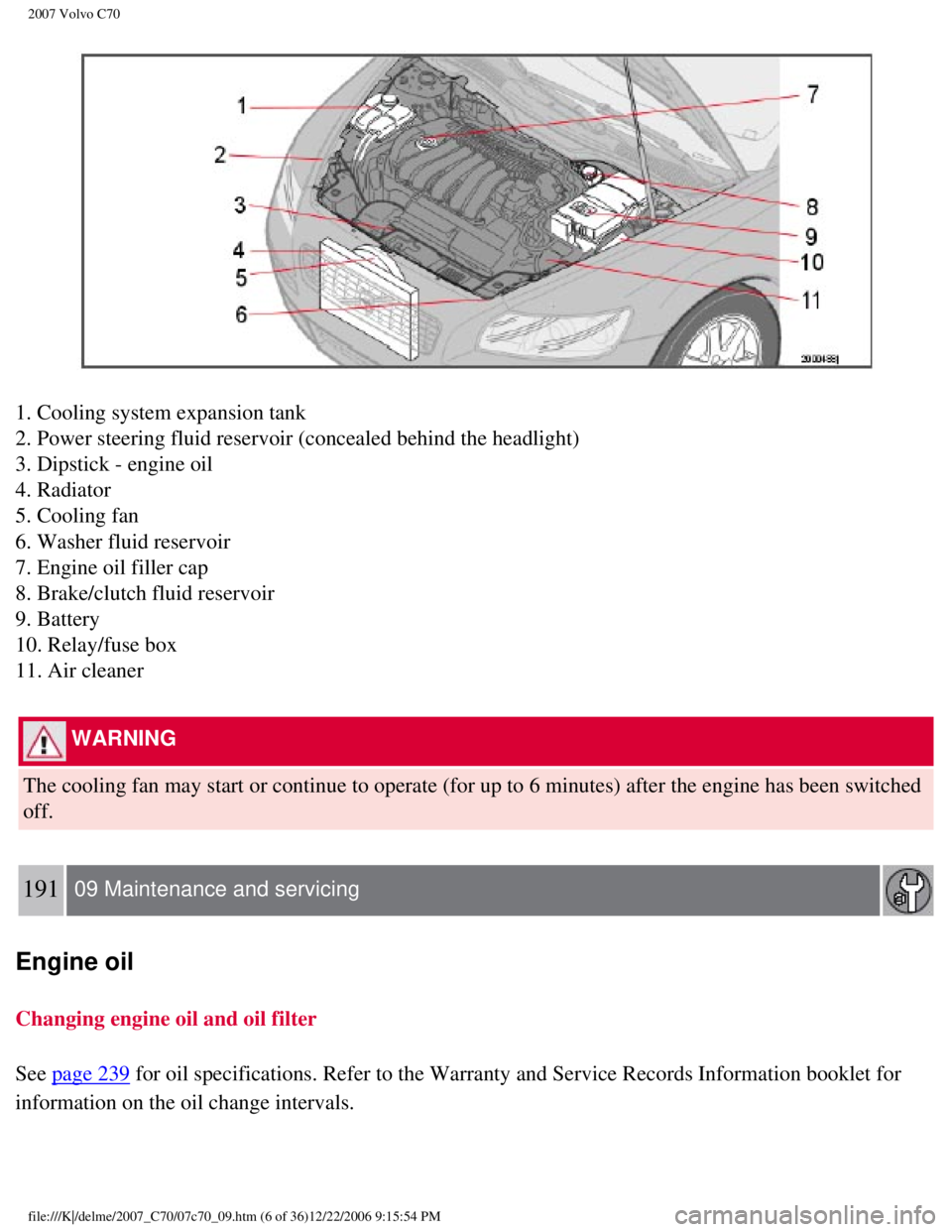
2007 Volvo C70
1. Cooling system expansion tank
2. Power steering fluid reservoir (concealed behind the headlight)
3. Dipstick - engine oil
4. Radiator
5. Cooling fan
6. Washer fluid reservoir
7. Engine oil filler cap
8. Brake/clutch fluid reservoir
9. Battery
10. Relay/fuse box
11. Air cleaner
WARNING
The cooling fan may start or continue to operate (for up to 6 minutes)\
after the engine has been switched
off.
191 09 Maintenance and servicing
Engine oil
Changing engine oil and oil filter
See
page 239 for oil specifications. Refer to the Warranty and Service Records Infor\
mation booklet for
information on the oil change intervals.
file:///K|/delme/2007_C70/07c70_09.htm (6 of 36)12/22/2006 9:15:54 PM
Page 209 of 276
12/22/2006 9:15:54 PM\")
2007 Volvo C70
196 09 Maintenance and servicing
Battery
Battery maintenance
file:///K|/delme/2007_C70/07c70_09.htm (13 of 36)12/22/2006 9:15:54 PM\
Page 210 of 276

2007 Volvo C70
Driving habits and conditions, climate, the number of starts, etc., all \
affect the service life and function of
the battery. In order for your battery to perform satisfactorily, keep t\
he following in mind:
l Check the fluid level in each cell in the battery every 24 months or eve\
ry 15,0001 miles (24,000 km),
whichever is sooner. The fluid should be at the level shown in the illus\
trations above (A). Do not overfill.
l Use a screw driver to open the caps or cover and a flashlight to inspect\
the level.
l If necessary, add distilled water. The level should never be above the i\
ndicator (A).
l The fluid level should be checked if the battery has been recharged.
l After inspection, be sure the cap over each battery cell or the cover is\
securely in place.
l Check that the battery cables are correctly connected and properly tight\
ened.
l Never disconnect the battery when the engine is running, or when the key\
is in the ignition. This could
damage the vehicle's electrical system.
l The battery should be disconnected from the vehicle when a battery charg\
er is used directly on the
battery.
file:///K|/delme/2007_C70/07c70_09.htm (14 of 36)12/22/2006 9:15:54 PM\