tires VOLVO C70 CONVERTIBLE 2007 Owner´s Manual
[x] Cancel search | Manufacturer: VOLVO, Model Year: 2007, Model line: C70 CONVERTIBLE, Model: VOLVO C70 CONVERTIBLE 2007Pages: 276, PDF Size: 9.81 MB
Page 3 of 276
2007 Volvo C70
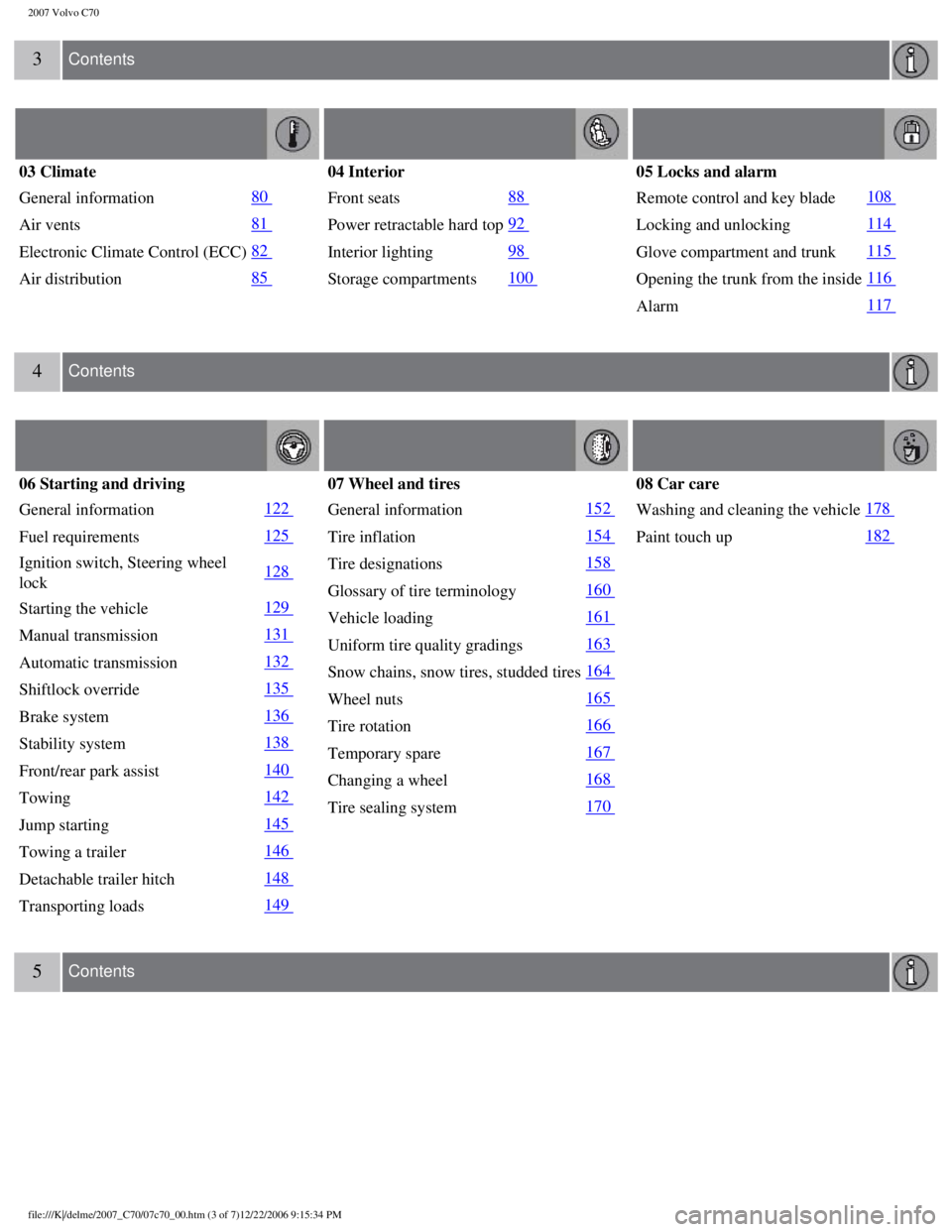
3 Contents
03 Climate
General information
80
Air vents
81
Electronic Climate Control (ECC)
82
Air distribution
85
04 Interior
Front seats
88
Power retractable hard top
92
Interior lighting
98
Storage compartments
100
05 Locks and alarm
Remote control and key blade
108
Locking and unlocking
114
Glove compartment and trunk
115
Opening the trunk from the inside
116
Alarm
117
4 Contents
06 Starting and driving
General information
122
Fuel requirements
125
Ignition switch, Steering wheel
lock
128
Starting the vehicle
129
Manual transmission
131
Automatic transmission
132
Shiftlock override
135
Brake system
136
Stability system
138
Front/rear park assist
140
Towing
142
Jump starting
145
Towing a trailer
146
Detachable trailer hitch
148
Transporting loads
149
07 Wheel and tires
General information
152
Tire inflation
154
Tire designations
158
Glossary of tire terminology
160
Vehicle loading
161
Uniform tire quality gradings
163
Snow chains, snow tires, studded tires
164
Wheel nuts
165
Tire rotation
166
Temporary spare
167
Changing a wheel
168
Tire sealing system
170
08 Car care
Washing and cleaning the vehicle
178
Paint touch up
182
5 Contents
file:///K|/delme/2007_C70/07c70_00.htm (3 of 7)12/22/2006 9:15:34 PM
Page 5 of 276

2007 Volvo C70
time of publication. Please note that some vehicles may be equipped diff\
erently, depending on special legal requirements. Optional
equipment described in this manual may not be available in all markets. \
l Volvo reserves the right to make model changes at any time, or to change\
specifications or design without notice and without incurring
obligation.
WARNING
If your vehicle is involved in an accident, unseen damage may affect its\
drivability and
safety.
WARNING
CALIFORNIA proposition 65
Engine exhaust, some of its constituents, and certain vehicle components\
contain or emit chemicals known to the state of California to
cause cancer, and birth defects or other reproductive harm. In addition,\
certain fluids contained in vehicles and certain products of
component wear contain or emit chemicals known to the State of Californi\
a to cause cancer, and birth defects or other reproductive
harm.
7 Introduction
Volvo and the environment
Volvo is committed to the well being of its customers. As a natural part\
of this commitment, we care about the environment in which we
all live. Caring for the environment means an everyday involvement in re\
ducing our environmental impact. Volvo's environmental
activities are based on a holistic view, which means we consider the ove\
rall environmental impact of a product throughout its complete
life cycle. In this context, design, production, product use, and recycl\
ing are all important considerations. In production, Volvo has partly
or completely phased out several chemicals including CFCs, lead chromate\
s, asbestos, and cadmium; and reduced the number of
chemicals used in our plants 50% since 1991.
Volvo was the first in the world to introduce into production a three-wa\
y catalytic converter with a Lambda sond, now called the heated
oxygen sensor, in 1976. The current version of this highly efficient sys\
tem reduces emissions of harmful substances (CO, HC, NOx) from
the exhaust pipe by approximately 95-99% and the search to eliminate the\
remaining emissions continues. Volvo is the only automobile
manufacturer to offer CFC-free retrofit kits for the air conditioning sy\
stem of all models as far back as the 1975 model 240. Advanced
electronic engine controls and cleaner fuels are bringing us closer to o\
ur goal. After Volvo vehicles and parts have fulfilled their use,
recycling is the next critical step in completing the life cycle. The me\
tal content is about 75% of the total weight of a vehicle, which makes
the vehicle among the most recycled industrial products. In order to hav\
e efficient and well controlled recycling, all Volvo variants have
printed dismantling manuals, indicating the weight and material of indiv\
idual components. For Volvo, all homogeneous plastic parts
weighing more than 3.4 oz. (100 grams) are marked with international s\
ymbols that indicate how the component is to be sorted for
recycling. In addition to continuous environmental refinement of convent\
ional gasoline-powered internal combustion engines, Volvo is
actively looking at advanced technology alternative-fuel vehicles.
When you drive a Volvo, you become our partner in the work to lessen the\
car's impact on the environment. To reduce your vehicle's
environmental impact, you can:
l Maintain proper air pressure in your tires. Tests have shown decreased f\
uel economy with improperly inflated tires.
l Follow the recommended maintenance schedule in your Warranty and Service\
Records Information booklet.
l Drive at a constant speed whenever possible.
l See a trained and qualified Volvo service technician as soon as possible\
for inspection if the check engine (malfunction indicator) light
illuminates, or stays on after the vehicle has started.
l Properly dispose of any vehicle-related waste such as used motor oil, us\
ed batteries, brake pads, etc.
l When cleaning your vehicle, please use genuine Volvo car care products. \
All Volvo car care products are formulated to be
environmentally friendly.
For additional information regarding the environmental activities in whi\
ch Volvo Cars of North America, LLC and Volvo Car Corporation
file:///K|/delme/2007_C70/07c70_00.htm (5 of 7)12/22/2006 9:15:34 PM
Page 69 of 276

This function provides the driver with an instantaneous conversion of th\
e cars current speed from km/h to m.p.h.
NOTE
Trip co")
2007 Volvo C70
Trip computer
ACTUAL SPEED (Canadian models only)
This function provides the driver with an instantaneous conversion of th\
e car's current speed from km/h to m.p.h.
NOTE
Trip computer readings may vary slightly depending on the circumference \
of the tires on the car, tire inflation, or
driving style.
60 02 Instruments and controls
Right-side steering wheel lever
Windshield wipers
A. Windshield/headlight washers
B. Rain sensor (option) - on/off
C. Thumb wheel
D. Not in use
Windshield wipers off
The windshield wipers are off when the lever is in position 0.
file:///K|/delme/2007_C70/07c70_02.htm (21 of 43)12/22/2006 9:15:42 PM\
Page 143 of 276

2007 Volvo C70
122 06 Starting and driving
General information
Economical driving conserves natural resources
Better driving economy may be obtained by thinking ahead, avoiding rapid\
starts and stops and adjusting
the speed of your vehicle to immediate traffic conditions.
Observe the following rules:
l Bring the engine to normal operating temperature as soon as possible by \
driving with a light foot on the
accelerator pedal for the first few minutes of operation. A cold engine \
uses more fuel and is subject to
increased wear.
l Whenever possible, avoid using the vehicle for driving short distances. \
This does not allow the engine
to reach normal operating temperature.
l Drive carefully and avoid rapid acceleration and hard braking.
l Use the transmission's Drive (D) position as often as possible and avo\
id using kickdown.
l Do not exceed posted speed limits.
l Avoid carrying unnecessary items (extra load) in the vehicle.
l Maintain correct tire pressure. Check tire pressure regularly (when tir\
es are cold).
l Remove snow tires when threat of snow or ice has ended.
l At highway driving speeds, fuel consumption will be lower with the air c\
onditioning on and the
windows closed than with the air conditioning off and the windows open. \
l Using the onboard trip computer's fuel consumption modes can help you le\
arn how to drive more
economically.
Other factors that decrease gas mileage are:
l Dirty air cleaner
l Dirty engine oil and clogged oil filter
l Dragging brakes
l Incorrect front end alignment
Some of the above mentioned items and others are checked at the standard\
maintenance intervals.
Avoid overheating the engine
Do not drive at engine speeds above 4,500 rpm if you tow a trailer in hi\
lly areas. This could cause the
engine oil to overheat.
file:///K|/delme/2007_C70/07c70_06.htm (2 of 18)12/22/2006 9:15:48 PM
Page 144 of 276

2007 Volvo C70
WARNING
Driving with the trunk open: Driving with the trunk open could lead to poisonous exhaust gases
entering the passenger compartment. If the trunk must be kept open for a\
ny reason, proceed as follows:
l Close the windows
l Set the ventilation system control to air flow to floor, windshield and \
side windows and the blower
control to its highest setting.
Weight distribution affects handling
At the specified curb weight your vehicle has a tendency to understeer, \
which means that the steering
wheel has to be turned more than might seem appropriate for the curvatur\
e of a bend. This ensures good
stability and reduces the risk of rear wheel skid. Remember that these p\
roperties can alter with the vehicle
load. The heavier the load in the cargo area, the less the tendency to u\
ndersteer.
Handling, roadholding
Vehicle load, tire design and inflation pressure all affect vehicle hand\
ling. Therefore,
123 06 Starting and driving
General information
check that the tires are inflated to the recommended pressure according \
to the vehicle load. See the "Tire
pressure" section. Loads should be distributed so that capacity weight o\
r maximum permissible axle loads
are not exceeded.
Driving through water
The vehicle can be driven through water up to a depth of approximately 9\
in. (25 cm), at a maximum
speed of 6 mph (10 km/h).
l Take particular care when driving through flowing water.
l Clean the electrical connections for trailer wiring after driving in mud\
or water
l When driving through water, maintain low speed and do not stop in the wa\
ter.
WARNING
After driving through water, press lightly on the brake pedal to ensure \
that the brakes are functioning
normally. Water or mud can make the brake linings slippery, resulting in\
delayed braking effect.
file:///K|/delme/2007_C70/07c70_06.htm (3 of 18)12/22/2006 9:15:48 PM
Page 145 of 276
, water\
may enter the differe")
2007 Volvo C70
CAUTION
l Engine damage will occur if water is drawn into the air cleaner.
l If the vehicle is driven through water deeper than 9 in (25 cm), water\
may enter the differential and
the transmission. This reduces the oil's lubricating capacity and may sh\
orten the service life of these
components.
l Do not allow the vehicle to stand in water up to the door sills longer t\
han absolutely necessary. This
could result in electrical malfunctions.
l If the engine has been stopped while the car is in water, do not attempt\
to restart the engine. Have the
car towed out of the water.
Cold weather precautions
If you wish to check your vehicle before the approach of cold weather, t\
he following advice is worth
noting:
l Make sure that the engine coolant contains 50 percent antifreeze. Any ot\
her mixture will reduce freeze
protection. This gives protection against freezing down to - 31°F (-\
35°C). See section "Coolant". The use
of "recycled" antifreeze is not approved by Volvo. Different types of an\
tifreeze must not be mixed.
l Volvo recommends using only genuine Volvo antifreeze in your vehicle's r\
adiator. Your Volvo retailer
stocks plenty of Volvo engine coolant to help protect your vehicle durin\
g cold weather.
l Try to keep the fuel tank well filled - this prevents the formation of c\
ondensation in the tank. In
addition, in extremely cold weather conditions it is worthwhile to add f\
uel line de-icer before refueling.
l The viscosity of the engine oil is important. Oil with low viscosity (t\
hinner oil) improves cold-weather
starting as well as decreasing fuel consumption while the engine is warm\
ing up. For winter use, 5W-30
oil, particularly the synthetic type
1, is recommended. Be sure to use good quality oil but do not use cold-
weather oil for hard driving or in warm weather. See
page 239 for more information.
l The load placed on the battery is greater during the winter since the wi\
ndshield wipers, lighting, etc. are
used more often. Moreover, the capacity of the battery decreases as the \
temperature drops. In very cold
weather, a poorly charged battery can freeze and be damaged. It is there\
fore advisable to check the state
of
1Synthetic oil is not used when the oil is changed at the normal maintena\
nce intervals except at owner request and
at additional charge. Please consult your Volvo retailer.
124 06 Starting and driving
General information
charge more frequently and spray an antirust oil on the battery posts.
l Volvo recommends the use of snow tires on all four wheels for winter dri\
ving - see the chapter "Wheels
and tires."
file:///K|/delme/2007_C70/07c70_06.htm (4 of 18)12/22/2006 9:15:48 PM
Page 147 of 276
, and replace those th\
at are worn. Check tir")
2007 Volvo C70
l Check condition of drive belts.
l Check state of the battery's charge.
l Examine tires carefully (the spare tire as well), and replace those th\
at are worn. Check tire pressures.
l The brakes, front wheel alignment, and steering gear should be checked b\
y your Volvo retailer only.
l Check all lights, including high beams.
l Reflective warning triangles are legally required in some states/provinc\
es.
l Have a word with your Volvo retailer if you intend to drive in countries\
where it may be difficult to
obtain the correct fuel.
l Consider your destination. If you will be driving through an area where \
snow or ice are likely to occur,
consider snow tires.
1 To prevent injury from contact with hot surfaces, do not inspect your v\
ehicle's transmission fluid yourself. Have
your vehicle's transmission fluid level inspected by a qualified Volvo s\
ervice technician.
125 06 Starting and driving
Fuel requirements
Octane rating
Volvo engines are designed to achieve rated horsepower, torque, and fuel\
economy performance using
premium 91 octane fuel.
Volvo recommends premium for best performance, but using 87 octane or ab\
ove will not affect engine
reliability.
file:///K|/delme/2007_C70/07c70_06.htm (6 of 18)12/22/2006 9:15:48 PM
Page 160 of 276

2007 Volvo C70
2 0 0 7
VOLVO C70
150 07 Wheels and tires
General information
152
Tire inflation
154
Tire designations
158
Glossary of tire terminology
160
Vehicle loading
161
Uniform tire quality gradings
163
Snow chains, snow tires, studded tires
164
Wheel nuts
165
Tire rotation
166
Temporary spare
167
Changing a wheel
168
Tire sealing system
170
151 07 Wheels and tires
152 07 Wheels and tires
file:///K|/delme/2007_C70/07c70_07.htm (1 of 30)12/22/2006 9:15:51 PM
Page 161 of 276

2007 Volvo C70
General information
Your vehicle is equipped with tires according to the vehicle's tire info\
rmation placard on the B-pillar (the
structural member at the side of the vehicle, at the rear of the driver'\
s door opening), or on the inside of
the fuel filler door on Canadian models.
The tires have good road holding characteristics and offer good handling\
on dry and wet surfaces. It
should be noted however that the tires have been developed to give these\
features on snow/ice-free
surfaces.
Certain models are equipped with "all-season" tires, which provide a som\
ewhat higher degree of road
holding on slippery surfaces than tires without the "all-season" rating.\
However, for optimum road
holding on icy or snow-covered roads, we recommend suitable winter tires\
on all four wheels.
When replacing tires, be sure that the new tires are the same size desig\
nation, type (radial) and preferably
from the same manufacturer, on all four wheels. Otherwise there is a ris\
k of altering the car's roadholding
and handling characteristics.
Storing wheels and tires
When storing complete wheels (tires mounted on rims), they should be s\
uspended off the floor or placed
on their sides on the floor.
Tires not mounted on rims should be stored on their sides or standing up\
right, but should not be
suspended.
CAUTION
Tires should preferably be stored in a cool, dry, dark place, and should\
never be stored in close
proximity to solvents, gasoline, oils, etc.
WARNING
l The wheel and tire sizes for your are specified to meet stringent stabil\
ity and handling requirements.
Unapproved wheel/ tire size combinations can negatively affect your vehi\
cle's stability and handling.
Approved tire sizes are shown in the Tire inflation pressure tables on
pages 156 and 157.
l Any damage caused by installation of unapproved wheel/tire size combinat\
ions will not be covered
by your new vehicle warranty. Volvo assumes no responsibility for death,\
injury, or expenses that may
result from such installations.
Tread wear indicator
file:///K|/delme/2007_C70/07c70_07.htm (2 of 30)12/22/2006 9:15:51 PM
Page 162 of 276
 is left on the\")
2007 Volvo C70
The tires have wear indicator strips running across or parallel to the t\
read. The letters TWI are printed on
the side of the tire. When approximately 1/16" (1.6 mm) is left on the\
tread, these strips become visible
and indicate that the tire should be replaced. Tires with less than 1/16\
" (1.6 mm) tread offer very poor
traction.
When replacing worn tires, it is recommended that the tire be identical \
in type (radial) and size as the one
being replaced. Using a tire of the same make (manufacturer) will prev\
ent alteration of the driving
characteristics of the vehicle.
153 07 Wheels and tires
General information
New Tires
Remember that tires are perishable goods. As of 2000, the manufacturing \
week and year (Department of
Transportation (DOT) stamp) will be indicated with 4 digits (e.g. 15\
02 means that the tire illustrated was
manufactured during week 15 of 2002).
Tire age
Tires degrade over time, even when they are not being used. It is recomm\
ended that tires generally be
replaced after 6 years of normal service. Heat caused by hot climates, f\
requent high loading conditions or
Ultra Violet (U.V) exposure can accelerate the aging process.
file:///K|/delme/2007_C70/07c70_07.htm (3 of 30)12/22/2006 9:15:51 PM