warning VOLVO S40 2000 Owner's Manual
[x] Cancel search | Manufacturer: VOLVO, Model Year: 2000, Model line: S40, Model: VOLVO S40 2000Pages: 84, PDF Size: 2.28 MB
Page 54 of 84
· Tar spots can be removed with kerosene or tar remover after the car has been washed.
· A stiff-bristle brush and lukewarm soapy water can be used to clean the wiper blades. Frequent cleaning improves
visibility considerably.
· Wash off the dirt from the underside (wheel housings fenders, etc.).
· In areas of high industrial fallout, more frequent washing is recommended.
CAUTION: During high pressure washing, the spray mouthpiece must never be closer to the vehicle than 13" (30
cm). Do not spray into the locks.
· When washing or steam cleaning the engine, avoid spraying water or steam directly on the electrical components or
toward the rear side of the engine.
· After cleaning the engine, the spark plug wells should be inspected for water and blown dry if necessary.
Suitable detergents
Special car washing detergents should be used. A suitable mixture is about 2.5 fl. oz. (8.5 cl) of detergent to 2.6 US
gal. (10 liters) of warm water. After washing with a detergent the car should be well rinsed with clean water.
WARNING!
· When the car is driven immediately after being washed, apply the brakes several times in order to remove any
moisture from the brake linings.
· Engine cleaning agents should not be used when the engine is warm. This may constitute a fire risk.
NOTE: When washing the car, remember to remove dirt from the drain holes in the doors and sills. Bumpers: Wash
the bumpers with the same cleaning agent used on the rest of the car. Never clean the bumpers with gasoline or paint
thinner. Difficult spots can be removed with denatured alcohol. To avoid scratches, do not dry the bumpers with paper.
pg. 100 Automatic car washing, Polishing and waxing
Automatic washing simple and quick
Brushless car washes are recommended. An automatic wash is a simple and quick way to clean your car, but it is
worth remembering that it may not be as thorough as when you yourself go over the car with sponge and water.
Keeping the underbody clean is most important, especially in the winter. Some automatic washers do not have
facilities for washing the underbody.
Before driving into an automatic wash, make sure that side view mirrors, auxiliary lamps, etc., are secure, otherwise
there is risk of the machine dislodging them. You should also lower the antenna (sedans).
We do NOT recommend washing your car in an automatic wash during the first six months (because the paint
will not have hardened sufficiently).
Polishing and waxing
Normally, polishing is not required during the first year after delivery, however, waxing is recommended.
ProCarManuals.com
Page 63 of 84
WARNING!
The coolant fan may start or continue to operate (for up to 6 minutes) after the engine has been switched off.
pg. 110 Fuel/emissions systems
Fuel system
The fuel system is allelectronic and is microprocessorcontrolled. It can continually compensate for variation in engine
load, speed and temperature to give the best economy and power. A mass air flow sensor measures the inducted air. In
this way the system can make instantaneous adjustments for changes in air temperature or density, thus always
assuring the best economy with the lowest possible exhaust emissions.
Heated oxygen sensor
This is an emission control system designed to reduce emissions and improve fuel economy. The heated oxygen sensor
monitors the composition of the exhaust gases leaving the engine. The exhaust gas analysis is fed into an electronic
module. This adjusts the airfuel ratio to provide optimum conditions for combustion and efficient reduction of the three
major pollutants (hydrocarbons, carbon monoxide and oxides of nitrogen (NOx) by a threeway catalytic converter.
Secondary Air Injection (certain models)
This system adds air to the hot exhaust gases as they are expelled from the engine. This causes a secondary
combustion of residual hydrocarbons and carbon monoxide, resulting in lower emissions levels in the exhaust gases.
Crankcase ventilation
The engine is provided with positive crankcase ventilation which prevents crankcase gases from being released into the
atmosphere. Instead, the crankcase gases are admitted to the intake manifold and cylinders.
Evaporative control system
The car is equipped with an evaporative control system which prevents gasoline vapor from being released into the
atmosphere.
The system consists of a fuel tank with filler pipe and cap, a rollover valve, a Fill Limit Vent Valve (FLVV), vapor
vent lines, a charcoal canister, a purge line, a purge control valve and engine connections.
In addition, there is a pressure sensor connected to the fuel tank and a filter -protected Canister Close Valve (CCV) on
the atmospheric side of the canister, for system diagnosis.
The gasoline vapor is channeled through the rollover valve and the FLVV via the vapor vent lines into the charcoal
canister, where it is
stored. When the engine is started, the gasoline vapor is drawn from the charcoal canister to the engine's air intake
system and into the combustion process.
NOTE:
· If the fuel filler cap is not closed tightly or if the engine is running when the car is refueled, the Malfunction Indicator
Lamp may indicate a fault.
ProCarManuals.com
Page 67 of 84
Coolant: Volvo original coolant/antifreeze
Capacity: 6 US qts. (5.7 liters)
Fuel system
The engine is equipped with a multipoint fuel injection system.
Distributor ignition system
Firing order: 13-4-2
Distributor ignition setting: Not adjustable
Spark plugs: Champion RC8PYP or equivalent
Spark plug gap: 0.03" (0.75 mm)
Tightening torque: 18.4 ft. lbs. (25 Nm)WARNING!
The distributor ignition system operates at very high voltages. Special safety precautions must be followed to
prevent injury. Always turn the ignition off when:
· Replacing distributor ignition components e.g. plugs, coil, etc.
· Do not touch any part of the distributor ignition system while the engine is running. This may result in unintended
movements and body injury.
All specifications are subject to change without notice.
Replacing spark plugs
The spark plugs should be changed according to your service program in your Warranty booklet. However, city
driving or fast highway driving may necessitate changing after 15,000 miles (24,000 km) of driving. When installing
new plugs, be sure to fit the right type and use correct torque, see "Specifications". When changing the plugs, check
that the suppressor connectors are in good condition. Cracked or damaged connectors should be replaced. When
changing the spark plugs, clean the terminals and the rubber seals.
Front suspension
Spring strut suspension with integrated shock absorbers and control arms linked to the support frame. Powerassisted
rack and pinion steering. Safety type steering column.
The alignment specifications apply to a car at curb weight (without passengers or cargo).
Toe-in measured on the wheel rims: 2,1 mm + - 0,7 mm
Toe-in measured on tire sides: 2,6 mm + - 0,8 mm
Rear suspension
Multilink individual rear wheel suspension with longitudinal support arms, double link arms and track rods.
ProCarManuals.com
Page 68 of 84
Toe-in measured on the tire sides: 2,6 mm + - 0,8 mm
pg. 123 Specifications
Power transmission
Automatic transmission: AW 50-42
4speed automatic electronically controlled gearbox comprising a hydraulic torque converter with a lockup function;
planetary gear, integrated final drive.
Operation via a floor mounted gear selector lever. Drive shafts with symmetrical joint location. Overdrive.
Final drive ratio 2.76:1
Reduction ratios
1st gear 3.61:1
2nd gear 2.06:1
3rd gear 1.37:1
4th gear 0.98:1
Reverse 3.96:1
Capacities
Fuel tank : 16 US gal. (60 liters)
Cooling system : 6 US qts. (5,7 liters)
Engine oil (incl. filter) : 5.7 US qts. ( 5.4 liters)
Automatic transmission : 8 US qts (7.6 liters)
Power steering fluid : 1.05 US qts (1 liters)
Washer fluid reservoir : 3.9 US qts. (3.75 liters)
Brake system : 0.42 US qts (0.4 liters)
Vehicle loading
The tires on your Volvo should perform to specifications at all normal loads when inflated as recommended on the tire
information label. The label is located on the inside of the fuel filler flap. The label lists both tire and vehicle design
limits. Do not load your car beyond the load limits indicated.
WARNING!
Improperly inflated tires will reduce tire life, adversely affect vehicle handling and can possibly lead to failure
resulting in loss of vehicle control without prior warning.
ProCarManuals.com
Page 71 of 84
* For permanent roof racks, check the manufacturer's weight specifications.
** Please refer to section "Trailer towing"WARNING!
When adding accessories, equipment, luggage and other cargo to your vehicle, the total loaded weight capacity of
the vehicle must not be exceeded.
All specifications are subject to change without notice.
pg. 126 Road Assistance
Your new Volvo comes with a four year road assistance program named ONCALL. Additional information, features,
and benefits are described in a separate information package in your glove compartment.
If you have misplaced your package, dial:
In the U.S.A .
1-800-63-VOLVO (1-800-638-6586)
In Canada:
1-800-263-0475
Volvo supports Voluntary Mechanic Certification by the A.S.E. (pertains to the USA only). Certified mechanics have
demonstrated a high degree of competence in specific areas. Besides passing exams each mechanic must also have
worked in the field for two or more years before a certificate is issued. These professional mechanics are fully able to
analyze vehicle problems and perform the necessary service procedures to keep your Volvo at peak operating
condition.
All specifications are subject to change without notice.
Contents | Top of Page
ProCarManuals.com
Page 79 of 84
2 0 0 0
VOLVO
S & V 40
INDEX
pg. 158 - 160 Index
A
ABS 21
,69
Adjustable steering wheel32
Air conditioning35
Air mix33
Air vents33
Airbag (SIPS)8
Airbag (SRS)4
Alarm41
Anti-lock Brake System (ABS)21,69
Antifreeze71,115
Ashtrays31
Audio systems
SC-813128
SC-816141
Automatic car washing100
Automatic transmission63,64,65,123
Driving mode selector63
Automatic transmission fluid118,120
Auxiliary socket31
B
Battery71,
124
Battery maintenance117
Booster cushion10
Brake failure warning light20
Brake fluid114,120
Brake fluid warning light20
Brake system69,70
Bulb failure warning20
Bulbs124
C
ProCarManuals.com
Page 80 of 84
Cabin air filter33
Capacities123
Center head restraint3
Central locking button39
Chains - winter driving77
Changing a wheel83
Child booster cushion10
Child safety13
Child safety locks - rear doors44
Clock18
Concealed storage bin (wagon)56
Coolant - checking/changing115
Cooling system64,122
Cruise control29
Cup holders51
Cupholders31,51
D
Dimensions125
Doors and locks39
Drive belt115
Driving economy60
Dynamic Stability Assistance (DSA)28
E
ECC - Electronic Climate Control34,35
Electrical system65,124
Electrically operated driver's seat47
Electrically operated front seats46
Electrically operated sun roof49
Electrically operated windows36
Emergency towing66
Emergency warning flashers24
Emissions systems110
Engine121
Engine compartment109
Engine oil113,120
Engine oil - checking/changing112
F
Fog light - rear22
Folding rear seat (sedan)53
Front courtesy lights48
Front seats45,46
Front seats - heated30
Front suspension122
Fuel gauge18
ProCarManuals.com
Page 81 of 84
Fuel system110,122
Fuel tank cover - opening59
Fuses91,92,93
G
Gas tank cover - opening59
Generator124
H
Hand brake30
Handling56
Hazard warning flashers24
Heated front seats30
Heating35
Heating and air conditioning33
Hood50
I
Ignition switch24
Immobilizer (start inhibitor)38
Instruments16,17
Integrated booster cushion10
J
Jack82
Jack (sedan)52
Jump starting68
K
Keyless entry system40
Keylock61
Keys38
L
Label information104
Locking button - central39
Locks39
Long distance trips72
Lubrication111
Lumbar support45,46
M
Maintenance schedule106
Maintenance service105
Malfunction indicator lamp20
Manual transmission fluid120
Mirrors - rear/side view47
O
Occupant safety14
Octane rating59
Odometer18
ProCarManuals.com
Page 82 of 84
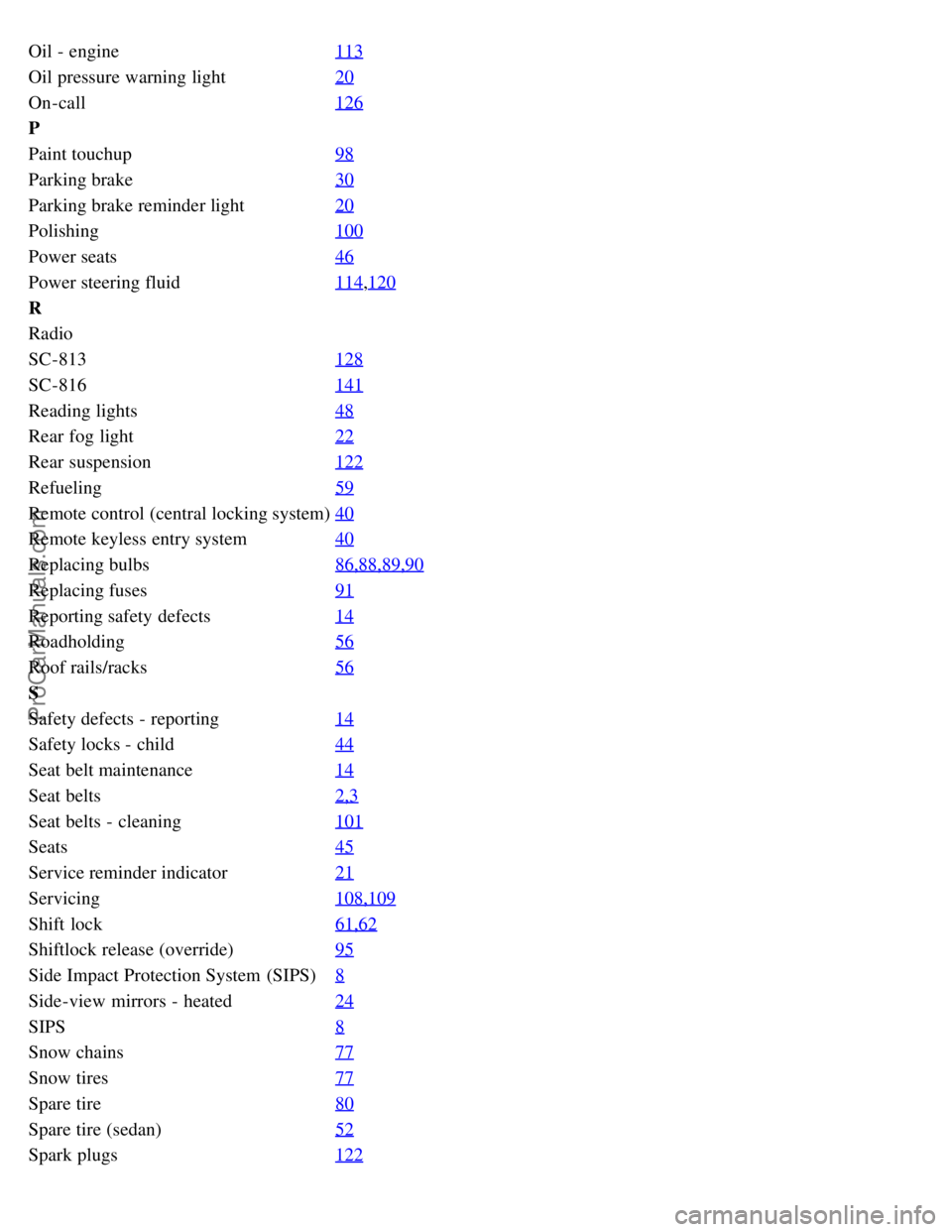
Oil - engine113
Oil pressure warning light20
On-call126
P
Paint touchup98
Parking brake30
Parking brake reminder light20
Polishing100
Power seats46
Power steering fluid114,120
R
Radio
SC-813128
SC-816141
Reading lights48
Rear fog light22
Rear suspension122
Refueling59
Remote control (central locking system)40
Remote keyless entry system40
Replacing bulbs86,88,89,90
Replacing fuses91
Reporting safety defects14
Roadholding56
Roof rails/racks56
S
Safety defects - reporting14
Safety locks - child44
Seat belt maintenance14
Seat belts2,3
Seat belts - cleaning101
Seats45
Service reminder indicator21
Servicing108,109
Shift lock61,62
Shiftlock release (override)95
Side Impact Protection System (SIPS)8
Side-view mirrors - heated24
SIPS8
Snow chains77
Snow tires77
Spare tire80
Spare tire (sedan)52
Spark plugs122
ProCarManuals.com
Page 83 of 84
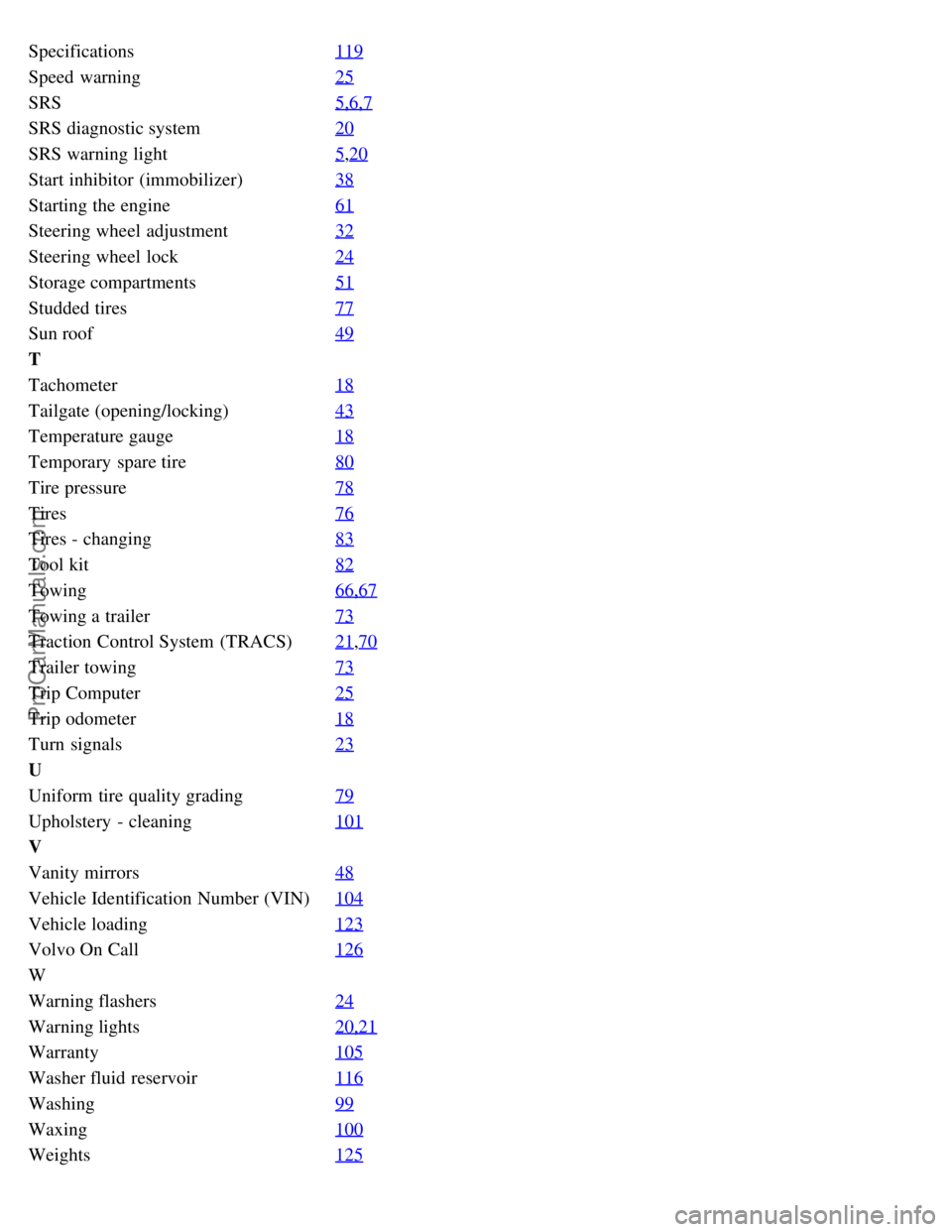
Specifications119
Speed warning25
SRS5,6,7
SRS diagnostic system20
SRS warning light5,20
Start inhibitor (immobilizer)38
Starting the engine61
Steering wheel adjustment32
Steering wheel lock24
Storage compartments51
Studded tires77
Sun roof49
T
Tachometer18
Tailgate (opening/locking)43
Temperature gauge18
Temporary spare tire80
Tire pressure78
Tires76
Tires - changing83
Tool kit82
Towing66,67
Towing a trailer73
Traction Control System (TRACS)21,70
Trailer towing73
Trip Computer25
Trip odometer18
Turn signals23
U
Uniform tire quality grading79
Upholstery - cleaning101
V
Vanity mirrors48
Vehicle Identification Number (VIN)104
Vehicle loading123
Volvo On Call126
W
Warning flashers24
Warning lights20,21
Warranty105
Washer fluid reservoir116
Washing99
Waxing100
Weights125
ProCarManuals.com