warning VOLVO S40 2000 User Guide
[x] Cancel search | Manufacturer: VOLVO, Model Year: 2000, Model line: S40, Model: VOLVO S40 2000Pages: 84, PDF Size: 2.28 MB
Page 19 of 84
Programming for On or OFF
Turn the headlight switch to position
.
Turn the ignition key in position II.
Pull the turn signal lever towards you and hold it while turning the headlight switch to position 0.
If the green light underneath the headlight switch is on the daytime running lights are on.
WARNING!
Do not activate or deactive the Daytime Running Lights while driving.
pg. 22 Headlights, Parking lights, Instrument illumination, Fog lights
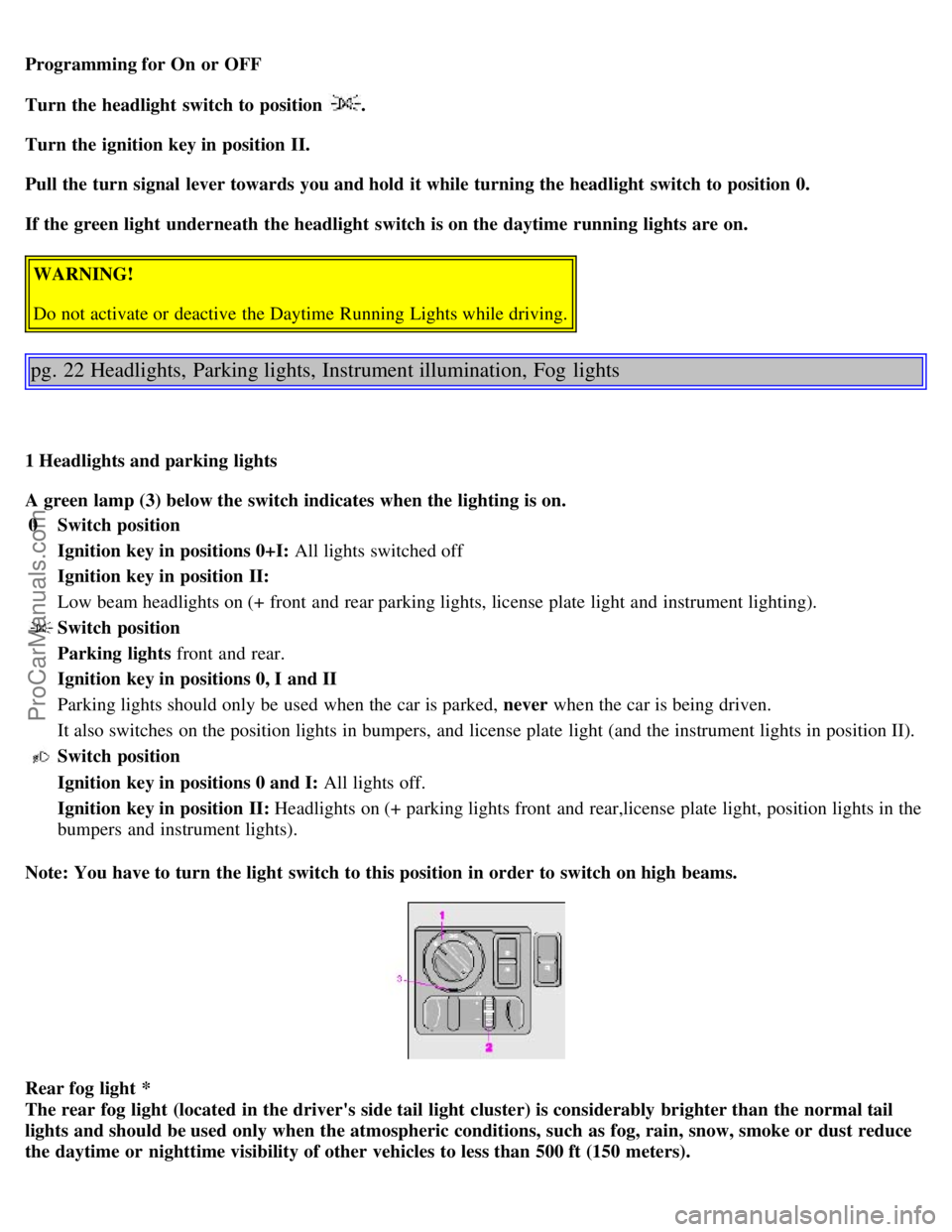
1 Headlights and parking lights
A green lamp (3) below the switch indicates when the lighting is on.0 Switch position
Ignition key in positions 0+I: All lights switched off
Ignition key in position II:
Low beam headlights on (+ front and rear parking lights, license plate light and instrument lighting).
Switch position
Parking lights front and rear.
Ignition key in positions 0, I and II
Parking lights should only be used when the car is parked, never when the car is being driven.
It also switches on the position lights in bumpers, and license plate light (and the instrument lights in position II).
Switch position
Ignition key in positions 0 and I: All lights off.
Ignition key in position II: Headlights on (+ parking lights front and rear,license plate light, position lights in the
bumpers and instrument lights).
Note: You have to turn the light switch to this position in order to switch on high beams.
Rear fog light *
The rear fog light (located in the driver's side tail light cluster) is considerably brighter than the normal tail
lights and should be used only when the atmospheric conditions, such as fog, rain, snow, smoke or dust reduce
the daytime or nighttime visibility of other vehicles to less than 500 ft (150 meters).
ProCarManuals.com
Page 24 of 84

Key
The key activates all locks (ignition switch/steering wheel lock, all doors, trunk/tailgate, fuel filler door and glove
compartment).
Immobilizer (start inhibitor)
Each of the keys supplied with your car is electronically coded. When the key is inserted into the igniton switch, the
code is transmitted to and compared with a code stored in the start inhibitor module. The car can only be started if a
properly coded key is used.
If you misplace a key, take the other keys to an authorized Volvo retailer. The existing code in the start inhibitor
module and all the keys will be erased as an antitheft measure and a new code will be programmed in.
NOTE:
You should never keep more than one of your ignition keys on the ring at the same time. This could cause conflicting
signals to be transmitted to the ignition switch, making it impossible to start the car.
This device complies with part 15 of the FCC rules. Operation is subject to the following condition: (1) This device
may not cause harmful interference, and (2) this device must accept any interference received, including interference
that may cause undesired operation.
pg. 39 Doors and locks
Doors and locks
Your car is equipped with a central locking system.
The key, used on the driver's door, the remote control, or central locking button, will lock/unlock all doors,
trunk/tailgate.
Turn the key once to unlock the driver's door and the fuel filler door.
Turn the key again within 10 seconds to unlock other doors, trunk/tailgate.
One turn with the key towards "lock" in the driver's door locks all doors, trunk/tailgate and fuel filler door with a 10
minutes delay in the fuel filler door.
WARNING!
ProCarManuals.com
Page 26 of 84

This device complies with FCC rules Part 15. Operation is subject to the following two conditions: (1) This device
may not cause harmful interference and (2) this device must accept any interference that may be received, including
interference that may cause undesired operation.
NOTE: If only the driver's door is unlocked, the lock will automatically reengage (re-lock) and the alarm will be set
after 2 minutes unless the door has been opened (see page 42
).
The lock/unlock and alarm features can also be utilized by using the keys. See section: Doors and Locks on page 39.
WARNING!
Volvo does not recommend using the transmitter to lock the doors from inside the car. The alarm would be activated
and would sound when one of the doors is opened. The doors must not be locked using the remote transmitter while
the vehicle is occupied. In case of an accident, this may hinder rapid access to the occupants of the vehicle.
Remote control not functioning.
If the remote control is not functioning the car can be started as follows:
Open the driver's door with the key. The alarm and alarm siren will activate.
Turn the ignition on. The alarm will deactivate.
Note: The remote control will not function if a key is left in the ignition switch.
pg. 41 Alarm
Alarm
The radio signal emitted from the transmitter, which is used to set/unset the alarm, is a "rolling code" signal. This
means that the signal is changed randomly for each transmission and is intended to help prevent unauthorized
recording of the code.
When armed (set), the alarm continuously monitors a number of points on the car. The following conditions will set off
the alarm:
· The hood is opened
· The trunk/tailgate is opened
· A door is opened
· The ignition switch is tampered with
ProCarManuals.com
Page 33 of 84
· Avoid using the air conditioning when it is not required. When engaged, the air conditioner's compressor places an
additional load on the engine. However, please note that fuel consumption is lower with the air conditioning on than it
is when driving with the air conditioning switched off and the windows down.
· Utilizing the fuel consumption modes in the Trip Computer can help you "learn" how to drive more economically.
Other factors which decrease gas mileage are:
· Worn or dirty spark plugs
· Incorrect spark plug gap
· Dirty air cleaner
· Dirty engine oil and clogged oil filter
· Dragging brakes
· Incorrect front end alignment
Some of the above mentioned items and others are checked at the standard Maintenance Service intervals.
NOTE : The automatic transmission's ( D)rive position should be used as often as possible to help improve fuel
economy.
WARNING!
It is recommended that tires of the same make and dimensions be used on all four wheels (including the use of snow
tires). Do not use bias ply tires as this will adversely alter vehicle handling characteristics. Maintain correct tire
pressure.
pg. 61 Starting the engine
Starting and stopping
1. Fasten the seat belt.WARNING!
Before starting, check that the seat, steering wheel and mirrors are adjusted properly. Make sure the brake pedal can
be depressed completely. Move the seat closer if necessary. Refer to section "front seats".
2. Apply the parking brake, if not already set. The gear selector is locked in the (P)ark position (SHIFT LOCK).
3. Without touching the accelerator pedal, turn the ignition key to the starting position. Allow the starter to operate
for up to 5 seconds. Release the key as soon as the engine starts. If the engine fails to start, repeat step 3.
For cold starts at altitudes above 6000 ft (1800 meters), depress the accelerator pedal halfway and turn the key to the
starting position. Release the pedal slowly when the engine starts.
4. To release the gear selector from the (P)ark position, the ignition key must be in position II and the brake pedal
must be depressed.
See page 95
for instructions on manually releasing the SHIFTLOCK system.
NOTE: Your car is equipped with a KEYLOCK system. When the engine is switched off, the gear selector must be
in the ( P)ark position before the starting key can be removed from the ignition switch.
5. Select the desired gear. The gear engages after a slight delay which is especially noticeable when selecting R.
ProCarManuals.com
Page 34 of 84
CAUTION:
The engine should be idling; never accelerate until after you feel the gear engage! Toorapid acceleration immediately
after selecting a gear will cause harsh engagement and premature transmission wear.
NOTE : Selecting P or N when idling at a standstill for prolonged periods of time will help prevent overheating of
transmission oil.
WARNING!
Always place the gear selector in Park and apply the parking brake before leaving the vehicle. Never leave the car
unattended with the engine running.
Always open the garage doors fully before starting the engine inside a garage to ensure adequate ventilation. The
exhaust gases contain carbon monoxide, which is invisible and odorless but very poisonous.
CAUTION:
Never race the engine immediately after starting. Oil flow may not reach some lubricating points fast enough to
prevent engine damage.
Do not race the engine just prior to switching off!
pg. 62 Automatic transmission
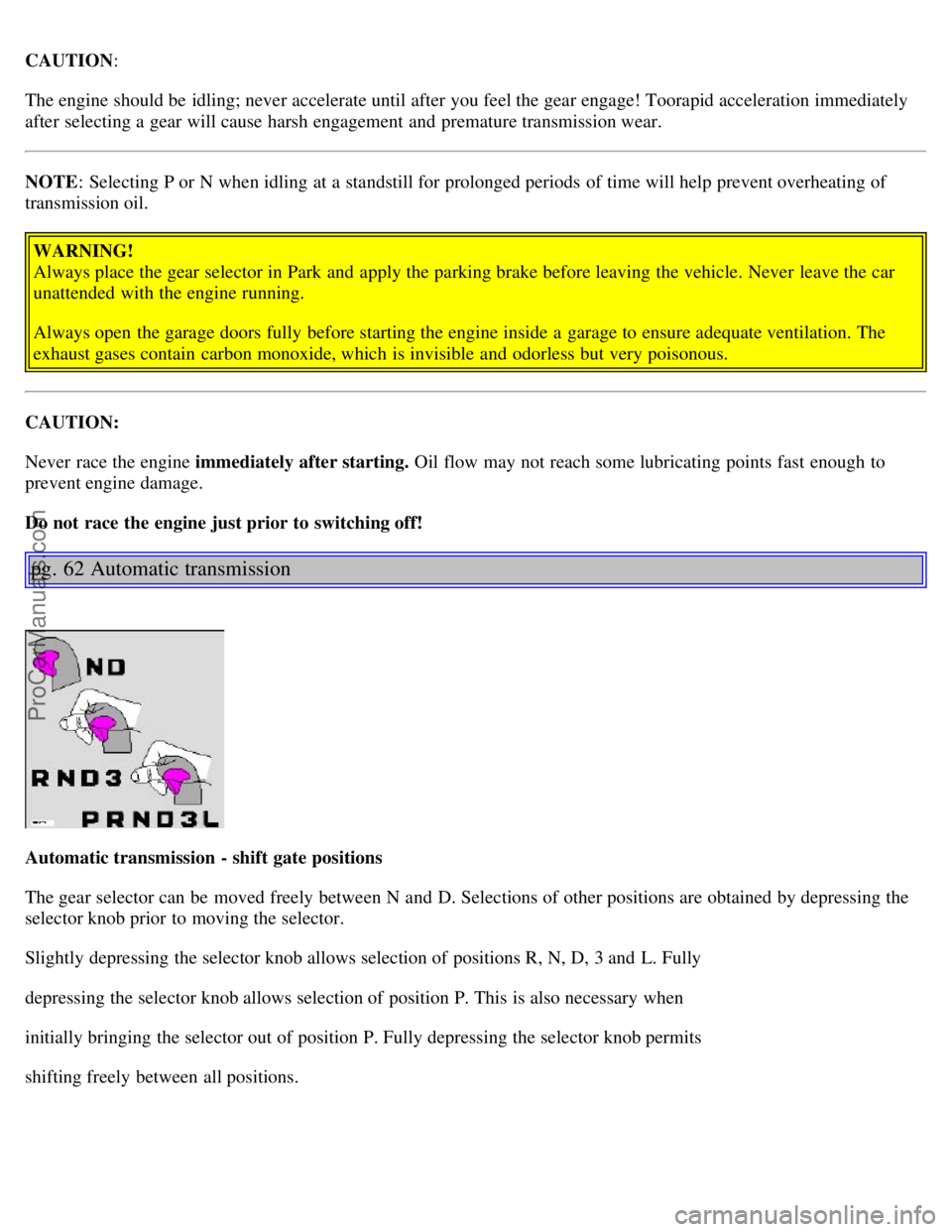
Automatic transmission - shift gate positions
The gear selector can be moved freely between N and D. Selections of other positions are obtained by depressing the
selector knob prior to moving the selector.
Slightly depressing the selector knob allows selection of positions R, N, D, 3 and L. Fully
depressing the selector knob allows selection of position P. This is also necessary when
initially bringing the selector out of position P. Fully depressing the selector knob permits
shifting freely between all positions.
ProCarManuals.com
Page 35 of 84
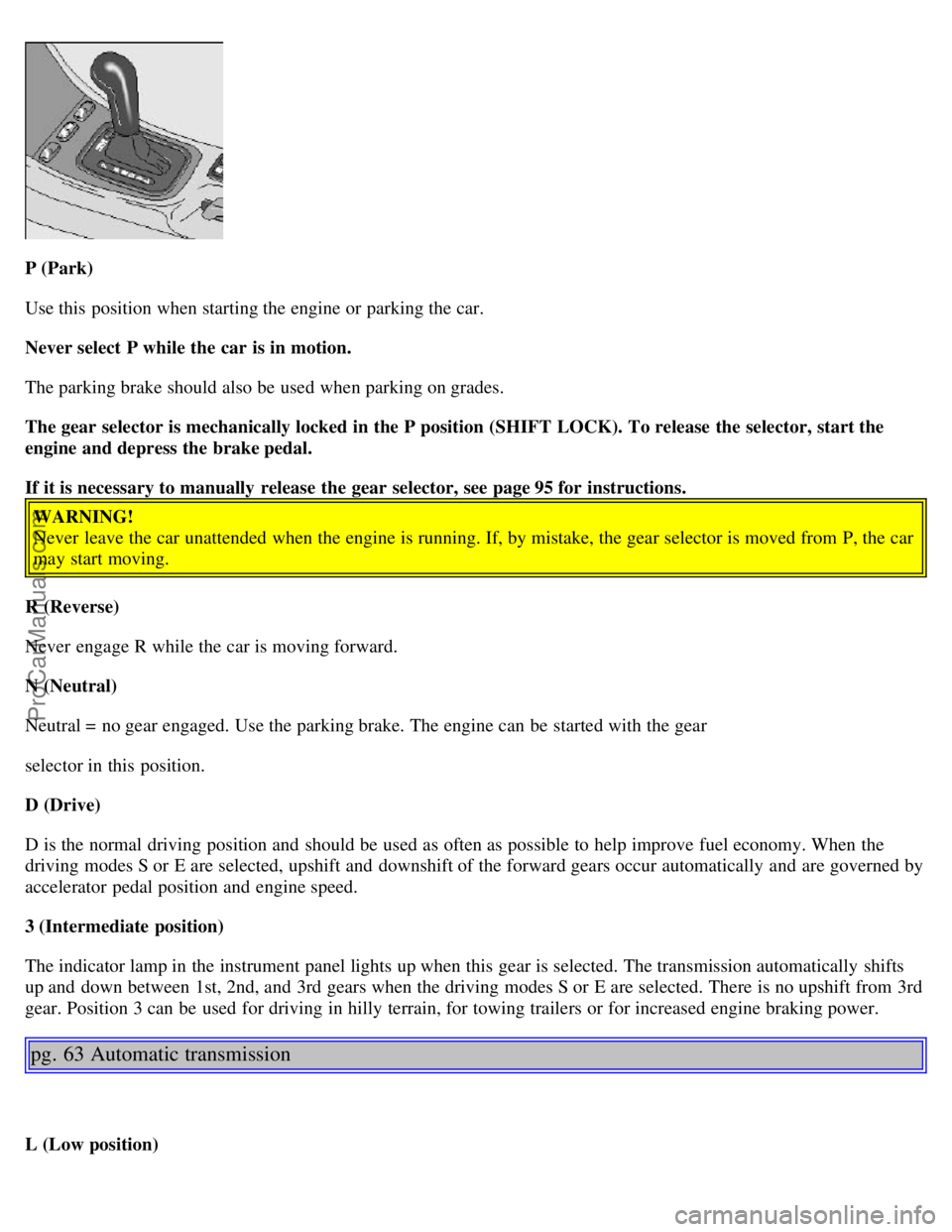
P (Park)
Use this position when starting the engine or parking the car.
Never select P while the car is in motion.
The parking brake should also be used when parking on grades.
The gear selector is mechanically locked in the P position (SHIFT LOCK). To release the selector, start the
engine and depress the brake pedal.
If it is necessary to manually release the gear selector, see page 95 for instructions.
WARNING!
Never leave the car unattended when the engine is running. If, by mistake, the gear selector is moved from P, the car
may start moving.
R (Reverse)
Never engage R while the car is moving forward.
N (Neutral)
Neutral = no gear engaged. Use the parking brake. The engine can be started with the gear
selector in this position.
D (Drive)
D is the normal driving position and should be used as often as possible to help improve fuel economy. When the
driving modes S or E are selected, upshift and downshift of the forward gears occur automatically and are governed by
accelerator pedal position and engine speed.
3 (Intermediate position)
The indicator lamp in the instrument panel lights up when this gear is selected. The transmission automatically shifts
up and down between 1st, 2nd, and 3rd gears when the driving modes S or E are selected. There is no upshift from 3rd
gear. Position 3 can be used for driving in hilly terrain, for towing trailers or for increased engine braking power.
pg. 63 Automatic transmission
L (Low position)
ProCarManuals.com
Page 41 of 84
· Check the tire pressure when refuelling.
· The tire pressure should be corrected only when the tires are cold.
· With warm tires, correct only when the pressure is too low. The tire temperature rises after driving just a few miles.
Vehicle loading
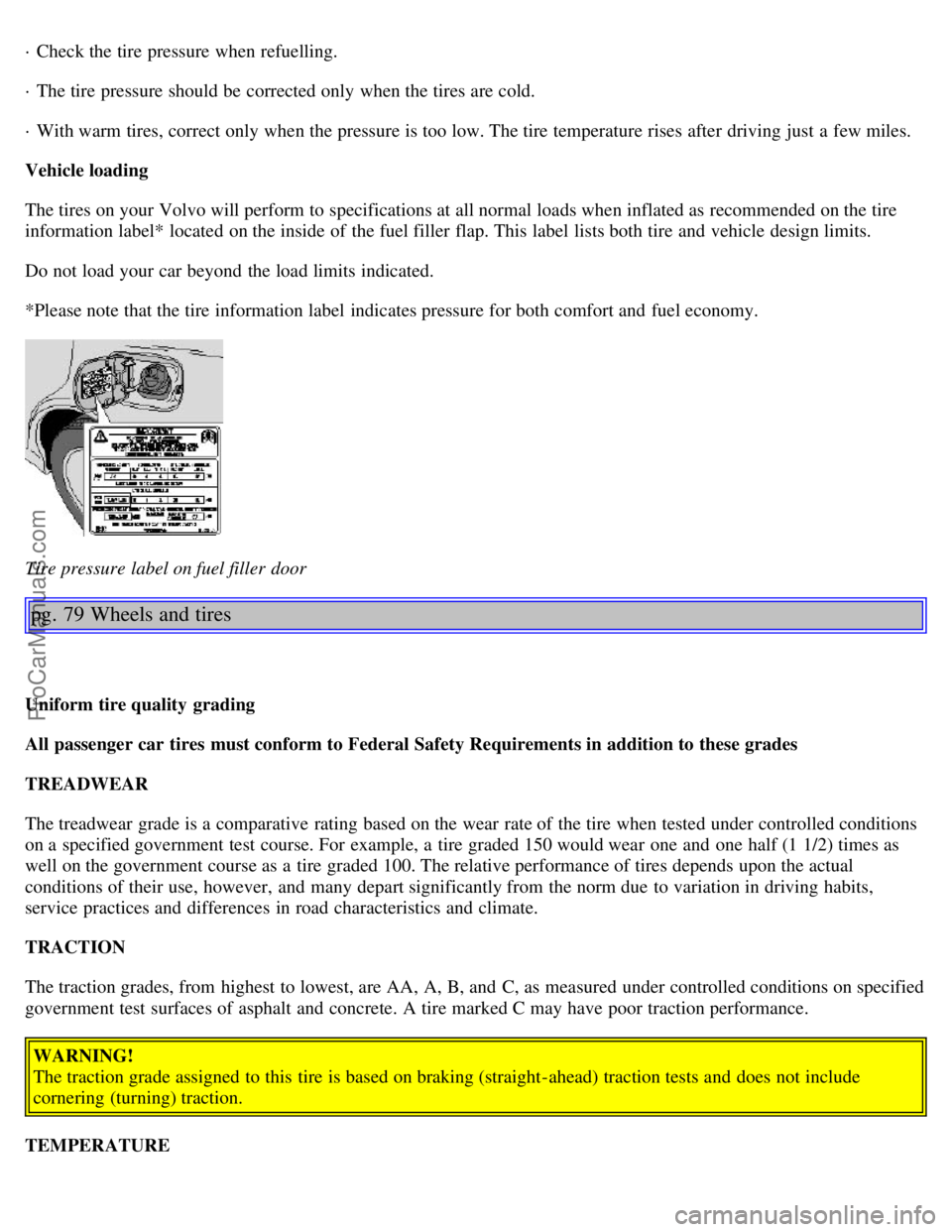
The tires on your Volvo will perform to specifications at all normal loads when inflated as recommended on the tire
information label* located on the inside of the fuel filler flap. This label lists both tire and vehicle design limits.
Do not load your car beyond the load limits indicated.
*Please note that the tire information label indicates pressure for both comfort and fuel economy.
Tire pressure label on fuel filler door
pg. 79 Wheels and tires
Uniform tire quality grading
All passenger car tires must conform to Federal Safety Requirements in addition to these grades
TREADWEAR
The treadwear grade is a comparative rating based on the wear rate of the tire when tested under controlled conditions
on a specified government test course. For example, a tire graded 150 would wear one and one half (1 1/2) times as
well on the government course as a tire graded 100. The relative performance of tires depends upon the actual
conditions of their use, however, and many depart significantly from the norm due to variation in driving habits,
service practices and differences in road characteristics and climate.
TRACTION
The traction grades, from highest to lowest, are AA, A, B, and C, as measured under controlled conditions on specified
government test surfaces of asphalt and concrete. A tire marked C may have poor traction performance.WARNING!
The traction grade assigned to this tire is based on braking (straight-ahead) traction tests and does not include
cornering (turning) traction.
TEMPERATURE
ProCarManuals.com
Page 42 of 84
The temperature grades are AA (the highest), A, B, and C, representing the tire's resistance to the generation of heat
and its ability to dissipate heat when tested under controlled conditions on a specified indoor laboratory test wheel.
Sustained high temperature can cause the material of the tire to degenerate and reduce tire life, and excessive
temperature can lead to sudden tire failure. The grade C corresponds to a level of performance which all passenger car
tires must meet under the Federal Motor Safety Standard No. 109. Grades B and A represent higher levels of
performance on the laboratory test wheel than the minimum required by law.WARNING!
The temperature grade for this tire is established for a tire that is properly inflated and not overloaded. Excessive
speed, underinflation, or excessive loading, either separately or in combination, can cause heat buildup and possible
tire failure.
pg. 80 Spare tire
Special Spare
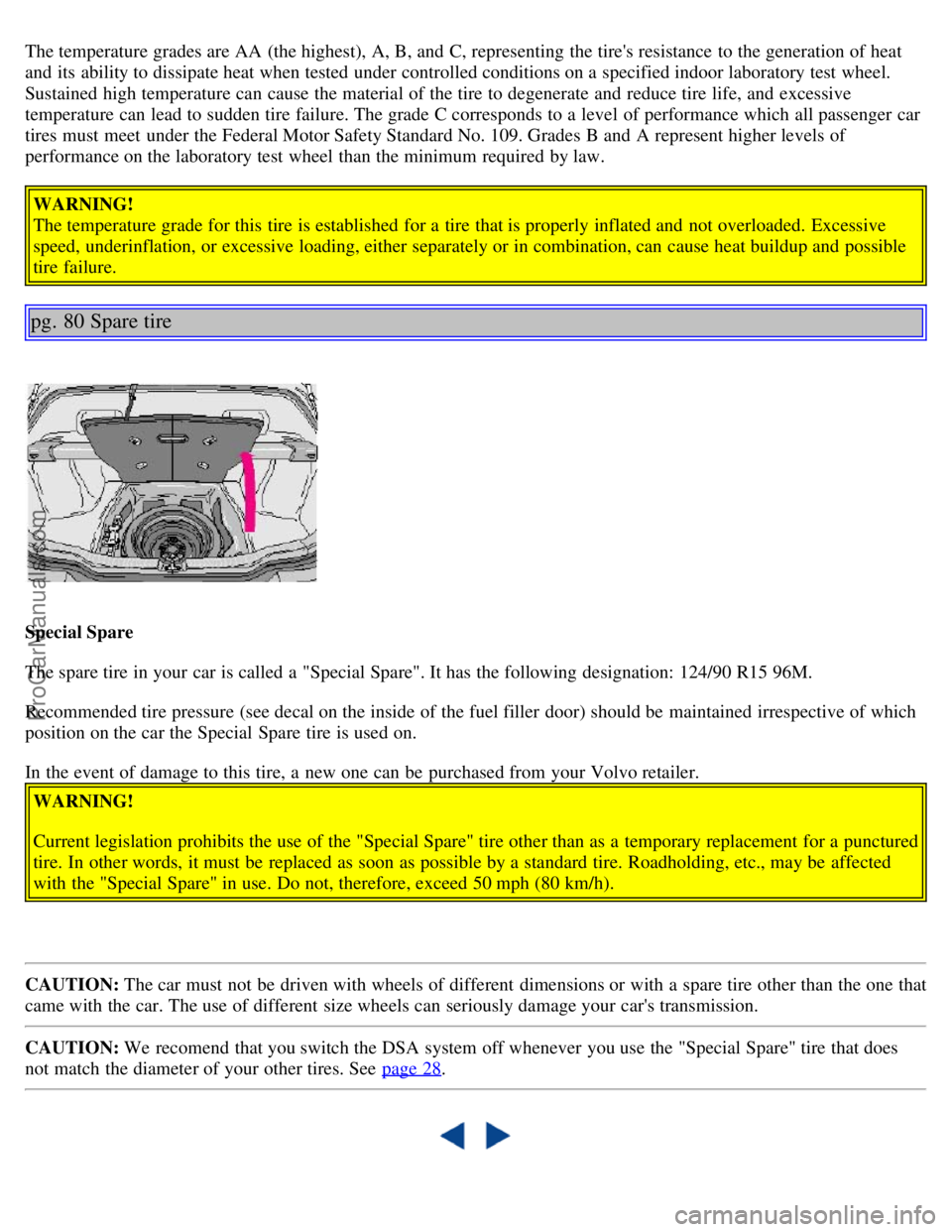
The spare tire in your car is called a "Special Spare". It has the following designation: 124/90 R15 96M.
Recommended tire pressure (see decal on the inside of the fuel filler door) should be maintained irrespective of which
position on the car the Special Spare tire is used on.
In the event of damage to this tire, a new one can be purchased from your Volvo retailer.WARNING!
Current legislation prohibits the use of the "Special Spare" tire other than as a temporary replacement for a punctured
tire. In other words, it must be replaced as soon as possible by a standard tire. Roadholding, etc., may be affected
with the "Special Spare" in use. Do not, therefore, exceed 50 mph (80 km/h).
CAUTION: The car must not be driven with wheels of different dimensions or with a spare tire other than the one that
came with the car. The use of different size wheels can seriously damage your car's transmission.
CAUTION: We recomend that you switch the DSA system off whenever you use the "Special Spare" tire that does
not match the diameter of your other tires. See page 28
.
ProCarManuals.com
Page 45 of 84
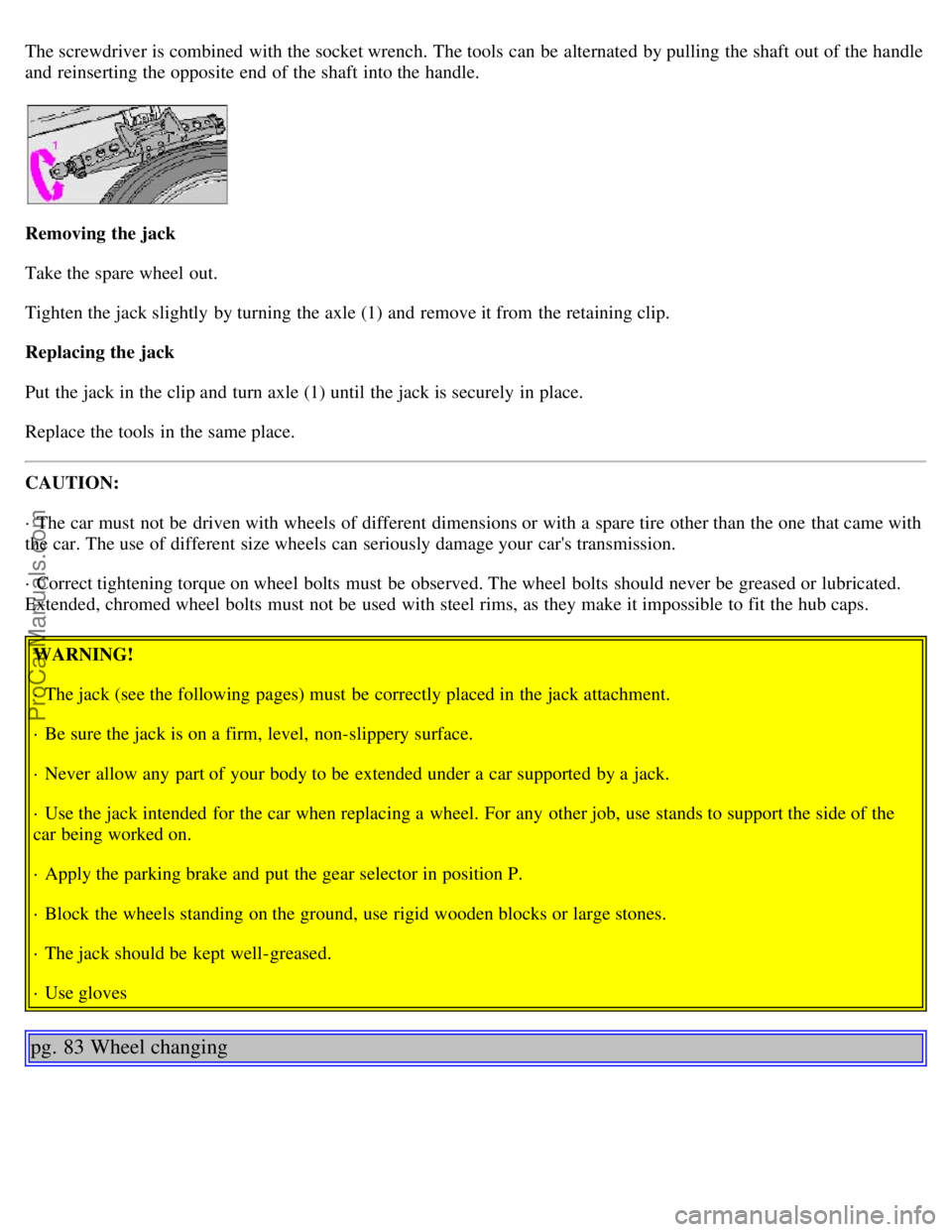
The screwdriver is combined with the socket wrench. The tools can be alternated by pulling the shaft out of the handle
and reinserting the opposite end of the shaft into the handle.
Removing the jack
Take the spare wheel out.
Tighten the jack slightly by turning the axle (1) and remove it from the retaining clip.
Replacing the jack
Put the jack in the clip and turn axle (1) until the jack is securely in place.
Replace the tools in the same place.
CAUTION:
· The car must not be driven with wheels of different dimensions or with a spare tire other than the one that came with
the car. The use of different size wheels can seriously damage your car's transmission.
· Correct tightening torque on wheel bolts must be observed. The wheel bolts should never be greased or lubricated.
Extended, chromed wheel bolts must not be used with steel rims, as they make it impossible to fit the hub caps.WARNING!
· The jack (see the following pages) must be correctly placed in the jack attachment.
· Be sure the jack is on a firm, level, non-slippery surface.
· Never allow any part of your body to be extended under a car supported by a jack.
· Use the jack intended for the car when replacing a wheel. For any other job, use stands to support the side of the
car being worked on.
· Apply the parking brake and put the gear selector in position P.
· Block the wheels standing on the ground, use rigid wooden blocks or large stones.
· The jack should be kept well-greased.
· Use gloves
pg. 83 Wheel changing
ProCarManuals.com
Page 47 of 84
· Attach the crank to the jack (C).
· Attach the lug wrench (D) to the crank.
· Raise the jack by cranking it clockwise. Be sure the jack engages the attachment point correctly.
The base of the jack must be flat on a level, firm, non-slippery surface. Before raising the car, check that the
jack is still correctly positioned in the attachment point.
· Raise the car until the wheel to be changed is lifted off the ground.
· Unscrew the wheel bolts completely and carefully remove the wheel so as not to damage the thread on the studs.WARNING!
The jack must be correctly placed in the jack attachment.
Installing the wheel
Clean the contact surfaces on the wheel and
hub. Lift the wheel and place it on the hub. Install the wheel bolts crosswise and tighten by turning lightly clockwise.
Lower the vehicle to the ground and alternately tighten the bolts to 81 ft. lbs. (110 Nm). Install the wheel cap (where
applicable).
pg. 85 Replacing bulbs
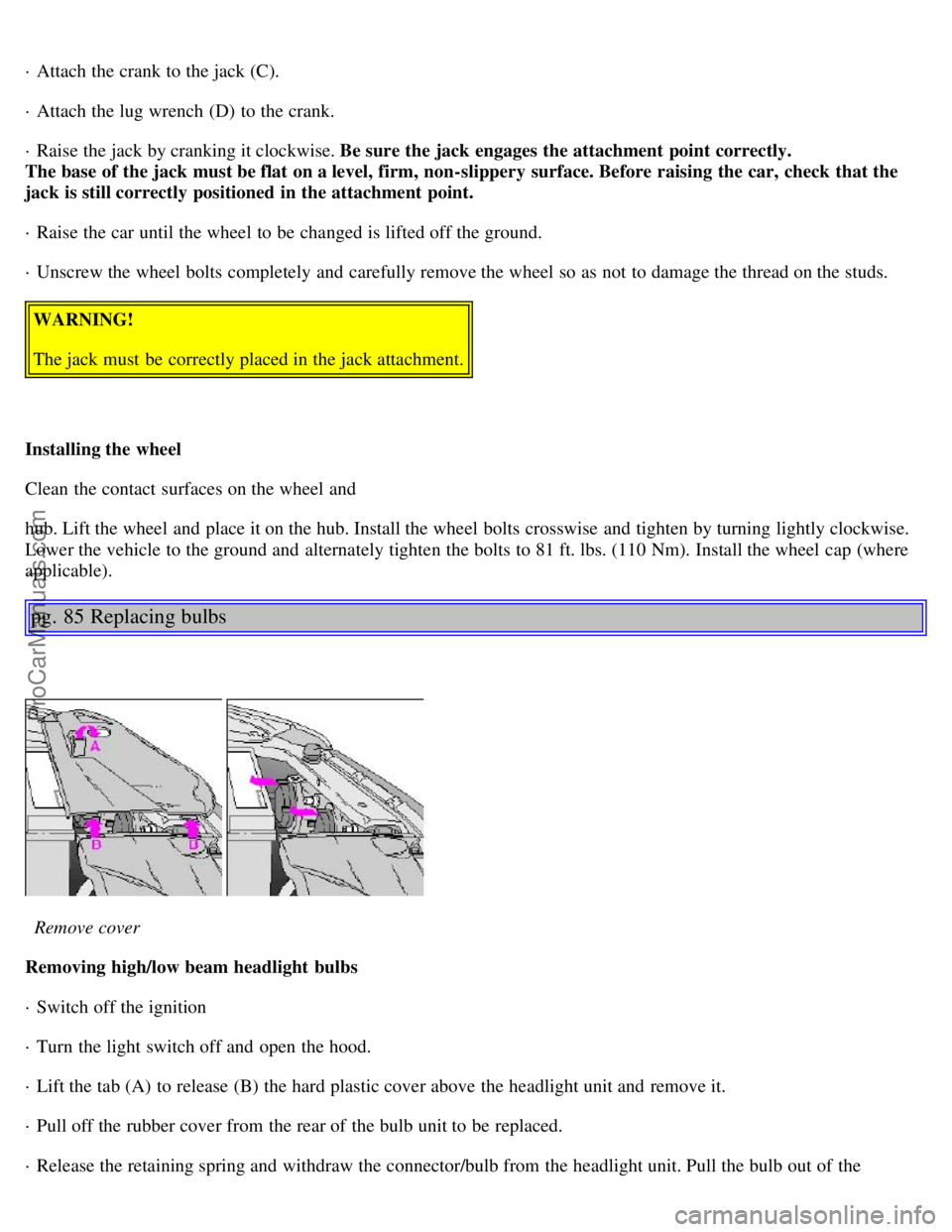
Remove cover
Removing high/low beam headlight bulbs
· Switch off the ignition
· Turn the light switch off and open the hood.
· Lift the tab (A) to release (B) the hard plastic cover above the headlight unit and remove it.
· Pull off the rubber cover from the rear of the bulb unit to be replaced.
· Release the retaining spring and withdraw the connector/bulb from the headlight unit. Pull the bulb out of the
ProCarManuals.com