flat tire VOLVO S40 2005 User Guide
[x] Cancel search | Manufacturer: VOLVO, Model Year: 2005, Model line: S40, Model: VOLVO S40 2005Pages: 127, PDF Size: 2.32 MB
Page 77 of 127

Bead area of the tire: Area of the tire next to the rim.
Sidewall of the tire: Area between the bead area and the tread.
Tread area of the tire: Area of the perimeter of the tire that contacts the road when mounted on the vehicle.
Rim: The metal support (wheel) for a tire or a tire and tube assembly upon which the tire beads are seated.
Maximum load rating: a figure indicating the maximum load in pounds and kilograms that can be carried by the
tire. This rating is established by the tire manufacturer.
Maximum permissible inflation pressure: the greatest amount of air pressure that should ever be put in the tire.
This limit is set by the tire manufacturer.
Recommended tire inflation pressure: inflation pressure, established by Volvo, which is based on the type of tires
that are mounted on a vehicle at the factory. This inflation pressure is affected by the number of occupants in the car,
the amount of cargo, and the speed at which the vehicle will be driven for a prolonged period. This information can be
found on the tire inflation placard(s) located on the driver's side B-pillar or on the inside of the fuel filler door on
Canadian models, and in the tire inflation table in this chapter.
Cold tires: The tires are considered to be cold when they have the same temperature as the surrounding (ambient)
air. This temperature is normally reached after the car has been parked for at least 3 hours.
pg. 130 Vehicle loading
Vehicle loading
Properly loading your vehicle will provide maximum return of vehicle design performance.
Before loading your vehicle, familiarize yourself with the following terms for determining your vehicle's weight
ratings, with or without a trailer, from the vehicle's Federal/ Canadian Motor Vehicle Safety Standards
(FMVSS/CMVSS) label, and the vehicle's tire information placard:
Curb weight
The weight of the vehicle including a full tank of fuel and all standard equipment. It does not include passengers,
cargo, or optional equipment.
Capacity weight
All weight added to the curb weight, including cargo and optional equipment. When towing, trailer hitch tongue load
is also part of cargo weight.
NOTE: For trailer towing information, please refer to the section "Towing a trailer" on page 120
.
Permissible axle weight
The maximum allowable weight that can be carried by a single axle (front or rear). These numbers are shown on the
Federal/Canadian Motor Vehicle Safety Standards (FMVSS/CMVSS) label. The total load on each axle must never
exceed its maximum permissible weight.
Gross vehicle weight (GVW)
The vehicle's curb weight + cargo + passengers.
NOTE:
The location of the various labels in your vehicle can be found on page 184.
A table listing important weight limits for your vehicle can be found on page 185.
Steps for Determining Correct Load Limit
(1) Locate the statement ''the combined weight of occupants and cargo should never exceed XXX pounds'' on your
vehicle's placard.
(2) Determine the combined weight of the driver and passengers that will be riding in your vehicle.
(3) Subtract the combined weight of the driver and passengers from XXX kilograms or XXX pounds.
(4) The resulting figure equals the available amount of cargo and luggage load capacity. For example, if the ''XXX''
amount equals 1400 lbs. and there will be five 150 lb. passengers in your vehicle, the amount of available cargo and
ProCarManuals.com
Page 78 of 127

luggage load capacity is 650 lbs. (1400-750 (5 x 150) = 650 lbs.)
(5) Determine the combined weight of luggage and cargo being loaded on the vehicle. That weight may not safely
exceed the available cargo and luggage load capacity calculated in Step 4.
(6) If your vehicle will be towing a trailer, load from your trailer will be transferred to your vehicle. Consult this
manual
1 to determine how this reduces the available cargo and luggage load capacity of your vehicle.
WARNING!
- Exceeding the permissible axle weight, gross vehicle weight, or any other weight rating limits can cause tire
overheating resulting in permanent deformation or catastrophic failure.
- Do not use replacement tires with lower load carrying capacities than the tires that were original equipment on the
vehicle because this will lower the vehicle's GVW rating. Replacement tires with a higher limit than the originals do
not increase the vehicle's GVW rating limitations.
1. See "Towing a trailer" on page 122
.
pg. 131 Uniform Tire Quality Grading
Uniform Tire Quality Grading
ALL PASSENGER VEHICLE TIRES MUST CONFORM TO FEDERAL SAFETY REQUIREMENTS IN
ADDITION TO THESE GRADES
Quality grades can be found, where applicable, on the tire sidewall between the tread shoulder and maximum
section width. For example:
Treadwear 200 Traction AA Temperature A
TREADWEAR
The treadwear grade is a comparative rating based on the wear rate of the tire when tested under controlled conditions
on a specified government test course. For example, a tire graded 150 would wear one and one half (1 1/2) times as
well on the government course as a tire graded 100. The relative performance of tires depends upon the actual
conditions of their use, however, and many depart significantly from the norm due to variation in driving habits,
maintenance practices and differences in road characteristics and climate.
TRACTION
The traction grades, from highest to lowest, are AA, A, B, and C, as measured under controlled conditions on specified
government test surfaces of asphalt and concrete. A tire marked C may have poor traction performance. The traction
grade assigned to this tire is based on braking (straight-ahead) traction tests and is not a measure of cornering (turning)
traction. WARNING!
The traction grade assigned to this tire is based on braking (straight-ahead) traction tests and is not a measure of
cornering (turning) traction.
TEMPERATURE
The temperature grades are AA (the highest), A, B, and C, representing the tire's resistance to the generation of heat
and its ability to dissipate heat when tested under controlled conditions on a specified indoor laboratory test wheel.
Sustained high temperature can cause the material of the tire to degenerate and reduce tire life, and excessive
temperature can lead to sudden tire failure. The grade C corresponds to a minimum level of performance that all
passenger vehicle tires must meet under the Federal Motor Safety Standard No. 109. Grades B and A represent higher
levels of performance on the laboratory test wheel than the minimum required by law. WARNING!
The temperature grade for this tire is established for a tire that is properly inflated and not overloaded. Excessive
speed, under-inflation, or excessive loading, either separately or in combination, can cause heat buildup and tire
ProCarManuals.com
Page 82 of 127
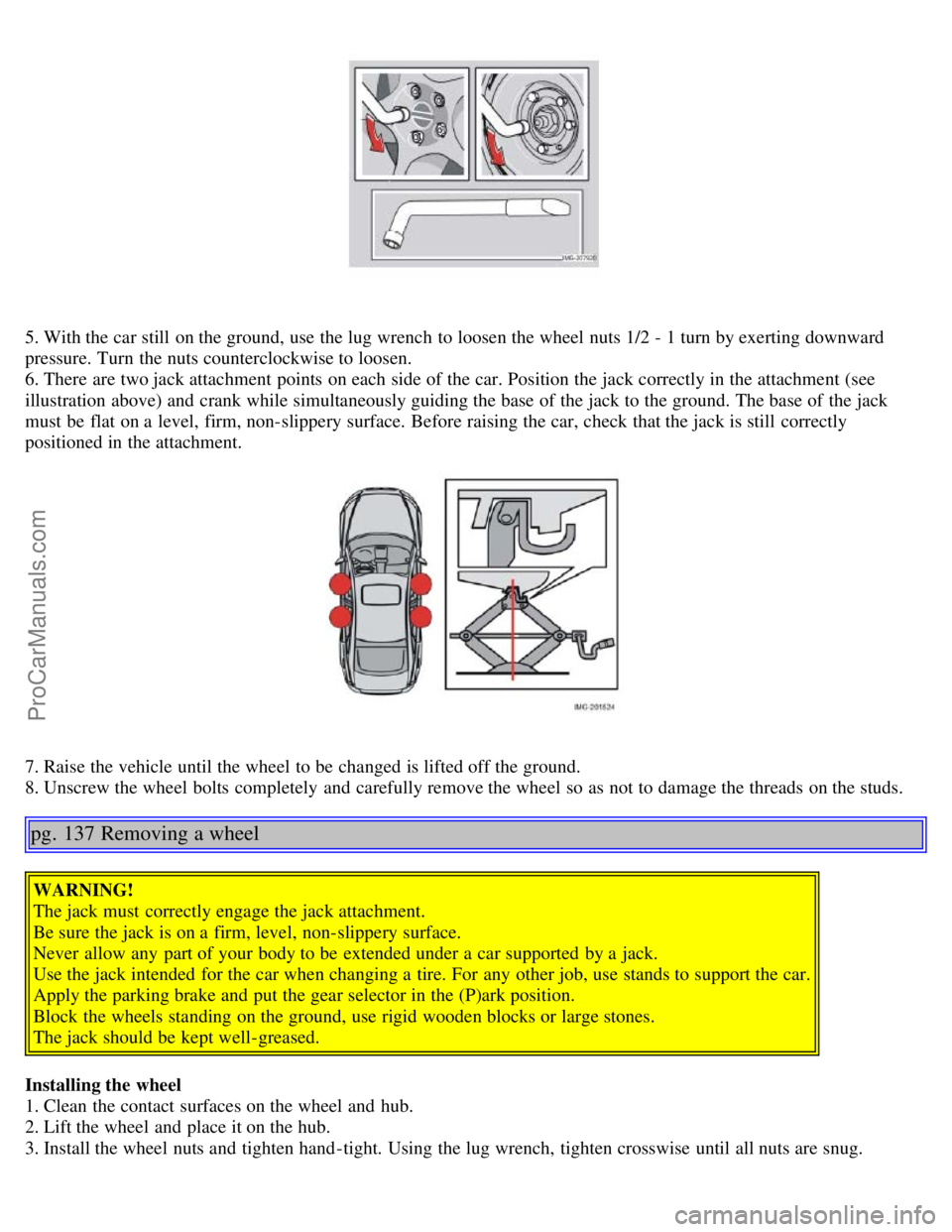
5. With the car still on the ground, use the lug wrench to loosen the wheel nuts 1/2 - 1 turn by exerting downward
pressure. Turn the nuts counterclockwise to loosen.
6. There are two jack attachment points on each side of the car. Position the jack correctly in the attachment (see
illustration above) and crank while simultaneously guiding the base of the jack to the ground. The base of the jack
must be flat on a level, firm, non-slippery surface. Before raising the car, check that the jack is still correctly
positioned in the attachment.
7. Raise the vehicle until the wheel to be changed is lifted off the ground.
8. Unscrew the wheel bolts completely and carefully remove the wheel so as not to damage the threads on the studs.
pg. 137 Removing a wheel
WARNING!
The jack must correctly engage the jack attachment.
Be sure the jack is on a firm, level, non-slippery surface.
Never allow any part of your body to be extended under a car supported by a jack.
Use the jack intended for the car when changing a tire. For any other job, use stands to support the car.
Apply the parking brake and put the gear selector in the (P)ark position.
Block the wheels standing on the ground, use rigid wooden blocks or large stones.
The jack should be kept well-greased.
Installing the wheel
1. Clean the contact surfaces on the wheel and hub.
2. Lift the wheel and place it on the hub.
3. Install the wheel nuts and tighten hand -tight. Using the lug wrench, tighten crosswise until all nuts are snug.
ProCarManuals.com
Page 121 of 127

Floor mats104
Floor mats, cleaning142
Front airbags17
Front fog light, replacing158
Front fog lights (option)45
Front seats, manual adjustment78
Front seats, power79
Fuel filler cap2
Fuel filler door2, 102
Fuel gauge38
Fuel requirements101
Fuel system188
Fuel tank capacity102
Fuse box in the passenger compartment, accessing163
Fuses161
Fuses in the engine compartment162
Fuses in the passenger compartment164
G
Gasoline101
Geartronic (manual shifting)108
Generator189
Generator warning light41
Glossary of tire terminology129
Glove compartment83
Glove compartment, locking93
Grocery bag holder (option)86
H
Hazard warning flashers53
Head restraints, rear seat84
Headlight flasher47
Headlight housing, removing156
Headlight washers51
Headlights45
High beam bulb, replacing157
High beam indicator38
High beams47
High/low beam headlights45
Home safe lighting47, 62
Hood, opening148
I
Ignition switch106
Immobilizer88, 104
Indicator and warning symbols38
Inflatable Curtain26
ProCarManuals.com
Page 124 of 127
Safety system warning light22, 41
Seat belt maintenance16
Seat belt reminder16, 41
Seat belts14
SEE MANUAL43
SERVICE REQUIRED43
Shiftlock2
Side impact protection (SIPS) airbags25
Side marker light, replacing158
Speedometer38
Spin control - SC113
SRS warning light22
Stability44
Stability system113
Stability system STC or DSTC44
Start inhibitor (immobilizer)88
Starting the vehicle104
Station formats176
STC44, 113
Steering wheel adjustment53
Steering wheel keypad, audio system170
Steering wheel lock106
Stone chips, paint touch-up143
STOP ENGINE43
STOP SAFELY43
Storage compartments82
Subwoofer172
Sunroof (moonroof)59
Supplemental Restraint System - SRS17
T
Tachometer38
Tail light bulb holder, removing159
Technician certification191
Temperature gauge38
Three-way catalytic converter190
TIME FOR REGULAR SERVICE43
Tire inflation pressure tables127
Tires, changing135
Tires, general information124
Traction control - TC113
Transmission, automatic108
Tread wear indicator124
Trip computer47
Trip odometer38
ProCarManuals.com
Page 125 of 127
Trunk86
Trunk lighting, replacing160
Turn signal bulb, replacing158
Turn signals47
U
Uniform Tire Quality Grading131
Unlock (personal settings)61
V
Vanity mirror80
Vanity mirror lighting, replacing160
Vehicle Event Data146
Vehicle Identification Number184
Vehicle loading130
Volvo and the environment3
Volvo Customer Care Center, contacting1
Volvo Inflatable Curtain26
Volvo maintenance146
Volvo On Call Roadside Assistance191
W
W Winter/Wet driving mode100
Warning flashers53
Warning light, safety systems22
Warning symbol38, 39
Warranties146
Washer fluid150
Washing the car140
Waxing141
Weight distribution98
Weights185
Wheel nuts134
Wheels, removing136
Whiplash Protection System (WHIPS)28
Windshield washer fluid150
Windshield wiper blades152
Windshield wipers51
Wiper blades152
SUPPLEMENT - VALET OR SERVICE LOCKING
At the time of printing for your All New S40 owner's manual, information about seat back locking was not available.
The following information supplements your S40 owner's manual page 90
description of valet or service locking of the
glove compartment, rear seat backrests, and trunk.
Valet or service locking
By utilizing the remote control with the key blade removed, the valet locking feature enables you to block access to the
ProCarManuals.com
Page 126 of 127
trunk and glove compartment for e.g. valet parking or when the car is brought to the retailer for service.
With the valet locking function activated:
The vehicle's doors can be locked or unlocked
The engine can be started
The glove compartment cannot be unlocked
Access to the trunk is blocked (the trunk lid cannot be unlocked or opened, and the rear seat backrests are locked in
the upright position)
To activate the valet locking function:
1. Remove the key blade from the remote control
2. Turn the key blade 180° clockwise in the glove compartment lock to activate the function. (A message appears in
the information display.)
3. Turn the key blade 180° clockwise in the lock cylinders located near the backrest catches on the upper outboard
sections of the backrests to lock the backrests in the upright position. Both locks must be locked to completely block
access to the trunk from inside the car.
4. Give the parking attendant or service personnel only the remote control (with the key blade removed) Turn the key
blade 180° counterclockwise in the glove compartment lock and the backrest locks to deactivate valet locking.
SUPPLEMENT - ACCESSORY 18-INCH TIRE PRESSURES
Tire inflation pressures
The tables below show recommended tire inflation pressures for 18-inch tires you may have purchased as an accessory
from your authorized Volvo retailer. If your vehicle is equipped with factory-installed tires, see your vehicle's tire
inflation placard located on the driver's door pillar. See additional guidance in your owner's manual.
Tire size Cold tire pressure for vehicle loads up to 800 lbs (365 kg)a.
Front Rear
215/45R18 93W Extra load 36 psi / 250 kPa 36 psi / 250 kPa
Speed rating
The speed rating "W" translates to 168 mph (270 km/h). Tire size Cold tire pressure for vehicle loads up to 495 lbs (225 kg)a.
Front Rear
215/45R18 93W Extra load 35 psi / 240 kPa 32 psi / 220 kPa
Load rating
The load rating "93" translates to 1433 lbs (550 kg).
a. These weights include the weight of all occupants of the car, plus cargo.
SUPPLEMENT - SAFETY - AIRBAG LABELS
Page 23 of your owner's manual shows outdated airbag labels. This supplement shows the correct positions and text of
airbag warning labels located on your vehicle's dashboard and sun visors.
This supplement belongs together with your owner's manual. See the Safety section of your owner's manual for
additional information about airbags and child safety.
ProCarManuals.com