ECU VOLVO S40 2009 Owner´s Manual
[x] Cancel search | Manufacturer: VOLVO, Model Year: 2009, Model line: S40, Model: VOLVO S40 2009Pages: 286, PDF Size: 7.08 MB
Page 163 of 286
06 Starting and driving
Transporting loads
06
163 Loading the vehicle
Your vehicle's load-carrying capacity is affec-
ted by factors such as:•
the number of passengers
•
tire inflation
•
the amount of optional or accessory equip-
ment installed
•
the amount of cargo.
See the chapter "Wheels and tires" for more
detailed information.
Before loading the car, turn off the engine, and
apply the parking brake when loading or
unloading long objects. The gear selector can
be inadvertently knocked out of position by
long cargo, causing the car to move.
Keep the following in mind when
loading the vehicle:•
Load objects in the trunk against the rear
seat backrest.
•
Load heavy cargo as low as possible.
•
Center wide loads.
•
Secure all cargo with restraining straps
anchored to the load securing eyelets.
•
Cover sharp edges on the load.
•
Seats can be folded down and head
restraints removed to extend the cargo
compartment, see page 113.
WARNING
•
Remember that an object weighing
44 lbs (20 kg) produces a force of
2,200 lbs (1,000 kg) in a head-on colli-
sion at 30 mph (50 km/h)!
•
When the rear backrest(s) are folded
down, the vehicle should not be loaded
to a level higher than 2 in. (5 cm) below
the upper edge of the rear side win-
dows. Objects placed higher than this
level could impede the function of the
Volvo Inflatable Curtain.
Load carriers (accessory)Load carriers are available as Volvo accesso-
ries. Follow the installation instructions sup-
plied with the load carriers.
Observe the following points when using load
carriers:•
To avoid damaging your car and to achieve
maximum safety when driving, we recom-
mend using the load carriers that Volvo has
developed especially for your car.
•
Volvo-approved removable roof racks are
designed to carry the maximum allowable
roof load for this vehicle: 165 lbs (75 kg).
For Non-Volvo roof racks, check the man-
ufacturer's weight limits for the rack.
•
Never exceed the rack manufacturer's
weigh limits and never exceed the maxi-
mum rated roof load of 165 lbs (75 kg).
•
Avoid single-point loads. Distribute loads
evenly.
•
Place heavier cargo at the bottom of the
load.
•
Secure the cargo correctly with appropri-
ate tie-down equipment.
•
Check periodically that the load carriers
and load are properly secured.
•
Remember that the car's center of gravity
and handling change when you carry a
load on the roof.
•
The car's wind resistance and fuel con-
sumption will increase with the size of the
load.
•
Drive smoothly. Avoid rapid starts, fast
cornering and hard braking.
Page 188 of 286
07 Wheels and tiresWheel nuts
07188
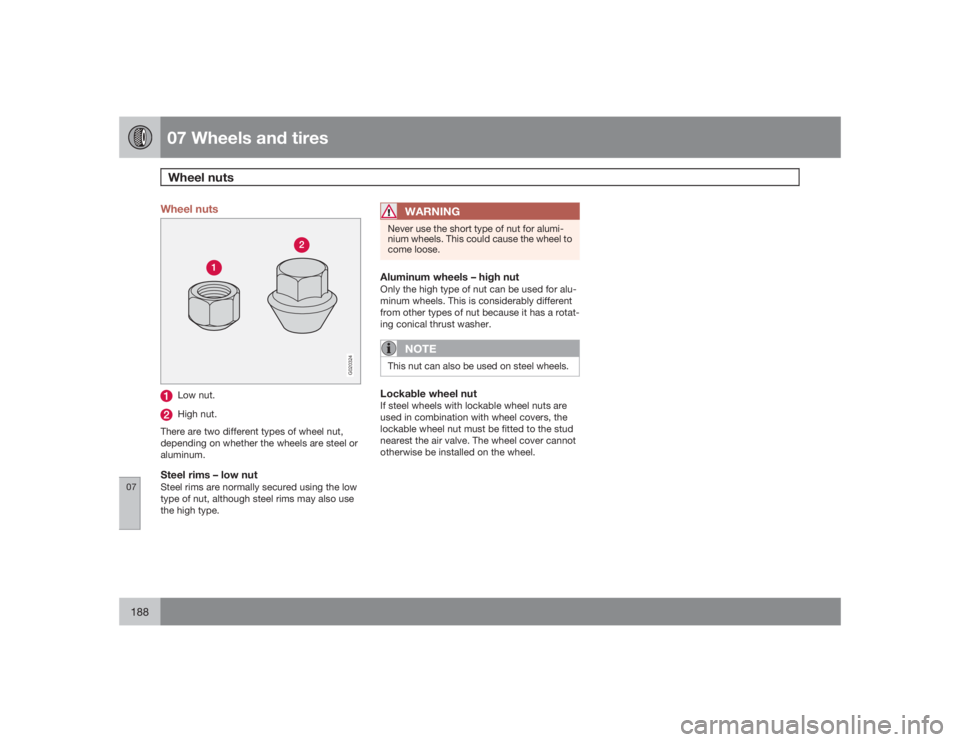
Wheel nuts
G020324
Low nut.High nut.
There are two different types of wheel nut,
depending on whether the wheels are steel or
aluminum.
Steel rims – low nutSteel rims are normally secured using the low
type of nut, although steel rims may also use
the high type.
WARNING
Never use the short type of nut for alumi-
nium wheels. This could cause the wheel to
come loose.Aluminum wheels – high nutOnly the high type of nut can be used for alu-
minum wheels. This is considerably different
from other types of nut because it has a rotat-
ing conical thrust washer.
NOTE
This nut can also be used on steel wheels.Lockable wheel nutIf steel wheels with lockable wheel nuts are
used in combination with wheel covers, the
lockable wheel nut must be fitted to the stud
nearest the air valve. The wheel cover cannot
otherwise be installed on the wheel.
Page 191 of 286
07 Wheels and tires
Changing a wheel
07
191
WARNING
•
The jack must correctly engage the jack
attachment.
•
Be sure the jack is on a firm, level, non-
slippery surface.
•
Never allow any part of your body to be
extended under a car supported by a
jack.
•
Use the jack intended for the car when
changing a tire. For any other job, use
stands to support the car.
•
Apply the parking brake and put the
gear selector in the Park (P) position or
reverse on models with a manual trans-
mission.
•
Block the wheels standing on the
ground, use rigid wooden blocks or
large stones.
•
The jack should be kept well-greased
and clean, and should not be damaged.
•
No objects should be placed between
the base of jack and the ground, or
between the jack and the attachment
bar on the vehicle.
Installing the wheel1. Clean the contact surfaces on the wheel
and hub.
2. Lift the wheel and place it on the hub.
3. Install the wheel nuts and tighten hand-
tight. Using the lug wrench, tighten cross-
wise until all nuts are snug.
4. Lower the vehicle to the ground and alter-
nately tighten the bolts crosswise to
81 ft. lbs. (110 Nm).
5. Install the wheel cap (where applicable).Returning the jack to its storage space
G029335
The jack (certain models) and tools should be
returned to their correct storage places after
use.•
On vehicles equipped with a jack and
spare wheel, the jack should be cranked
down to the position shown in the illustra-
tion.
•
On vehicles equipped with the tire sealing
system, the jack should be cranked down
as far as possible and returned to its stor-
age position in the foam block.WARNING
The jack and any tools should always be
returned to their proper storage compart-
ments after use to help keep them securely
in place in the event of sudden braking, etc.
Page 194 of 286
07 Wheels and tiresTire Sealing System
07194
3. Ensure that the on/off switch is in position
0 (the 0 side of the switch should be
pressed down).
4. Put on the gloves included in the tire seal-
ing system.
WARNING
Contact with the sealing compound may
cause skin irritation. If contact occurs, wash
the affected area immediately with soap and
water.5. Unscrew the orange cover over the bottle
holder and unscrew the cap on the bottle
of sealing compound.
NOTE
Do not break the seal on the bottle. This
occurs automatically when the bottle is
screwed into the holder.6. Screw the bottle into the bottle holder.
WARNING
The bottle is equipped with a catch to keep
it securely in place and help prevent sealing
compound leakage. Once in place, the bot-
tle cannot be unscrewed. This must be done
by a trained and qualified Volvo service
technician.7. Remove the valve cap from the tire’s infla-
tion valve and screw the tire sealing sys-
tem’s hose connector onto the valve as
tightly as possible by hand.
8. Connect the electrical wire to the nearest
12-volt socket in the vehicle.
9. Start the vehicle’s engine.
10. Start the tire sealing system’s compressor
by pressing the on/off switch to position I.
WARNING
•Never stand next to the tire being inflated
when the compressor is in operation.•If cracks, bubbles, etc. form on the tire,
switch off the compressor immediately.•If there is visible damage to the sidewall
or the rim, the tire cannot be repaired.
The vehicle should not be driven if this
occurs. Contact a towing service or
Volvo On Call Roadside Assistance if
applicable.NOTE
The air pressure gauge will temporarily
show an increase in pressure to approxi-
mately 88 psi (6 bar) while the sealing com-
pound is being pumped into the tire. The
pressure should return to a normal level
after approximately 30 seconds.11. Within seven minutes, inflate the tire to
between 22—44 psi (1.8—3.0 bar). Switch
off the compressor briefly to get a clear
reading from the pressure gauge. The
compressor should not be used for more
than 10 minutes at a time to avoid over-
heating.
Page 203 of 286
08 Car care
Washing and cleaning the car
08``203
CAUTION
•
During high pressure washing, the
spray mouthpiece must never be closer
to the vehicle than 13" (30 cm). Do not
spray into the locks.
•
Dirt, snow, etc., on the headlights can
reduce lighting capacity considerably.
Clean the headlights regularly, for
example when refueling.
•
When washing or steam cleaning the
engine, avoid spraying water or steam
directly on the electrical components or
toward the rear side of the engine.
•
Always close the moonroof (option) and
sun shade before washing your vehicle.
•
Never use abrasive cleaning agents on
the moonroof.
•
Never use wax on the rubber seals
around the moonroof.
Automatic washing – simple and quickWe do NOT recommend washing your car in an
automatic wash during the first six months
(because the paint will not have hardened suf-
ficiently).
An automatic wash is a simple and quick way
to clean your car, but it is worth remembering
that it may not be as thorough as when you
yourself go over the car with sponge and water.Keeping the underbody clean is most impor-
tant, especially in the winter. Some automatic
washers do not have facilities for washing the
underbody.
CAUTION
•
Before driving into an automatic car
wash, turn off the optional rain sensor
to avoid damaging the windshield wip-
ers.
•
Make sure that side view mirrors, auxil-
iary lamps, etc, are secure, and that any
antenna(s) are retracted or removed.
Otherwise there is risk of the machine
dislodging them
•
Chromed wheels: Clean chrome-
plated wheels using the same deter-
gents used for the body of the vehicle.
Aggressive wheel-cleaning agents can
permanently stain chrome-plated
wheels.WARNING
•
When the car is driven immediately after
being washed, apply the brakes several
times in order to remove any moisture
from the brake linings.
•
Engine cleaning agents should not be
used when the engine is warm. This
constitutes a fire risk.
Exterior lightingCondensation may form temporarily on the
inside of the lenses of exterior lights such as
headlights, fog lights, or taillights. This is nor-
mal and the lights are designed to withstand
moisture. Normally, condensation will dissi-
pate after the lights have been on for a short
time.Polishing and Waxing•
Normally, polishing is not required during
the first year after delivery, however, wax-
ing may be beneficial.
•
Before applying polish or wax the vehicle
must be washed and dried. Tar spots can
be removed with kerosene or tar remover.
Difficult spots may require a fine rubbing
compound.
•
After polishing use liquid or paste wax.
•
Several commercially available products
contain both polish and wax.
•
Waxing alone does not substitute for pol-
ishing a dull surface.
•
A wide range of polymer-based waxes can
be purchased today. These waxes are easy
to use and produce a long-lasting, high-
gloss finish that protects the bodywork
against oxidation, road dirt and fading.
•
Do not polish or wax your vehicle in direct
sunlight (the surface of the vehicle should
not be warmer than 113 °F (45 °C).
Page 220 of 286
09 Maintenance and servicingWiper blades
09220
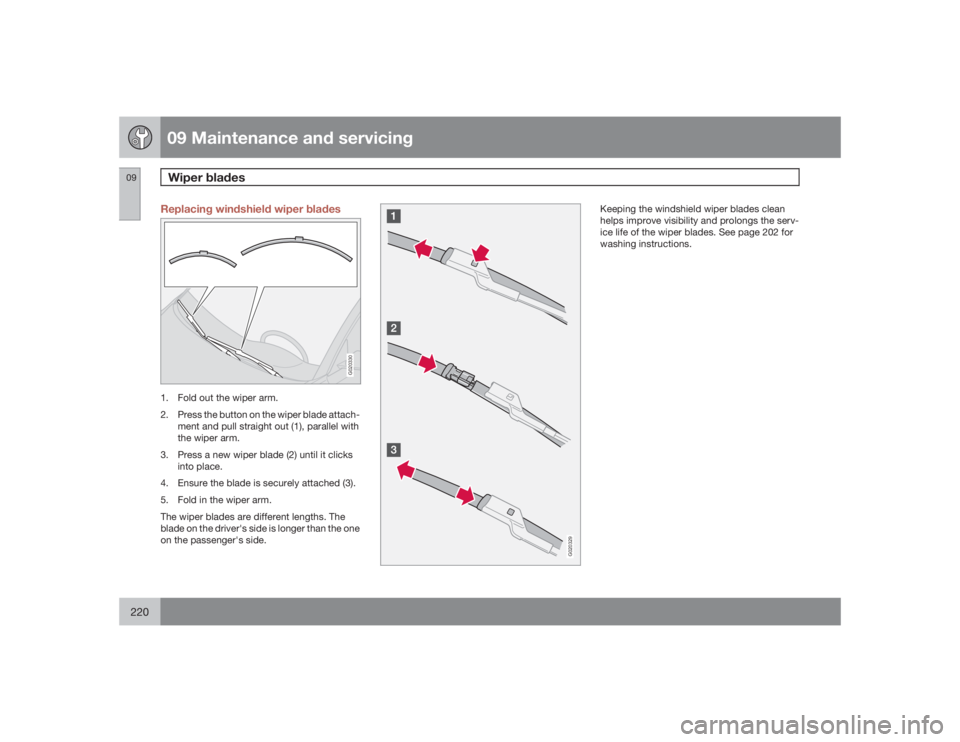
Replacing windshield wiper blades
G020330
1. Fold out the wiper arm.
2. Press the button on the wiper blade attach-
ment and pull straight out (1), parallel with
the wiper arm.
3. Press a new wiper blade (2) until it clicks
into place.
4. Ensure the blade is securely attached (3).
5. Fold in the wiper arm.
The wiper blades are different lengths. The
blade on the driver's side is longer than the one
on the passenger's side.
G020329
Keeping the windshield wiper blades clean
helps improve visibility and prolongs the serv-
ice life of the wiper blades. See page 202 for
washing instructions.
Page 221 of 286
09 Maintenance and servicing
Battery
09``221 Battery maintenance
Driving habits and conditions, climate, the
number of starts, etc., all affect the service life
and function of the battery. In order for your
battery to perform satisfactorily, keep the fol-
lowing in mind:
Check the fluid level in each cell in the battery
every 24 months or every 15,000
1 miles
(24,000 km), whichever is sooner.
•
Use a screw driver to open the caps or
cover and a flashlight to inspect the level.
•
If necessary, add distilled water. The level
should never be above the indicator.
•
The fluid level should be checked if the
battery has been recharged.
•
After inspection, be sure the cap over each
battery cell or the cover is securely in
place.
•
Check that the battery cables are correctly
connected and properly tightened.
•
Never disconnect the battery when the
engine is running, or when the key is in the
ignition. This could damage the vehicle's
electrical system.
•
The battery should be disconnected from
the vehicle when a battery charger is used
directly on the battery.
WARNING
PROPOSITION 65 WARNING!
Battery posts, terminals, and related acces-
sories contain lead and lead compounds,
chemicals known to the state of California
to cause cancer and reproductive harm.
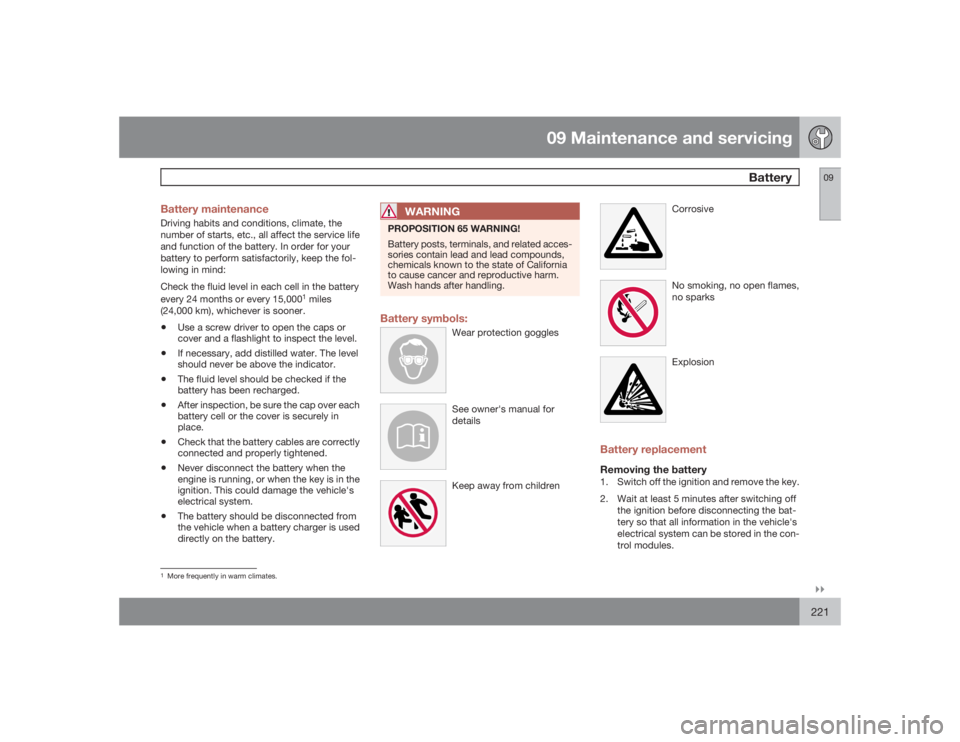
Wash hands after handling.Battery symbols:
Wear protection gogglesSee owner's manual for
detailsKeep away from children
CorrosiveNo smoking, no open flames,
no sparksExplosion
Battery replacementRemoving the battery1. Switch off the ignition and remove the key.
2. Wait at least 5 minutes after switching off
the ignition before disconnecting the bat-
tery so that all information in the vehicle's
electrical system can be stored in the con-
trol modules.
1More frequently in warm climates.
Page 234 of 286
09 Maintenance and servicingFuses
09234
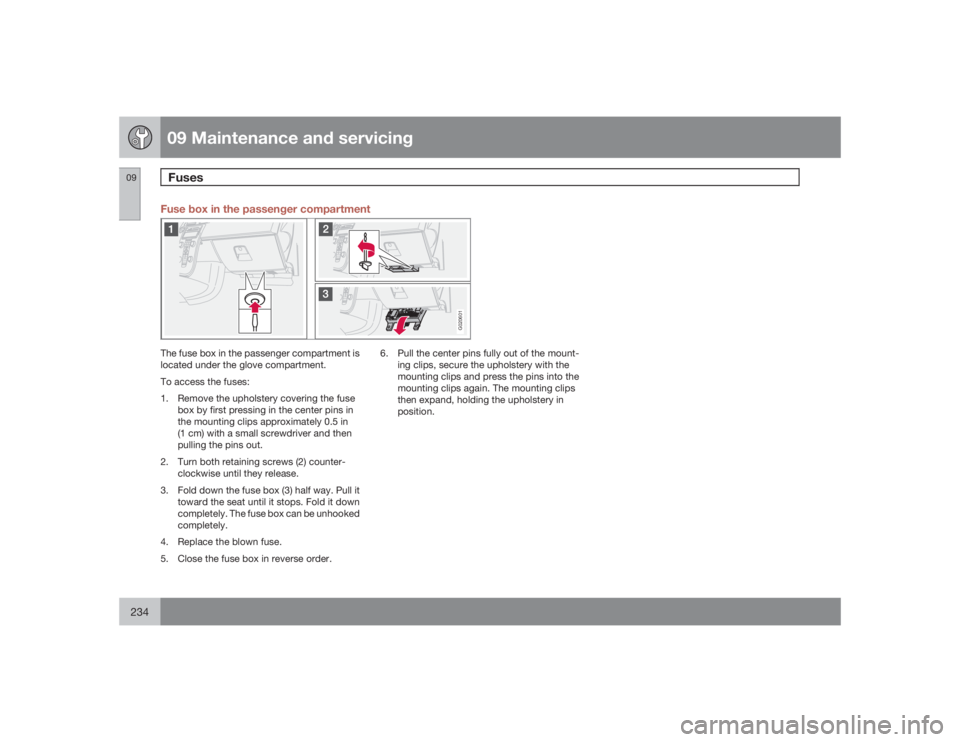
Fuse box in the passenger compartment
G020601
The fuse box in the passenger compartment is
located under the glove compartment.
To access the fuses:
1. Remove the upholstery covering the fuse
box by first pressing in the center pins in
the mounting clips approximately 0.5 in
(1 cm) with a small screwdriver and then
pulling the pins out.
2. Turn both retaining screws (2) counter-
clockwise until they release.
3. Fold down the fuse box (3) half way. Pull it
toward the seat until it stops. Fold it down
completely. The fuse box can be unhooked
completely.
4. Replace the blown fuse.
5. Close the fuse box in reverse order.6. Pull the center pins fully out of the mount-
ing clips, secure the upholstery with the
mounting clips and press the pins into the
mounting clips again. The mounting clips
then expand, holding the upholstery in
position.
Page 246 of 286
10 AudioRadio functions
10246
(see also "Selecting a channel" in the right
column).
2. Call Sirius at 1-888-539-SIRIUS (7474).
3. When asked for the Sirius ID number press
AUTO to display this number. It is also
possible to retrieve the Sirius ID from the
MENU.
4.
"UPDATING SUBSCRIPTION
" will be
displayed while the subscription is being
updated, after which the display will return
to the normal view.
SIRUS ID
The SIRIUS ID is required when contacting the
Sirius Call Center. It is used to activate your
account and when making any account trans-
actions. The SIRIUS ID is sometimes referred
to as the Electronic Serial Number (ESN).
Selecting a channel category1. Select Sirius radio mode as described
above.
2.
PressENTER.
3. Use the up/down arrow keys to scroll
through the list of categories.
4.
PressENTER or the right arrow key to
select a category.5. Use the left or right arrow keys to select a
channel in the currently chosen category.
6.
PressENTER to listen to a channel.
NOTE
•
The category "All" is default, which ena-
bles you to scroll through the entire list
of available satellite channels.
•
The channel categories are automati-
cally updated several times a year. This
takes approximately two minutes and
will interrupt normal broadcasting. A
message will be displayed while updat-
ing is in progress. Information on chan-
nel or feature updates is available at
www.sirius.com.
Selecting a channelThere are three ways of tuning in a channel:•
Using the left and right arrow keys
•
By turning the tuning control
•
Through direct channel entry
Direct channel entryThe Sirius satellite channels are numbered
consecutively throughout all of the categories.
To access a channel directly:1.
PressMENU and scroll to "Direct channel
entry."
2. Use the numerical keypad to enter the
channel's number.
3.
PressENTER. The radio will tune to this
channel, even if it belongs to a category
other than the currently selected one.
NOTE
•
The numbers of skipped or locked
channels will not be displayed.
•
If a channel is locked, the access code
must be entered before the channel can
be selected. See "Unlocking a channel"
on page 247.
Scanning
NOTE
SCAN automatically searches through the
list of satellite channels. see page 245 for
more detailed information.Storing a channel•
Along press on one of the number keys
stores the currently tuned channel on that
key.
•
Ashort press on a number key while the
radio is in Sirius 1or 2 mode will tune to the