child lock VOLVO S40 2011 Owner´s Manual
[x] Cancel search | Manufacturer: VOLVO, Model Year: 2011, Model line: S40, Model: VOLVO S40 2011Pages: 294, PDF Size: 6.69 MB
Page 5 of 294
Contents
* Option/accessory, for more information, see Introduction.5
03
03 Climate
General information.................................. 94
Air vents.................................................... 96
Manual climate control.............................. 97
Electronic Climate Control (ECC)*.......... 100
Air distribution......................................... 103
04
04 Interior
Front seats.............................................. 106
Interior lighting........................................ 110
Storage compartments........................... 112
Rear seat................................................. 115
Trunk ...................................................... 118
05
05 Locks and alarm
Remote key and key blade..................... 122
Valet locking ........................................... 126
Keyless drive*.......................................... 127
Locking and unlocking............................ 131
Child safety locks.................................... 133
Alarm*..................................................... 134
Page 20 of 294
01 Safety
Seat belts 01
20
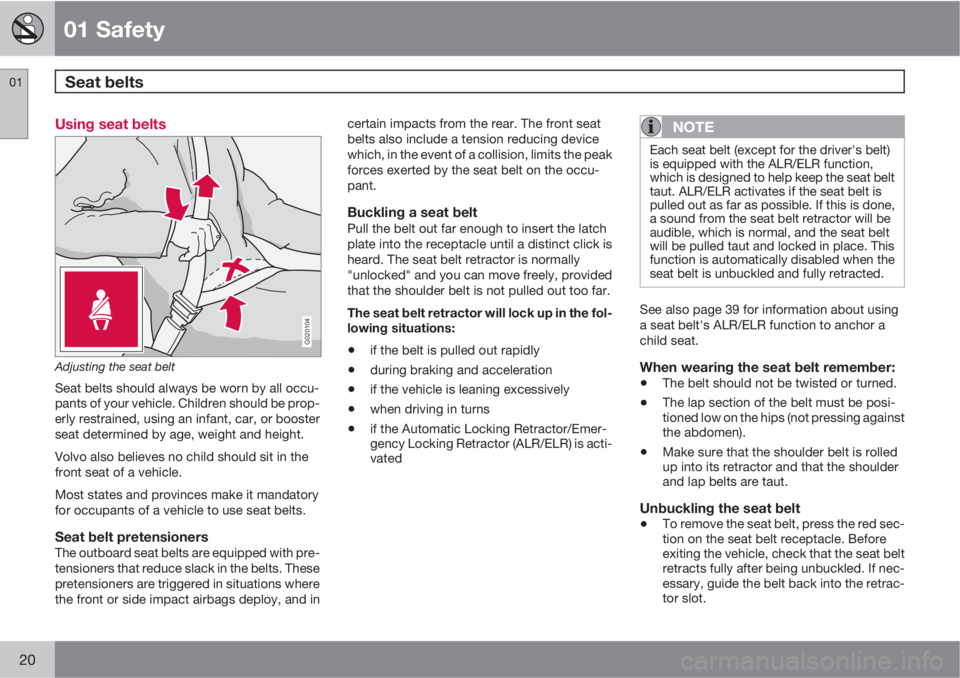
Using seat belts
G020104
Adjusting the seat belt
Seat belts should always be worn by all occu-
pants of your vehicle. Children should be prop-
erly restrained, using an infant, car, or booster
seat determined by age, weight and height.
Volvo also believes no child should sit in the
front seat of a vehicle.
Most states and provinces make it mandatory
for occupants of a vehicle to use seat belts.
Seat belt pretensionersThe outboard seat belts are equipped with pre-
tensioners that reduce slack in the belts. These
pretensioners are triggered in situations where
the front or side impact airbags deploy, and incertain impacts from the rear. The front seat
belts also include a tension reducing device
which, in the event of a collision, limits the peak
forces exerted by the seat belt on the occu-
pant.
Buckling a seat beltPull the belt out far enough to insert the latch
plate into the receptacle until a distinct click is
heard. The seat belt retractor is normally
"unlocked" and you can move freely, provided
that the shoulder belt is not pulled out too far.
The seat belt retractor will lock up in the fol-
lowing situations:
•if the belt is pulled out rapidly
•during braking and acceleration
•if the vehicle is leaning excessively
•when driving in turns
•if the Automatic Locking Retractor/Emer-
gency Locking Retractor (ALR/ELR) is acti-
vated
NOTE
Each seat belt (except for the driver's belt)
is equipped with the ALR/ELR function,
which is designed to help keep the seat belt
taut. ALR/ELR activates if the seat belt is
pulled out as far as possible. If this is done,
a sound from the seat belt retractor will be
audible, which is normal, and the seat belt
will be pulled taut and locked in place. This
function is automatically disabled when the
seat belt is unbuckled and fully retracted.
See also page 39 for information about using
a seat belt's ALR/ELR function to anchor a
child seat.
When wearing the seat belt remember:
•The belt should not be twisted or turned.
•The lap section of the belt must be posi-
tioned low on the hips (not pressing against
the abdomen).
•Make sure that the shoulder belt is rolled
up into its retractor and that the shoulder
and lap belts are taut.
Unbuckling the seat belt
•To remove the seat belt, press the red sec-
tion on the seat belt receptacle. Before
exiting the vehicle, check that the seat belt
retracts fully after being unbuckled. If nec-
essary, guide the belt back into the retrac-
tor slot.
Page 30 of 294
01 Safety
Occupant Weight Sensor (OWS) 01
30
example by altering or adapting the driver's or
front passenger's seat(s) and/or airbag sys-
tems, please contact Volvo at:
In the USA
Volvo Cars of North America, LLC
Customer Care Center
1 Volvo Drive
P.O. Box 914
Rockleigh, New Jersey 07647
1-800-458-1552
In Canada
Volvo Cars of Canada Corp.
National Customer Service
175 Gordon Baker Road North York, Ontario
M2H 2N7
1-800-663-8255WARNING
•No objects that add to the total weight
on the seat should be placed on the
front passenger's seat. If a child is
seated in the front passenger's seat
with any additional weight, this extra
weight could cause the OWS system to
enable the airbag, which might cause it
to deploy in the event of a collision,
thereby injuring the child.
•The seat belt should never be wrapped
around an object on the front passeng-
er's seat. This could interfere with the
OWS system's function.
•The front passenger's seat belt should
never be used in a way that exerts more
pressure on the passenger than normal.
This could increase the pressure exer-
ted on the weight sensor by a child, and
could result in the airbag being enabled,
which might cause it to deploy in the
event of a collision, thereby injuring the
child.
WARNING
Keep the following points in mind with
respect to the OWS system. Failure to follow
these instructions could adversely affect the
system's function and result in serious injury
to the occupant of the front passenger's
seat:
•The full weight of the front seat passen-
ger should always be on the seat cush-
ion. The passenger should never lift
him/herself off the seat cushion using
the armrest in the door or the center
console, by pressing the feet on the
floor, by sitting on the edge of the seat
cushion, or by pressing against the
backrest in a way that reduces pressure
on the seat cushion. This could cause
OWS to disable the passenger's side
front airbag.
•Do not place any type of object on the
front passenger's seat in such a way
that jamming, pressing, or squeezing
occurs between the object and the front
seat, other than as a direct result of the
correct use of the Automatic Locking
Retractor/Emergency Locking Retrac-
tor (ALR/ELR) seat belt, see page 39.
•No objects should be placed under the
front passenger's seat. This could inter-
fere with the OWS system's function.
Page 39 of 294
01 Safety
Child safety01
39 Automatic Locking Retractor/
Emergency Locking Retractor (ALR/
ELR)
To make child seat installation easier, each
seat belt (except for the driver's belt) is equip-
ped with a locking mechanism to help keep the
seat belt taut.
When attaching the seat belt to a child
seat:
1. Attach the seat belt to the child seat
according to the child seat manufacturer's
instructions.
2. Pull the seat belt out as far as possible.
3. Insert the seat belt latch plate into the
buckle (lock) in the usual way.
4. Release the seat belt and pull it taut around
the child seat.
A sound from the seat belt retractor will be
audible at this time and is normal. The belt will
now be locked in place. This function is auto-
matically disabled when the seat belt is
unlocked and the belt is fully retracted.
WARNING
Do not use child safety seats or child
booster cushions/backrests in the front
passenger's seat. We also recommend that
children who have outgrown these devices
sit in the rear seat with the seat belt properly
fastened.
Volvo's recommendationsWhy does Volvo believe that no child should sit
in the front seat of a car? It's quite simple really.
A front airbag is a very powerful device
designed, by law, to help protect an adult.
Because of the size of the airbag and its speed
of inflation, a child should never be placed in
the front seat, even if he or she is properly bel-
ted or strapped into a child safety seat. Volvo
has been an innovator in safety for over sev-
enty-five years, and we'll continue to do our
part. But we need your help. Please remember
to put your children in the back seat, and
buckle them up.
Volvo has some very specific
recommendations:
•Always wear your seat belt.
•Airbags are a SUPPLEMENTAL safety
device which, when used with a three-
point seat belt can help reduce serious
injuries during certain types of accidents.Volvo recommends that you do not dis-
connect the airbag system in your vehicle.
•Volvo strongly recommends that everyone
in the vehicle be properly restrained.
•Volvo recommends that ALL occupants
(adults and children) shorter than 4 feet
7 inches (140 cm) be seated in the back
seat of any vehicle with a front passenger
side airbag.
•Drive safely!
Page 42 of 294
01 Safety
Infant seats 01
42
Securing an infant seat with a seat belt
G026417
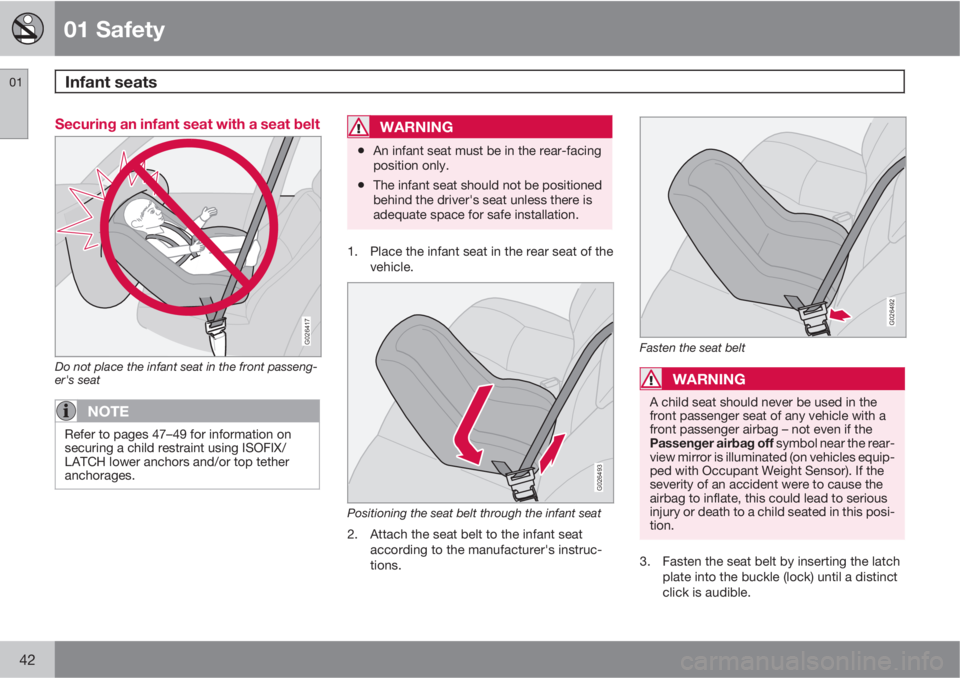
Do not place the infant seat in the front passeng-
er's seat
NOTE
Refer to pages 47–49 for information on
securing a child restraint using ISOFIX/
LATCH lower anchors and/or top tether
anchorages.
WARNING
•An infant seat must be in the rear-facing
position only.
•The infant seat should not be positioned
behind the driver's seat unless there is
adequate space for safe installation.
1. Place the infant seat in the rear seat of the
vehicle.
G026493
Positioning the seat belt through the infant seat
2. Attach the seat belt to the infant seat
according to the manufacturer's instruc-
tions.
G026492
Fasten the seat belt
WARNING
A child seat should never be used in the
front passenger seat of any vehicle with a
front passenger airbag – not even if the
Passenger airbag off symbol near the rear-
view mirror is illuminated (on vehicles equip-
ped with Occupant Weight Sensor). If the
severity of an accident were to cause the
airbag to inflate, this could lead to serious
injury or death to a child seated in this posi-
tion.
3. Fasten the seat belt by inserting the latch
plate into the buckle (lock) until a distinct
click is audible.
Page 43 of 294
01 Safety
Infant seats01
43
G026494
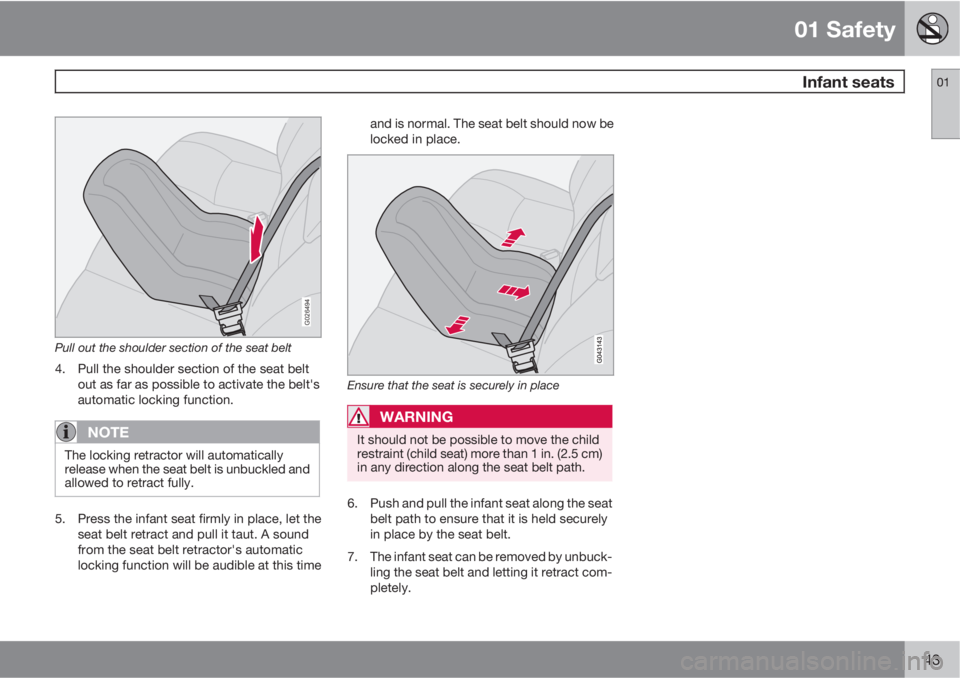
Pull out the shoulder section of the seat belt
4. Pull the shoulder section of the seat belt
out as far as possible to activate the belt's
automatic locking function.
NOTE
The locking retractor will automatically
release when the seat belt is unbuckled and
allowed to retract fully.
5. Press the infant seat firmly in place, let the
seat belt retract and pull it taut. A sound
from the seat belt retractor's automatic
locking function will be audible at this timeand is normal. The seat belt should now be
locked in place.
Ensure that the seat is securely in place
WARNING
It should not be possible to move the child
restraint (child seat) more than 1 in. (2.5 cm)
in any direction along the seat belt path.
6. Push and pull the infant seat along the seat
belt path to ensure that it is held securely
in place by the seat belt.
7. The infant seat can be removed by unbuck-
ling the seat belt and letting it retract com-
pletely.
Page 45 of 294
01 Safety
Convertible seats01
45
G026500
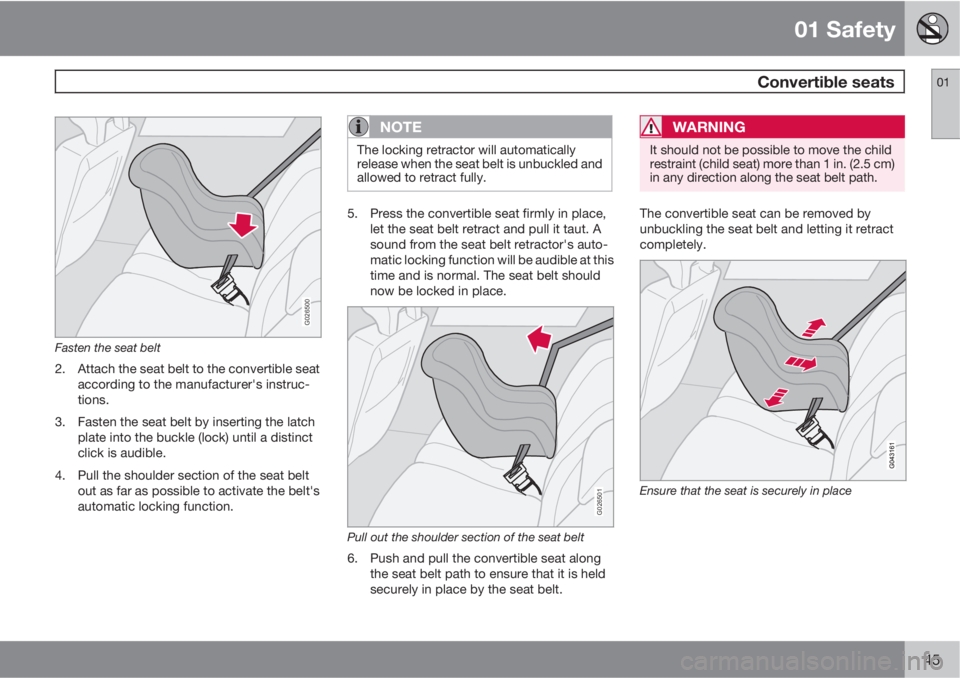
Fasten the seat belt
2. Attach the seat belt to the convertible seat
according to the manufacturer's instruc-
tions.
3. Fasten the seat belt by inserting the latch
plate into the buckle (lock) until a distinct
click is audible.
4. Pull the shoulder section of the seat belt
out as far as possible to activate the belt's
automatic locking function.
NOTE
The locking retractor will automatically
release when the seat belt is unbuckled and
allowed to retract fully.
5. Press the convertible seat firmly in place,
let the seat belt retract and pull it taut. A
sound from the seat belt retractor's auto-
matic locking function will be audible at this
time and is normal. The seat belt should
now be locked in place.
G026501
Pull out the shoulder section of the seat belt
6. Push and pull the convertible seat along
the seat belt path to ensure that it is held
securely in place by the seat belt.
WARNING
It should not be possible to move the child
restraint (child seat) more than 1 in. (2.5 cm)
in any direction along the seat belt path.
The convertible seat can be removed by
unbuckling the seat belt and letting it retract
completely.
Ensure that the seat is securely in place
Page 46 of 294
01 Safety
Booster cushions 01
46
Securing a booster cushion
G026489
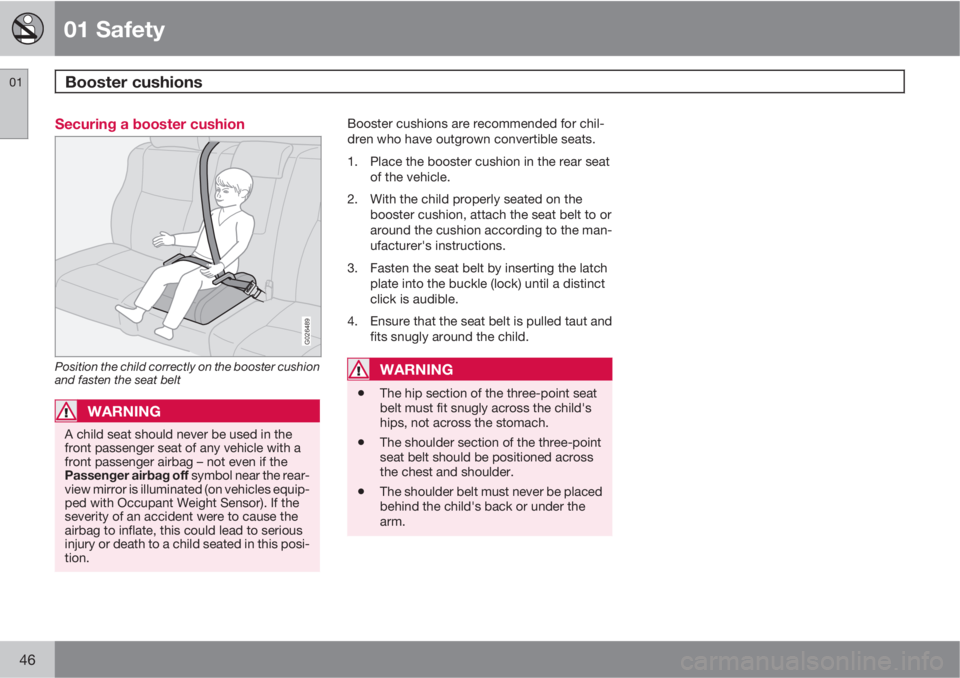
Position the child correctly on the booster cushion
and fasten the seat belt
WARNING
A child seat should never be used in the
front passenger seat of any vehicle with a
front passenger airbag – not even if the
Passenger airbag off symbol near the rear-
view mirror is illuminated (on vehicles equip-
ped with Occupant Weight Sensor). If the
severity of an accident were to cause the
airbag to inflate, this could lead to serious
injury or death to a child seated in this posi-
tion.
Booster cushions are recommended for chil-
dren who have outgrown convertible seats.
1. Place the booster cushion in the rear seat
of the vehicle.
2. With the child properly seated on the
booster cushion, attach the seat belt to or
around the cushion according to the man-
ufacturer's instructions.
3. Fasten the seat belt by inserting the latch
plate into the buckle (lock) until a distinct
click is audible.
4. Ensure that the seat belt is pulled taut and
fits snugly around the child.
WARNING
•The hip section of the three-point seat
belt must fit snugly across the child's
hips, not across the stomach.
•The shoulder section of the three-point
seat belt should be positioned across
the chest and shoulder.
•The shoulder belt must never be placed
behind the child's back or under the
arm.
Page 49 of 294
01 Safety
Top tether anchors01
49 Top tether anchors
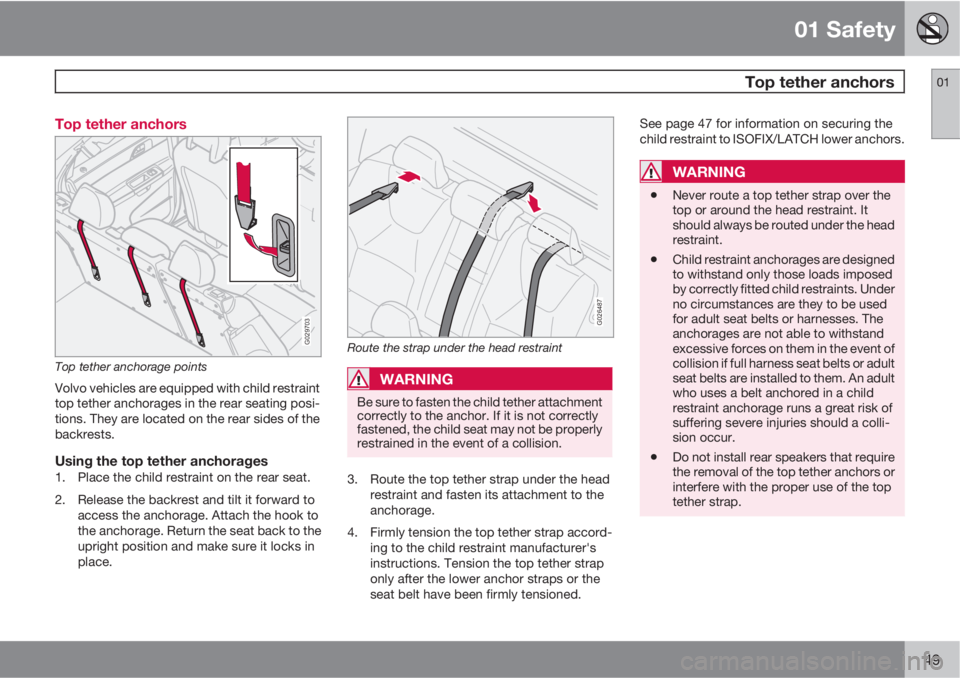
G029703
Top tether anchorage points
Volvo vehicles are equipped with child restraint
top tether anchorages in the rear seating posi-
tions. They are located on the rear sides of the
backrests.
Using the top tether anchorages1. Place the child restraint on the rear seat.
2. Release the backrest and tilt it forward to
access the anchorage. Attach the hook to
the anchorage. Return the seat back to the
upright position and make sure it locks in
place.
G026487
Route the strap under the head restraint
WARNING
Be sure to fasten the child tether attachment
correctly to the anchor. If it is not correctly
fastened, the child seat may not be properly
restrained in the event of a collision.
3. Route the top tether strap under the head
restraint and fasten its attachment to the
anchorage.
4. Firmly tension the top tether strap accord-
ing to the child restraint manufacturer's
instructions. Tension the top tether strap
only after the lower anchor straps or the
seat belt have been firmly tensioned.See page 47 for information on securing the
child restraint to ISOFIX/LATCH lower anchors.
WARNING
•Never route a top tether strap over the
top or around the head restraint. It
should always be routed under the head
restraint.
•Child restraint anchorages are designed
to withstand only those loads imposed
by correctly fitted child restraints. Under
no circumstances are they to be used
for adult seat belts or harnesses. The
anchorages are not able to withstand
excessive forces on them in the event of
collision if full harness seat belts or adult
seat belts are installed to them. An adult
who uses a belt anchored in a child
restraint anchorage runs a great risk of
suffering severe injuries should a colli-
sion occur.
•Do not install rear speakers that require
the removal of the top tether anchors or
interfere with the proper use of the top
tether strap.
Page 78 of 294
02 Instruments and controls
Power windows
02
78
Operation
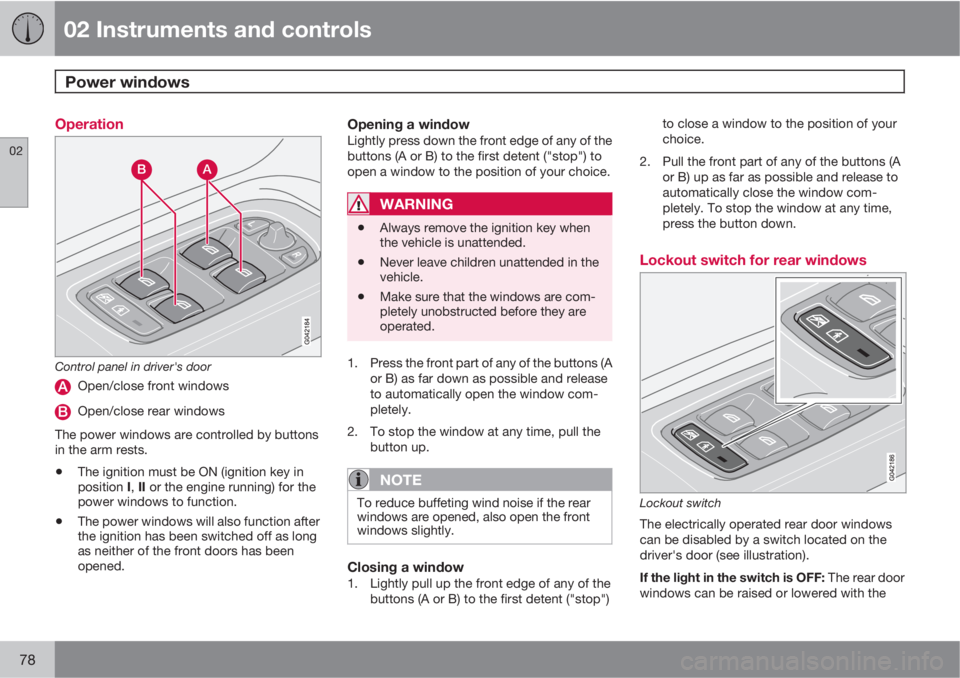
Control panel in driver's door
Open/close front windows
Open/close rear windows
The power windows are controlled by buttons
in the arm rests.
•The ignition must be ON (ignition key in
position I, II or the engine running) for the
power windows to function.
•The power windows will also function after
the ignition has been switched off as long
as neither of the front doors has been
opened.
Opening a windowLightly press down the front edge of any of the
buttons (A or B) to the first detent ("stop") to
open a window to the position of your choice.
WARNING
•Always remove the ignition key when
the vehicle is unattended.
•Never leave children unattended in the
vehicle.
•Make sure that the windows are com-
pletely unobstructed before they are
operated.
1. Press the front part of any of the buttons (A
or B) as far down as possible and release
to automatically open the window com-
pletely.
2. To stop the window at any time, pull the
button up.
NOTE
To reduce buffeting wind noise if the rear
windows are opened, also open the front
windows slightly.
Closing a window1. Lightly pull up the front edge of any of the
buttons (A or B) to the first detent ("stop")to close a window to the position of your
choice.
2. Pull the front part of any of the buttons (A
or B) up as far as possible and release to
automatically close the window com-
pletely. To stop the window at any time,
press the button down.
Lockout switch for rear windows
Lockout switch
The electrically operated rear door windows
can be disabled by a switch located on the
driver's door (see illustration).
If the light in the switch is OFF: The rear door
windows can be raised or lowered with the