mirror VOLVO S60 2001 User Guide
[x] Cancel search | Manufacturer: VOLVO, Model Year: 2001, Model line: S60, Model: VOLVO S60 2001Pages: 128, PDF Size: 2.52 MB
Page 58 of 128

You can disconnect the automatic function by pressing the courtesy light button for more than 3 seconds. Briefly
pressing the courtesy light button again automatically reconnects the function.
The courtesy light timer periods can be changed. Contact your Volvo retailer.
Reading lights - front/ rear
The reading lights can be switched on or off by pressing the respective buttons. These lights switch off automatically
after 10 minutes if the engine is not running. If the engine is running, the lights stay on indefinitely. The lights can be
switched off at any time by pressing the button.
pg. 105 Floor mats (option)
Vanity mirror
The light comes on when you open the cover.
Floor mats (option)
Volvo offers floor mats specially manufactured for your car. They must be properly placed and secured in the mat
clips.
WARNING!
An extra mat on the driver's floor can cause the accelerator pedal to catch. Check that the movement of the
accelerator pedal is not impeded. No more than one protective floor covering may be used at one time.
ProCarManuals.com
Page 79 of 128
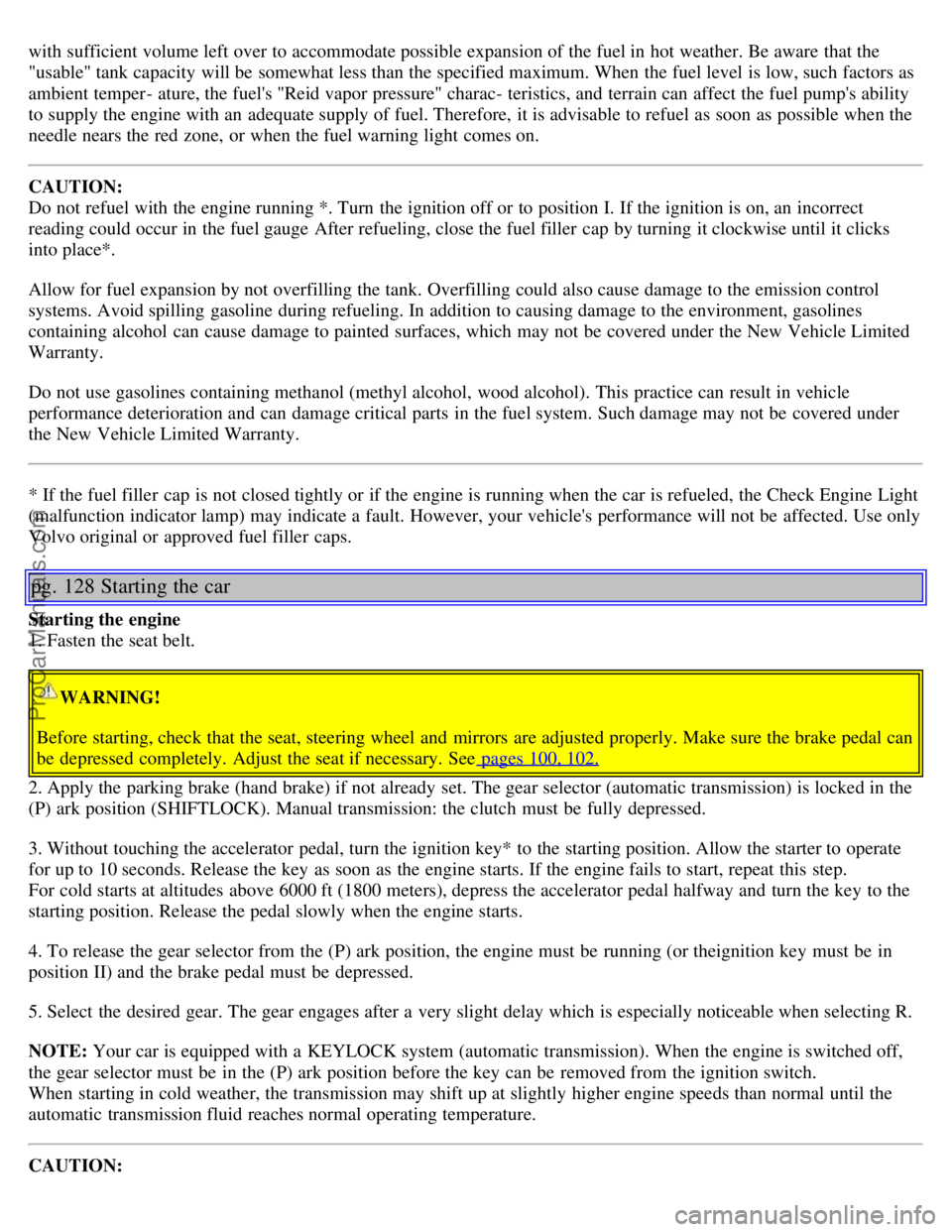
with sufficient volume left over to accommodate possible expansion of the fuel in hot weather. Be aware that the
"usable" tank capacity will be somewhat less than the specified maximum. When the fuel level is low, such factors as
ambient temper- ature, the fuel's "Reid vapor pressure" charac- teristics, and terrain can affect the fuel pump's ability
to supply the engine with an adequate supply of fuel. Therefore, it is advisable to refuel as soon as possible when the
needle nears the red zone, or when the fuel warning light comes on.
CAUTION:
Do not refuel with the engine running *. Turn the ignition off or to position I. If the ignition is on, an incorrect
reading could occur in the fuel gauge After refueling, close the fuel filler cap by turning it clockwise until it clicks
into place*.
Allow for fuel expansion by not overfilling the tank. Overfilling could also cause damage to the emission control
systems. Avoid spilling gasoline during refueling. In addition to causing damage to the environment, gasolines
containing alcohol can cause damage to painted surfaces, which may not be covered under the New Vehicle Limited
Warranty.
Do not use gasolines containing methanol (methyl alcohol, wood alcohol). This practice can result in vehicle
performance deterioration and can damage critical parts in the fuel system. Such damage may not be covered under
the New Vehicle Limited Warranty.
* If the fuel filler cap is not closed tightly or if the engine is running when the car is refueled, the Check Engine Light
(malfunction indicator lamp) may indicate a fault. However, your vehicle's performance will not be affected. Use only
Volvo original or approved fuel filler caps.
pg. 128 Starting the car
Starting the engine
1. Fasten the seat belt.
WARNING!
Before starting, check that the seat, steering wheel and mirrors are adjusted properly. Make sure the brake pedal can
be depressed completely. Adjust the seat if necessary. See pages 100, 102.
2. Apply the parking brake (hand brake) if not already set. The gear selector (automatic transmission) is locked in the
(P) ark position (SHIFTLOCK). Manual transmission: the clutch must be fully depressed.
3. Without touching the accelerator pedal, turn the ignition key* to the starting position. Allow the starter to operate
for up to 10 seconds. Release the key as soon as the engine starts. If the engine fails to start, repeat this step.
For cold starts at altitudes above 6000 ft (1800 meters), depress the accelerator pedal halfway and turn the key to the
starting position. Release the pedal slowly when the engine starts.
4. To release the gear selector from the (P) ark position, the engine must be running (or theignition key must be in
position II) and the brake pedal must be depressed.
5. Select the desired gear. The gear engages after a very slight delay which is especially noticeable when selecting R.
NOTE: Your car is equipped with a KEYLOCK system (automatic transmission). When the engine is switched off,
the gear selector must be in the (P) ark position before the key can be removed from the ignition switch.
When starting in cold weather, the transmission may shift up at slightly higher engine speeds than normal until the
automatic transmission fluid reaches normal operating temperature.
CAUTION:
ProCarManuals.com
Page 98 of 128

Automatic car wash
An automatic car wash is a simple and quick way of washing the car. Bear in mind, however, that an automatic car
wash can never replace a proper handwashing. During the first months of the car's life - while the paint is still curing
- we recommend that you handwash the car.
WARNING!
When the car is driven immediately after being washed, apply the brakes several times in order to remove any
moisture from the brake linings. Engine cleaning agents should not be used when the engine is warm. This
constitutes a fire risk.
Automatic washing - simple and quick
We do NOT recommend washing your car in an automatic wash during the first six months (because the paint will
not have hardened sufficiently).
An automatic wash is a simple and quick way to clean your car, but it is worth remembering that it may not be as
pg. 161 Washing and cleaning the car
thorough as when you yourself go over the car with sponge and water. Keeping the underbody clean is most
important, especially in the winter. Some automatic washers do not have facilities for washing the underbody.
Before driving into an automatic car wash, make sure that side view mirrors, auxiliary lamps, etc, are secure, and
that any antenna( s) are retracted or removed. Otherwise there is risk of the machine dislodging them.
Polishing and Waxing
Normally, polishing is not required during the first year after delivery, however, waxing may be beneficial.
Before applying polish or wax the car must be washed and dried. Tar spots can be removed with kerosene or tar
remover. Difficult spots may require a fine rubbing compound.
After polishing use liquid or paste wax.
Several commercially available products contain both polish and wax.
Waxing alone does not substitute for polishing a dull surface.
A wide range of polymer- based car waxes can be purchased today. These waxes are easy to use and produce a
long-lasting, high- gloss finish that protects thebodywork against oxidation, road dirt and fading.
Do not polish or wax your car in direct sunlight (the surface of the car should not be warmer than 113° F (45° C).
Cleaning the upholstery
The fabric can be cleaned with soapy water or a detergent. For more difficult spots caused by oil, ice cream, shoe
polish, grease, etc., use a clothing/ fabric stain remover.
The plastic in the upholstery can be cleaned with a soft cloth and mild soap solution.
Leather upholstery/ suede- like upholstery (alcanteraª) can be cleaned with a soft cloth and mild soap solution. For
more difficult spots, Volvo offers a leather care kit.
Under no circumstances should gasoline, naphtha or similar cleaning agents be used on the plastic or the leather
since these can cause damage.
Cleaning the seat belts
Clean only with lukewarm water and a mild soap solution.
Cleaning floor mats
The floor mats should be vacuumed or brushed clean regularly, especially during winter when they should be taken
out for drying. Spots on textile mats can be removed with a mild detergent.
ProCarManuals.com
Page 116 of 128

Glove compartment lighting2 WBA 9 s
Vanity mirror 1.2 WSV 5.5
pg. 199 Electrical system
Electrical system
12- volt system with voltage controlled generator. Single wire system in which the chassis and engine block are used
as conductors, grounded on the chassis.
Battery
Voltage 12 V
Cold start capacity (CCA) 600 A
Reserve capacity (RC) 115 min
If you must replace your battery, be sure to replace it with a battery of the same cold start capacity and reserve
capacity as the original (See the decal on the battery).
Generator max. current 120 A
Starter motor, power 1.4 kW
Spark plugs P/ N272313- 8 or equivalent
Gap 0.028- 0.032 in. 0.7- 0.8 mm
Tightening torque 22 ft. lbs. (30 Nm)
Firing order 1- 2- 4- 5- 3
Replacing spark plugs
The spark plugs should be changed every 30,000 miles (48,000 km). However, city driving or fast highway driving
may necessitate changing after 15,000 miles (24,000 km) of driving. When installing new plugs, be sure to fit the
right type and use correct torque. When changing the plugs, check that the suppressor connectors are in good
condition. Cracked or damaged connectors should be replaced. When changing the spark plugs, clean the terminals
and the rubber seals.
WARNING!
The distributor ignition system operates at very high voltages. Special safety precautions must be followed to
prevent injury. Always turn the ignition off when:
áReplacing distributor ignition components e. g. plugs, coil, etc.
áDo not touch any part of the distributor ignition system while the engine is running. This may result in unintended
movements and body injury.
pg. 200 Engine specifications
Engine specifications
B5244SB5234T3 B5244T3
Output (kW/ rps) 125/ 98184/ 87 147/ 100
(hp/ rpm) 168/ 5900247/ 5200 197/ 6000
Torque (Nm/ rps) 230/ 75330/ 42- 87 285/ 30- 83
(ft. lbs./ rpm) 170/ 4500243/ 2500- 5200 210/ 1800- 5000
No. of cylinders 55 5
ProCarManuals.com
Page 121 of 128

Direction indicators40
Dolby Surround Pro Logic78
Door mirror defroster42
Door mirrors37
Driving economically130
DSTC (Dynamic Stability Traction Control)34 , 38
Dual - threshold airbags13
E
ECC54
Economical driving130
Electric socket38 , 45
Electrical system199
Electrically operated windows46
Engine - starting128
Engine compartment170
Engine oil171
Engine oil, capacity194
Engine specifications200
Engine oil - checking172
Environment3
F
Fan55
, 59
Federal Clean Air Act164
FIX NEXT SERVICE35
Floor mats105
Fog lamp33 , 183
Front seat - backrest101
Front seats100
Front seats - heated42
Front seats - manual adjustment100
Front seats - power102
Front seats - power(programming the memory)103
Front suspension197
Fuel2 , 126
Fuel filler cap2 , 127
Fuel filler door2 , 127
Fuel gauge30
Fuel tank, capacity194
Fuses186
G
Gasoline126
Gear position132
Geartronic135
Geartronic - kickdown136
ProCarManuals.com
Page 124 of 128
Radiator170
Radio65
Rain sensor41
Reading lamps104
Rear fog lights39
Rear seat111
Rear suspension197
Rear window defroster42 , 59
Rearview mirror/ door mirrors48
Recirculation56 , 60
REDUCE SPEED35
Refrigerant (A/ C system)52
Refueling126 , 127
Remote control - central locking system117
Replacing the battery177
Reporting safety defects28
Reverse gear inhibitor132
Roadholding131
Roof racks (load carriers)148
S
Safety9
Safety defects - reporting28
Seat belt10
Seat belt maintenance28
Seat belt reminder48
Seat belts (keeping child seats in place)27
SEE MANUAL35
Service164
Service reminder33
SERVICE REQUIRED35
SERVICE URGENT35
Shiftlock2 , 128
Side airbags18
Side marker lamp183
SIPS airbags18
Ski hatch112
Snow chains153
Snow tires153
Spare tires154
Spare wheel113
Spark plugs199
Specifications191
Speedometer30
Spoiler lamps39
ProCarManuals.com
Page 125 of 128
SRS12
Stability system139
Start inhibitor (immobilizer)116
Starter switch and steering wheel lock129
Starting the car128
STC (Stability Traction Control)34, 37, 139
Steering wheel adjustment36
Steering wheel lock129
Stone chips162
STOP ENGINE35
STOP SAFELY ASAP35
Storage compartments107
Storage compartments in the passenger compartment106
Studded tires153
Sun roof (electrically operated)49
Sun visor50
Supplemental Restraint System (SRS)12
Supplemental Restraint System (SRS) - warning light33
Suspension197
Switches in the center console37
T
Tachometer30
Temperature (climate control)55
Temperature gauge30
Temporary spare tire154
Text window - messages35
Tire economy - improving152
Tires152
Tires - tread wear indicators155
Tools113
Towing141
Towing a trailer144
Trailer indicator lamp33
Trailer towing144
Trip computer43
Trip odometer30
Trunk - unlocking120
Type designations192
U
Uniform Tire Quality Grading157
, 158
Unlocking119
Unlocking the trunk120
V
Vanity mirror105
ProCarManuals.com