brake pads VOLVO S60 2001 Owners Manual
[x] Cancel search | Manufacturer: VOLVO, Model Year: 2001, Model line: S60, Model: VOLVO S60 2001Pages: 128, PDF Size: 2.52 MB
Page 3 of 128
For Volvo, all homogeneous plastic parts weighing more than 1.7 oz. (50 grams) are marked with international
symbols that indicate how the component is to be sorted for recycling.
In addition to continuous environmental refinement of conventional gasoline- powered internal combustion engines,
Volvo is actively looking at advanced technology alternative- fuel vehicles.
When you drive a Volvo, you become our partner in the work to lessen the car's impact on the environment. To reduce
your vehicle's environmental impact, you can:
Maintain proper air pressure in your tires. Tests have shown decreased fuel economy with improperly inflated tires.
Follow the recommended maintenance schedule.
Drive at a constant speed.
See an authorized Volvo retailer as soon as possible for inspection if the check engine (malfunction indicator) lamp
illuminates, or stays on after the vehicle has started.
Properly dispose of any vehicle- related waste such as used motor oil, used batteries, brake pads, etc.
When cleaning your car, use Volvo's own car care products, all of which have systematically been adapted to the
environment.
For additional information regarding the environmental activities in which Volvo Cars of North America, Inc. and
Volvo Car Corporation are involved, visit our Internet Home Page at: http://www.volvocars.com
Prem-Air
On the surface of the radiator in the engine compartment, there is a special coating called Prem- Air. Prem- Air works
as a catalytic converter, converting most of the ground level ozone passing through the radiator into oxygen, thereby
reducing harmful ground-level ozone.
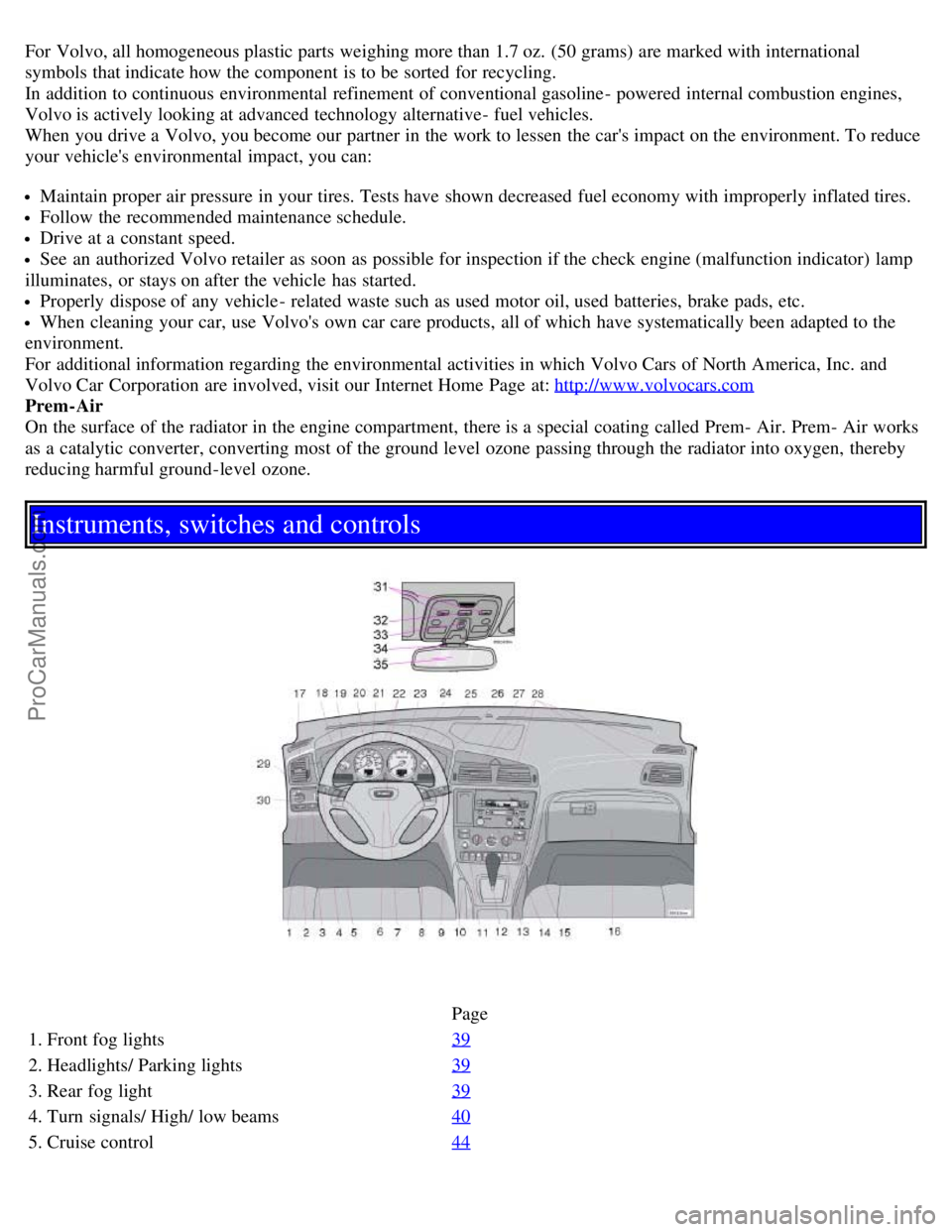
Instruments, switches and controls
Page
1. Front fog lights 39
2. Headlights/ Parking lights39
3. Rear fog light39
4. Turn signals/ High/ low beams40
5. Cruise control44
ProCarManuals.com
Page 26 of 128
For Volvo, all homogeneous plastic parts weighing more than 1.7 oz. (50 grams) are marked with international
symbols that indicate how the component is to be sorted for recycling.
In addition to continuous environmental refinement of conventional gasoline- powered internal combustion engines,
Volvo is actively looking at advanced technology alternative- fuel vehicles.
When you drive a Volvo, you become our partner in the work to lessen the car's impact on the environment. To reduce
your vehicle's environmental impact, you can:
Maintain proper air pressure in your tires. Tests have shown decreased fuel economy with improperly inflated tires.
Follow the recommended maintenance schedule.
Drive at a constant speed.
See an authorized Volvo retailer as soon as possible for inspection if the check engine (malfunction indicator) lamp
illuminates, or stays on after the vehicle has started.
Properly dispose of any vehicle- related waste such as used motor oil, used batteries, brake pads, etc.
When cleaning your car, use Volvo's own car care products, all of which have systematically been adapted to the
environment.
For additional information regarding the environmental activities in which Volvo Cars of North America, Inc. and
Volvo Car Corporation are involved, visit our Internet Home Page at: http://www.volvocars.com
Prem-Air
On the surface of the radiator in the engine compartment, there is a special coating called Prem- Air. Prem- Air works
as a catalytic converter, converting most of the ground level ozone passing through the radiator into oxygen, thereby
reducing harmful ground-level ozone.
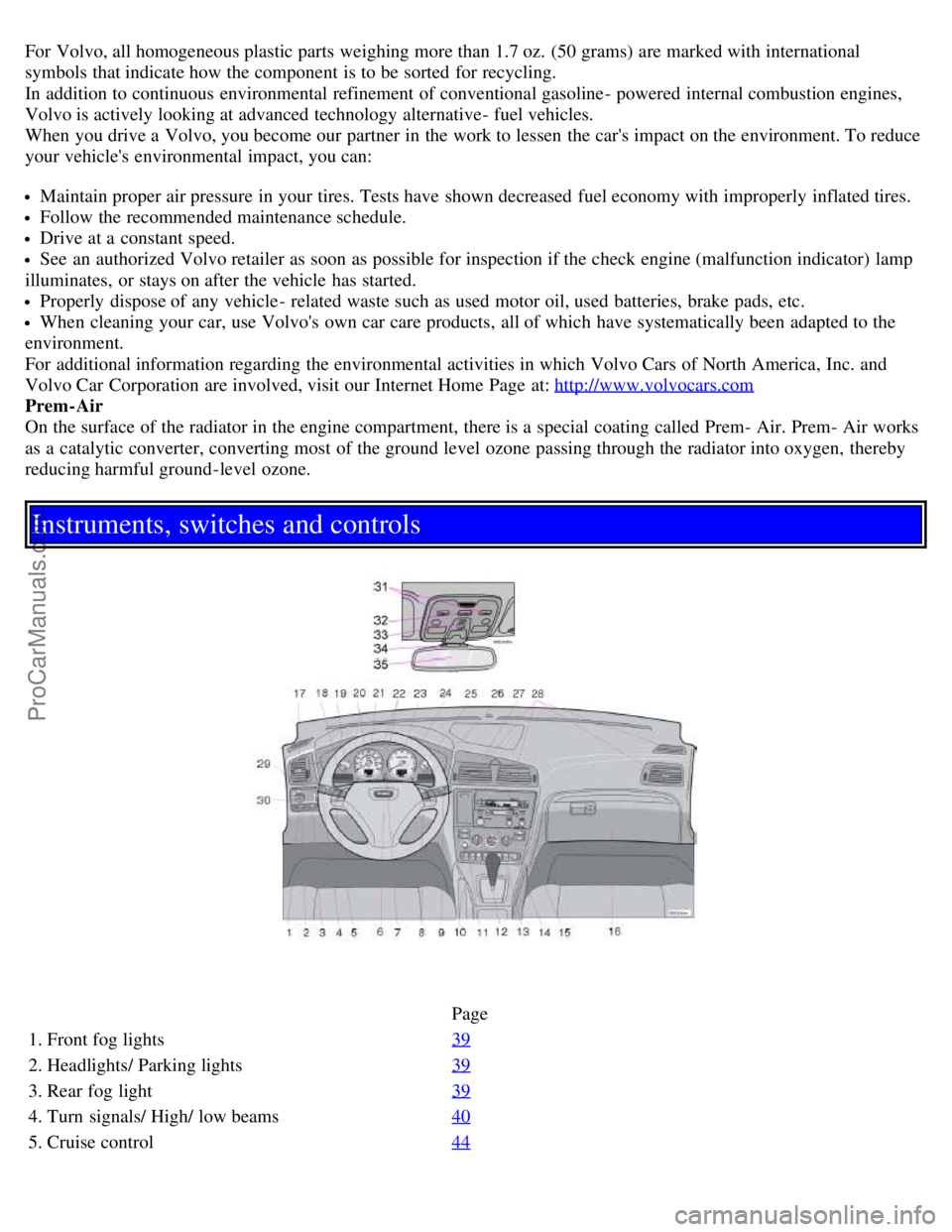
Instruments, switches and controls
Page
1. Front fog lights 39
2. Headlights/ Parking lights39
3. Rear fog light39
4. Turn signals/ High/ low beams40
5. Cruise control44
ProCarManuals.com
Page 87 of 128
If you slow down to a very low speed, the transmission will automatically shift down.
When starting in the (MAN) ual position, 3rd gear is the highest gear that may be selected.
NOTE: Kickdown does not function when the transmission is in the manual shift (Geartronic) mode.
Kickdown
Automatic shift to a lower gear (kickdown) is achieved by depressing the accelerator pedal fully and briskly. An
upshift will occur when approaching the top speed for a particular gear or by releasing the accelerator pedal slightly.
Kickdown can be used for maximum acceleration or when passing at highway speeds.
Kickdown does not function when the transmission is in the manual shift (Geartronic) mode.
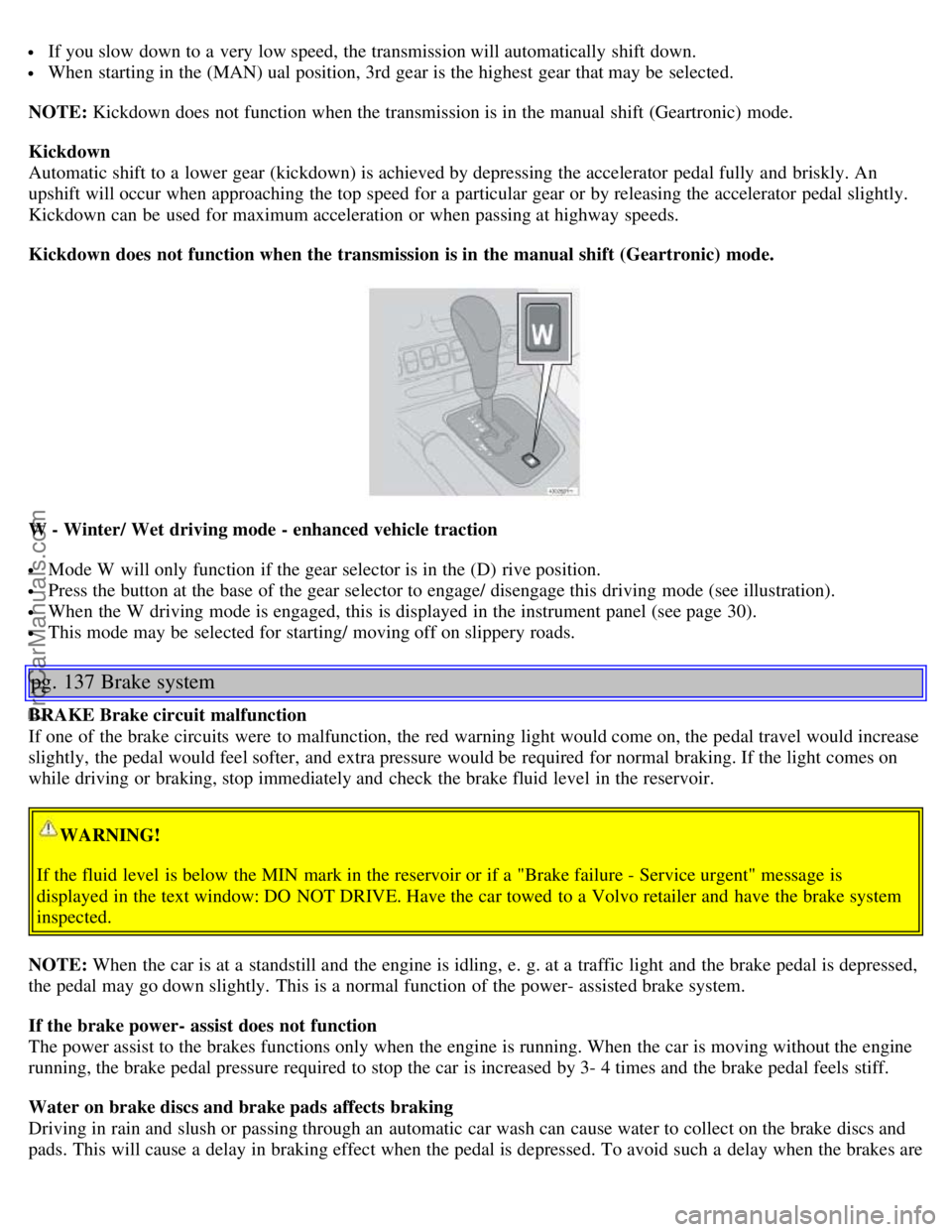
W - Winter/ Wet driving mode - enhanced vehicle traction
Mode W will only function if the gear selector is in the (D) rive position.
Press the button at the base of the gear selector to engage/ disengage this driving mode (see illustration).
When the W driving mode is engaged, this is displayed in the instrument panel (see page 30).
This mode may be selected for starting/ moving off on slippery roads.
pg. 137 Brake system
BRAKE Brake circuit malfunction
If one of the brake circuits were to malfunction, the red warning light would come on, the pedal travel would increase
slightly, the pedal would feel softer, and extra pressure would be required for normal braking. If the light comes on
while driving or braking, stop immediately and check the brake fluid level in the reservoir.
WARNING!
If the fluid level is below the MIN mark in the reservoir or if a "Brake failure - Service urgent" message is
displayed in the text window: DO NOT DRIVE. Have the car towed to a Volvo retailer and have the brake system
inspected.
NOTE: When the car is at a standstill and the engine is idling, e. g. at a traffic light and the brake pedal is depressed,
the pedal may go down slightly. This is a normal function of the power- assisted brake system.
If the brake power- assist does not function
The power assist to the brakes functions only when the engine is running. When the car is moving without the engine
running, the brake pedal pressure required to stop the car is increased by 3- 4 times and the brake pedal feels stiff.
Water on brake discs and brake pads affects braking
Driving in rain and slush or passing through an automatic car wash can cause water to collect on the brake discs and
pads. This will cause a delay in braking effect when the pedal is depressed. To avoid such a delay when the brakes are
ProCarManuals.com
Page 103 of 128

(thousand km)(12)(24)(36) (48)(60) (72)(84) (96)(108) (120)(132)(144)
EMISSION SYSTEM MAINTENANCE
Engine
Fuel line filter
1
PCV nipple (orifice)/hoses, clean I I
Battery (check charge and electrolyte level) II II II II I III
Brakes
Inspect brake pads, replace components as necessary I II II II I III
Brake fluid level
2 - check
I I I I I I
Steering/suspension
Tires
3, check pressure, wear and condition I
I II II II I III
Check power steering fluid level I I I I I I
Body
Power antenna (clean) L L L L L L
Trunk/hood, hinges and latches L L L L
Cabin air filter (see page 167
) R R R R R R
1) Replace at 105,000 miles (168,000 km)
2) Brake fluid should be changed at owner request every second year or 30,000 miles (48,000 km). The fluid
should be replaced once a year or every 15,000 miles (24,000 km) when driving under extremely hard
conditions (mountain driving, etc.).
3) Rotate tires at owner request.
The following items should be checked weekly by the driver (it takes only a few minutes):
Engine oil level, brake fluid level, radiator coolant level, operation of all lights, horns, windshield wipers, tire
pressure (all five tires), windshield washer fluid level
The following should also be carried out at regular intervals:
Washing (check all drain holes), polishing, cleaning
pg. 167 Maintenance Schedule
Air cleaner
Replace the air cleaner cartridge with a new one every 30,000 miles (48,000 km). The cartridge should be replaced
more often when driving under dirty and dusty conditions. The filter cannot be cleaned and therefore should always
be replaced with a new one.
Timing belt
For proper functioning of the vehicle and its emission control systems, the timing belt must be replaced every 105,000
miles (168,000 km). Engine damage will occur if the belt fails.
Fuel filler cap, tank and lines and
connections The effectiveness of the fuel system to contain hydrocarbons is dependent largely on a leak- free system.
Check for proper sealing of the fuel filler cap which contains "O" ring type seals. NOTE: If the fuel filler cap is not
closed tightly or if the engine is running when the car is refueled, the Malfunction Indicator Lamp (" Check Engine")
may indicate a fault. However, your vehicle's performance will not be affected. Use only Volvo original or approved
fuel filler caps.
ProCarManuals.com