wheel VOLVO S60 2001 Owner's Manual
[x] Cancel search | Manufacturer: VOLVO, Model Year: 2001, Model line: S60, Model: VOLVO S60 2001Pages: 128, PDF Size: 2.52 MB
Page 67 of 128
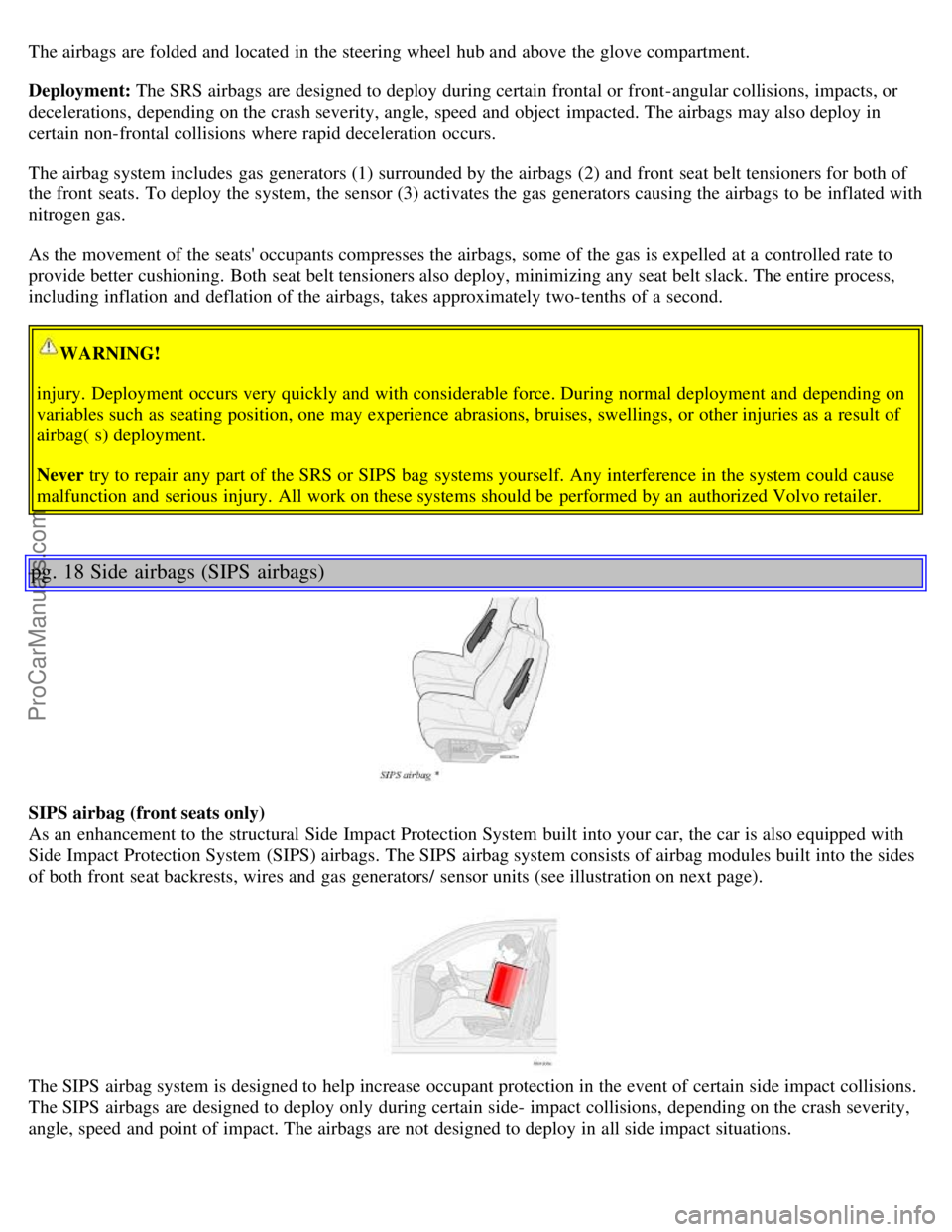
The airbags are folded and located in the steering wheel hub and above the glove compartment.
Deployment: The SRS airbags are designed to deploy during certain frontal or front -angular collisions, impacts, or
decelerations, depending on the crash severity, angle, speed and object impacted. The airbags may also deploy in
certain non-frontal collisions where rapid deceleration occurs.
The airbag system includes gas generators (1) surrounded by the airbags (2) and front seat belt tensioners for both of
the front seats. To deploy the system, the sensor (3) activates the gas generators causing the airbags to be inflated with
nitrogen gas.
As the movement of the seats' occupants compresses the airbags, some of the gas is expelled at a controlled rate to
provide better cushioning. Both seat belt tensioners also deploy, minimizing any seat belt slack. The entire process,
including inflation and deflation of the airbags, takes approximately two-tenths of a second.
WARNING!
injury. Deployment occurs very quickly and with considerable force. During normal deployment and depending on
variables such as seating position, one may experience abrasions, bruises, swellings, or other injuries as a result of
airbag( s) deployment.
Never try to repair any part of the SRS or SIPS bag systems yourself. Any interference in the system could cause
malfunction and serious injury. All work on these systems should be performed by an authorized Volvo retailer.
pg. 18 Side airbags (SIPS airbags)
SIPS airbag (front seats only)
As an enhancement to the structural Side Impact Protection System built into your car, the car is also equipped with
Side Impact Protection System (SIPS) airbags. The SIPS airbag system consists of airbag modules built into the sides
of both front seat backrests, wires and gas generators/ sensor units (see illustration on next page).
The SIPS airbag system is designed to help increase occupant protection in the event of certain side impact collisions.
The SIPS airbags are designed to deploy only during certain side- impact collisions, depending on the crash severity,
angle, speed and point of impact. The airbags are not designed to deploy in all side impact situations.
ProCarManuals.com
Page 79 of 128
with sufficient volume left over to accommodate possible expansion of the fuel in hot weather. Be aware that the
"usable" tank capacity will be somewhat less than the specified maximum. When the fuel level is low, such factors as
ambient temper- ature, the fuel's "Reid vapor pressure" charac- teristics, and terrain can affect the fuel pump's ability
to supply the engine with an adequate supply of fuel. Therefore, it is advisable to refuel as soon as possible when the
needle nears the red zone, or when the fuel warning light comes on.
CAUTION:
Do not refuel with the engine running *. Turn the ignition off or to position I. If the ignition is on, an incorrect
reading could occur in the fuel gauge After refueling, close the fuel filler cap by turning it clockwise until it clicks
into place*.
Allow for fuel expansion by not overfilling the tank. Overfilling could also cause damage to the emission control
systems. Avoid spilling gasoline during refueling. In addition to causing damage to the environment, gasolines
containing alcohol can cause damage to painted surfaces, which may not be covered under the New Vehicle Limited
Warranty.
Do not use gasolines containing methanol (methyl alcohol, wood alcohol). This practice can result in vehicle
performance deterioration and can damage critical parts in the fuel system. Such damage may not be covered under
the New Vehicle Limited Warranty.
* If the fuel filler cap is not closed tightly or if the engine is running when the car is refueled, the Check Engine Light
(malfunction indicator lamp) may indicate a fault. However, your vehicle's performance will not be affected. Use only
Volvo original or approved fuel filler caps.
pg. 128 Starting the car
Starting the engine
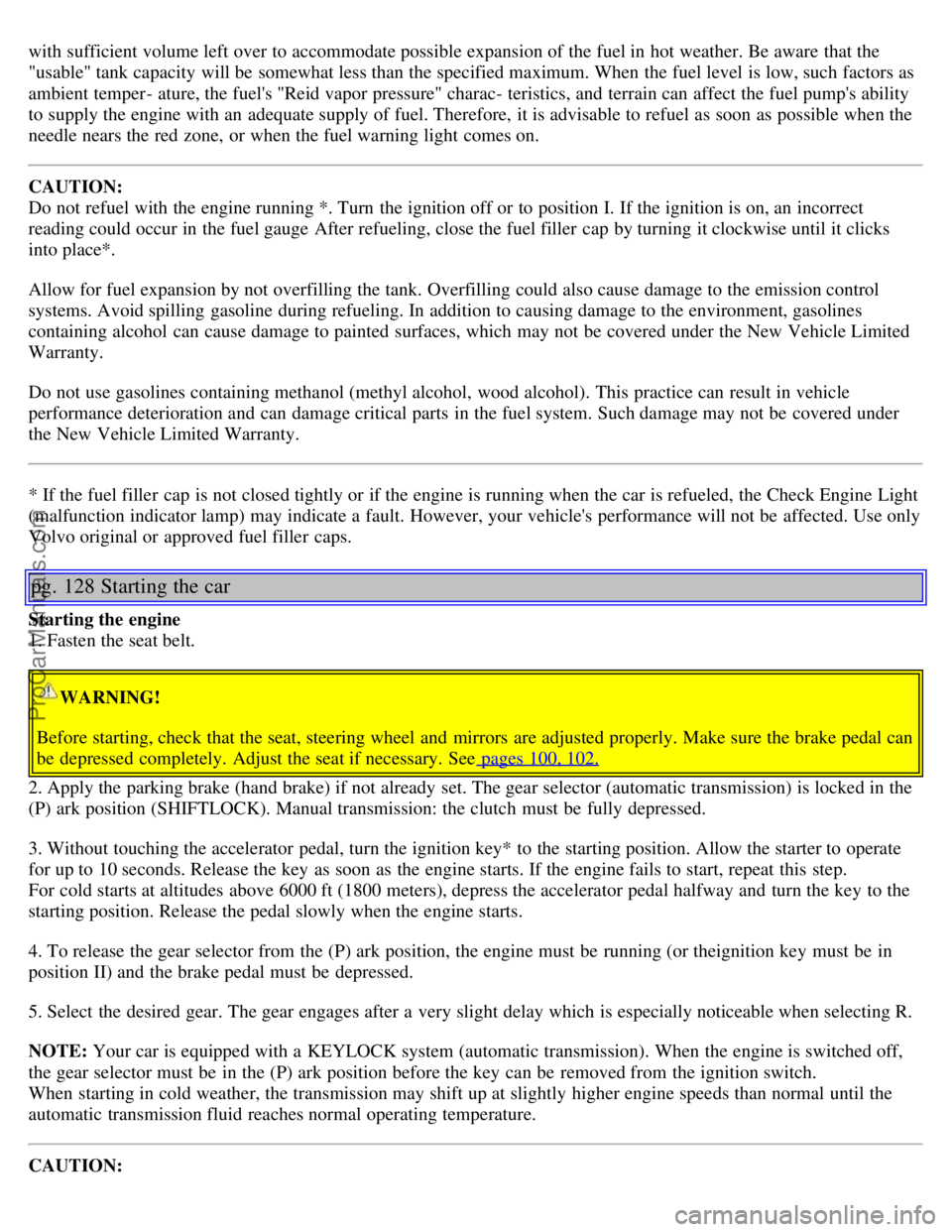
1. Fasten the seat belt.
WARNING!
Before starting, check that the seat, steering wheel and mirrors are adjusted properly. Make sure the brake pedal can
be depressed completely. Adjust the seat if necessary. See pages 100, 102.
2. Apply the parking brake (hand brake) if not already set. The gear selector (automatic transmission) is locked in the
(P) ark position (SHIFTLOCK). Manual transmission: the clutch must be fully depressed.
3. Without touching the accelerator pedal, turn the ignition key* to the starting position. Allow the starter to operate
for up to 10 seconds. Release the key as soon as the engine starts. If the engine fails to start, repeat this step.
For cold starts at altitudes above 6000 ft (1800 meters), depress the accelerator pedal halfway and turn the key to the
starting position. Release the pedal slowly when the engine starts.
4. To release the gear selector from the (P) ark position, the engine must be running (or theignition key must be in
position II) and the brake pedal must be depressed.
5. Select the desired gear. The gear engages after a very slight delay which is especially noticeable when selecting R.
NOTE: Your car is equipped with a KEYLOCK system (automatic transmission). When the engine is switched off,
the gear selector must be in the (P) ark position before the key can be removed from the ignition switch.
When starting in cold weather, the transmission may shift up at slightly higher engine speeds than normal until the
automatic transmission fluid reaches normal operating temperature.
CAUTION:
ProCarManuals.com
Page 80 of 128
Automatic transmission
The engine should be idling when you move the gear selector. Never accelerate until after you feel the transmission
engage! Acceler- ating immediately after selecting a gear will cause harsh engagement and premature transmission
wear.
Selecting P or N when idling at a standstill for prolonged periods of time will help prevent overheating of the
automatic trans - mission fluid.
WARNING!
Always place the gear selector in Park and apply the parking brake before leaving the vehicle. Never leave the car
unattended with the engine running.
Always open garage doors fully before starting the engine inside a garage to ensure adequate ventilation. The
exhaust gases contain carbon monoxide, which is invisible and odorless but very poisonous
Do not race a cold engine immediately after starting. Oil flow may not reach some lubrication points fast enough to
prevent engine damage.
* If two of the keys to your car are close together, e. g., on the same key ring, when you try to start the car, this could
cause interference in the immobilizer system and result in the car not starting. If this should occur, remove one of the
keys from the key ring before trying to start the car again.
pg. 129 Starting the car
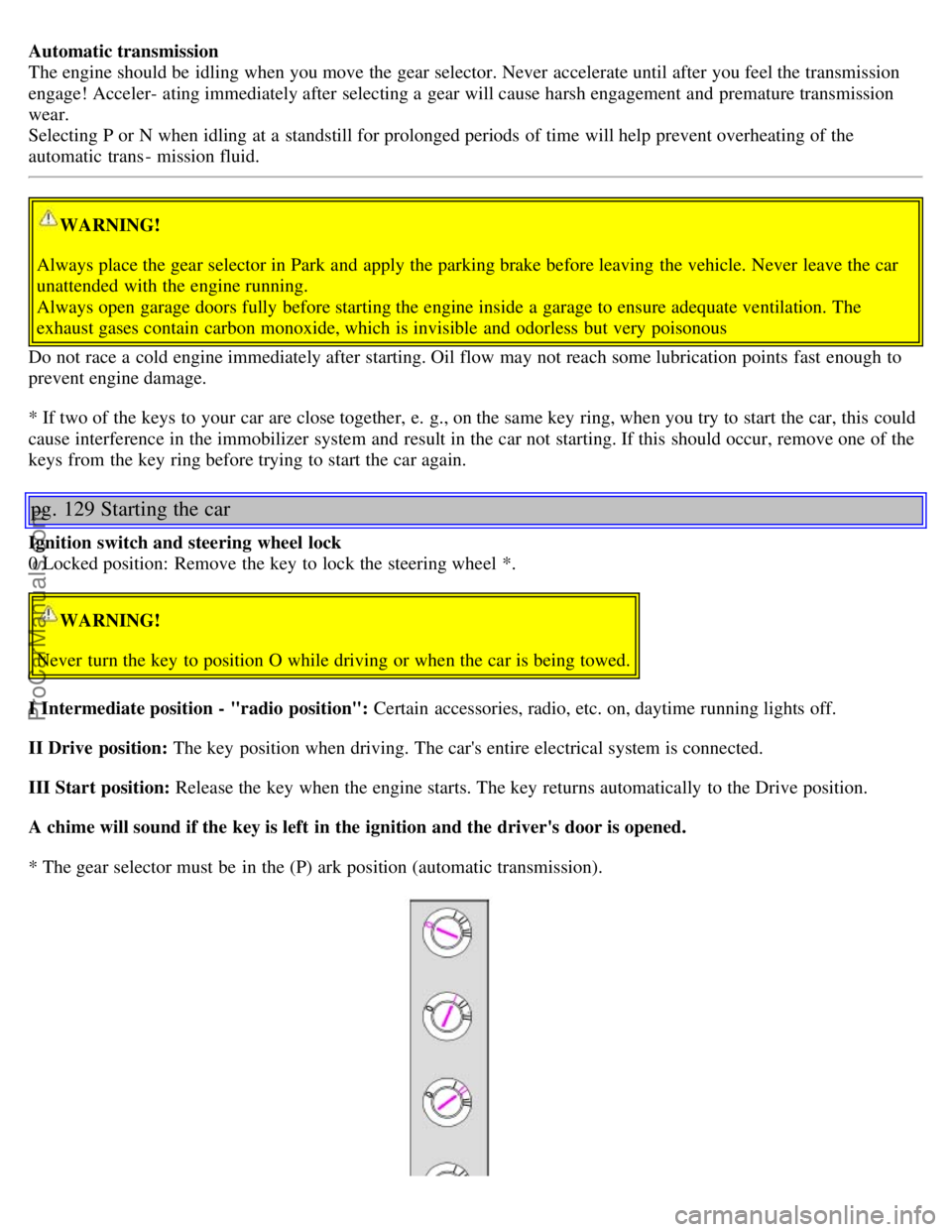
Ignition switch and steering wheel lock
0 Locked position: Remove the key to lock the steering wheel *.
WARNING!
Never turn the key to position O while driving or when the car is being towed.
I Intermediate position - "radio position": Certain accessories, radio, etc. on, daytime running lights off.
II Drive position: The key position when driving. The car's entire electrical system is connected.
III Start position: Release the key when the engine starts. The key returns automatically to the Drive position.
A chime will sound if the key is left in the ignition and the driver's door is opened.
* The gear selector must be in the (P) ark position (automatic transmission).
ProCarManuals.com
Page 81 of 128
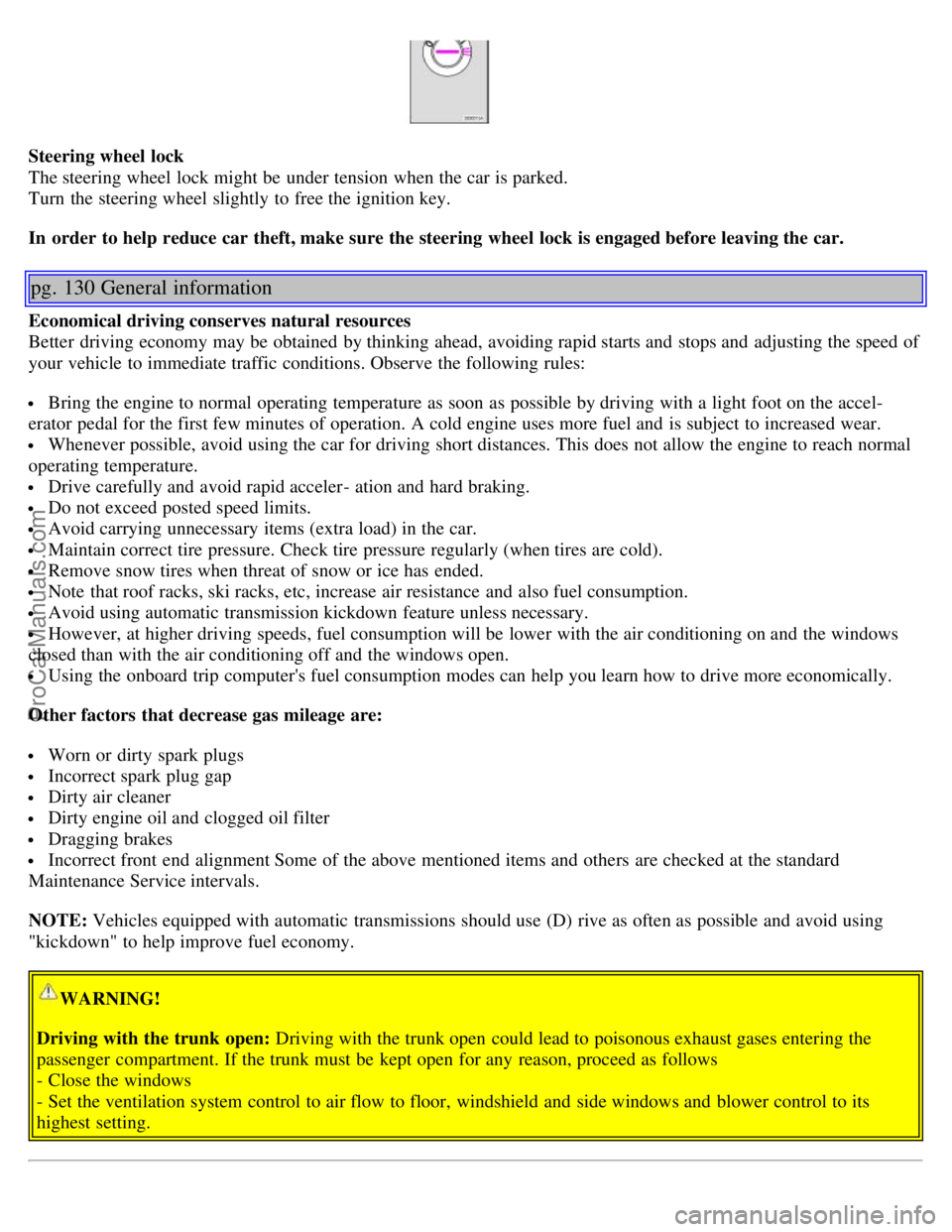
Steering wheel lock
The steering wheel lock might be under tension when the car is parked.
Turn the steering wheel slightly to free the ignition key.
In order to help reduce car theft, make sure the steering wheel lock is engaged before leaving the car.
pg. 130 General information
Economical driving conserves natural resources
Better driving economy may be obtained by thinking ahead, avoiding rapid starts and stops and adjusting the speed of
your vehicle to immediate traffic conditions. Observe the following rules:
Bring the engine to normal operating temperature as soon as possible by driving with a light foot on the accel-
erator pedal for the first few minutes of operation. A cold engine uses more fuel and is subject to increased wear.
Whenever possible, avoid using the car for driving short distances. This does not allow the engine to reach normal
operating temperature.
Drive carefully and avoid rapid acceler- ation and hard braking.
Do not exceed posted speed limits.
Avoid carrying unnecessary items (extra load) in the car.
Maintain correct tire pressure. Check tire pressure regularly (when tires are cold).
Remove snow tires when threat of snow or ice has ended.
Note that roof racks, ski racks, etc, increase air resistance and also fuel consumption.
Avoid using automatic transmission kickdown feature unless necessary.
However, at higher driving speeds, fuel consumption will be lower with the air conditioning on and the windows
closed than with the air conditioning off and the windows open.
Using the onboard trip computer's fuel consumption modes can help you learn how to drive more economically.
Other factors that decrease gas mileage are:
Worn or dirty spark plugs
Incorrect spark plug gap
Dirty air cleaner
Dirty engine oil and clogged oil filter
Dragging brakes
Incorrect front end alignment Some of the above mentioned items and others are checked at the standard
Maintenance Service intervals.
NOTE: Vehicles equipped with automatic transmissions should use (D) rive as often as possible and avoid using
"kickdown" to help improve fuel economy.
WARNING!
Driving with the trunk open: Driving with the trunk open could lead to poisonous exhaust gases entering the
passenger compartment. If the trunk must be kept open for any reason, proceed as follows
- Close the windows
- Set the ventilation system control to air flow to floor, windshield and side windows and blower control to its
highest setting.
ProCarManuals.com
Page 82 of 128
CAUTION: Drive slowly and carefully if going through standing water (i. e. flooded roadways, etc.). Damage to the
engine could result if excess water is drawn in through the air intake system. Never drive the vehicle in water deeper
than 1 foot (300 mm). See the flood warning on page 16.
Weight distribution affects handling
At the specified curb weight your car has a tendency to understeer, which means that the steering wheel has to be
turned more than might seem appropriate for the curvature of a bend. This ensures good stability and reduces the risk
of rear wheel skid. Remember that these properties can alter with the vehicle load.
pg. 131 General information
The heavier the load in the trunk (max. 220 lbs, 100 kg), the less the tendency to understeer.
Handling, roadholding
Vehicle load, tire design and inflation pressure all affect vehicle handling. Therefore, check that the tires are inflated
to the recommended pressure according to the vehicle load. See "Tire pressure" section.
Loads should be distributed so that capacity weight or maximum permissible axle loads are not exceeded.
pg. 132 Manual transmission
Shift positions
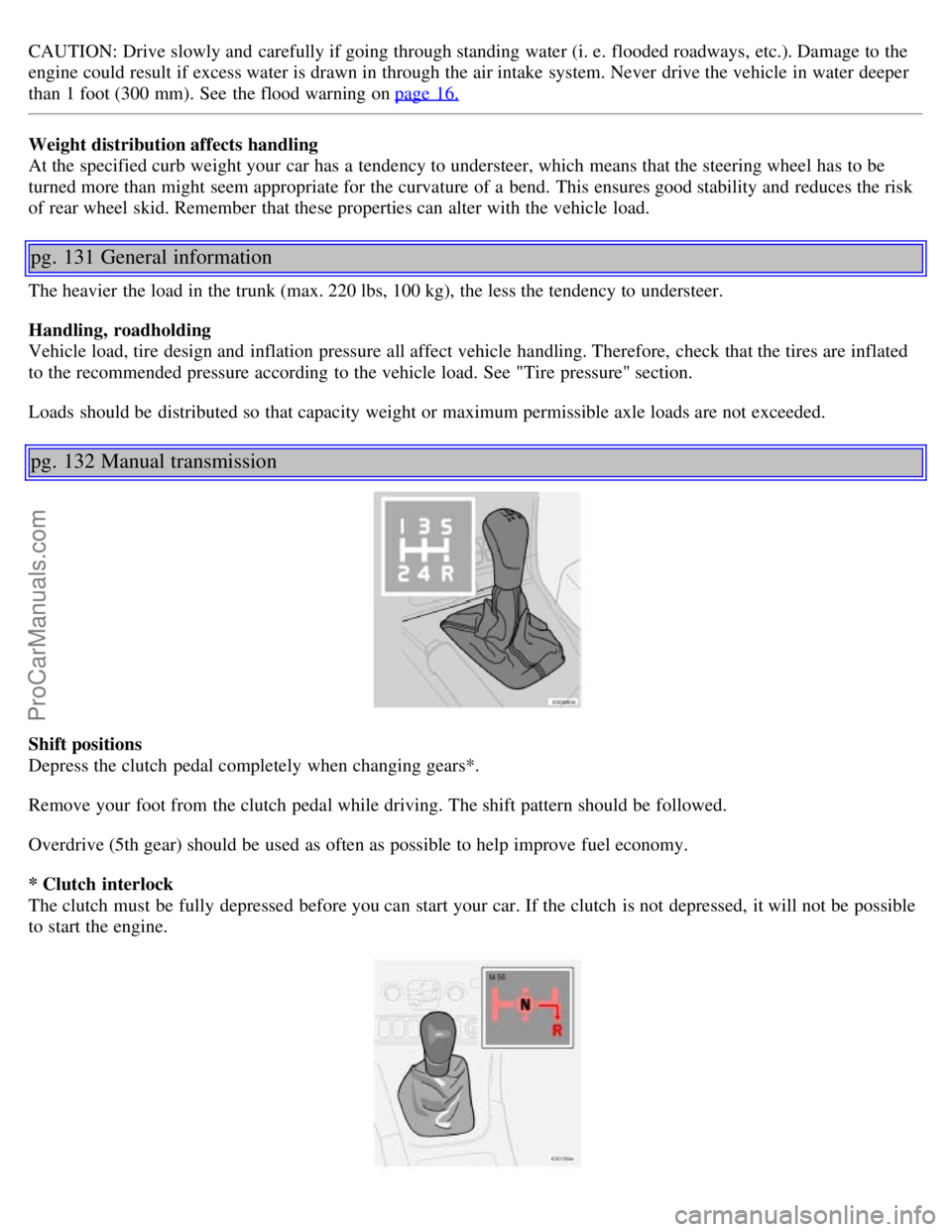
Depress the clutch pedal completely when changing gears*.
Remove your foot from the clutch pedal while driving. The shift pattern should be followed.
Overdrive (5th gear) should be used as often as possible to help improve fuel economy.
* Clutch interlock
The clutch must be fully depressed before you can start your car. If the clutch is not depressed, it will not be possible
to start the engine.
ProCarManuals.com
Page 90 of 128
2 0 0 1
VOLVO S60
Wheels and tires
pg. 151 Wheels and tires
General information 152
Tire pressure154
Tread wear indicators155
Changing wheels156
Uniform Tire Quality Grading158
pg. 152 General information
General information about wheels and tires
Your vehicle is equipped with tires according to the tire information label on the inside of the fuel filler door.
All tires have a dimension designation.
Example of designation: 215/ 55R16.
215 section width (mm)
55 relationship between section
height and width
R radial tire
16 wheel rim diameter (")
The tires have good road holding characteristics and offer good handling on dry and wet surfaces. It should be noted
however that the tires have been developed to give these features on snow/ ice- free surfaces.
Certain models are equipped with "all- season" tires, which provide a somewhat higher degree of road holding
on slippery surfaces than tires without the "all- season" rating. However, for optimum road holding on icy or
snow-covered roads - we recommend suitable winter tires on all four wheels. When replacing tires, be sure that the
new tires are the same size designation, type (radial) and preferably from the same manufacturer, on all four wheels.
Otherwise there is a risk of altering the car's roadholding and handling characteristics.
NOTE: When storing wheel/ tire assemblies (e. g. winter tires and wheels), either stand the assemblies upright, or
suspend them off the ground. Laying wheel/ tire assemblies on their sides for prolonged periods can cause wheel and/
or tire damage.
New tires
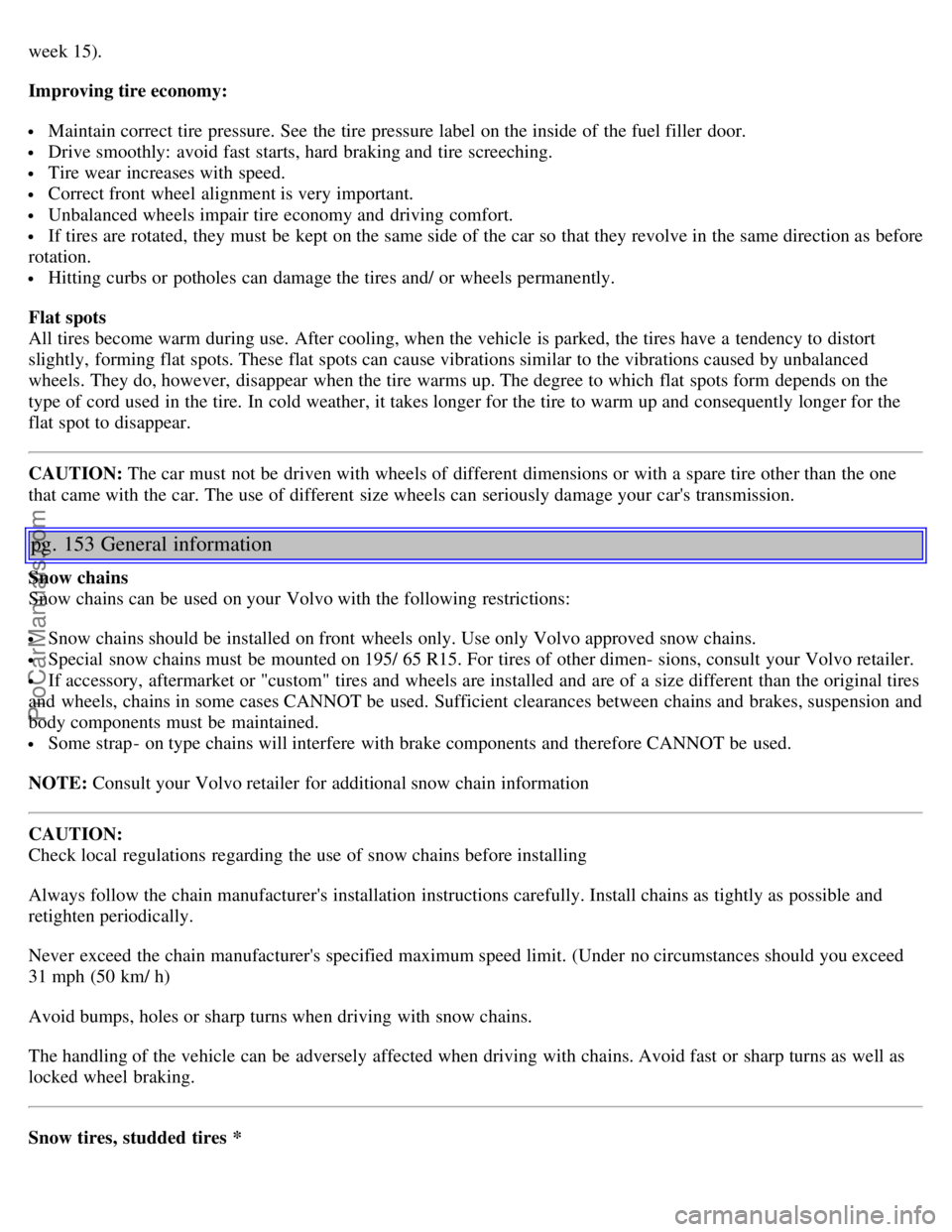
Remember that tires are perishable goods. This tire was manufactured week 15 in 1998! (158). As of 2000,
manufacturing year and week will be indicated with 4 digits (e. g. 0015 means that the tire is manufactured year 2000,
ProCarManuals.com
Page 91 of 128
week 15).
Improving tire economy:
Maintain correct tire pressure. See the tire pressure label on the inside of the fuel filler door.
Drive smoothly: avoid fast starts, hard braking and tire screeching.
Tire wear increases with speed.
Correct front wheel alignment is very important.
Unbalanced wheels impair tire economy and driving comfort.
If tires are rotated, they must be kept on the same side of the car so that they revolve in the same direction as before
rotation.
Hitting curbs or potholes can damage the tires and/ or wheels permanently.
Flat spots
All tires become warm during use. After cooling, when the vehicle is parked, the tires have a tendency to distort
slightly, forming flat spots. These flat spots can cause vibrations similar to the vibrations caused by unbalanced
wheels. They do, however, disappear when the tire warms up. The degree to which flat spots form depends on the
type of cord used in the tire. In cold weather, it takes longer for the tire to warm up and consequently longer for the
flat spot to disappear.
CAUTION: The car must not be driven with wheels of different dimensions or with a spare tire other than the one
that came with the car. The use of different size wheels can seriously damage your car's transmission.
pg. 153 General information
Snow chains
Snow chains can be used on your Volvo with the following restrictions:
Snow chains should be installed on front wheels only. Use only Volvo approved snow chains.
Special snow chains must be mounted on 195/ 65 R15. For tires of other dimen- sions, consult your Volvo retailer.
If accessory, aftermarket or "custom" tires and wheels are installed and are of a size different than the original tires
and wheels, chains in some cases CANNOT be used. Sufficient clearances between chains and brakes, suspension and
body components must be maintained.
Some strap - on type chains will interfere with brake components and therefore CANNOT be used.
NOTE: Consult your Volvo retailer for additional snow chain information
CAUTION:
Check local regulations regarding the use of snow chains before installing
Always follow the chain manufacturer's installation instructions carefully. Install chains as tightly as possible and
retighten periodically.
Never exceed the chain manufacturer's specified maximum speed limit. (Under no circumstances should you exceed
31 mph (50 km/ h)
Avoid bumps, holes or sharp turns when driving with snow chains.
The handling of the vehicle can be adversely affected when driving with chains. Avoid fast or sharp turns as well as
locked wheel braking.
Snow tires, studded tires *
ProCarManuals.com
Page 92 of 128

Tires for winter use:
Owners who live in or regularly commute through areas with sustained periods of snow or icy driving conditions are
strongly advised to fit suitable winter tires to help retain the highest degree of traction.
It is important to install winter tires on all four wheels to help retain traction during cornering, braking, and
accelerating. Failure to do so could reduce traction to an unsafe level or adversely affect handling. Do not mix tires of
different design as this could also negatively affect overall tire road grip.
Volvo recommends195/ 65 R15 (205/ 55R16 on turbo models) winter tires on all four wheels.
Winter tires wear more quickly on dry roads in warm weather. They should be removed when the winter driving
season has ended.
Studded tires should be run- in 300- 600 miles (500- 1000 km) during which the car should be driven as smoothly as
possible to give the studs the opportunity to seat properly in the tires. The tires should have the same rotational
direction throughout their entire lifetime. In other words, if you wish to rotate the wheels, make sure that the same
wheels are always on the same side of the car.
NOTE: Please consult state or provincial regulations restricting the use of studded winter tires before installing such
tires.
* Where permitted
pg. 154 Tire pressure
Checking and correcting tire pressure
The tire pressure label is located on the inside of the fuel filler door.
Check the tire pressure regularly.
The tire pressure should be corrected only when the tires are cold.
With warm tires, correct only when the pressure is too low. The tire temperature rises after driving just a few miles.
Vehicle loading The tires on your Volvo will perform to specifi- cations at all normal loads when inflated as
recommended on the tire information label located on the inside of the fuel filler door. This label lists both tire and
vehicle design limits. Do not load your car beyond the load limits indicated.
WARNING!
Improperly inflated tires will reduce tire life, adversely affect vehicle handling and can possibly lead to failure
resulting in loss of vehicle control without prior warning.
ProCarManuals.com
Page 93 of 128
Temporary Spare (certain models)
The spare tire in your car is called a "Temporary Spare". It has the following designation: T125/ 80 R17.
Recommended tire pressure (see decal on Fuel filler door) should be maintained irrespective of which position on the
car the Temporary Spare tire is used on. In the event of damage to this tire, a new one can be purchased from your
Volvo retailer.
WARNING!
Current legislation prohibits the use of the "Temporary Spare" tire other than as a temporary replacement for a
punctured tire. It must be replaced as soon as possible by a standard tire. Road holding and handling may be
affected with the "Temporary Spare" in use. Do not exceed 50 mph (80 km/ h). Do not drive farther than 50 miles
(80 km) on a temporary spare tire.
CAUTION:
The car must not be driven with wheels of different dimensions or with a spare tire other than the one that came with
the car. The use of different size wheels can seriously damage your car's transmission.
NOTE: Certain models may be equipped with a full- size spare tire. When used, it should be inflated to the same
pressure as the tire it is replacing.
pg. 155 Tread wear indicators
Tires have tread
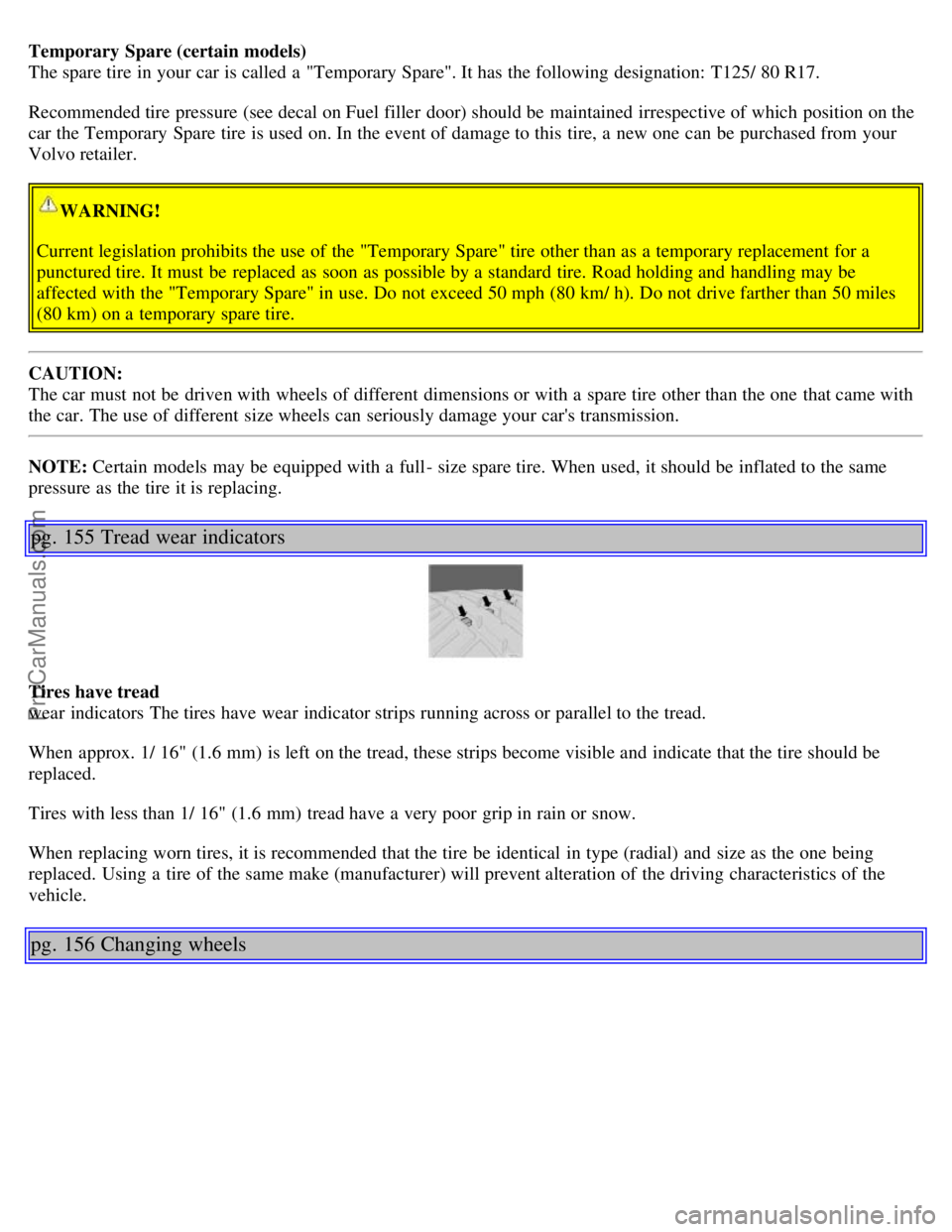
wear indicators The tires have wear indicator strips running across or parallel to the tread.
When approx. 1/ 16" (1.6 mm) is left on the tread, these strips become visible and indicate that the tire should be
replaced.
Tires with less than 1/ 16" (1.6 mm) tread have a very poor grip in rain or snow.
When replacing worn tires, it is recommended that the tire be identical in type (radial) and size as the one being
replaced. Using a tire of the same make (manufacturer) will prevent alteration of the driving characteristics of the
vehicle.
pg. 156 Changing wheels
ProCarManuals.com
Page 94 of 128
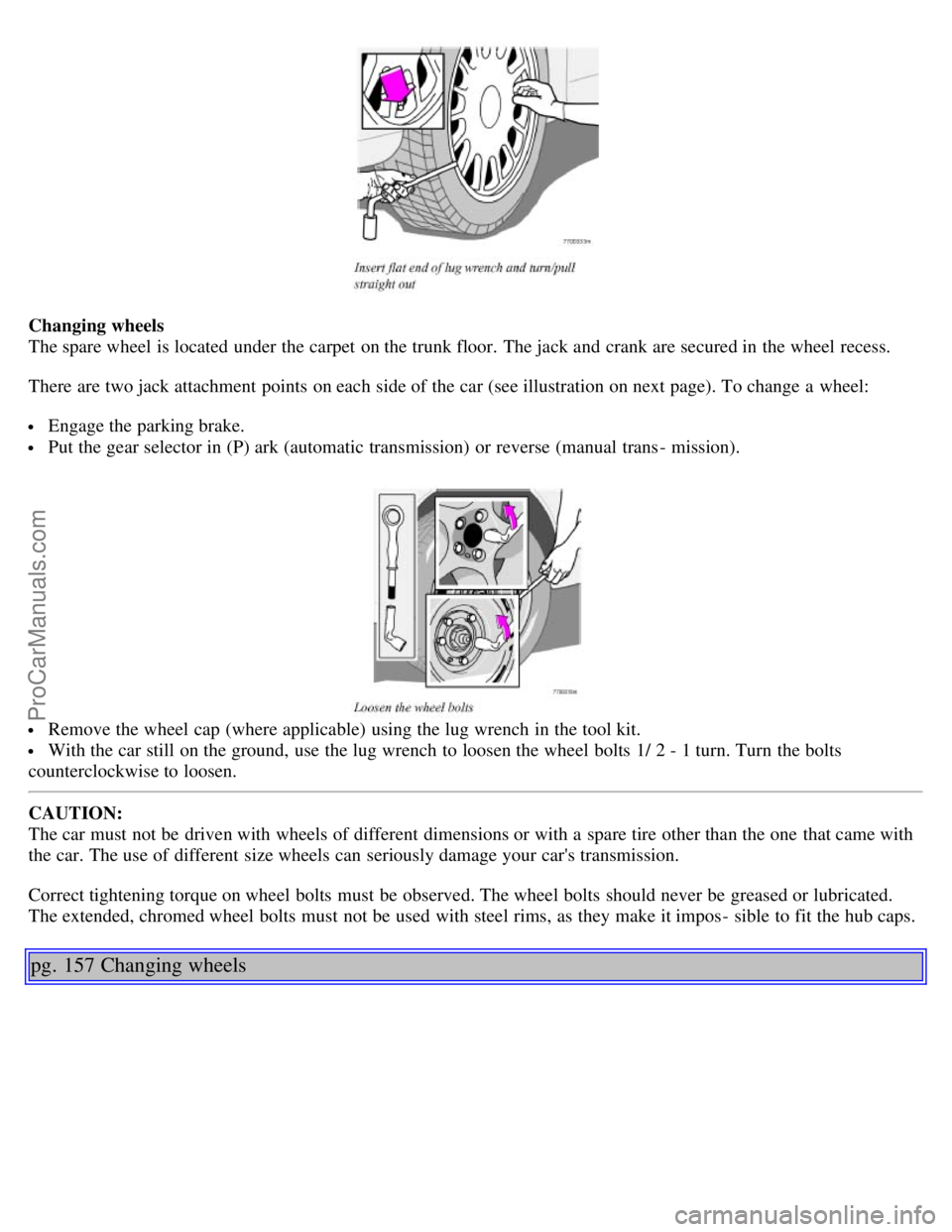
Changing wheels
The spare wheel is located under the carpet on the trunk floor. The jack and crank are secured in the wheel recess.
There are two jack attachment points on each side of the car (see illustration on next page). To change a wheel:
Engage the parking brake.
Put the gear selector in (P) ark (automatic transmission) or reverse (manual trans - mission).
Remove the wheel cap (where applicable) using the lug wrench in the tool kit.
With the car still on the ground, use the lug wrench to loosen the wheel bolts 1/ 2 - 1 turn. Turn the bolts
counterclockwise to loosen.
CAUTION:
The car must not be driven with wheels of different dimensions or with a spare tire other than the one that came with
the car. The use of different size wheels can seriously damage your car's transmission.
Correct tightening torque on wheel bolts must be observed. The wheel bolts should never be greased or lubricated.
The extended, chromed wheel bolts must not be used with steel rims, as they make it impos - sible to fit the hub caps.
pg. 157 Changing wheels
ProCarManuals.com