wheel VOLVO S60 2001 Owner's Guide
[x] Cancel search | Manufacturer: VOLVO, Model Year: 2001, Model line: S60, Model: VOLVO S60 2001Pages: 128, PDF Size: 2.52 MB
Page 95 of 128

Position the jack correctly on the bar in the attachment (see illustration above) and crank while simultaneously
guiding the base of the jack to the ground. The base of the jack must be flat on a level, firm, non- slippery surface.
Before raising the car, check that the jack is still correctly positioned in the attachment.
Raise the vehicle until the wheel to be changed is lifted off the ground.
Unscrew the wheel bolts completely and carefully remove the wheel so as not to damage the threads on the studs.
NOTE: To avoid excessive wear and the necessity of rebalancing, mark and reinstall wheels in the same location and
position as before removal. To lessen the chance of imbalance, each wheel hub is equipped with a guide stud to
ensure that a removed wheel can be reinstalled in its original position (as when changing over to winter tires/ wheels).
Installing the wheel
Clean the contact surfaces on the wheel and hub.
Lift the wheel and place it on the hub.
Install the wheel bolts and tighten hand - tight. Using the lug wrench, tighten crosswise until all bolts are snug.
Lower the vehicle to the ground and alternately tighten the bolts crosswise to 102 ft. lbs. (140 Nm).
Install the wheel cap (where applicable).
WARNING!
The jack must correctly engage the bar in the jack attachment. The car's weight must not rest on the jack
attachment. See illustration "Attaching the jack" to the left.
Be sure the jack is on a firm, level, non-slippery surface.
Never allow any part of your body to be extended under a car supported by a jack. Use the jack intended for the car
when replacing a wheel. For any other job, use stands to support the side of the car being worked on.
Apply the parking brake and put the gear selector in the (P) ark position (or reverse on manual transmissions).
Block the wheels standing on the ground, use rigid wooden blocks or large stones. The jack should be kept well-
ProCarManuals.com
Page 96 of 128
greased.
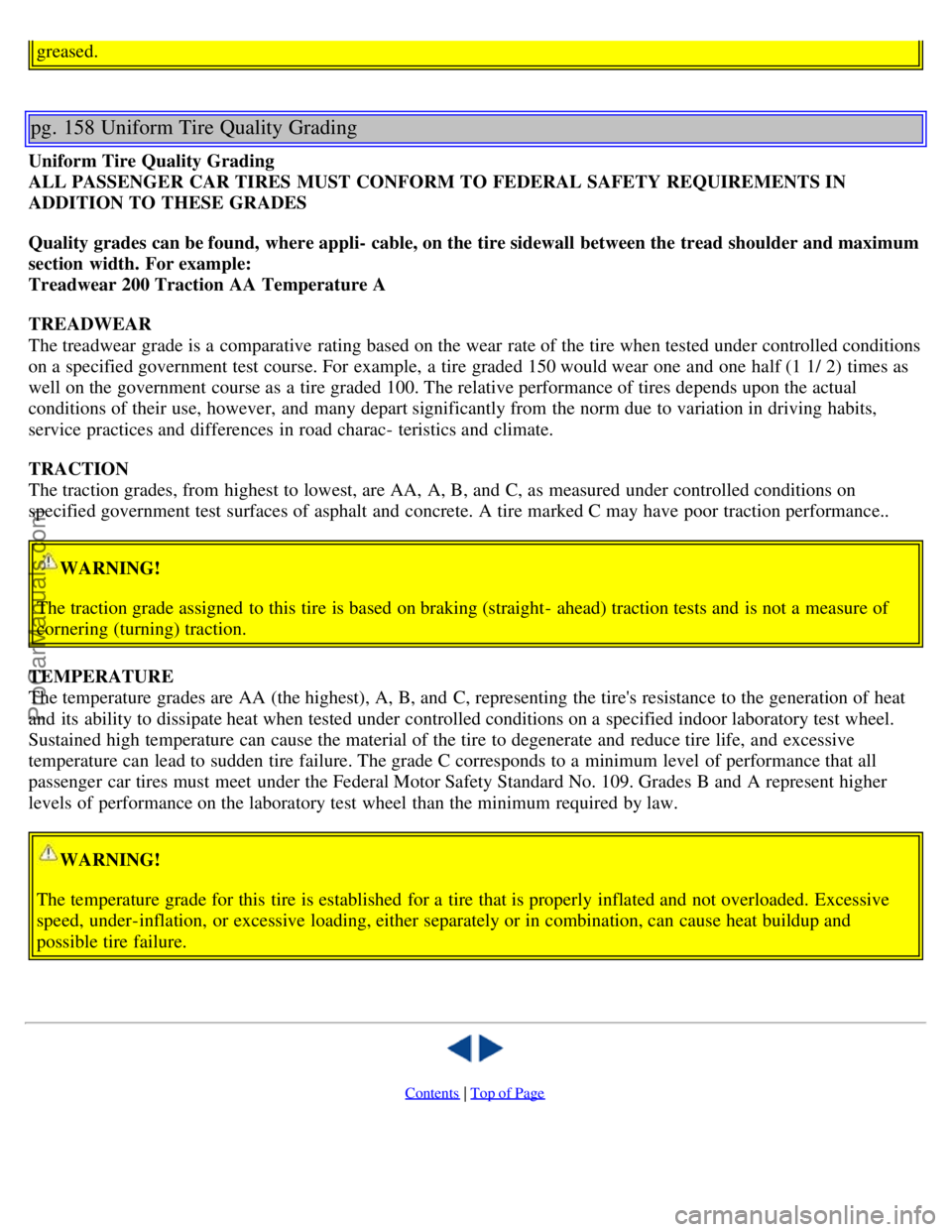
pg. 158 Uniform Tire Quality Grading
Uniform Tire Quality Grading
ALL PASSENGER CAR TIRES MUST CONFORM TO FEDERAL SAFETY REQUIREMENTS IN
ADDITION TO THESE GRADES
Quality grades can be found, where appli- cable, on the tire sidewall between the tread shoulder and maximum
section width. For example:
Treadwear 200 Traction AA Temperature A
TREADWEAR
The treadwear grade is a comparative rating based on the wear rate of the tire when tested under controlled conditions
on a specified government test course. For example, a tire graded 150 would wear one and one half (1 1/ 2) times as
well on the government course as a tire graded 100. The relative performance of tires depends upon the actual
conditions of their use, however, and many depart significantly from the norm due to variation in driving habits,
service practices and differences in road charac- teristics and climate.
TRACTION
The traction grades, from highest to lowest, are AA, A, B, and C, as measured under controlled conditions on
specified government test surfaces of asphalt and concrete. A tire marked C may have poor traction performance..
WARNING!
The traction grade assigned to this tire is based on braking (straight- ahead) traction tests and is not a measure of
cornering (turning) traction.
TEMPERATURE
The temperature grades are AA (the highest), A, B, and C, representing the tire's resistance to the generation of heat
and its ability to dissipate heat when tested under controlled conditions on a specified indoor laboratory test wheel.
Sustained high temperature can cause the material of the tire to degenerate and reduce tire life, and excessive
temperature can lead to sudden tire failure. The grade C corresponds to a minimum level of performance that all
passenger car tires must meet under the Federal Motor Safety Standard No. 109. Grades B and A represent higher
levels of performance on the laboratory test wheel than the minimum required by law.
WARNING!
The temperature grade for this tire is established for a tire that is properly inflated and not overloaded. Excessive
speed, under-inflation, or excessive loading, either separately or in combination, can cause heat buildup and
possible tire failure.
Contents | Top of Page
ProCarManuals.com
Page 97 of 128

2 0 0 1
VOLVO S60
Car care
pg. 159 Car care
Washing and cleaning the car 160
Paint touch up162
pg. 160 Washing and cleaning the car
Washing and cleaning the car
The car should be washed at regular intervals since dirt, dust, insects and tar spots adhere to the paint and may
cause damage. It is particularly important to wash the car frequently in the wintertime to prevent corrosion, when salt
has been used on the roads.
When washing the car, do not expose it to direct sunlight. Use lukewarm water to soften the dirt before you wash
with a sponge, and plenty of water, to avoid scratching.
Bird droppings: Remove from paintwork as soon as possible. Otherwise the finish may be permanently damaged.
A detergent can be used to facilitate the softening of dirt and oil.
A water- soluble grease solvent may be used in cases of sticky dirt. However, use a wash place equipped with a
drainage separator.
Dry the car with a clean chamois and remember to clean the drain holes in the doors and rocker panels.
Tar spots can be removed with kerosene or tar remover after the car has been washed.
A stiff- bristle brush and lukewarm soapy water can be used to clean the wiper blades. Frequent cleaning improves
visibility considerably.
Wash off the dirt from the underside (wheel housings, fenders, etc.).
In areas of high industrial fallout, more frequent washing is recommended.
CAUTION:
During high pressure washing, the spray mouthpiece must never be closer to the vehicle than 13" (30 cm). Do not
spray into the locks.
When washing or steam cleaning the engine, avoid spraying water or steam directly on the electrical components or
toward the rear side of the engine.
After cleaning the engine, the spark plug wells should be inspected for water and blown dry if necessary.
Suitable detergents: Special car washing detergents should be used. A suitable mixture is about 2.5 fl. oz. (8.5 cl) of
detergent to 2.6 US gal. (10 liters) of warm water. After washing with a detergent the car should be well rinsed with
clean water.
Bumpers: Wash the bumpers with the same cleaning agent used on the rest of the car. Never clean the bumpers with
gasoline or paint thinner. Difficult spots can be removed with denatured alcohol. To avoid scratches, do not dry the
bumpers with paper.
NOTE: When washing the car, remember to remove dirt from the drain holes in the doors and sills.
ProCarManuals.com
Page 112 of 128

*The Vehicle Identification Number (VIN) should always be quoted in all correspondence concerning your vehicle
with the retailer and when ordering parts.
pg. 193 Dimensions, weights
Dimensions
Length 180 in. (458 cm)
Width 71 in. (180 cm)
Height 56.2 in. (143 cm)
Wheelbase 107 in. (272 cm)
Front track 61.5 in. (156 cm)
Rear track 61.4 (156 cm)
Turning circle, between curbs 35.4- 38.7 ft. (10.8- 11.8 m)
Cargo capacity, trunk SAE V1 - 13.9 (394)
Weights
Gross vehicle weight *
5 cyl. (manual transmission)
USA 4360 lbs (1978 kg)
Canada 1980 kg
5 cyl. (automatic transmission)
USA 4400 lbs (1996 kg)
Canada 1996 kg
5 cyl. turbo (manual transmission)
USA 4430 lbs (2009 kg)
Canada 2110 kg
5 cyl. turbo (automatic transmission)
USA 4470 lbs (2028 kg)
Canada 2030 kg
ProCarManuals.com
Page 115 of 128
three- way catalytic converter.
Do not park your car over combustible materials, such as grass or leaves, which can come into contact with the hot
exhaust system and cause such materials to ignite under certain wind and weather conditions.
Excessive starter cranking (in excess of one minute), or an intermittently firing or flooded engine can cause three-
way catalytic converter or exhaust system overheating.
Remember that tampering or unauthorized modifications to the engine, the Electronic Control Module, or the
vehicle may be illegal and can cause three- way catalytic converter or exhaust system overheating. This includes:
- Altering fuel injection setting or components.
- Altering emission system components or location or removing components.
- Repeated use of leaded fuel.
NOTE: Unleaded fuel is required for cars with three-way catalytic converters.)
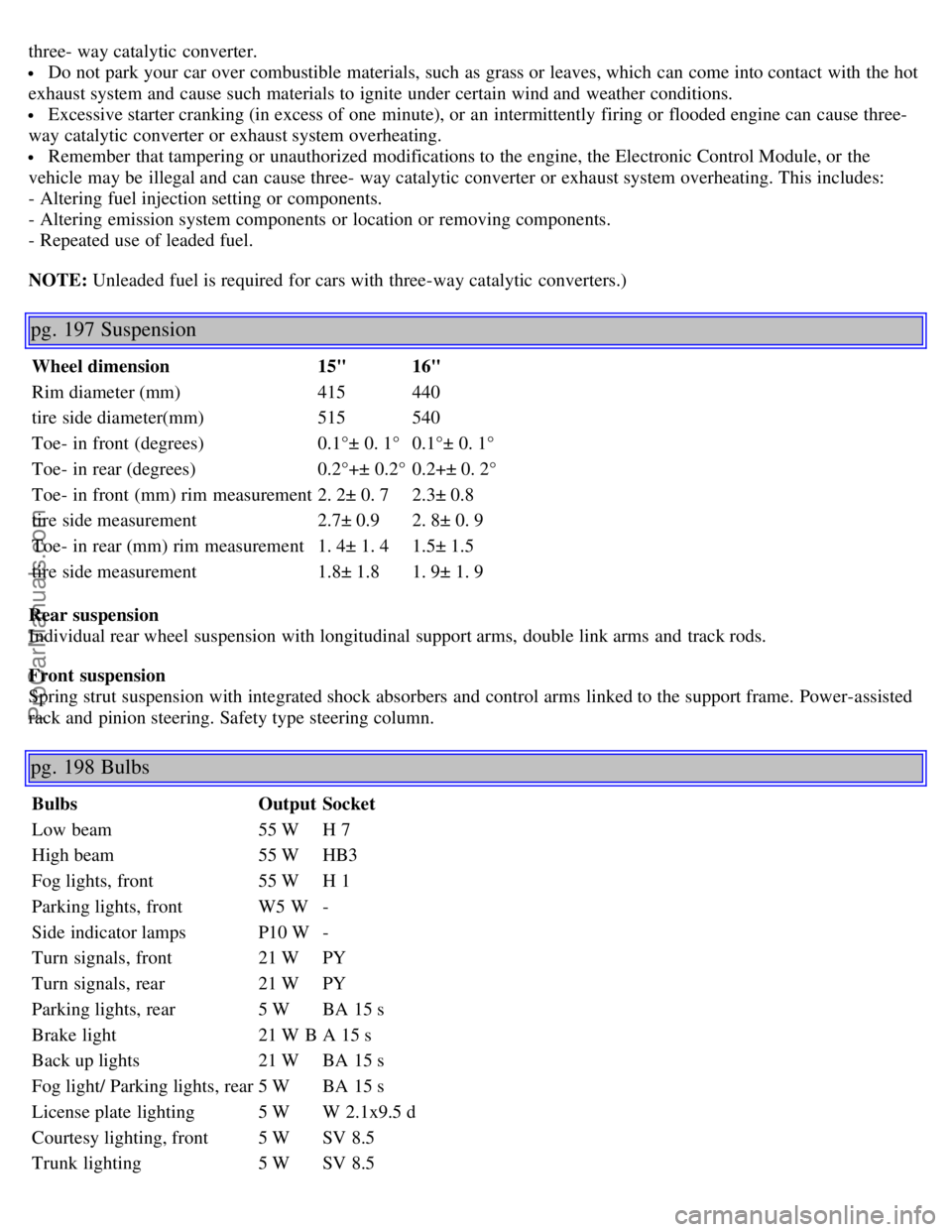
pg. 197 Suspension
Wheel dimension 15"16"
Rim diameter (mm) 415440
tire side diameter(mm) 515540
Toe- in front (degrees) 0.1°± 0. 1°0.1°± 0. 1°
Toe- in rear (degrees) 0.2°+± 0.2°0.2+± 0. 2°
Toe- in front (mm) rim measurement 2. 2± 0. 72.3± 0.8
tire side measurement 2.7± 0.92. 8± 0. 9
Toe- in rear (mm) rim measurement 1. 4± 1. 41.5± 1.5
tire side measurement 1.8± 1.81. 9± 1. 9
Rear suspension
Individual rear wheel suspension with longitudinal support arms, double link arms and track rods.
Front suspension
Spring strut suspension with integrated shock absorbers and control arms linked to the support frame. Power-assisted
rack and pinion steering. Safety type steering column.
pg. 198 Bulbs
Bulbs OutputSocket
Low beam 55 WH 7
High beam 55 WHB3
Fog lights, front 55 WH 1
Parking lights, front W5 W-
Side indicator lamps P10 W-
Turn signals, front 21 WPY
Turn signals, rear 21 WPY
Parking lights, rear 5 WBA 15 s
Brake light 21 W BA 15 s
Back up lights 21 WBA 15 s
Fog light/ Parking lights, rear 5 WBA 15 s
License plate lighting 5 WW 2.1x9.5 d
Courtesy lighting, front 5 WSV 8.5
Trunk lighting 5 WSV 8.5
ProCarManuals.com
Page 119 of 128

2 0 0 1
VOLVO S60
Index
pg. 203 Index
A
A/ C (air conditioning) 56
, 59
ABS2 , 31 , 138
Accessory bracket109
Adjustable steering wheel36
Advanced User Mode (AUM) - radio72
Air bags - dual threshold/ stage13
Air distribution53 , 56 , 60
Air filter170
Air quality sensor57
Air vents53
Airbag - Side Impact (SIPS)18
Airbags (front)12
Alarm115 , 122
Anti-lock Brake System (ABS)02 , 31
Approach lighting40
Ashtray45 , 107
Audio61
Audio systems - general information81
Audio systems - specifications80
AUTO (climate control)55
Electronic Climate Control, ECC54
Automatic transmission130 , 133
Automatic transmission - adaptive system134
Automatic transmission - kickdown134
Auxiliary lamps37
Average speed43
B
Back up light183
Backrest111
Bass65
Battery168 , 176 , 199
Battery - replacing177
Belt check169
ProCarManuals.com
Page 120 of 128

Booster cushion24
Booster cushion (integrated)25
Bottle holder110
Brake circuit137
Brake fluid174
Brake light183
Brake system32 , 137
Bulbs179 , 198
C
Capacities194
Cargo compartment111
Cassette player73
Catalytic converter196
CD player75 , 77
Ceiling lighting185
Center console - storage compartments107
Central locking system - remote control117
Changing coolant169
Changing oil and oil filter171
Changing wheels156
Check Engine warning light33
Child restraint anchorages26
Child safety24
Child safety locks121
Child seat (Isofix fasteners)25
Cigarette lighter45
Climate control systems -general information52
Clock30
Coat hanger109
Coin compartment107
Cold weather precautions149
Coolant173
Coolant - changing169, 173
Coolant - checking level of169
Cooling system195
Courtesy light104
Cruise control44
Cup holder107 , 108
Cup holder in rear seat107
Current fuel consumption43
D
Defroster55
Dimension designation152
Direction indicator (tires)183
ProCarManuals.com
Page 123 of 128
LED illumination40
Lighting panel39
Load carriers148
Locking119
Locking steering wheel129
Locks115
Long distance trips150
Long loads - carrying112
Low beam bulb180
Lubricants195
M
Maintenance Schedule165
Maintenance services164
Malfunction indicator light33
Manual climate control with air conditioning58
Manual transmission132
Messages in the display35
Multifilter with air quality sensor57
N
Normal turns (direction indicators)40
O
Occupant safety28
Octane rating126
Odometer30
Oil pressure33
Oil quality171
Oil viscosity171
Opening/ locking the trunk120
P
P Park133
, 135
Paint162
Paint - color code162
Paintwork damage162
Parking brake33 , 45
Parking lights39
Pen holder108
Polishing161
Power seat102
Power steering fluid174
Power sun roof49
Prem- Air3
Programme type PT70
PROPOSITION 65 WARNING143
R
ProCarManuals.com
Page 124 of 128
Radiator170
Radio65
Rain sensor41
Reading lamps104
Rear fog lights39
Rear seat111
Rear suspension197
Rear window defroster42 , 59
Rearview mirror/ door mirrors48
Recirculation56 , 60
REDUCE SPEED35
Refrigerant (A/ C system)52
Refueling126 , 127
Remote control - central locking system117
Replacing the battery177
Reporting safety defects28
Reverse gear inhibitor132
Roadholding131
Roof racks (load carriers)148
S
Safety9
Safety defects - reporting28
Seat belt10
Seat belt maintenance28
Seat belt reminder48
Seat belts (keeping child seats in place)27
SEE MANUAL35
Service164
Service reminder33
SERVICE REQUIRED35
SERVICE URGENT35
Shiftlock2 , 128
Side airbags18
Side marker lamp183
SIPS airbags18
Ski hatch112
Snow chains153
Snow tires153
Spare tires154
Spare wheel113
Spark plugs199
Specifications191
Speedometer30
Spoiler lamps39
ProCarManuals.com
Page 125 of 128
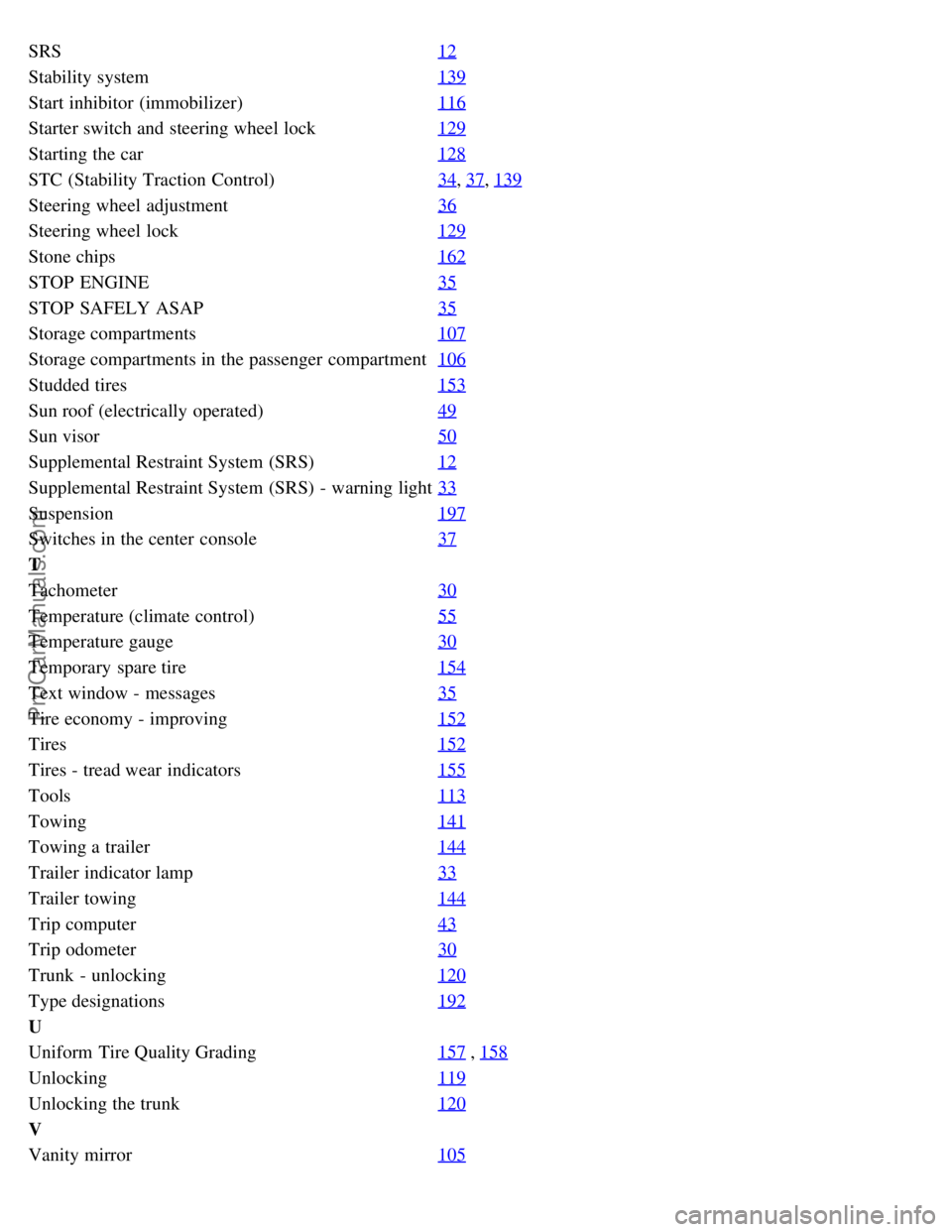
SRS12
Stability system139
Start inhibitor (immobilizer)116
Starter switch and steering wheel lock129
Starting the car128
STC (Stability Traction Control)34, 37, 139
Steering wheel adjustment36
Steering wheel lock129
Stone chips162
STOP ENGINE35
STOP SAFELY ASAP35
Storage compartments107
Storage compartments in the passenger compartment106
Studded tires153
Sun roof (electrically operated)49
Sun visor50
Supplemental Restraint System (SRS)12
Supplemental Restraint System (SRS) - warning light33
Suspension197
Switches in the center console37
T
Tachometer30
Temperature (climate control)55
Temperature gauge30
Temporary spare tire154
Text window - messages35
Tire economy - improving152
Tires152
Tires - tread wear indicators155
Tools113
Towing141
Towing a trailer144
Trailer indicator lamp33
Trailer towing144
Trip computer43
Trip odometer30
Trunk - unlocking120
Type designations192
U
Uniform Tire Quality Grading157
, 158
Unlocking119
Unlocking the trunk120
V
Vanity mirror105
ProCarManuals.com