weight VOLVO S60 2006 User Guide
[x] Cancel search | Manufacturer: VOLVO, Model Year: 2006, Model line: S60, Model: VOLVO S60 2006Pages: 132, PDF Size: 2.33 MB
Page 83 of 132
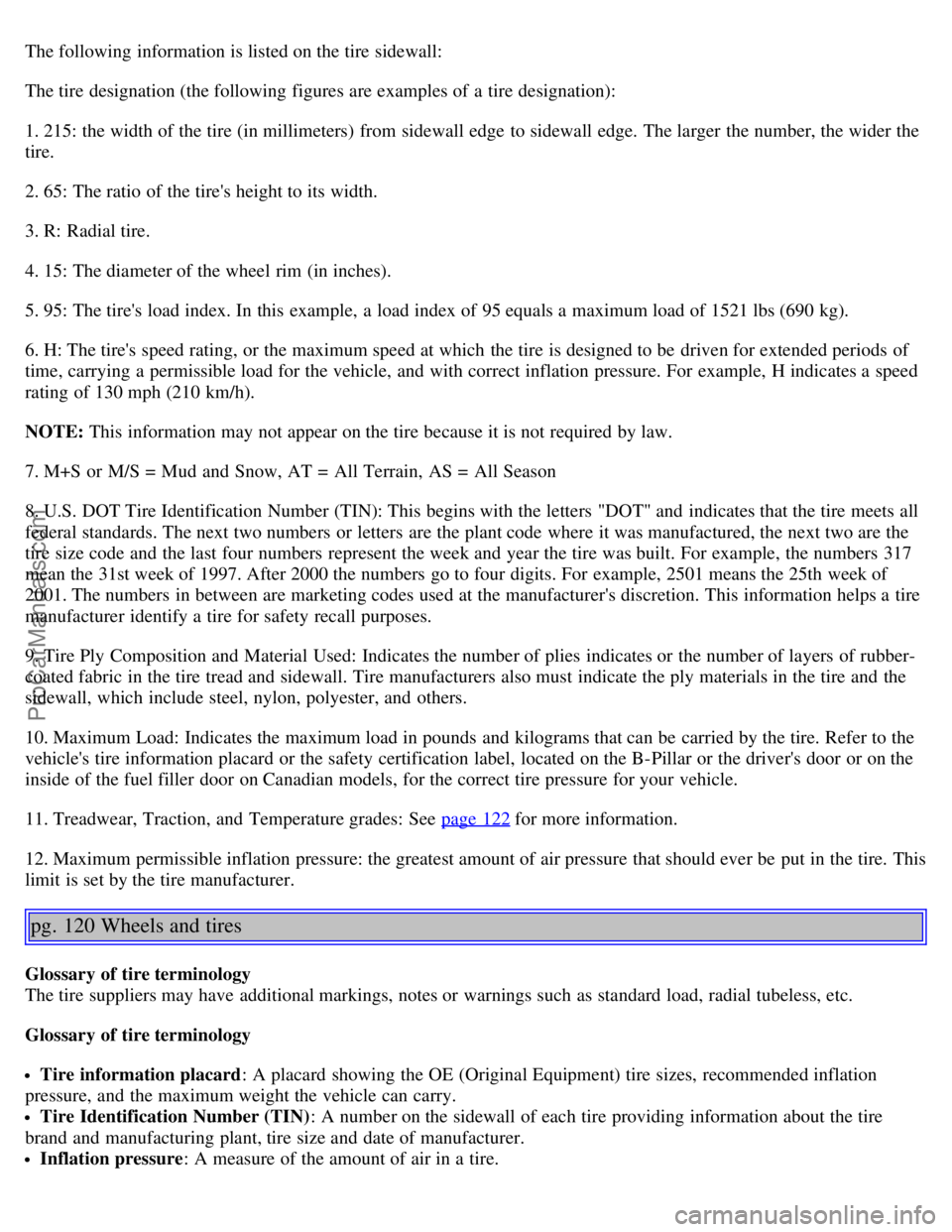
The following information is listed on the tire sidewall:
The tire designation (the following figures are examples of a tire designation):
1. 215: the width of the tire (in millimeters) from sidewall edge to sidewall edge. The larger the number, the wider the
tire.
2. 65: The ratio of the tire's height to its width.
3. R: Radial tire.
4. 15: The diameter of the wheel rim (in inches).
5. 95: The tire's load index. In this example, a load index of 95 equals a maximum load of 1521 lbs (690 kg).
6. H: The tire's speed rating, or the maximum speed at which the tire is designed to be driven for extended periods of
time, carrying a permissible load for the vehicle, and with correct inflation pressure. For example, H indicates a speed
rating of 130 mph (210 km/h).
NOTE: This information may not appear on the tire because it is not required by law.
7. M+S or M/S = Mud and Snow, AT = All Terrain, AS = All Season
8. U.S. DOT Tire Identification Number (TIN): This begins with the letters "DOT" and indicates that the tire meets all
federal standards. The next two numbers or letters are the plant code where it was manufactured, the next two are the
tire size code and the last four numbers represent the week and year the tire was built. For example, the numbers 317
mean the 31st week of 1997. After 2000 the numbers go to four digits. For example, 2501 means the 25th week of
2001. The numbers in between are marketing codes used at the manufacturer's discretion. This information helps a tire
manufacturer identify a tire for safety recall purposes.
9. Tire Ply Composition and Material Used: Indicates the number of plies indicates or the number of layers of rubber-
coated fabric in the tire tread and sidewall. Tire manufacturers also must indicate the ply materials in the tire and the
sidewall, which include steel, nylon, polyester, and others.
10. Maximum Load: Indicates the maximum load in pounds and kilograms that can be carried by the tire. Refer to the
vehicle's tire information placard or the safety certification label, located on the B-Pillar or the driver's door or on the
inside of the fuel filler door on Canadian models, for the correct tire pressure for your vehicle.
11. Treadwear, Traction, and Temperature grades: See page 122
for more information.
12. Maximum permissible inflation pressure: the greatest amount of air pressure that should ever be put in the tire. This
limit is set by the tire manufacturer.
pg. 120 Wheels and tires
Glossary of tire terminology
The tire suppliers may have additional markings, notes or warnings such as standard load, radial tubeless, etc.
Glossary of tire terminology
Tire information placard : A placard showing the OE (Original Equipment) tire sizes, recommended inflation
pressure, and the maximum weight the vehicle can carry.
Tire Identification Number (TIN) : A number on the sidewall of each tire providing information about the tire
brand and manufacturing plant, tire size and date of manufacturer.
Inflation pressure : A measure of the amount of air in a tire.
ProCarManuals.com
Page 84 of 132
![VOLVO S60 2006 User Guide Standard load: A class of P-metric or Metric tires designed to carry a maximum load at 35 psi [37 psi (2.5 bar) for
Metric tires]. Increasing the inflation pressure beyond this pressure will not](/img/45/58512/w960_58512-83.png "VOLVO S60 2006 User Guide Standard load: A class of P-metric or Metric tires designed to carry a maximum load at 35 psi [37 psi (2.5 bar) for
Metric tires]. Increasing the inflation pressure beyond this pressure will not")
Standard load: A class of P-metric or Metric tires designed to carry a maximum load at 35 psi [37 psi (2.5 bar) for
Metric tires]. Increasing the inflation pressure beyond this pressure will not increase the tires load carrying capability.
Extra load: A class of P-metric or Metric tires designed to carry a heavier maximum load at 41 psi [43 psi (2.9 bar)
for Metric tires]. Increasing the inflation pressure beyond this pressure will not increase the tires load carrying
capability.
kPa : Kilopascal, a metric unit of air pressure.
PSI: Pounds per square inch, a standard unit of air pressure.
B-pillar : The structural member at the side of the vehicle behind the front door.
Bead area of the tire : Area of the tire next to the rim.
Sidewall of the tire: Area between the bead area and the tread.
Tread area of the tire : Area of the perimeter of the tire that contacts the road when mounted on the vehicle.
Rim: The metal support (wheel) for a tire or a tire and tube assembly upon which the tire beads are seated.
Maximum load rating : a figure indicating the maximum load in pounds and kilograms that can be carried by the
tire. This rating is established by the tire manufacturer.
Maximum permissible inflation pressure : the greatest amount of air pressure that should ever be put in the tire.
This limit is set by the tire manufacturer.
Recommended tire inflation pressure : inflation pressure, established by Volvo, which is based on the type of tires
that are mounted on a vehicle at the factory. This inflation pressure is affected by the number of occupants in the car,
the amount of cargo, and the speed at which the vehicle will be driven for a prolonged period. This information can be
found on the tire inflation placard(s) located on the driver's side B-pillar or on the inside of the fuel filler door on
Canadian models, and in the tire inflation table in this chapter.
Cold tires : The tires are considered to be cold when they have the same temperature as the surrounding (ambient)
air. This temperature is normally reached after the car has been parked for at least 3 hours.
pg. 121 Wheels and tires
Vehicle loading
Properly loading your vehicle will provide maximum return of vehicle design performance.
Before loading your vehicle, familiarize yourself with the following terms for determining your vehicle's weight
ratings, with or without a trailer, from the vehicle's Federal/ Canadian Motor Vehicle Safety Standards
(FMVSS/CMVSS) label, and the vehicle's tire information placard:
Curb weight
The weight of the vehicle including a full tank of fuel and all standard equipment. It does not include passengers,
cargo, or optional equipment.
Capacity weight
All weight added to the curb weight, including cargo and optional equipment. When towing, trailer hitch tongue load
is also part of cargo weight.
NOTE: For trailer towing information, please refer to the section "Towing a trailer" on page 103
.
Permissible axle weight
The maximum allowable weight that can be carried by a single axle (front or rear). These numbers are shown on the
Federal/Canadian Motor Vehicle Safety Standards (FMVSS/CMVSS) label. The total load on each axle must never
exceed its maximum permissible weight.
Gross vehicle weight (GVW)
The vehicle's curb weight + cargo + passengers.
NOTE:
The location of the various labels in your vehicle can be found on page 164.
ProCarManuals.com
Page 85 of 132

A table listing important weight limits for your vehicle can be found on page 166.
Steps for Determining Correct Load Limit
(1) Locate the statement "the combined weight of occupants and cargo should never exceed XXX pounds'' on your
vehicle's placard.
(2) Determine the combined weight of the driver and passengers that will be riding in your vehicle.
(3) Subtract the combined weight of the driver and passengers from XXX kilograms or XXX pounds.
(4) The resulting figure equals the available amount of cargo and luggage load capacity. For example, if the "XXX''
amount equals 1400 lbs. and there will be five 150 lb. passengers in your vehicle, the amount of available cargo and
luggage load capacity is 650 lbs. (1400-750 (5 x 150) = 650 lbs.)
(5) Determine the combined weight of luggage and cargo being loaded on the vehicle. That weight may not safely
exceed the available cargo and luggage load capacity calculated in Step 4.
(6) If your vehicle will be towing a trailer, load from your trailer will be transferred to your vehicle. Consult this
manual
1 to determine how this reduces the available cargo and luggage load capacity of your vehicle.
WARNING!
- Exceeding the permissible axle weight, gross vehicle weight, or any other weight rating limits can cause tire
overheating resulting in permanent deformation or catastrophic failure.
- Do not use replacement tires with lower load carrying capacities than the tires that were original equipment on the
vehicle because this will lower the vehicle's GVW rating. Replacement tires with a higher limit than the originals do
not increase the vehicle's GVW rating limitations.
1. See "Towing a trailer" on page 103
WARNING!
pg. 122 Wheels and tires
Uniform Tire Quality Grading
ALL PASSENGER VEHICLE TIRES MUST CONFORM TO FEDERAL SAFETY REQUIREMENTS IN
ADDITION TO THESE GRADES
Quality grades can be found, where applicable, on the tire sidewall between the tread shoulder and maximum
section width. For example:
Treadwear 200 Traction AA Temperature A
TREADWEAR
The treadwear grade is a comparative rating based on the wear rate of the tire when tested under controlled conditions
on a specified government test course. For example, a tire graded 150 would wear one and one half (1 1/2) times as
well on the government course as a tire graded 100. The relative performance of tires depends upon the actual
conditions of their use, however, and many depart significantly from the norm due to variation in driving habits,
service practices and differences in road characteristics and climate.
TRACTION
The traction grades, from highest to lowest, are AA, A, B, and C, as measured under controlled conditions on specified
government test surfaces of asphalt and concrete. A tire marked C may have poor traction performance.
ProCarManuals.com
Page 89 of 132
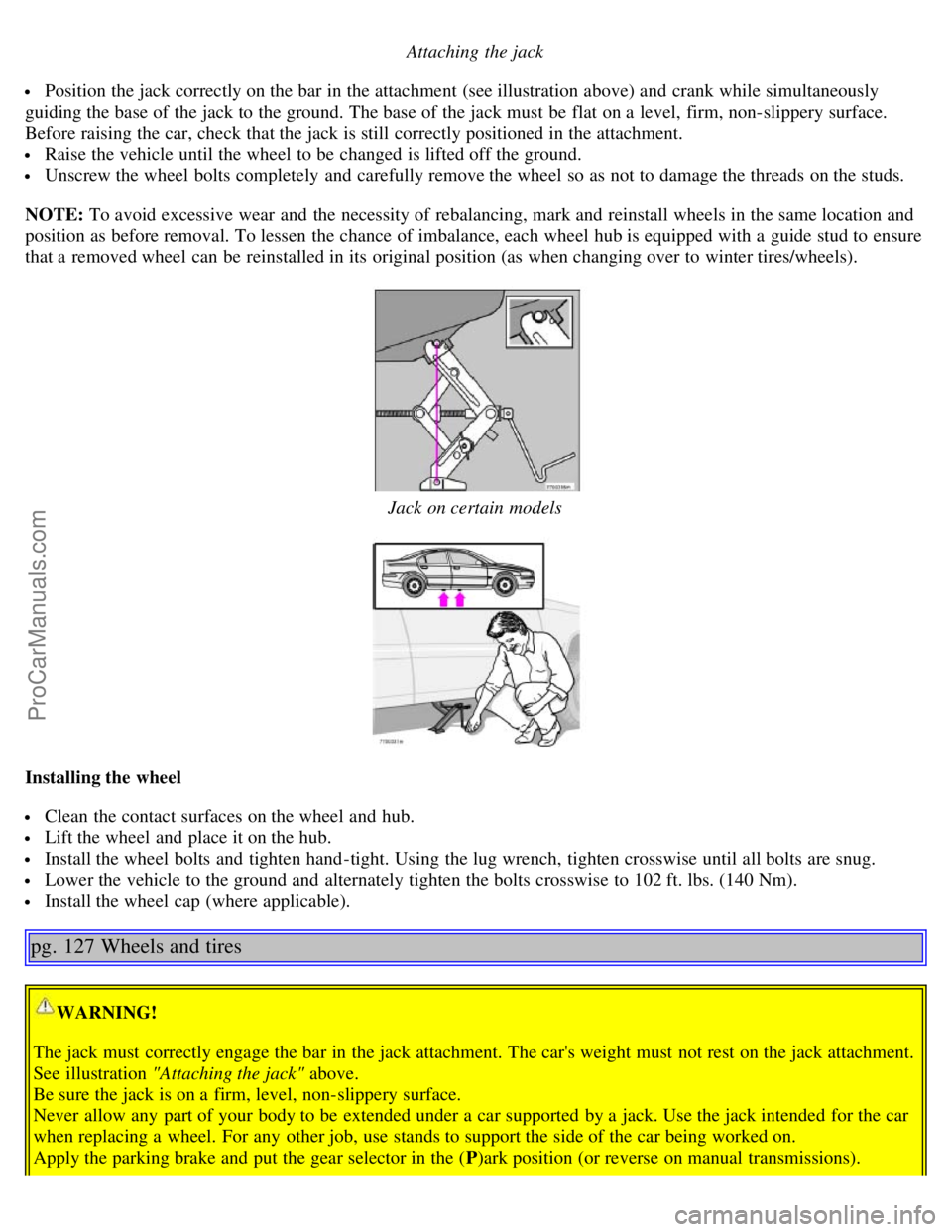
Attaching the jack
Position the jack correctly on the bar in the attachment (see illustration above) and crank while simultaneously
guiding the base of the jack to the ground. The base of the jack must be flat on a level, firm, non-slippery surface.
Before raising the car, check that the jack is still correctly positioned in the attachment.
Raise the vehicle until the wheel to be changed is lifted off the ground.
Unscrew the wheel bolts completely and carefully remove the wheel so as not to damage the threads on the studs.
NOTE: To avoid excessive wear and the necessity of rebalancing, mark and reinstall wheels in the same location and
position as before removal. To lessen the chance of imbalance, each wheel hub is equipped with a guide stud to ensure
that a removed wheel can be reinstalled in its original position (as when changing over to winter tires/wheels).
Jack on certain models
Installing the wheel
Clean the contact surfaces on the wheel and hub.
Lift the wheel and place it on the hub.
Install the wheel bolts and tighten hand -tight. Using the lug wrench, tighten crosswise until all bolts are snug.
Lower the vehicle to the ground and alternately tighten the bolts crosswise to 102 ft. lbs. (140 Nm).
Install the wheel cap (where applicable).
pg. 127 Wheels and tires
WARNING!
The jack must correctly engage the bar in the jack attachment. The car's weight must not rest on the jack attachment.
See illustration "Attaching the jack" above.
Be sure the jack is on a firm, level, non-slippery surface.
Never allow any part of your body to be extended under a car supported by a jack. Use the jack intended for the car
when replacing a wheel. For any other job, use stands to support the side of the car being worked on.
Apply the parking brake and put the gear selector in the ( P)ark position (or reverse on manual transmissions).
ProCarManuals.com
Page 99 of 132
Note the following before you begin working on your car:
Battery
Ensure that the battery cables are correctly connected and tightened.
Never disconnect the battery when the engine is running (e.g. when replacing the battery).
Never use a fast charger to charge the battery. The battery cables should be disconnected when recharging.
The battery contains acid that is both corrosive and poisonous. It is important that the battery is handled in an
environmentally friendly way. Let your Volvo dealer assist you.
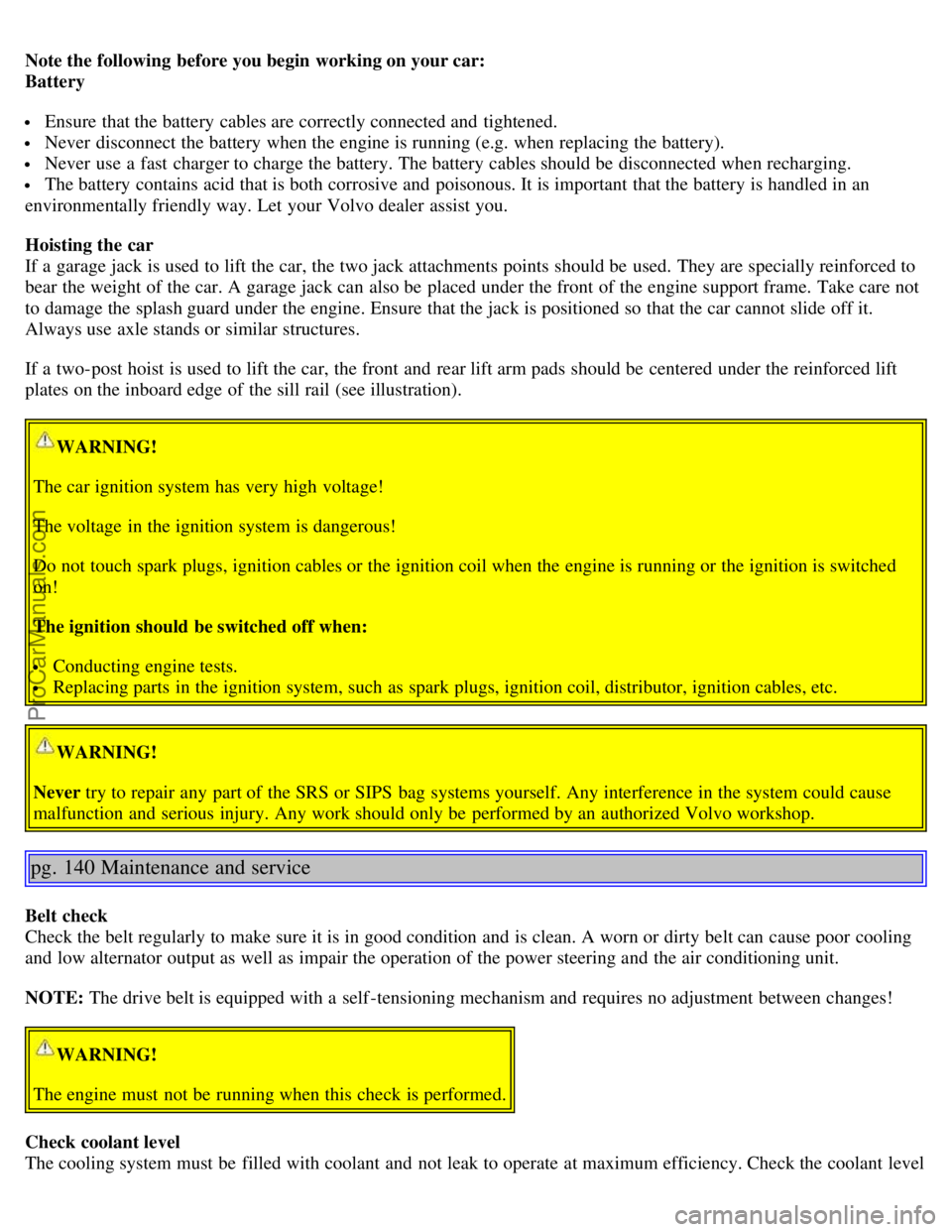
Hoisting the car
If a garage jack is used to lift the car, the two jack attachments points should be used. They are specially reinforced to
bear the weight of the car. A garage jack can also be placed under the front of the engine support frame. Take care not
to damage the splash guard under the engine. Ensure that the jack is positioned so that the car cannot slide off it.
Always use axle stands or similar structures.
If a two-post hoist is used to lift the car, the front and rear lift arm pads should be centered under the reinforced lift
plates on the inboard edge of the sill rail (see illustration).
WARNING!
The car ignition system has very high voltage!
The voltage in the ignition system is dangerous!
Do not touch spark plugs, ignition cables or the ignition coil when the engine is running or the ignition is switched
on!
The ignition should be switched off when:
Conducting engine tests.
Replacing parts in the ignition system, such as spark plugs, ignition coil, distributor, ignition cables, etc.
WARNING!
Never try to repair any part of the SRS or SIPS bag systems yourself. Any interference in the system could cause
malfunction and serious injury. Any work should only be performed by an authorized Volvo workshop.
pg. 140 Maintenance and service
Belt check
Check the belt regularly to make sure it is in good condition and is clean. A worn or dirty belt can cause poor cooling
and low alternator output as well as impair the operation of the power steering and the air conditioning unit.
NOTE: The drive belt is equipped with a self -tensioning mechanism and requires no adjustment between changes!
WARNING!
The engine must not be running when this check is performed.
Check coolant level
The cooling system must be filled with coolant and not leak to operate at maximum efficiency. Check the coolant level
ProCarManuals.com
Page 101 of 132

4. Dipstick - engine oil
5. Radiator
6. Cooling fan
7. Oil filler cap - engine
8. Clutch/brake fluid reservoir
9. Relay/fuse box
10. Air cleaner
11. Battery (in trunk)
12. Data plate
WARNING!
The cooling fan (6) may start or continue to operate (for up to 6 minutes) after the engine has been switched off.
pg. 142 Maintenance and service
Engine oil
Oil specifications
Engine oil must meet the minimum ILSAC specification GF-3, API SL, or ACEA A1/B1. Lower quality oils may not
offer the same fuel economy, engine performance, or engine protection.
Volvo Cars recommends
.
Depending on your driving habits, premium or synthetic oils may provide superior fuel economy and engine
protection. Consult your Volvo retailer for recommendations on premium or synthetic oils.
Oil additives must not be used.
NOTE: Synthetic oil is not used when the oil is changed at normal maintenance services. This oil is only used at
customer request, at additional charge. Please consult your Volvo retailer.
Oil viscosity (stable ambient temperatures)
Operation in hot climates
When temperatures exceed 86° F (30° C) in your area, Volvo recommends, for the protection of your engine, that you
use a heavier weight oil, such as SAE 10W/30. See the viscosity chart.
ProCarManuals.com
Page 106 of 132
2 0 0 6
VOLVO S60
Specifications
pg. 163 Specifications
Label information 164
Dimensions and weights165
Capacities167
Engine oil168
Fluids169
Cooling system169
Three way catalytic converter170
Suspension171
Bulbs172
Electrical system173
Engine specifications174
All specifications are subject to change without prior notice.
pg. 164 Specifications
Label information
1 Vehicle Emission Control Information
Your Volvo is designed to meet all applicable emission standards, as evidenced by the certification label on the
underside of the hood. For further information regarding these regulations, please consult your Volvo retailer.
2 Vacuum hose routing
(underside of hood)
3 Loads and Tire Pressures
(on inside of fuel filler door): Canadian models only.
4 Model plate
Vehicle Identification Number (VIN). Codes for color and upholstery, etc. The plate is located in the engine
compartment, on the inside of the left front fender.
5 Vehicle Identification Number (VIN) *
The VIN plate is located on the top left surface of the dashboard. The VIN is also stamped on the right hand door
pillar.
6 Federal Motor Vehicle Safety Standards (FMVSS) specifications (USA) and Ministry of Transport (CMVSS)
standards (Canada)
ProCarManuals.com
Page 107 of 132
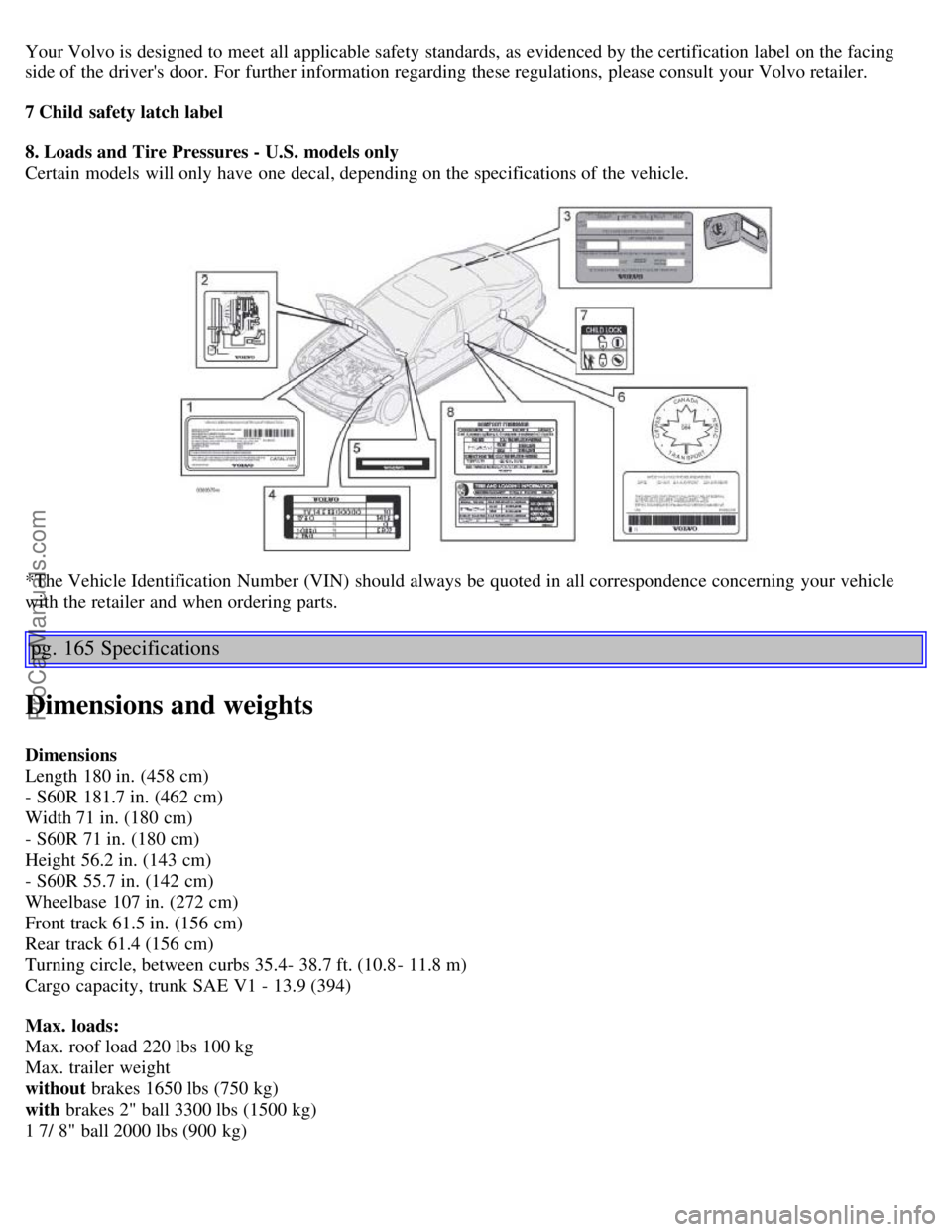
Your Volvo is designed to meet all applicable safety standards, as evidenced by the certification label on the facing
side of the driver's door. For further information regarding these regulations, please consult your Volvo retailer.
7 Child safety latch label
8. Loads and Tire Pressures - U.S. models only
Certain models will only have one decal, depending on the specifications of the vehicle.
*The Vehicle Identification Number (VIN) should always be quoted in all correspondence concerning your vehicle
with the retailer and when ordering parts.
pg. 165 Specifications
Dimensions and weights
Dimensions
Length 180 in. (458 cm)
- S60R 181.7 in. (462 cm)
Width 71 in. (180 cm)
- S60R 71 in. (180 cm)
Height 56.2 in. (143 cm)
- S60R 55.7 in. (142 cm)
Wheelbase 107 in. (272 cm)
Front track 61.5 in. (156 cm)
Rear track 61.4 (156 cm)
Turning circle, between curbs 35.4- 38.7 ft. (10.8- 11.8 m)
Cargo capacity, trunk SAE V1 - 13.9 (394)
Max. loads:
Max. roof load 220 lbs 100 kg
Max. trailer weight
without brakes 1650 lbs (750 kg)
with brakes 2" ball 3300 lbs (1500 kg)
1 7/ 8" ball 2000 lbs (900 kg)
ProCarManuals.com
Page 108 of 132
Max. tongue weight:
Trailer weights below 2,650 lbs (1,200 kg) 110 lbs (50 kg)
Trailer weights above 2,650 lbs (1,200 kg) 165 lbs (75 kg)
See also page 103
for additional information
* When driving for prolonged periods at temperatures above 86°F (30°C), the maximum recommended weight is 2000
lbs (900 kg).
WARNING!
When adding accessories, equipment, luggage and other cargo to your vehicle, the total capacity weight must not be
exceeded.
pg. 166 Specifications
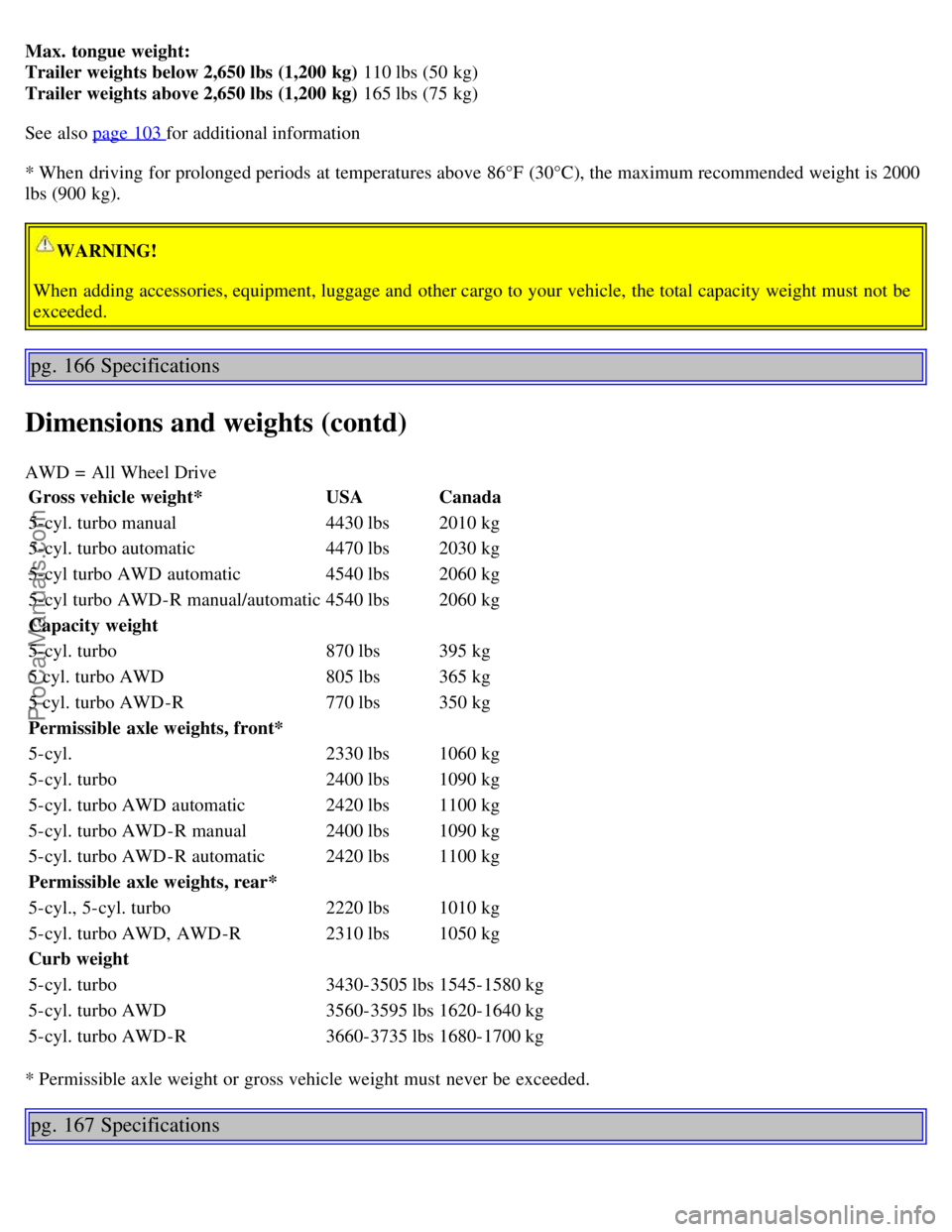
Dimensions and weights (contd)
AWD = All Wheel Drive Gross vehicle weight* USACanada
5-cyl. turbo manual 4430 lbs2010 kg
5-cyl. turbo automatic 4470 lbs2030 kg
5-cyl turbo AWD automatic 4540 lbs2060 kg
5-cyl turbo AWD-R manual/automatic 4540 lbs2060 kg
Capacity weight
5-cyl. turbo 870 lbs395 kg
5 cyl. turbo AWD 805 lbs365 kg
5 cyl. turbo AWD-R 770 lbs350 kg
Permissible axle weights, front*
5-cyl. 2330 lbs1060 kg
5-cyl. turbo 2400 lbs1090 kg
5-cyl. turbo AWD automatic 2420 lbs1100 kg
5-cyl. turbo AWD-R manual 2400 lbs1090 kg
5-cyl. turbo AWD-R automatic 2420 lbs1100 kg
Permissible axle weights, rear*
5-cyl., 5-cyl. turbo 2220 lbs1010 kg
5-cyl. turbo AWD, AWD-R 2310 lbs1050 kg
Curb weight
5-cyl. turbo 3430-3505 lbs1545-1580 kg
5-cyl. turbo AWD 3560-3595 lbs1620-1640 kg
5-cyl. turbo AWD-R 3660-3735 lbs1680-1700 kg
* Permissible axle weight or gross vehicle weight must never be exceeded.
pg. 167 Specifications
ProCarManuals.com
Page 123 of 132
C
Capacities167
Capacity weight121
Carbon Monoxide - Important Warning83
Catalytic converter170
Ceiling lighting156
Central locking system - remote control73
Changing coolant140
Changing wheels125
Check Engine warning light27
Child restraint anchorages21
Child safety locks77
Child seat anchors20
Cigarette lighter41
Climate control systems -general information50
Clock24
Coat hanger67
Cold weather precautions107
Coolant144
Coolant - changing140, 144
Coolant - checking level of140
Cooling system169
Courtesy light62
Cruise control39
Curb weight121
Current fuel consumption38
D
Defroster53
Detachable trailer hitch105
Door mirror defroster37
Door mirrors30
Driving economically87
DSTC29
E
ECC52
Economical driving87
Electric socket30 , 41
Electrical system173
Electrically operated moonroof46
Electrically operated windows42
Emission inspection138
Engine - starting85
Engine compartment141
Engine oil142
ProCarManuals.com