instrument panel VOLVO S60 2006 Owner's Manual
[x] Cancel search | Manufacturer: VOLVO, Model Year: 2006, Model line: S60, Model: VOLVO S60 2006Pages: 132, PDF Size: 2.33 MB
Page 81 of 132
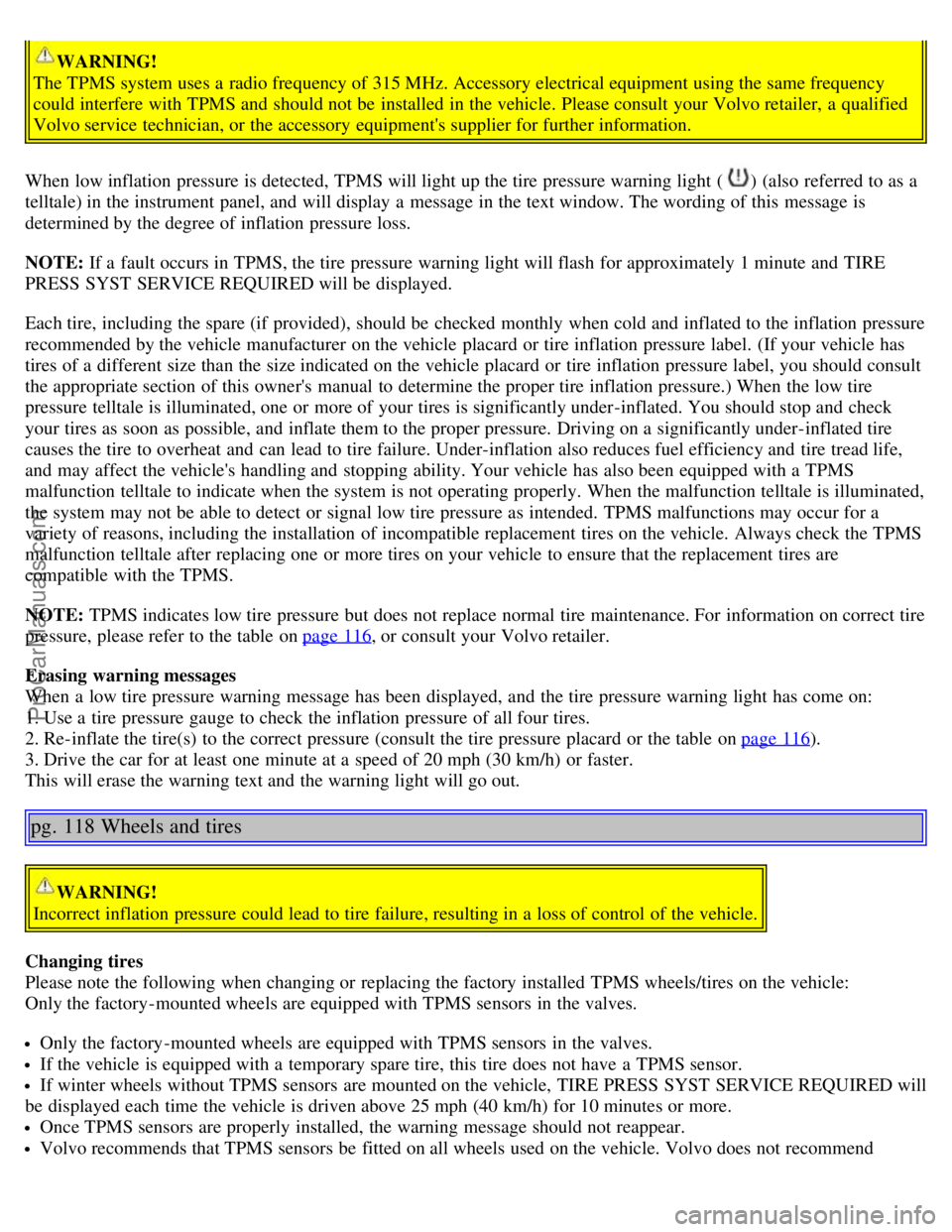
WARNING!
The TPMS system uses a radio frequency of 315 MHz. Accessory electrical equipment using the same frequency
could interfere with TPMS and should not be installed in the vehicle. Please consult your Volvo retailer, a qualified
Volvo service technician, or the accessory equipment's supplier for further information.
When low inflation pressure is detected, TPMS will light up the tire pressure warning light (
) (also referred to as a
telltale) in the instrument panel, and will display a message in the text window. The wording of this message is
determined by the degree of inflation pressure loss.
NOTE: If a fault occurs in TPMS, the tire pressure warning light will flash for approximately 1 minute and TIRE
PRESS SYST SERVICE REQUIRED will be displayed.
Each tire, including the spare (if provided), should be checked monthly when cold and inflated to the inflation pressure
recommended by the vehicle manufacturer on the vehicle placard or tire inflation pressure label. (If your vehicle has
tires of a different size than the size indicated on the vehicle placard or tire inflation pressure label, you should consult
the appropriate section of this owner's manual to determine the proper tire inflation pressure.) When the low tire
pressure telltale is illuminated, one or more of your tires is significantly under-inflated. You should stop and check
your tires as soon as possible, and inflate them to the proper pressure. Driving on a significantly under-inflated tire
causes the tire to overheat and can lead to tire failure. Under-inflation also reduces fuel efficiency and tire tread life,
and may affect the vehicle's handling and stopping ability. Your vehicle has also been equipped with a TPMS
malfunction telltale to indicate when the system is not operating properly. When the malfunction telltale is illuminated,
the system may not be able to detect or signal low tire pressure as intended. TPMS malfunctions may occur for a
variety of reasons, including the installation of incompatible replacement tires on the vehicle. Always check the TPMS
malfunction telltale after replacing one or more tires on your vehicle to ensure that the replacement tires are
compatible with the TPMS.
NOTE: TPMS indicates low tire pressure but does not replace normal tire maintenance. For information on correct tire
pressure, please refer to the table on page 116
, or consult your Volvo retailer.
Erasing warning messages
When a low tire pressure warning message has been displayed, and the tire pressure warning light has come on:
1. Use a tire pressure gauge to check the inflation pressure of all four tires.
2. Re-inflate the tire(s) to the correct pressure (consult the tire pressure placard or the table on page 116
).
3. Drive the car for at least one minute at a speed of 20 mph (30 km/h) or faster.
This will erase the warning text and the warning light will go out.
pg. 118 Wheels and tires
WARNING!
Incorrect inflation pressure could lead to tire failure, resulting in a loss of control of the vehicle.
Changing tires
Please note the following when changing or replacing the factory installed TPMS wheels/tires on the vehicle:
Only the factory-mounted wheels are equipped with TPMS sensors in the valves.
Only the factory-mounted wheels are equipped with TPMS sensors in the valves.
If the vehicle is equipped with a temporary spare tire, this tire does not have a TPMS sensor.
If winter wheels without TPMS sensors are mounted on the vehicle, TIRE PRESS SYST SERVICE REQUIRED will
be displayed each time the vehicle is driven above 25 mph (40 km/h) for 10 minutes or more.
Once TPMS sensors are properly installed, the warning message should not reappear.
Volvo recommends that TPMS sensors be fitted on all wheels used on the vehicle. Volvo does not recommend
ProCarManuals.com
Page 82 of 132
moving sensors back and forth between sets of wheels.
CAUTION:
When inflating tires with TPMS valves, press the pump's mouthpiece straight onto the valve to help avoid bending or
otherwise damaging the valve.
Self supporting run flat tires (option)
Certain models equipped with the Tire Pressure Monitoring System (TPMS) can also be equipped with self supporting
run flat tires. Tires of this type have specially reinforced sidewalls that make it possible to continue driving in the
event of a drop in inflation pressure. Tires of this type are mounted on special rims.
NOTE: Self supporting run flat tires are only available in conjunction with TPMS. If a self supporting run flat tire
should lose inflation pressure, the yellow TPMS warning symbol (
) in the instrument panel lights up to alert the
driver, and a message will be shown in the text window in the instrument panel.
If this occurs, reduce vehicle speed to a maximum of 50 mph (80 km/h). The vehicle can be driven approximately 50
miles (80 km), or somewhat farther if the vehicle is not heavily loaded. The tire should be replaced as soon as
possible.
Hard braking and sudden steering maneuvers should be avoided.
In certain cases, it may be difficult to see which self supporting run flat tire is defective. To determine which tire is
damaged, check the inflation pressure of all four tires.
WARNING!
Only specially trained persons should mount self supporting run flat tires.
If self supporting run flat tires are mounted, the vehicle must be equipped with a Tire Pressure Monitoring
System.
After a low pressure warning has been displayed, do not exceed 50 mph (80 km/h).
Avoid severe cornering and hard braking, and minimize the distance traveled before replacing the self supporting
run flat tire.
Self supporting run flat tires cannot be repaired. They must be replaced if damaged or punctured.
pg. 119 Wheels and tires
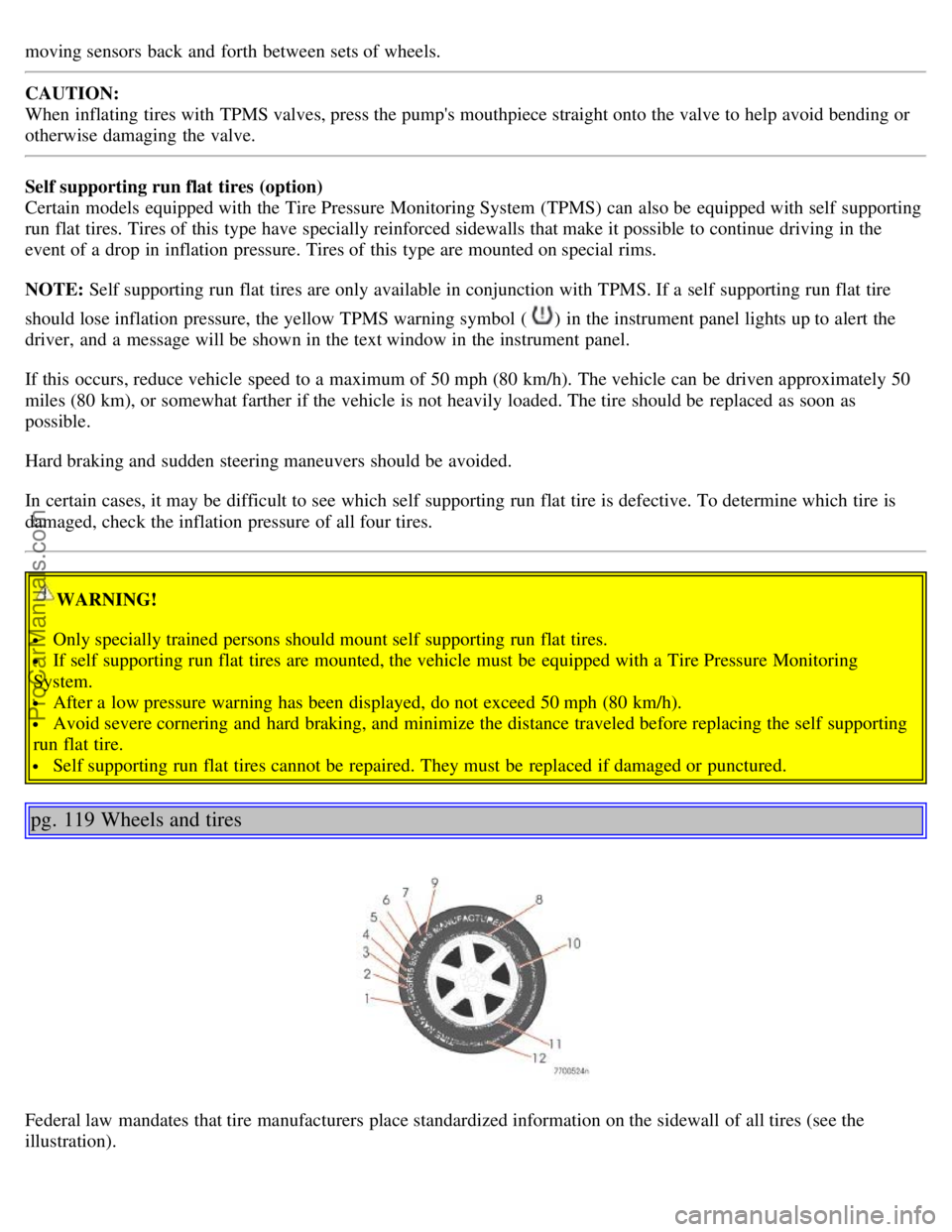
Federal law mandates that tire manufacturers place standardized information on the sidewall of all tires (see the
illustration).
ProCarManuals.com
Page 103 of 132
If the engine is warm, wait for at least 10-15 minutes after the engine has been switched off before checking the oil.
Checking the oil
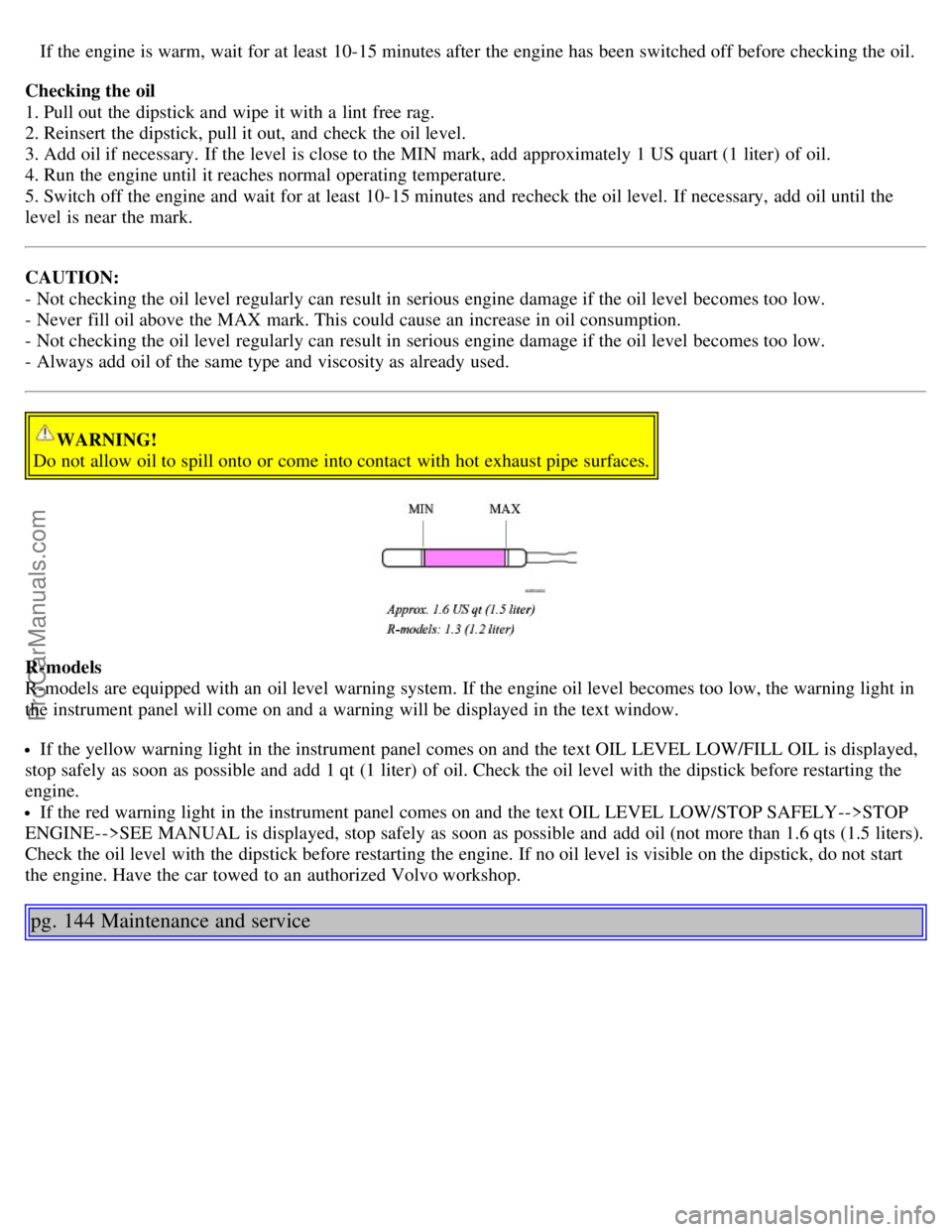
1. Pull out the dipstick and wipe it with a lint free rag.
2. Reinsert the dipstick, pull it out, and check the oil level.
3. Add oil if necessary. If the level is close to the MIN mark, add approximately 1 US quart (1 liter) of oil.
4. Run the engine until it reaches normal operating temperature.
5. Switch off the engine and wait for at least 10-15 minutes and recheck the oil level. If necessary, add oil until the
level is near the mark.
CAUTION:
- Not checking the oil level regularly can result in serious engine damage if the oil level becomes too low.
- Never fill oil above the MAX mark. This could cause an increase in oil consumption.
- Not checking the oil level regularly can result in serious engine damage if the oil level becomes too low.
- Always add oil of the same type and viscosity as already used.
WARNING!
Do not allow oil to spill onto or come into contact with hot exhaust pipe surfaces.
R-models
R-models are equipped with an oil level warning system. If the engine oil level becomes too low, the warning light in
the instrument panel will come on and a warning will be displayed in the text window.
If the yellow warning light in the instrument panel comes on and the text OIL LEVEL LOW/FILL OIL is displayed,
stop safely as soon as possible and add 1 qt (1 liter) of oil. Check the oil level with the dipstick before restarting the
engine.
If the red warning light in the instrument panel comes on and the text OIL LEVEL LOW/STOP SAFELY-->STOP
ENGINE-->SEE MANUAL is displayed, stop safely as soon as possible and add oil (not more than 1.6 qts (1.5 liters).
Check the oil level with the dipstick before restarting the engine. If no oil level is visible on the dipstick, do not start
the engine. Have the car towed to an authorized Volvo workshop.
pg. 144 Maintenance and service
ProCarManuals.com
Page 125 of 132
High beam headlights34
High beam indicator24
Hoisting the car139
Home safe lighting34
HomeLink® Universal Transceiver194
Hood - opening141
I
Ignition switch86
Immobilizer (start inhibitor)72
Indicator and warning symbols24 , 25
Inflation pressure tables116
Inflation pressure, checking115
Inspection, preparing for138
Instrument panel24
Integrated booster cushion19
Interior57
Interior lighting62
Introductioni
ISOFIX/LATCH anchors20
J
Jack126
Jack, location of70
Jump starting102
K
Keylockii
, 85
Keys71
Kickdown91
L
LATCH (ISOFIX) anchors20
Lighting panel32
Load carriers106
Locking steering wheel86
Locking the car75
Locks71
Long distance trips108
Long loads - carrying69
Low beam bulb, changing151
Low beam headlights34
M
Maintenance service136
Maintenance, periodic137
Malfunction indicator light27
Manual transmission89
Messages in the display28
ProCarManuals.com