roof VOLVO S60 2007 User Guide
[x] Cancel search | Manufacturer: VOLVO, Model Year: 2007, Model line: S60, Model: VOLVO S60 2007Pages: 200, PDF Size: 4.03 MB
Page 137 of 200
2 0 0 7
VOLVO S60
Vehicle care
pg. 161 Vehicle care
Washing and cleaning the vehicle 162
Paint touch up166
pg. 162 Vehicle care
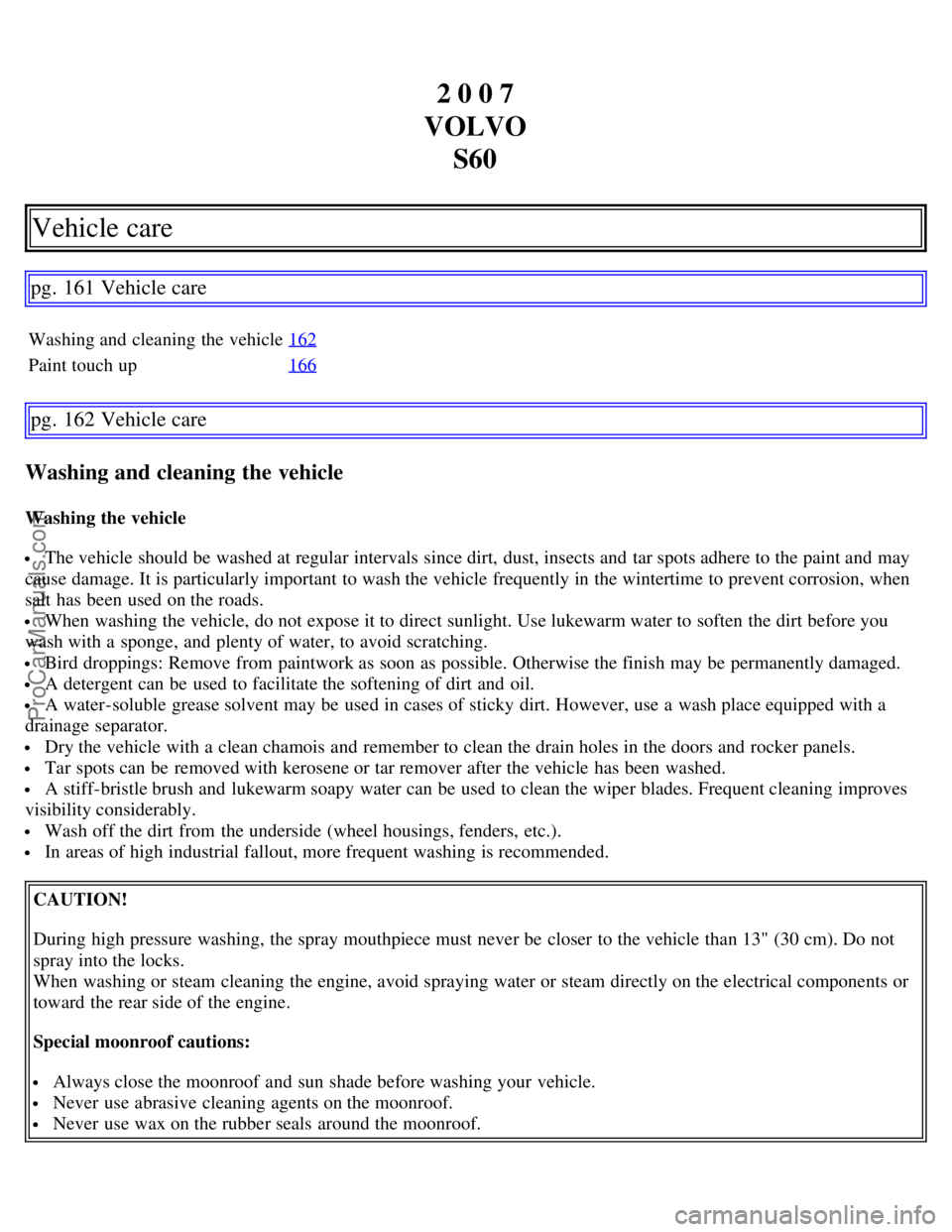
Washing and cleaning the vehicle
Washing the vehicle
The vehicle should be washed at regular intervals since dirt, dust, insects and tar spots adhere to the paint and may
cause damage. It is particularly important to wash the vehicle frequently in the wintertime to prevent corrosion, when
salt has been used on the roads.
When washing the vehicle, do not expose it to direct sunlight. Use lukewarm water to soften the dirt before you
wash with a sponge, and plenty of water, to avoid scratching.
Bird droppings: Remove from paintwork as soon as possible. Otherwise the finish may be permanently damaged.
A detergent can be used to facilitate the softening of dirt and oil.
A water-soluble grease solvent may be used in cases of sticky dirt. However, use a wash place equipped with a
drainage separator.
Dry the vehicle with a clean chamois and remember to clean the drain holes in the doors and rocker panels.
Tar spots can be removed with kerosene or tar remover after the vehicle has been washed.
A stiff-bristle brush and lukewarm soapy water can be used to clean the wiper blades. Frequent cleaning improves
visibility considerably.
Wash off the dirt from the underside (wheel housings, fenders, etc.).
In areas of high industrial fallout, more frequent washing is recommended.
CAUTION!
During high pressure washing, the spray mouthpiece must never be closer to the vehicle than 13" (30 cm). Do not
spray into the locks.
When washing or steam cleaning the engine, avoid spraying water or steam directly on the electrical components or
toward the rear side of the engine.
Special moonroof cautions:
Always close the moonroof and sun shade before washing your vehicle.
Never use abrasive cleaning agents on the moonroof.
Never use wax on the rubber seals around the moonroof.
ProCarManuals.com
Page 155 of 200
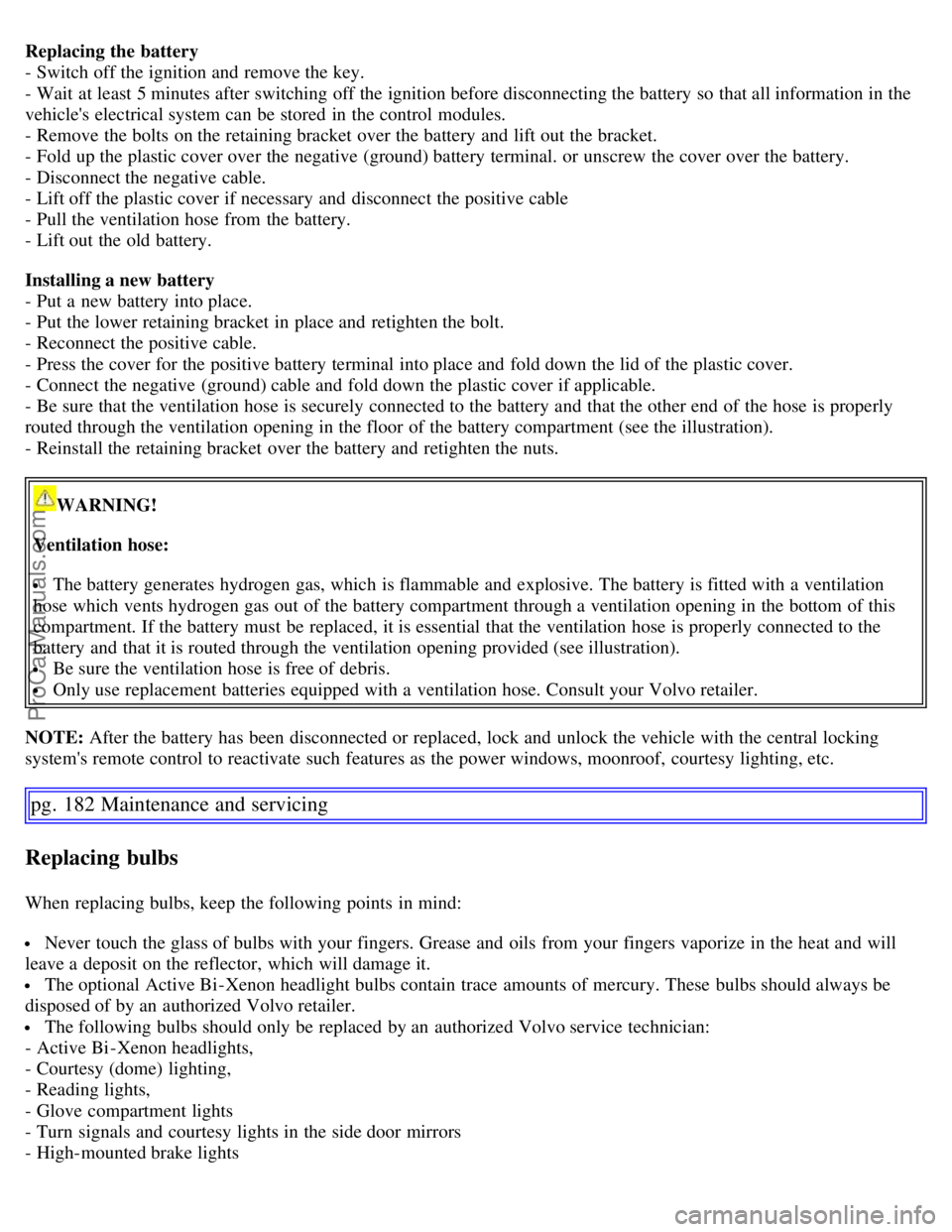
Replacing the battery
- Switch off the ignition and remove the key.
- Wait at least 5 minutes after switching off the ignition before disconnecting the battery so that all information in the
vehicle's electrical system can be stored in the control modules.
- Remove the bolts on the retaining bracket over the battery and lift out the bracket.
- Fold up the plastic cover over the negative (ground) battery terminal. or unscrew the cover over the battery.
- Disconnect the negative cable.
- Lift off the plastic cover if necessary and disconnect the positive cable
- Pull the ventilation hose from the battery.
- Lift out the old battery.
Installing a new battery
- Put a new battery into place.
- Put the lower retaining bracket in place and retighten the bolt.
- Reconnect the positive cable.
- Press the cover for the positive battery terminal into place and fold down the lid of the plastic cover.
- Connect the negative (ground) cable and fold down the plastic cover if applicable.
- Be sure that the ventilation hose is securely connected to the battery and that the other end of the hose is properly
routed through the ventilation opening in the floor of the battery compartment (see the illustration).
- Reinstall the retaining bracket over the battery and retighten the nuts.
WARNING!
Ventilation hose:
The battery generates hydrogen gas, which is flammable and explosive. The battery is fitted with a ventilation
hose which vents hydrogen gas out of the battery compartment through a ventilation opening in the bottom of this
compartment. If the battery must be replaced, it is essential that the ventilation hose is properly connected to the
battery and that it is routed through the ventilation opening provided (see illustration).
Be sure the ventilation hose is free of debris.
Only use replacement batteries equipped with a ventilation hose. Consult your Volvo retailer.
NOTE: After the battery has been disconnected or replaced, lock and unlock the vehicle with the central locking
system's remote control to reactivate such features as the power windows, moonroof, courtesy lighting, etc.
pg. 182 Maintenance and servicing
Replacing bulbs
When replacing bulbs, keep the following points in mind:
Never touch the glass of bulbs with your fingers. Grease and oils from your fingers vaporize in the heat and will
leave a deposit on the reflector, which will damage it.
The optional Active Bi -Xenon headlight bulbs contain trace amounts of mercury. These bulbs should always be
disposed of by an authorized Volvo retailer.
The following bulbs should only be replaced by an authorized Volvo service technician:
- Active Bi -Xenon headlights,
- Courtesy (dome) lighting,
- Reading lights,
- Glove compartment lights
- Turn signals and courtesy lights in the side door mirrors
- High-mounted brake lights
ProCarManuals.com
Page 167 of 200
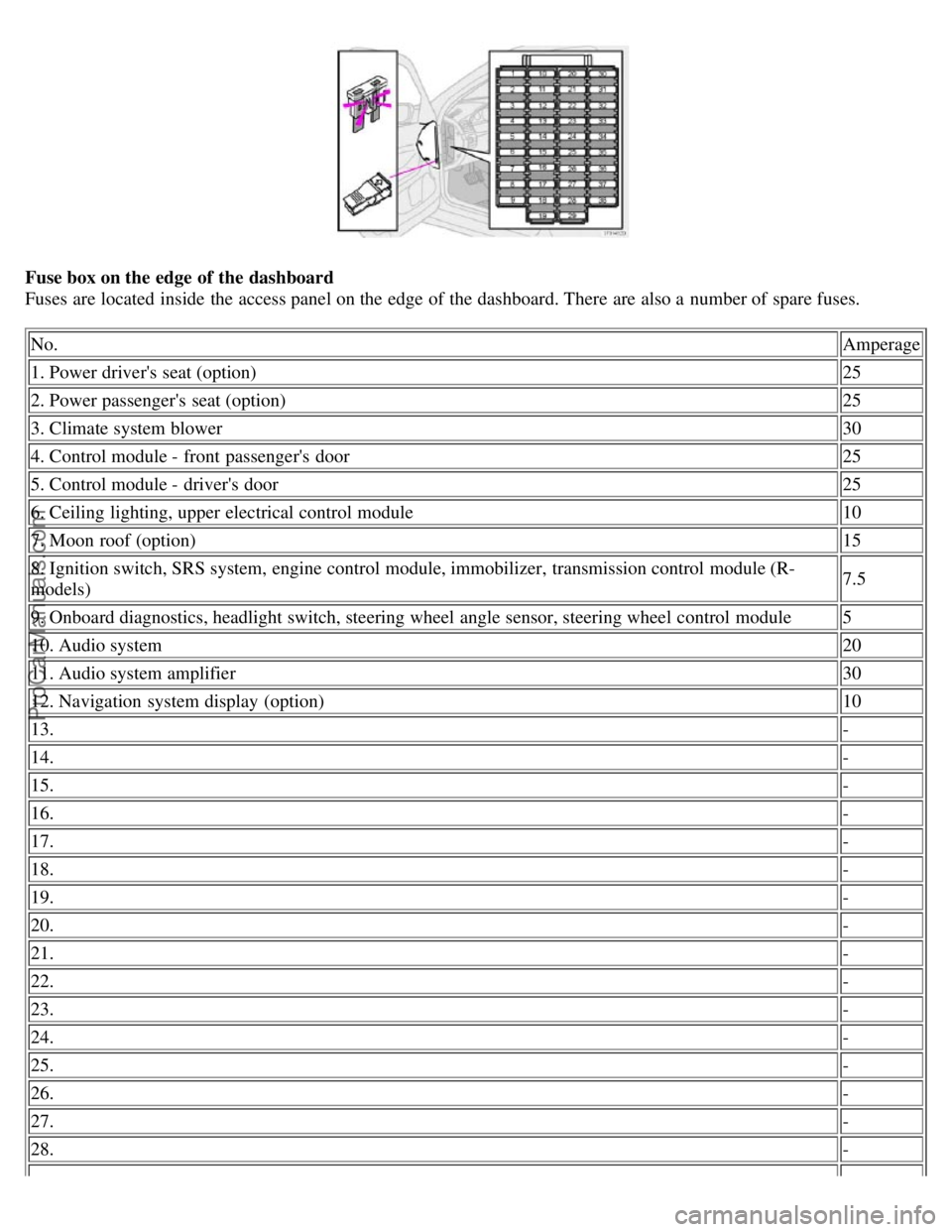
Fuse box on the edge of the dashboard
Fuses are located inside the access panel on the edge of the dashboard. There are also a number of spare fuses.No. Amperage
1. Power driver's seat (option) 25
2. Power passenger's seat (option) 25
3. Climate system blower 30
4. Control module - front passenger's door 25
5. Control module - driver's door 25
6. Ceiling lighting, upper electrical control module 10
7. Moon roof (option) 15
8. Ignition switch, SRS system, engine control module, immobilizer, transmission control module (R-
models) 7.5
9. Onboard diagnostics, headlight switch, steering wheel angle sensor, steering wheel control module 5
10. Audio system 20
11. Audio system amplifier 30
12. Navigation system display (option) 10
13. -
14. -
15. -
16. -
17. -
18. -
19. -
20. -
21. -
22. -
23. -
24. -
25. -
26. -
27. -
28. -
ProCarManuals.com
Page 172 of 200
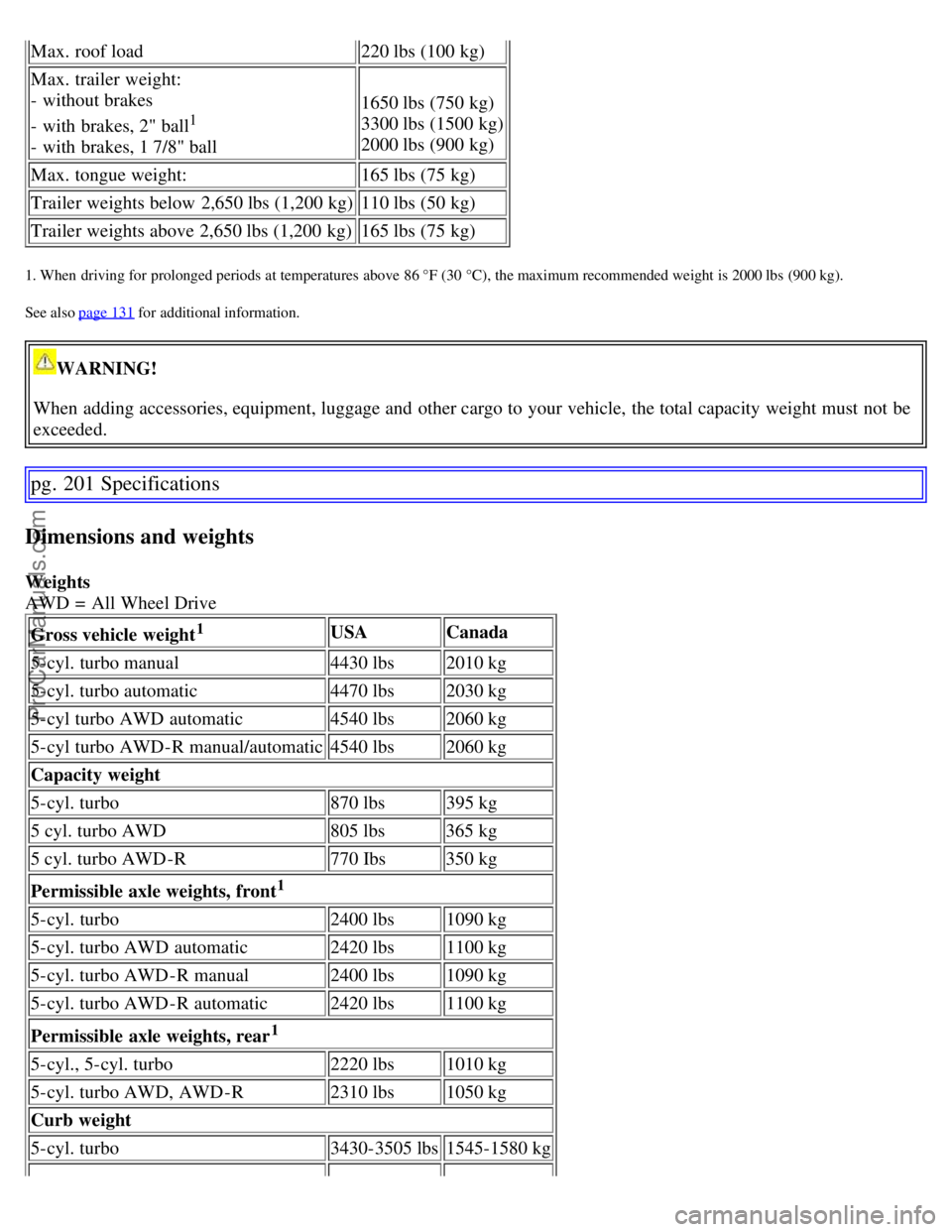
Max. roof load220 lbs (100 kg)
Max. trailer weight:
- without brakes
- with brakes, 2" ball
1
- with brakes, 1 7/8" ball1650 lbs (750 kg)
3300 lbs (1500 kg)
2000 lbs (900 kg)
Max. tongue weight: 165 lbs (75 kg)
Trailer weights below 2,650 lbs (1,200 kg) 110 lbs (50 kg)
Trailer weights above 2,650 lbs (1,200 kg) 165 lbs (75 kg)
1. When driving for prolonged periods at temperatures above 86 °F (30 °C), the maximum recommended weight is 2000 lbs (900 kg).
See also page 131
for additional information.
WARNING!
When adding accessories, equipment, luggage and other cargo to your vehicle, the total capacity weight must not be
exceeded.
pg. 201 Specifications
Dimensions and weights
Weights
AWD = All Wheel Drive Gross vehicle weight
1USA Canada
5-cyl. turbo manual 4430 lbs2010 kg
5-cyl. turbo automatic 4470 lbs2030 kg
5-cyl turbo AWD automatic 4540 lbs2060 kg
5-cyl turbo AWD-R manual/automatic 4540 lbs2060 kg
Capacity weight
5-cyl. turbo 870 lbs395 kg
5 cyl. turbo AWD 805 lbs365 kg
5 cyl. turbo AWD-R 770 Ibs350 kg
Permissible axle weights, front
1
5-cyl. turbo 2400 lbs1090 kg
5-cyl. turbo AWD automatic 2420 lbs1100 kg
5-cyl. turbo AWD-R manual 2400 lbs1090 kg
5-cyl. turbo AWD-R automatic 2420 lbs1100 kg
Permissible axle weights, rear
1
5-cyl., 5-cyl. turbo 2220 lbs1010 kg
5-cyl. turbo AWD, AWD-R 2310 lbs1050 kg
Curb weight
5-cyl. turbo 3430-3505 lbs1545-1580 kg
ProCarManuals.com
Page 195 of 200
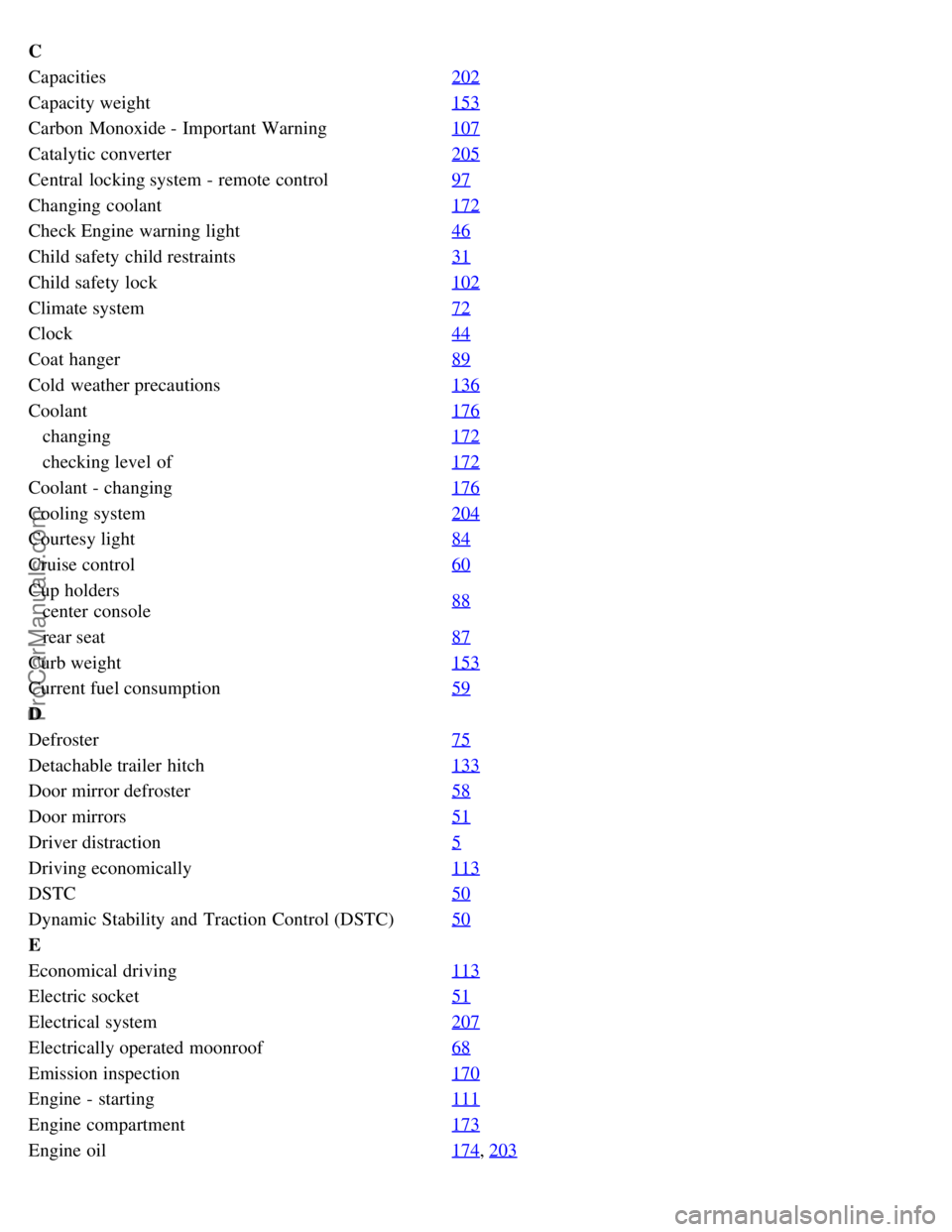
C
Capacities202
Capacity weight153
Carbon Monoxide - Important Warning107
Catalytic converter205
Central locking system - remote control97
Changing coolant172
Check Engine warning light46
Child safety child restraints31
Child safety lock102
Climate system72
Clock44
Coat hanger89
Cold weather precautions136
Coolant176
changing172
checking level of172
Coolant - changing176
Cooling system204
Courtesy light84
Cruise control60
Cup holders
center console88
rear seat
87
Curb weight153
Current fuel consumption59
D
Defroster75
Detachable trailer hitch133
Door mirror defroster58
Door mirrors51
Driver distraction5
Driving economically113
DSTC50
Dynamic Stability and Traction Control (DSTC)50
E
Economical driving113
Electric socket51
Electrical system207
Electrically operated moonroof68
Emission inspection170
Engine - starting111
Engine compartment173
Engine oil174, 203
ProCarManuals.com
Page 197 of 200
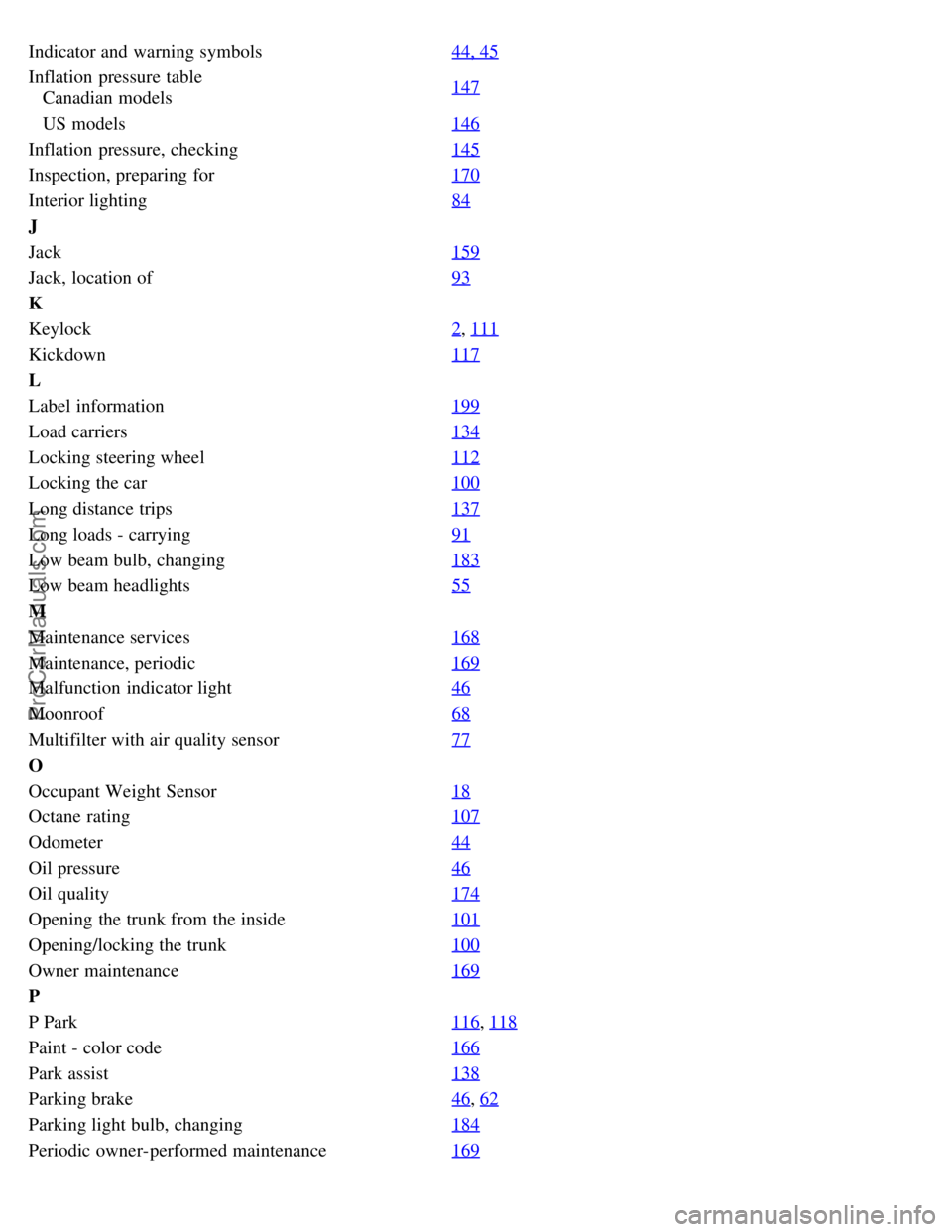
Indicator and warning symbols44, 45
Inflation pressure table
Canadian models147
US models
146
Inflation pressure, checking145
Inspection, preparing for170
Interior lighting84
J
Jack159
Jack, location of93
K
Keylock2
, 111
Kickdown117
L
Label information199
Load carriers134
Locking steering wheel112
Locking the car100
Long distance trips137
Long loads - carrying91
Low beam bulb, changing183
Low beam headlights55
M
Maintenance services168
Maintenance, periodic169
Malfunction indicator light46
Moonroof68
Multifilter with air quality sensor77
O
Occupant Weight Sensor18
Octane rating107
Odometer44
Oil pressure46
Oil quality174
Opening the trunk from the inside101
Opening/locking the trunk100
Owner maintenance169
P
P Park116
, 118
Paint - color code166
Park assist138
Parking brake46, 62
Parking light bulb, changing184
Periodic owner-performed maintenance169
ProCarManuals.com
Page 198 of 200
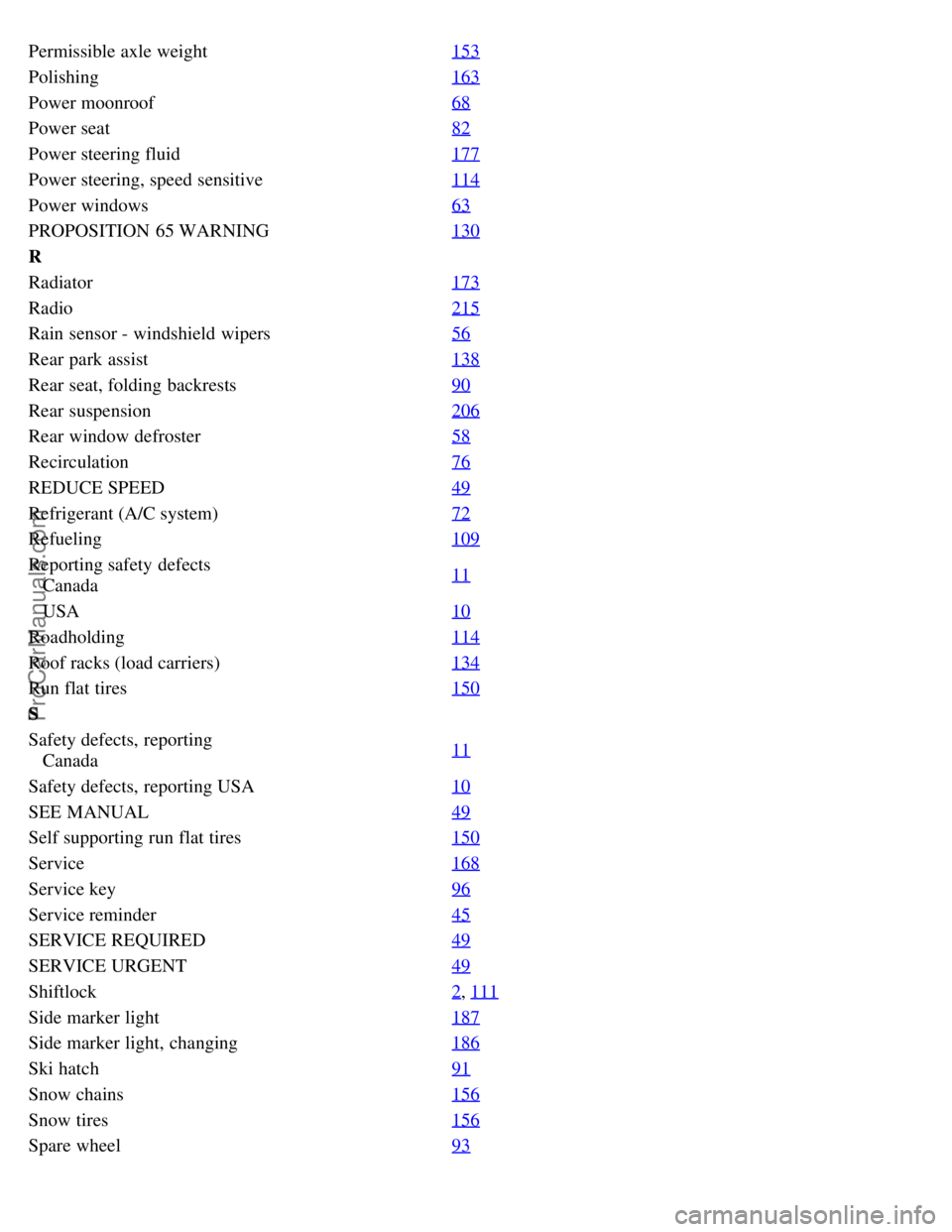
Permissible axle weight153
Polishing163
Power moonroof68
Power seat82
Power steering fluid177
Power steering, speed sensitive114
Power windows63
PROPOSITION 65 WARNING130
R
Radiator173
Radio215
Rain sensor - windshield wipers56
Rear park assist138
Rear seat, folding backrests90
Rear suspension206
Rear window defroster58
Recirculation76
REDUCE SPEED49
Refrigerant (A/C system)72
Refueling109
Reporting safety defects
Canada11
USA
10
Roadholding114
Roof racks (load carriers)134
Run flat tires150
S
Safety defects, reporting
Canada11
Safety defects, reporting USA
10
SEE MANUAL49
Self supporting run flat tires150
Service168
Service key96
Service reminder45
SERVICE REQUIRED49
SERVICE URGENT49
Shiftlock2, 111
Side marker light187
Side marker light, changing186
Ski hatch91
Snow chains156
Snow tires156
Spare wheel93
ProCarManuals.com