roof VOLVO S60 2007 Owners Manual
[x] Cancel search | Manufacturer: VOLVO, Model Year: 2007, Model line: S60, Model: VOLVO S60 2007Pages: 200, PDF Size: 4.03 MB
Page 19 of 200
seat backrests.
WARNING!
The SIPS airbag system is a supplement to the structural Side Impact Protection System and the three-point seat
belt system. It is not designed to deploy during collisions from the front or rear of the vehicle or in rollover
situations.
The use of seat covers on the front seats may impede SIPS airbag deployment.
No objects, accessory equipment or stickers may be placed on, attached to or installed near the SIPS airbag
system or in the area affected by SIPS airbag deployment.
Never try to open or repair any components of the SIPS airbag system. This should be done only by a trained and
qualified Volvo service technician.
In order for the SIPS airbag to provide its best protection, both front seat occupants should sit in an upright
position with the seat belt properly fastened.
Failure to follow these instructions can result in injury to the occupants of the vehicle in the event of an accident.
pg. 25 Safety
Volvo Inflatable Curtain (VIC)
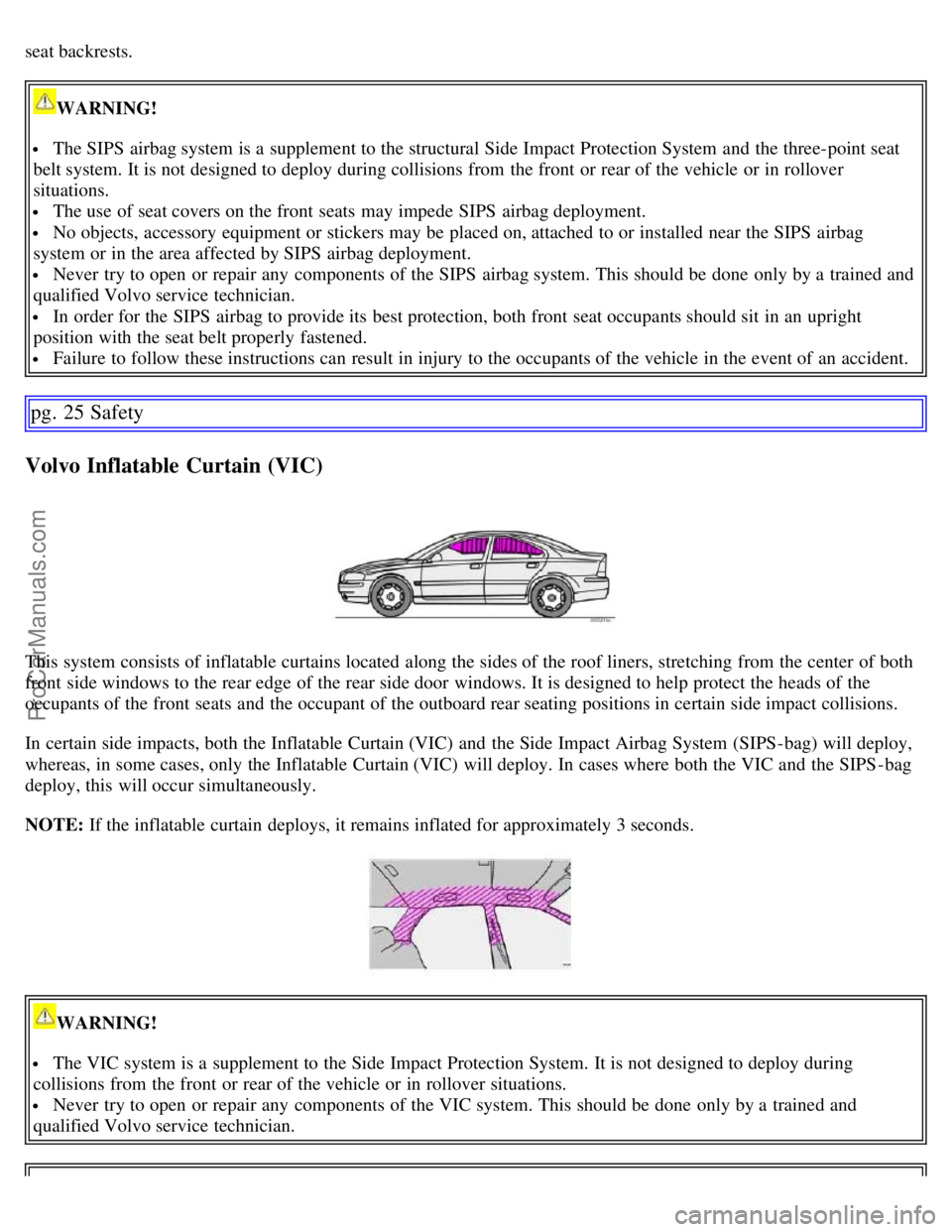
This system consists of inflatable curtains located along the sides of the roof liners, stretching from the center of both
front side windows to the rear edge of the rear side door windows. It is designed to help protect the heads of the
occupants of the front seats and the occupant of the outboard rear seating positions in certain side impact collisions.
In certain side impacts, both the Inflatable Curtain (VIC) and the Side Impact Airbag System (SIPS-bag) will deploy,
whereas, in some cases, only the Inflatable Curtain (VIC) will deploy. In cases where both the VIC and the SIPS -bag
deploy, this will occur simultaneously.
NOTE: If the inflatable curtain deploys, it remains inflated for approximately 3 seconds.
WARNING!
The VIC system is a supplement to the Side Impact Protection System. It is not designed to deploy during
collisions from the front or rear of the vehicle or in rollover situations.
Never try to open or repair any components of the VIC system. This should be done only by a trained and
qualified Volvo service technician.
ProCarManuals.com
Page 34 of 200
2 0 0 7
VOLVO S60
Instruments and controls
pg. 41 Instruments and controls
Instrument overview 42
Instrument panel44
Indicator and warning symbols45
Switches in the center console50
Steering wheel adjustment52
Lighting panel53
Left-side steering wheel lever55
Right-side steering wheel lever56
Hazard warning flashers, rear window/sideview mirror defroster58
Trip computer59
Cruise control60
Parking brake, auxiliary socket/cigarette lighter62
Power windows63
Rearview mirror/sideview mirrors65
Power moonroof (option)68
pg. 42 Instruments and controls
Instrument overview
ProCarManuals.com
Page 36 of 200
11. Center console switches50
12. Climate control72
13. Audio system212
14. 12 V socket62
15. Hazard warning flashers58
16. Glove compartment89
17. Panel vents73
18. Text window48
19. Temperature gauge44
20. Odometer/Trip odometer/ Cruise control indicator44
21. Speedometer44
22. Turn signal indicators44
23. Tachometer44
24. Ambient temperature/Clock/ Selected gear indicator44
25. Fuel gauge44
26. Indicator and warning symbols45
27. Panel vents73
28. Instrument lighting54
29. Not in use
30. Lighting panel53
31. Reading lights84
32. Interior lighting84
33. Moonroof control68
34. Seat belt reminder12
35. Rearview mirror65
36. Lock button, for all doors100
37. Blocking rear seat power windows64
38. Controls, power windows63
39. Controls, sideview mirrors67
40. Four-C active chassis system121
pg. 44 Instruments and controls
Instrument panel
1. Turn signal indicators - right/left
2. Text window
ProCarManuals.com
Page 59 of 200
The mirrors should always be adjusted prior to driving. Objects seen in the passenger's side wide -angle sideview
mirror are closer than they appear to be.
Remote central locking and sideview mirror memory-option
If you lock the vehicle and later unlock it with the same remote control and open the driver's door, the sideview
mirrors (and the driver's seat) will automatically move to the position they were in when you left the vehicle. This
feature will work in the same way with all of the remote control transmitters (up to 3) that you use with your vehicle.
This feature will not function if you lock your vehicle with the key.
Water repellent glass-option on certain models
The side door windows can be treated with a water repellent coating. The symbol to the left indicates
these windows have this coating. The optional laminated side windows always have this coating.
The coating improves vision by causing the water to run off quickly.
See page 163
for information on cleaning this type of glass.
CAUTION!
Use only suitable plastic scrapers to remove ice or snow from the windows. Using a metal ice scraper could damage
the water repellent coating.
pg. 68 Instruments and controls
Power moonroof (option)
Power moonroof
To operate the moonroof, turn the ignition key to position I or II, or start the engine. The moonroof can be operated in
two ways:
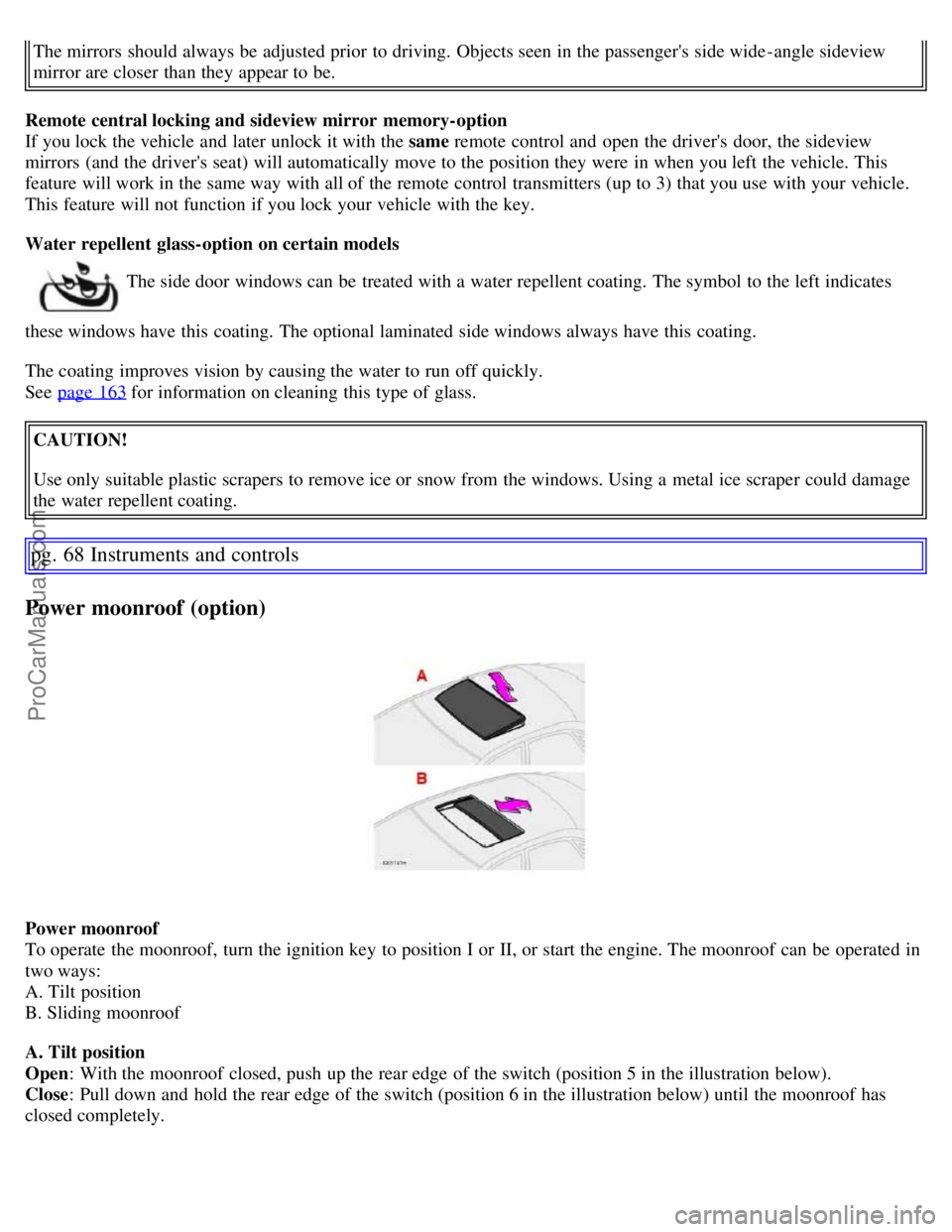
A. Tilt position
B. Sliding moonroof
A. Tilt position
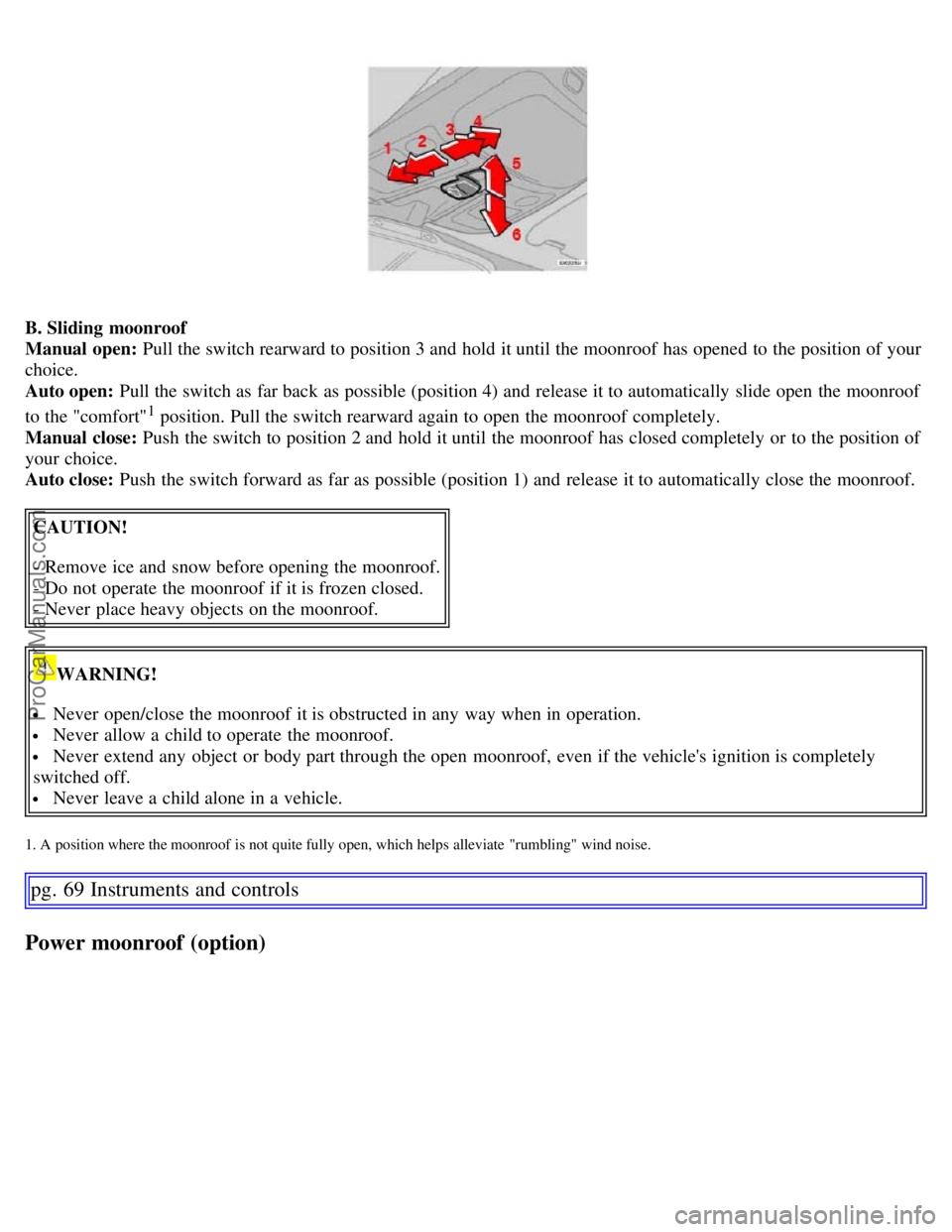
Open : With the moonroof closed, push up the rear edge of the switch (position 5 in the illustration below).
Close : Pull down and hold the rear edge of the switch (position 6 in the illustration below) until the moonroof has
closed completely.
ProCarManuals.com
Page 60 of 200
B. Sliding moonroof
Manual open: Pull the switch rearward to position 3 and hold it until the moonroof has opened to the position of your
choice.
Auto open: Pull the switch as far back as possible (position 4) and release it to automatically slide open the moonroof
to the "comfort"
1 position. Pull the switch rearward again to open the moonroof completely.
Manual close: Push the switch to position 2 and hold it until the moonroof has closed completely or to the position of
your choice.
Auto close: Push the switch forward as far as possible (position 1) and release it to automatically close the moonroof.
CAUTION!
- Remove ice and snow before opening the moonroof.
- Do not operate the moonroof if it is frozen closed.
- Never place heavy objects on the moonroof.
WARNING!
Never open/close the moonroof it is obstructed in any way when in operation.
Never allow a child to operate the moonroof.
Never extend any object or body part through the open moonroof, even if the vehicle's ignition is completely
switched off.
Never leave a child alone in a vehicle.
1. A position where the moonroof is not quite fully open, which helps alleviate "rumbling" wind noise.
pg. 69 Instruments and controls
Power moonroof (option)
ProCarManuals.com
Page 61 of 200
Sun visor
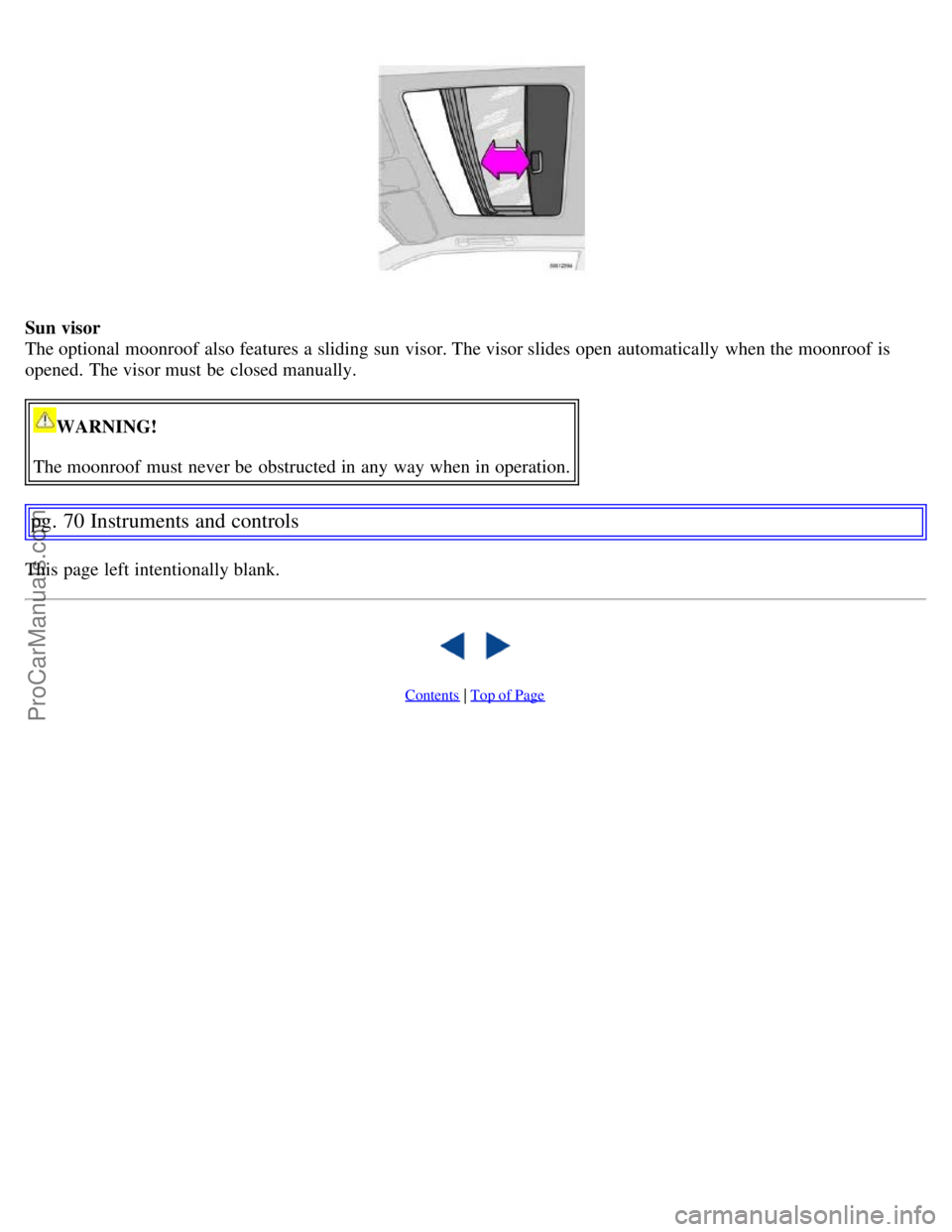
The optional moonroof also features a sliding sun visor. The visor slides open automatically when the moonroof is
opened. The visor must be closed manually.
WARNING!
The moonroof must never be obstructed in any way when in operation.
pg. 70 Instruments and controls
This page left intentionally blank.
Contents | Top of Page
ProCarManuals.com
Page 62 of 200
2 0 0 7
VOLVO S60
Climate
pg. 71 Climate
Climate control systems - general information 72
Air distribution73
Electronic climate control, ECC74
pg. 72 Climate
Climate control systems - general information
Condensation on the inside of the windows
Keeping the insides of the windows clean will help reduce the amount of condensation that forms on the windows. Use
a commercial window cleaning agent to clean the windows.
Ice and snow
Always keep the air intake grille at the base of the windshield free of snow.
Cabin air filter
Replace the cabin air filter with a new one at the recommended intervals. Please refer to your Warranty and Service
Records Information booklet, or consult your Volvo retailer for these intervals. The filter should be replaced more
often when driving under dirty and dusty conditions. The filter cannot be cleaned and therefore should always be
replaced with a new one.
Sensors
The sunlight sensor on the dashboard and passenger compartment temperature sensor in the ECC control panel should
not be covered in any way as this could cause incorrect information to be sent to the ECC system.
Parking the vehicle in warm weather
If your vehicle has been parked in the sun in warm weather, opening the windows and moonroof (option) for several
minutes before driving will help release the warm air from the passenger compartment. When the engine is running,
close the windows and moonroof and use the recirculation function for several minutes to enable the air conditioning
to cool the compartment as quickly as possible.
Windows and optional moonroof
The ECC system will function best if the windows and optional moonroof are closed. If you drive with the moonroof
open, we recommend that you manually adjust the temperature and blower control (the LED in the AUTO switch
should be off).
Acceleration
The air conditioning is momentarily disengaged during full-throttle acceleration.
ProCarManuals.com
Page 84 of 200
Automatic re-locking
If the doors are unlocked, the locks will automatically reengage (re-lock) and the alarm will rearm after 2 minutes
unless a door or the trunk has been opened. This helps prevent the car from inadvertently being left unlocked.
FCC ID:LQNP2T-APU
This device complies with part 15 of the FCC rules. Operation is subject to the following conditions: (1) This device
may not cause harmful interference, and (2) this device must accept any interference received, including interference
that may cause undesired operation.
Canadian 2306104388
Model 504 2927 by Donnelly
Operation is subject to the following conditions: (1) this device may not cause interference, and (2) this device must
accept any interference, including interference that may cause undesired operation of the device.
Canadian 2306104388A
Model 509 977 by Connaught Electronics
Operation is subject to the following conditions: (1) this device may not cause interference, and (2) this device must
accept any interference, including interference that may cause undesired operation of the device.
WARNING!
Never use the transmitter to lock the doors from inside the vehicle. Doing so would ACTIVATE:
the break-in alarm, which would sound if one of the doors were opened
the optional interior motion and inclination alarm sensors. Doing so would DEACTIVATE:
the moonroof and interior courtesy light controls.
the central locking buttons on the front door armrests, although the interior door handles would still function to
allow occupants to leave the vehicle.
Disabled features would remain disabled until the remote is used again to unlock the vehicle.
In addition, locking an occupied vehicle would hinder rapid access to the occupants in an accident or emergency.
pg. 99 Locks and alarm
Remote control
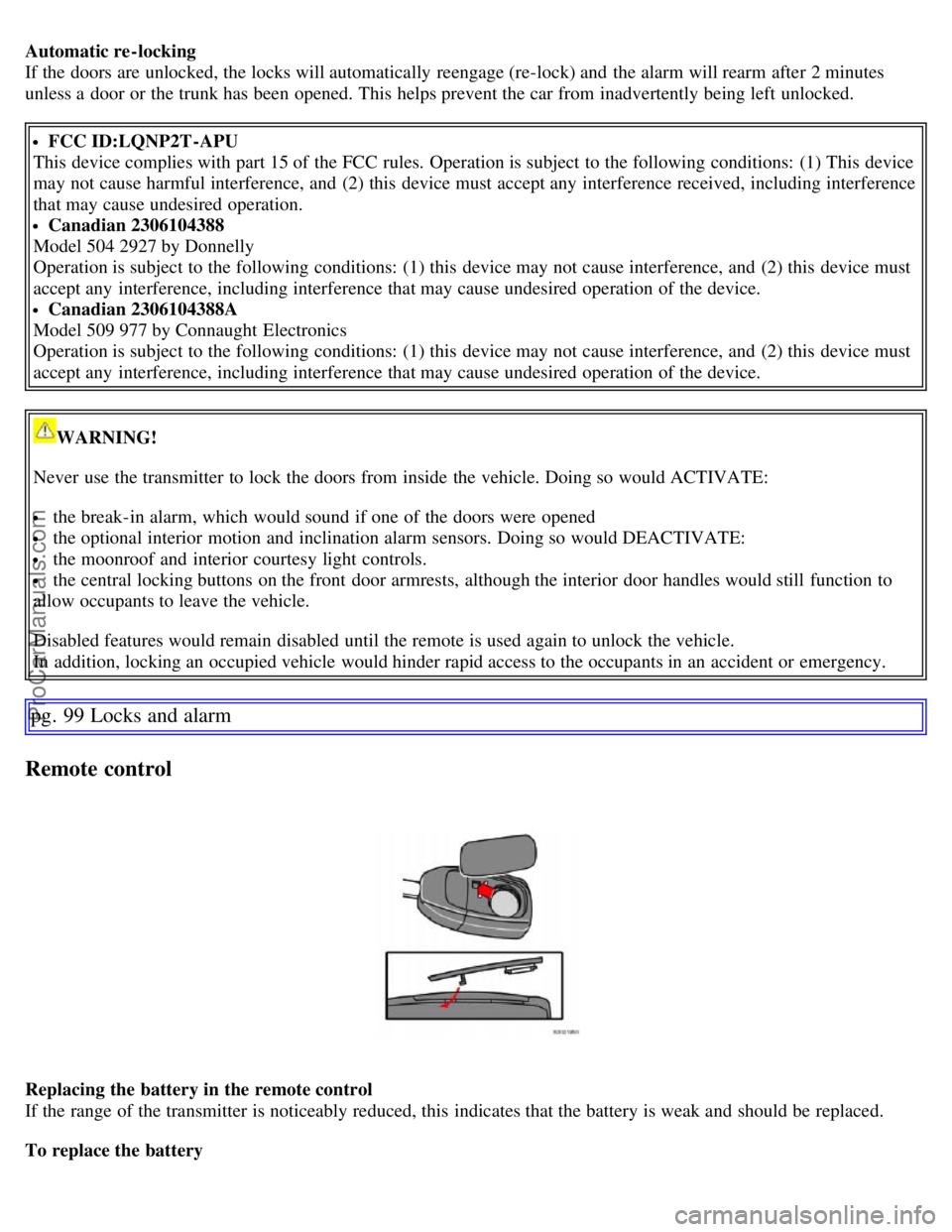
Replacing the battery in the remote control
If the range of the transmitter is noticeably reduced, this indicates that the battery is weak and should be replaced.
To replace the battery
ProCarManuals.com
Page 98 of 200
Remove snow tires when threat of snow or ice has ended.
Note that roof racks, ski racks, etc, increase air resistance and also fuel consumption.
Avoid using automatic transmission kickdown feature unless necessary.
However, at higher driving speeds, fuel consumption will be lower with the air conditioning on and the windows
closed than with the air conditioning off and the windows open.
Using the onboard trip computer's fuel consumption modes can help you learn how to drive more economically.
Other factors that decrease gas mileage are:
Dirty air cleaner
Dirty engine oil and clogged oil filter
Dragging brakes
Incorrect front end alignment.
Some of the above mentioned items and others are checked at the standard Maintenance Service intervals.
NOTE: Vehicles equipped with automatic transmissions should use (D)rive as often as possible and avoid using
"kickdown" to help improve fuel economy.
CAUTION!
Drive slowly and carefully if going through standing water (i.e. flooded roadways, etc.). Damage to the engine could
result if excess water is drawn in through the air intake system. Never drive the vehicle in water deeper than 1 foot
(300 mm).
pg. 114 Starting and driving
Handling and road holding
Weight distribution affects handling
At the specified curb weight your vehicle has a tendency to understeer, which means that the steering wheel has to be
turned more than might seem appropriate for the curvature of a bend.
This ensures good stability and reduces the risk of rear wheel skid. Remember that these properties can alter with the
vehicle load. The heavier the load in the trunk (max. 220 lbs, 100 kg), the less the tendency to understeer.
Handling, roadholding
Vehicle load, tire design and inflation pressure all affect vehicle handling. Therefore, check that the tires are inflated to
the recommended pressure according to the vehicle load. See "Tire pressure" section.
Loads should be distributed so that capacity weight or maximum permissible axle loads are not exceeded.
Speed-sensitive power steering (Option on certain models)
With this feature, the steering is most responsive at lower speeds to make parking, driving in city traffic, etc., easier.
The effect of the power steering diminishes as you accelerate for greater stability at highway speeds.
Driving through water
The vehicle can be driven through water up to a depth of approximately 9 in. (25 cm), at a maximum speed of 6 mph
(10 km/h).
Take particular care when driving through flowing water.
Clean the electrical connections for trailer wiring after driving in mud or water When driving through water, maintain
low speed and do not stop in the water.
WARNING!
ProCarManuals.com
Page 116 of 200

To avoid damaging your vehicle and to achieve maximum safety when driving, we recommend using the load
carriers that Volvo has developed especially for your vehicle.
Volvo-approved removable roof racks are designed to carry the maximum allowable roof load for this vehicle: 220
lbs (100 kg). For Non-Volvo roof racks, check the manufacturer's weight limits for the rack.
Never exceed the rack manufacturer's weigh limits and never exceed the maximum rated roof load of 220 lbs (100
kg).
Avoid single-point loads. Distribute loads evenly.
Place heavier cargo at the bottom of the load.
Secure the cargo correctly with appropriate tie-down equipment.
Check periodically that the load carriers and load are properly secured.
Remember that the vehicle's center of gravity and handling change when you carry a load on the roof.
The vehicle's wind resistance and fuel consumption will increase with the size of the load.
Drive smoothly. Avoid rapid starts, fast cornering and hard braking.
Attaching load carriers
The attachment brackets for the load carriers are located under the roof molding.
- Make sure that the load carriers are placed in the right direction. See the mark on the decal under the cover.
- Press the guide lugs into the holes (1).
- Carefully lower the opposite side of the load carrier to the roof.
- Loosen the tightening wheel slightly. Slide the hook on the load carrier attachment into the attachment bracket under
the roof molding.
- Turn the tightening wheel to secure the load carrier in the attachment bracket.
pg. 135 Starting and driving
Load carriers (accessory)
- Repeat this procedure for the other load carrier attachments.
- Check that the hooks on all four load carrier attachments are securely tightened in the respective attachment brackets
on the roof of the vehicle.
- Press down the covers.
Check periodically that the load carriers and load are properly secured.
pg. 136 Starting and driving
Cold weather precautions
ProCarManuals.com