wheel VOLVO S60 2007 User Guide
[x] Cancel search | Manufacturer: VOLVO, Model Year: 2007, Model line: S60, Model: VOLVO S60 2007Pages: 200, PDF Size: 4.03 MB
Page 43 of 200
locked/unlocked using the master key or the remote control.
To use this function:
- Turn the master key to position II.
- Press the "Valet lock" button. An LED in the button will light up and "VALET LOCK
pg. 51 Instruments and controls
Switches in the center console
ON" will be displayed in the text window to indicate that this function is activated.
- The function can be turned off (deactivated) by turning the ignition key to position II and pressing the "Valet lock"
button again (the LED in the button will go out and VALET LOCK OFF" will be displayed in the text window).
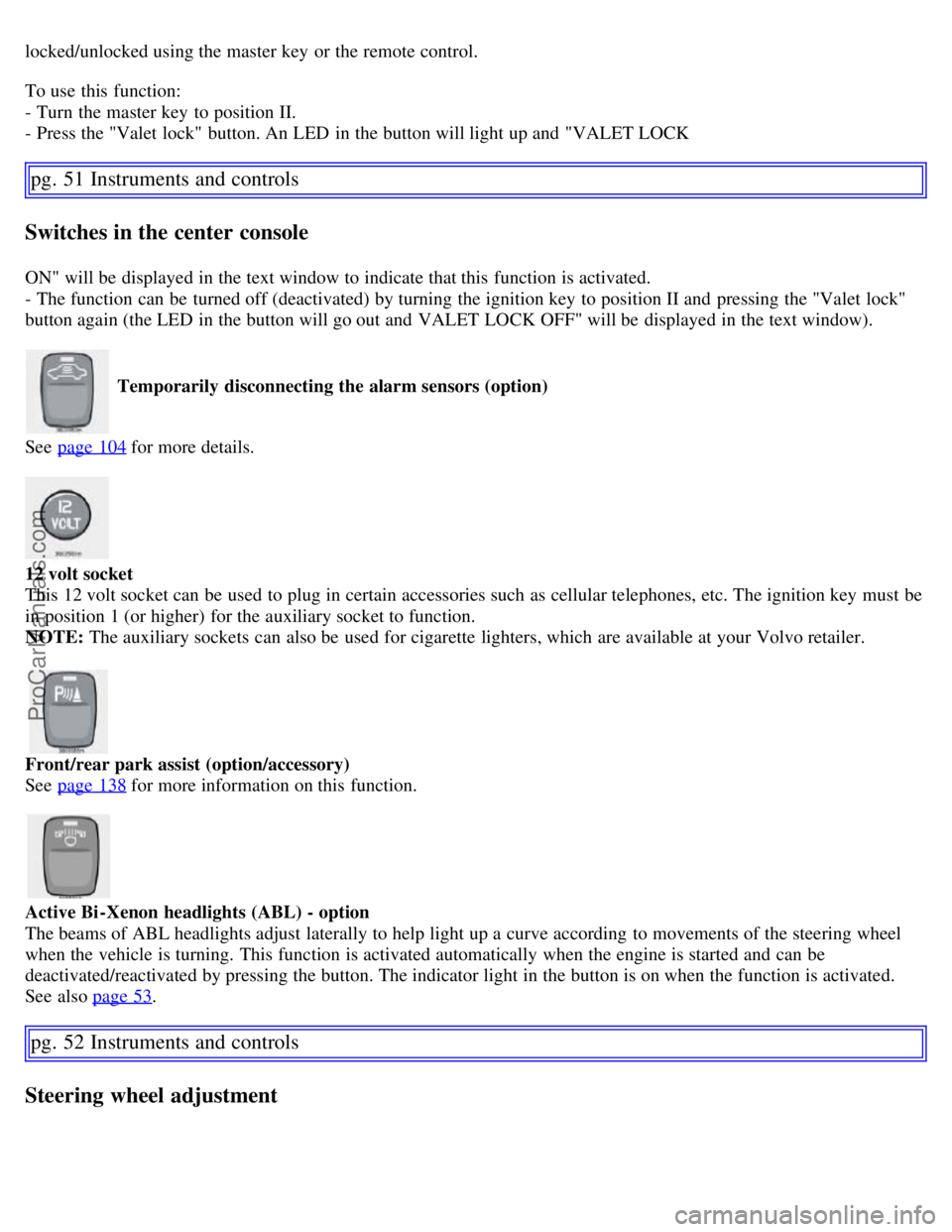
Temporarily disconnecting the alarm sensors (option)
See page 104
for more details.
12 volt socket
This 12 volt socket can be used to plug in certain accessories such as cellular telephones, etc. The ignition key must be
in position 1 (or higher) for the auxiliary socket to function.
NOTE: The auxiliary sockets can also be used for cigarette lighters, which are available at your Volvo retailer.
Front/rear park assist (option/accessory)
See page 138
for more information on this function.
Active Bi -Xenon headlights (ABL) - option
The beams of ABL headlights adjust laterally to help light up a curve according to movements of the steering wheel
when the vehicle is turning. This function is activated automatically when the engine is started and can be
deactivated/reactivated by pressing the button. The indicator light in the button is on when the function is activated.
See also page 53
.
pg. 52 Instruments and controls
Steering wheel adjustment
ProCarManuals.com
Page 44 of 200
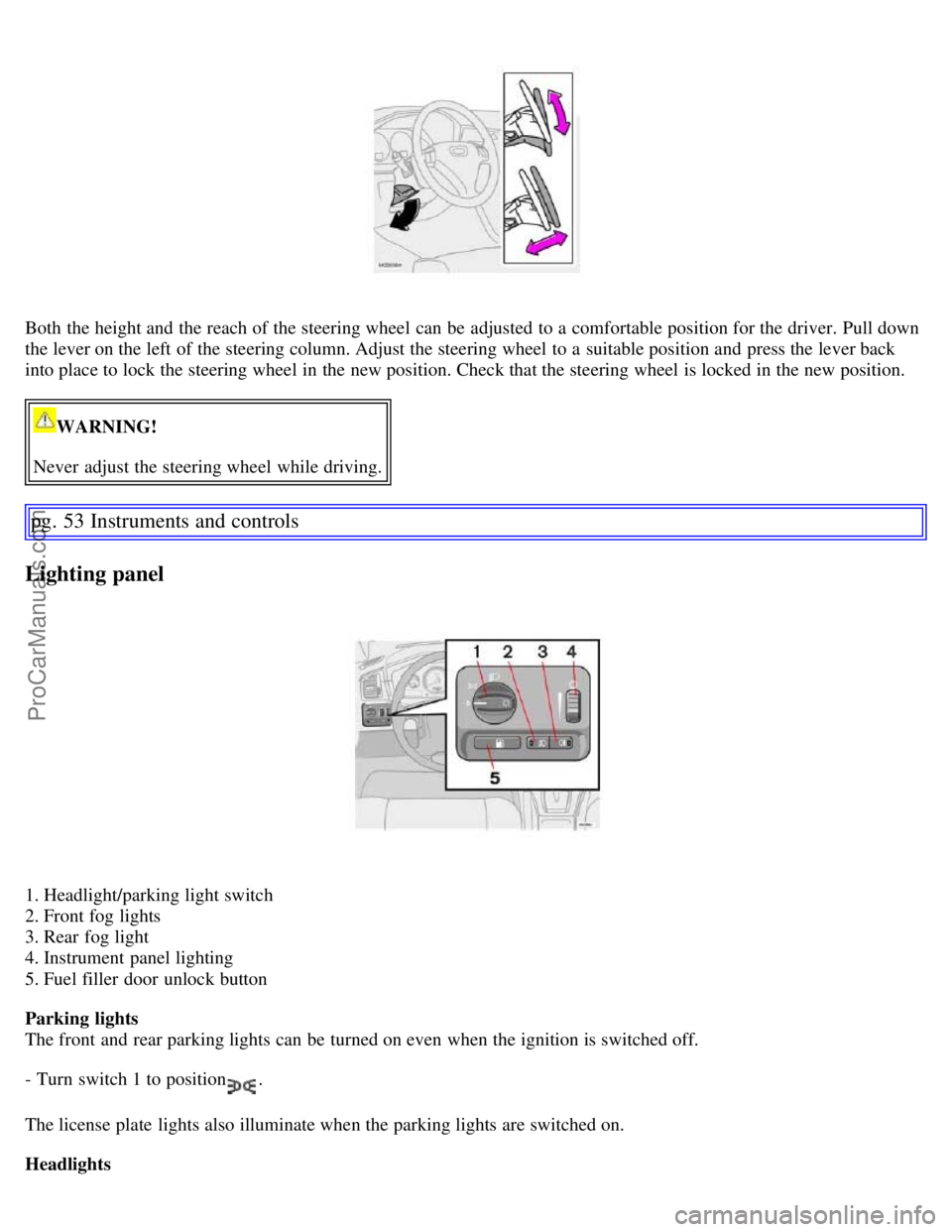
Both the height and the reach of the steering wheel can be adjusted to a comfortable position for the driver. Pull down
the lever on the left of the steering column. Adjust the steering wheel to a suitable position and press the lever back
into place to lock the steering wheel in the new position. Check that the steering wheel is locked in the new position.
WARNING!
Never adjust the steering wheel while driving.
pg. 53 Instruments and controls
Lighting panel
1. Headlight/parking light switch
2. Front fog lights
3. Rear fog light
4. Instrument panel lighting
5. Fuel filler door unlock button
Parking lights
The front and rear parking lights can be turned on even when the ignition is switched off.
- Turn switch 1 to position
.
The license plate lights also illuminate when the parking lights are switched on.
Headlights
ProCarManuals.com
Page 45 of 200
- Turn the ignition key to position II.
- The low beam headlights (daytime running lights) illuminate automatically, except when the light switch (1) is in
position
1.
See page 55
for information on switching between high and low beams.
NOTE: Active Bi -Xenon headlights (option): Turn the headlight switch to position 0 to activate a daylight sensor,
which automatically switches the low beams on or off, depending on ambient light conditions.
When driving in daylight, the headlights will switch off and the daytime running lights will come on. In darkness, the
daytime running lights will switch off and the Active Bi -Xenon headlights will switch on.
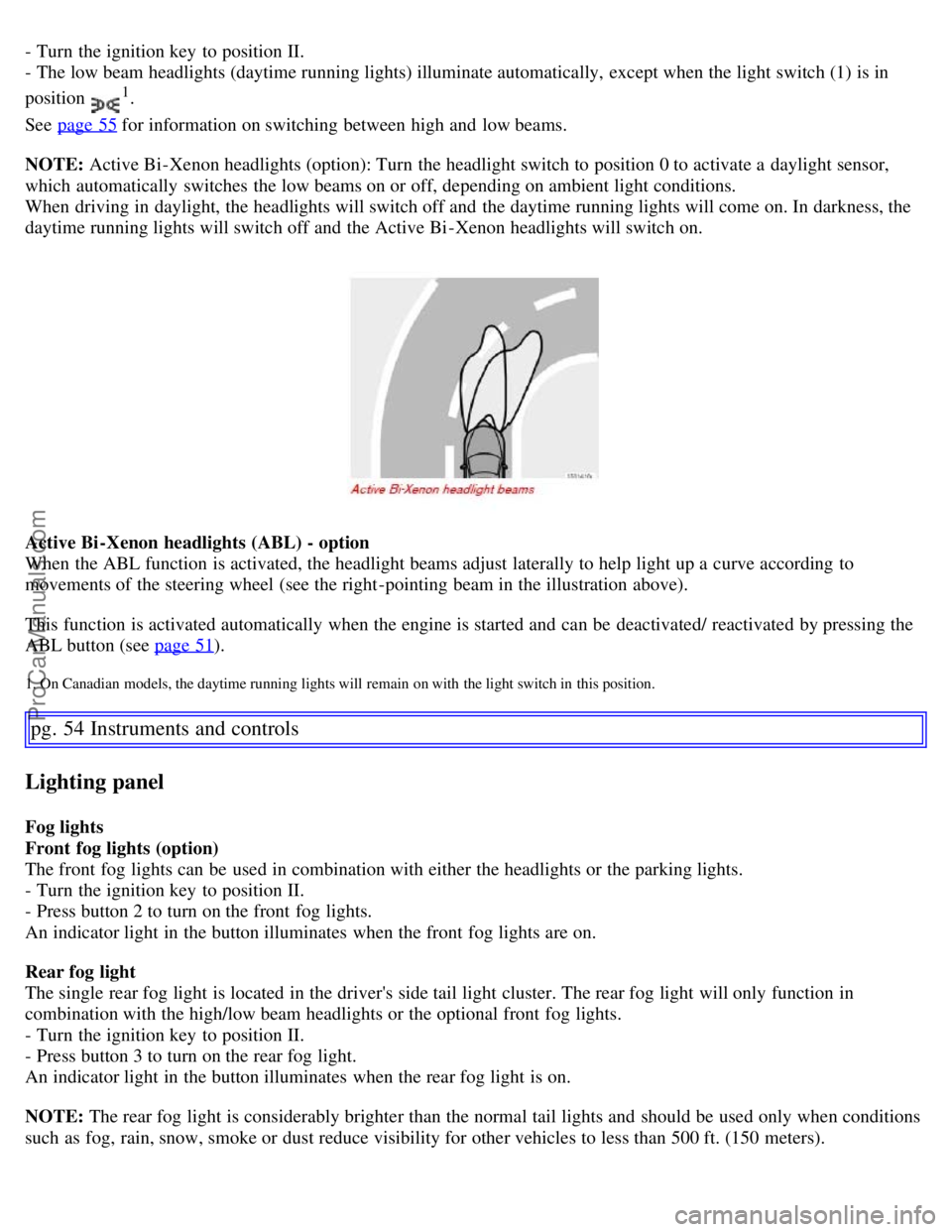
Active Bi -Xenon headlights (ABL) - option
When the ABL function is activated, the headlight beams adjust laterally to help light up a curve according to
movements of the steering wheel (see the right-pointing beam in the illustration above).
This function is activated automatically when the engine is started and can be deactivated/ reactivated by pressing the
ABL button (see page 51
).
1. On Canadian models, the daytime running lights will remain on with the light switch in this position.
pg. 54 Instruments and controls
Lighting panel
Fog lights
Front fog lights (option)
The front fog lights can be used in combination with either the headlights or the parking lights.
- Turn the ignition key to position II.
- Press button 2 to turn on the front fog lights.
An indicator light in the button illuminates when the front fog lights are on.
Rear fog light
The single rear fog light is located in the driver's side tail light cluster. The rear fog light will only function in
combination with the high/low beam headlights or the optional front fog lights.
- Turn the ignition key to position II.
- Press button 3 to turn on the rear fog light.
An indicator light in the button illuminates when the rear fog light is on.
NOTE: The rear fog light is considerably brighter than the normal tail lights and should be used only when conditions
such as fog, rain, snow, smoke or dust reduce visibility for other vehicles to less than 500 ft. (150 meters).
ProCarManuals.com
Page 46 of 200
Instrument panel lighting
The instrument panel lighting illuminates when the ignition key is in position II and the light switch (1) is in either
position
or .
- Move the thumb wheel (4) up to increase brightness or down to decrease brightness.
Unlocking the fuel filler door
Press button 5 when the vehicle is at a standstill to unlock the fuel filler door. Please note that the fuel filler door will
remain unlocked until the vehicle begins to move forward. An audible click will be heard when the fuel filler door
relocks.
NOTE: If the fuel filler door does not unlock after the button has been pressed, drive the vehicle at a speed of at least
5 mph (8 km/h), stop the vehicle, and press the button again. See the information to the right on unlocking the fuel
filler door manually.
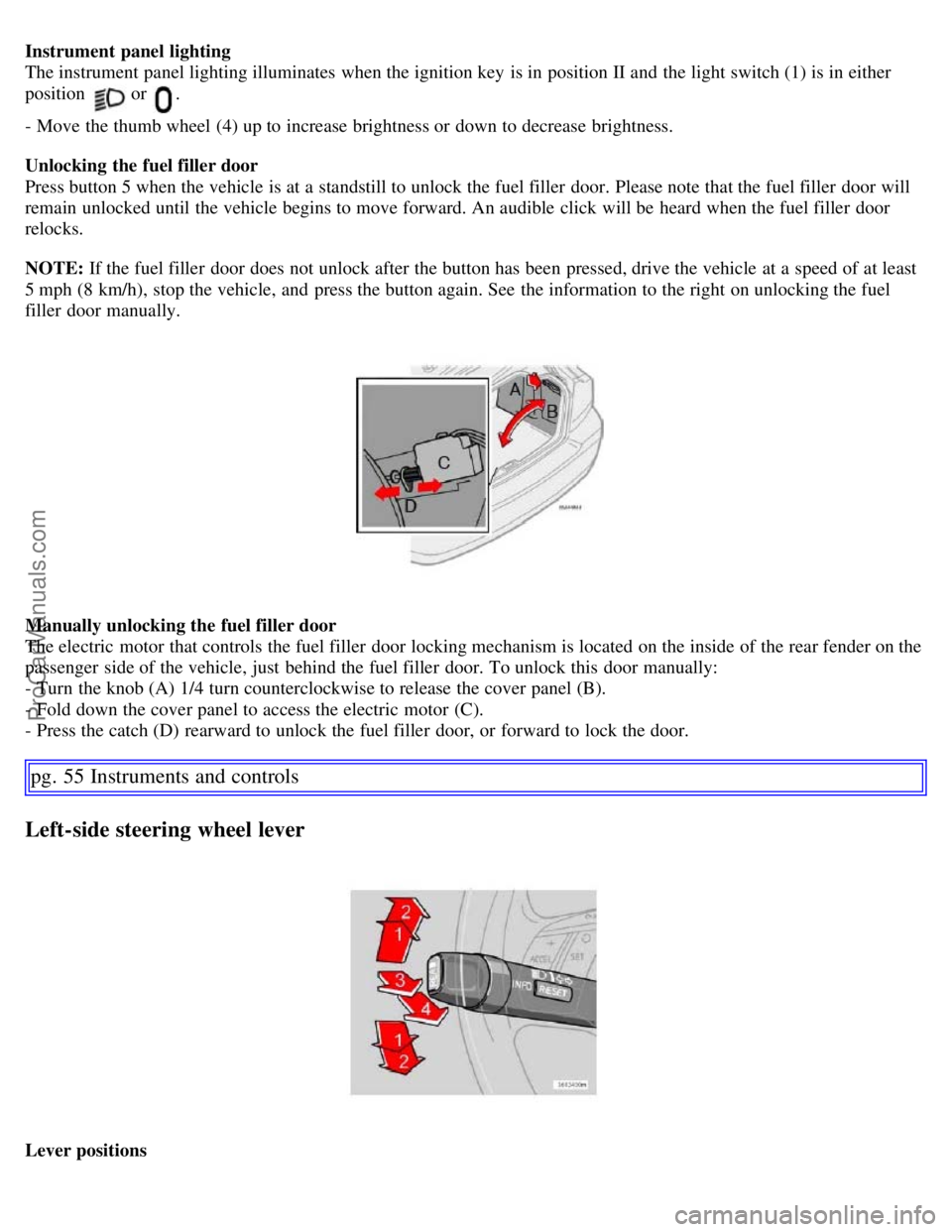
Manually unlocking the fuel filler door
The electric motor that controls the fuel filler door locking mechanism is located on the inside of the rear fender on the
passenger side of the vehicle, just behind the fuel filler door. To unlock this door manually:
- Turn the knob (A) 1/4 turn counterclockwise to release the cover panel (B).
- Fold down the cover panel to access the electric motor (C).
- Press the catch (D) rearward to unlock the fuel filler door, or forward to lock the door.
pg. 55 Instruments and controls
Left-side steering wheel lever
Lever positions
ProCarManuals.com
Page 47 of 200
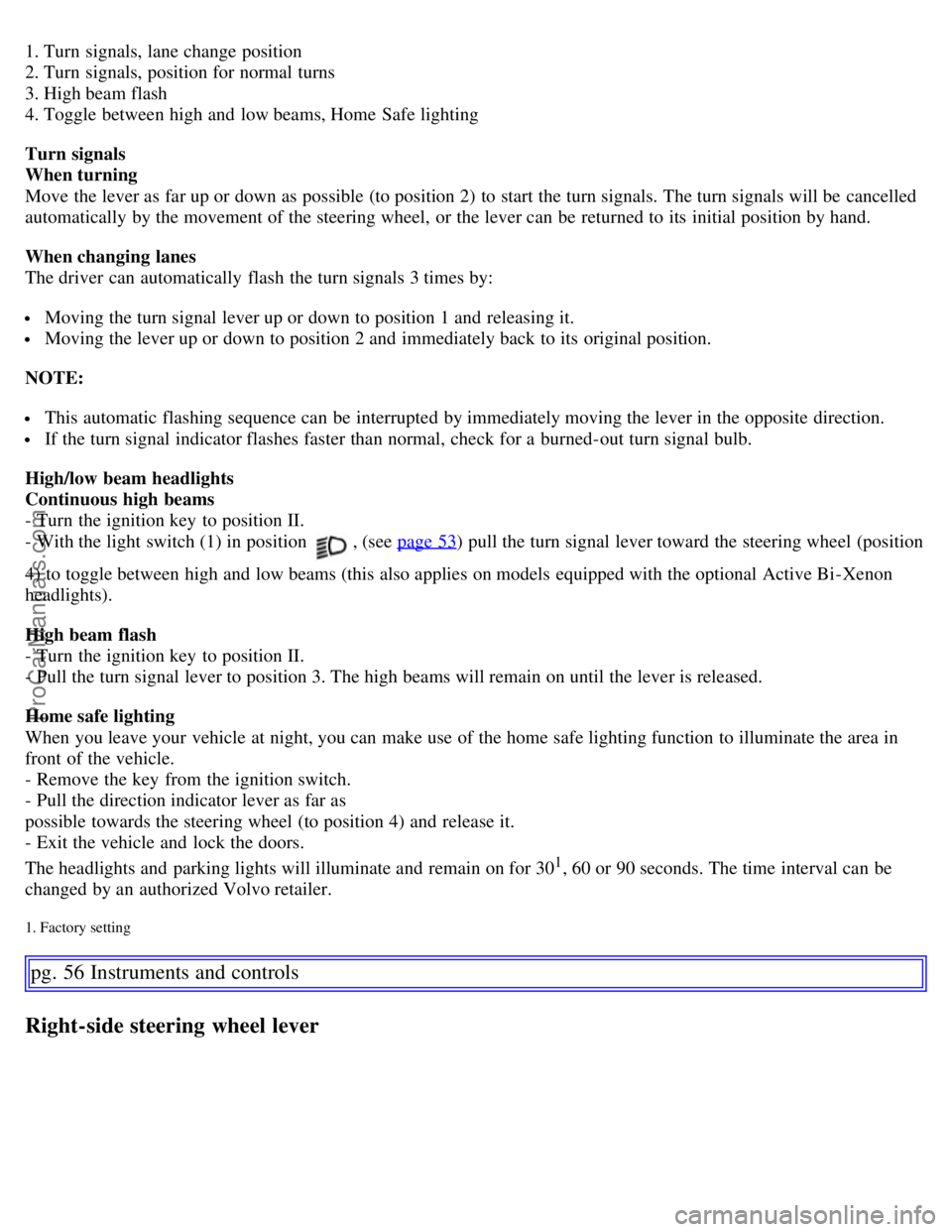
1. Turn signals, lane change position
2. Turn signals, position for normal turns
3. High beam flash
4. Toggle between high and low beams, Home Safe lighting
Turn signals
When turning
Move the lever as far up or down as possible (to position 2) to start the turn signals. The turn signals will be cancelled
automatically by the movement of the steering wheel, or the lever can be returned to its initial position by hand.
When changing lanes
The driver can automatically flash the turn signals 3 times by:
Moving the turn signal lever up or down to position 1 and releasing it.
Moving the lever up or down to position 2 and immediately back to its original position.
NOTE:
This automatic flashing sequence can be interrupted by immediately moving the lever in the opposite direction.
If the turn signal indicator flashes faster than normal, check for a burned-out turn signal bulb.
High/low beam headlights
Continuous high beams
- Turn the ignition key to position II.
- With the light switch (1) in position
, (see page 53) pull the turn signal lever toward the steering wheel (position
4) to toggle between high and low beams (this also applies on models equipped with the optional Active Bi -Xenon
headlights).
High beam flash
- Turn the ignition key to position II.
- Pull the turn signal lever to position 3. The high beams will remain on until the lever is released.
Home safe lighting
When you leave your vehicle at night, you can make use of the home safe lighting function to illuminate the area in
front of the vehicle.
- Remove the key from the ignition switch.
- Pull the direction indicator lever as far as
possible towards the steering wheel (to position 4) and release it.
- Exit the vehicle and lock the doors.
The headlights and parking lights will illuminate and remain on for 30
1, 60 or 90 seconds. The time interval can be
changed by an authorized Volvo retailer.
1. Factory setting
pg. 56 Instruments and controls
Right-side steering wheel lever
ProCarManuals.com
Page 49 of 200
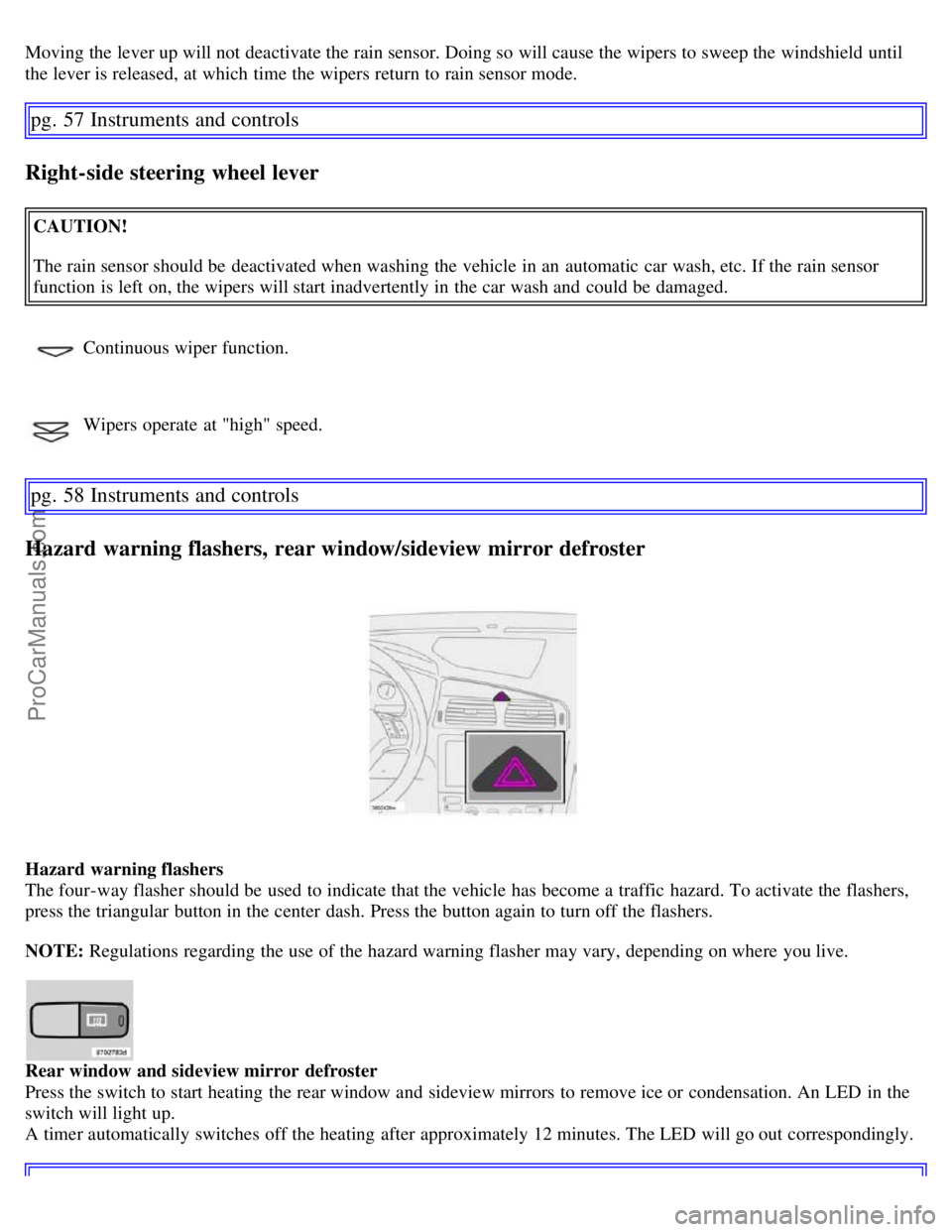
Moving the lever up will not deactivate the rain sensor. Doing so will cause the wipers to sweep the windshield until
the lever is released, at which time the wipers return to rain sensor mode.
pg. 57 Instruments and controls
Right-side steering wheel lever
CAUTION!
The rain sensor should be deactivated when washing the vehicle in an automatic car wash, etc. If the rain sensor
function is left on, the wipers will start inadvertently in the car wash and could be damaged.
Continuous wiper function.
Wipers operate at "high" speed.
pg. 58 Instruments and controls
Hazard warning flashers, rear window/sideview mirror defroster
Hazard warning flashers
The four-way flasher should be used to indicate that the vehicle has become a traffic hazard. To activate the flashers,
press the triangular button in the center dash. Press the button again to turn off the flashers.
NOTE: Regulations regarding the use of the hazard warning flasher may vary, depending on where you live.
Rear window and sideview mirror defroster
Press the switch to start heating the rear window and sideview mirrors to remove ice or condensation. An LED in the
switch will light up.
A timer automatically switches off the heating after approximately 12 minutes. The LED will go out correspondingly.
ProCarManuals.com
Page 51 of 200
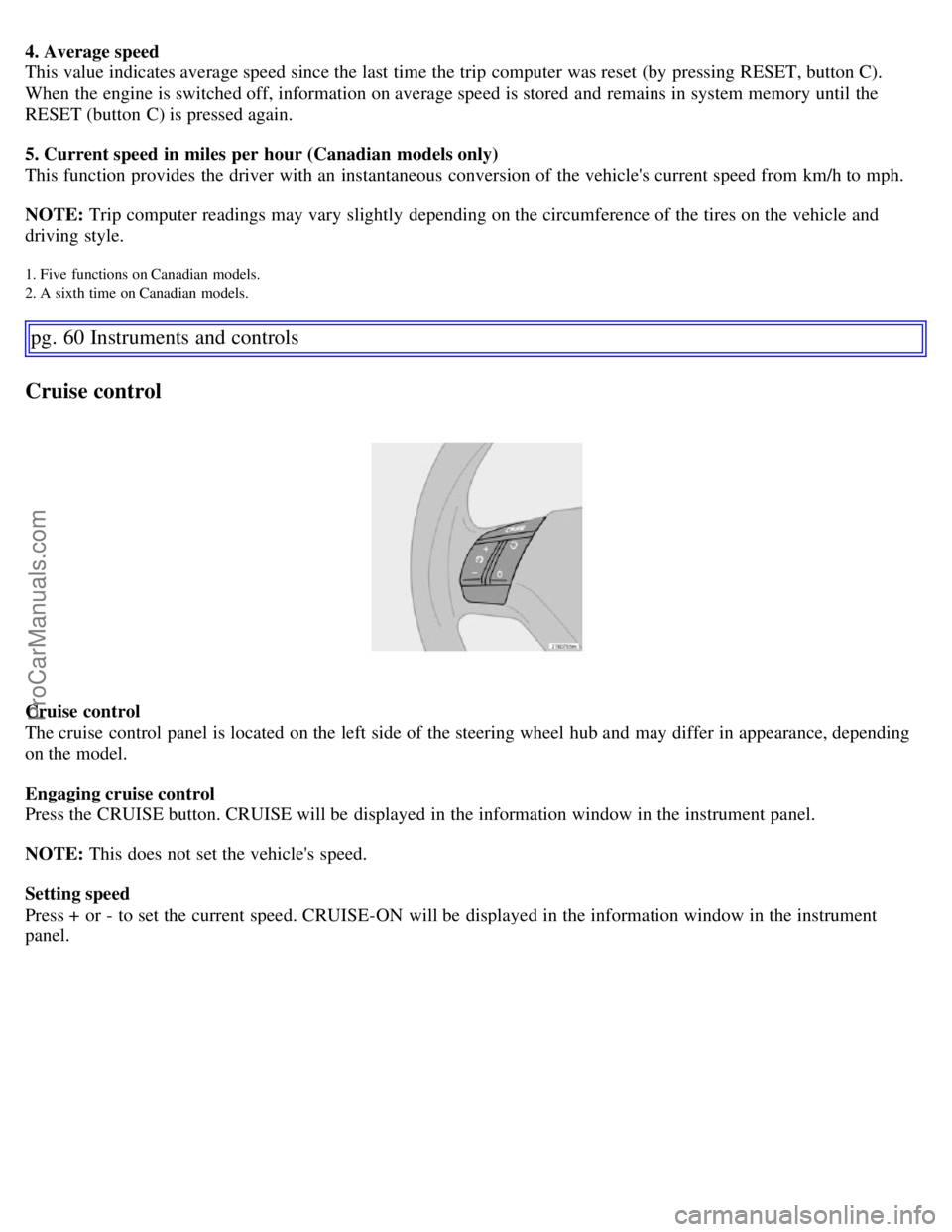
4. Average speed
This value indicates average speed since the last time the trip computer was reset (by pressing RESET, button C).
When the engine is switched off, information on average speed is stored and remains in system memory until the
RESET (button C) is pressed again.
5. Current speed in miles per hour (Canadian models only)
This function provides the driver with an instantaneous conversion of the vehicle's current speed from km/h to mph.
NOTE: Trip computer readings may vary slightly depending on the circumference of the tires on the vehicle and
driving style.
1. Five functions on Canadian models.
2. A sixth time on Canadian models.
pg. 60 Instruments and controls
Cruise control
Cruise control
The cruise control panel is located on the left side of the steering wheel hub and may differ in appearance, depending
on the model.
Engaging cruise control
Press the CRUISE button. CRUISE will be displayed in the information window in the instrument panel.
NOTE: This does not set the vehicle's speed.
Setting speed
Press + or - to set the current speed. CRUISE-ON will be displayed in the information window in the instrument
panel.
ProCarManuals.com
Page 52 of 200
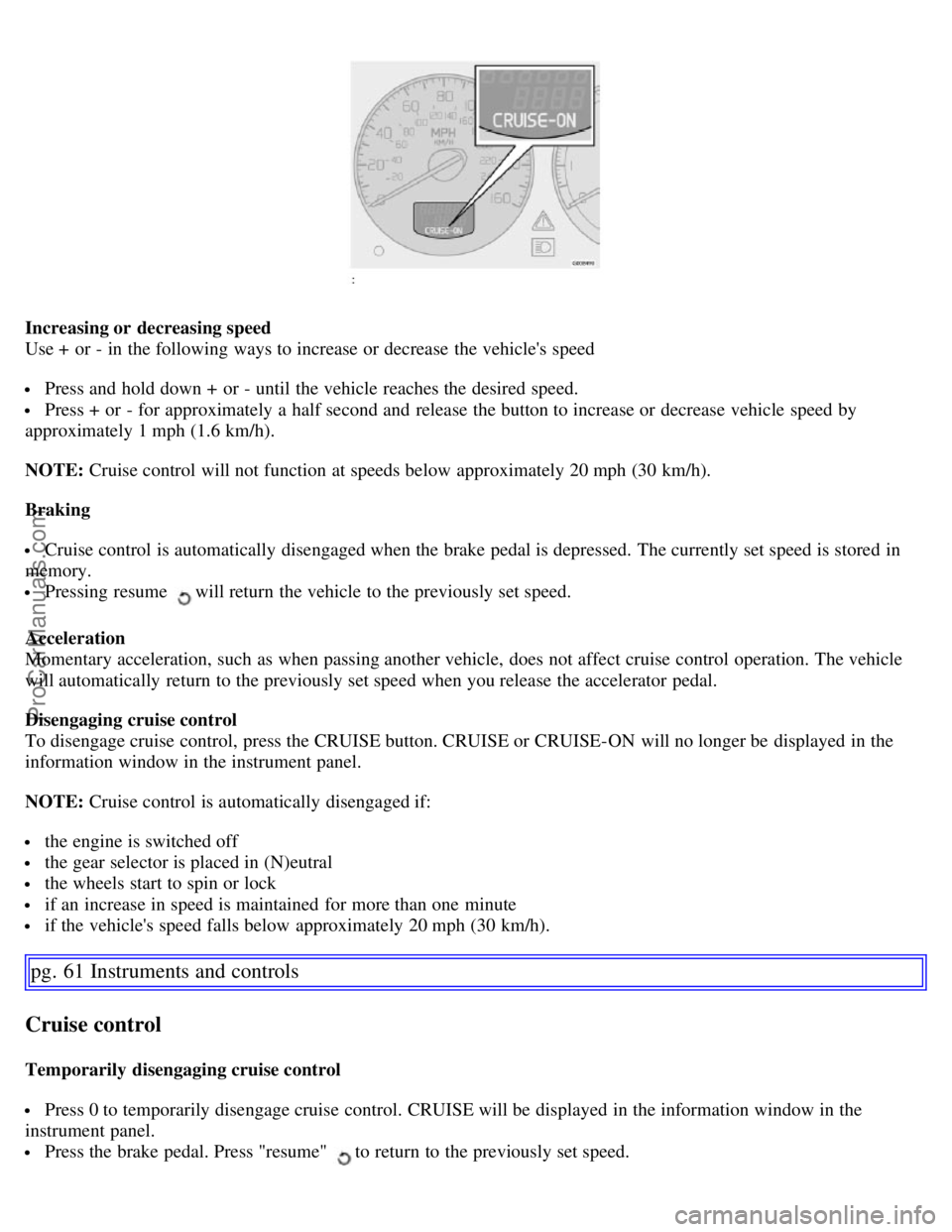
Increasing or decreasing speed
Use + or - in the following ways to increase or decrease the vehicle's speed
Press and hold down + or - until the vehicle reaches the desired speed.
Press + or - for approximately a half second and release the button to increase or decrease vehicle speed by
approximately 1 mph (1.6 km/h).
NOTE: Cruise control will not function at speeds below approximately 20 mph (30 km/h).
Braking
Cruise control is automatically disengaged when the brake pedal is depressed. The currently set speed is stored in
memory.
Pressing resume will return the vehicle to the previously set speed.
Acceleration
Momentary acceleration, such as when passing another vehicle, does not affect cruise control operation. The vehicle
will automatically return to the previously set speed when you release the accelerator pedal.
Disengaging cruise control
To disengage cruise control, press the CRUISE button. CRUISE or CRUISE-ON will no longer be displayed in the
information window in the instrument panel.
NOTE: Cruise control is automatically disengaged if:
the engine is switched off
the gear selector is placed in (N)eutral
the wheels start to spin or lock
if an increase in speed is maintained for more than one minute
if the vehicle's speed falls below approximately 20 mph (30 km/h).
pg. 61 Instruments and controls
Cruise control
Temporarily disengaging cruise control
Press 0 to temporarily disengage cruise control. CRUISE will be displayed in the information window in the
instrument panel.
Press the brake pedal. Press "resume" to return to the previously set speed.
ProCarManuals.com
Page 53 of 200
WARNING!
Cruise control should not be used in heavy traffic or when driving on wet or slippery roads, or when driving on
unpaved or uneven road surfaces. Cruise control may not maintain set speed on steep downgrades.
pg. 62 Instruments and controls
Parking brake, auxiliary socket/cigarette lighter
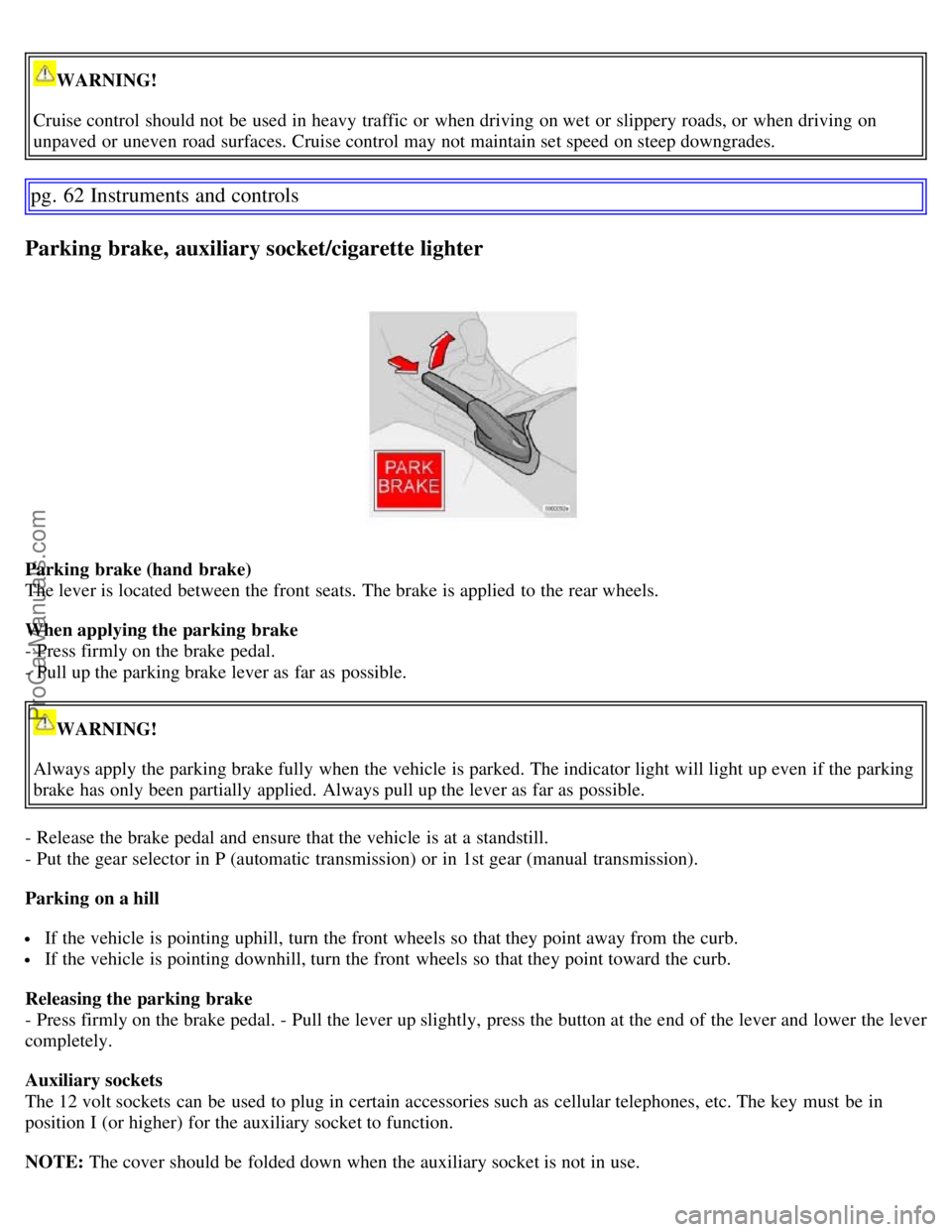
Parking brake (hand brake)
The lever is located between the front seats. The brake is applied to the rear wheels.
When applying the parking brake
- Press firmly on the brake pedal.
- Pull up the parking brake lever as far as possible.
WARNING!
Always apply the parking brake fully when the vehicle is parked. The indicator light will light up even if the parking
brake has only been partially applied. Always pull up the lever as far as possible.
- Release the brake pedal and ensure that the vehicle is at a standstill.
- Put the gear selector in P (automatic transmission) or in 1st gear (manual transmission).
Parking on a hill
If the vehicle is pointing uphill, turn the front wheels so that they point away from the curb.
If the vehicle is pointing downhill, turn the front wheels so that they point toward the curb.
Releasing the parking brake
- Press firmly on the brake pedal. - Pull the lever up slightly, press the button at the end of the lever and lower the lever
completely.
Auxiliary sockets
The 12 volt sockets can be used to plug in certain accessories such as cellular telephones, etc. The key must be in
position I (or higher) for the auxiliary socket to function.
NOTE: The cover should be folded down when the auxiliary socket is not in use.
ProCarManuals.com
Page 69 of 200
2 0 0 7
VOLVO S60
Interior
pg. 79 Interior
Front seats 80
Interior lighting84
Storage compartments86
Rear seat and trunk90
Spare wheel, tools and jack93
pg. 80 Interior
Front seats
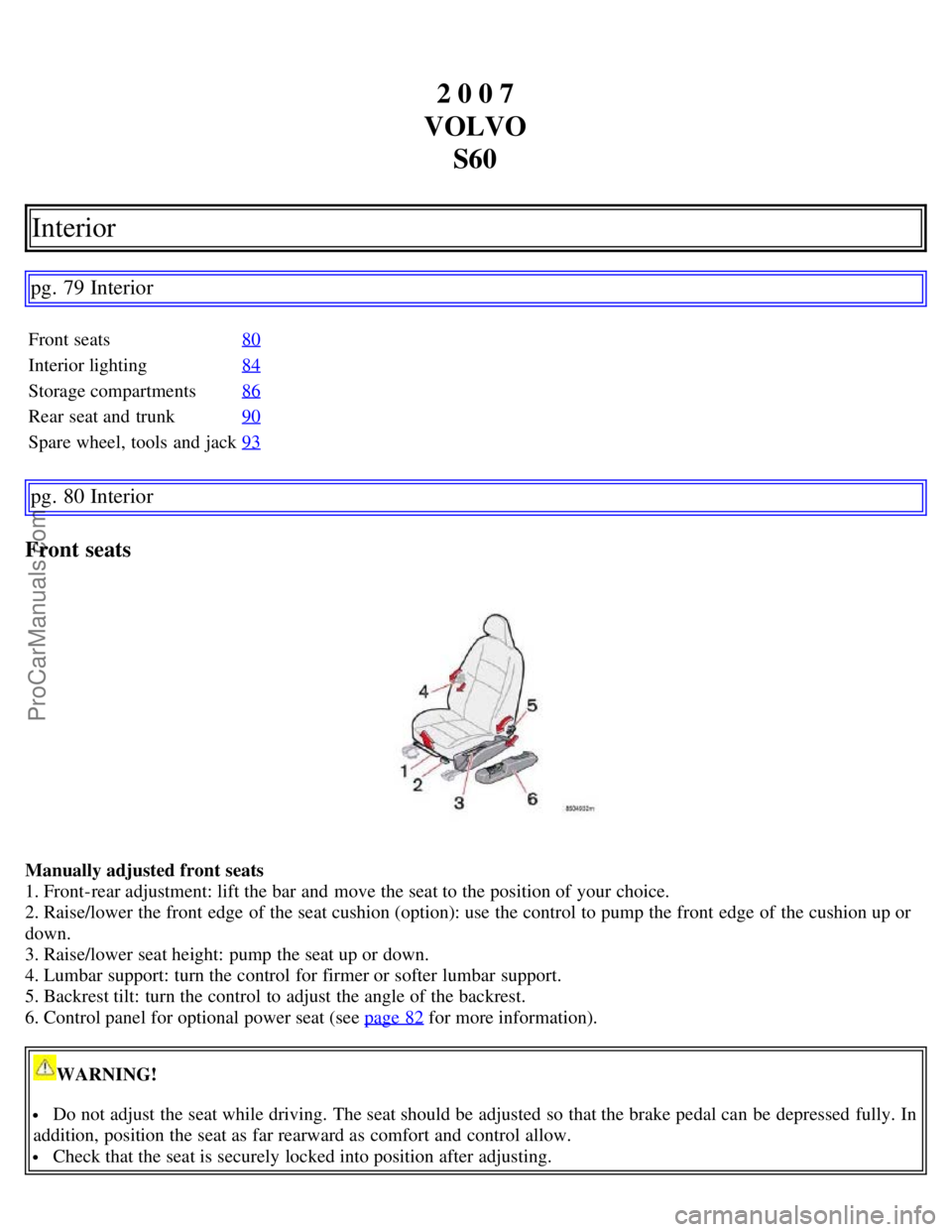
Manually adjusted front seats
1. Front-rear adjustment: lift the bar and move the seat to the position of your choice.
2. Raise/lower the front edge of the seat cushion (option): use the control to pump the front edge of the cushion up or
down.
3. Raise/lower seat height: pump the seat up or down.
4. Lumbar support: turn the control for firmer or softer lumbar support.
5. Backrest tilt: turn the control to adjust the angle of the backrest.
6. Control panel for optional power seat (see page 82
for more information).
WARNING!
Do not adjust the seat while driving. The seat should be adjusted so that the brake pedal can be depressed fully. In
addition, position the seat as far rearward as comfort and control allow.
Check that the seat is securely locked into position after adjusting.
ProCarManuals.com