ECU VOLVO S60 2007 Owner's Manual
[x] Cancel search | Manufacturer: VOLVO, Model Year: 2007, Model line: S60, Model: VOLVO S60 2007Pages: 200, PDF Size: 4.03 MB
Page 138 of 200
After cleaning the engine, the spark plug wells should be inspected for water and blown dry if necessary.
Suitable detergents: Special vehicle washing detergents should be used. A suitable mixture is about 2.5 fl. oz. (8.5 cl)
of detergent to 2.6 US gal. (10 liters) of warm water. After washing with a detergent the vehicle should be well rinsed
with clean water.
Exterior plastic components
Cleaning exterior plastic components should be done with a cleaning agent specially designed for this purpose.
Solvents or stain removers should not be used. Consult your Volvo retailer.
NOTE: When washing the vehicle, remember to remove dirt from the drain holes in the doors and sills.
WARNING!
When the vehicle is driven immediately after being washed, apply the brakes several times in order to remove any
moisture from the brake linings. Engine cleaning agents should not be used when the engine is warm. This
constitutes a fire risk.
pg. 163 Vehicle care
Washing and cleaning the vehicle
Automatic washing - simple and quick
We do NOT recommend washing your vehicle in an automatic wash during the first six months (because the paint
will not have hardened sufficiently).
An automatic wash is a simple and quick way to clean your vehicle, but it is worth remembering that it may not be
as thorough as when you yourself go over the vehicle with sponge and water. Keeping the underbody clean is most
important, especially in the winter. Some automatic washers do not have facilities for washing the underbody.
Before driving into an automatic vehicle wash, make sure that side view mirrors, auxiliary lamps, etc, are secure,
and that any antenna(s) are retracted or removed. Otherwise there is risk of the machine dislodging them.
Exterior lighting
Condensation may form temporarily on the inside of the lenses of exterior lights such as headlights, fog lights, or tail
lights. This is normal and the lights are designed to withstand moisture. Normally, condensation will dissipate after the
lights have been on for a short time.
Polishing and waxing
Normally, polishing is not required during the first year after delivery, however, waxing may be beneficial.
Before applying polish or wax the vehicle must be washed and dried. Tar spots can be removed with kerosene or tar
remover. Difficult spots may require a fine rubbing compound.
After polishing use liquid or paste wax.
Several commercially available products contain both polish and wax.
Waxing alone does not substitute for polishing a dull surface.
A wide range of polymer-based vehicle waxes can be purchased today. These waxes are easy to use and produce a
long-lasting, high-gloss finish that protects the bodywork against oxidation, road dirt and fading.
Do not polish or wax your vehicle in direct sunlight (the surface of the vehicle should not be warmer than 113° F
(45° C).
CAUTION!
ProCarManuals.com
Page 153 of 200
Battery maintenance
The battery in your vehicle is located under the floor of the trunk.
Driving habits and conditions, climate, the number of starts, etc. all affect the service life and function of the battery.
In order for your battery to perform satisfactorily, keep the following in mind:
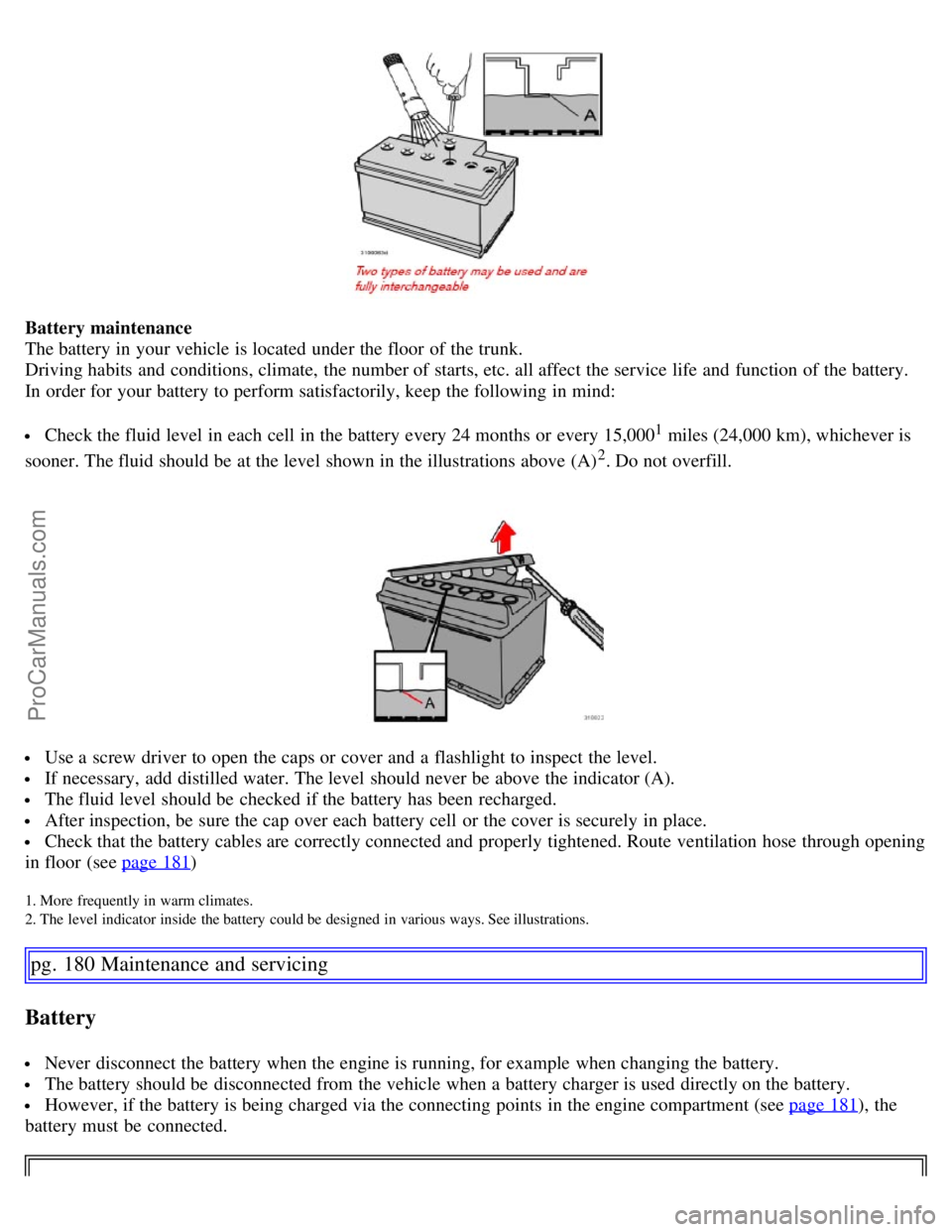
Check the fluid level in each cell in the battery every 24 months or every 15,0001 miles (24,000 km), whichever is
sooner. The fluid should be at the level shown in the illustrations above (A)
2. Do not overfill.
Use a screw driver to open the caps or cover and a flashlight to inspect the level.
If necessary, add distilled water. The level should never be above the indicator (A).
The fluid level should be checked if the battery has been recharged.
After inspection, be sure the cap over each battery cell or the cover is securely in place.
Check that the battery cables are correctly connected and properly tightened. Route ventilation hose through opening
in floor (see page 181
)
1. More frequently in warm climates.
2. The level indicator inside the battery could be designed in various ways. See illustrations.
pg. 180 Maintenance and servicing
Battery
Never disconnect the battery when the engine is running, for example when changing the battery.
The battery should be disconnected from the vehicle when a battery charger is used directly on the battery.
However, if the battery is being charged via the connecting points in the engine compartment (see page 181), the
battery must be connected.
ProCarManuals.com
Page 155 of 200
Replacing the battery
- Switch off the ignition and remove the key.
- Wait at least 5 minutes after switching off the ignition before disconnecting the battery so that all information in the
vehicle's electrical system can be stored in the control modules.
- Remove the bolts on the retaining bracket over the battery and lift out the bracket.
- Fold up the plastic cover over the negative (ground) battery terminal. or unscrew the cover over the battery.
- Disconnect the negative cable.
- Lift off the plastic cover if necessary and disconnect the positive cable
- Pull the ventilation hose from the battery.
- Lift out the old battery.
Installing a new battery
- Put a new battery into place.
- Put the lower retaining bracket in place and retighten the bolt.
- Reconnect the positive cable.
- Press the cover for the positive battery terminal into place and fold down the lid of the plastic cover.
- Connect the negative (ground) cable and fold down the plastic cover if applicable.
- Be sure that the ventilation hose is securely connected to the battery and that the other end of the hose is properly
routed through the ventilation opening in the floor of the battery compartment (see the illustration).
- Reinstall the retaining bracket over the battery and retighten the nuts.
WARNING!
Ventilation hose:
The battery generates hydrogen gas, which is flammable and explosive. The battery is fitted with a ventilation
hose which vents hydrogen gas out of the battery compartment through a ventilation opening in the bottom of this
compartment. If the battery must be replaced, it is essential that the ventilation hose is properly connected to the
battery and that it is routed through the ventilation opening provided (see illustration).
Be sure the ventilation hose is free of debris.
Only use replacement batteries equipped with a ventilation hose. Consult your Volvo retailer.
NOTE: After the battery has been disconnected or replaced, lock and unlock the vehicle with the central locking
system's remote control to reactivate such features as the power windows, moonroof, courtesy lighting, etc.
pg. 182 Maintenance and servicing
Replacing bulbs
When replacing bulbs, keep the following points in mind:
Never touch the glass of bulbs with your fingers. Grease and oils from your fingers vaporize in the heat and will
leave a deposit on the reflector, which will damage it.
The optional Active Bi -Xenon headlight bulbs contain trace amounts of mercury. These bulbs should always be
disposed of by an authorized Volvo retailer.
The following bulbs should only be replaced by an authorized Volvo service technician:
- Active Bi -Xenon headlights,
- Courtesy (dome) lighting,
- Reading lights,
- Glove compartment lights
- Turn signals and courtesy lights in the side door mirrors
- High-mounted brake lights
ProCarManuals.com
Page 158 of 200
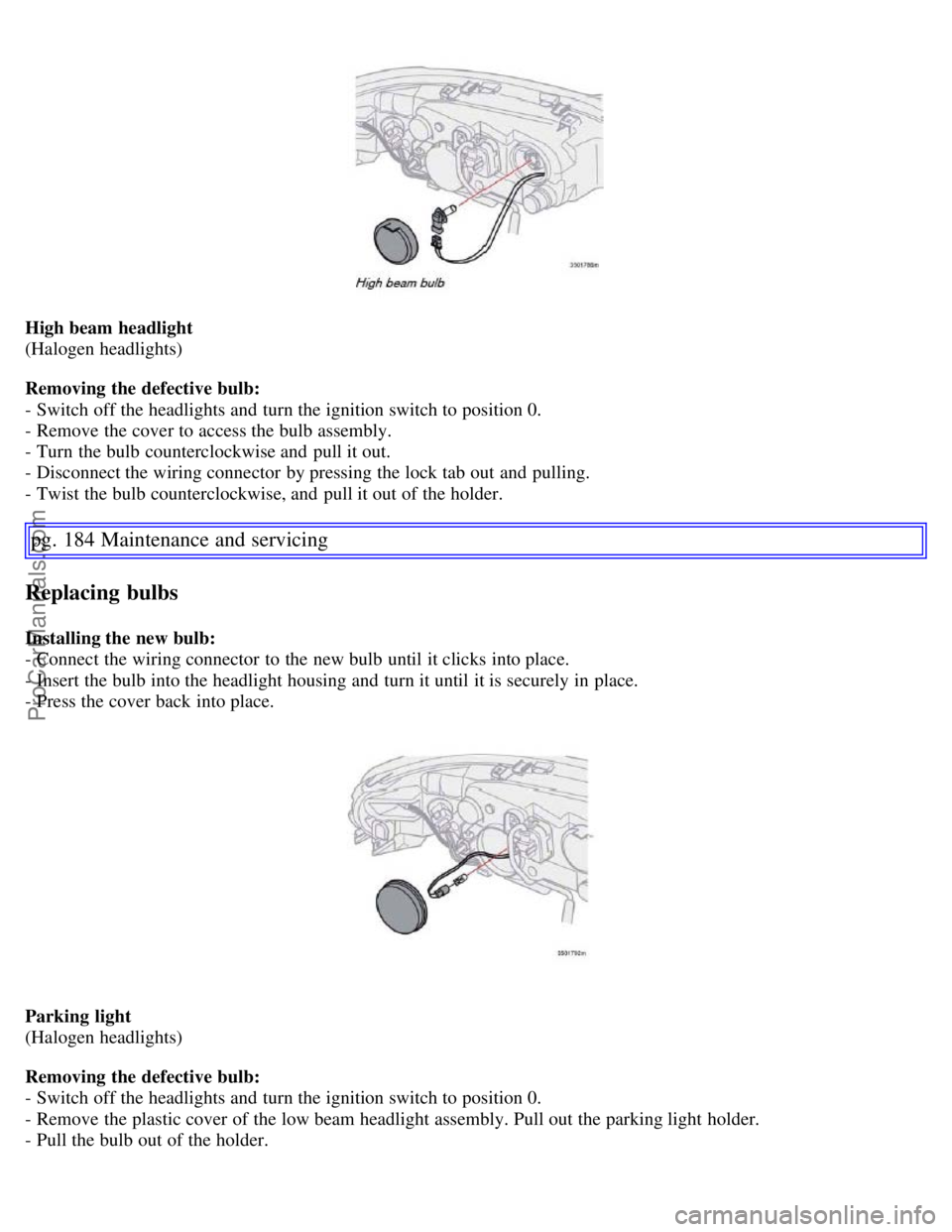
High beam headlight
(Halogen headlights)
Removing the defective bulb:
- Switch off the headlights and turn the ignition switch to position 0.
- Remove the cover to access the bulb assembly.
- Turn the bulb counterclockwise and pull it out.
- Disconnect the wiring connector by pressing the lock tab out and pulling.
- Twist the bulb counterclockwise, and pull it out of the holder.
pg. 184 Maintenance and servicing
Replacing bulbs
Installing the new bulb:
- Connect the wiring connector to the new bulb until it clicks into place.
- Insert the bulb into the headlight housing and turn it until it is securely in place.
- Press the cover back into place.
Parking light
(Halogen headlights)
Removing the defective bulb:
- Switch off the headlights and turn the ignition switch to position 0.
- Remove the plastic cover of the low beam headlight assembly. Pull out the parking light holder.
- Pull the bulb out of the holder.
ProCarManuals.com
Page 161 of 200
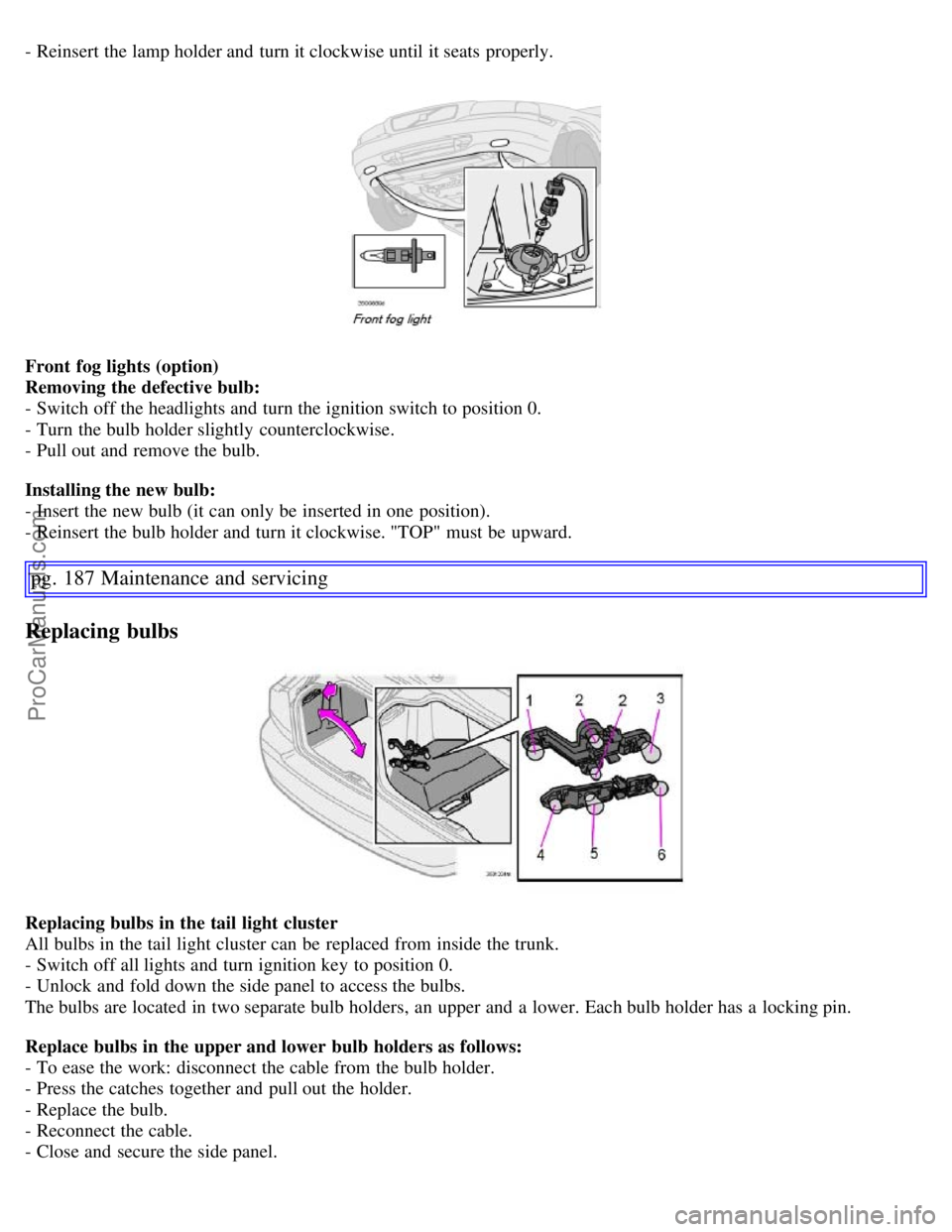
- Reinsert the lamp holder and turn it clockwise until it seats properly.
Front fog lights (option)
Removing the defective bulb:
- Switch off the headlights and turn the ignition switch to position 0.
- Turn the bulb holder slightly counterclockwise.
- Pull out and remove the bulb.
Installing the new bulb:
- Insert the new bulb (it can only be inserted in one position).
- Reinsert the bulb holder and turn it clockwise. "TOP" must be upward.
pg. 187 Maintenance and servicing
Replacing bulbs
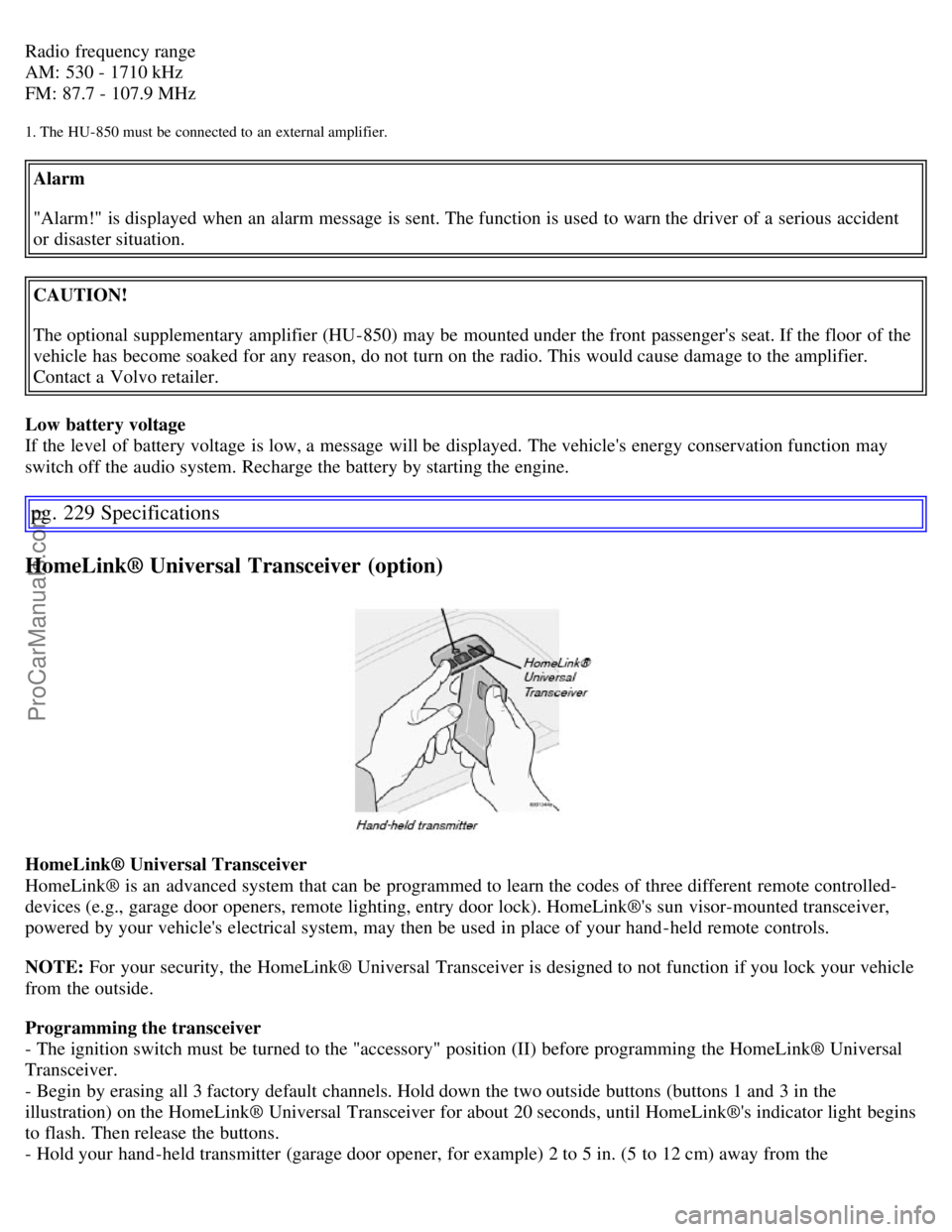
Replacing bulbs in the tail light cluster
All bulbs in the tail light cluster can be replaced from inside the trunk.
- Switch off all lights and turn ignition key to position 0.
- Unlock and fold down the side panel to access the bulbs.
The bulbs are located in two separate bulb holders, an upper and a lower. Each bulb holder has a locking pin.
Replace bulbs in the upper and lower bulb holders as follows:
- To ease the work: disconnect the cable from the bulb holder.
- Press the catches together and pull out the holder.
- Replace the bulb.
- Reconnect the cable.
- Close and secure the side panel.
ProCarManuals.com
Page 191 of 200
Radio frequency range
AM: 530 - 1710 kHz
FM: 87.7 - 107.9 MHz
1. The HU- 850 must be connected to an external amplifier.
Alarm
"Alarm!" is displayed when an alarm message is sent. The function is used to warn the driver of a serious accident
or disaster situation.
CAUTION!
The optional supplementary amplifier (HU-850) may be mounted under the front passenger's seat. If the floor of the
vehicle has become soaked for any reason, do not turn on the radio. This would cause damage to the amplifier.
Contact a Volvo retailer.
Low battery voltage
If the level of battery voltage is low, a message will be displayed. The vehicle's energy conservation function may
switch off the audio system. Recharge the battery by starting the engine.
pg. 229 Specifications
HomeLink® Universal Transceiver (option)
HomeLink® Universal Transceiver
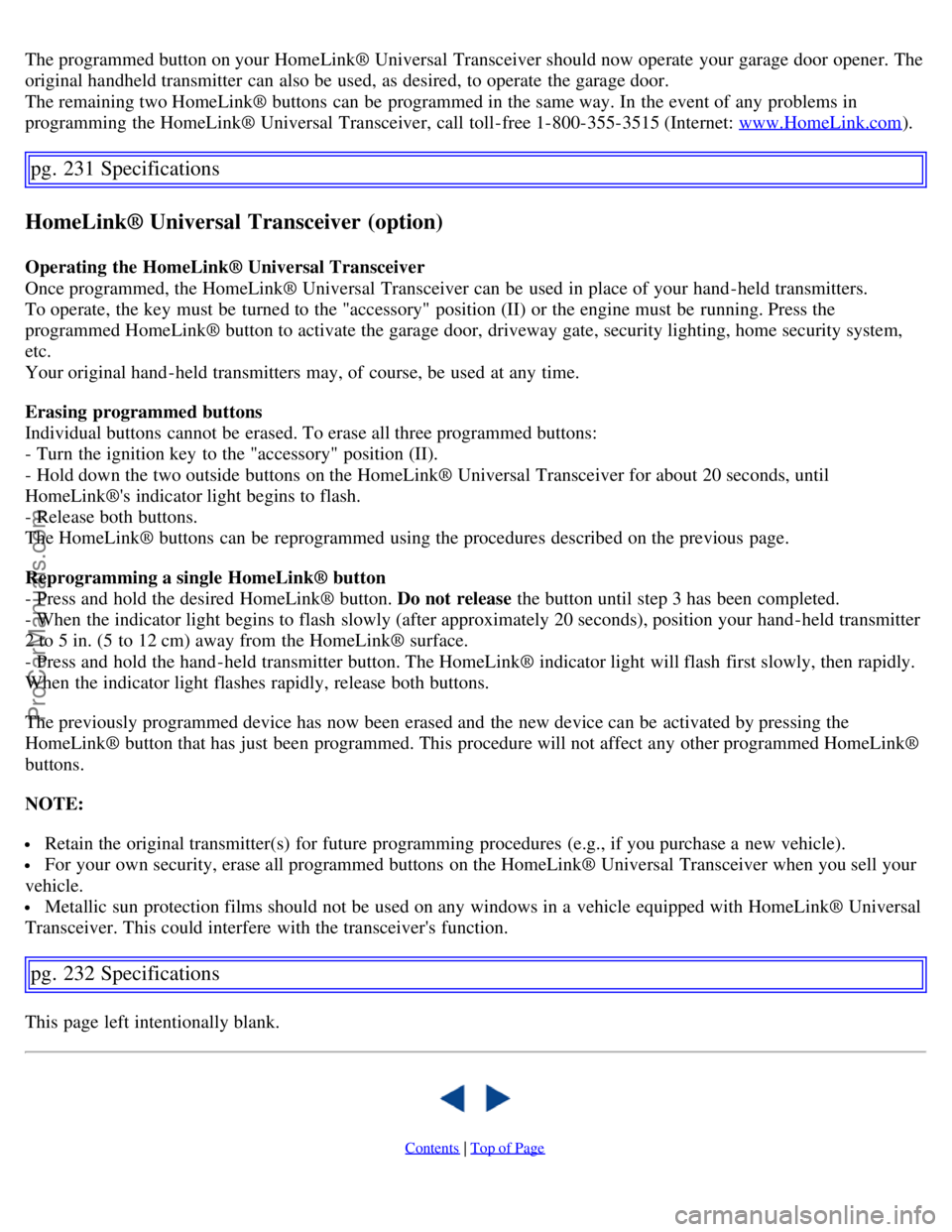
HomeLink® is an advanced system that can be programmed to learn the codes of three different remote controlled-
devices (e.g., garage door openers, remote lighting, entry door lock). HomeLink®'s sun visor-mounted transceiver,
powered by your vehicle's electrical system, may then be used in place of your hand -held remote controls.
NOTE: For your security, the HomeLink® Universal Transceiver is designed to not function if you lock your vehicle
from the outside.
Programming the transceiver
- The ignition switch must be turned to the "accessory" position (II) before programming the HomeLink® Universal
Transceiver.
- Begin by erasing all 3 factory default channels. Hold down the two outside buttons (buttons 1 and 3 in the
illustration) on the HomeLink® Universal Transceiver for about 20 seconds, until HomeLink®'s indicator light begins
to flash. Then release the buttons.
- Hold your hand -held transmitter (garage door opener, for example) 2 to 5 in. (5 to 12 cm) away from the
ProCarManuals.com
Page 193 of 200
The programmed button on your HomeLink® Universal Transceiver should now operate your garage door opener. The
original handheld transmitter can also be used, as desired, to operate the garage door.
The remaining two HomeLink® buttons can be programmed in the same way. In the event of any problems in
programming the HomeLink® Universal Transceiver, call toll-free 1-800-355-3515 (Internet: www.HomeLink.com
).
pg. 231 Specifications
HomeLink® Universal Transceiver (option)
Operating the HomeLink® Universal Transceiver
Once programmed, the HomeLink® Universal Transceiver can be used in place of your hand -held transmitters.
To operate, the key must be turned to the "accessory" position (II) or the engine must be running. Press the
programmed HomeLink® button to activate the garage door, driveway gate, security lighting, home security system,
etc.
Your original hand -held transmitters may, of course, be used at any time.
Erasing programmed buttons
Individual buttons cannot be erased. To erase all three programmed buttons:
- Turn the ignition key to the "accessory" position (II).
- Hold down the two outside buttons on the HomeLink® Universal Transceiver for about 20 seconds, until
HomeLink®'s indicator light begins to flash.
- Release both buttons.
The HomeLink® buttons can be reprogrammed using the procedures described on the previous page.
Reprogramming a single HomeLink® button
- Press and hold the desired HomeLink® button. Do not release the button until step 3 has been completed.
- When the indicator light begins to flash slowly (after approximately 20 seconds), position your hand -held transmitter
2 to 5 in. (5 to 12 cm) away from the HomeLink® surface.
- Press and hold the hand -held transmitter button. The HomeLink® indicator light will flash first slowly, then rapidly.
When the indicator light flashes rapidly, release both buttons.
The previously programmed device has now been erased and the new device can be activated by pressing the
HomeLink® button that has just been programmed. This procedure will not affect any other programmed HomeLink®
buttons.
NOTE:
Retain the original transmitter(s) for future programming procedures (e.g., if you purchase a new vehicle).
For your own security, erase all programmed buttons on the HomeLink® Universal Transceiver when you sell your
vehicle.
Metallic sun protection films should not be used on any windows in a vehicle equipped with HomeLink® Universal
Transceiver. This could interfere with the transceiver's function.
pg. 232 Specifications
This page left intentionally blank.
Contents | Top of Page
ProCarManuals.com