ECU VOLVO S60 2007 User Guide
[x] Cancel search | Manufacturer: VOLVO, Model Year: 2007, Model line: S60, Model: VOLVO S60 2007Pages: 200, PDF Size: 4.03 MB
Page 69 of 200
2 0 0 7
VOLVO S60
Interior
pg. 79 Interior
Front seats 80
Interior lighting84
Storage compartments86
Rear seat and trunk90
Spare wheel, tools and jack93
pg. 80 Interior
Front seats
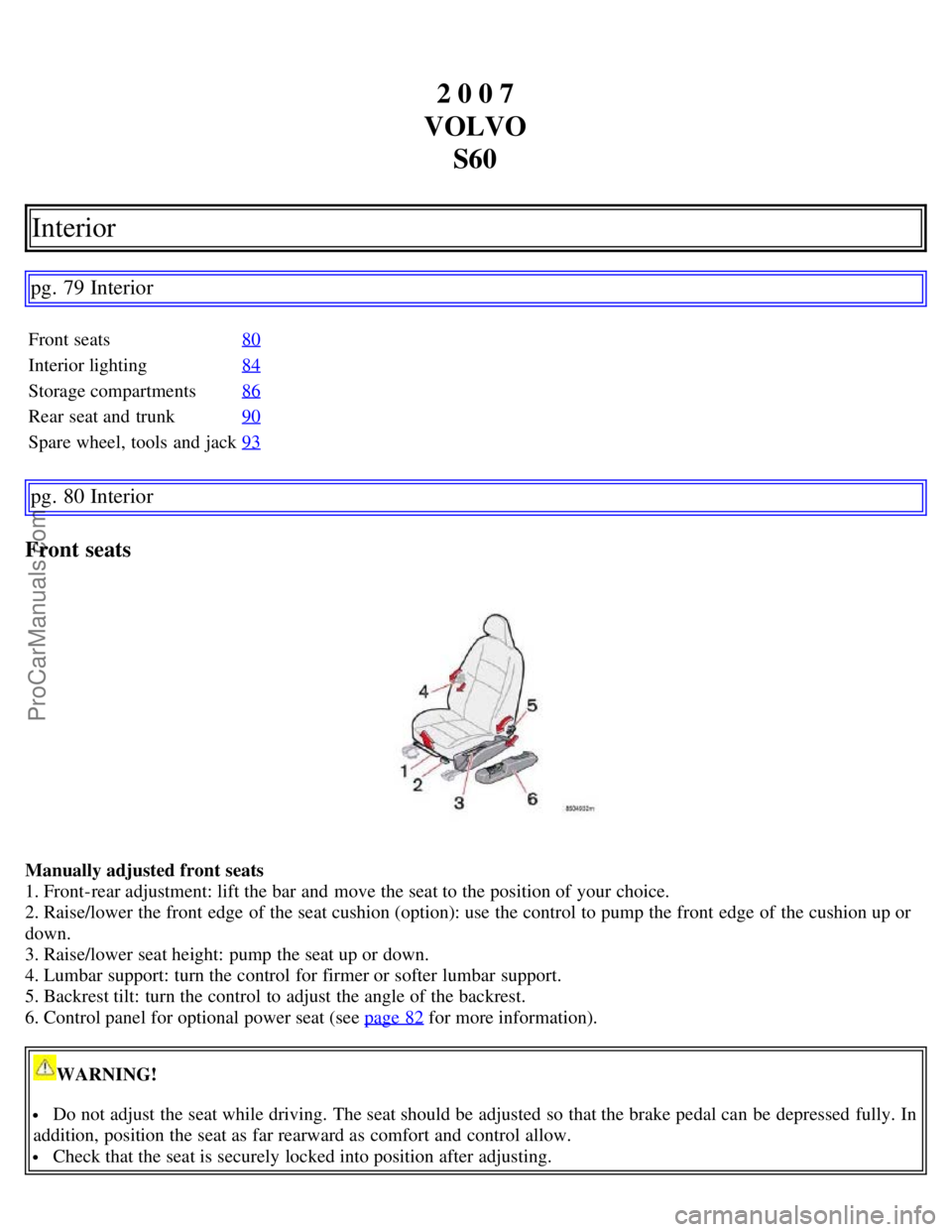
Manually adjusted front seats
1. Front-rear adjustment: lift the bar and move the seat to the position of your choice.
2. Raise/lower the front edge of the seat cushion (option): use the control to pump the front edge of the cushion up or
down.
3. Raise/lower seat height: pump the seat up or down.
4. Lumbar support: turn the control for firmer or softer lumbar support.
5. Backrest tilt: turn the control to adjust the angle of the backrest.
6. Control panel for optional power seat (see page 82
for more information).
WARNING!
Do not adjust the seat while driving. The seat should be adjusted so that the brake pedal can be depressed fully. In
addition, position the seat as far rearward as comfort and control allow.
Check that the seat is securely locked into position after adjusting.
ProCarManuals.com
Page 70 of 200
pg. 81 Interior
Front seats
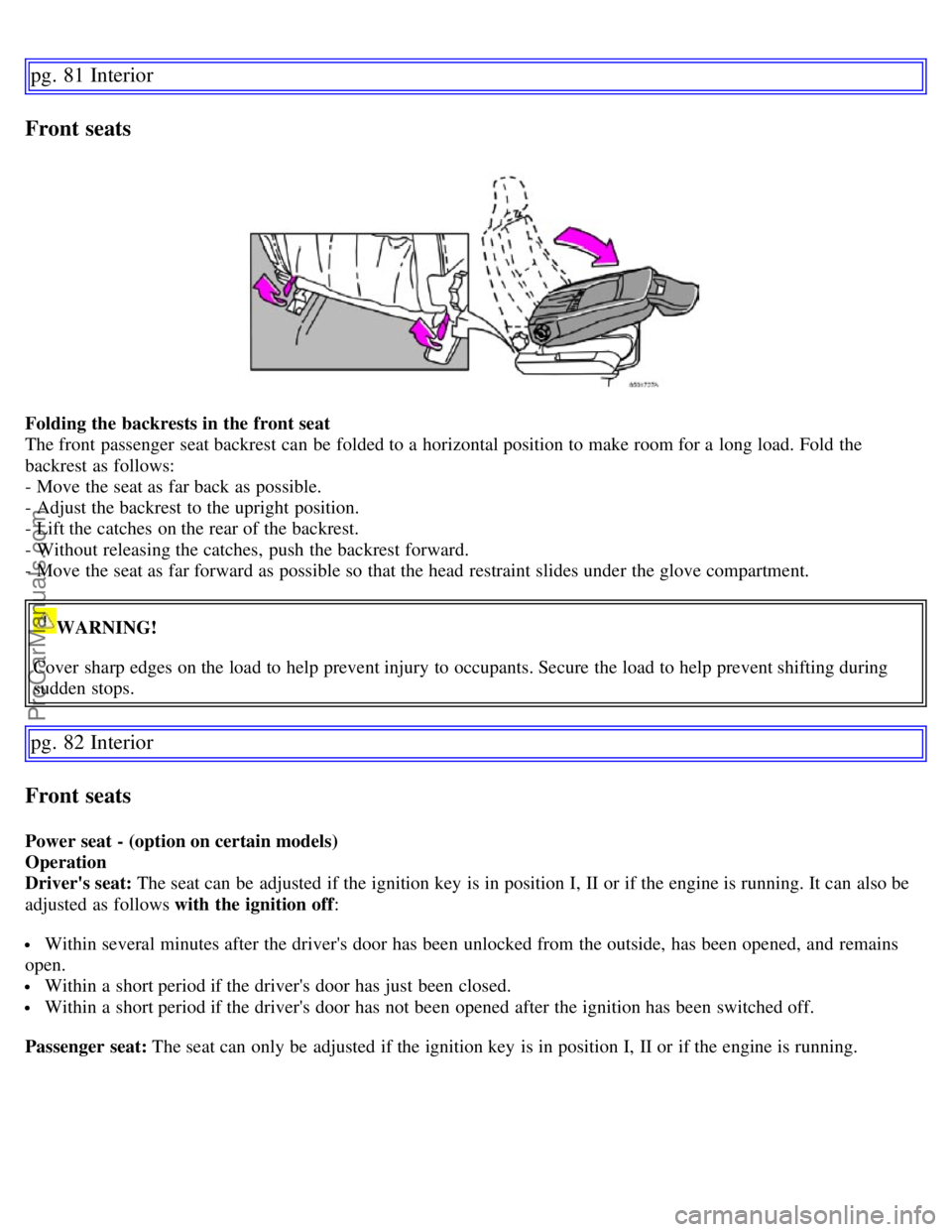
Folding the backrests in the front seat
The front passenger seat backrest can be folded to a horizontal position to make room for a long load. Fold the
backrest as follows:
- Move the seat as far back as possible.
- Adjust the backrest to the upright position.
- Lift the catches on the rear of the backrest.
- Without releasing the catches, push the backrest forward.
- Move the seat as far forward as possible so that the head restraint slides under the glove compartment.
WARNING!
Cover sharp edges on the load to help prevent injury to occupants. Secure the load to help prevent shifting during
sudden stops.
pg. 82 Interior
Front seats
Power seat - (option on certain models)
Operation
Driver's seat: The seat can be adjusted if the ignition key is in position I, II or if the engine is running. It can also be
adjusted as follows with the ignition off :
Within several minutes after the driver's door has been unlocked from the outside, has been opened, and remains
open.
Within a short period if the driver's door has just been closed.
Within a short period if the driver's door has not been opened after the ignition has been switched off.
Passenger seat: The seat can only be adjusted if the ignition key is in position I, II or if the engine is running.
ProCarManuals.com
Page 78 of 200
WARNING!
Keep vehicle doors and the luggage compartment locked and keep keys out of a child's reach. Unsupervised
children could lock themselves in an open trunk and risk injury. Children should be taught not to play in vehicles.
On hot days, the temperature in the trunk or vehicle interior can rise very quickly. Exposure of people to these
high temperatures for even a short period of time can cause heat-related injury or death. Small children are
particularly at risk.
WARNING!
When the backrest is returned to the upright position, check that it is properly locked in place. Return the head
restraints to the upright position.
Long loads should always be securely anchored to help avoid injury in the event of a sudden stop.
Always turn the engine off and apply the parking brake when loading/ unloading the vehicle.
Place the transmission in the (P)ark position (automatic transmission) to help prevent inadvertent movement of the
gear selector.
The vehicle features a 60/40 split fold-downs rear seat. This function is performed by handles inside the trunk,
and also provides a means for children and adults to enter the passenger compartment in the event they become
locked inside the trunk.
Adults are advised to familiarize themselves with the operation and location of the release handles.
To fold down the rear seats from inside the trunk, pull the release control handles located on either side of the
trunk.
pg. 91 Interior
Rear seat and trunk
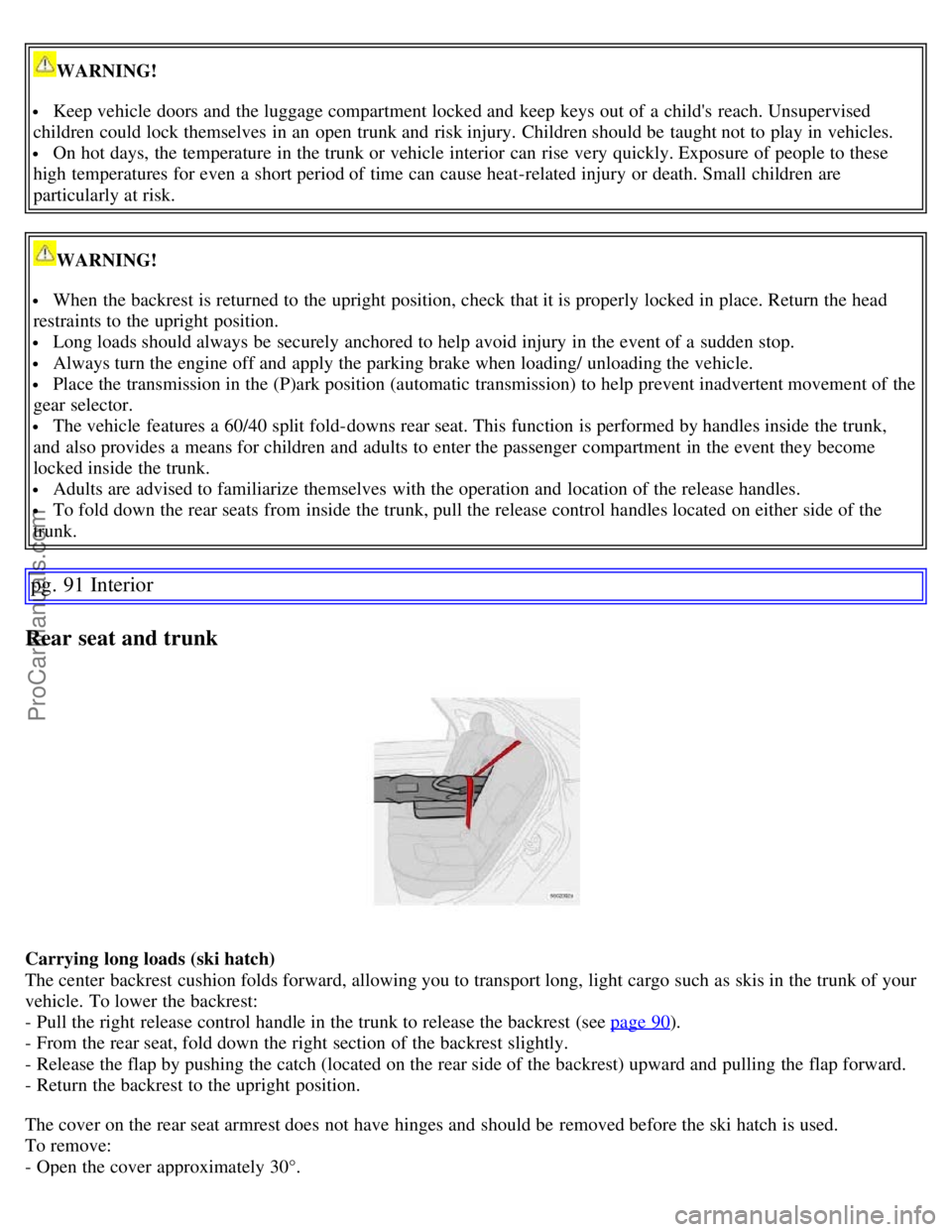
Carrying long loads (ski hatch)
The center backrest cushion folds forward, allowing you to transport long, light cargo such as skis in the trunk of your
vehicle. To lower the backrest:
- Pull the right release control handle in the trunk to release the backrest (see page 90
).
- From the rear seat, fold down the right section of the backrest slightly.
- Release the flap by pushing the catch (located on the rear side of the backrest) upward and pulling the flap forward.
- Return the backrest to the upright position.
The cover on the rear seat armrest does not have hinges and should be removed before the ski hatch is used.
To remove:
- Open the cover approximately 30°.
ProCarManuals.com
Page 79 of 200
- Pull it straight up.
To put in place:
- Press the cover into the groove behind the upholstery.
- Close the cover.
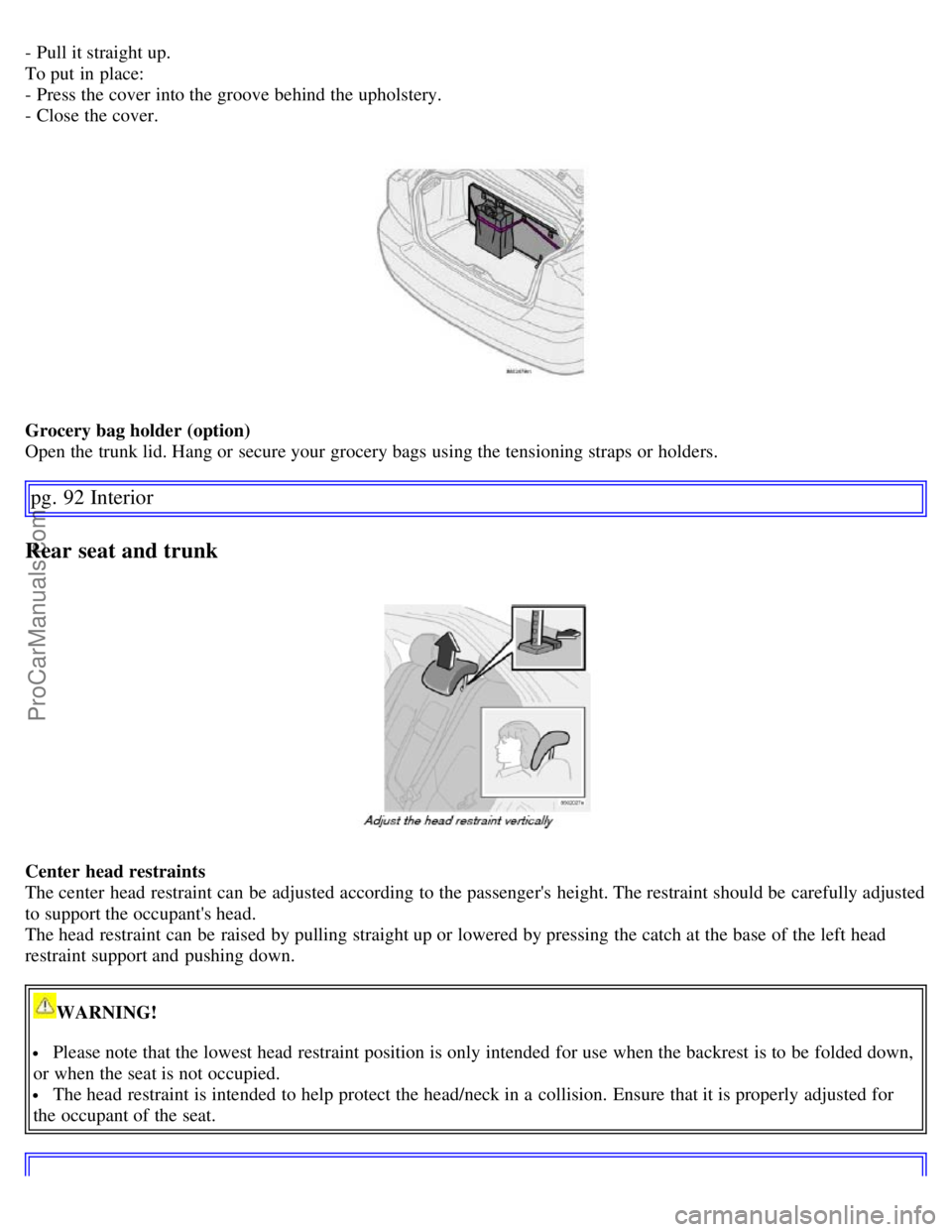
Grocery bag holder (option)
Open the trunk lid. Hang or secure your grocery bags using the tensioning straps or holders.
pg. 92 Interior
Rear seat and trunk
Center head restraints
The center head restraint can be adjusted according to the passenger's height. The restraint should be carefully adjusted
to support the occupant's head.
The head restraint can be raised by pulling straight up or lowered by pressing the catch at the base of the left head
restraint support and pushing down.
WARNING!
Please note that the lowest head restraint position is only intended for use when the backrest is to be folded down,
or when the seat is not occupied.
The head restraint is intended to help protect the head/neck in a collision. Ensure that it is properly adjusted for
the occupant of the seat.
ProCarManuals.com
Page 80 of 200
pg. 93 Interior
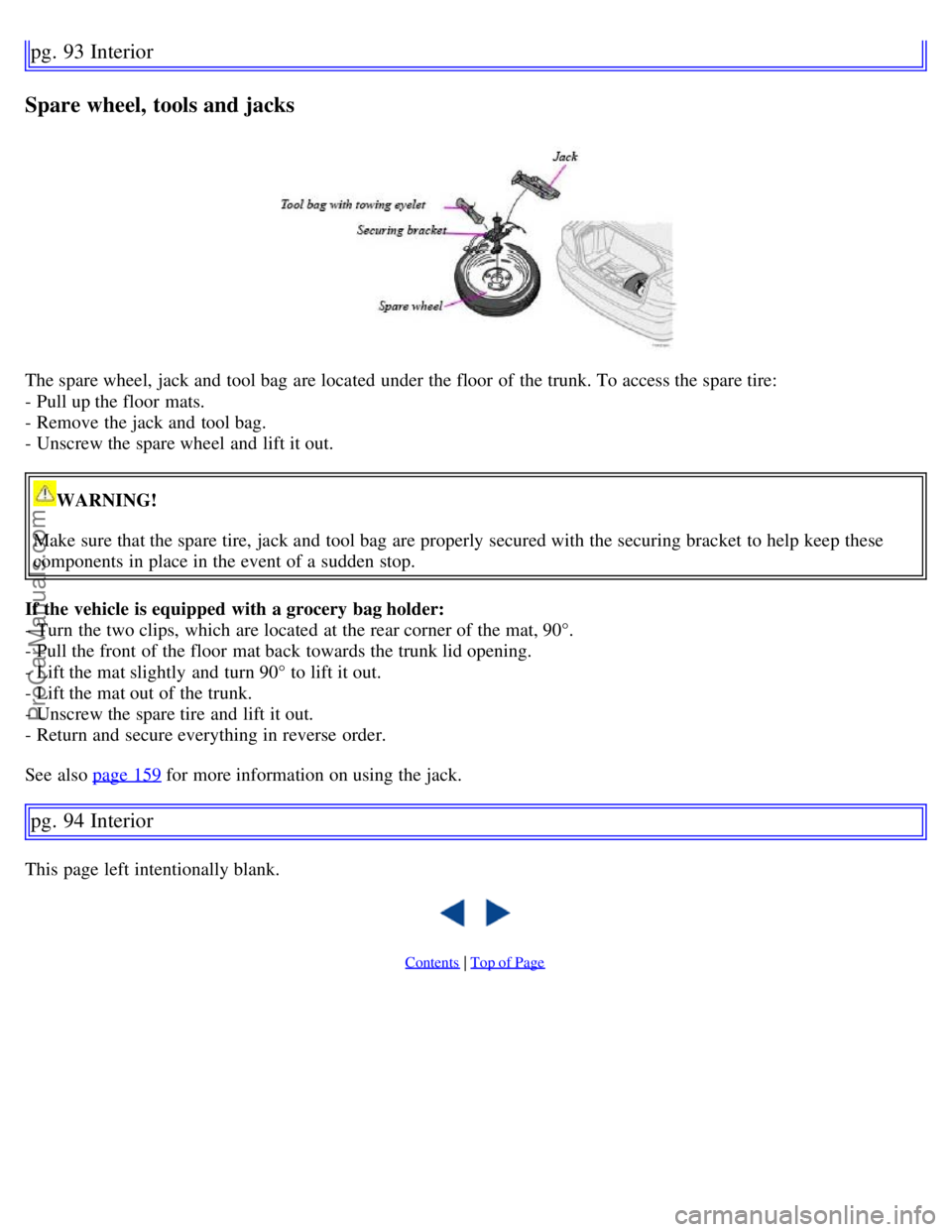
Spare wheel, tools and jacks
The spare wheel, jack and tool bag are located under the floor of the trunk. To access the spare tire:
- Pull up the floor mats.
- Remove the jack and tool bag.
- Unscrew the spare wheel and lift it out.
WARNING!
Make sure that the spare tire, jack and tool bag are properly secured with the securing bracket to help keep these
components in place in the event of a sudden stop.
If the vehicle is equipped with a grocery bag holder:
- Turn the two clips, which are located at the rear corner of the mat, 90°.
- Pull the front of the floor mat back towards the trunk lid opening.
- Lift the mat slightly and turn 90° to lift it out.
- Lift the mat out of the trunk.
- Unscrew the spare tire and lift it out.
- Return and secure everything in reverse order.
See also page 159
for more information on using the jack.
pg. 94 Interior
This page left intentionally blank.
Contents | Top of Page
ProCarManuals.com
Page 110 of 200
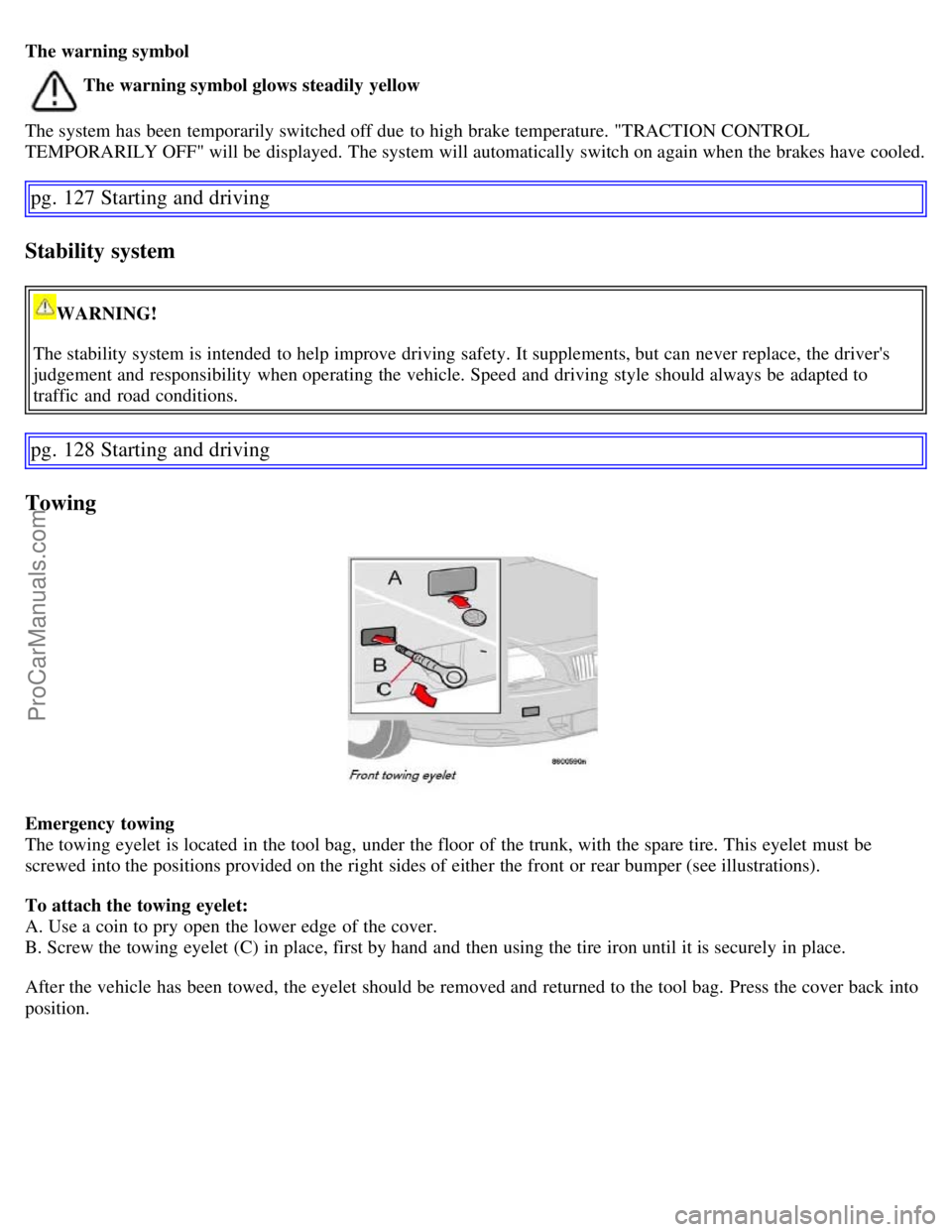
The warning symbol
The warning symbol glows steadily yellow
The system has been temporarily switched off due to high brake temperature. "TRACTION CONTROL
TEMPORARILY OFF" will be displayed. The system will automatically switch on again when the brakes have cooled.
pg. 127 Starting and driving
Stability system
WARNING!
The stability system is intended to help improve driving safety. It supplements, but can never replace, the driver's
judgement and responsibility when operating the vehicle. Speed and driving style should always be adapted to
traffic and road conditions.
pg. 128 Starting and driving
Towing
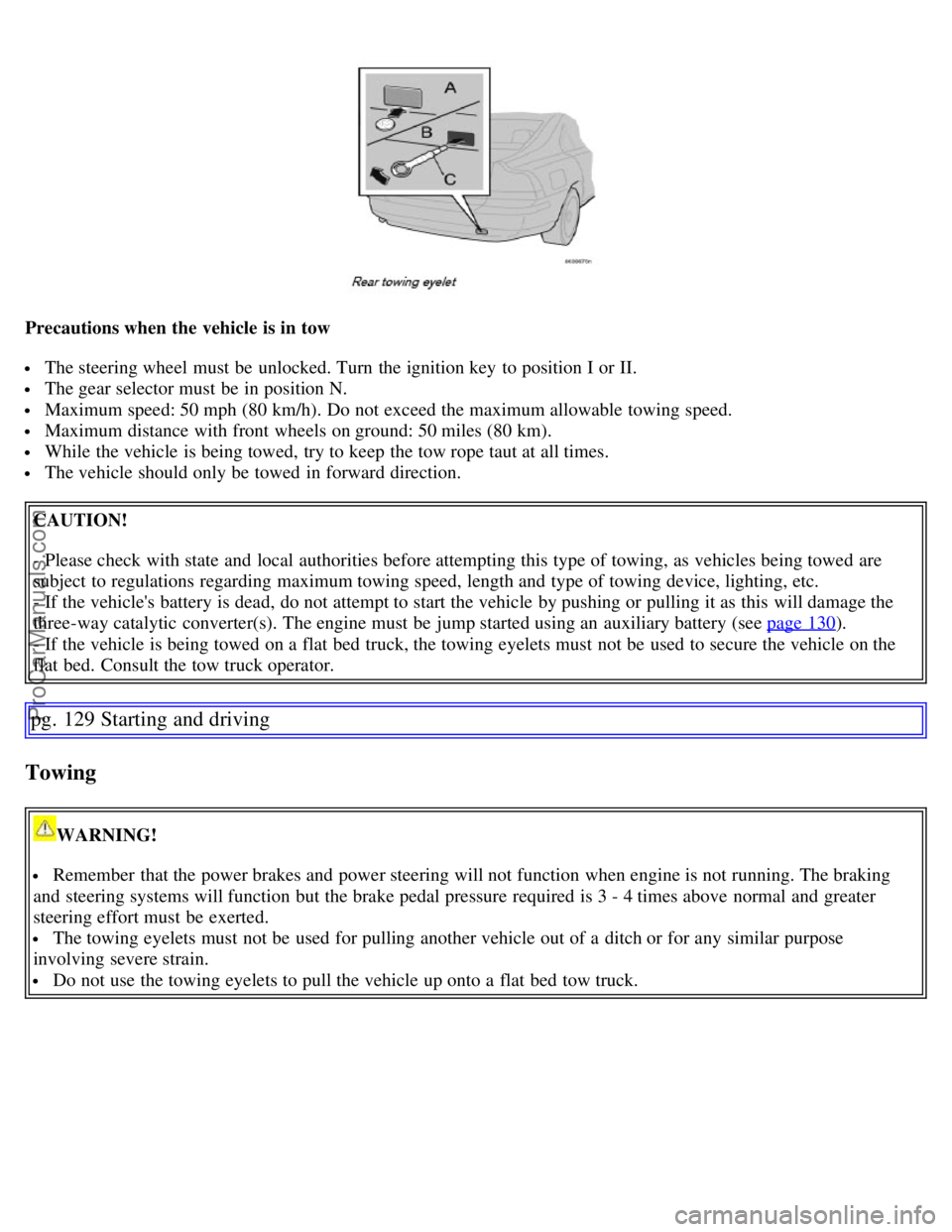
Emergency towing
The towing eyelet is located in the tool bag, under the floor of the trunk, with the spare tire. This eyelet must be
screwed into the positions provided on the right sides of either the front or rear bumper (see illustrations).
To attach the towing eyelet:
A. Use a coin to pry open the lower edge of the cover.
B. Screw the towing eyelet (C) in place, first by hand and then using the tire iron until it is securely in place.
After the vehicle has been towed, the eyelet should be removed and returned to the tool bag. Press the cover back into
position.
ProCarManuals.com
Page 111 of 200
Precautions when the vehicle is in tow
The steering wheel must be unlocked. Turn the ignition key to position I or II.
The gear selector must be in position N.
Maximum speed: 50 mph (80 km/h). Do not exceed the maximum allowable towing speed.
Maximum distance with front wheels on ground: 50 miles (80 km).
While the vehicle is being towed, try to keep the tow rope taut at all times.
The vehicle should only be towed in forward direction.
CAUTION!
- Please check with state and local authorities before attempting this type of towing, as vehicles being towed are
subject to regulations regarding maximum towing speed, length and type of towing device, lighting, etc.
- If the vehicle's battery is dead, do not attempt to start the vehicle by pushing or pulling it as this will damage the
three-way catalytic converter(s). The engine must be jump started using an auxiliary battery (see page 130
).
- If the vehicle is being towed on a flat bed truck, the towing eyelets must not be used to secure the vehicle on the
flat bed. Consult the tow truck operator.
pg. 129 Starting and driving
Towing
WARNING!
Remember that the power brakes and power steering will not function when engine is not running. The braking
and steering systems will function but the brake pedal pressure required is 3 - 4 times above normal and greater
steering effort must be exerted.
The towing eyelets must not be used for pulling another vehicle out of a ditch or for any similar purpose
involving severe strain.
Do not use the towing eyelets to pull the vehicle up onto a flat bed tow truck.
ProCarManuals.com
Page 112 of 200
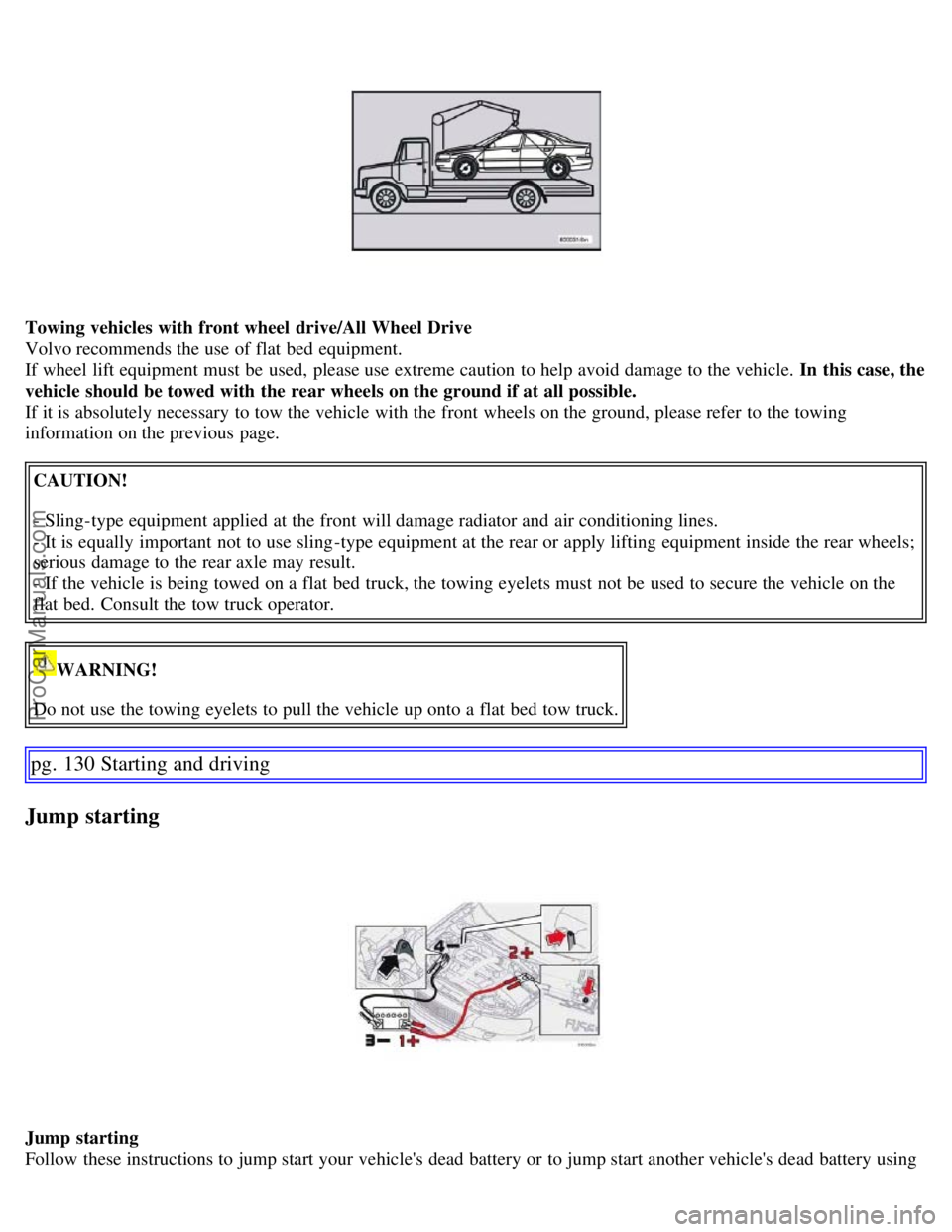
Towing vehicles with front wheel drive/All Wheel Drive
Volvo recommends the use of flat bed equipment.
If wheel lift equipment must be used, please use extreme caution to help avoid damage to the vehicle. In this case, the
vehicle should be towed with the rear wheels on the ground if at all possible.
If it is absolutely necessary to tow the vehicle with the front wheels on the ground, please refer to the towing
information on the previous page.CAUTION!
- Sling-type equipment applied at the front will damage radiator and air conditioning lines.
- It is equally important not to use sling -type equipment at the rear or apply lifting equipment inside the rear wheels;
serious damage to the rear axle may result.
- If the vehicle is being towed on a flat bed truck, the towing eyelets must not be used to secure the vehicle on the
flat bed. Consult the tow truck operator.
WARNING!
Do not use the towing eyelets to pull the vehicle up onto a flat bed tow truck.
pg. 130 Starting and driving
Jump starting
Jump starting
Follow these instructions to jump start your vehicle's dead battery or to jump start another vehicle's dead battery using
ProCarManuals.com
Page 116 of 200

To avoid damaging your vehicle and to achieve maximum safety when driving, we recommend using the load
carriers that Volvo has developed especially for your vehicle.
Volvo-approved removable roof racks are designed to carry the maximum allowable roof load for this vehicle: 220
lbs (100 kg). For Non-Volvo roof racks, check the manufacturer's weight limits for the rack.
Never exceed the rack manufacturer's weigh limits and never exceed the maximum rated roof load of 220 lbs (100
kg).
Avoid single-point loads. Distribute loads evenly.
Place heavier cargo at the bottom of the load.
Secure the cargo correctly with appropriate tie-down equipment.
Check periodically that the load carriers and load are properly secured.
Remember that the vehicle's center of gravity and handling change when you carry a load on the roof.
The vehicle's wind resistance and fuel consumption will increase with the size of the load.
Drive smoothly. Avoid rapid starts, fast cornering and hard braking.
Attaching load carriers
The attachment brackets for the load carriers are located under the roof molding.
- Make sure that the load carriers are placed in the right direction. See the mark on the decal under the cover.
- Press the guide lugs into the holes (1).
- Carefully lower the opposite side of the load carrier to the roof.
- Loosen the tightening wheel slightly. Slide the hook on the load carrier attachment into the attachment bracket under
the roof molding.
- Turn the tightening wheel to secure the load carrier in the attachment bracket.
pg. 135 Starting and driving
Load carriers (accessory)
- Repeat this procedure for the other load carrier attachments.
- Check that the hooks on all four load carrier attachments are securely tightened in the respective attachment brackets
on the roof of the vehicle.
- Press down the covers.
Check periodically that the load carriers and load are properly secured.
pg. 136 Starting and driving
Cold weather precautions
ProCarManuals.com
Page 133 of 200

pg. 157 Wheels and tires
Temporary spare
The spare tire in your vehicle is called a "Temporary Spare".
Recommended tire pressure (see the placard on the B-pillar or on the fuel filler door) should be maintained irrespective
of which position on the vehicle the temporary spare tire is used on.
In the event of damage to this tire, a new one can be purchased from your Volvo retailer.
WARNING!
Current legislation prohibits the use of the "Temporary Spare" tire other than as a temporary replacement for a
punctured tire. It must be replaced as soon as possible by a standard tire. Road holding and handling may be affected
with the "Temporary Spare" in use. Do not exceed 50 mph (80 km/h). Do not drive farther than 50 miles (80 km) on
a temporary spare tire.
CAUTION!
The vehicle must not be driven with wheels of different dimensions or with a spare tire other than the one that came
with the vehicle. The use of different size wheels can seriously damage your vehicle's transmission.
pg. 158 Wheels and tires
Changing wheels
Changing wheels
The spare wheel is located under the carpet on the trunk floor. The jack and crank are secured in the wheel recess.
There are two jack attachment points on each side of the vehicle (see illustration on next page).
To change a wheel:
- Engage the parking brake.
- Put the gear selector in (P)ark (automatic transmission) or reverse (manual transmission).
ProCarManuals.com