tires VOLVO S60 2007 Owner's Manual
[x] Cancel search | Manufacturer: VOLVO, Model Year: 2007, Model line: S60, Model: VOLVO S60 2007Pages: 200, PDF Size: 4.03 MB
Page 131 of 200
manual to determine how this reduces the available cargo and luggage load capacity of your vehicle.
1. See "Towing a trailer" on page 131.
pg. 154 Wheels and tires
Vehicle loading
WARNING!
Exceeding the permissible axle weight, gross vehicle weight, or any other weight rating limits can cause tire
overheating resulting in permanent deformation or catastrophic failure.
Do not use replacement tires with lower load carrying capacities than the tires that were original equipment on the
vehicle because this will lower the vehicle's GVW rating. Replacement tires with a higher limit than the originals do
not increase the vehicle's GVW rating limitations.
pg. 155 Wheels and tires
Uniform Tire Quality Grading
ALL PASSENGER VEHICLE TIRES MUST CONFORM TO FEDERAL SAFETY REQUIREMENTS IN
ADDITION TO THESE GRADES
Quality grades can be found, where applicable, on the tire sidewall between the tread shoulder and maximum
section width. For example:
Treadwear 200 Traction AA Temperature A
TREADWEAR
The treadwear grade is a comparative rating based on the wear rate of the tire when tested under controlled conditions
on a specified government test course. For example, a tire graded 150 would wear one and one half (1 1/2) times as
well on the government course as a tire graded 100. The relative performance of tires depends upon the actual
conditions of their use, however, and many depart significantly from the norm due to variation in driving habits,
maintenance practices and differences in road characteristics and climate.
TRACTION
The traction grades, from highest to lowest, are AA, A, B, and C, as measured under controlled conditions on specified
government test surfaces of asphalt and concrete. A tire marked C may have poor traction performance.
WARNING!
The traction grade assigned to this tire is based on braking (straight-ahead) traction tests and is not a measure of
cornering (turning) traction.
TEMPERATURE
The temperature grades are AA (the highest), A, B, and C, representing the tire's resistance to the generation of heat
and its ability to dissipate heat when tested under controlled conditions on a specified indoor laboratory test wheel.
Sustained high temperature can cause the material of the tire to degenerate and reduce tire life, and excessive
temperature can lead to sudden tire failure. The grade C corresponds to a minimum level of performance that all
passenger vehicle tires must meet under the Federal Motor Safety Standard No. 109. Grades B and A represent higher
levels of performance on the laboratory test wheel than the minimum required by law.
ProCarManuals.com
Page 132 of 200
WARNING!
The temperature grade for this tire is established for a tire that is properly inflated and not overloaded. Excessive
speed, under-inflation, or excessive loading, either separately or in combination, can cause heat buildup and tire
failure.
pg. 156 Wheels and tires
Snow chains, snow tires, studded tires
Snow chains
Snow chains can be used on your Volvo with the following restrictions:
Snow chains should be installed on front wheels only. Use only Volvo approved snow chains.
If accessory, aftermarket or "custom" tires and wheels are installed and are of a size different than the original tires
and wheels, chains in some cases CANNOT be used. Sufficient clearances between chains and brakes, suspension and
body components must be maintained.
Some strap -on type chains will interfere with brake components and therefore CANNOT be used.
All Wheel Drive models: Snow chains should only be installed on the front wheels. Only chains adapted for AWD
models should be used.
Consult your Volvo retailer for additional snow chain information.
CAUTION!
- Check local regulations regarding the use of snow chains before installing. Always follow the chain manufacturer's
installation instructions carefully. Install chains as tightly as possible and retighten periodically.
- Never exceed the chain manufacturer's specified maximum speed limit. (Under no circumstances should you
exceed 31 mph (50 km/h)).
- Avoid bumps, holes or sharp turns when driving with snow chains.
- The handling of the vehicle can be adversely affected when driving with chains. Avoid fast or sharp turns as well
as locked wheel braking.
Snow tires, studded tires
1
Tires for winter use:
Owners who live in or regularly commute through areas with sustained periods of snow or icy driving conditions are
strongly advised to fit suitable winter tires to help retain the highest degree of traction.
It is important to install winter tires on all four wheels to help retain traction during cornering, braking, and
accelerating. Failure to do so could reduce traction to an unsafe level or adversely affect handling.
Do not mix tires of different design as this could also negatively affect overall tire road grip.
Winter tires wear more quickly on dry roads in warm weather. They should be removed when the winter driving
season has ended.
Studded tires should be run-in 300-600 miles (500-1000 km) during which the vehicle should be driven as smoothly
as possible to give the studs the opportunity to seat properly in the tires. The tires should have the same rotational
direction throughout their entire lifetime.
NOTE: Please consult state or provincial regulations restricting the use of studded winter tires before installing such
tires.
1. Where permitted
ProCarManuals.com
Page 133 of 200

pg. 157 Wheels and tires
Temporary spare
The spare tire in your vehicle is called a "Temporary Spare".
Recommended tire pressure (see the placard on the B-pillar or on the fuel filler door) should be maintained irrespective
of which position on the vehicle the temporary spare tire is used on.
In the event of damage to this tire, a new one can be purchased from your Volvo retailer.
WARNING!
Current legislation prohibits the use of the "Temporary Spare" tire other than as a temporary replacement for a
punctured tire. It must be replaced as soon as possible by a standard tire. Road holding and handling may be affected
with the "Temporary Spare" in use. Do not exceed 50 mph (80 km/h). Do not drive farther than 50 miles (80 km) on
a temporary spare tire.
CAUTION!
The vehicle must not be driven with wheels of different dimensions or with a spare tire other than the one that came
with the vehicle. The use of different size wheels can seriously damage your vehicle's transmission.
pg. 158 Wheels and tires
Changing wheels
Changing wheels
The spare wheel is located under the carpet on the trunk floor. The jack and crank are secured in the wheel recess.
There are two jack attachment points on each side of the vehicle (see illustration on next page).
To change a wheel:
- Engage the parking brake.
- Put the gear selector in (P)ark (automatic transmission) or reverse (manual transmission).
ProCarManuals.com
Page 134 of 200
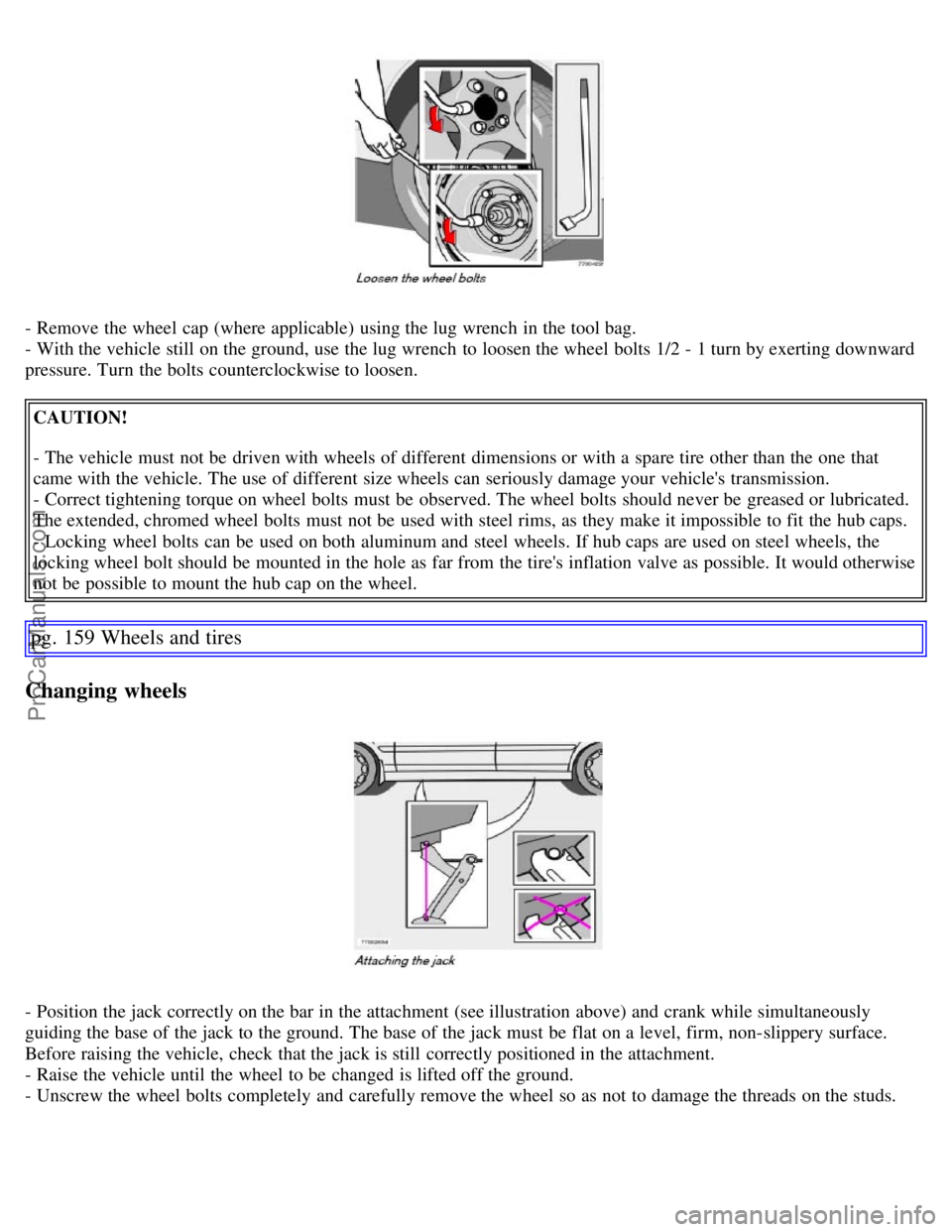
- Remove the wheel cap (where applicable) using the lug wrench in the tool bag.
- With the vehicle still on the ground, use the lug wrench to loosen the wheel bolts 1/2 - 1 turn by exerting downward
pressure. Turn the bolts counterclockwise to loosen.CAUTION!
- The vehicle must not be driven with wheels of different dimensions or with a spare tire other than the one that
came with the vehicle. The use of different size wheels can seriously damage your vehicle's transmission.
- Correct tightening torque on wheel bolts must be observed. The wheel bolts should never be greased or lubricated.
The extended, chromed wheel bolts must not be used with steel rims, as they make it impossible to fit the hub caps.
- Locking wheel bolts can be used on both aluminum and steel wheels. If hub caps are used on steel wheels, the
locking wheel bolt should be mounted in the hole as far from the tire's inflation valve as possible. It would otherwise
not be possible to mount the hub cap on the wheel.
pg. 159 Wheels and tires
Changing wheels
- Position the jack correctly on the bar in the attachment (see illustration above) and crank while simultaneously
guiding the base of the jack to the ground. The base of the jack must be flat on a level, firm, non-slippery surface.
Before raising the vehicle, check that the jack is still correctly positioned in the attachment.
- Raise the vehicle until the wheel to be changed is lifted off the ground.
- Unscrew the wheel bolts completely and carefully remove the wheel so as not to damage the threads on the studs.
ProCarManuals.com
Page 135 of 200
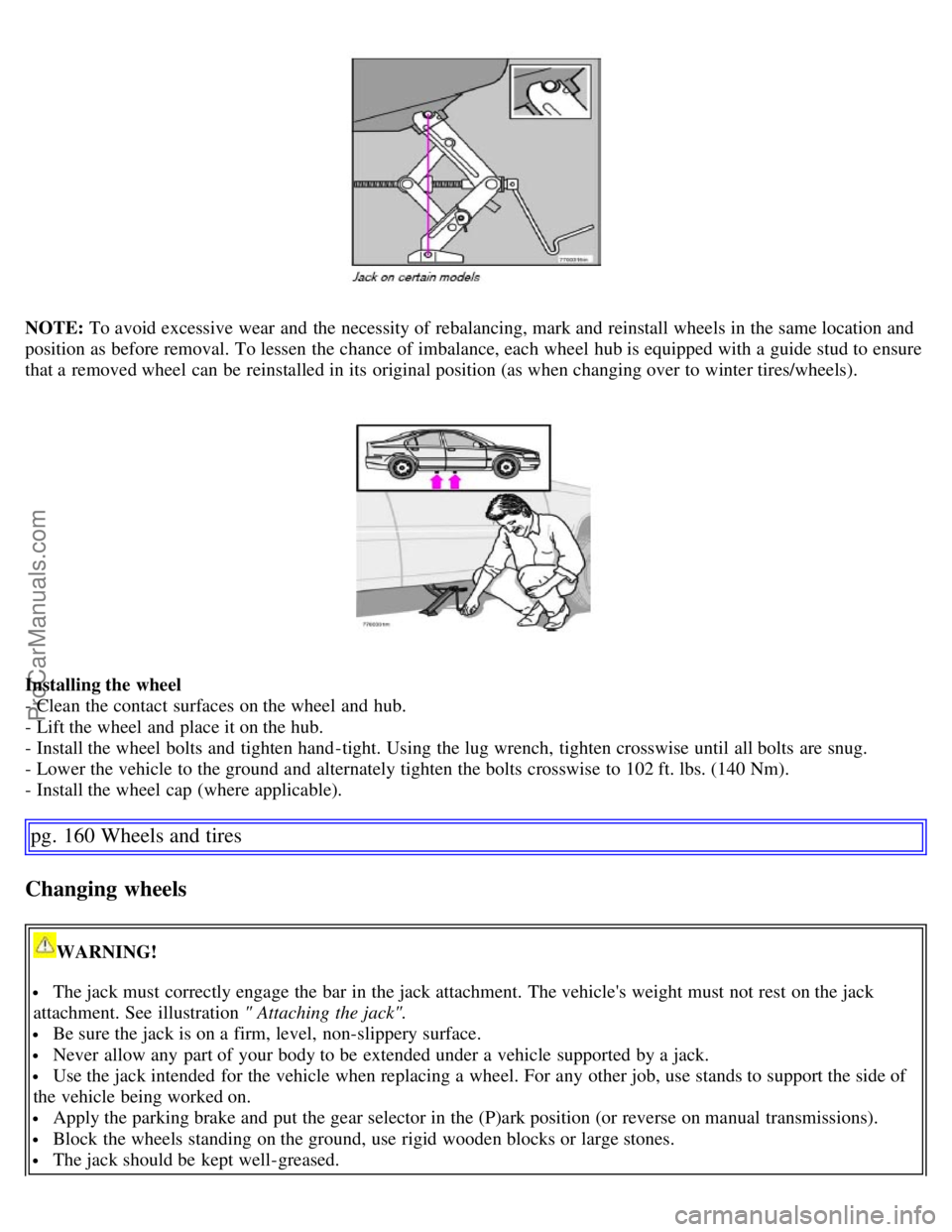
NOTE: To avoid excessive wear and the necessity of rebalancing, mark and reinstall wheels in the same location and
position as before removal. To lessen the chance of imbalance, each wheel hub is equipped with a guide stud to ensure
that a removed wheel can be reinstalled in its original position (as when changing over to winter tires/wheels).
Installing the wheel
- Clean the contact surfaces on the wheel and hub.
- Lift the wheel and place it on the hub.
- Install the wheel bolts and tighten hand -tight. Using the lug wrench, tighten crosswise until all bolts are snug.
- Lower the vehicle to the ground and alternately tighten the bolts crosswise to 102 ft. lbs. (140 Nm).
- Install the wheel cap (where applicable).
pg. 160 Wheels and tires
Changing wheels
WARNING!
The jack must correctly engage the bar in the jack attachment. The vehicle's weight must not rest on the jack
attachment. See illustration " Attaching the jack".
Be sure the jack is on a firm, level, non-slippery surface.
Never allow any part of your body to be extended under a vehicle supported by a jack.
Use the jack intended for the vehicle when replacing a wheel. For any other job, use stands to support the side of
the vehicle being worked on.
Apply the parking brake and put the gear selector in the (P)ark position (or reverse on manual transmissions).
Block the wheels standing on the ground, use rigid wooden blocks or large stones.
The jack should be kept well-greased.
ProCarManuals.com
Page 143 of 200
Vehicle Event Data (Black Box)
Your vehicle's driving and safety systems employ computers that monitor, and share with each other, information
about your vehicle's operation. One or more of these computers may store what they monitor, either during normal
vehicle operation or in a crash or near-crash event. Stored information may be read and used by:
Volvo Car Corporation
service and repair facilities
law enforcement or government agencies
others who may assert a legal right to know, or who obtain your consent to know such information.
Applicable warranties
In accordance with applicable U.S. and Canadian regulations, the following list of warranties is provided.
New Car Limited Warranty
Parts and Accessories Limited Warranty
Corrosion Protection Limited Warranty
Seat Belt and Supplemental Restraint Systems Limited Warranty
Emission Design and Defect Warranty
Emission Performance Warranty
These are the Federal warranties; other warranties are provided as required by state/ provincial law. Refer to your
separate Warranty and Service Records Information booklet for detailed information concerning each of the warranties.
pg. 169 Maintenance and servicing
Maintaining your vehicle
Owner maintenance
Periodic maintenance requirements and intervals are described in your vehicle's Warranty and Service Records
Information booklet.
The following points can be carried out between the normally scheduled maintenance services.
Each time the vehicle is refueled:
Check the engine oil level
Clean the windshield, windshield wipers, headlights, and tail lights
Monthly:
Check cold tire pressure in all tires. Inspect the tires for wear.
Check that engine coolant and other fluid levels are between the indicated "min" and "max" markings.
Clean interior glass surfaces with a glass cleaner and soft paper towels.
Wipe driver information displays with a soft cloth.
Visually inspect battery terminals for corrosion. Corrosion may indicate a loose terminal connector, or a battery near
the end of its useful service life. Consult your Volvo retailer for additional information.
As needed:
Wash the vehicle, including the undercarriage, to reduce wear that can be caused by a buildup of dirt, and corrosion
that can be caused by salt residues.
Clean leaves and twigs from air intake vents at the base of the windshield, and from other places where they may
collect.
ProCarManuals.com
Page 198 of 200
Permissible axle weight153
Polishing163
Power moonroof68
Power seat82
Power steering fluid177
Power steering, speed sensitive114
Power windows63
PROPOSITION 65 WARNING130
R
Radiator173
Radio215
Rain sensor - windshield wipers56
Rear park assist138
Rear seat, folding backrests90
Rear suspension206
Rear window defroster58
Recirculation76
REDUCE SPEED49
Refrigerant (A/C system)72
Refueling109
Reporting safety defects
Canada11
USA
10
Roadholding114
Roof racks (load carriers)134
Run flat tires150
S
Safety defects, reporting
Canada11
Safety defects, reporting USA
10
SEE MANUAL49
Self supporting run flat tires150
Service168
Service key96
Service reminder45
SERVICE REQUIRED49
SERVICE URGENT49
Shiftlock2, 111
Side marker light187
Side marker light, changing186
Ski hatch91
Snow chains156
Snow tires156
Spare wheel93
ProCarManuals.com
Page 199 of 200
Speedometer44
Sport mode119
Stability systems125
Stability Traction Control (STC)125
Start inhibitor (immobilizer)96
Starting the car111
STC50, 125
Steering wheel lock112
Stone chips, touching up166
STOP ENGINE49
Storage compartments86, 87
Studded tires156
Sun visor69
Supplemental Restraint System (SRS) - warning light45
Suspension206
T
Tachometer44
Temperature control75
Temperature gauge44
Text window - messages48
TIME FOR REGULAR SERVICE49
Tire designations151
Tire economy, improving143
Tire inflation144
Tire inflation pressure table
Canadian models147
Tire inflation pressure table US models
146
Tire inflation pressure, checking145
Tire pressure monitoring system47
Tire Pressure Monitoring System (TPMS)148
Towing - cars with All Wheel Drive129
Towing a trailer131
Towing the car128
Trailer hitch - detachable133
Trailer indicator lamp47
Trailer towing131
Transmission - automatic116
Transmission - Geartronic118
Tread wear indicator142
Trip computer59
Trip odometer44
Trunk
opening from the inside101
Trunk unlocking
100
ProCarManuals.com