weight VOLVO S60 2007 Owner's Manual
[x] Cancel search | Manufacturer: VOLVO, Model Year: 2007, Model line: S60, Model: VOLVO S60 2007Pages: 200, PDF Size: 4.03 MB
Page 131 of 200
manual to determine how this reduces the available cargo and luggage load capacity of your vehicle.
1. See "Towing a trailer" on page 131.
pg. 154 Wheels and tires
Vehicle loading
WARNING!
Exceeding the permissible axle weight, gross vehicle weight, or any other weight rating limits can cause tire
overheating resulting in permanent deformation or catastrophic failure.
Do not use replacement tires with lower load carrying capacities than the tires that were original equipment on the
vehicle because this will lower the vehicle's GVW rating. Replacement tires with a higher limit than the originals do
not increase the vehicle's GVW rating limitations.
pg. 155 Wheels and tires
Uniform Tire Quality Grading
ALL PASSENGER VEHICLE TIRES MUST CONFORM TO FEDERAL SAFETY REQUIREMENTS IN
ADDITION TO THESE GRADES
Quality grades can be found, where applicable, on the tire sidewall between the tread shoulder and maximum
section width. For example:
Treadwear 200 Traction AA Temperature A
TREADWEAR
The treadwear grade is a comparative rating based on the wear rate of the tire when tested under controlled conditions
on a specified government test course. For example, a tire graded 150 would wear one and one half (1 1/2) times as
well on the government course as a tire graded 100. The relative performance of tires depends upon the actual
conditions of their use, however, and many depart significantly from the norm due to variation in driving habits,
maintenance practices and differences in road characteristics and climate.
TRACTION
The traction grades, from highest to lowest, are AA, A, B, and C, as measured under controlled conditions on specified
government test surfaces of asphalt and concrete. A tire marked C may have poor traction performance.
WARNING!
The traction grade assigned to this tire is based on braking (straight-ahead) traction tests and is not a measure of
cornering (turning) traction.
TEMPERATURE
The temperature grades are AA (the highest), A, B, and C, representing the tire's resistance to the generation of heat
and its ability to dissipate heat when tested under controlled conditions on a specified indoor laboratory test wheel.
Sustained high temperature can cause the material of the tire to degenerate and reduce tire life, and excessive
temperature can lead to sudden tire failure. The grade C corresponds to a minimum level of performance that all
passenger vehicle tires must meet under the Federal Motor Safety Standard No. 109. Grades B and A represent higher
levels of performance on the laboratory test wheel than the minimum required by law.
ProCarManuals.com
Page 135 of 200
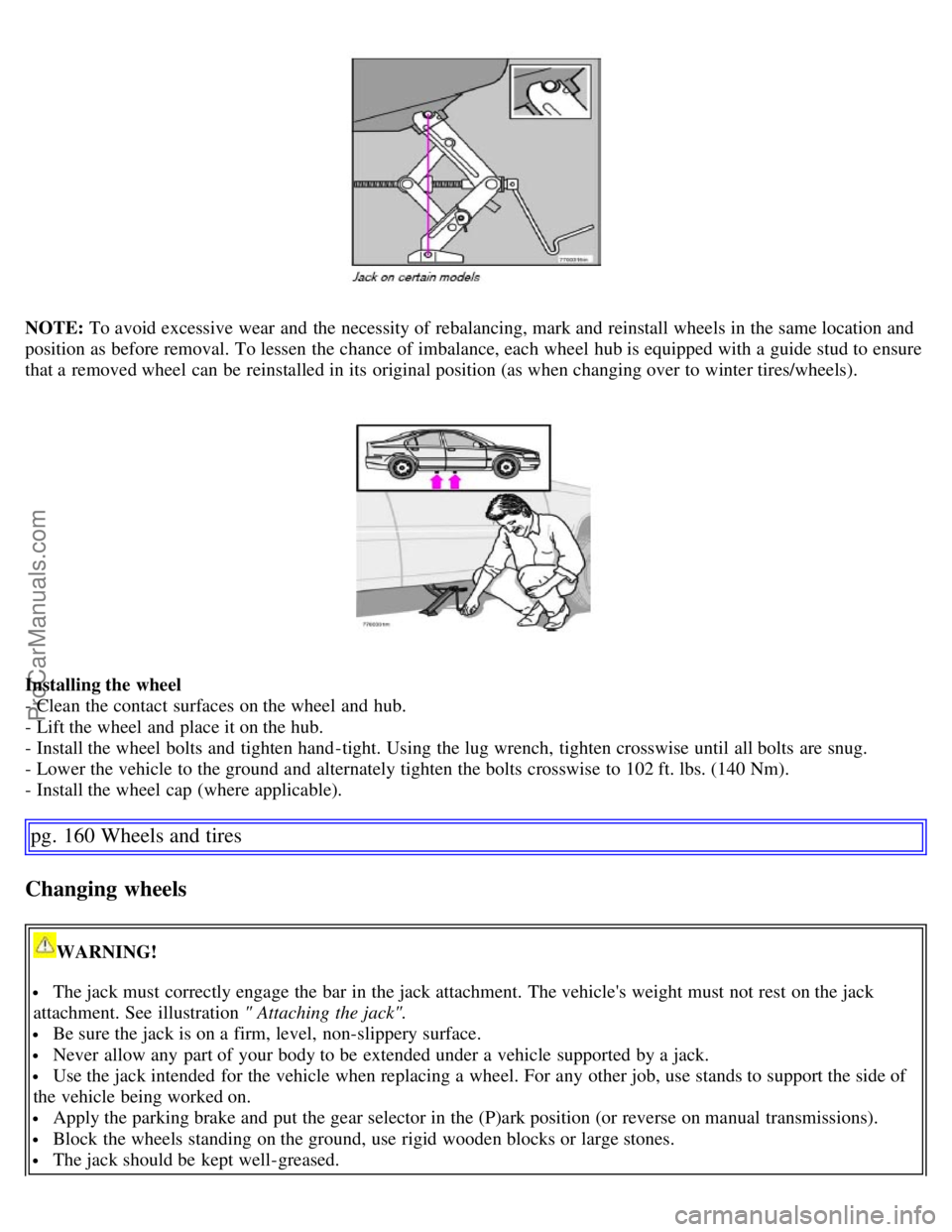
NOTE: To avoid excessive wear and the necessity of rebalancing, mark and reinstall wheels in the same location and
position as before removal. To lessen the chance of imbalance, each wheel hub is equipped with a guide stud to ensure
that a removed wheel can be reinstalled in its original position (as when changing over to winter tires/wheels).
Installing the wheel
- Clean the contact surfaces on the wheel and hub.
- Lift the wheel and place it on the hub.
- Install the wheel bolts and tighten hand -tight. Using the lug wrench, tighten crosswise until all bolts are snug.
- Lower the vehicle to the ground and alternately tighten the bolts crosswise to 102 ft. lbs. (140 Nm).
- Install the wheel cap (where applicable).
pg. 160 Wheels and tires
Changing wheels
WARNING!
The jack must correctly engage the bar in the jack attachment. The vehicle's weight must not rest on the jack
attachment. See illustration " Attaching the jack".
Be sure the jack is on a firm, level, non-slippery surface.
Never allow any part of your body to be extended under a vehicle supported by a jack.
Use the jack intended for the vehicle when replacing a wheel. For any other job, use stands to support the side of
the vehicle being worked on.
Apply the parking brake and put the gear selector in the (P)ark position (or reverse on manual transmissions).
Block the wheels standing on the ground, use rigid wooden blocks or large stones.
The jack should be kept well-greased.
ProCarManuals.com
Page 145 of 200
Battery
Ensure that the battery cables are correctly connected and tightened.
Never disconnect the battery when the engine is running (e.g. when replacing the battery).
Never use a fast charger to charge the battery. The battery cables should be disconnected when recharging.
The battery contains acid that is both corrosive and poisonous. It is important that the battery is handled in an
environmentally friendly way. Let your Volvo dealer assist you.
Hoisting the vehicle
If a garage jack is used to lift the vehicle, the two jack attachments points should be used. They are specially
reinforced to bear the weight of the vehicle. A garage jack can also be placed under the front of the engine support
frame. Take care not to damage the splash guard under the engine. Ensure that the jack is positioned so that the vehicle
cannot slide off it. Always use axle stands or similar structures.
If a two-post hoist is used to lift the vehicle, the front and rear lift arm pads should be centered under the reinforced
lift plates on the inboard edge of the sill rail (see illustration).
pg. 172 Maintenance and servicing
Working on your vehicle
WARNING!
The vehicle ignition system has very high voltage!
The voltage in the ignition system is dangerous!
Do not touch spark plugs, ignition cables or the ignition coil when the engine is running or the ignition is switched
on!
The ignition should be switched off when:
Conducting engine tests.
Replacing parts in the ignition system, such as spark plugs, ignition coil, distributor, ignition cables, etc.
WARNING!
Never try to repair any part of the SRS or SIPS bag systems yourself. Any interference in the system could cause
malfunction and serious injury. Any work should only be performed by an authorized Volvo workshop.
Belt check
Check the belt regularly to make sure it is in good condition and is clean. A worn or dirty belt can cause poor cooling
and low alternator output as well as impair the operation of the power steering and the air conditioning unit.
NOTE: The drive belt is equipped with a self -tensioning mechanism and requires no adjustment between changes.
WARNING!
The engine must not be running when this check is performed.
Check coolant level
The cooling system must be filled with coolant and not leak to operate at maximum efficiency. Check the coolant level
regularly. The level should be between the "MAX" and "MIN" marks on the expansion tank. The check should be
ProCarManuals.com
Page 147 of 200
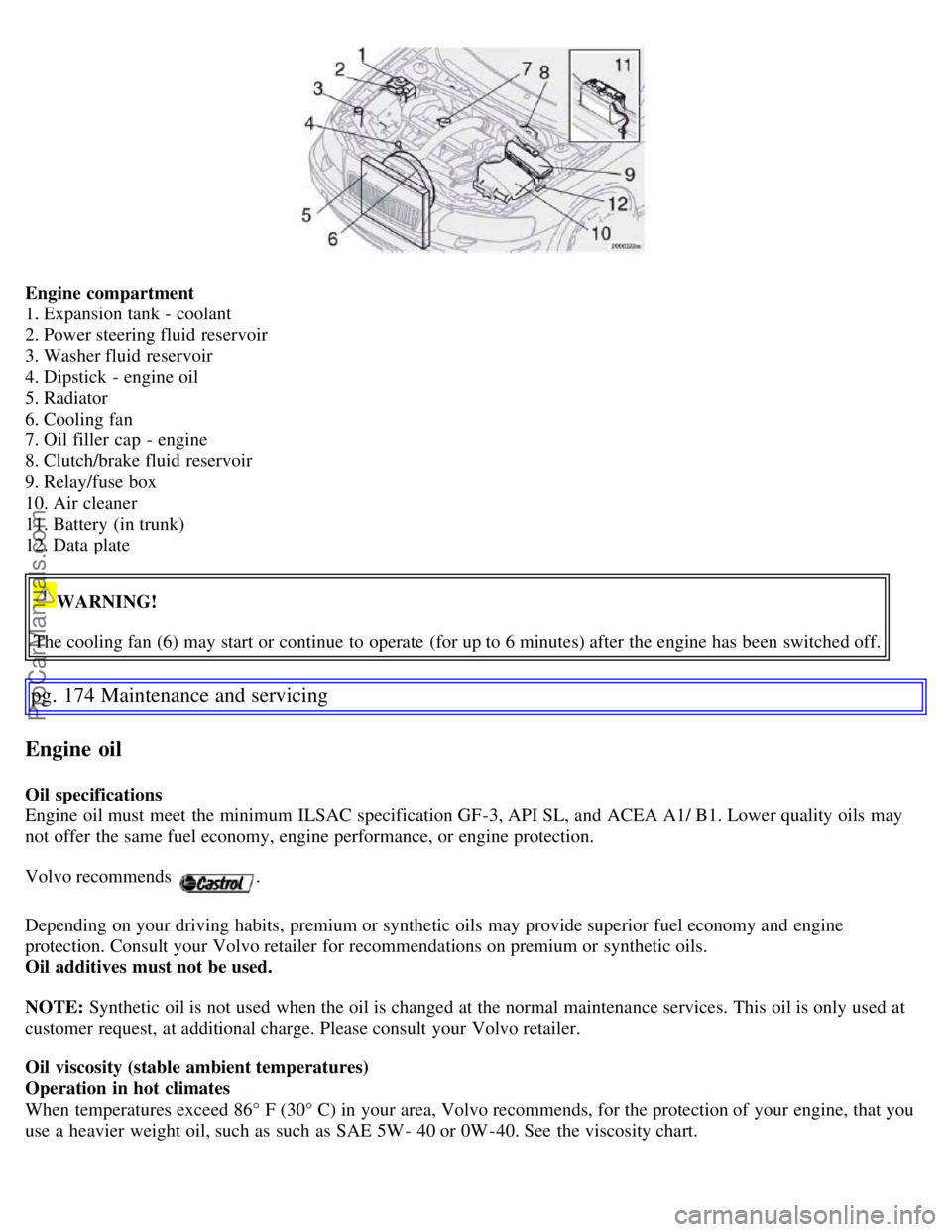
Engine compartment
1. Expansion tank - coolant
2. Power steering fluid reservoir
3. Washer fluid reservoir
4. Dipstick - engine oil
5. Radiator
6. Cooling fan
7. Oil filler cap - engine
8. Clutch/brake fluid reservoir
9. Relay/fuse box
10. Air cleaner
11. Battery (in trunk)
12. Data plate
WARNING!
The cooling fan (6) may start or continue to operate (for up to 6 minutes) after the engine has been switched off.
pg. 174 Maintenance and servicing
Engine oil
Oil specifications
Engine oil must meet the minimum ILSAC specification GF-3, API SL, and ACEA A1/ B1. Lower quality oils may
not offer the same fuel economy, engine performance, or engine protection.
Volvo recommends
.
Depending on your driving habits, premium or synthetic oils may provide superior fuel economy and engine
protection. Consult your Volvo retailer for recommendations on premium or synthetic oils.
Oil additives must not be used.
NOTE: Synthetic oil is not used when the oil is changed at the normal maintenance services. This oil is only used at
customer request, at additional charge. Please consult your Volvo retailer.
Oil viscosity (stable ambient temperatures)
Operation in hot climates
When temperatures exceed 86° F (30° C) in your area, Volvo recommends, for the protection of your engine, that you
use a heavier weight oil, such as such as SAE 5W - 40 or 0W -40. See the viscosity chart.
ProCarManuals.com
Page 170 of 200
2 0 0 7
VOLVO S60
Specifications
pg. 197 Specifications
Label information 198
Dimensions and weights200
Capacities202
Engine oil203
Fluids and cooling system204
Three way catalytic converter205
Suspension206
Electrical system207
Engine specifications209
Volvo programs210
All specifications are subject to change without prior notice.
pg. 198 Specifications
Label information
pg. 199 Specifications
ProCarManuals.com
Page 171 of 200

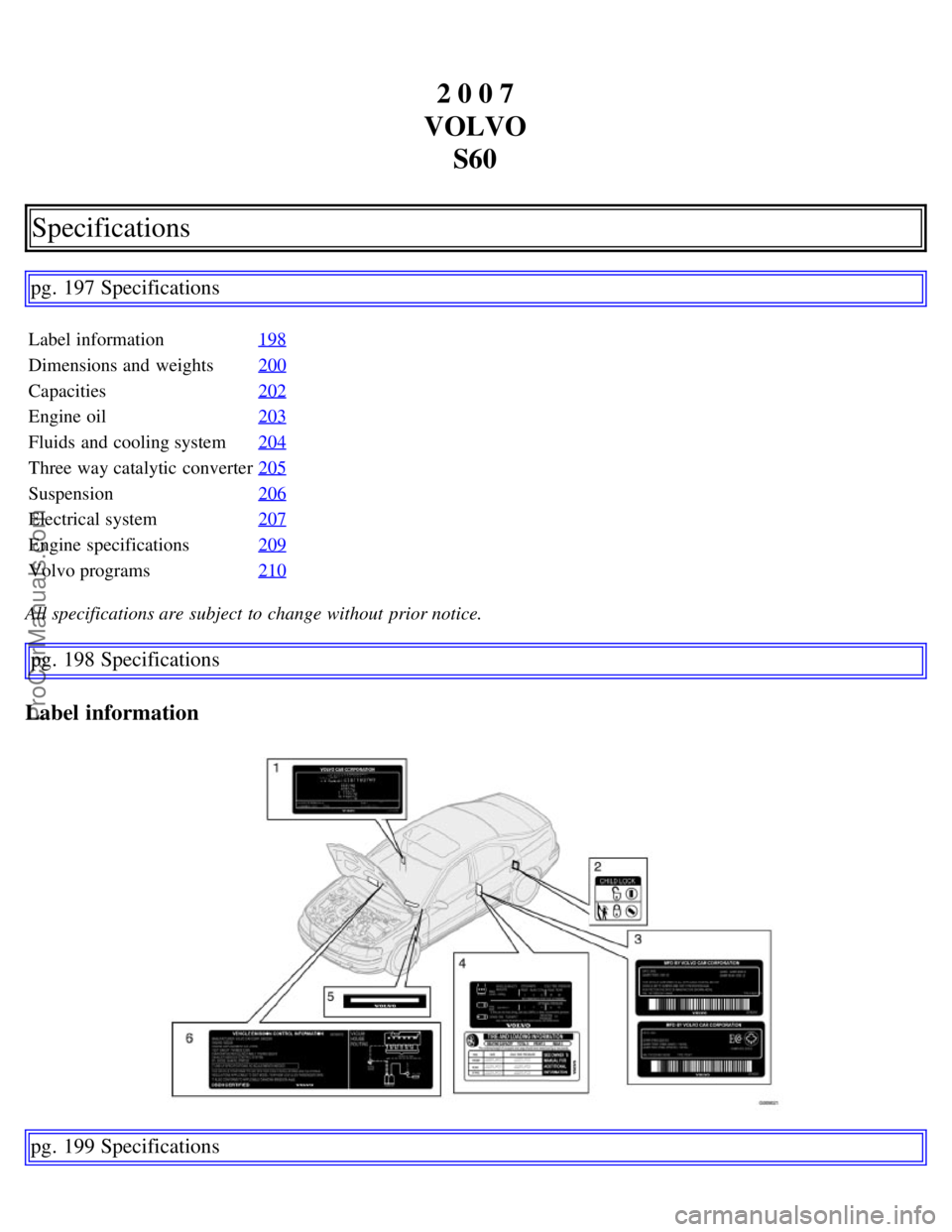
Label information
1. Model plate
Vehicle Identification Number (VIN). Codes for color and upholstery, etc.
2. Child safety lock labels
1
3. Federal Motor Vehicle Safety Standards (FMVSS) specifications (USA) and Ministry of Transport (CMVSS)
standards (Canada)
Your Volvo is designed to meet all applicable safety standards, as evidenced by the certification label on the facing
side of the driver's door. For further information regarding these regulations, please consult your Volvo retailer.
4. Loads and Tire Pressures
The appearance of the decal will vary, depending on the market for which the vehicle is intended.
Canadian models: upper decal
U.S. models: lower decal
5. Vehicle Identification Number (VIN)
The VIN plate is located on the top left surface of the dashboard. The VIN is also stamped on the right hand door
pillar.
The Vehicle Identification Number (VIN) should always be quoted in all correspondence concerning your vehicle with
the retailer and when ordering parts.
6. Vehicle Emission Control Information/ Vacuum hose routing
Your Volvo is designed to meet all applicable emission standards, as evidenced by the certification label on the
underside of the hood. For further information regarding these regulations, please consult your Volvo retailer.
1. Not on vehicles equipped with the optional power child safety locks.
pg. 200 Specifications
Dimensions and weights
Dimensions Length 180 in. (458 cm)
S60R - 181.7 in. (462 cm)
Width 71 in. (180 cm)
S60R - 71 in. (180 cm)
Height 56.2 in. (143 cm)
S60R - 55.7 in. (142 cm)
Wheelbase 107 in. (272 cm)
Front track 61.5 in. (156 cm)
Rear track 61.4 in. (156 cm)
Turning circle 35.4-38.7 ft.
(10.8-11.8 m)
S60R: 42.7 ft (13 m)
Cargo capacity, trunk SAE V1 - 13.9 (394)
Max. loads
ProCarManuals.com
Page 172 of 200
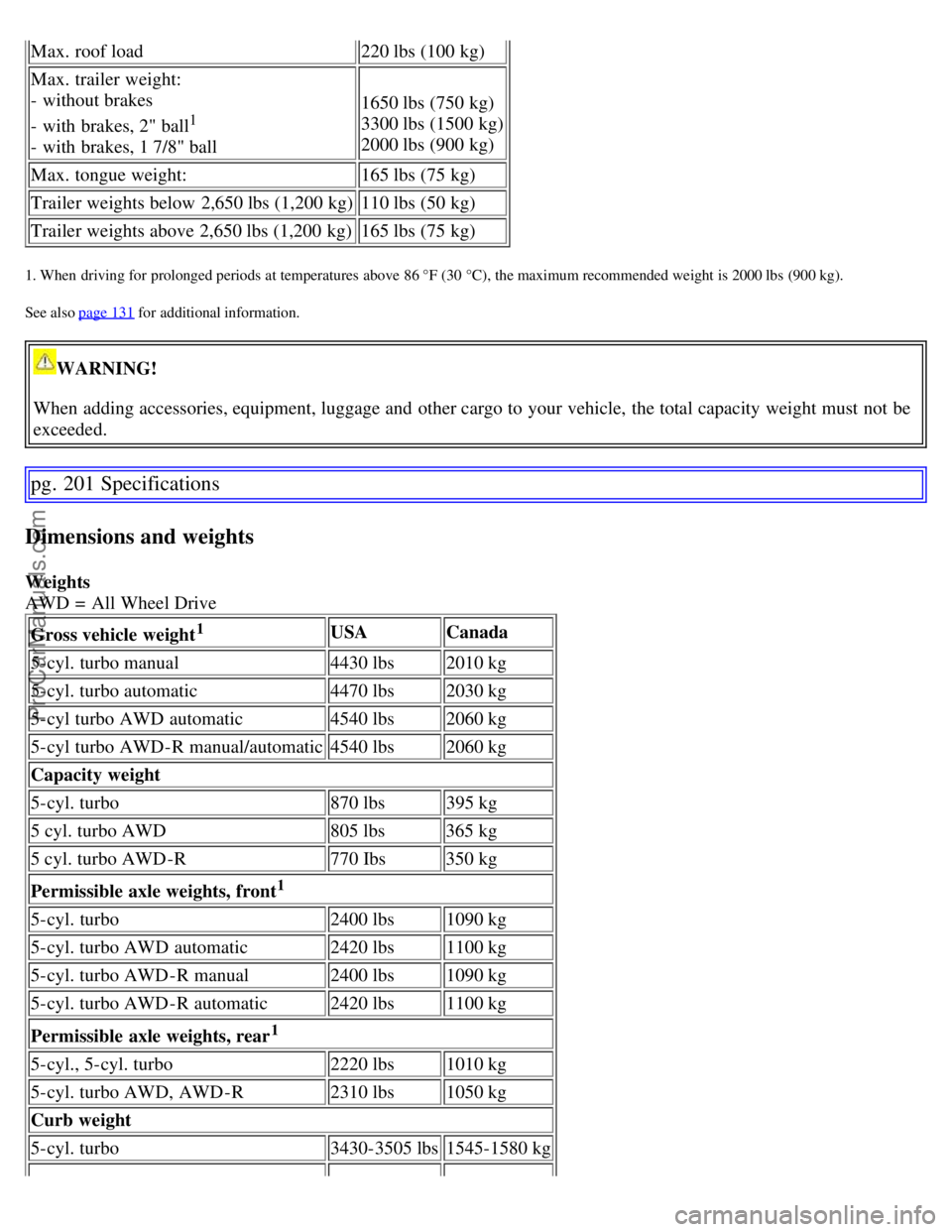
Max. roof load220 lbs (100 kg)
Max. trailer weight:
- without brakes
- with brakes, 2" ball
1
- with brakes, 1 7/8" ball1650 lbs (750 kg)
3300 lbs (1500 kg)
2000 lbs (900 kg)
Max. tongue weight: 165 lbs (75 kg)
Trailer weights below 2,650 lbs (1,200 kg) 110 lbs (50 kg)
Trailer weights above 2,650 lbs (1,200 kg) 165 lbs (75 kg)
1. When driving for prolonged periods at temperatures above 86 °F (30 °C), the maximum recommended weight is 2000 lbs (900 kg).
See also page 131
for additional information.
WARNING!
When adding accessories, equipment, luggage and other cargo to your vehicle, the total capacity weight must not be
exceeded.
pg. 201 Specifications
Dimensions and weights
Weights
AWD = All Wheel Drive Gross vehicle weight
1USA Canada
5-cyl. turbo manual 4430 lbs2010 kg
5-cyl. turbo automatic 4470 lbs2030 kg
5-cyl turbo AWD automatic 4540 lbs2060 kg
5-cyl turbo AWD-R manual/automatic 4540 lbs2060 kg
Capacity weight
5-cyl. turbo 870 lbs395 kg
5 cyl. turbo AWD 805 lbs365 kg
5 cyl. turbo AWD-R 770 Ibs350 kg
Permissible axle weights, front
1
5-cyl. turbo 2400 lbs1090 kg
5-cyl. turbo AWD automatic 2420 lbs1100 kg
5-cyl. turbo AWD-R manual 2400 lbs1090 kg
5-cyl. turbo AWD-R automatic 2420 lbs1100 kg
Permissible axle weights, rear
1
5-cyl., 5-cyl. turbo 2220 lbs1010 kg
5-cyl. turbo AWD, AWD-R 2310 lbs1050 kg
Curb weight
5-cyl. turbo 3430-3505 lbs1545-1580 kg
ProCarManuals.com
Page 173 of 200
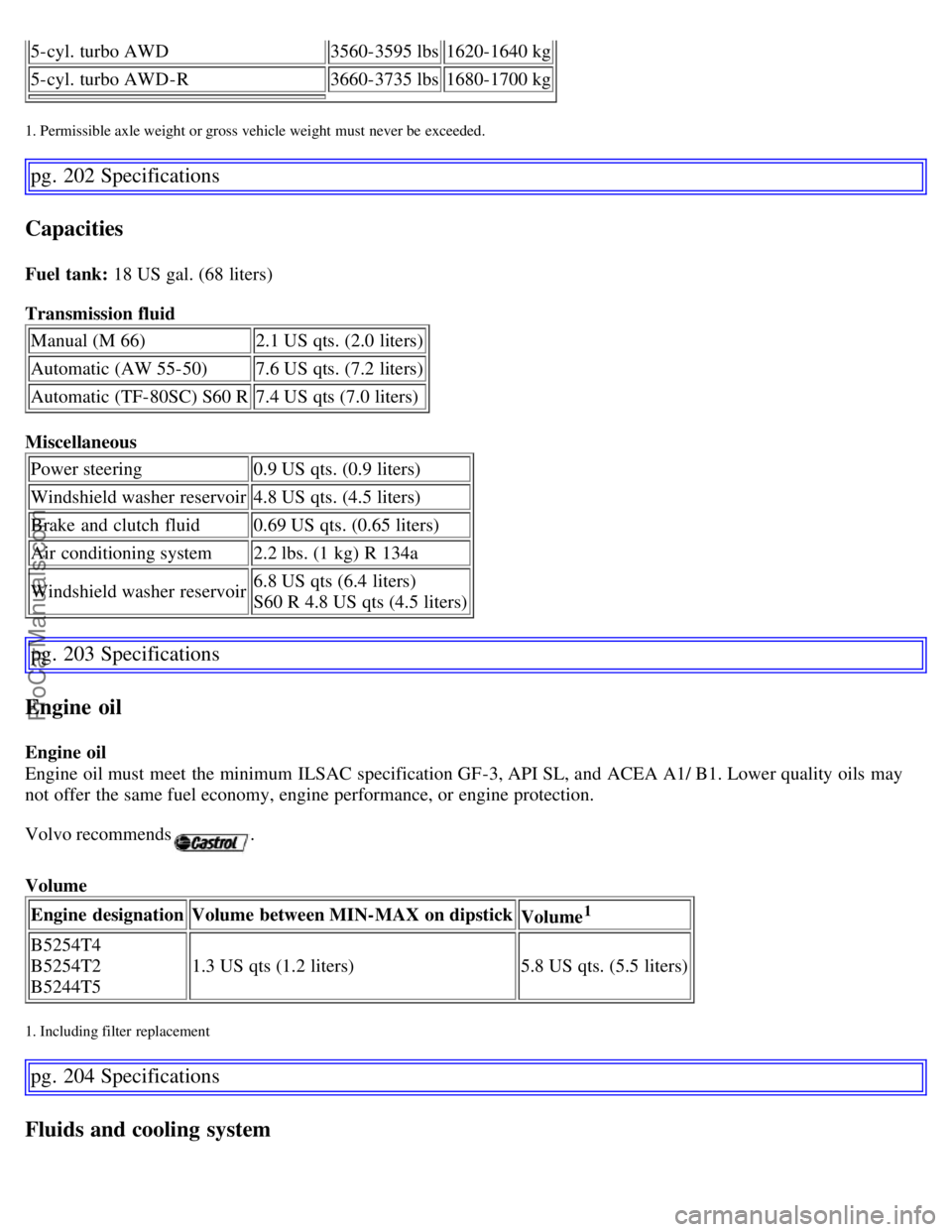
5-cyl. turbo AWD3560-3595 lbs1620-1640 kg
5-cyl. turbo AWD-R 3660-3735 lbs1680-1700 kg
1. Permissible axle weight or gross vehicle weight must never be exceeded.
pg. 202 Specifications
Capacities
Fuel tank: 18 US gal. (68 liters)
Transmission fluid
Manual (M 66) 2.1 US qts. (2.0 liters)
Automatic (AW 55-50) 7.6 US qts. (7.2 liters)
Automatic (TF-80SC) S60 R 7.4 US qts (7.0 liters)
Miscellaneous Power steering 0.9 US qts. (0.9 liters)
Windshield washer reservoir 4.8 US qts. (4.5 liters)
Brake and clutch fluid 0.69 US qts. (0.65 liters)
Air conditioning system 2.2 lbs. (1 kg) R 134a
Windshield washer reservoir 6.8 US qts (6.4 liters)
S60 R 4.8 US qts (4.5 liters)
pg. 203 Specifications
Engine oil
Engine oil
Engine oil must meet the minimum ILSAC specification GF-3, API SL, and ACEA A1/ B1. Lower quality oils may
not offer the same fuel economy, engine performance, or engine protection.
Volvo recommends
.
Volume Engine designation Volume between MIN-MAX on dipstick
Volume
1
B5254T4
B5254T2
B5244T51.3 US qts (1.2 liters)
5.8 US qts. (5.5 liters)
1. Including filter replacement
pg. 204 Specifications
Fluids and cooling system
ProCarManuals.com
Page 195 of 200
C
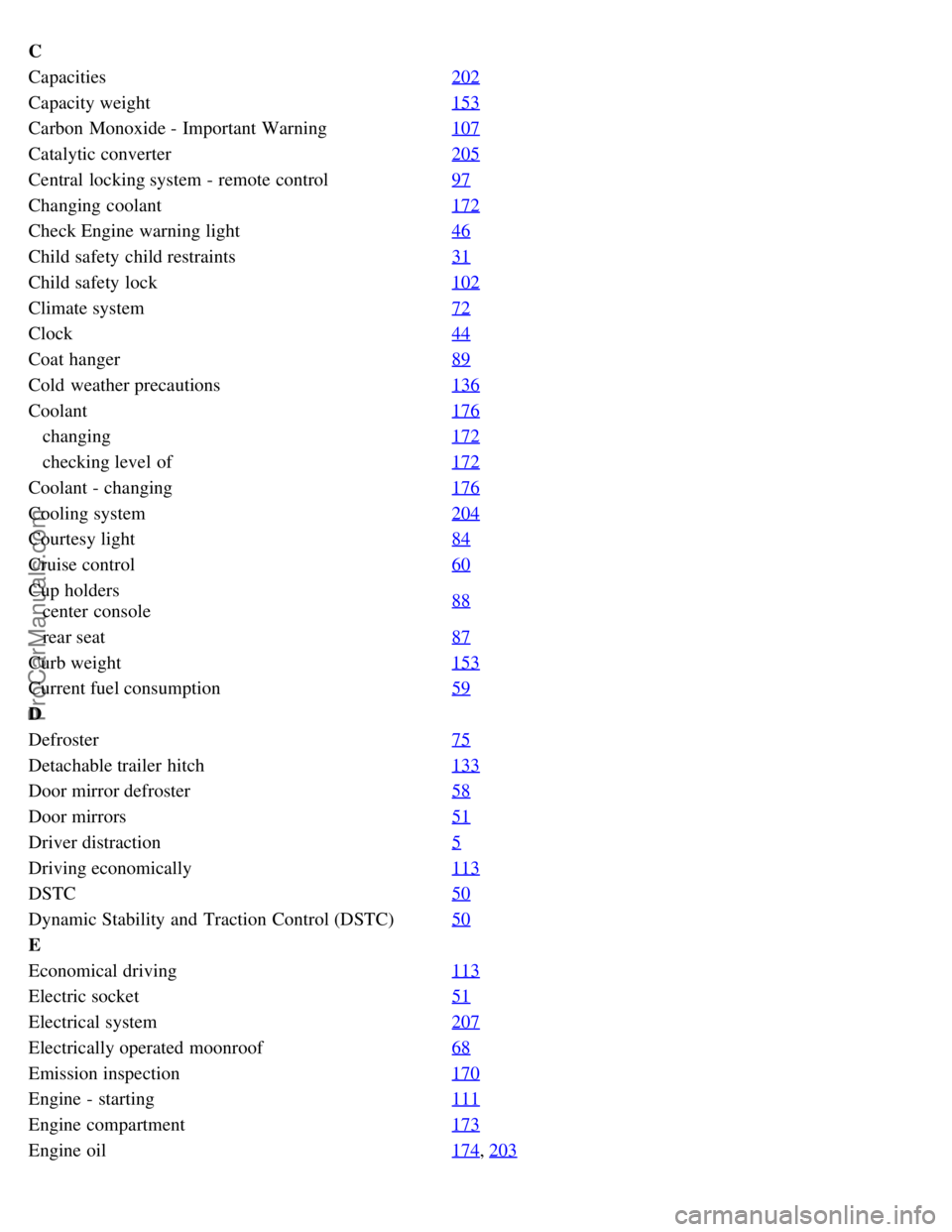
Capacities202
Capacity weight153
Carbon Monoxide - Important Warning107
Catalytic converter205
Central locking system - remote control97
Changing coolant172
Check Engine warning light46
Child safety child restraints31
Child safety lock102
Climate system72
Clock44
Coat hanger89
Cold weather precautions136
Coolant176
changing172
checking level of172
Coolant - changing176
Cooling system204
Courtesy light84
Cruise control60
Cup holders
center console88
rear seat
87
Curb weight153
Current fuel consumption59
D
Defroster75
Detachable trailer hitch133
Door mirror defroster58
Door mirrors51
Driver distraction5
Driving economically113
DSTC50
Dynamic Stability and Traction Control (DSTC)50
E
Economical driving113
Electric socket51
Electrical system207
Electrically operated moonroof68
Emission inspection170
Engine - starting111
Engine compartment173
Engine oil174, 203
ProCarManuals.com
Page 196 of 200
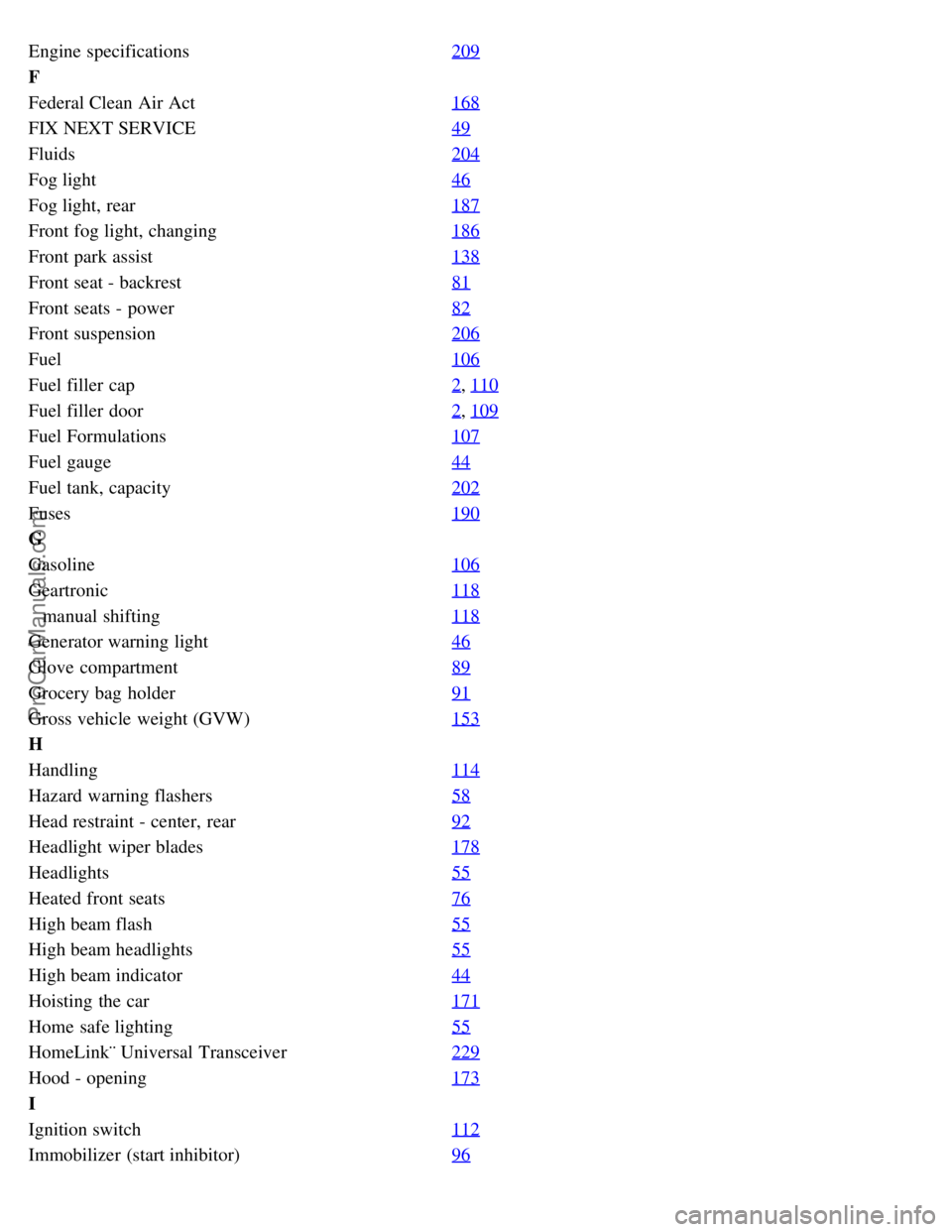
Engine specifications209
F
Federal Clean Air Act168
FIX NEXT SERVICE49
Fluids204
Fog light46
Fog light, rear187
Front fog light, changing186
Front park assist138
Front seat - backrest81
Front seats - power82
Front suspension206
Fuel106
Fuel filler cap2, 110
Fuel filler door2, 109
Fuel Formulations107
Fuel gauge44
Fuel tank, capacity202
Fuses190
G
Gasoline106
Geartronic118
manual shifting118
Generator warning light46
Glove compartment89
Grocery bag holder91
Gross vehicle weight (GVW)153
H
Handling114
Hazard warning flashers58
Head restraint - center, rear92
Headlight wiper blades178
Headlights55
Heated front seats76
High beam flash55
High beam headlights55
High beam indicator44
Hoisting the car171
Home safe lighting55
HomeLink¨ Universal Transceiver229
Hood - opening173
I
Ignition switch112
Immobilizer (start inhibitor)96
ProCarManuals.com