ignition VOLVO S60 2007 Owner's Guide
[x] Cancel search | Manufacturer: VOLVO, Model Year: 2007, Model line: S60, Model: VOLVO S60 2007Pages: 200, PDF Size: 4.03 MB
Page 97 of 200
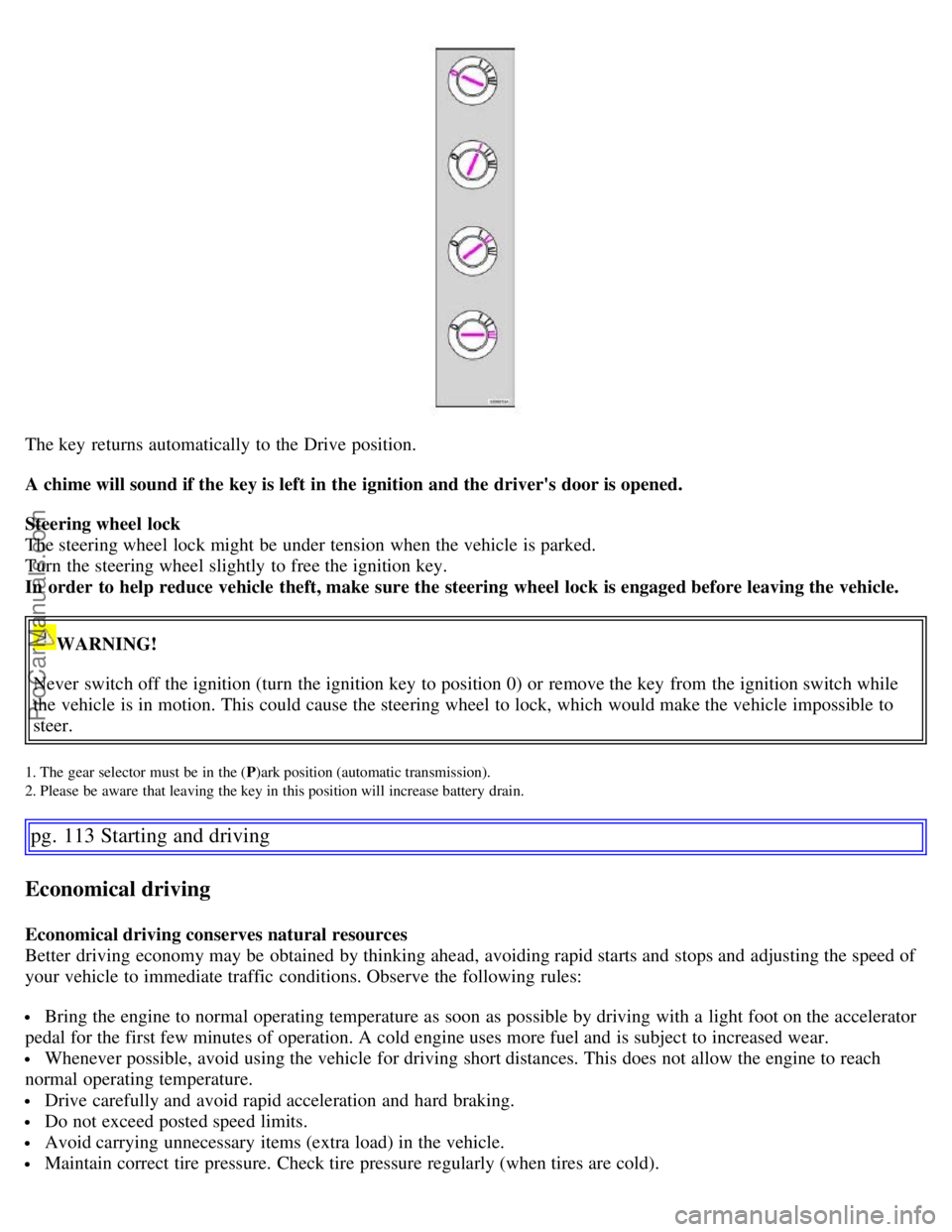
The key returns automatically to the Drive position.
A chime will sound if the key is left in the ignition and the driver's door is opened.
Steering wheel lock
The steering wheel lock might be under tension when the vehicle is parked.
Turn the steering wheel slightly to free the ignition key.
In order to help reduce vehicle theft, make sure the steering wheel lock is engaged before leaving the vehicle.
WARNING!
Never switch off the ignition (turn the ignition key to position 0) or remove the key from the ignition switch while
the vehicle is in motion. This could cause the steering wheel to lock, which would make the vehicle impossible to
steer.
1. The gear selector must be in the ( P)ark position (automatic transmission).
2. Please be aware that leaving the key in this position will increase battery drain.
pg. 113 Starting and driving
Economical driving
Economical driving conserves natural resources
Better driving economy may be obtained by thinking ahead, avoiding rapid starts and stops and adjusting the speed of
your vehicle to immediate traffic conditions. Observe the following rules:
Bring the engine to normal operating temperature as soon as possible by driving with a light foot on the accelerator
pedal for the first few minutes of operation. A cold engine uses more fuel and is subject to increased wear.
Whenever possible, avoid using the vehicle for driving short distances. This does not allow the engine to reach
normal operating temperature.
Drive carefully and avoid rapid acceleration and hard braking.
Do not exceed posted speed limits.
Avoid carrying unnecessary items (extra load) in the vehicle.
Maintain correct tire pressure. Check tire pressure regularly (when tires are cold).
ProCarManuals.com
Page 100 of 200
pg. 116 Starting and driving
Automatic transmission (option)
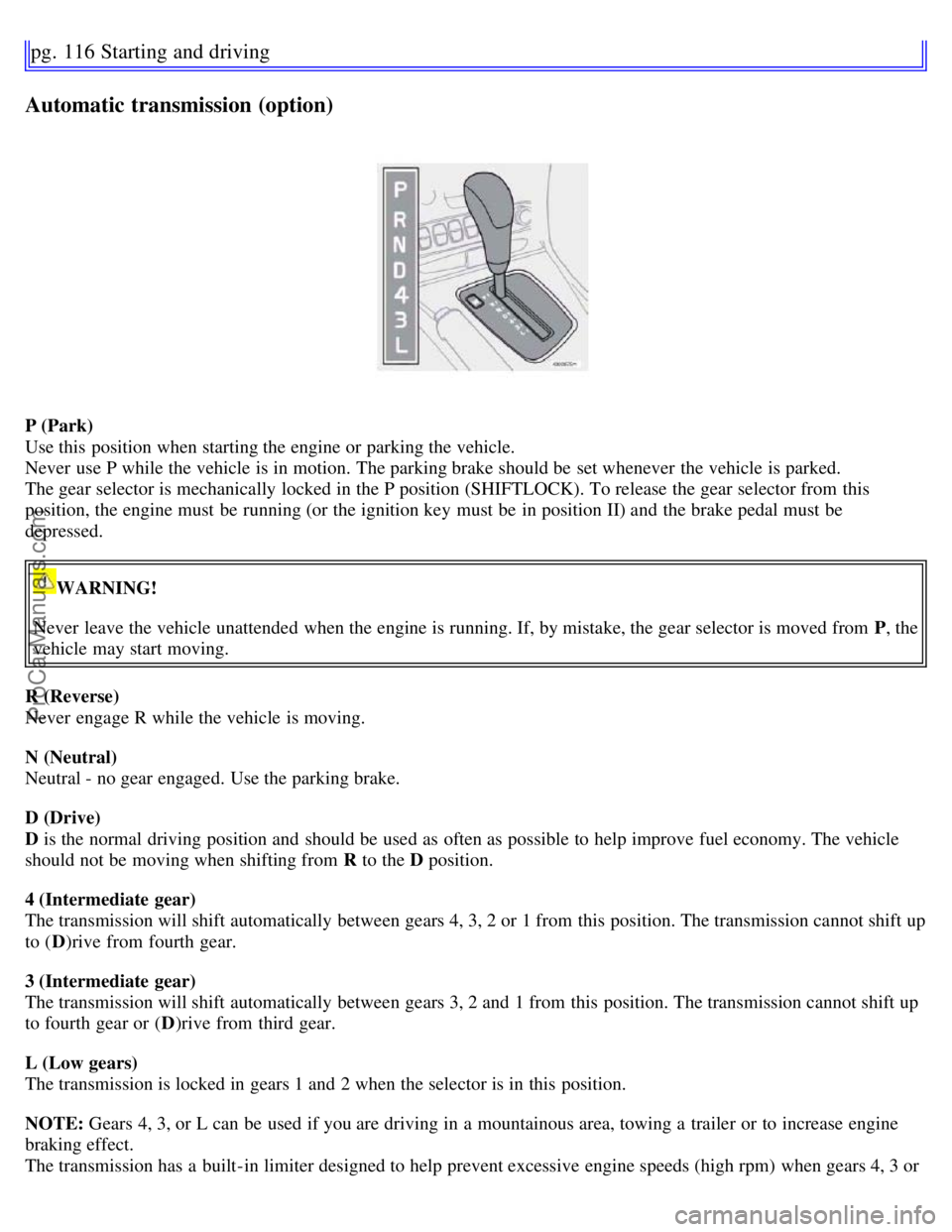
P (Park)
Use this position when starting the engine or parking the vehicle.
Never use P while the vehicle is in motion. The parking brake should be set whenever the vehicle is parked.
The gear selector is mechanically locked in the P position (SHIFTLOCK). To release the gear selector from this
position, the engine must be running (or the ignition key must be in position II) and the brake pedal must be
depressed.
WARNING!
Never leave the vehicle unattended when the engine is running. If, by mistake, the gear selector is moved from P , the
vehicle may start moving.
R (Reverse)
Never engage R while the vehicle is moving.
N (Neutral)
Neutral - no gear engaged. Use the parking brake.
D (Drive)
D is the normal driving position and should be used as often as possible to help improve fuel economy. The vehicle
should not be moving when shifting from R to the D position.
4 (Intermediate gear)
The transmission will shift automatically between gears 4, 3, 2 or 1 from this position. The transmission cannot shift up
to ( D)rive from fourth gear.
3 (Intermediate gear)
The transmission will shift automatically between gears 3, 2 and 1 from this position. The transmission cannot shift up
to fourth gear or ( D)rive from third gear.
L (Low gears)
The transmission is locked in gears 1 and 2 when the selector is in this position.
NOTE: Gears 4, 3, or L can be used if you are driving in a mountainous area, towing a trailer or to increase engine
braking effect.
The transmission has a built-in limiter designed to help prevent excessive engine speeds (high rpm) when gears 4, 3 or
ProCarManuals.com
Page 102 of 200
higher engine speeds to heat the three-way catalytic converter as quickly as possible.
Automatic transmission - adaptive system
The automatic transmission is controlled by an adaptive control system that constantly monitors the way in which the
transmission functions. It senses and adapts each gear shift for optimal performance.
pg. 118 Starting and driving
Geartronic (option)
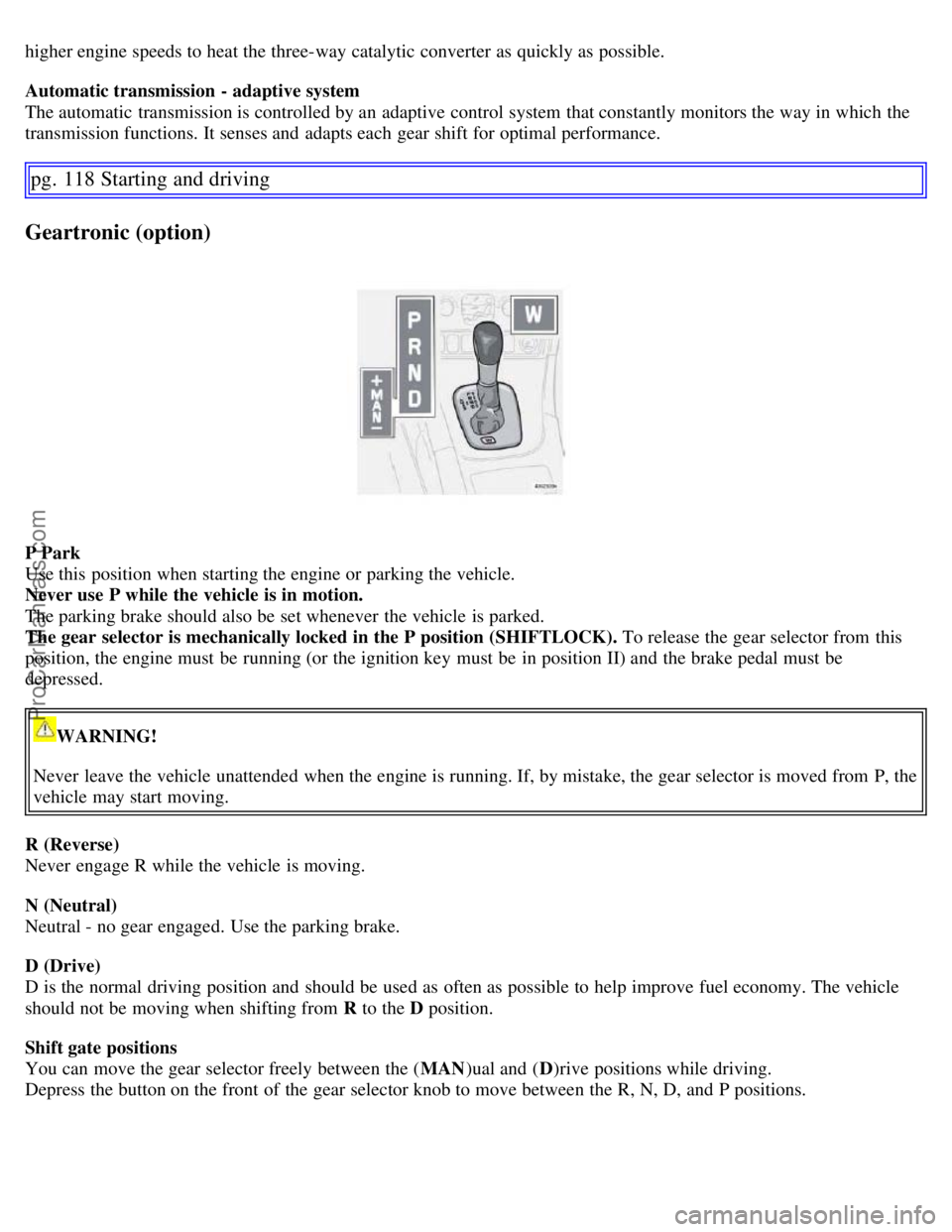
P Park
Use this position when starting the engine or parking the vehicle.
Never use P while the vehicle is in motion.
The parking brake should also be set whenever the vehicle is parked.
The gear selector is mechanically locked in the P position (SHIFTLOCK). To release the gear selector from this
position, the engine must be running (or the ignition key must be in position II) and the brake pedal must be
depressed.
WARNING!
Never leave the vehicle unattended when the engine is running. If, by mistake, the gear selector is moved from P, the
vehicle may start moving.
R (Reverse)
Never engage R while the vehicle is moving.
N (Neutral)
Neutral - no gear engaged. Use the parking brake.
D (Drive)
D is the normal driving position and should be used as often as possible to help improve fuel economy. The vehicle
should not be moving when shifting from R to the D position.
Shift gate positions
You can move the gear selector freely between the ( MAN)ual and ( D)rive positions while driving.
Depress the button on the front of the gear selector knob to move between the R, N, D, and P positions.
ProCarManuals.com
Page 109 of 200
Stability system
Active Yaw Control (AYC) - DSTC only
This function helps maintain directional stability, for example when cornering, by braking one or more of the wheels if
the vehicle shows a tendency to skid or slide laterally.
R-models only
The AYC function can be deactivated. This is done by pressing the DSTC button on the center control panel (see the
illustration on page 50) for approximately one second. This procedure must be repeated 5 times, after which "DSTC
REDUCED FUNCTION" will be displayed in the text window. AYC will be automatically reactivated the next time
the ignition is switched on.
The indicator light in the DSTC button will be off.
WARNING!
The car's handling and stability characteristics will be altered if the STC or DSTC system functions have been
disabled.
STC/DSTC-related messages in the text window
"TRACTION CONTROL TEMPORARILY OFF" - The system has been temporarily switched off due to high brake
temperature and will automatically switch on again when the brakes have cooled.
"ANTI SKID SERVICE REQUIRED" - the system has been automatically disengaged due to a fault. An authorized
Volvo retailer should check the system.
Symbols in the instrument panel
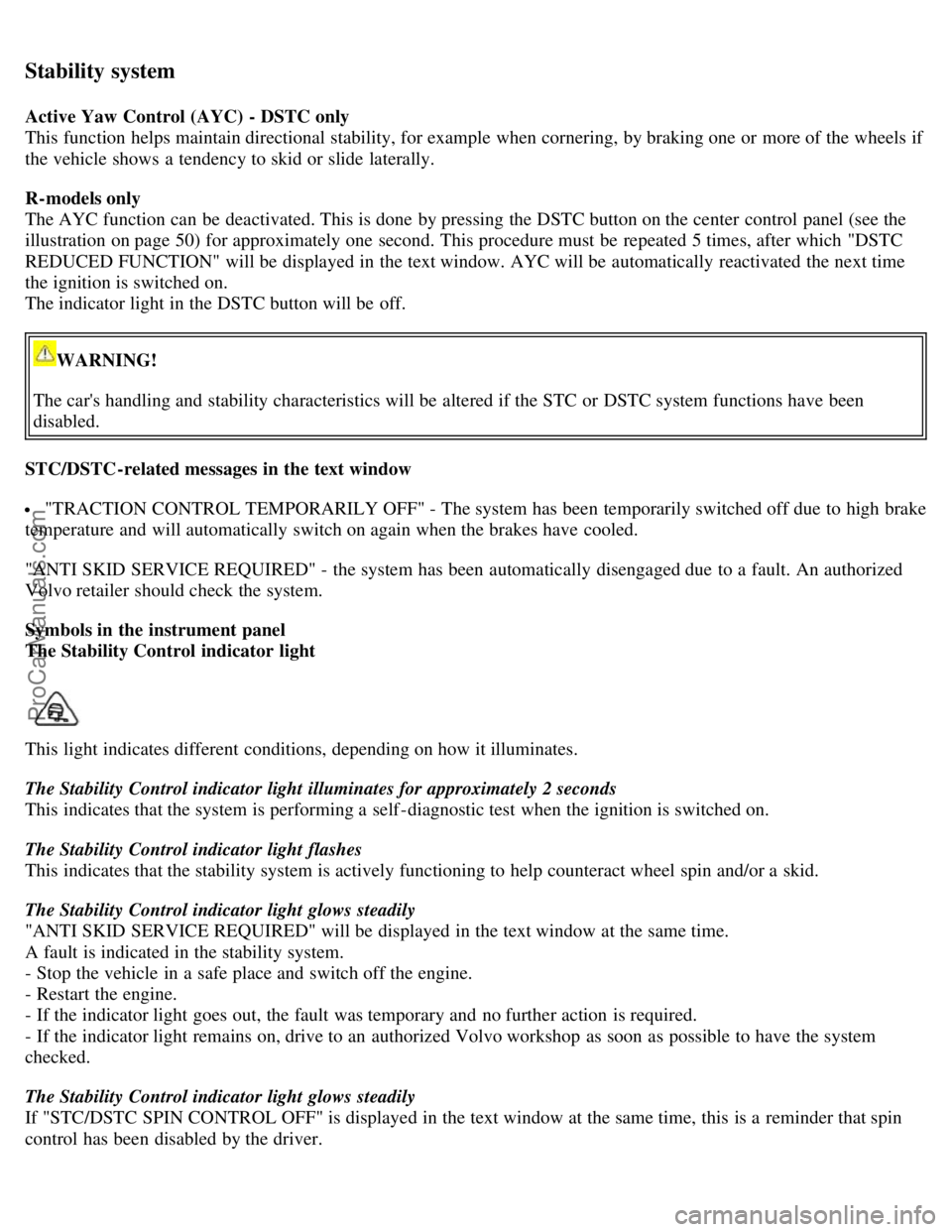
The Stability Control indicator light
This light indicates different conditions, depending on how it illuminates.
The Stability Control indicator light illuminates for approximately 2 seconds
This indicates that the system is performing a self -diagnostic test when the ignition is switched on.
The Stability Control indicator light flashes
This indicates that the stability system is actively functioning to help counteract wheel spin and/or a skid.
The Stability Control indicator light glows steadily
"ANTI SKID SERVICE REQUIRED" will be displayed in the text window at the same time.
A fault is indicated in the stability system.
- Stop the vehicle in a safe place and switch off the engine.
- Restart the engine.
- If the indicator light goes out, the fault was temporary and no further action is required.
- If the indicator light remains on, drive to an authorized Volvo workshop as soon as possible to have the system
checked.
The Stability Control indicator light glows steadily
If "STC/DSTC SPIN CONTROL OFF" is displayed in the text window at the same time, this is a reminder that spin
control has been disabled by the driver.
ProCarManuals.com
Page 111 of 200
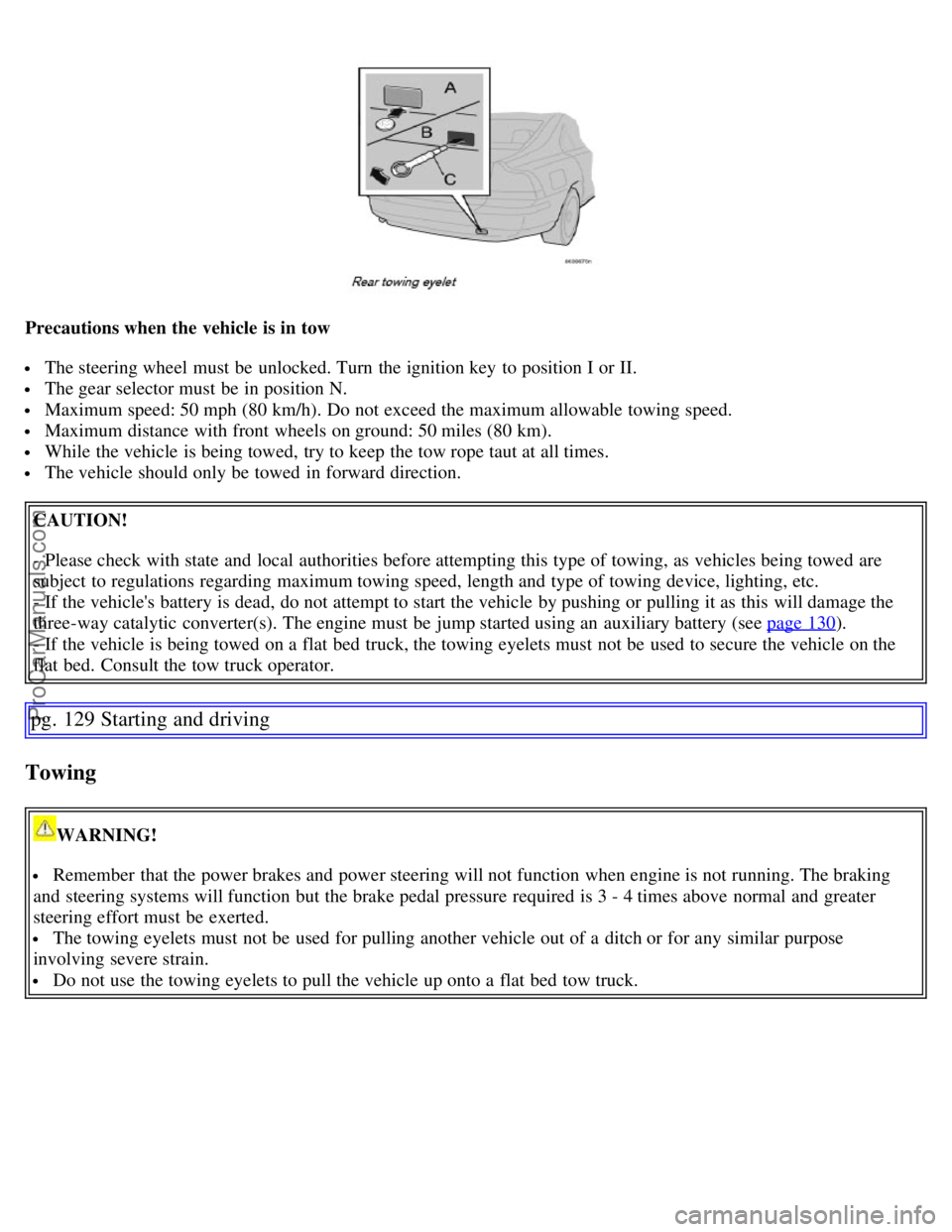
Precautions when the vehicle is in tow
The steering wheel must be unlocked. Turn the ignition key to position I or II.
The gear selector must be in position N.
Maximum speed: 50 mph (80 km/h). Do not exceed the maximum allowable towing speed.
Maximum distance with front wheels on ground: 50 miles (80 km).
While the vehicle is being towed, try to keep the tow rope taut at all times.
The vehicle should only be towed in forward direction.
CAUTION!
- Please check with state and local authorities before attempting this type of towing, as vehicles being towed are
subject to regulations regarding maximum towing speed, length and type of towing device, lighting, etc.
- If the vehicle's battery is dead, do not attempt to start the vehicle by pushing or pulling it as this will damage the
three-way catalytic converter(s). The engine must be jump started using an auxiliary battery (see page 130
).
- If the vehicle is being towed on a flat bed truck, the towing eyelets must not be used to secure the vehicle on the
flat bed. Consult the tow truck operator.
pg. 129 Starting and driving
Towing
WARNING!
Remember that the power brakes and power steering will not function when engine is not running. The braking
and steering systems will function but the brake pedal pressure required is 3 - 4 times above normal and greater
steering effort must be exerted.
The towing eyelets must not be used for pulling another vehicle out of a ditch or for any similar purpose
involving severe strain.
Do not use the towing eyelets to pull the vehicle up onto a flat bed tow truck.
ProCarManuals.com
Page 113 of 200
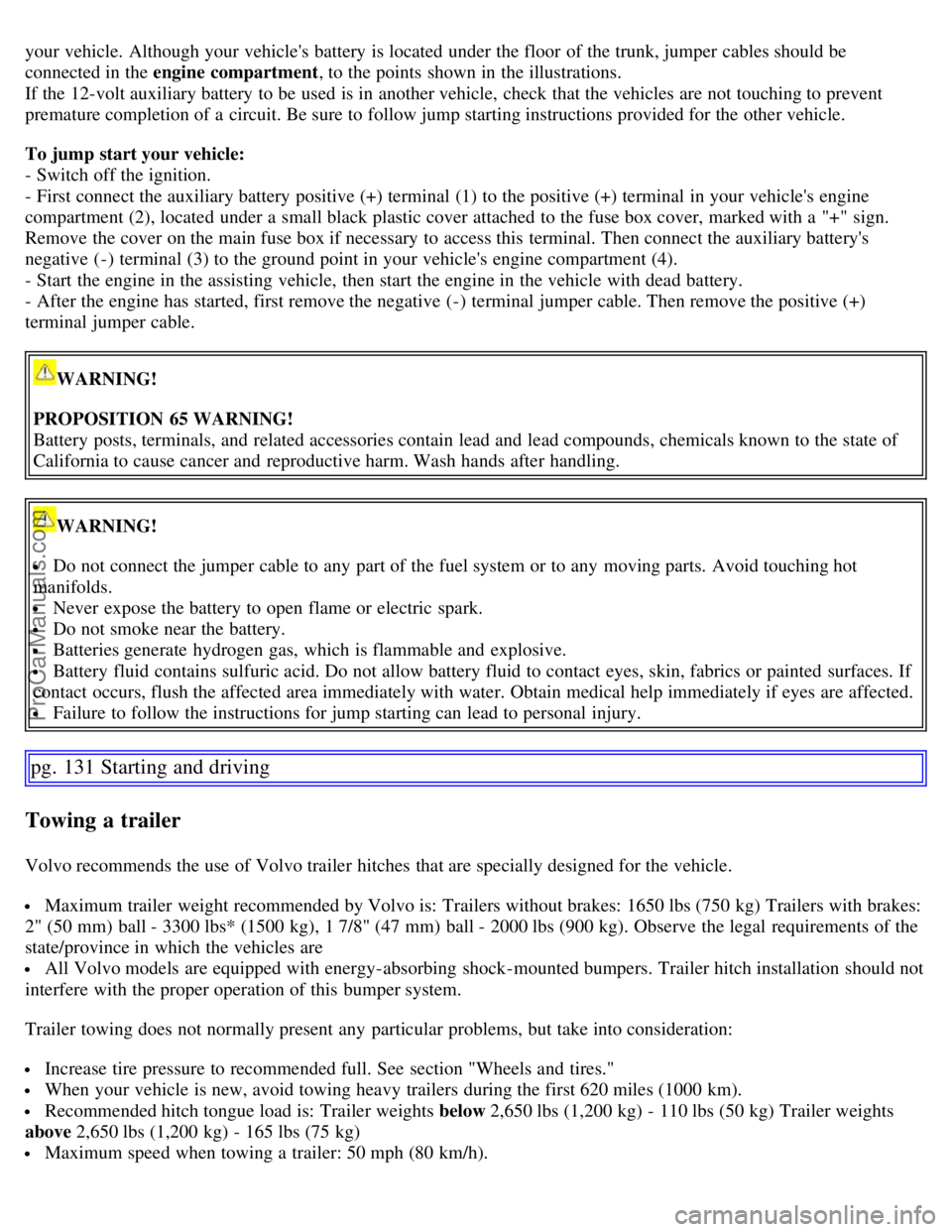
your vehicle. Although your vehicle's battery is located under the floor of the trunk, jumper cables should be
connected in the engine compartment, to the points shown in the illustrations.
If the 12-volt auxiliary battery to be used is in another vehicle, check that the vehicles are not touching to prevent
premature completion of a circuit. Be sure to follow jump starting instructions provided for the other vehicle.
To jump start your vehicle:
- Switch off the ignition.
- First connect the auxiliary battery positive (+) terminal (1) to the positive (+) terminal in your vehicle's engine
compartment (2), located under a small black plastic cover attached to the fuse box cover, marked with a "+" sign.
Remove the cover on the main fuse box if necessary to access this terminal. Then connect the auxiliary battery's
negative (-) terminal (3) to the ground point in your vehicle's engine compartment (4).
- Start the engine in the assisting vehicle, then start the engine in the vehicle with dead battery.
- After the engine has started, first remove the negative (-) terminal jumper cable. Then remove the positive (+)
terminal jumper cable.
WARNING!
PROPOSITION 65 WARNING!
Battery posts, terminals, and related accessories contain lead and lead compounds, chemicals known to the state of
California to cause cancer and reproductive harm. Wash hands after handling.
WARNING!
Do not connect the jumper cable to any part of the fuel system or to any moving parts. Avoid touching hot
manifolds.
Never expose the battery to open flame or electric spark.
Do not smoke near the battery.
Batteries generate hydrogen gas, which is flammable and explosive.
Battery fluid contains sulfuric acid. Do not allow battery fluid to contact eyes, skin, fabrics or painted surfaces. If
contact occurs, flush the affected area immediately with water. Obtain medical help immediately if eyes are affected.
Failure to follow the instructions for jump starting can lead to personal injury.
pg. 131 Starting and driving
Towing a trailer
Volvo recommends the use of Volvo trailer hitches that are specially designed for the vehicle.
Maximum trailer weight recommended by Volvo is: Trailers without brakes: 1650 lbs (750 kg) Trailers with brakes:
2" (50 mm) ball - 3300 lbs* (1500 kg), 1 7/8" (47 mm) ball - 2000 lbs (900 kg). Observe the legal requirements of the
state/province in which the vehicles are
All Volvo models are equipped with energy-absorbing shock-mounted bumpers. Trailer hitch installation should not
interfere with the proper operation of this bumper system.
Trailer towing does not normally present any particular problems, but take into consideration:
Increase tire pressure to recommended full. See section "Wheels and tires."
When your vehicle is new, avoid towing heavy trailers during the first 620 miles (1000 km).
Recommended hitch tongue load is: Trailer weights below 2,650 lbs (1,200 kg) - 110 lbs (50 kg) Trailer weights
above 2,650 lbs (1,200 kg) - 165 lbs (75 kg)
Maximum speed when towing a trailer: 50 mph (80 km/h).
ProCarManuals.com
Page 145 of 200
Battery
Ensure that the battery cables are correctly connected and tightened.
Never disconnect the battery when the engine is running (e.g. when replacing the battery).
Never use a fast charger to charge the battery. The battery cables should be disconnected when recharging.
The battery contains acid that is both corrosive and poisonous. It is important that the battery is handled in an
environmentally friendly way. Let your Volvo dealer assist you.
Hoisting the vehicle
If a garage jack is used to lift the vehicle, the two jack attachments points should be used. They are specially
reinforced to bear the weight of the vehicle. A garage jack can also be placed under the front of the engine support
frame. Take care not to damage the splash guard under the engine. Ensure that the jack is positioned so that the vehicle
cannot slide off it. Always use axle stands or similar structures.
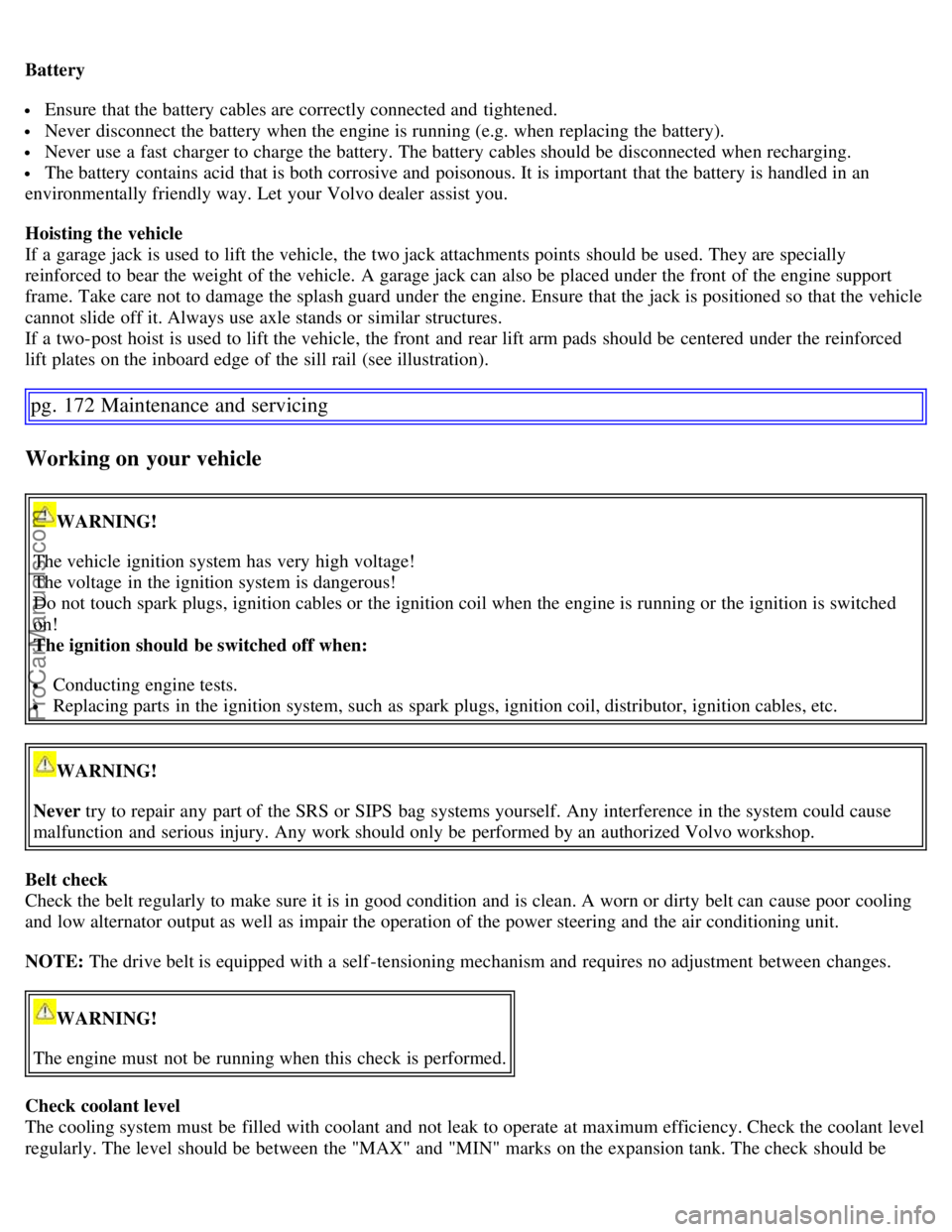
If a two-post hoist is used to lift the vehicle, the front and rear lift arm pads should be centered under the reinforced
lift plates on the inboard edge of the sill rail (see illustration).
pg. 172 Maintenance and servicing
Working on your vehicle
WARNING!
The vehicle ignition system has very high voltage!
The voltage in the ignition system is dangerous!
Do not touch spark plugs, ignition cables or the ignition coil when the engine is running or the ignition is switched
on!
The ignition should be switched off when:
Conducting engine tests.
Replacing parts in the ignition system, such as spark plugs, ignition coil, distributor, ignition cables, etc.
WARNING!
Never try to repair any part of the SRS or SIPS bag systems yourself. Any interference in the system could cause
malfunction and serious injury. Any work should only be performed by an authorized Volvo workshop.
Belt check
Check the belt regularly to make sure it is in good condition and is clean. A worn or dirty belt can cause poor cooling
and low alternator output as well as impair the operation of the power steering and the air conditioning unit.
NOTE: The drive belt is equipped with a self -tensioning mechanism and requires no adjustment between changes.
WARNING!
The engine must not be running when this check is performed.
Check coolant level
The cooling system must be filled with coolant and not leak to operate at maximum efficiency. Check the coolant level
regularly. The level should be between the "MAX" and "MIN" marks on the expansion tank. The check should be
ProCarManuals.com
Page 155 of 200
Replacing the battery
- Switch off the ignition and remove the key.
- Wait at least 5 minutes after switching off the ignition before disconnecting the battery so that all information in the
vehicle's electrical system can be stored in the control modules.
- Remove the bolts on the retaining bracket over the battery and lift out the bracket.
- Fold up the plastic cover over the negative (ground) battery terminal. or unscrew the cover over the battery.
- Disconnect the negative cable.
- Lift off the plastic cover if necessary and disconnect the positive cable
- Pull the ventilation hose from the battery.
- Lift out the old battery.
Installing a new battery
- Put a new battery into place.
- Put the lower retaining bracket in place and retighten the bolt.
- Reconnect the positive cable.
- Press the cover for the positive battery terminal into place and fold down the lid of the plastic cover.
- Connect the negative (ground) cable and fold down the plastic cover if applicable.
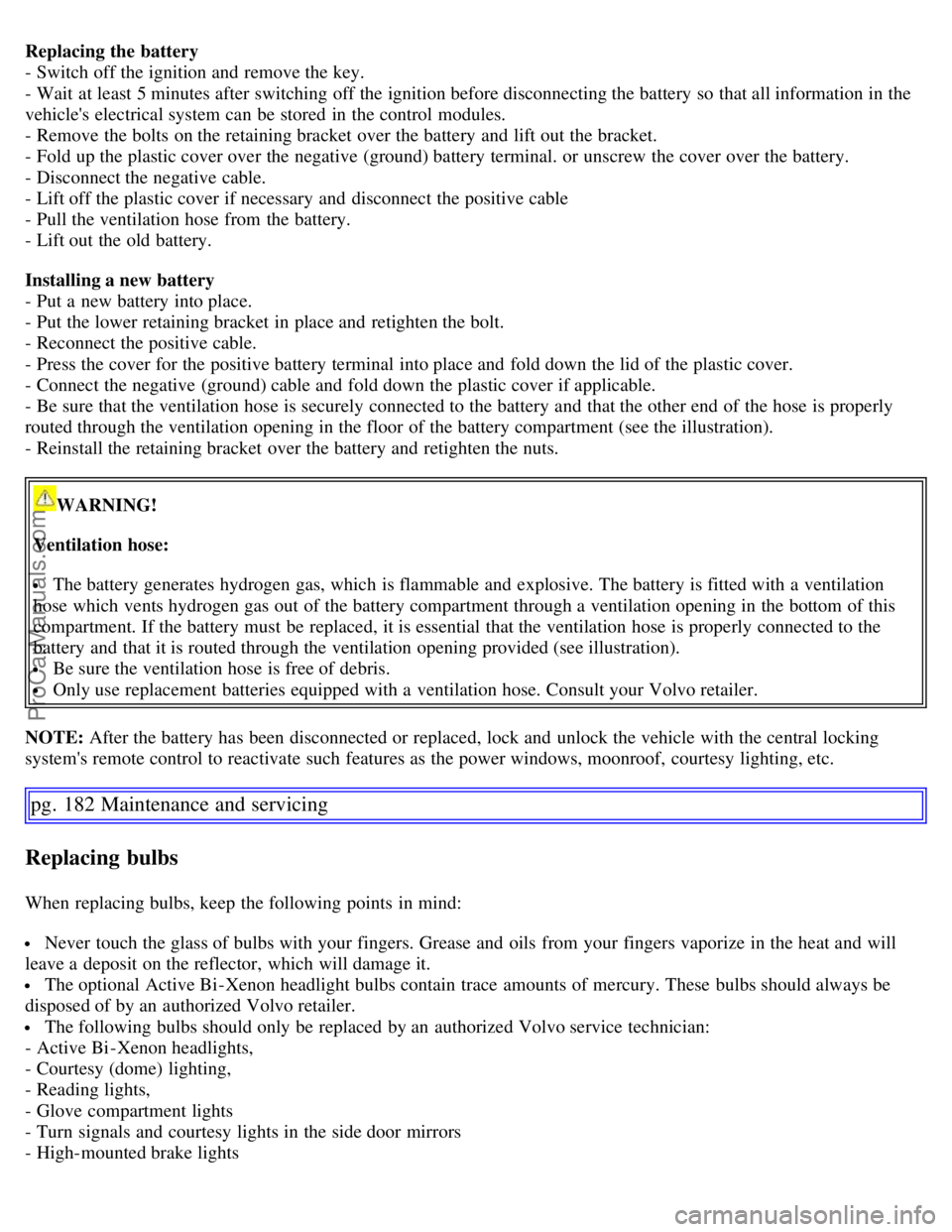
- Be sure that the ventilation hose is securely connected to the battery and that the other end of the hose is properly
routed through the ventilation opening in the floor of the battery compartment (see the illustration).
- Reinstall the retaining bracket over the battery and retighten the nuts.
WARNING!
Ventilation hose:
The battery generates hydrogen gas, which is flammable and explosive. The battery is fitted with a ventilation
hose which vents hydrogen gas out of the battery compartment through a ventilation opening in the bottom of this
compartment. If the battery must be replaced, it is essential that the ventilation hose is properly connected to the
battery and that it is routed through the ventilation opening provided (see illustration).
Be sure the ventilation hose is free of debris.
Only use replacement batteries equipped with a ventilation hose. Consult your Volvo retailer.
NOTE: After the battery has been disconnected or replaced, lock and unlock the vehicle with the central locking
system's remote control to reactivate such features as the power windows, moonroof, courtesy lighting, etc.
pg. 182 Maintenance and servicing
Replacing bulbs
When replacing bulbs, keep the following points in mind:
Never touch the glass of bulbs with your fingers. Grease and oils from your fingers vaporize in the heat and will
leave a deposit on the reflector, which will damage it.
The optional Active Bi -Xenon headlight bulbs contain trace amounts of mercury. These bulbs should always be
disposed of by an authorized Volvo retailer.
The following bulbs should only be replaced by an authorized Volvo service technician:
- Active Bi -Xenon headlights,
- Courtesy (dome) lighting,
- Reading lights,
- Glove compartment lights
- Turn signals and courtesy lights in the side door mirrors
- High-mounted brake lights
ProCarManuals.com
Page 157 of 200
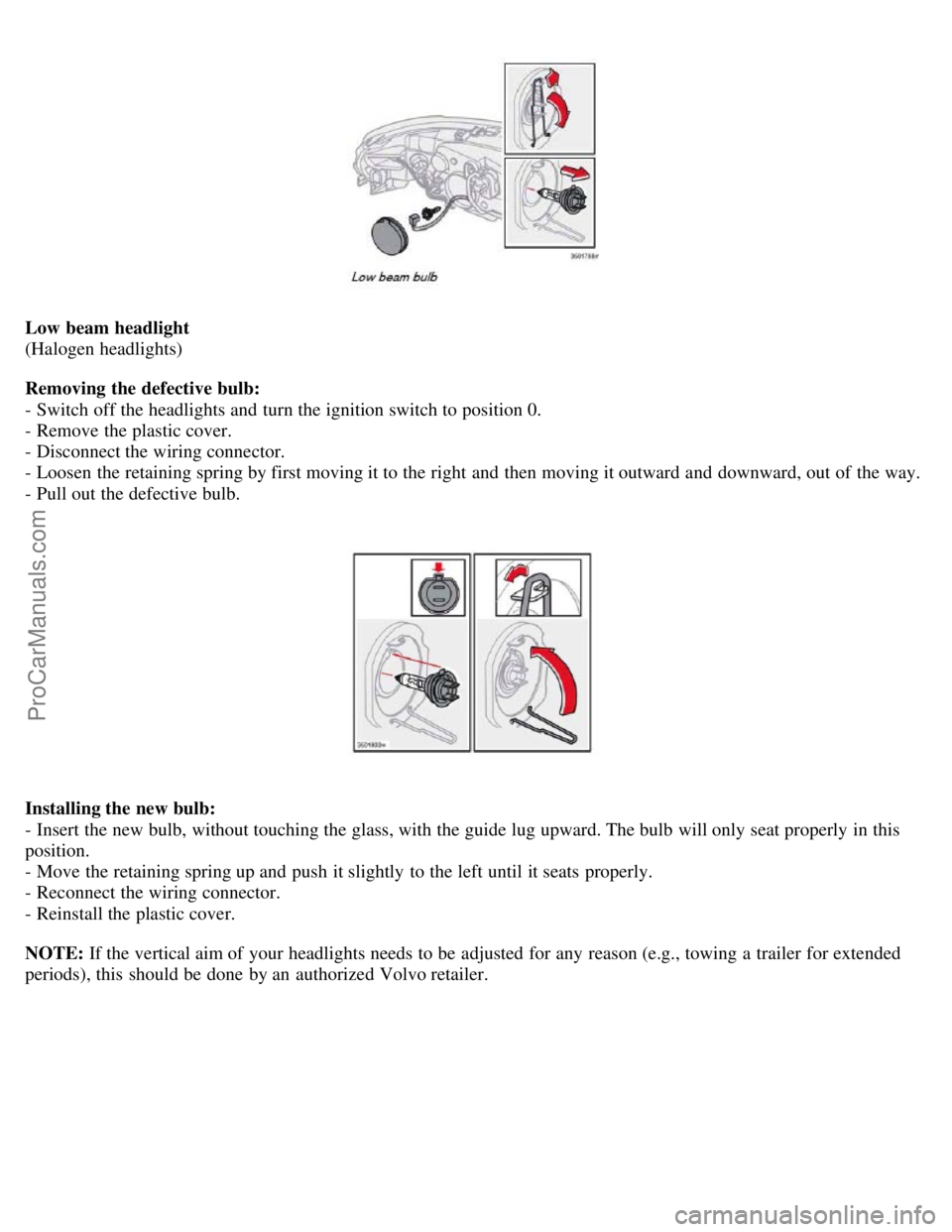
Low beam headlight
(Halogen headlights)
Removing the defective bulb:
- Switch off the headlights and turn the ignition switch to position 0.
- Remove the plastic cover.
- Disconnect the wiring connector.
- Loosen the retaining spring by first moving it to the right and then moving it outward and downward, out of the way.
- Pull out the defective bulb.
Installing the new bulb:
- Insert the new bulb, without touching the glass, with the guide lug upward. The bulb will only seat properly in this
position.
- Move the retaining spring up and push it slightly to the left until it seats properly.
- Reconnect the wiring connector.
- Reinstall the plastic cover.
NOTE: If the vertical aim of your headlights needs to be adjusted for any reason (e.g., towing a trailer for extended
periods), this should be done by an authorized Volvo retailer.
ProCarManuals.com
Page 158 of 200
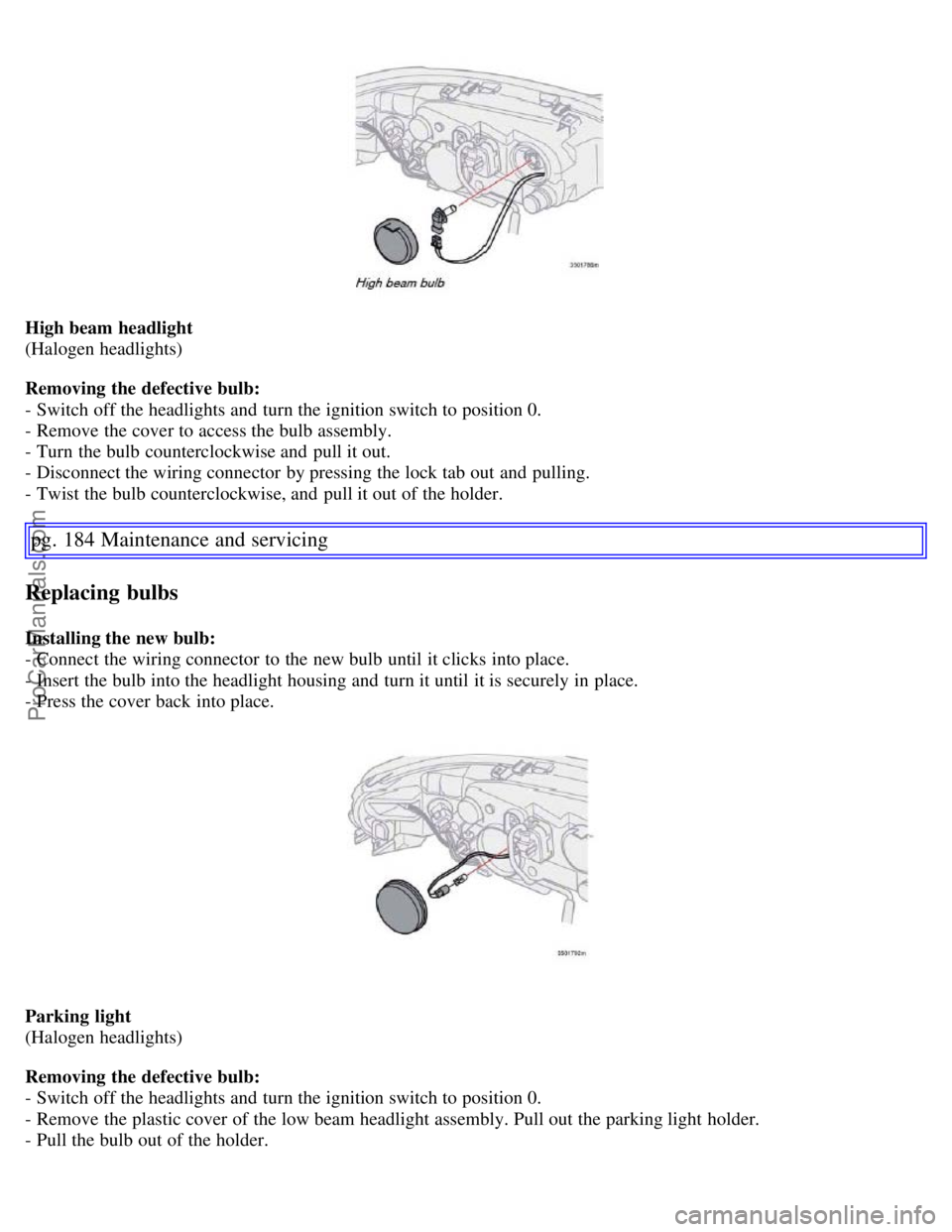
High beam headlight
(Halogen headlights)
Removing the defective bulb:
- Switch off the headlights and turn the ignition switch to position 0.
- Remove the cover to access the bulb assembly.
- Turn the bulb counterclockwise and pull it out.
- Disconnect the wiring connector by pressing the lock tab out and pulling.
- Twist the bulb counterclockwise, and pull it out of the holder.
pg. 184 Maintenance and servicing
Replacing bulbs
Installing the new bulb:
- Connect the wiring connector to the new bulb until it clicks into place.
- Insert the bulb into the headlight housing and turn it until it is securely in place.
- Press the cover back into place.
Parking light
(Halogen headlights)
Removing the defective bulb:
- Switch off the headlights and turn the ignition switch to position 0.
- Remove the plastic cover of the low beam headlight assembly. Pull out the parking light holder.
- Pull the bulb out of the holder.
ProCarManuals.com