trailer VOLVO S60 2008 User Guide
[x] Cancel search | Manufacturer: VOLVO, Model Year: 2008, Model line: S60, Model: VOLVO S60 2008Pages: 230, PDF Size: 5.33 MB
Page 135 of 230
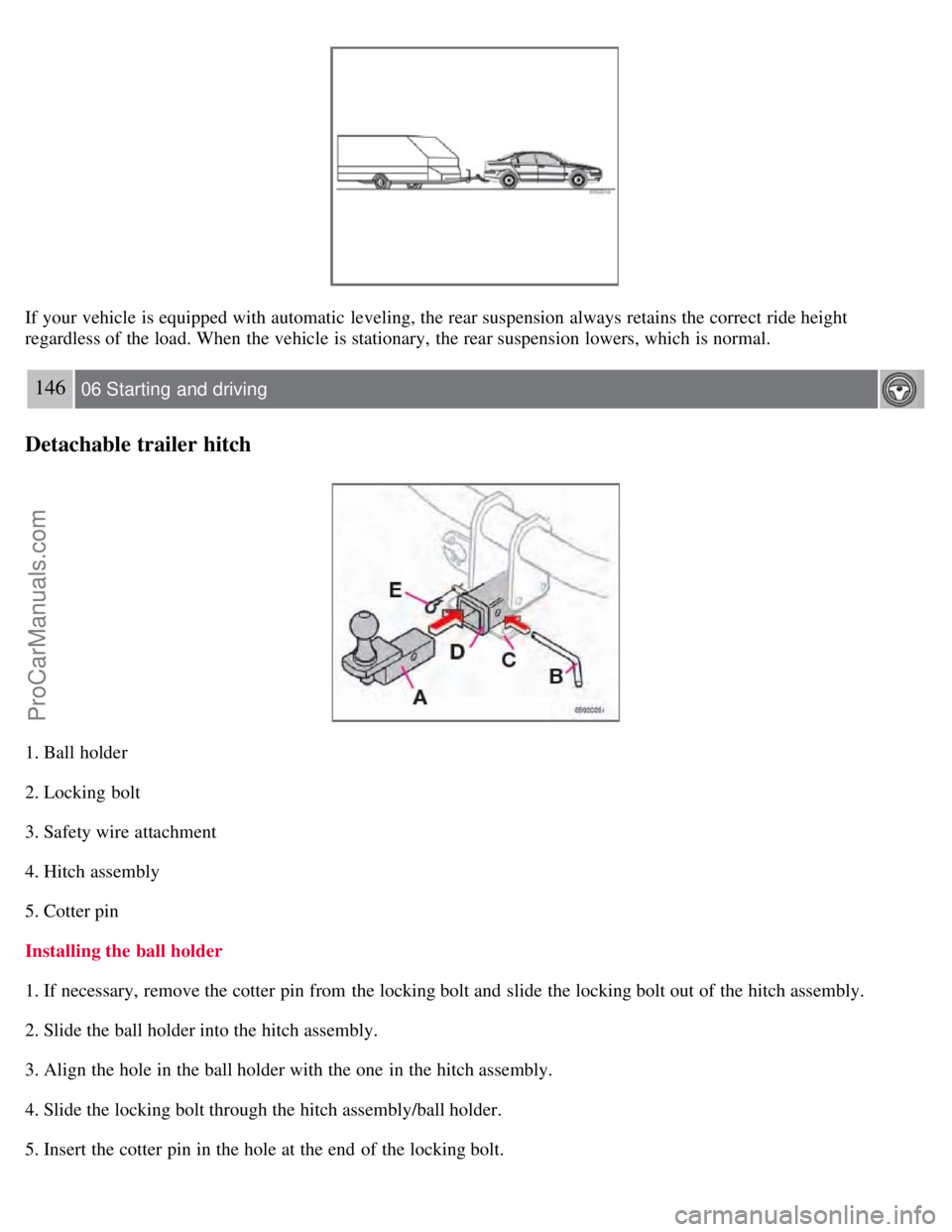
If your vehicle is equipped with automatic leveling, the rear suspension always retains the correct ride height
regardless of the load. When the vehicle is stationary, the rear suspension lowers, which is normal.
146 06 Starting and driving
Detachable trailer hitch
1. Ball holder
2. Locking bolt
3. Safety wire attachment
4. Hitch assembly
5. Cotter pin
Installing the ball holder
1. If necessary, remove the cotter pin from the locking bolt and slide the locking bolt out of the hitch assembly.
2. Slide the ball holder into the hitch assembly.
3. Align the hole in the ball holder with the one in the hitch assembly.
4. Slide the locking bolt through the hitch assembly/ball holder.
5. Insert the cotter pin in the hole at the end of the locking bolt.
ProCarManuals.com
Page 140 of 230
The system must be deactivated when towing a trailer, carrying bicycles in a rear-mounted carrier, etc, which could
trigger the rear park assist system's sensors.
NOTE
Rear park assist is deactivated automatically when towing a trailer if Volvo genuine trailer wiring is used.
Front park assist
The distance monitored in front of the vehicle is approximately 2.5 ft (0.8 m). The audible signal comes from the audio
system's front speakers.
It may not be possible to combine auxiliary headlights and front park assist since these lights could trigger the
system's sensors.
152 06 Starting and driving
Front/rear park assist (option/accessory)
Activating/deactivating park assist
The system is activated automatically when the vehicle is started.
Press the Park assist button on the center console (see page 55) to temporarily deactivate the system(s). The
indicator light in the button will go out when the system has been deactivated.
Park assist will be automatically reactivated the next time the engine is started, or if the button is pressed (the
indicator light in the button will illuminate).
NOTE
Front park assist is disengaged automatically when the parking brake is applied.
If the vehicle is equipped with front and rear park assist, both systems will be deactivated by pressing the button.
Audible signals from the park assist system
The Park Assist system uses an intermittent tone that pulses faster as you come close to an object, and becomes
constant when you are within approximately 1 ft (30 cm) of an object in front of or behind the vehicle. If the volume
of another source from the audio system is high, this will be automatically lowered.
If there are objects within this distance both behind and in front of the vehicle, the signal alternates between front and
rear speakers.
Faults in the system
If the yellow warning symbol illuminates and PARK ASSIST SERVICE REQUIRED is shown on the
information display, this indicates that the system is not functioning properly and has been disengaged. Consult a
trained and qualified Volvo service technician.
CAUTION
In certain circumstances, the park assist system may give unexpected warning signals that can be caused by external
ProCarManuals.com
Page 151 of 230
vehicle's tire information placard or the safety certification label, located on the B-Pillar or the driver's door or on the
inside of the fuel filler door on Canadian models, for the correct tire pressure for your vehicle.
11. Treadwear, Traction, and Temperature grades: See page 168
for more information.
12. Maximum permissible inflation pressure: the greatest amount of air pressure that should ever be put in the tire. This
limit is set by the tire manufacturer.
165 07 Wheels and tires
Glossary of tire terminology
Tire suppliers may have additional markings, notes or warnings such as standard load, radial tubeless, etc.
Tire information placard: A placard showing the OE (Original Equipment) tire sizes, recommended inflation
pressure, and the maximum weight the vehicle can carry.
Tire Identification Number (TIN): A number on the sidewall of each tire providing information about the tire
brand and manufacturing plant, tire size and date of manufacturer.
Inflation pressure: A measure of the amount of air in a tire.
Standard load: A class of P-metric or Metric tires designed to carry a maximum load at 35 psi [37 psi (2.5 bar) for
Metric tires]. Increasing the inflation pressure beyond this pressure will not increase the tires load carrying capability.
Extra load: A class of P-metric or Metric tires designed to carry a heavier maximum load at 41 psi [43 psi (2.9 bar)
for Metric tires]. Increasing the inflation pressure beyond this pressure will not increase the tires load carrying
capability.
kPa: Kilopascal, a metric unit of air pressure.
PSI: Pounds per square inch, a standard unit of air pressure.
B-pillar: The structural member at the side of the vehicle behind the front door.
Bead area of the tire: Area of the tire next to the rim.
Sidewall of the tire: Area between the bead area and the tread.
Tread area of the tire: Area of the perimeter of the tire that contacts the road when mounted on the vehicle.
Rim: The metal support (wheel) for a tire or a tire and tube assembly upon which the tire beads are seated.
Maximum load rating: a figure indicating the maximum load in pounds and kilograms that can be carried by the
tire. This rating is established by the tire manufacturer.
Maximum permissible inflation pressure: the greatest amount of air pressure that should ever be put in the tire.
This limit is set by the tire manufacturer.
Recommended tire inflation pressure: inflation pressure, established by Volvo, which is based on the type of tires
that are mounted on a vehicle at the factory. This inflation pressure is affected by the number of occupants in the
vehicle, the amount of cargo, and the speed at which the vehicle will be driven for a prolonged period. This
information can be found on the tire inflation placard(s) located on the driver's side B-pillar or on the inside of the fuel
filler door on Canadian models, and in the tire inflation table in this chapter.
Cold tires: The tires are considered to be cold when they have the same temperature as the surrounding (ambient)
air. This temperature is normally reached after the vehicle has been parked for at least 3 hours.
166 07 Wheels and tires
Vehicle loading
Properly loading your vehicle will provide maximum return of vehicle design performance.
Before loading your vehicle, familiarize yourself with the following terms for deter-mining your vehicle's weight
ratings, with or without a trailer, from the vehicle's Federal/ Canadian Motor Vehicle Safety Standards
(FMVSS/CMVSS) label, and the vehicle's tire information placard:
ProCarManuals.com
Page 152 of 230
Curb weight
The weight of the vehicle including a full tank of fuel and all standard equipment. It does not include passengers,
cargo, or optional equipment.
Capacity weight
All weight added to the curb weight, including cargo and optional equipment. When towing, trailer hitch tongue load
is also part of cargo weight.
NOTE
NOTE: For trailer towing information, please refer to the section "Towing a trailer" on page 144
.
Permissible axle weight
The maximum allowable weight that can be carried by a single axle (front or rear). These numbers are shown on the
Federal/Canadian Motor Vehicle Safety Standards (FMVSS/CMVSS) label. The total load on each axle must never
exceed its maximum permissible weight.
Gross vehicle weight (GVW)
The vehicle's curb weight + cargo + passengers.
NOTE
The location of the various labels in your vehicle can be found on page 243.
A table listing important weight limits for your vehicle can be found on page 245.
Steps for Determining Correct Load Limit
1. Locate the statement "the combined weight of occupants and cargo should never exceed XXX pounds'' on your
vehicle's placard.
2. Determine the combined weight of the driver and passengers that will be riding in your vehicle.
3. Subtract the combined weight of the driver and passengers from XXX kilograms or XXX pounds.
4. The resulting figure equals the available amount of cargo and luggage load capacity. For example, if the "XXX"
amount equals 1400 lbs. and there will be five 150 lb. passengers in your vehicle, the amount of available cargo and
luggage load capacity is 650 lbs. (1400-750 (5 x 150) = 650 lbs.)
5. Determine the combined weight of luggage and cargo being loaded on the vehicle. That weight may not safely
exceed the available cargo and luggage load capacity calculated in Step 4.
6. If your vehicle will be towing a trailer, load from your trailer will be transferred to your vehicle. Consult this
manual
1 to determine how this reduces the available cargo and luggage load capacity of your vehicle.
1See "Towing a trailer" on page 144.
167 07 Wheels and tires
ProCarManuals.com
Page 172 of 230
Oil additives must not be used.
NOTE
Synthetic oil is not used when the oil is changed at the normal maintenance services. This oil is only used at customer
request, at additional charge. Please consult a trained and qualified Volvo service technician.
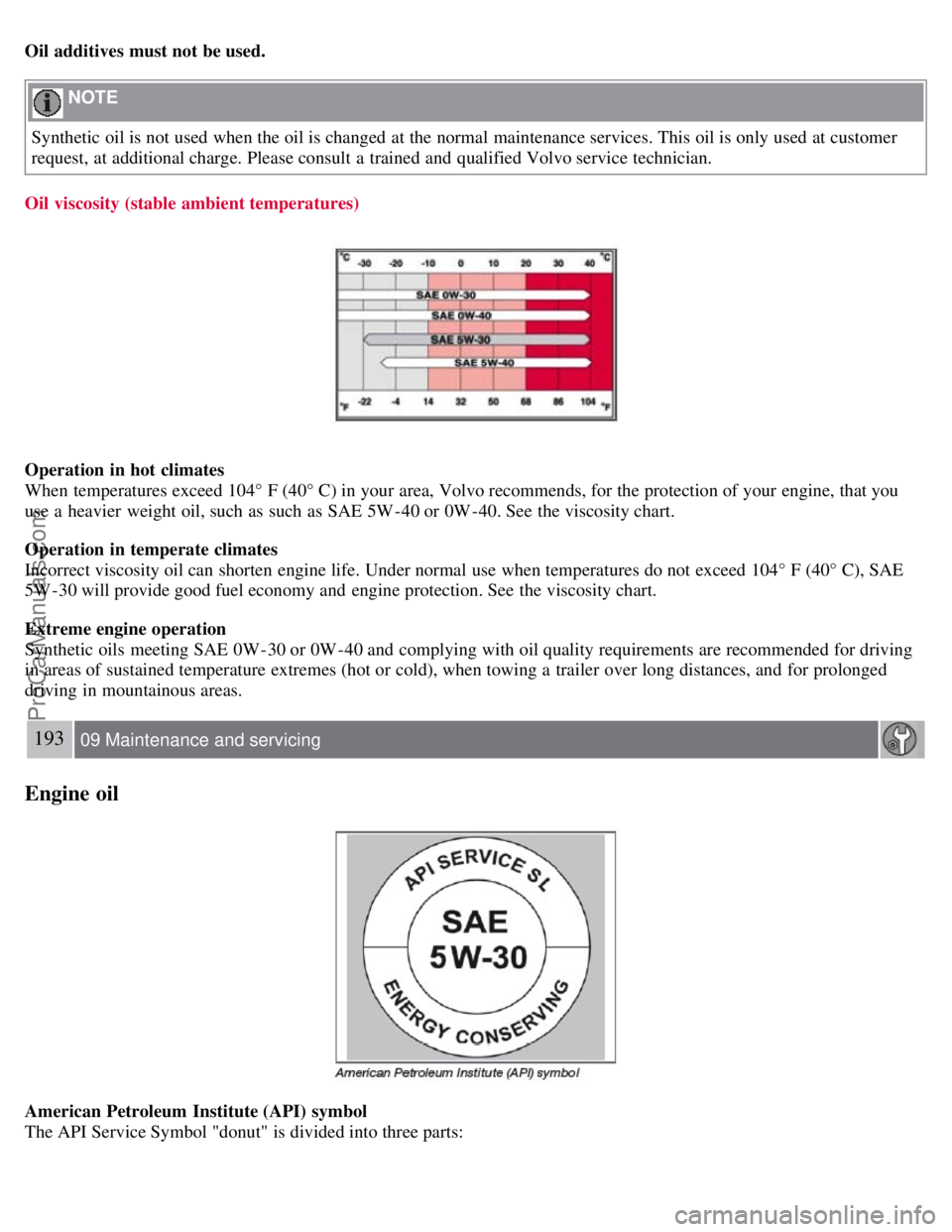
Oil viscosity (stable ambient temperatures)
Operation in hot climates
When temperatures exceed 104° F (40° C) in your area, Volvo recommends, for the protection of your engine, that you
use a heavier weight oil, such as such as SAE 5W -40 or 0W -40. See the viscosity chart.
Operation in temperate climates
Incorrect viscosity oil can shorten engine life. Under normal use when temperatures do not exceed 104° F (40° C), SAE
5W -30 will provide good fuel economy and engine protection. See the viscosity chart.
Extreme engine operation
Synthetic oils meeting SAE 0W -30 or 0W -40 and complying with oil quality requirements are recommended for driving
in areas of sustained temperature extremes (hot or cold), when towing a trailer over long distances, and for prolonged
driving in mountainous areas.
193 09 Maintenance and servicing
Engine oil
American Petroleum Institute (API) symbol
The API Service Symbol "donut" is divided into three parts:
ProCarManuals.com
Page 183 of 230
3. Reconnect the wiring connector.
4. Reinstall the plastic cover.
NOTE
If the vertical aim of your headlights needs to be adjusted for any reason (e.g., towing a trailer for extended periods),
this should be done by a trained and qualified Volvo service technician.
203 09 Maintenance and servicing
Replacing bulbs
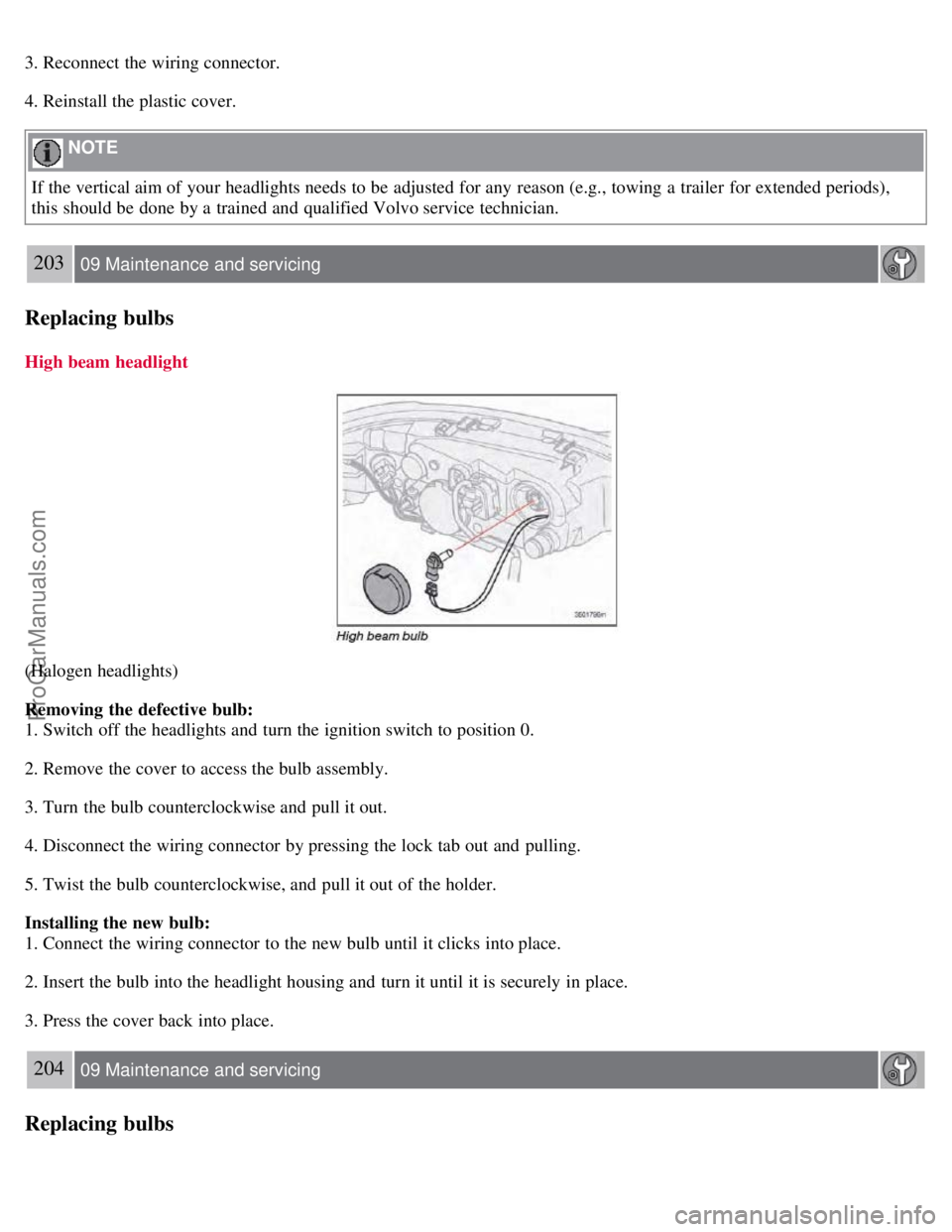
High beam headlight
(Halogen headlights)
Removing the defective bulb:
1. Switch off the headlights and turn the ignition switch to position 0.
2. Remove the cover to access the bulb assembly.
3. Turn the bulb counterclockwise and pull it out.
4. Disconnect the wiring connector by pressing the lock tab out and pulling.
5. Twist the bulb counterclockwise, and pull it out of the holder.
Installing the new bulb:
1. Connect the wiring connector to the new bulb until it clicks into place.
2. Insert the bulb into the headlight housing and turn it until it is securely in place.
3. Press the cover back into place.
204 09 Maintenance and servicing
Replacing bulbs
ProCarManuals.com
Page 218 of 230
NOTE
The transmission oil does not normally need to be changed during the service life of the vehicle. However, it may be
necessary to replace the oil if the vehicle is often driven in areas of sustained temperature extremes (hot or cold), when
towing a trailer over long distances, for prolonged driving in mountainous areas, or if the vehicle is often driven short
distances in temperatures under 40°F (5°C).
247 11 Specifications
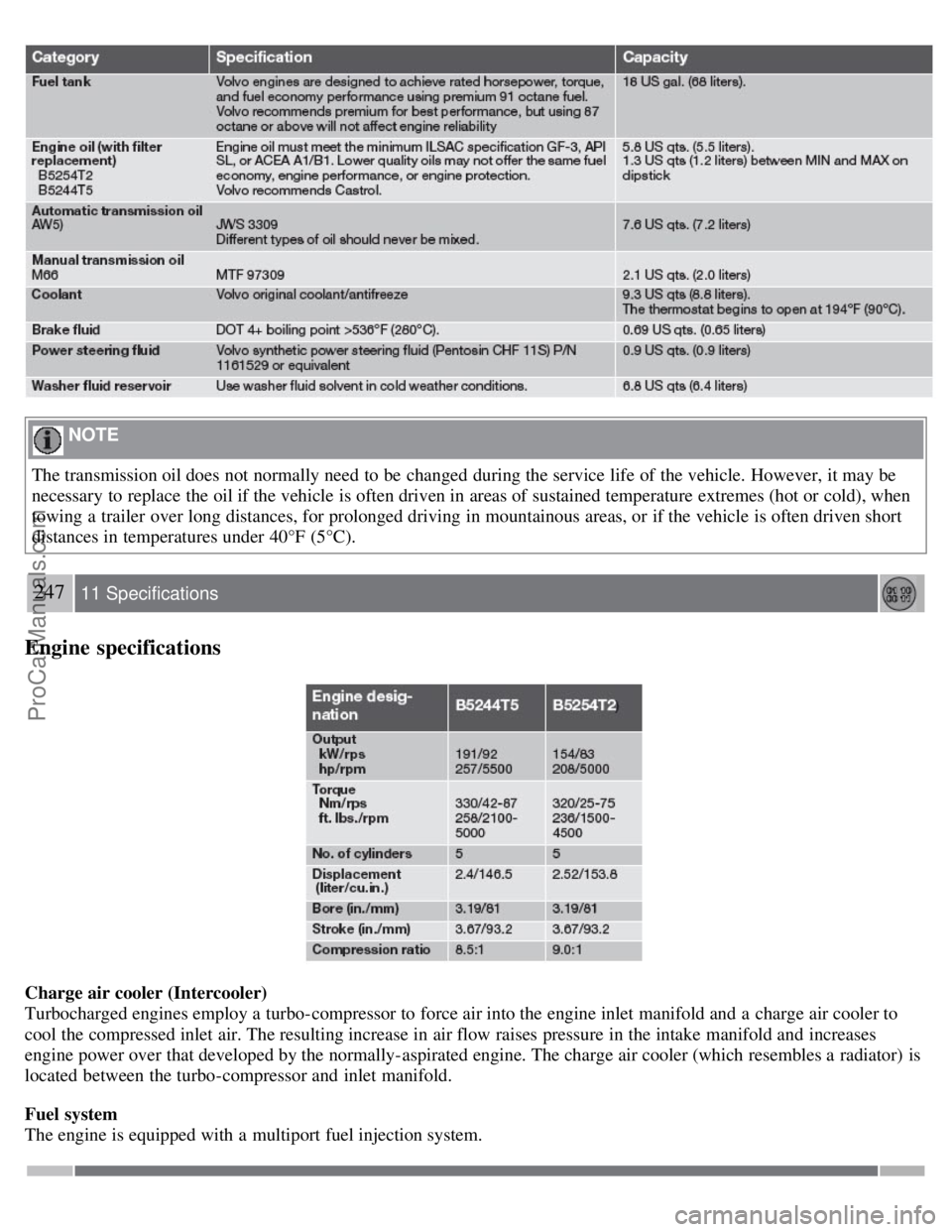
Engine specifications
Charge air cooler (Intercooler)
Turbocharged engines employ a turbo-compressor to force air into the engine inlet manifold and a charge air cooler to
cool the compressed inlet air. The resulting increase in air flow raises pressure in the intake manifold and increases
engine power over that developed by the normally-aspirated engine. The charge air cooler (which resembles a radiator) is
located between the turbo-compressor and inlet manifold.
Fuel system
The engine is equipped with a multiport fuel injection system.
ProCarManuals.com
Page 225 of 230
Current fuel consumption64
D
Defroster87
Detachable trailer hitch146
Dimensions244
Disabling the passenger's side front
airbag21
Door mirrors
defroster63
Driver distraction9
Driving economically129
Driving through water130
Dynamic Stability and Traction
Control (DSTC)139
E
Economical driving129
Electrical system249
Electrically operated moonroof76
Emission inspection188
Engine
specifications247
starting127
Engine compartment191
Engine oil192
Environment7
F
Federal Clean Air Act186
FIX NEXT SERVICE53
Fog lights
front58
rear58
Folding head restraints54
Front airbags17, 18, 21
Front park assist151
Front seats
folding backrests93
manually operated92
power operated94
Front suspension251
Fuel122
Fuel filler cap6, 125
Fuel filler door125
Fuel Formulations124
Fuel gauge48
ProCarManuals.com
Page 229 of 230
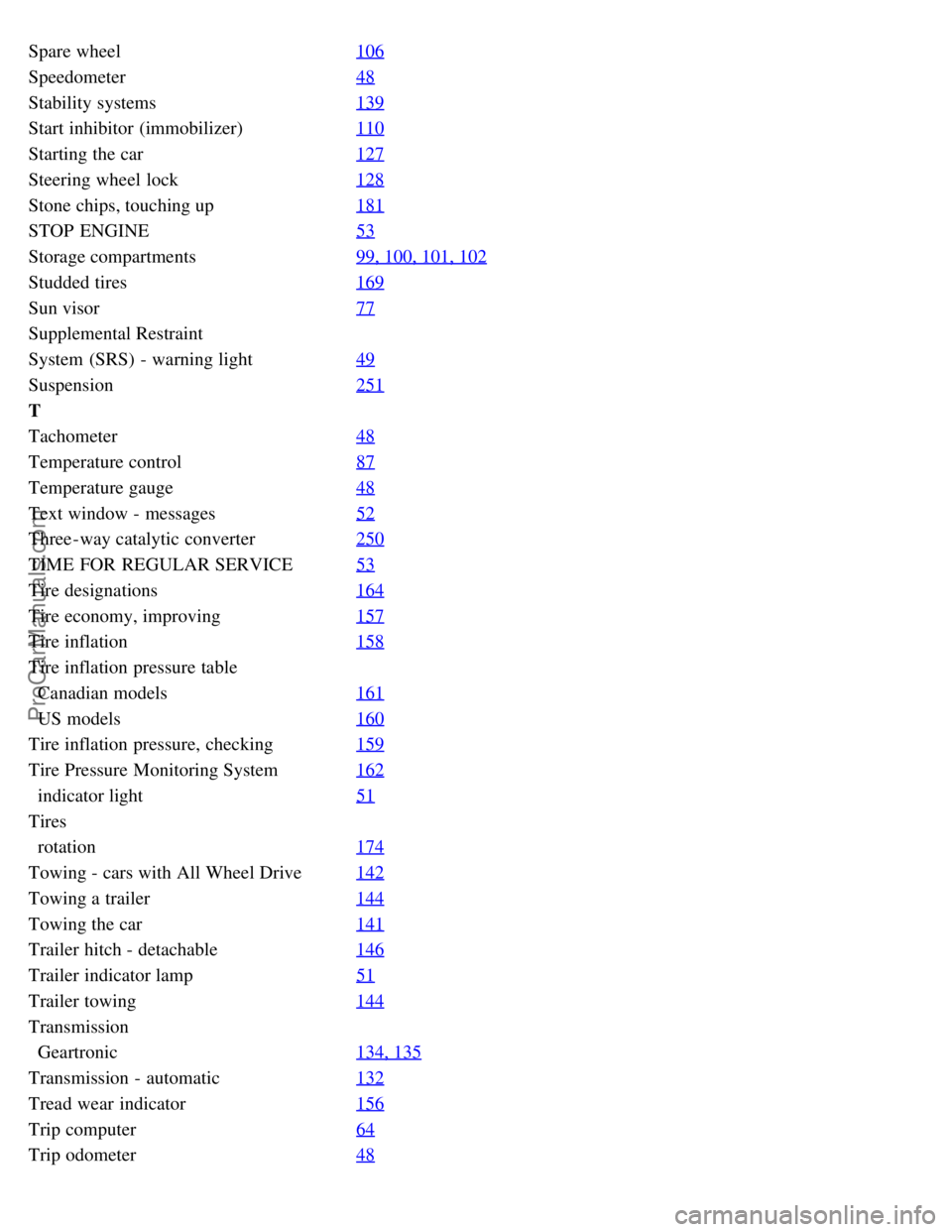
Spare wheel106
Speedometer48
Stability systems139
Start inhibitor (immobilizer)110
Starting the car127
Steering wheel lock128
Stone chips, touching up181
STOP ENGINE53
Storage compartments99, 100, 101, 102
Studded tires169
Sun visor77
Supplemental Restraint
System (SRS) - warning light49
Suspension251
T
Tachometer48
Temperature control87
Temperature gauge48
Text window - messages52
Three-way catalytic converter250
TIME FOR REGULAR SERVICE53
Tire designations164
Tire economy, improving157
Tire inflation158
Tire inflation pressure table
Canadian models161
US models160
Tire inflation pressure, checking159
Tire Pressure Monitoring System162
indicator light51
Tires
rotation174
Towing - cars with All Wheel Drive142
Towing a trailer144
Towing the car141
Trailer hitch - detachable146
Trailer indicator lamp51
Trailer towing144
Transmission
Geartronic134, 135
Transmission - automatic132
Tread wear indicator156
Trip computer64
Trip odometer48
ProCarManuals.com