ESP VOLVO S60 2009 Owner´s Manual
[x] Cancel search | Manufacturer: VOLVO, Model Year: 2009, Model line: S60, Model: VOLVO S60 2009Pages: 254, PDF Size: 6.17 MB
Page 128 of 254
06 Starting and drivingHandling and road holding
06128
Weight distribution affects handlingAt the specified curb weight your vehicle has a
tendency to understeer, which means that the
steering wheel has to be turned more than
might seem appropriate for the curvature of a
bend.
This ensures good stability and reduces the
risk of rear wheel skid. Remember that these
properties can alter with the vehicle load.
The heavier the load in the trunk (max. 220 lbs,
100 kg), the less the tendency to understeer.Handling, roadholdingVehicle load, tire design and inflation pressure
all affect vehicle handling. Therefore, check
that the tires are inflated to the recommended
pressure according to the vehicle load. See
"Tire pressure" section.
Loads should be distributed so that capacity
weight or maximum permissible axle loads are
not exceeded.
Speed-sensitive power steering
(Option on certain models)With this feature, the steering is most respon-
sive at lower speeds to make parking, driving
in city traffic, etc., easier. The effect of the
power steering diminishes as you accelerate
for greater stability at highway speeds.Driving through waterThe vehicle can be driven through water up to
a depth of approximately 9 in. (25 cm), at a
maximum speed of 6 mph (10 km/h).
Take particular care when driving through flow-
ing water.
Clean the electrical connections for trailer wir-
ing after driving in mud or water.
When driving through water, maintain low
speed and do not stop in the water.
WARNING
After driving through water, press lightly on
the brake pedal to ensure that the brakes
are functioning normally. Water or mud can
make the brake linings slippery, resulting in
delayed braking effect.
CAUTION
•
Engine damage will occur if water is
drawn into the air cleaner.
•
If the vehicle is driven through water
deeper than 9 in (25 cm), water may
enter the differential and the transmis-
sion. This reduces the oil's lubricating
capacity and may shorten the service
life of these components.
•
Do not allow the vehicle to stand in
water up to the door sills longer than
absolutely necessary. This could result
in electrical malfunctions.
•
If the engine has been stopped while the
car is in water, do not attempt to restart
the engine. Have the car towed out of
the water.
Page 139 of 254

06 Starting and driving
Stability system
06
139
DSTC-related messages in the text
window•
"TRACTION CONTROL TEMPORARILY
OFF
" - The system has been temporarily
switched off due to high brake temperature
and will automatically switch on again
when the brakes have cooled.
•
"ANTI SKID SERVICE REQUIRED
" - the
system has been automatically disen-
gaged due to a fault. A trained and qualified
Volvo service technician should check the
system.
Symbols in the instrument panelThe Stability Control indicator light
This light indicates different condi-
tions, depending on how it illumi-
nates.
The Stability Control indicator light
illuminates for approximately 2 secondsThis indicates that the system is performing a
self-diagnostic test when the ignition is
switched on.The Stability Control indicator light
flashesThis indicates that the stability system is
actively functioning to help counteract wheel
spin and/or a skid.
The Stability Control indicator light
glows steadily"ANTI SKID SERVICE REQUIRED
" will be
displayed in the text window at the same time.
A fault is indicated in the stability system.
1. Stop the vehicle in a safe place and switch
off the engine.
2. Restart the engine.
3. If the indicator light goes out, the fault was
temporary and no further action is
required.
4. If the indicator light remains on, drive to an
authorized Volvo workshop as soon as
possible to have the system checked.
The Stability Control indicator light
glows steadilyIf "
DSTC SPIN CONTROL OFF
" is displayed
in the text window at the same time, this is a
reminder that spin control has been disabled
by the driver.
The warning symbol
The warning symbol glows
steadily yellow
The system has been temporarily switched off
due to high brake temperature. "
TRACTION
CONTROL TEMPORARILY OFF" will be dis-
played. The system will automatically switch
on again when the brakes have cooled.
WARNING
The stability system is intended to help
improve driving safety. It supplements, but
can never replace, the driver's judgement
and responsibility when operating the vehi-
cle. Speed and driving style should always
be adapted to traffic and road conditions.
Page 146 of 254
06 Starting and drivingLoad carriers (accessory)
06146
G027340
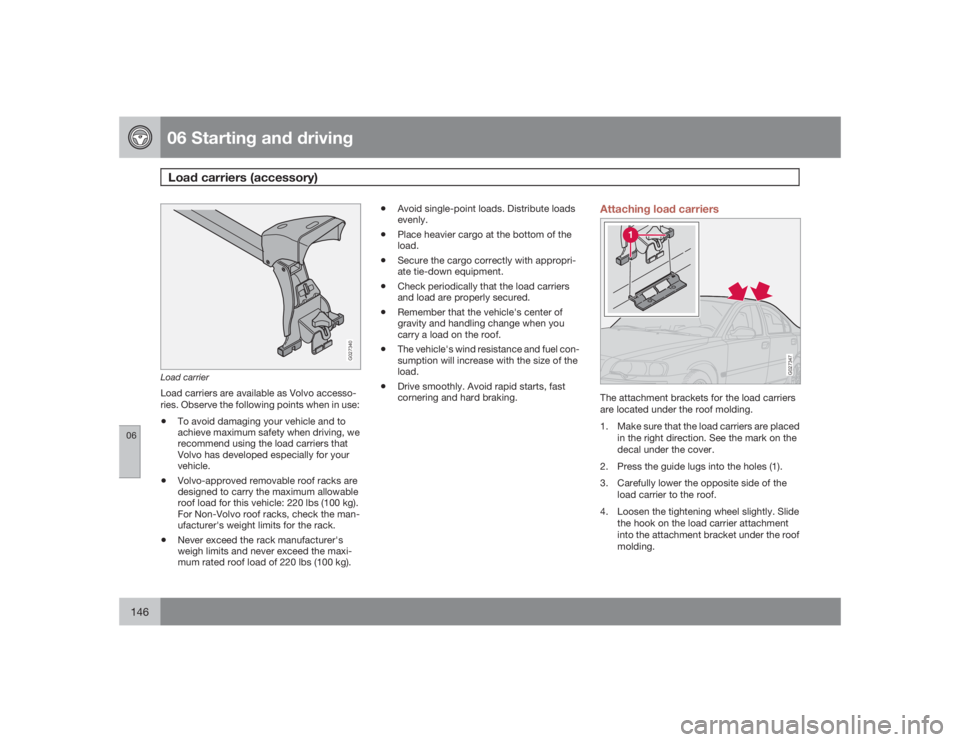
Load carrierLoad carriers are available as Volvo accesso-
ries. Observe the following points when in use:•
To avoid damaging your vehicle and to
achieve maximum safety when driving, we
recommend using the load carriers that
Volvo has developed especially for your
vehicle.
•
Volvo-approved removable roof racks are
designed to carry the maximum allowable
roof load for this vehicle: 220 lbs (100 kg).
For Non-Volvo roof racks, check the man-
ufacturer's weight limits for the rack.
•
Never exceed the rack manufacturer's
weigh limits and never exceed the maxi-
mum rated roof load of 220 lbs (100 kg).
•
Avoid single-point loads. Distribute loads
evenly.
•
Place heavier cargo at the bottom of the
load.
•
Secure the cargo correctly with appropri-
ate tie-down equipment.
•
Check periodically that the load carriers
and load are properly secured.
•
Remember that the vehicle's center of
gravity and handling change when you
carry a load on the roof.
•
The vehicle's wind resistance and fuel con-
sumption will increase with the size of the
load.
•
Drive smoothly. Avoid rapid starts, fast
cornering and hard braking.
Attaching load carriers
G027347
The attachment brackets for the load carriers
are located under the roof molding.
1. Make sure that the load carriers are placed
in the right direction. See the mark on the
decal under the cover.
2. Press the guide lugs into the holes (1).
3. Carefully lower the opposite side of the
load carrier to the roof.
4. Loosen the tightening wheel slightly. Slide
the hook on the load carrier attachment
into the attachment bracket under the roof
molding.
Page 147 of 254
06 Starting and driving
Load carriers (accessory)
06
147
5. Turn the tightening wheel to secure the
load carrier in the attachment bracket.
6. Repeat this procedure for the other load
carrier attachments.
7. Check that the hooks on all four load carrier
attachments are securely tightened in the
respective attachment brackets on the roof
of the vehicle.
8. Press down the covers.
Check periodically that the load carriers and
load are properly secured.
Page 154 of 254
07 Wheels and tiresGeneral information
07154
Your vehicle is equipped with tires according
to the vehicle's tire information placard on the
B-pillar (the structural member at the side of
the vehicle, at the rear of the driver's door
opening), or on the inside of the fuel filler door
on Canadian models.
CAUTION
Some Volvo models are equipped with an
Ultra High Performance tire and wheel com-
bination designed to provide maximum dry
pavement performance with consideration
for hydroplaning resistance. As such, they
may be more susceptible to road hazard
damage and, depending on driving condi-
tions, may achieve a tread life of less than
20,000 miles (30,000 km). Even if this vehi-
cle is equipped with Volvo’s advanced AWD
or DSTC system, these tires are not
designed for winter driving, and should be
replaced with winter tires when weather
conditions dictate.The tires have good road holding characteris-
tics and offer good handling on dry and wet
surfaces. It should be noted however that the
tires have been developed to give these fea-
tures on snow/ice-free surfaces.
Certain models are equipped with "all-season"
tires, which provide a somewhat higher degree
of road holding on slippery surfaces than tires
without the "all-season" rating. However, foroptimum road holding on icy or snow-covered
roads, we recommend suitable winter tires on
all four wheels.
When replacing tires, be sure that the new tires
are the same size designation, type (radial) and
preferably from the same manufacturer, on all
four wheels. Otherwise there is a risk of altering
the vehicle's roadholding and handling charac-
teristics.
Storing wheels and tiresWhen storing complete wheels (tires mounted
on rims), they should be suspended off the
floor or placed on their sides on the floor.
Tires not mounted on rims should be stored on
their sides or standing upright, but should not
be suspended.
CAUTION
Tires should preferably be stored in a cool,
dry, dark place, and should never be stored
in close proximity to solvents, gasoline, oils,
etc.
WARNING
The wheel and tire sizes for your Volvo are
specified to meet stringent stability and
handling requirements. Unapproved wheel/
tire size combinations can negatively affect
your vehicle's stability and handling.
Approved tire sizes are shown in the Tire
inflation pressure tables on pages 158 and
159.
Any damage caused by installation of unap-
proved wheel/tire size combinations will not
be covered by your new vehicle warranty.
Volvo assumes no responsibility for death,
injury, or expenses that may result from
such installations.
Page 156 of 254
07 Wheels and tiresTire inflation
07156
G032513
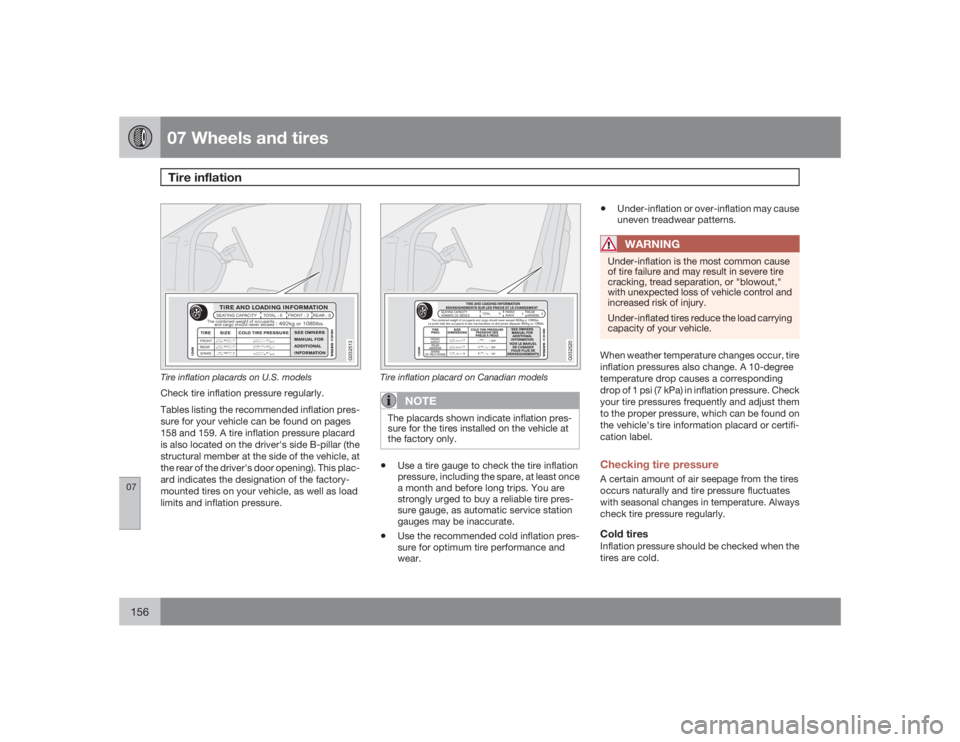
Tire inflation placards on U.S. modelsCheck tire inflation pressure regularly.
Tables listing the recommended inflation pres-
sure for your vehicle can be found on pages
158 and 159. A tire inflation pressure placard
is also located on the driver's side B-pillar (the
structural member at the side of the vehicle, at
the rear of the driver's door opening). This plac-
ard indicates the designation of the factory-
mounted tires on your vehicle, as well as load
limits and inflation pressure.
G032520
Tire inflation placard on Canadian models
NOTE
The placards shown indicate inflation pres-
sure for the tires installed on the vehicle at
the factory only.•
Use a tire gauge to check the tire inflation
pressure, including the spare, at least once
a month and before long trips. You are
strongly urged to buy a reliable tire pres-
sure gauge, as automatic service station
gauges may be inaccurate.
•
Use the recommended cold inflation pres-
sure for optimum tire performance and
wear.
•
Under-inflation or over-inflation may cause
uneven treadwear patterns.WARNING
Under-inflation is the most common cause
of tire failure and may result in severe tire
cracking, tread separation, or "blowout,"
with unexpected loss of vehicle control and
increased risk of injury.
Under-inflated tires reduce the load carrying
capacity of your vehicle.When weather temperature changes occur, tire
inflation pressures also change. A 10-degree
temperature drop causes a corresponding
drop of 1 psi (7 kPa) in inflation pressure. Check
your tire pressures frequently and adjust them
to the proper pressure, which can be found on
the vehicle's tire information placard or certifi-
cation label.Checking tire pressureA certain amount of air seepage from the tires
occurs naturally and tire pressure fluctuates
with seasonal changes in temperature. Always
check tire pressure regularly.Cold tiresInflation pressure should be checked when the
tires are cold.
Page 167 of 254
07 Wheels and tires
Temporary spare
07
167
The spare tire in your vehicle is called a "Tem-
porary Spare".
Recommended tire pressure (see the placard
on the B-pillar or on the fuel filler door) should
be maintained irrespective of which position on
the vehicle the temporary spare tire is used on.
In the event of damage to this tire, a new one
can be purchased from your Volvo retailer.
WARNING
Current legislation prohibits the use of the
"Temporary Spare" tire other than as a tem-
porary replacement for a punctured tire. It
must be replaced as soon as possible by a
standard tire. Road holding and handling
may be affected with the "Temporary
Spare" in use. Do not exceed 50 mph
(80 km/h).
CAUTION
The vehicle must not be driven with wheels
of different dimensions or with a spare tire
other than the one that came with the vehi-
cle. The use of different size wheels can
seriously damage your vehicle's transmis-
sion.
Page 172 of 254
07 Wheels and tiresTire Pressure Monitoring System (TPMS) - U.S. models
07172
The tire pressure monitoring system uses sen-
sors mounted in the tire valves to check infla-
tion pressure levels. When the vehicle is
moving at a speed of approximately 20 mph
(30 km/h) or faster, these sensors transmit
inflation pressure data to a receiver located in
the vehicle.USA - FCC ID: MRXG403MA4
A
This device complies with part 15 of the FCC
rules. Operation is subject to the following
conditions: (1) This device may not cause
harmful interference, and (2) this device
must accept any interference received,
including interference that may cause unde-
sired operation.AOn certain models, the FCC code is MRXTG315AM04When low inflation pressure is detected, TPMS
will light up the tire pressure warning light (also
referred to as a telltale) in the instrument panel,
and will display a message in the text window.
The wording of this message is determined by
the degree of inflation pressure loss.
NOTE
If a fault occurs in TPMS, the tire pressure
warning light will flash for approximately
1 minute and
TIRE PRESS SYST
SERVICE REQUIRED
will be displayed.
Each tire, including the spare (if provided),
should be checked monthly when cold and
inflated to the inflation pressure recommended
by the vehicle manufacturer on the vehicle
placard or tire inflation pressure label. (If your
vehicle has tires of a different size than the size
indicated on the vehicle placard or tire inflation
pressure label, you should determine the
proper tire inflation pressure for those tires.)
As an added safety feature, your vehicle has
been equipped with a tire pressure monitoring
system (TPMS) that illuminates a low tire pres-
sure telltale when one or more of your tires is
significantly under-inflated. Accordingly, when
the low tire pressure telltale illuminates, you
should stop and check your tires as soon as
possible, and inflate them to the proper pres-
sure. Driving on a significantly under-inflated
tire causes the tire to overheat and can lead to
tire failure. Under-inflation also reduces fuel
efficiency and tire tread life, and may affect the
vehicle's handling and stopping ability.
Please note that the TPMS is not a substitute
for proper tire maintenance, and it is the driv-er's responsibility to maintain correct tire pres-
sure, even if under-inflation has not reached
the level to trigger illumination of the TPMS low
tire pressure telltale.
Your vehicle has also been equipped with a
TPMS malfunction indicator to indicate when
the system is not operating properly. The
TPMS malfunction indicator is combined with
the low tire pressure telltale. When the system
detects a malfunction, the telltale will flash for
approximately one minute and then remain
continuously illuminated. This sequence will
continue upon subsequent vehicle start-ups as
long as the malfunction exists. When the mal-
function indicator is illuminated, the system
may not be able to detect or signal low tire
pressure as intended. TPMS malfunctions may
occur for a variety of reasons, including the
installation of replacement or alternate tires or
wheels on the vehicle that prevent the TPMS
from functioning properly. Always check the
TPMS malfunction telltale after replacing one
or more tires or wheels on your vehicle to
ensure that the replacement or alternate tires
and wheels allow the TPMS to continue to
function properly.
Page 177 of 254
08 Car care
Washing and cleaning the vehicle
08``177
NOTE
When washing the vehicle, remember to
remove dirt from the drain holes in the doors
and sills
WARNING
When the vehicle is driven immediately after
being washed, apply the brakes several
times in order to remove any moisture from
the brake linings.
Engine cleaning agents should not be used
when the engine is warm. This constitutes a
fire risk.Automatic washing - simple and quick•
We do NOT recommend washing your
vehicle in an automatic wash during the
first six months (because the paint will not
have hardened sufficiently).
•
An automatic wash is a simple and quick
way to clean your vehicle, but it is worth
remembering that it may not be as thor-
ough as when you yourself go over the
vehicle with sponge and water. Keeping
the underbody clean is most important,
especially in the winter. Some automatic
washers do not have facilities for washing
the underbody.
•
Before driving into an automatic vehicle
wash, make sure that side view mirrors,auxiliary lamps, etc, are secure, and that
any antenna(s) are retracted or removed.
Otherwise there is risk of the machine dis-
lodging them.
Exterior lightingCondensation may form temporarily on the
inside of the lenses of exterior lights such as
headlights, fog lights, or tail lights. This is nor-
mal and the lights are designed to withstand
moisture. Normally, condensation will dissi-
pate after the lights have been on for a short
time.Polishing and waxing•
Normally, polishing is not required during
the first year after delivery, however, wax-
ing may be beneficial.
•
Before applying polish or wax the vehicle
must be washed and dried. Tar spots can
be removed with kerosene or tar remover.
Difficult spots may require a fine rubbing
compound.
•
After polishing use liquid or paste wax.
•
Several commercially available products
contain both polish and wax.
•
Waxing alone does not substitute for pol-
ishing a dull surface.
•
A wide range of polymer-based vehicle
waxes can be purchased today. Thesewaxes are easy to use and produce a long-
lasting, high-gloss finish that protects the
bodywork against oxidation, road dirt and
fading.
•
Do not polish or wax your vehicle in direct
sunlight (the surface of the vehicle should
not be warmer than 113 ° F (45 ° C).CAUTION
Volvo does not recommend the use of long-
life or durable paint protection coatings,
some of which may claim to prevent pitting,
fading, oxidation, etc. These coatings have
not been tested by Volvo for compatibility
with your vehicle's clear coat. Some of them
may cause the clear coat to soften, crack,
or cloud. Damage caused by application of
paint protection coatings may not be cov-
ered under your vehicle's paint warranty.Cleaning the upholsteryFabricClean with soapy water or a detergent. For
more difficult spots caused by oil, ice cream,
shoe polish, grease, etc., use a clothing/fabric
stain remover. Consult your Volvo retailer.Interior plastic componentsCleaning interior plastic components should
be done with a cleaning agent specially
Page 179 of 254
08 Car care
Washing and cleaning the vehicle
08
179
Cleaning floor matsThe floor mats should be vacuumed or brushed
clean regularly, especially during winter when
they should be taken out for drying. Spots on
textile mats can be removed with a mild deter-
gent.Bear in mind•
Take extra care when removing stains such
as ink or lipstick since the coloring can
spread.
•
Use solvents sparingly. Too much solvent
can damage the seat padding.
•
Start from the outside of the stain and work
toward the center.