warning VOLVO S60 2009 Owner´s Manual
[x] Cancel search | Manufacturer: VOLVO, Model Year: 2009, Model line: S60, Model: VOLVO S60 2009Pages: 254, PDF Size: 6.17 MB
Page 36 of 254
01 SafetyInfant seats
0136
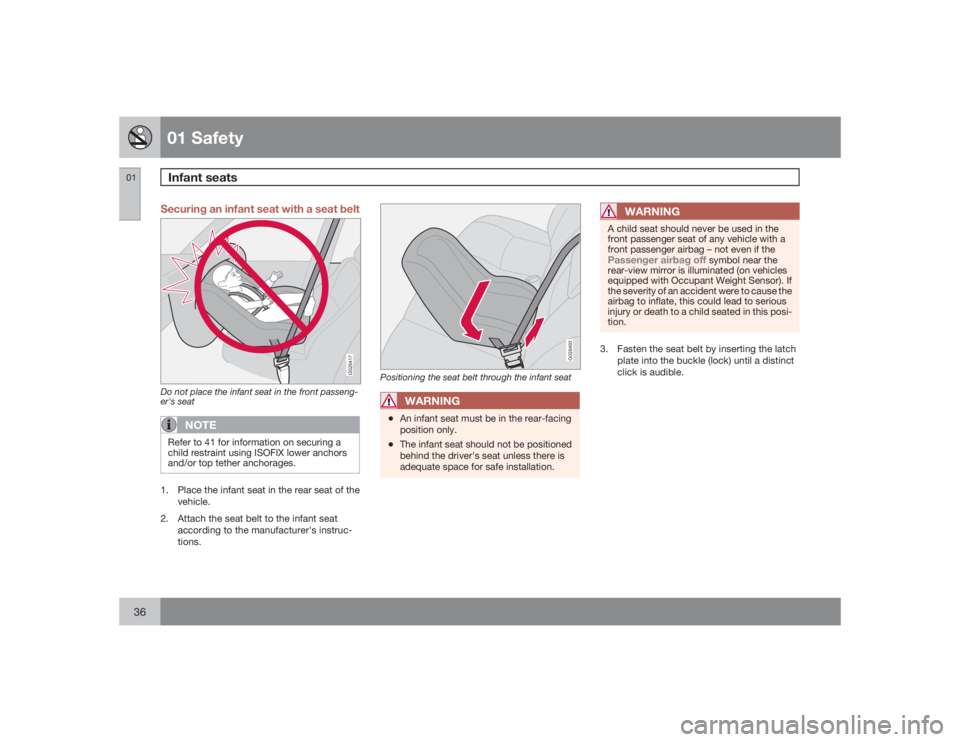
Securing an infant seat with a seat belt
G026417
Do not place the infant seat in the front passeng-
er's seat
NOTE
Refer to 41 for information on securing a
child restraint using ISOFIX lower anchors
and/or top tether anchorages.1. Place the infant seat in the rear seat of the
vehicle.
2. Attach the seat belt to the infant seat
according to the manufacturer's instruc-
tions.
G026493
Positioning the seat belt through the infant seat
WARNING
•An infant seat must be in the rear-facing
position only.•The infant seat should not be positioned
behind the driver's seat unless there is
adequate space for safe installation.
WARNING
A child seat should never be used in the
front passenger seat of any vehicle with a
front passenger airbag – not even if thePassenger airbag off
symbol near the
rear-view mirror is illuminated (on vehicles
equipped with Occupant Weight Sensor). If
the severity of an accident were to cause the
airbag to inflate, this could lead to serious
injury or death to a child seated in this posi-
tion.
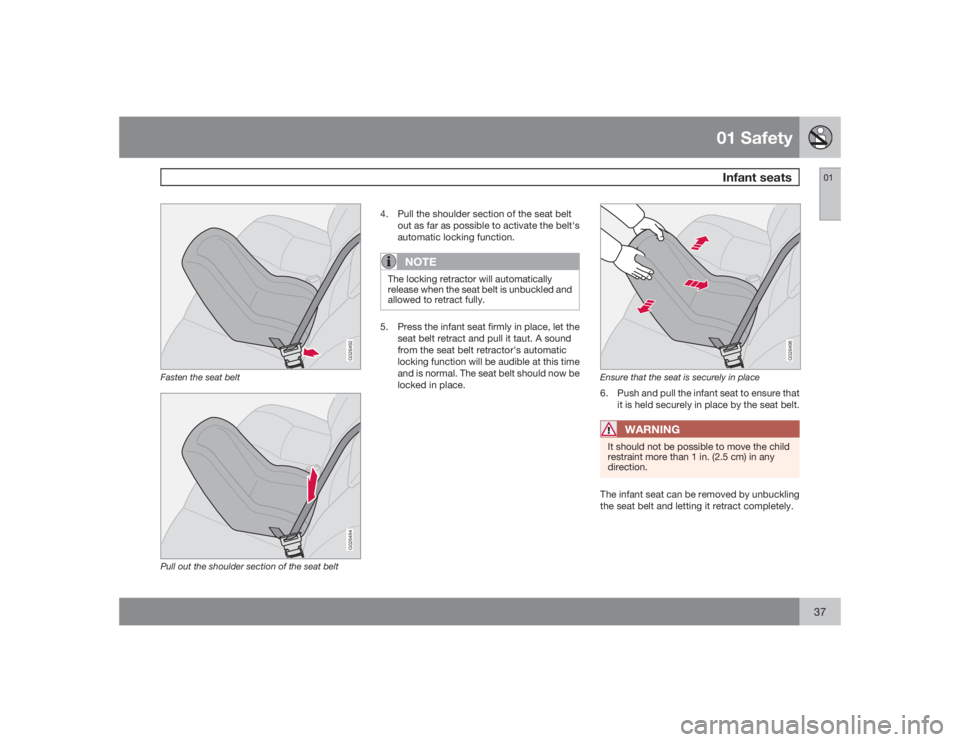
3. Fasten the seat belt by inserting the latch
plate into the buckle (lock) until a distinct
click is audible.
Page 37 of 254
01 SafetyInfant seats
0137
G026492
Fasten the seat belt
G026494
Pull out the shoulder section of the seat belt
4. Pull the shoulder section of the seat belt
out as far as possible to activate the belt's
automatic locking function.
NOTE
The locking retractor will automatically
release when the seat belt is unbuckled and
allowed to retract fully.5. Press the infant seat firmly in place, let the
seat belt retract and pull it taut. A sound
from the seat belt retractor's automatic
locking function will be audible at this time
and is normal. The seat belt should now be
locked in place.
G026498
Ensure that the seat is securely in place6. Push and pull the infant seat to ensure that
it is held securely in place by the seat belt.
WARNING
It should not be possible to move the child
restraint more than 1 in. (2.5 cm) in any
direction.The infant seat can be removed by unbuckling
the seat belt and letting it retract completely.
Page 38 of 254
01 SafetyConvertible seats
0138
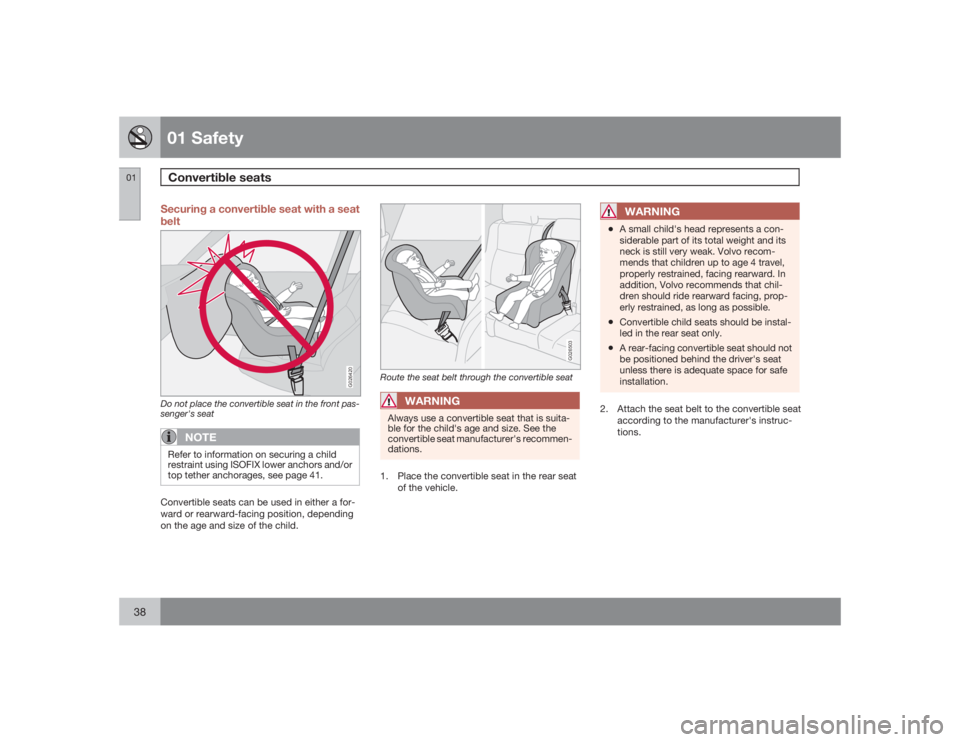
Securing a convertible seat with a seat
belt
G026420
Do not place the convertible seat in the front pas-
senger's seat
NOTE
Refer to information on securing a child
restraint using ISOFIX lower anchors and/or
top tether anchorages, see page 41.Convertible seats can be used in either a for-
ward or rearward-facing position, depending
on the age and size of the child.
G026503
Route the seat belt through the convertible seat
WARNING
Always use a convertible seat that is suita-
ble for the child's age and size. See the
convertible seat manufacturer's recommen-
dations.1. Place the convertible seat in the rear seat
of the vehicle.
WARNING
•A small child's head represents a con-
siderable part of its total weight and its
neck is still very weak. Volvo recom-
mends that children up to age 4 travel,
properly restrained, facing rearward. In
addition, Volvo recommends that chil-
dren should ride rearward facing, prop-
erly restrained, as long as possible.•Convertible child seats should be instal-
led in the rear seat only.•A rear-facing convertible seat should not
be positioned behind the driver's seat
unless there is adequate space for safe
installation.
2. Attach the seat belt to the convertible seat
according to the manufacturer's instruc-
tions.
Page 39 of 254
01 Safety
Convertible seats
0139
G026500
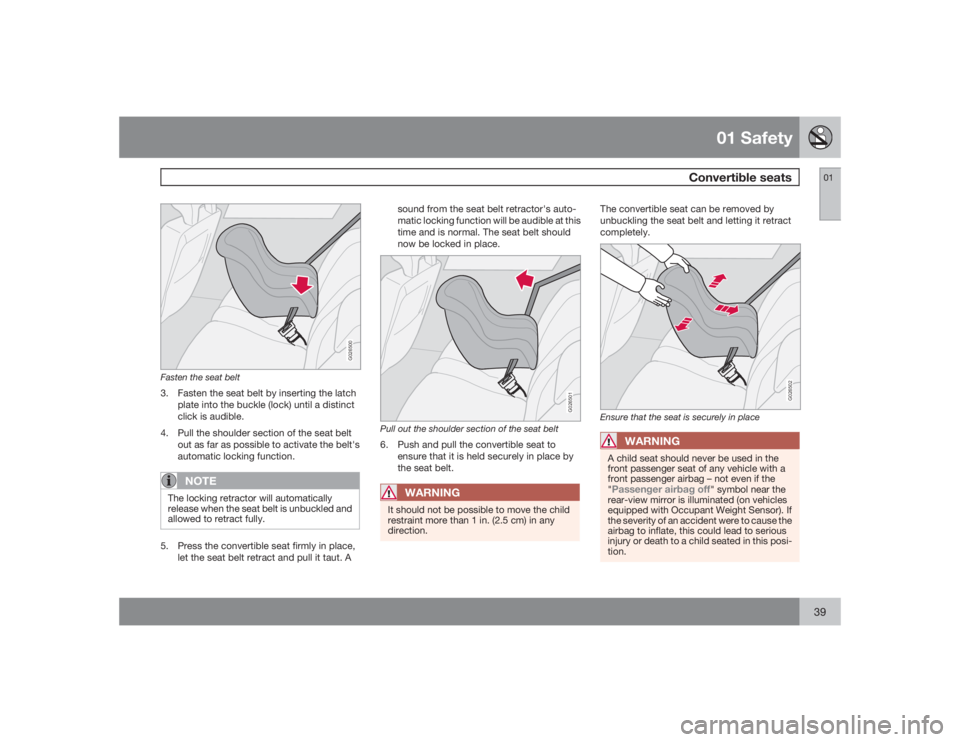
Fasten the seat belt3. Fasten the seat belt by inserting the latch
plate into the buckle (lock) until a distinct
click is audible.
4. Pull the shoulder section of the seat belt
out as far as possible to activate the belt's
automatic locking function.
NOTE
The locking retractor will automatically
release when the seat belt is unbuckled and
allowed to retract fully.5. Press the convertible seat firmly in place,
let the seat belt retract and pull it taut. Asound from the seat belt retractor's auto-
matic locking function will be audible at this
time and is normal. The seat belt should
now be locked in place.
G026501
Pull out the shoulder section of the seat belt6. Push and pull the convertible seat to
ensure that it is held securely in place by
the seat belt.
WARNING
It should not be possible to move the child
restraint more than 1 in. (2.5 cm) in any
direction.
The convertible seat can be removed by
unbuckling the seat belt and letting it retract
completely.
G026502
Ensure that the seat is securely in place
WARNING
A child seat should never be used in the
front passenger seat of any vehicle with a
front passenger airbag – not even if the
"Passenger airbag off
" symbol near the
rear-view mirror is illuminated (on vehicles
equipped with Occupant Weight Sensor). If
the severity of an accident were to cause the
airbag to inflate, this could lead to serious
injury or death to a child seated in this posi-
tion.
Page 40 of 254
01 SafetyBooster cushions
0140
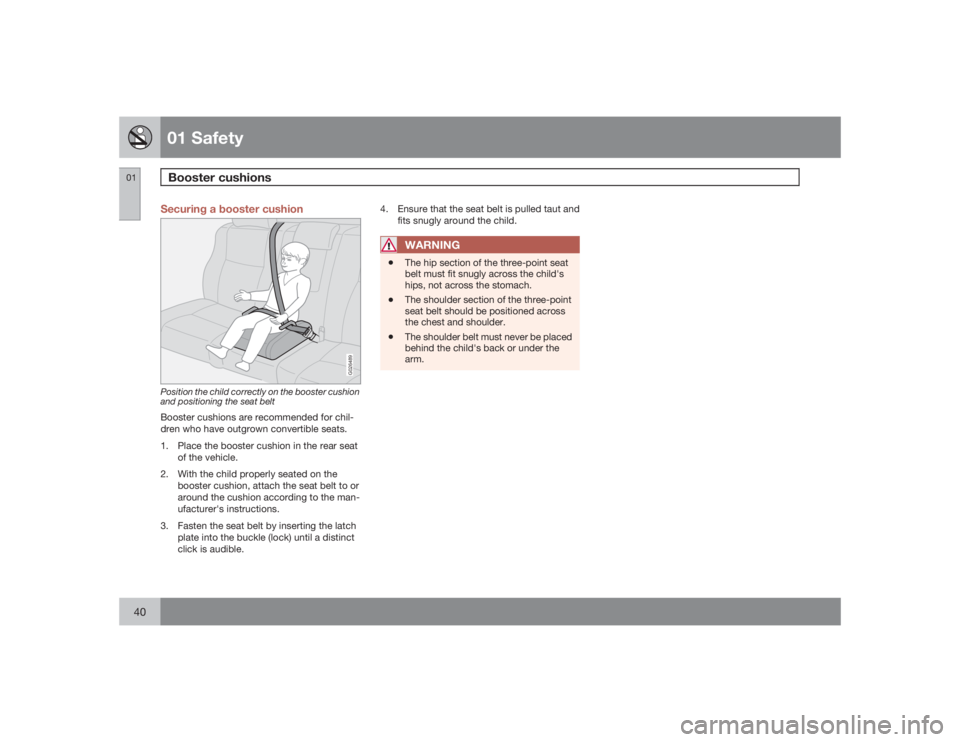
Securing a booster cushion
G026489
Position the child correctly on the booster cushion
and positioning the seat beltBooster cushions are recommended for chil-
dren who have outgrown convertible seats.
1. Place the booster cushion in the rear seat
of the vehicle.
2. With the child properly seated on the
booster cushion, attach the seat belt to or
around the cushion according to the man-
ufacturer's instructions.
3. Fasten the seat belt by inserting the latch
plate into the buckle (lock) until a distinct
click is audible.4. Ensure that the seat belt is pulled taut and
fits snugly around the child.
WARNING
•
The hip section of the three-point seat
belt must fit snugly across the child's
hips, not across the stomach.
•
The shoulder section of the three-point
seat belt should be positioned across
the chest and shoulder.
•
The shoulder belt must never be placed
behind the child's back or under the
arm.
Page 42 of 254
01 SafetyISOFIX lower anchors
0142
WARNING
•
Be sure to fasten the attachment cor-
rectly to the anchor (see the illustration).
If the attachment is not correctly fas-
tened, the child restraint may not be
properly secured in the event of a colli-
sion.
•
The ISOFIX lower child restraint
anchors are only intended for use with
child seats positioned in the outboard
seating positions. These anchors are
not certified for use with any child
restraint that is positioned in the center
seating position. When securing a child
restraint in the center seating position,
use only the vehicle's center seat belt.
Page 43 of 254
01 Safety
Top tether anchors
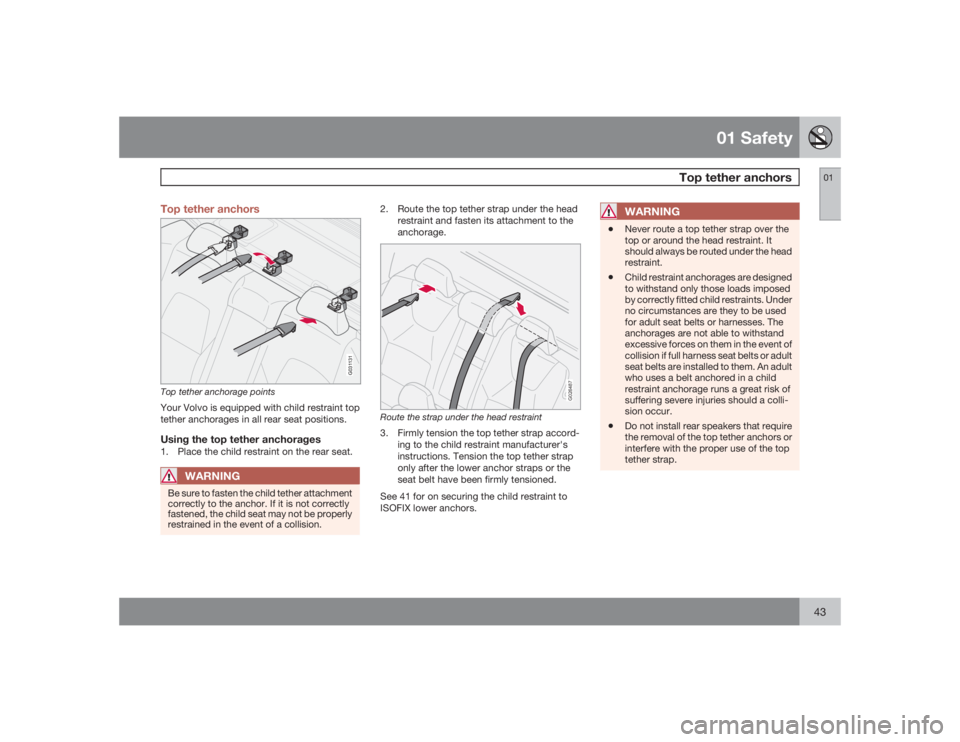
0143 Top tether anchors
G031131
Top tether anchorage pointsYour Volvo is equipped with child restraint top
tether anchorages in all rear seat positions.Using the top tether anchorages1. Place the child restraint on the rear seat.
WARNING
Be sure to fasten the child tether attachment
correctly to the anchor. If it is not correctly
fastened, the child seat may not be properly
restrained in the event of a collision.
2. Route the top tether strap under the head
restraint and fasten its attachment to the
anchorage.
G026487
Route the strap under the head restraint3. Firmly tension the top tether strap accord-
ing to the child restraint manufacturer's
instructions. Tension the top tether strap
only after the lower anchor straps or the
seat belt have been firmly tensioned.
See 41 for on securing the child restraint to
ISOFIX lower anchors.
WARNING
•
Never route a top tether strap over the
top or around the head restraint. It
should always be routed under the head
restraint.
•
Child restraint anchorages are designed
to withstand only those loads imposed
by correctly fitted child restraints. Under
no circumstances are they to be used
for adult seat belts or harnesses. The
anchorages are not able to withstand
excessive forces on them in the event of
collision if full harness seat belts or adult
seat belts are installed to them. An adult
who uses a belt anchored in a child
restraint anchorage runs a great risk of
suffering severe injuries should a colli-
sion occur.
•
Do not install rear speakers that require
the removal of the top tether anchors or
interfere with the proper use of the top
tether strap.
Page 46 of 254
G020901
46
Instrument overview................................................................................ 48
Instrument panel..................................................................................... 50
Indicator and warning symbols............................................................... 52
Buttons in the center console................................................................. 56
Steering wheel adjustment...................................................................... 58
Lighting panel.......................................................................................... 59
Fuel filler door–unlocking manually......................................................... 61
Left-side steering wheel lever................................................................. 62
Right-side steering wheel lever............................................................... 64
Hazard warning flashers, door mirror defroster...................................... 66
Trip computer.......................................................................................... 67
Cruise control.......................................................................................... 69
Parking brake.......................................................................................... 71
12-volt socket......................................................................................... 72
Power windows....................................................................................... 73
Mirrors..................................................................................................... 75
Power moonroof (option)........................................................................ 78
HomeLink® Wireless Control System (option)....................................... 80
Page 49 of 254
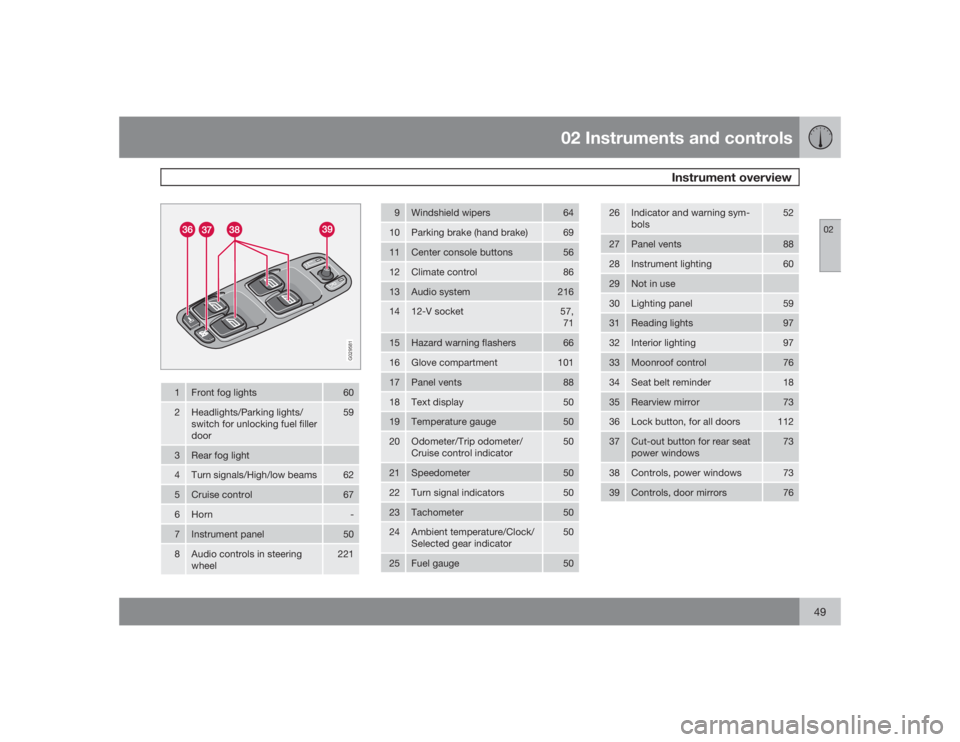
02 Instruments and controls
Instrument overview
0249
G029581
1
Front fog lights
60
2
Headlights/Parking lights/
switch for unlocking fuel filler
door
59
3
Rear fog light
4
Turn signals/High/low beams
62
5
Cruise control
67
6
Horn
-
7
Instrument panel
50
8
Audio controls in steering
wheel
221
9
Windshield wipers
64
10
Parking brake (hand brake)
69
11
Center console buttons
56
12
Climate control
86
13
Audio system
216
14
12-V socket
57,
71
15
Hazard warning flashers
66
16
Glove compartment
101
17
Panel vents
88
18
Text display
50
19
Temperature gauge
50
20
Odometer/Trip odometer/
Cruise control indicator
50
21
Speedometer
50
22
Turn signal indicators
50
23
Tachometer
50
24
Ambient temperature/Clock/
Selected gear indicator
50
25
Fuel gauge
50
26
Indicator and warning sym-
bols
52
27
Panel vents
88
28
Instrument lighting
60
29
Not in use
30
Lighting panel
59
31
Reading lights
97
32
Interior lighting
97
33
Moonroof control
76
34
Seat belt reminder
18
35
Rearview mirror
73
36
Lock button, for all doors
112
37
Cut-out button for rear seat
power windows
73
38
Controls, power windows
73
39
Controls, door mirrors
76
Page 50 of 254
02 Instruments and controlsInstrument panel
0250
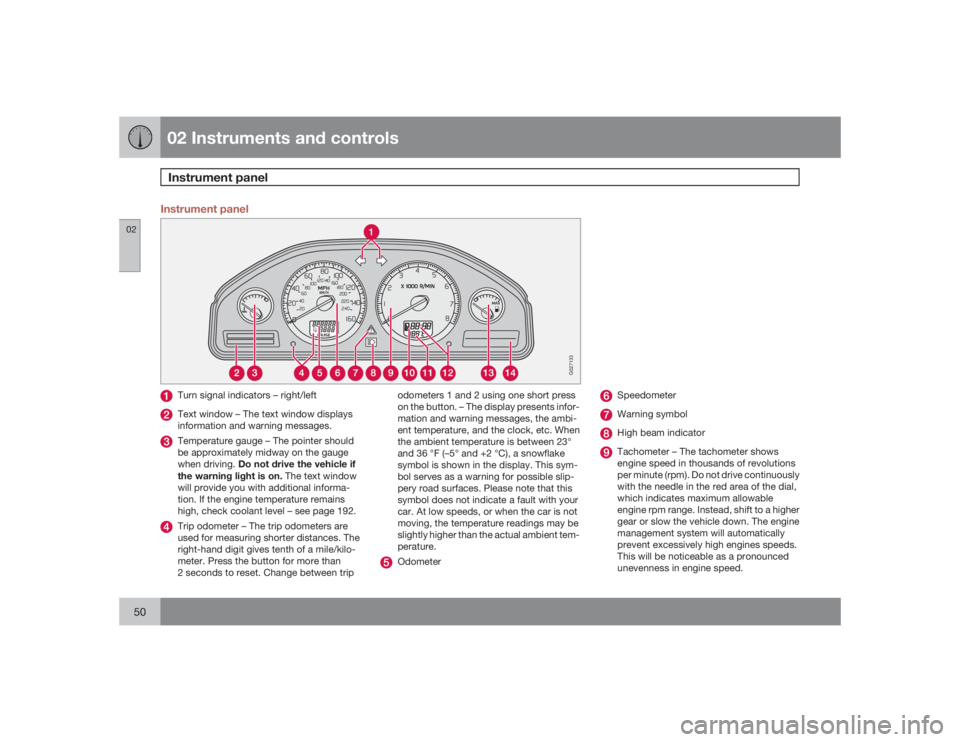
Instrument panel
G027133
Turn signal indicators – right/leftText window – The text window displays
information and warning messages.Temperature gauge – The pointer should
be approximately midway on the gauge
when driving. Do not drive the vehicle if
the warning light is on. The text window
will provide you with additional informa-
tion. If the engine temperature remains
high, check coolant level – see page 192.Trip odometer – The trip odometers are
used for measuring shorter distances. The
right-hand digit gives tenth of a mile/kilo-
meter. Press the button for more than
2 seconds to reset. Change between tripodometers 1 and 2 using one short press
on the button. – The display presents infor-
mation and warning messages, the ambi-
ent temperature, and the clock, etc. When
the ambient temperature is between 23°
and 36 °F (–5° and +2 °C), a snowflake
symbol is shown in the display. This sym-
bol serves as a warning for possible slip-
pery road surfaces. Please note that this
symbol does not indicate a fault with your
car. At low speeds, or when the car is not
moving, the temperature readings may be
slightly higher than the actual ambient tem-
perature.
Odometer
SpeedometerWarning symbolHigh beam indicatorTachometer – The tachometer shows
engine speed in thousands of revolutions
per minute (rpm). Do not drive continuously
with the needle in the red area of the dial,
which indicates maximum allowable
engine rpm range. Instead, shift to a higher
gear or slow the vehicle down. The engine
management system will automatically
prevent excessively high engines speeds.
This will be noticeable as a pronounced
unevenness in engine speed.