wheel VOLVO S60 2009 Owner´s Manual
[x] Cancel search | Manufacturer: VOLVO, Model Year: 2009, Model line: S60, Model: VOLVO S60 2009Pages: 254, PDF Size: 6.17 MB
Page 173 of 254
07 Wheels and tires
Tire Pressure Monitoring System (TPMS) - U.S. models
07
173
NOTE
TPMS indicates low tire pressure but does
not replace normal tire maintenance. For
information on correct tire pressure, please
refer to the tables on pages 158 and 159, or
consult your Volvo retailer.Erasing warning messagesWhen a low tire pressure warning message has
been displayed, and the tire pressure warning
light has come on:•
Use a tire pressure gauge to check the
inflation pressure of all four tires.
•
Re-inflate the tire(s) to the correct pressure
(consult the tire pressure placard or the
tables on pages 158 and 159).
•
Drive the vehicle for several minutes at a
speed of 20 mph (30 km/h) or faster.
This will erase the warning text and the warning
light will go out.WARNING
Incorrect inflation pressure could lead to tire
failure, resulting in a loss of control of the
vehicle.
Changing wheels with TPMSPlease note the following when changing or
replacing the factory installed TPMS wheels/
tires on the vehicle:•
Only the factory-mounted wheels are
equipped with TPMS sensors in the valves.
•
If the vehicle is equipped with a temporary
spare tire, this tire does not have a TPMS
sensor.
•
If wheels without TPMS sensors are moun-
ted on the vehicle,
TIRE PRESS SYST
SERVICE REQUIRED
will be displayed
each time the vehicle is driven above
25 mph (40 km/h) for 10 minutes or more.
•
Once TPMS sensors are properly installed,
the warning message should not reappear.
•
Volvo recommends that TPMS sensors be
fitted on all wheels used on the vehicle.
Volvo does not recommend moving sen-
sors back and forth between sets of
wheels.NOTE
If a tire is changed or if the TPMS sensor is
moved to another wheel, the sensor’s seal,
nut and valve core should be replaced.
CAUTION
When inflating tires with TPMS valves, press
the pump's mouthpiece straight onto the
valve to help avoid bending or otherwise
damaging the valve.
Page 176 of 254
08 Car careWashing and cleaning the vehicle
08176
Washing the vehicle•
The vehicle should be washed at regular
intervals since dirt, dust, insects and tar
spots adhere to the paint and may cause
damage. It is particularly important to wash
the vehicle frequently in the wintertime to
prevent corrosion, when salt has been
used on the roads.
•
When washing the vehicle, do not expose
it to direct sunlight. Use lukewarm water to
soften the dirt before you wash with a
sponge, and plenty of water, to avoid
scratching.
•
Bird droppings: Remove from paintwork as
soon as possible. Otherwise the finish may
be permanently damaged.
•
A detergent can be used to facilitate the
softening of dirt and oil.
•
A water-soluble grease solvent may be
used in cases of sticky dirt. However, use
a wash place equipped with a drainage
separator.
•
Dry the vehicle with a clean chamois and
remember to clean the drain holes in the
doors and rocker panels.
•
Tar spots can be removed with kerosene
or tar remover after the vehicle has been
washed.
•
A stiff-bristle brush and lukewarm soapy
water can be used to clean the wiper
blades. Frequent cleaning of the wind-shield and wiper blades improves visibility
considerably and also helps prolong the
service life of the wiper blades.
•
Wash off the dirt from the underside (wheel
housings, fenders, etc.).
•
In areas of high industrial fallout, more fre-
quent washing is recommended.CAUTION
•
When washing or steam cleaning the
engine, avoid spraying water or steam
directly on the electrical components or
toward the rear side of the engine.
•
Dirt, snow, etc., on the headlights can
reduce lighting capacity considerably.
Clean the headlights regularly, for
example when refueling.
•
During high pressure washing, the
spray mouthpiece must never be closer
to the vehicle than 13 " (30 cm). Do not
spray into the locks.
Special moonroof cautions:
•
Always close the moonroof and sun
shade before washing your vehicle.
•
Never use abrasive cleaning agents on
the moonroof.
•
Never use wax on the rubber seals
around the moonroof.
•
After cleaning the engine, the spark plug
wells should be inspected for water and
blown dry if necessary.
Suitable detergents: Special vehicle washing
detergents should be used. A suitable mixture
is about 2.5 fl. oz. (8.5 cl) of detergent to 2.6 US
gal. (10 liters) of warm water. After washing
with a detergent the vehicle should be well
rinsed with clean water.
Exterior components
Volvo recommends the use of special cleaning
products, available at your Volvo retailer, for
cleaning colored plastic, rubber, or ornamental
components such as chromed strips on the
exterior of your vehicle. The instructions for
using these products should be followed care-
fully. Solvents or stain removers should not be
used.CAUTION
•
Avoid waxing or polishing plastic or rub-
ber components
•
Polishing chromed strips can wear
away or damage the surface
•
Polishes containing abrasive sub-
stances should not be used
Page 178 of 254
08 Car careWashing and cleaning the vehicle
08178
designed for this purpose. Consult your Volvo
retailer.Alcantera™ suede-like materialSuede-like upholstery can be cleaned with a
soft cloth and mild soap solution.Leather careVolvo's leather upholstery is manufactured
with a protectant to repel soiling. Over time,
sunlight, grease and dirt can break down the
protection. Staining, cracking, scuffing, and
fading can result.
Volvo offers an easy-to-use, non-greasy
leather care kit formulated to clean and beau-
tify your vehicle's leather, and to renew the
protective qualities of its finish. The cleaner
removes dirt and oil buildup. The light cream
protectant restores a barrier against soil and
sunlight.
Volvo also offers a special leather softener that
should be applied after the cleaner and pro-
tectant. It leaves leather soft and smooth, and
reduces friction between leather and other fin-
ishes in the vehicle.
Volvo recommends cleaning, protecting and
conditioning your vehicle's leather two to four
times a year. Ask your Volvo retailer about
Leather Care Kit 951 0251 and Leather Soft-
ener 943 7429.
Cleaning leather upholstery1. Pour leather cleaner on a damp sponge
and squeeze it until the cleaner foams.
2. Apply the foam to the stain by moving the
sponge with circular movements.
3. Dampen the stain thoroughly with the
sponge. Let the sponge absorb the stain,
do not rub.
4. Dry the stain with soft paper towels or a
towel, and allow the leather to dry com-
pletely.Protecting leather upholstery1. Put a small amount of protectant cream on
a cloth and apply a thin coating of cream
to the upholstery with light circular move-
ments.
2. Allow the leather to dry for 20 minutes.
This will help the leather resist staining and
protect against sunlight's harmful UV rays.
CAUTION
•
Under no circumstances should gaso-
line, naphtha or similar cleaning agents
be used on the plastic or the leather
since these can cause damage.
•
Take extra care when removing stains
such as ink or lipstick since the coloring
can spread.
•
Use solvents sparingly. Too much sol-
vent can damage the seat padding.
•
Start from the outside of the stain and
work toward the center.
•
Sharp objects (e.g. pencils or pens in a
pocket) or velcro fasteners on clothing
may damage the textile upholstery.
•
Clothing that is not colorfast, such as
new jeans or suede garments, may stain
the upholstery.
Chromed wheels: Clean chrome-plated
wheels using the same detergents used for
the body of the vehicle. Aggressive wheel-
cleaning agents can permanently stain
chrome-plated wheels.
Cleaning the seat beltsClean only with lukewarm water and a mild
soap solution.
Page 193 of 254
09 Maintenance and servicing
Fluids
09
193
WARNING
•
Never remove the radiator cap while the
engine is warm. Wait until the vehicle
cools.
•
If it is necessary to top up the coolant
when the engine is warm, unscrew the
expansion tank cap slowly so that the
overpressure dissipates.
Clutch and brake fluid reservoir
G031030
The clutch and brake fluid should always be
above the MIN mark on the side of the reser-
voir. Check, without removing the cap, that
there is sufficient fluid in the reservoir.Fluid type: DOT 4+ boiling point >536 °F
(280 °C), P/N 9437433.
Replace: Every second year or 30,000 miles
(48,000 km). The fluid should be replaced once
a year or every 15,000 miles (24,000 km) when
driving under extremely hard conditions
(mountain driving, etc.).
Always entrust brake fluid changing to a
trained and qualified Volvo service technician.
Power steering fluid reservoir
ADD FULL
G027200
The fluid level should always be between the
ADD and FULL marks.Fluid type: Volvo synthetic power steering fluid
(Pentosin CHF 11S) P/N 1161529 or equiva-
lent.
Replace: No fluid change required.
NOTE
If a problem should occur in the power
steering system or if the vehicle has no elec-
trical current and must be towed, it is still
possible to steer the vehicle. However, keep
in mind that greater effort will be required to
turn the steering wheel.
Page 209 of 254
09 Maintenance and servicing
Fuses
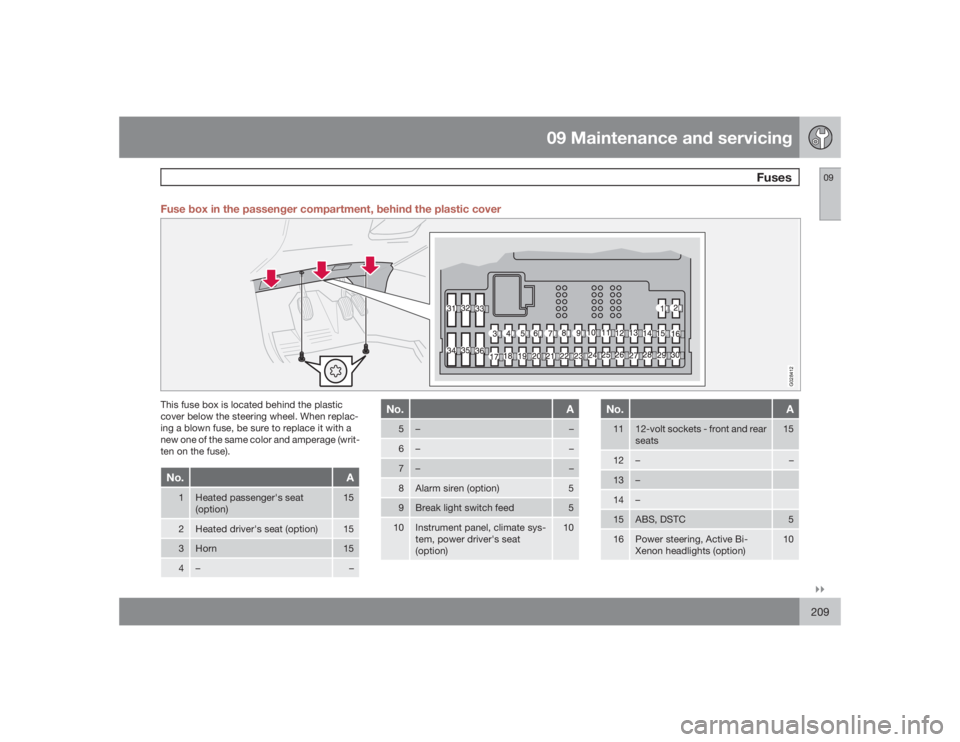
09``209 Fuse box in the passenger compartment, behind the plastic cover
G028412
This fuse box is located behind the plastic
cover below the steering wheel. When replac-
ing a blown fuse, be sure to replace it with a
new one of the same color and amperage (writ-
ten on the fuse).No.
A
1
Heated passenger's seat
(option)
15
2
Heated driver's seat (option)
15
3
Horn
15
4
–
–
No.
A
5
–
–
6
–
–
7
–
–
8
Alarm siren (option)
5
9
Break light switch feed
5
10
Instrument panel, climate sys-
tem, power driver's seat
(option)
10
No.
A
11
12-volt sockets - front and rear
seats
15
12
–
–
13
–
14
–
15
ABS, DSTC
5
16
Power steering, Active Bi-
Xenon headlights (option)
10
Page 211 of 254

09 Maintenance and servicing
Fuses
09``211 Fuse box on the edge of the dashboard
2224 2321
29272826 25
987
19181716
45632
1314151211
38363733
34353132
20
1
10
30
G032340
Fuses are located inside the access panel on
the edge of the dashboard. There are also a
number of spare fuses.No.
A
1
Power driver's seat (option)
25
2
Power passenger's seat
(option)
25
3
Climate system blower
30
4
Control module - front pas-
senger's door
25
No.
A
5
Control module - driver's door
25
6
Ceiling lighting, upper electri-
cal control module
10
7
Moon roof (option)
15
8
Ignition switch, SRS system,
engine control module, immo-
bilizer)
7,5
No.
A
9
Onboard diagnostics, head-
light switch, steering wheel
angle sensor, steering wheel
control module
5
10
Audio system
20
11
Audio system amplifier (option)
30
12
Navigation system display
(option)
10
13 –
38
–
Page 213 of 254
09 Maintenance and servicing
Fuses
09
213
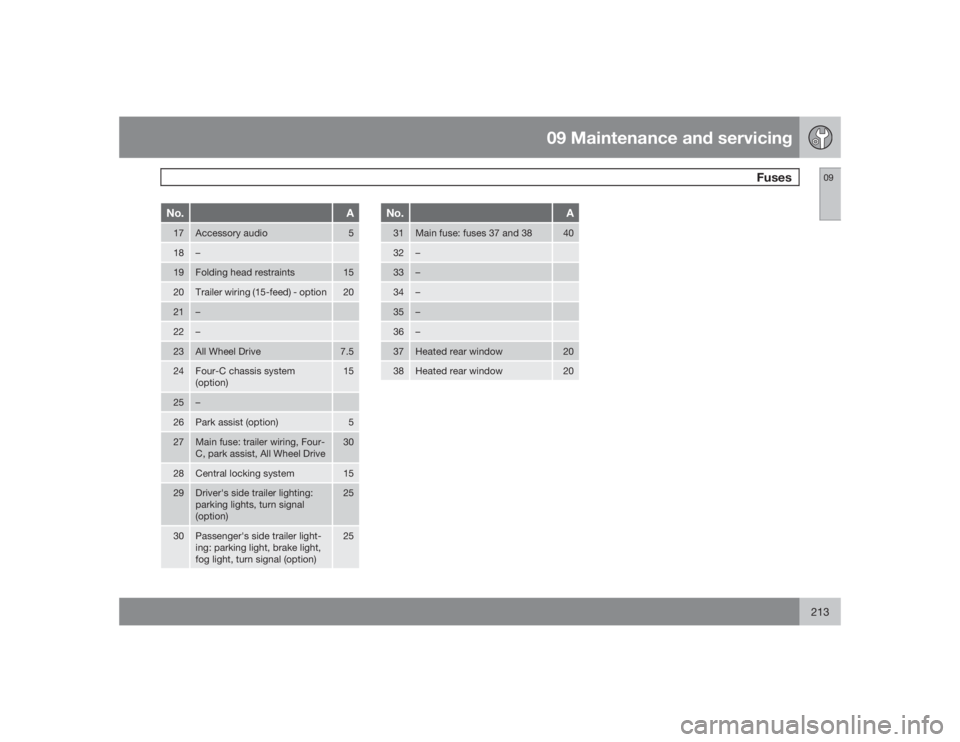
No.
A
17
Accessory audio
5
18
–
19
Folding head restraints
15
20
Trailer wiring (15-feed) - option
20
21
–
22
–
23
All Wheel Drive
7.5
24
Four-C chassis system
(option)
15
25
–
26
Park assist (option)
5
27
Main fuse: trailer wiring, Four-
C, park assist, All Wheel Drive
30
28
Central locking system
15
29
Driver's side trailer lighting:
parking lights, turn signal
(option)
25
30
Passenger's side trailer light-
ing: parking light, brake light,
fog light, turn signal (option)
25
No.
A
31
Main fuse: fuses 37 and 38
40
32
–
33
–
34
–
35
–
36
–
37
Heated rear window
20
38
Heated rear window
20
Page 216 of 254

10 AudioIntroduction
10216
The audio system in your vehicle is operated
with the buttons and knobs in the system's
front panel. Certain functions, such as adjust-
ing the volume, changing radio stations or
tracks on a CD, etc, can also be controlled with
the steering wheel-mounted keypad.
The audio system is available in two versions:HU-650Features: AM/FM radio, single-disc CD player,
4×25W output, six
1 speakers.
HU-850Features: AM/FM radio, integrated 6-disc CD
changer, 4×50W or 4×70W output plus 25W
Dolby Pro Logic II, eleven speakers.Compact disc care•
Keep the discs clean. Wipe them with a
soft, clean, lint-free cloth, working from the
center outwards. If necessary, dampen the
cloth with a neutral soap solution. Dry thor-
oughly before using.
•
Never use cleaning spray or antistatic liq-
uid. Use only cleaners specifically made for
CDs.
•
Use discs of the correct size only (3.5"
discs should never be used).
•
The discs should conform to the norms
EN60908 (IEC60908). CDR discs cancause listening problems due to the quality
of the disc or recording equipment used.
•
Do not put tape or labels on the disc itself.
•
Volvo does not recommend the use of
plastic outer rings on the disc.
•
Condensation may occur on discs/optical
components of the changer in cold winter
weather. The disc can be dried with a
clean, lint-free cloth. Optical components
in the CD changer may, however, take up
to one hour to dry off.
•
Never attempt to play a disc which is dam-
aged in any way.
•
When not in use, the discs should be
stored in their covers. Avoid storing discs
in excessive heat, direct sunlight or dusty
locations.
1T5 and 2.5T/2.5T AWD with the Premium package: eight speakers
Page 219 of 254

10 Audio
Radio functions HU-650/HU-850
10``219
Switch on/off
Press the knob to switch on or
turn off the radio.
Volume controlTurn the knob clockwise to increase volume.
Volume control is electronic and does not have
an end stop. If you have a key pad in the steer-
ing wheel, increase or decrease the volume
with the + or – buttons.Volume control - ALARMIf a CD is playing when the radio receives an
alarm bulletin (available in certain areas only),
the CD player enters pause mode. The bulletin
is broadcast at the volume selected for this
type of message.
G026678
Auxiliary (AUX) 3.5 mm connector portAfter the bulletin has been completed, the
audio system reverts to the originally selected
sound.AUX connector (option)The AUX (auxiliary) port can be used to connect
external devices such as an mp3 player.
Turn the SOURCE control (see the illustrations
on on page 217 or 218) to choose AUX.
If the player is being charged through a 12-volt
socket while it is connect to the AUX port,
sound quality may be impaired.
The volume of the external sound source AUX
may be different from the volume of the internalsound sources such as the CD player or the
radio.
To change the AUX volume level:
1. While playing the radio or a CD, lower the
audio volume to about one-quarter.
2. Switch to AUX mode on the audio system.
3. Connect the headphone output from your
music player to the AUX input using a cable
with a stereo 3.5mm miniplug at both ends.
4. Set your music player's headphone vol-
ume to three-quarters using the player's
volume controls.
5.
PressSOURCE, turn the SOURCE knob,
select
ADVANCED MENU
and press
SOURCE.
6.
Press the SOURCE knob, turn to AUDIO
SETTINGS and press SOURCE.
7.
Press the SOURCE knob, turn to
AUX
INPUT
and press SOURCE.
8. Turn the volume knob to raise or lower the
AUX Input Volume
until you hear music at
a comfortable level.
9. If there is distortion, lower your music play-
er's headphone volume until the distortion
goes away.
10. Finally, exit the menu and adjust the audio
volume to a comfortable level.
Page 221 of 254

10 Audio
Radio functions HU-650/HU-850
10``221 Selecting a sound source
The sound source (e.g. AM,
FM, etc.) can be selected in two
ways:
•
Use the sound source buttons (see the
center illustration above).
•
Turn the SOURCE knob (see illustration) to
select a sound source (AM1, AM2, FM1,
FM2, FM3, or CD). Press the knob to select
theAM or FMband of your choice.
The sound source selected will be shown in the
display.
Scan
Press the SCAN button to start
the station scan function. When
a station is found, scanning
stops for approximately 10 sec-
onds, after which scanning will
continue.
Press the SCAN or SOURCE button when a
station has been found if you would like to lis-
ten to that station and to discontinue the scan
function.
Station seek up/downPress
or
to start the seek func-
tion. The radio seeks the next audible station
and tunes it in. Repeat the procedure to con-
tinue the seek function.
Manual station searchPress
or
and hold it down.
MAN will be shown in the display. The radio
scans slowly in the selected direction and will
increase the scanning speed after a few sec-
onds. Release the button when the desired
frequency appears in the display.
The frequency can be fine-tuned by short
presses on the or
keys.
The system will remain in manual search mode
for 5 seconds after the button is released, after
which it will return to seek mode.
Steering wheel key pad (option)
G027901
If the vehicle is equipped with the key pad in
the steering wheel press the right or left arrow
to switch between preset stations.