warning VOLVO S60 2009 Owner´s Manual
[x] Cancel search | Manufacturer: VOLVO, Model Year: 2009, Model line: S60, Model: VOLVO S60 2009Pages: 254, PDF Size: 6.17 MB
Page 165 of 254

07 Wheels and tiresUniform Tire Quality Grading
07
165
ALL PASSENGER VEHICLE TIRES MUST
CONFORM TO FEDERAL SAFETY
REQUIREMENTS IN ADDITION TO THESE
GRADES
Quality grades can be found, where applicable,
on the tire sidewall between the tread shoulder
and maximum section width. For example:
Treadwear 200 Traction AA Temperature ATREADWEARThe treadwear grade is a comparative rating
based on the wear rate of the tire when tested
under controlled conditions on a specified gov-
ernment test course. For example, a tire gra-
ded 150 would wear one and one half (1 1/2)
times as well on the government course as a
tire graded 100. The relative performance of
tires depends upon the actual conditions of
their use, however, and many depart signifi-
cantly from the norm due to variation in driving
habits, maintenance practices and differences
in road characteristics and climate.
TRACTIONThe traction grades, from highest to lowest, are
AA, A, B, and C, as measured under controlled
conditions on specified government test sur-
faces of asphalt and concrete. A tire marked C
may have poor traction performance.
WARNING
The traction grade assigned to this tire is
based on braking (straight-ahead) traction
tests and is not a measure of cornering
(turning) traction.TEMPERATUREThe temperature grades are AA (the highest),
A, B, and C, representing the tire's resistance
to the generation of heat and its ability to dis-
sipate heat when tested under controlled con-
ditions on a specified indoor laboratory test
wheel. Sustained high temperature can cause
the material of the tire to degenerate and
reduce tire life, and excessive temperature can
lead to sudden tire failure. The grade C corre-
sponds to a minimum level of performance that
all passenger vehicle tires must meet under the
Federal Motor Safety Standard No. 109.
Grades B and A represent higher levels of per-
formance on the laboratory test wheel than the
minimum required by law.
WARNING
The temperature grade for this tire is estab-
lished for a tire that is properly inflated and
not overloaded. Excessive speed, underin-
flation, or excessive loading, either sepa-
rately or in combination, can cause heat
buildup and tire failure.
Page 167 of 254
07 Wheels and tires
Temporary spare
07
167
The spare tire in your vehicle is called a "Tem-
porary Spare".
Recommended tire pressure (see the placard
on the B-pillar or on the fuel filler door) should
be maintained irrespective of which position on
the vehicle the temporary spare tire is used on.
In the event of damage to this tire, a new one
can be purchased from your Volvo retailer.
WARNING
Current legislation prohibits the use of the
"Temporary Spare" tire other than as a tem-
porary replacement for a punctured tire. It
must be replaced as soon as possible by a
standard tire. Road holding and handling
may be affected with the "Temporary
Spare" in use. Do not exceed 50 mph
(80 km/h).
CAUTION
The vehicle must not be driven with wheels
of different dimensions or with a spare tire
other than the one that came with the vehi-
cle. The use of different size wheels can
seriously damage your vehicle's transmis-
sion.
Page 171 of 254
07 Wheels and tires
Changing wheels
07
171
WARNING
•
The jack must correctly engage the jack
attachment.
•
Be sure the jack is on a firm, level, non-
slippery surface.
•
Never allow any part of your body to be
extended under a vehicle supported by
a jack.
•
Use the jack intended for the vehicle
when changing a tire. For any other job,
use stands to support the vehicle.
•
Apply the parking brake and put the
gear selector in the Park (P) position.
•
Block the wheels standing on the
ground, use rigid wooden blocks or
large stones.
•
The jack should be kept well-greased
and clean, and should not be damaged.
•
No objects should be placed between
the base of jack and the ground, or
between the jack and the attachment
bar on the vehicle.
The jack and tools should be returned to their
storage spaces. The jack should be cranked
down fully so that it fits into the intended space.
Page 172 of 254
07 Wheels and tiresTire Pressure Monitoring System (TPMS) - U.S. models
07172
The tire pressure monitoring system uses sen-
sors mounted in the tire valves to check infla-
tion pressure levels. When the vehicle is
moving at a speed of approximately 20 mph
(30 km/h) or faster, these sensors transmit
inflation pressure data to a receiver located in
the vehicle.USA - FCC ID: MRXG403MA4
A
This device complies with part 15 of the FCC
rules. Operation is subject to the following
conditions: (1) This device may not cause
harmful interference, and (2) this device
must accept any interference received,
including interference that may cause unde-
sired operation.AOn certain models, the FCC code is MRXTG315AM04When low inflation pressure is detected, TPMS
will light up the tire pressure warning light (also
referred to as a telltale) in the instrument panel,
and will display a message in the text window.
The wording of this message is determined by
the degree of inflation pressure loss.
NOTE
If a fault occurs in TPMS, the tire pressure
warning light will flash for approximately
1 minute and
TIRE PRESS SYST
SERVICE REQUIRED
will be displayed.
Each tire, including the spare (if provided),
should be checked monthly when cold and
inflated to the inflation pressure recommended
by the vehicle manufacturer on the vehicle
placard or tire inflation pressure label. (If your
vehicle has tires of a different size than the size
indicated on the vehicle placard or tire inflation
pressure label, you should determine the
proper tire inflation pressure for those tires.)
As an added safety feature, your vehicle has
been equipped with a tire pressure monitoring
system (TPMS) that illuminates a low tire pres-
sure telltale when one or more of your tires is
significantly under-inflated. Accordingly, when
the low tire pressure telltale illuminates, you
should stop and check your tires as soon as
possible, and inflate them to the proper pres-
sure. Driving on a significantly under-inflated
tire causes the tire to overheat and can lead to
tire failure. Under-inflation also reduces fuel
efficiency and tire tread life, and may affect the
vehicle's handling and stopping ability.
Please note that the TPMS is not a substitute
for proper tire maintenance, and it is the driv-er's responsibility to maintain correct tire pres-
sure, even if under-inflation has not reached
the level to trigger illumination of the TPMS low
tire pressure telltale.
Your vehicle has also been equipped with a
TPMS malfunction indicator to indicate when
the system is not operating properly. The
TPMS malfunction indicator is combined with
the low tire pressure telltale. When the system
detects a malfunction, the telltale will flash for
approximately one minute and then remain
continuously illuminated. This sequence will
continue upon subsequent vehicle start-ups as
long as the malfunction exists. When the mal-
function indicator is illuminated, the system
may not be able to detect or signal low tire
pressure as intended. TPMS malfunctions may
occur for a variety of reasons, including the
installation of replacement or alternate tires or
wheels on the vehicle that prevent the TPMS
from functioning properly. Always check the
TPMS malfunction telltale after replacing one
or more tires or wheels on your vehicle to
ensure that the replacement or alternate tires
and wheels allow the TPMS to continue to
function properly.
Page 173 of 254
07 Wheels and tires
Tire Pressure Monitoring System (TPMS) - U.S. models
07
173
NOTE
TPMS indicates low tire pressure but does
not replace normal tire maintenance. For
information on correct tire pressure, please
refer to the tables on pages 158 and 159, or
consult your Volvo retailer.Erasing warning messagesWhen a low tire pressure warning message has
been displayed, and the tire pressure warning
light has come on:•
Use a tire pressure gauge to check the
inflation pressure of all four tires.
•
Re-inflate the tire(s) to the correct pressure
(consult the tire pressure placard or the
tables on pages 158 and 159).
•
Drive the vehicle for several minutes at a
speed of 20 mph (30 km/h) or faster.
This will erase the warning text and the warning
light will go out.WARNING
Incorrect inflation pressure could lead to tire
failure, resulting in a loss of control of the
vehicle.
Changing wheels with TPMSPlease note the following when changing or
replacing the factory installed TPMS wheels/
tires on the vehicle:•
Only the factory-mounted wheels are
equipped with TPMS sensors in the valves.
•
If the vehicle is equipped with a temporary
spare tire, this tire does not have a TPMS
sensor.
•
If wheels without TPMS sensors are moun-
ted on the vehicle,
TIRE PRESS SYST
SERVICE REQUIRED
will be displayed
each time the vehicle is driven above
25 mph (40 km/h) for 10 minutes or more.
•
Once TPMS sensors are properly installed,
the warning message should not reappear.
•
Volvo recommends that TPMS sensors be
fitted on all wheels used on the vehicle.
Volvo does not recommend moving sen-
sors back and forth between sets of
wheels.NOTE
If a tire is changed or if the TPMS sensor is
moved to another wheel, the sensor’s seal,
nut and valve core should be replaced.
CAUTION
When inflating tires with TPMS valves, press
the pump's mouthpiece straight onto the
valve to help avoid bending or otherwise
damaging the valve.
Page 177 of 254
08 Car care
Washing and cleaning the vehicle
08``177
NOTE
When washing the vehicle, remember to
remove dirt from the drain holes in the doors
and sills
WARNING
When the vehicle is driven immediately after
being washed, apply the brakes several
times in order to remove any moisture from
the brake linings.
Engine cleaning agents should not be used
when the engine is warm. This constitutes a
fire risk.Automatic washing - simple and quick•
We do NOT recommend washing your
vehicle in an automatic wash during the
first six months (because the paint will not
have hardened sufficiently).
•
An automatic wash is a simple and quick
way to clean your vehicle, but it is worth
remembering that it may not be as thor-
ough as when you yourself go over the
vehicle with sponge and water. Keeping
the underbody clean is most important,
especially in the winter. Some automatic
washers do not have facilities for washing
the underbody.
•
Before driving into an automatic vehicle
wash, make sure that side view mirrors,auxiliary lamps, etc, are secure, and that
any antenna(s) are retracted or removed.
Otherwise there is risk of the machine dis-
lodging them.
Exterior lightingCondensation may form temporarily on the
inside of the lenses of exterior lights such as
headlights, fog lights, or tail lights. This is nor-
mal and the lights are designed to withstand
moisture. Normally, condensation will dissi-
pate after the lights have been on for a short
time.Polishing and waxing•
Normally, polishing is not required during
the first year after delivery, however, wax-
ing may be beneficial.
•
Before applying polish or wax the vehicle
must be washed and dried. Tar spots can
be removed with kerosene or tar remover.
Difficult spots may require a fine rubbing
compound.
•
After polishing use liquid or paste wax.
•
Several commercially available products
contain both polish and wax.
•
Waxing alone does not substitute for pol-
ishing a dull surface.
•
A wide range of polymer-based vehicle
waxes can be purchased today. Thesewaxes are easy to use and produce a long-
lasting, high-gloss finish that protects the
bodywork against oxidation, road dirt and
fading.
•
Do not polish or wax your vehicle in direct
sunlight (the surface of the vehicle should
not be warmer than 113 ° F (45 ° C).CAUTION
Volvo does not recommend the use of long-
life or durable paint protection coatings,
some of which may claim to prevent pitting,
fading, oxidation, etc. These coatings have
not been tested by Volvo for compatibility
with your vehicle's clear coat. Some of them
may cause the clear coat to soften, crack,
or cloud. Damage caused by application of
paint protection coatings may not be cov-
ered under your vehicle's paint warranty.Cleaning the upholsteryFabricClean with soapy water or a detergent. For
more difficult spots caused by oil, ice cream,
shoe polish, grease, etc., use a clothing/fabric
stain remover. Consult your Volvo retailer.Interior plastic componentsCleaning interior plastic components should
be done with a cleaning agent specially
Page 187 of 254
09 Maintenance and servicing
Working on your vehicle
09``187
G027252
Note the following before you begin working
on your vehicleBattery•
Ensure that the battery cables are correctly
connected and tightened.
•
Never disconnect the battery when the
engine is running (e.g. when replacing the
battery).
•
Never use a fast charger to charge the bat-
tery. The battery cables should be discon-
nected when recharging.
•
The battery contains acid that is both cor-
rosive and poisonous. It is important that
the battery is handled in an environmen-
tally friendly way. Let your Volvo dealer
assist you.
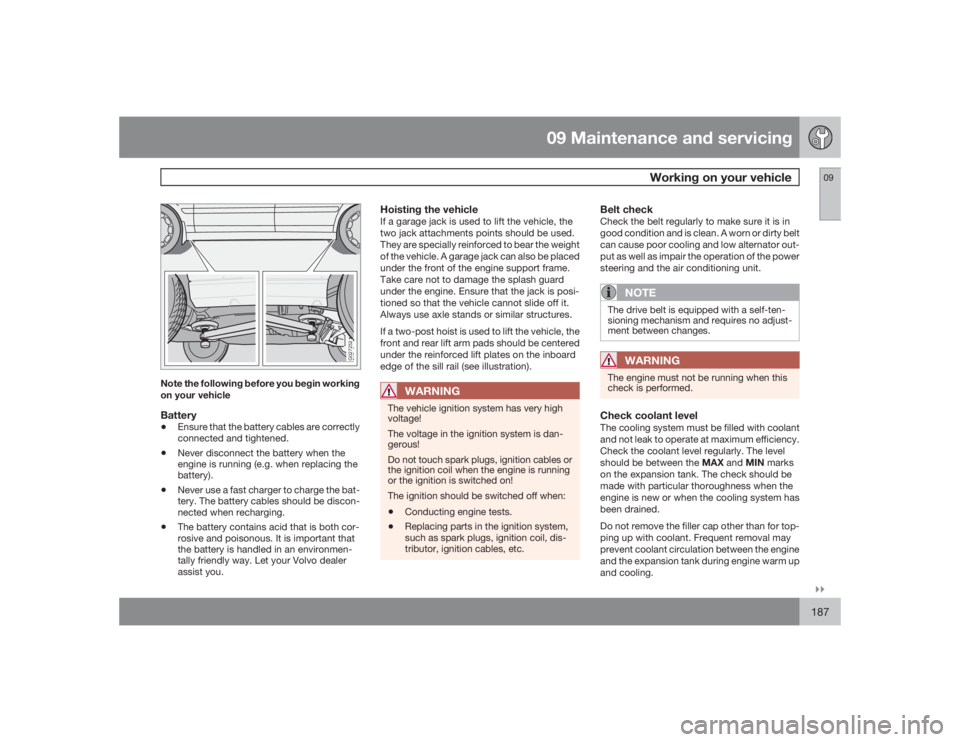
Hoisting the vehicleIf a garage jack is used to lift the vehicle, the
two jack attachments points should be used.
They are specially reinforced to bear the weight
of the vehicle. A garage jack can also be placed
under the front of the engine support frame.
Take care not to damage the splash guard
under the engine. Ensure that the jack is posi-
tioned so that the vehicle cannot slide off it.
Always use axle stands or similar structures.
If a two-post hoist is used to lift the vehicle, the
front and rear lift arm pads should be centered
under the reinforced lift plates on the inboard
edge of the sill rail (see illustration).
WARNING
The vehicle ignition system has very high
voltage!
The voltage in the ignition system is dan-
gerous!
Do not touch spark plugs, ignition cables or
the ignition coil when the engine is running
or the ignition is switched on!
The ignition should be switched off when:•
Conducting engine tests.
•
Replacing parts in the ignition system,
such as spark plugs, ignition coil, dis-
tributor, ignition cables, etc.
Belt checkCheck the belt regularly to make sure it is in
good condition and is clean. A worn or dirty belt
can cause poor cooling and low alternator out-
put as well as impair the operation of the power
steering and the air conditioning unit.
NOTE
The drive belt is equipped with a self-ten-
sioning mechanism and requires no adjust-
ment between changes.
WARNING
The engine must not be running when this
check is performed.Check coolant levelThe cooling system must be filled with coolant
and not leak to operate at maximum efficiency.
Check the coolant level regularly. The level
should be between the MAX and MIN marks
on the expansion tank. The check should be
made with particular thoroughness when the
engine is new or when the cooling system has
been drained.
Do not remove the filler cap other than for top-
ping up with coolant. Frequent removal may
prevent coolant circulation between the engine
and the expansion tank during engine warm up
and cooling.
Page 188 of 254
09 Maintenance and servicingWorking on your vehicle
09188
Changing coolantNormally, the coolant does not need to be
changed. If the system must be drained, con-
sult a trained and qualified Volvo service tech-
nician.
NOTE
Do not top off with water only. This reduces
the rust-protective and antifreeze qualities
of the coolant and has a lower boiling point.
It can also cause damage to the cooling
system if it should freeze. Top off with Volvo
Genuine Coolant/Antifreeze only (a
50/50 mix of water and antifreeze)
CAUTION
The cooling system must always be kept
filled to the correct level. If it is not kept filled,
there can be high local temperatures in the
engine which could result in damage. Dif-
ferent types of antifreeze/coolant may not
be mixed.
WARNING
Never remove the radiator cap while the
engine is warm. Wait until the vehicle cools.
Page 189 of 254
09 Maintenance and servicing
Hood and engine compartment
09
189
G027253
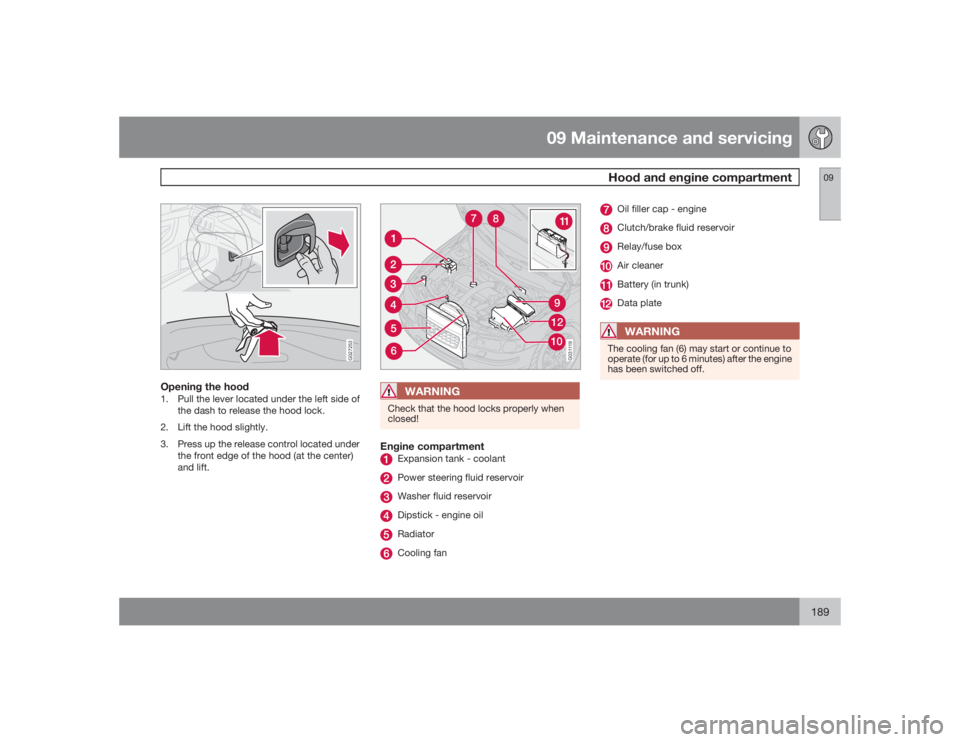
Opening the hood1. Pull the lever located under the left side of
the dash to release the hood lock.
2. Lift the hood slightly.
3. Press up the release control located under
the front edge of the hood (at the center)
and lift.
7
8
9
10
612
G031119
WARNING
Check that the hood locks properly when
closed!Engine compartment
Expansion tank - coolantPower steering fluid reservoirWasher fluid reservoirDipstick - engine oilRadiatorCooling fan
Oil filler cap - engineClutch/brake fluid reservoirRelay/fuse boxAir cleanerBattery (in trunk)Data plateWARNING
The cooling fan (6) may start or continue to
operate (for up to 6 minutes) after the engine
has been switched off.
Page 191 of 254
09 Maintenance and servicing
Engine oil
09
191
NOTE
Volvo uses different systems to indicate a
low oil level or pressure. Some models have
an oil pressure sensor, in which case a
warning symbol (see page 52) is used to
indicate low oil pressure. Other models have
an oil level sensor, in which case the driver
is alerted by the warning symbol in the cen-
ter of the instrument panel and a text in the
information display. Some models use both
systems. Contact a trained and qualified
Volvo service technician for more informa-
tion.Changing engine oil and oil filterSee the information on oil specifications above
and page 240 for oil volumes. Refer to the
Warranty and Service Records Information
booklet for information on the oil change inter-
vals.
NOTE
•
Volvo does not recommend the use of
oil additives.
•
Synthetic oil is not used when the oil is
changed at the normal maintenance
intervals except at owner request and at
additional charge. Please consult a
trained and qualified Volvo service tech-
nician.
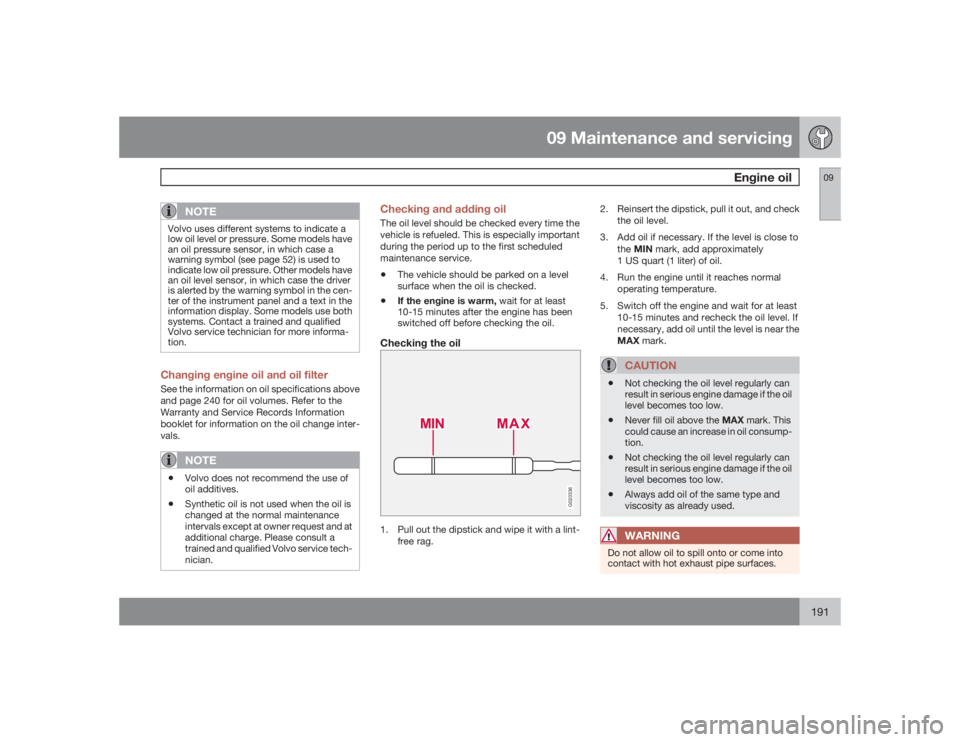
Checking and adding oilThe oil level should be checked every time the
vehicle is refueled. This is especially important
during the period up to the first scheduled
maintenance service.•
The vehicle should be parked on a level
surface when the oil is checked.
•
If the engine is warm, wait for at least
10-15 minutes after the engine has been
switched off before checking the oil.
Checking the oil
G020336
1. Pull out the dipstick and wipe it with a lint-
free rag.2. Reinsert the dipstick, pull it out, and check
the oil level.
3. Add oil if necessary. If the level is close to
theMINmark, add approximately
1 US quart (1 liter) of oil.
4. Run the engine until it reaches normal
operating temperature.
5. Switch off the engine and wait for at least
10-15 minutes and recheck the oil level. If
necessary, add oil until the level is near the
MAX mark.
CAUTION
•
Not checking the oil level regularly can
result in serious engine damage if the oil
level becomes too low.
•
Never fill oil above the MAX mark. This
could cause an increase in oil consump-
tion.
•
Not checking the oil level regularly can
result in serious engine damage if the oil
level becomes too low.
•
Always add oil of the same type and
viscosity as already used.WARNING
Do not allow oil to spill onto or come into
contact with hot exhaust pipe surfaces.