fuel VOLVO S60 2014 Owner´s Manual
[x] Cancel search | Manufacturer: VOLVO, Model Year: 2014, Model line: S60, Model: VOLVO S60 2014Pages: 386, PDF Size: 11.24 MB
Page 318 of 386
08 Wheels and tires
Tire Pressure Monitoring System (TPMS)
08
316
Introduction
NOTE
USA – FCC ID: KR5S122780002 This device complies with part 15 of the FCC rules. Operation is subject to the fol-lowing conditions: (1) This device may notcause harmful interference, and (2) thisdevice must accept any interferencereceived, including interference that maycause undesired operation.
The tire pressure monitoring system1
uses
sensors mounted in the tire valves to check inflation pressure levels. When the vehicle ismoving at a speed of approximately 20 mph(30 km/h) or faster, these sensors transmitinflation pressure data to a receiver located inthe vehicle. When low inflation pressure is detected or if a sensor is not functioning properly, TPMS will light up the tire pressure warning light (
)
(also referred to as a telltale) in the instrument panel and will display one of the following messages in the text window:
Tire pressure
low or
Tire needs air now.
NOTE
If a fault occurs in TPMS, the tire pressure warning light will flash for approximately 1 minute and
Tire press. syst Service
required will be displayed.
Each tire, including the spare 2
(if provided),
should be checked monthly when cold and inflated to the inflation pressure recom-mended by the vehicle manufacturer on thevehicle placard or tire inflation pressure label.(If your vehicle has tires of a different sizethan the size indicated on the vehicle placardor tire inflation pressure label, you shoulddetermine the proper tire inflation pressure forthose tires.) As an added safety feature, your vehicle has been equipped with a tire pressure monitor-ing system (TPMS) that illuminates a low tirepressure telltale when one or more of yourtires is significantly under-inflated. Accord-ingly, when the low tire pressure telltale illu-minates, you should stop and check yourtires as soon as possible, and inflate them tothe proper pressure. Driving on a significantlyunder-inflated tire causes the tire to overheatand can lead to tire failure. Under-inflationalso reduces fuel efficiency and tire tread life, and may affect the vehicle's handling andstopping ability. Please note that the TPMS is not a substitute for proper tire maintenance, and it is the driv-er's responsibility to maintain correct tirepressure, even if under-inflation has notreached the level to trigger illumination of theTPMS low tire pressure telltale. Your vehicle has also been equipped with a TPMS malfunction indicator to indicate whenthe system is not operating properly. TheTPMS malfunction indicator is combined withthe low tire pressure telltale. When the sys-tem detects a malfunction, the telltale willflash for approximately one minute and thenremain continuously illuminated. Thissequence will continue upon subsequentvehicle start-ups as long as the malfunctionexists. When the malfunction indicator is illu-minated, the system may not be able todetect or signal low tire pressure as intended.TPMS malfunctions may occur for a variety ofreasons, including the installation of replace-ment or alternate tires or wheels on the vehi-cle that prevent the TPMS from functioningproperly. Always check the TPMS malfunc-tion telltale after replacing one or more tiresor wheels on your vehicle to ensure that the
1
Not available in all markets or in all models.
2 Available as an accessory
Page 325 of 386
09 Maintenance and specifications
Maintaining your car09
323
Owner maintenance
Periodic maintenance requirements and inter- vals are described in your vehicle's Warrantyand Service Records Information booklet. The following points can be carried out between the normally scheduled maintenanceservices.
Each time the car is refueled:
•Check the engine oil level.
• Clean the windshield, windshield wipers, headlights, and taillights.
Monthly:
• Check cold tire pressure in all tires.Inspect the tires for wear.
• Check that engine coolant and other fluidlevels are between the indicated "min"and "max" markings.
• Clean interior glass surfaces with a glasscleaner and soft paper towels.
• Wipe driver information displays with asoft cloth.
• Visually inspect battery terminals for cor-rosion. Corrosion may indicate a looseterminal connector, or a battery near theend of its useful service life. Consult yourVolvo retailer for additional information.
As needed:Wash the car, including the undercarriage, to reduce wear that can be caused by a buildupof dirt, and corrosion that can be caused bysalt residues. Clean leaves and twigs from air intake vents at the base of the windshield, and from otherplaces where they may collect.
NOTE
Complete service information for qualified technicians is available online for purchaseor subscription at www.volvotechinfo.com.
Hoisting the vehicle
If a garage jack is used to lift the vehicle, the two jack attachments points should be used. They are specially reinforced to bear theweight of the vehicle. A garage jack can alsobe placed under the front of the engine sup-port frame. Take care not to damage thesplash guard under the engine. Ensure thatthe jack is positioned so that the vehicle can-not slide off it. Always use axle stands or sim-ilar structures. If a two-post hoist is used to lift the vehicle, the front and rear lift arm pads should becentered under the reinforced lift plates onthe inboard edge of the sill rail (see illustra-tion).
Emission inspection readiness
What is an Onboard Diagnostic System
(OBD II)?
OBD II is part of your vehicle's computerized engine management system. It stores diag-nostic information about your vehicle's emis-sion controls. It can light the Check Enginelight (MIL) if it detects an emission control"fault." A "fault" is a component or systemthat is not performing within an expectedrange. A fault may be permanent or tempo-rary. OBD II will store a message about anyfault.
Page 348 of 386

09 Maintenance and specifications
Fuses 09
346
PosFunctionA
Control module - auto- matic transmission15
A/C compressor15
Relay-coils5
Starter motor relay30
Ignition coils20
Engine Control Module10
Injection system, mass air meter, engine con-trol module15
A/C compressor, engine valves, enginecontrol module (6-cyl.),solenoids (6-cyl. non-turbo only), mass airmeter (5-cyl. only)10
EVAP valve, heated oxygen sensor15
Vacuum pump/crank- case ventilation heater(5-cylinder engine)10
PosFunctionA
Fuel leakage detection5
–
Cooling fan60 (5-cyl. engine) 80 (6-cyl. engine)
Electro-hydraulic power steering100
Page 350 of 386

09 Maintenance and specifications
Fuses 09
348* Option/accessory, for more information, see Introduction.
PosFunctionA
Keyless drive*7.5
Power driver's seat*20
Power front passenger's seat*20
Windshield washers25
Infotainment control module5
Infotainment system, Sir- iusXM ™ satellite radio*10
Infotainment system15
Bluetooth hands-free system5
-
Power moonroof* Courtesy lighting, climate sys- tem sensor5
12-volt sockets15
Heated rear seat* (passeng- er's side)15
Heated rear seat* (driver's side)15
PosFunctionA
-
Heated front passenger's seat*15
Heated driver's seat*15
Park assist*, trailer hitch con- trol module*, park assist cam-era* Blind Spot Information Sys- tem (BLIS)*5
All Wheel Drive* control mod- ule5
Active chassis system*10
Positions: fuse box B
PosFunctionA
-
-
Front courtesy lighting, driv- er's door power window con-trols, power seat(s)*, Home- LInk ®
Wireless Control Sys-
tem*7.5
PosFunctionA
Instrument panel5
Adaptive cruise control/colli- sion warning*10
Courtesy lighting, rain sensor*7.5
Steering wheel module7.5
Cental locking: fuel filler door10
Electrically heated steering wheel*15
Electrically heated windshield*15
Trunk open10
Electrical folding rear seat outboard head restraints*10
Fuel pump20
Climate system control panel5
-
Alarm, On-board diagnostic system5
-
Page 354 of 386
09 Maintenance and specifications
Vehicle care 09
352
Washing the car
The following points should be kept in mind when washing and cleaning the car: •The car should be washed at regular intervals since dirt, dust, insects and tarspots adhere to the paint and may causedamage. To help prevent corrosion, it isparticularly important to wash the car fre-quently in the wintertime.
• Avoid washing your car in direct sunlight.Doing so may cause detergents and waxto dry out and become abrasive. To avoidscratching, use lukewarm water to softenthe dirt before you wash with a softsponge, and plenty of sudsy water.
• Bird droppings
: Remove from paintwork
as soon as possible. Otherwise the finishmay be permanently damaged.
• A detergent can be used to facilitate thesoftening of dirt and oil.
• Dry the car with a clean chamois andremember to clean the drain holes in thedoors and rocker panels.
• Tar spots can be removed with tarremover after the car has been washed.
• A stiff-bristle brush and lukewarm soapywater can be used to clean the wiperblades. Frequent cleaning of the wind-shield and wiper blades improves visibility considerably and also helps prolong theservice life of the wiper blades.
• Wash off the dirt from the underside(wheel housings, fenders, etc).
• In areas of high industrial fallout, morefrequent washing is recommended.
NOTE
When washing the car, remember to remove dirt from the drain holes in thedoors and sills.
CAUTION
• During high pressure washing, the spray mouthpiece must never becloser to the vehicle than 13" (30 cm).Do not spray into the locks.
• Dirt, snow, etc., on the headlights canreduce lighting capacity considerably.Clean the headlights regularly, forexample when refueling.
Special moonroof cautions:
• Always close the moonroof and sunshade before washing your vehicle.
• Never use abrasive cleaning agents onthe moonroof.
• Never use wax on the rubber sealsaround the moonroof.
Exterior componentsVolvo recommends the use of special clean- ing products, available at your Volvo retailer,for cleaning colored plastic, rubber, or orna-mental components such as chromed stripson the exterior of your vehicle. The instruc-tions for using these products should be fol-lowed carefully. Solvents or stain removersshould not be used.
CAUTION
•Avoid waxing or polishing plastic or rubber components
• Polishing chromed strips can wearaway or damage the surface
• Polishes containing abrasive sub-stances should not be used
Automatic car wash
•
We do NOT recommend washing your car in an automatic wash during the firstfew months (because the paint will nothave hardened sufficiently).
• An automatic wash is a simple and quickway to clean your car, but it is worthremembering that it may not be as thor-ough as when you yourself go over thecar with sponge and water. Keeping theunderbody clean is most important, espe-cially in the winter. Some automatic
Page 368 of 386
10 Specifications
Specifications
10
366
Specification/Model5-cyl.3.0T
Displacement2.497 liters / (152.4 cu. in.)2.95 liters (175 cu. in.)
Compression ratio9.5:19.3:1
Oil specifications
Full synthetic engine oil meeting the minimum ACEA A5/B5 must be used. Lower quality oilsmay not offer the same fuel economy, engineperformance, or engine protection. Refer to the warranty and Service Records information booklet for information on oilchange intervals and oil type requirements.
NOTE
This vehicle comes from the factory with synthetic oil.
Oil additives must not be used.
Oil viscosityIncorrect viscosity oil can shorten engine life under normal use. SAE 5W-30 will providegood fuel economy and engine protection.See the viscosity chart.
Viscosity chart
Extreme engine operationSAE 0W-30 oil meeting ACEA A5/B5 require- ments is recommended for driving in areaswith sustained low temperatures.
Page 369 of 386
10 Specifications
Specifications
10
}}
367
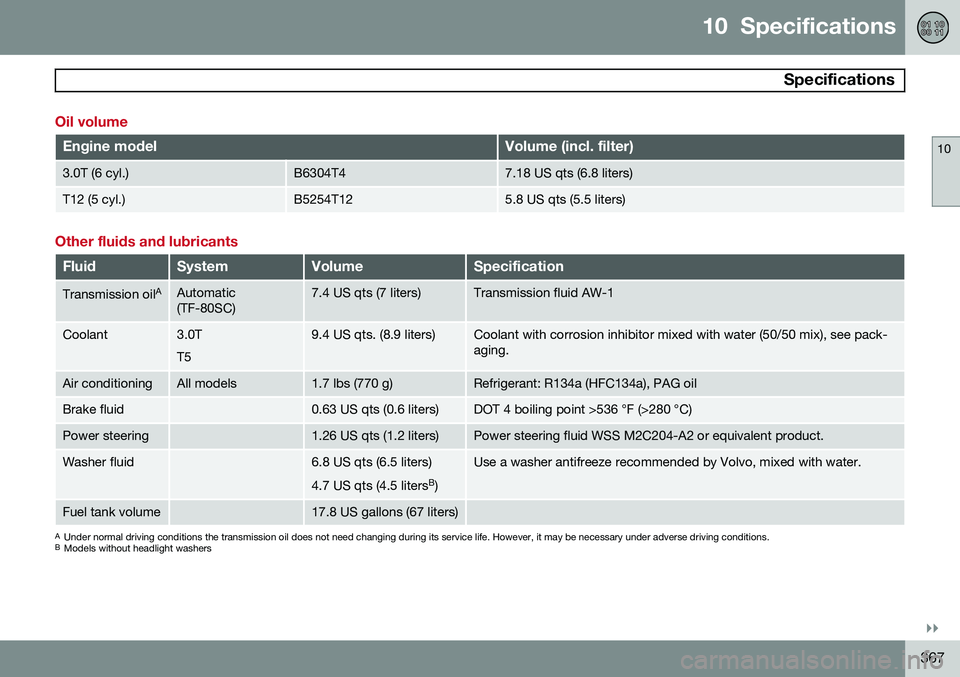
Oil volume
Engine modelVolume (incl. filter)
3.0T (6 cyl.)B6304T47.18 US qts (6.8 liters)
T12 (5 cyl.)B5254T125.8 US qts (5.5 liters)
Other fluids and lubricants
FluidSystemVolumeSpecification
Transmission oilAAutomatic (TF-80SC)7.4 US qts (7 liters)Transmission fluid AW-1
Coolant3.0T T59.4 US qts. (8.9 liters)Coolant with corrosion inhibitor mixed with water (50/50 mix), see pack- aging.
Air conditioningAll models1.7 lbs (770 g)Refrigerant: R134a (HFC134a), PAG oil
Brake fluid0.63 US qts (0.6 liters)DOT 4 boiling point >536 °F (>280 °C)
Power steering1.26 US qts (1.2 liters)Power steering fluid WSS M2C204-A2 or equivalent product.
Washer fluid6.8 US qts (6.5 liters) 4.7 US qts (4.5 liters B
)Use a washer antifreeze recommended by Volvo, mixed with water.
Fuel tank volume17.8 US gallons (67 liters)
A Under normal driving conditions the transmission oil does not need changing during its service life. However, it may be necessary under adverse driving conditions.
B Models without headlight washers
Page 371 of 386
10 Specifications
Overview of information and warning symbols
10
* Option/accessory, for more information, see Introduction.369
Introduction
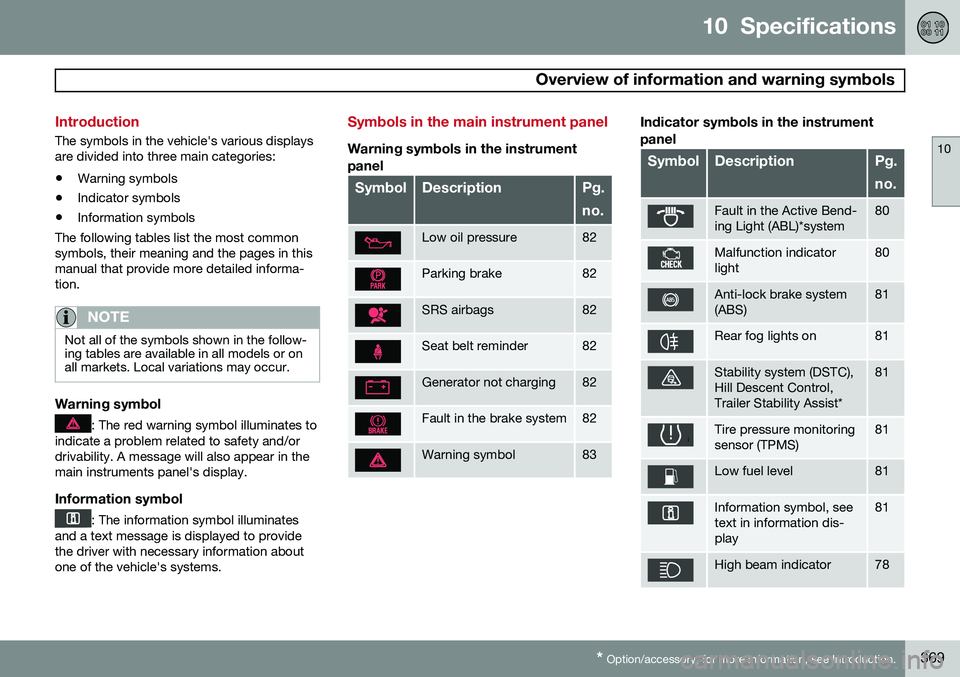
The symbols in the vehicle's various displays are divided into three main categories:
• Warning symbols
• Indicator symbols
• Information symbols
The following tables list the most commonsymbols, their meaning and the pages in thismanual that provide more detailed informa-tion.
NOTE
Not all of the symbols shown in the follow- ing tables are available in all models or onall markets. Local variations may occur.
Warning symbol
: The red warning symbol illuminates to
indicate a problem related to safety and/or drivability. A message will also appear in themain instruments panel's display.
Information symbol
: The information symbol illuminates
and a text message is displayed to provide the driver with necessary information aboutone of the vehicle's systems.
Symbols in the main instrument panel
Warning symbols in the instrument
panel
SymbolDescriptionPg. no.
Low oil pressure82
Parking brake82
SRS airbags82
Seat belt reminder82
Generator not charging82
Fault in the brake system82
Warning symbol83
Indicator symbols in the instrument panel
SymbolDescriptionPg. no.
Fault in the Active Bend- ing Light (ABL)*system80
Malfunction indicator light80
Anti-lock brake system (ABS)81
Rear fog lights on81
Stability system (DSTC), Hill Descent Control,Trailer Stability Assist*81
Tire pressure monitoring sensor (TPMS)81
Low fuel level81
Information symbol, see text in information dis-play81
High beam indicator78
Page 372 of 386
10 Specifications
Overview of information and warning symbols
10
370* Option/accessory, for more information, see Introduction.
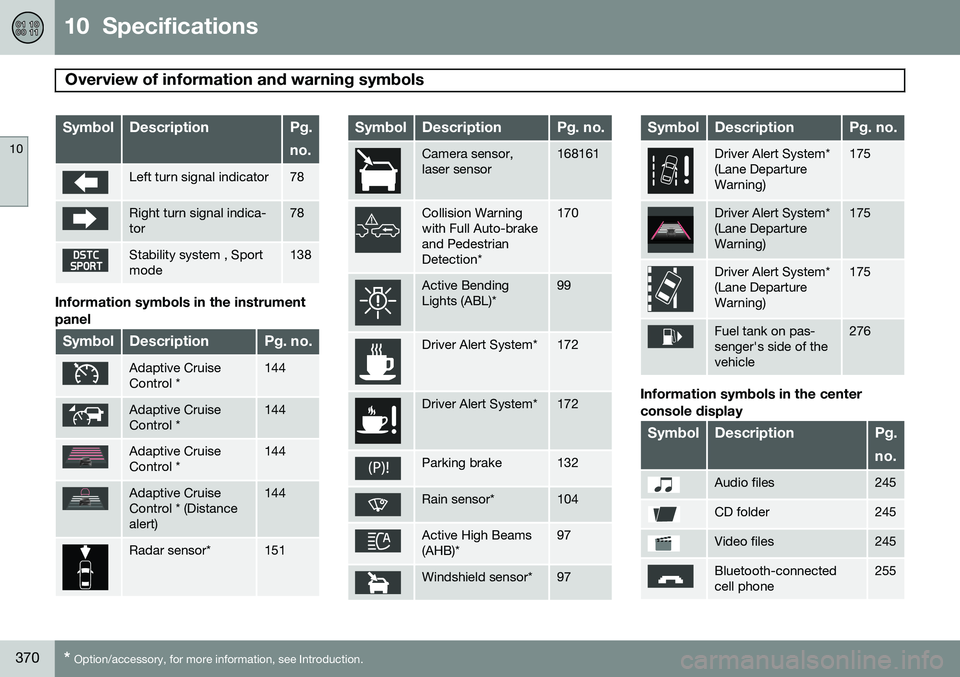
SymbolDescriptionPg. no.
Left turn signal indicator78
Right turn signal indica- tor78
Stability system , Sport mode138
Information symbols in the instrument panel
SymbolDescriptionPg. no.
Adaptive Cruise Control *144
Adaptive Cruise Control *144
Adaptive Cruise Control *144
Adaptive Cruise Control * (Distancealert)144
Radar sensor*151
SymbolDescriptionPg. no.
Camera sensor, laser sensor168161
Collision Warning with Full Auto-brakeand PedestrianDetection*170
Active Bending Lights (ABL)*99
Driver Alert System*172
Driver Alert System*172
Parking brake132
Rain sensor*104
Active High Beams (AHB)*97
Windshield sensor*97
SymbolDescriptionPg. no.
Driver Alert System* (Lane DepartureWarning)175
Driver Alert System* (Lane DepartureWarning)175
Driver Alert System* (Lane DepartureWarning)175
Fuel tank on pas- senger's side of thevehicle276
Information symbols in the center console display
SymbolDescriptionPg. no.
Audio files245
CD folder245
Video files245
Bluetooth-connected cell phone255
Page 378 of 386
11 Index
11
376
E
ECC................................................. 208, 210
Eco guide................................................. 127
Economical driving.................................. 270
Electrically heated steering wheel............. 95
Electric parking brake.............................. 132
Electronic Climate Control....... 206, 208, 210air distribution table............................ 211
Interior Air Quality System.................. 210
Emergency locking retractor...................... 39
Emergency starting.................................. 121
Emergency towing................................... 285
Emission inspection readiness................ 323Engine overheating........................................... 82
specifications...................................... 365
starting................................................ 118
switching off....................................... 121
Engine compartment overview................ 325
Engine Drag Control (EDC)...................... 138
Engine oil................................................. 366 checking............................................. 326
low pressure warning light.................... 81
volumes.............................................. 367 Engine remote start (ERS)........................ 120
Environment............................................... 12
Eyelets for anchoring loads..................... 279
F
Federal Clean Air Act............................... 322 Flat tires
repairing with tire sealing system....... 306
Floor mats cleaning.............................................. 355
placing correctly................................. 118
Fluid specifications.................................. 367
Fog lights................................................... 81 rear...................................................... 100
Four C (active chassis system)................ 219
Front airbags.............................................. 23 disconnecting passenger’s side air-
bag.................................................. 27, 28
Front park assist.............................. 178, 180
Front seats........................................... 88, 90
Fuel filler cap........................................... 277
Fuel filler door, opening........................... 276
Fuel level warning light.............................. 81 Fuel requirements............................ 274, 275
Fuel tank volume..................................... 367
Fuses....................... 343, 344, 347, 350, 351
G
Garage door opener
HomeLink ®
Wireless Control System. 115
Gasoline requirements............................. 275
Gas tank volume...................................... 367
Gauges...................................................... 77
Geartronic................................................ 124
Geartronic automatic transmission.......... 124
Generator warning light............................. 82
Glossary of tire terminology..................... 300
Grocery bag holder.................................. 280
Gross vehicle weight............................... 301
H
Hazard warning flashers.......................... 101
HD digital radio........................................ 237