tire pressure VOLVO S60 2014 Owner´s Manual
[x] Cancel search | Manufacturer: VOLVO, Model Year: 2014, Model line: S60, Model: VOLVO S60 2014Pages: 386, PDF Size: 11.24 MB
Page 319 of 386
08 Wheels and tires
Tire Pressure Monitoring System (TPMS)
08
317
replacement or alternate tires and wheels allow the TPMS to continue to function prop-erly.
NOTE
TPMS indicates low tire pressure but does not replace normal tire maintenance. Forinformation on correct tire pressure, pleaserefer to the tire inflation pressure table inthis chapter or consult your Volvo retailer.
Erasing warning messagesWhen a low tire pressure warning message has been displayed, and the tire pressurewarning light has come on:
1. Use a tire pressure gauge to check the
inflation pressure of all four tires.
2. Re-inflate the tire(s) to the correct pres- sure (consult the tire pressure placard or the inflation pressure table on page 296.
3. In certain cases, it may be necessary to drive the vehicle for several minutes at aspeed of 20 mph (30 km/h) or faster. Thiswill erase the warning text and the warn-ing light will go out.
WARNING
Incorrect inflation pressure could lead to tire failure, resulting in a loss of control ofthe vehicle.
Changing wheels with TPMSPlease note the following when changing or replacing the factory installed TPMS wheels/tires on the vehicle:
• Only the factory-mounted wheels are equipped with TPMS sensors in thevalves.
• If the vehicle is equipped with a tempo-rary spare tire, this tire does not have aTPMS sensor.
• If wheels without TPMS sensors are mounted on the vehicle,
TIRE PRESS
SYST SERVICE REQUIRED will be dis-
played each time the vehicle is driven above 25 mph (40 km/h) for 10 minutes ormore.
• Once TPMS sensors are properly instal-led, the warning message should notreappear. If the message is still displayed,drive the vehicle for several minutes at aspeed of 20 mph (30 km/h) or faster toerase the message.
• Volvo recommends that TPMS sensorsbe fitted on all wheels used on the vehi-cle. Volvo does not recommend moving sensors back and forth between sets ofwheels.
CAUTION
When inflating tires with TPMS valves, press the pump's mouthpiece straightonto the valve to help avoid bending orotherwise damaging the valve.
CAUTION
•
After pumping the tires, always rein- stall the valve cap to help avoid dam-age to the valve from dirt, gravel, etc.
• Use plastic valve caps only. Metalcaps could corrode and become diffi-cult to remove.
Page 320 of 386
08 Wheels and tires
Tire Pressure Monitoring System (TPMS)
08
318* Option/accessory, for more information, see Introduction.
NOTE
• If you change to tires with a different recommended inflation pressure, theTPMS system must be recalibrated tothese tires. On U.S. models, this mustbe done by a trained and qualifiedVolvo service technician. On Canadianmodels, see the following section"Recalibrating TPMS."
• If a tire is changed, or if the TPMS sen-sor is moved to another wheel, thesensor's seal, nut, and valve coreshould be replaced.
• When installing TPMS sensors, thevehicle must be parked for at least15 minutes with the ignition off. If thevehicle is driven within 15 minutes, aTPMS error message will be displayed.
Recalibrating TPMS (Canadian models only)*
In certain cases, it may be necessary to reca- librate TPMS to conform to Volvo's recom-mended tire inflation pressures (see the infla-tion pressure table on page 296), for exam-ple, if higher inflation pressure is necessarywhen transporting heavy loads, etc. This is done in the vehicle's menu system. See page 197 for a description of the menusystem. To recalibrate:
1. Switch off the engine.
2. Inflate the tires to the desired pressure
and put the ignition in mode I or II (see
page 87 for additional information).
3. Press the MY CAR key in the center con-
sole control panel and select
Settings
Car settingsTyre pressure
4. Press OK/MENU , select Calibrate tyre
pressure and press OK/MENU again.
5. Drive the vehicle at a speed above 25 mph (40 km/h) continuously for at least 10 minutes.
> When the calibration message is nolonger displayed, TPMS has been recalibrated to the new inflation pres-sure.
Activating/deactivating TPMS
(Canadian models only)*
1. Switch off the engine.
2. Put the ignition in mode I or II (see page
87 for additional information).
3. Press the MY CAR key in the center con-
sole control panel and select
Settings
Car settingsTyre pressure
4. Select Tyre pressure system and press
OK/MENU to turn the system on or off.
Self-supporting run flat tires (SST)*
Self-supporting run flat tires are available as optional equipment. The vehicle must beequipped with the Tire Pressure MonitoringSystem (TPMS) if tires of this type are instal-led. Tires of this type have specially reinforced sidewalls that make it possible to continuedriving to a limited extent even though the tirehas lost some or all of its inflation pressure.These tires are mounted on special rims (nor-mal tires can also be mounted on these rims). If an SST tire loses inflation pressure, the yel- low TPMS symbol illuminates in the instru-ment panel and a text message is also dis-played. If this happens, reduce speed to notmore than 50 mph (80 km/h). The tire shouldbe replaced as soon as possible. Drive carefully; it may be difficult to determine which tire is damaged. To find the damagedtire, check the inflation pressure in all fourtires.
Page 321 of 386
08 Wheels and tires
Tire Pressure Monitoring System (TPMS)
08
319
WARNING
•SST tires should only be mounted by service technicians who are familiarwith tires of this type.
• SST tires may only be mounted onvehicles equipped with TPMS.
• Do not drive faster than 50 mph(80 km/h) if TPMS indicates that a tirehas lost inflation pressure.
• Do not drive farther than 50 miles(80 km) before replacing a damagedSST tire.
• Drive carefully and avoid e.g., hardbraking or fast turns.
• SST tires must be replaced if they aredamaged. A tire of this type cannot berepaired.
Page 325 of 386
09 Maintenance and specifications
Maintaining your car09
323
Owner maintenance
Periodic maintenance requirements and inter- vals are described in your vehicle's Warrantyand Service Records Information booklet. The following points can be carried out between the normally scheduled maintenanceservices.
Each time the car is refueled:
•Check the engine oil level.
• Clean the windshield, windshield wipers, headlights, and taillights.
Monthly:
• Check cold tire pressure in all tires.Inspect the tires for wear.
• Check that engine coolant and other fluidlevels are between the indicated "min"and "max" markings.
• Clean interior glass surfaces with a glasscleaner and soft paper towels.
• Wipe driver information displays with asoft cloth.
• Visually inspect battery terminals for cor-rosion. Corrosion may indicate a looseterminal connector, or a battery near theend of its useful service life. Consult yourVolvo retailer for additional information.
As needed:Wash the car, including the undercarriage, to reduce wear that can be caused by a buildupof dirt, and corrosion that can be caused bysalt residues. Clean leaves and twigs from air intake vents at the base of the windshield, and from otherplaces where they may collect.
NOTE
Complete service information for qualified technicians is available online for purchaseor subscription at www.volvotechinfo.com.
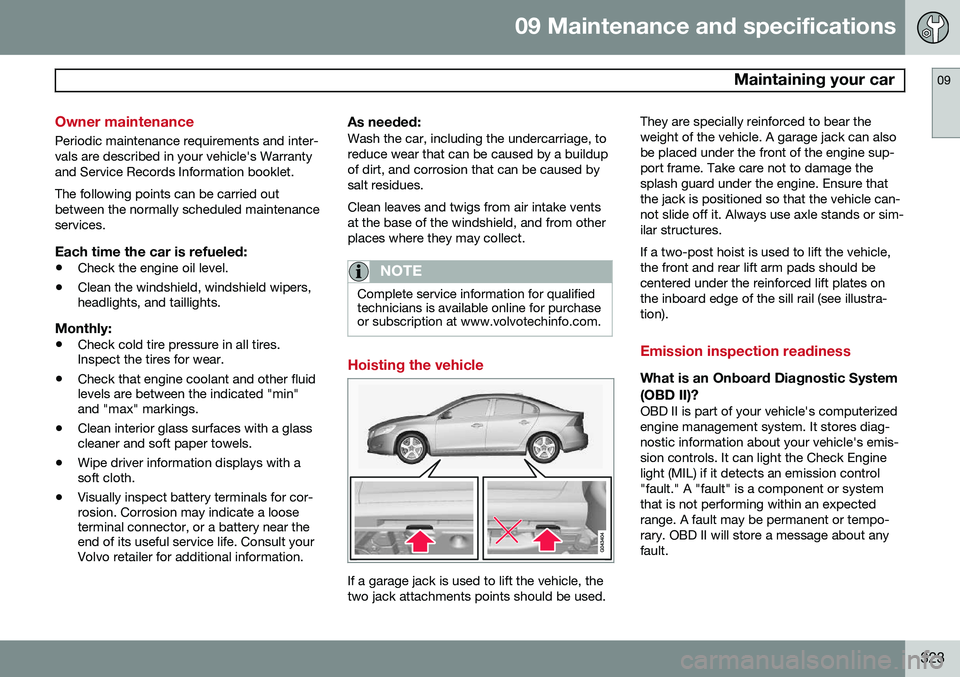
Hoisting the vehicle
If a garage jack is used to lift the vehicle, the two jack attachments points should be used. They are specially reinforced to bear theweight of the vehicle. A garage jack can alsobe placed under the front of the engine sup-port frame. Take care not to damage thesplash guard under the engine. Ensure thatthe jack is positioned so that the vehicle can-not slide off it. Always use axle stands or sim-ilar structures. If a two-post hoist is used to lift the vehicle, the front and rear lift arm pads should becentered under the reinforced lift plates onthe inboard edge of the sill rail (see illustra-tion).
Emission inspection readiness
What is an Onboard Diagnostic System
(OBD II)?
OBD II is part of your vehicle's computerized engine management system. It stores diag-nostic information about your vehicle's emis-sion controls. It can light the Check Enginelight (MIL) if it detects an emission control"fault." A "fault" is a component or systemthat is not performing within an expectedrange. A fault may be permanent or tempo-rary. OBD II will store a message about anyfault.
Page 363 of 386
10 Specifications
Label information
10
361
List of labels
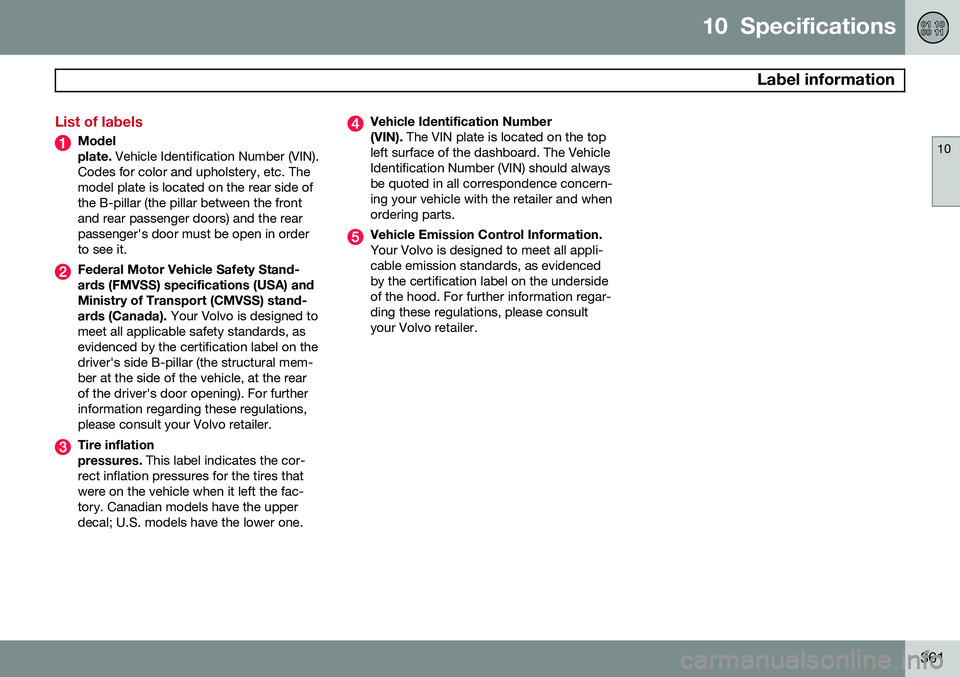
Model plate. Vehicle Identification Number (VIN).
Codes for color and upholstery, etc. The model plate is located on the rear side ofthe B-pillar (the pillar between the frontand rear passenger doors) and the rearpassenger's door must be open in orderto see it.
Federal Motor Vehicle Safety Stand- ards (FMVSS) specifications (USA) andMinistry of Transport (CMVSS) stand- ards (Canada). Your Volvo is designed to
meet all applicable safety standards, as evidenced by the certification label on thedriver's side B-pillar (the structural mem-ber at the side of the vehicle, at the rearof the driver's door opening). For furtherinformation regarding these regulations,please consult your Volvo retailer.
Tire inflation pressures. This label indicates the cor-
rect inflation pressures for the tires that were on the vehicle when it left the fac-tory. Canadian models have the upperdecal; U.S. models have the lower one.
Vehicle Identification Number (VIN). The VIN plate is located on the top
left surface of the dashboard. The Vehicle Identification Number (VIN) should alwaysbe quoted in all correspondence concern-ing your vehicle with the retailer and whenordering parts.
Vehicle Emission Control Information. Your Volvo is designed to meet all appli- cable emission standards, as evidencedby the certification label on the undersideof the hood. For further information regar-ding these regulations, please consultyour Volvo retailer.
Page 371 of 386
10 Specifications
Overview of information and warning symbols
10
* Option/accessory, for more information, see Introduction.369
Introduction
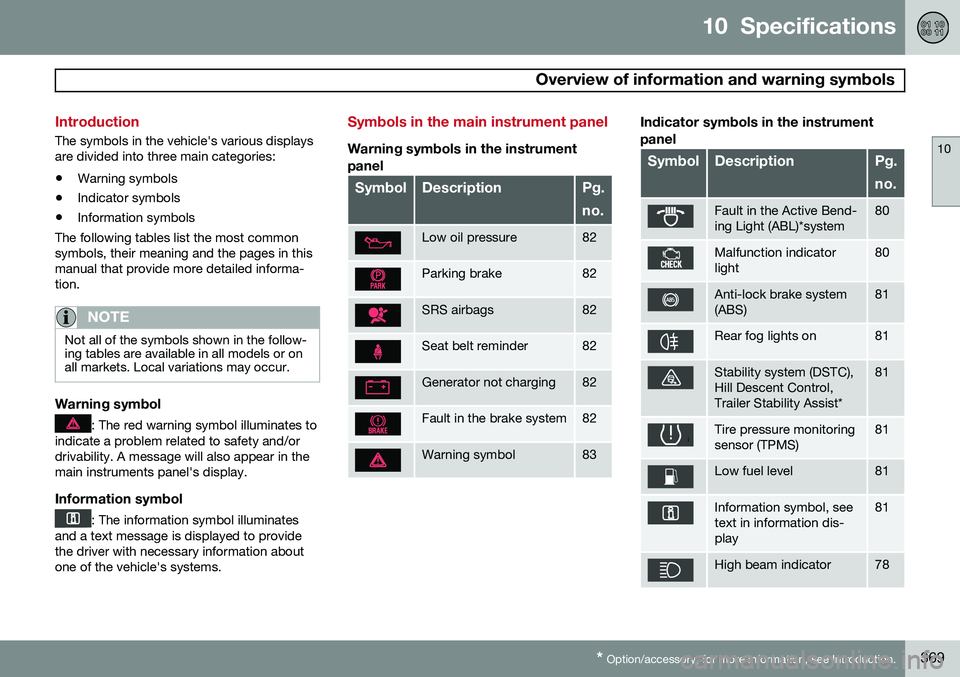
The symbols in the vehicle's various displays are divided into three main categories:
• Warning symbols
• Indicator symbols
• Information symbols
The following tables list the most commonsymbols, their meaning and the pages in thismanual that provide more detailed informa-tion.
NOTE
Not all of the symbols shown in the follow- ing tables are available in all models or onall markets. Local variations may occur.
Warning symbol
: The red warning symbol illuminates to
indicate a problem related to safety and/or drivability. A message will also appear in themain instruments panel's display.
Information symbol
: The information symbol illuminates
and a text message is displayed to provide the driver with necessary information aboutone of the vehicle's systems.
Symbols in the main instrument panel
Warning symbols in the instrument
panel
SymbolDescriptionPg. no.
Low oil pressure82
Parking brake82
SRS airbags82
Seat belt reminder82
Generator not charging82
Fault in the brake system82
Warning symbol83
Indicator symbols in the instrument panel
SymbolDescriptionPg. no.
Fault in the Active Bend- ing Light (ABL)*system80
Malfunction indicator light80
Anti-lock brake system (ABS)81
Rear fog lights on81
Stability system (DSTC), Hill Descent Control,Trailer Stability Assist*81
Tire pressure monitoring sensor (TPMS)81
Low fuel level81
Information symbol, see text in information dis-play81
High beam indicator78
Page 378 of 386
11 Index
11
376
E
ECC................................................. 208, 210
Eco guide................................................. 127
Economical driving.................................. 270
Electrically heated steering wheel............. 95
Electric parking brake.............................. 132
Electronic Climate Control....... 206, 208, 210air distribution table............................ 211
Interior Air Quality System.................. 210
Emergency locking retractor...................... 39
Emergency starting.................................. 121
Emergency towing................................... 285
Emission inspection readiness................ 323Engine overheating........................................... 82
specifications...................................... 365
starting................................................ 118
switching off....................................... 121
Engine compartment overview................ 325
Engine Drag Control (EDC)...................... 138
Engine oil................................................. 366 checking............................................. 326
low pressure warning light.................... 81
volumes.............................................. 367 Engine remote start (ERS)........................ 120
Environment............................................... 12
Eyelets for anchoring loads..................... 279
F
Federal Clean Air Act............................... 322 Flat tires
repairing with tire sealing system....... 306
Floor mats cleaning.............................................. 355
placing correctly................................. 118
Fluid specifications.................................. 367
Fog lights................................................... 81 rear...................................................... 100
Four C (active chassis system)................ 219
Front airbags.............................................. 23 disconnecting passenger’s side air-
bag.................................................. 27, 28
Front park assist.............................. 178, 180
Front seats........................................... 88, 90
Fuel filler cap........................................... 277
Fuel filler door, opening........................... 276
Fuel level warning light.............................. 81 Fuel requirements............................ 274, 275
Fuel tank volume..................................... 367
Fuses....................... 343, 344, 347, 350, 351
G
Garage door opener
HomeLink ®
Wireless Control System. 115
Gasoline requirements............................. 275
Gas tank volume...................................... 367
Gauges...................................................... 77
Geartronic................................................ 124
Geartronic automatic transmission.......... 124
Generator warning light............................. 82
Glossary of tire terminology..................... 300
Grocery bag holder.................................. 280
Gross vehicle weight............................... 301
H
Hazard warning flashers.......................... 101
HD digital radio........................................ 237
Page 382 of 386

11 Index
11
380
Seat beltsAutomatic locking retractor/Emer-
gency locking retractor......................... 39
buckling................................................ 18
maintenance......................................... 19
pretensioners........................................ 18
reminder................................................ 19
reminder warning light.......................... 82securing child restraint
systems.................................... 43, 45, 47
unbuckling............................................ 19
use during pregnancy........................... 21
using..................................................... 18
Seats, front.......................................... 88, 89
Sensus..................................................... 194
Shiftlock....................................................... 9 override............................................... 126
Side door mirrors..................................... 108
Side impact airbags................................... 31
Sign information (RSI).............................. 140SiriusXM ™ satellite radio......................... 239
Snow chains............................................ 304
Snow tires................................................ 304
Spare tire................................................. 305
Speed-dependent steering...................... 219 Spin control............................................. 138
SRS............................................................ 22
Stability system............................... 138, 139
Corner Traction Control (CTC)............ 138
Engine Drag Control (EDC)................. 138
indicator light........................................ 81
Starting the engine.................................. 118 remote start........................................ 120
with keyless drive............................... 118
Starting the vehicle after a crash (crash mode).................... 36
Start inhibitor (immobilizer)........................ 56 Steering wheel adjusting............................................... 94
heated................................................... 95
horn....................................................... 94
keypad.................................. 94, 197, 227
Steering wheel paddles............................. 94
Stone chips, touching up......................... 355
Storage spaces........................................ 220
Studded tires........................................... 304
Sunroof (moonroof).................................. 113
Sun shade........................................ 106, 107
Supplemental restraint system.................. 22 warning light......................................... 82 Symbols, overview................................... 369
T
Temperature sensor
ambient................................................. 84
Temporary spare tire............................... 305
Three-way catalytic converter................. 277
Tire designations..................................... 298
Tire inflation pressure.............................. 296
Tire Pressure Monitoring System.... 316, 317 indicator light........................................ 81
Tires......................................................... 290 age...................................................... 290
changing from summer to winter........ 291
glossary of terms................................ 300
improving economy............................ 291
inflation pressure................................ 293
inflation pressure table....................... 296
load ratings......................................... 295
rotation............................................... 290
Self-supporting run flat tires (SST)..... 318
snow................................................... 304
spare................................................... 305
specifications...................................... 294
speed ratings...................................... 294
Page 383 of 386
11 Index
11
381
storing................................................. 292
studded............................................... 304
tire pressure monitoring system......... 316
tire sealing system.............................. 306
tread wear indicator............................ 291
uniform tire quality grading................. 303
Tire sealing system.................................. 306 Top tether anchors (child restraint sys-
tems).......................................................... 50
Touching up paint.................................... 355
Towing a trailer................................ 282, 283
Towing the vehicle................................... 285
Traction control........................................ 138
Trailer towing................................... 282, 283Transmission general description..................... 123, 124
Hill Start Assist................................... 123
oil........................................................ 367
shiftlock override................................ 126
Tread wear indicator................................ 291
Trip computer.......................................... 212
Trip odometers.......................................... 84
Trips, long distance................................. 271 Trunk
changing bulbs................................... 335
driving with it open............................. 270
opening manually................................. 69
Tunnel detection........................................ 99
Turn signals............................................. 101 indicator lights...................................... 81
U
Uniform Tire Quality Grading................... 303
Unlocking the vehicle.......................... 57, 67
Upholstery care....................................... 353
V
Valet locking.............................................. 63
Vanity mirror............................................ 222 changing bulbs................................... 335
Vehicle Event Data....................................... 9
Vehicle loading................................ 279, 301 roof loads............................................ 281
Vehicle maintenance................................ 322 performed by the owner..................... 323 Vehicle weights........................................ 364Voice control
cell phones......................................... 263
Volvo and the environment........................ 12
Volvo maintenance.................................. 322
Volvo On Call Roadside Assistance........ 372
Volvo programs....................................... 372
Volvo Sensus........................................... 194
W
Warning flashers, hazard......................... 101
Warning lights................................ 77, 79, 81
Warning symbol......................................... 83
Warning system, collision................ 164, 165
Warranties................................................ 322
Washer fluid..................................... 338, 367Washers headlight............................................. 105
windshield........................................... 104
Water, driving through............................. 271
Waxing..................................................... 353
Weights.................................................... 364