tire pressure VOLVO S60 2016 Owner´s Manual
[x] Cancel search | Manufacturer: VOLVO, Model Year: 2016, Model line: S60, Model: VOLVO S60 2016Pages: 392, PDF Size: 10.04 MB
Page 283 of 392
08 Starting and driving
08
}}
281
be switched off (but will be on again the next time the engine is started)
• TSA may not intervene when the vehicleand trailer begin to sway if the driver triesto compensate for the swaying motion bymoving the steering wheel rapidly
How TSA worksOnce swaying has begun, it can be very diffi- cult to stop, which makes it difficult to controlthe vehicle and trailer. The TSA system continuously monitors the vehicle's movements, particularly lateralmovement. If the system detects a tendencyto sway, the brakes are applied individuallyon the front wheels, which has a stabilizingeffect on the vehicle and trailer. This is oftenenough to enable the driver to regain controlof the vehicle. If this is not adequate to stop the swaying motion, the brakes are applied to all of thewheels on the vehicle and on the trailer if it isequipped with brakes, and engine power istemporarily reduced. As the swaying motionbegins to decrease and the vehicle-trailerhave once again become stable, TSA will nowstop regulating the brakes/engine power andthe driver regains control of the vehicle.
Related information
• Towing a trailer (p. 279)
• Loading – general (p. 135)
Towing the vehicle
Always check with state and local authorities before attempting to tow another vehiclebecause this type of towing is subject to reg-ulations regarding maximum towing speed,length and type of towing device, lighting, etc.
1. With the remote key fully pressed into the
ignition slot 16
, press START/STOP
ENGINE for approximately 2 seconds to
activate ignition mode II. 2. The remote key must remain in the igni-
tion slot 17
for the entire time that the vehi-
cle is being towed.
3. Keep the tow rope taut when the towing vehicle slows down by applying light pressure on the brake pedal. This willhelp prevent jarring movements of thevehicle being towed.
4. Be prepared to apply the brakes to stop the vehicle being towed.
16Not necessary in vehicles with the optional keyless drive.
Page 287 of 392
09 Wheels and tires
09
285
Tires – general information
Your vehicle is equipped with tires according to the vehicle's tire information placard on theB-pillar (the structural member at the side ofthe vehicle, at the rear of the driver's dooropening).
Introduction
CAUTION
Some Volvo models are equipped with an Ultra High Performance tire and wheelcombination designed to provide maxi-mum dry pavement performance with con-sideration for hydroplaning resistance.They may be more susceptible to roadhazard damage and, depending on drivingconditions, may achieve a tread life of lessthan 20,000 miles (30,000 km). Even if thisvehicle is equipped with Volvo’s advancedAWD or stability system, these tires are notdesigned for winter driving, and should bereplaced with winter tires when weatherconditions dictate.
The tires have good road holding characteris- tics and offer good handling on dry and wetsurfaces. It should be noted however that thetires have been developed to give these fea-tures on snow/ice-free surfaces. Most models are equipped with "all-season" tires, which provide a somewhat higherdegree of road holding on slippery surfacesthan tires without the "all-season" rating.However, for optimum road holding on icy orsnow-covered roads, we recommend suitablewinter tires on all four wheels. When replacing tires, be sure that the new tires are the same size designation, type(radial) and preferably from the same manu-facturer, on all four wheels. Otherwise there isa risk of altering the car's roadholding andhandling characteristics.
Tire rotationYour vehicle has no required tire rotation. Tirewear is affected by a number of factors suchas tire inflation, ambient temperature, drivingstyle, etc.
NOTE
•
If the tires are rotated, they should only be moved from front to rear orvice versa. They should never be rota-ted left to right/right to left.
• Ideally, tire rotation should be done thefirst time after approximately 3,000miles (5,000 km) and thereafter at6,000-mile (10,000-km) intervals.Some customers find that tire rotationmay help to get extra mileage from tirelife.
• Tire rotation should only be performedif front/rear tire wear is fairly even andtread height is above 1/16" (1.6 mm).
Related information
•
Tire inflation – pressure table (p. 297)
• Tire specifications (p. 295)
• Changing a wheel – direction of rotation (p. 288)
• Tires – tread wear indicator (p. 287)
Page 288 of 392
09 Wheels and tires
09
286
Tires – storage and age
When storing complete wheels (tires mounted on rims), they should be suspended off thefloor or placed on their sides on the floor.
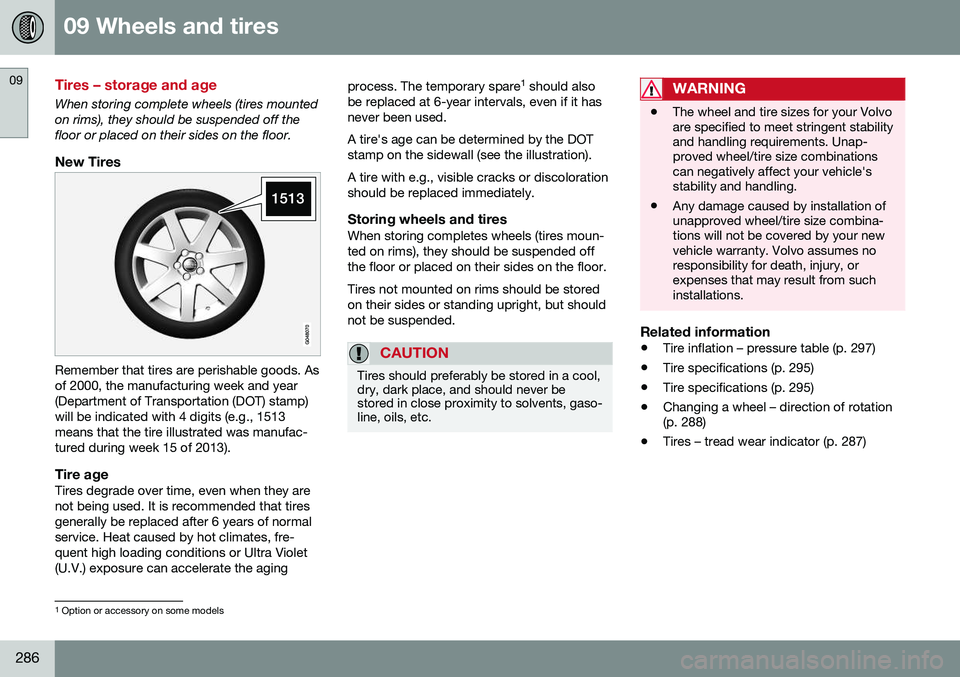
New Tires
Remember that tires are perishable goods. Asof 2000, the manufacturing week and year(Department of Transportation (DOT) stamp)will be indicated with 4 digits (e.g., 1513means that the tire illustrated was manufac-tured during week 15 of 2013).
Tire ageTires degrade over time, even when they are not being used. It is recommended that tiresgenerally be replaced after 6 years of normalservice. Heat caused by hot climates, fre-quent high loading conditions or Ultra Violet(U.V.) exposure can accelerate the agingprocess. The temporary spare
1
should also
be replaced at 6-year intervals, even if it hasnever been used. A tire's age can be determined by the DOT stamp on the sidewall (see the illustration). A tire with e.g., visible cracks or discoloration should be replaced immediately.
Storing wheels and tiresWhen storing completes wheels (tires moun-ted on rims), they should be suspended offthe floor or placed on their sides on the floor. Tires not mounted on rims should be stored on their sides or standing upright, but shouldnot be suspended.
CAUTION
Tires should preferably be stored in a cool, dry, dark place, and should never bestored in close proximity to solvents, gaso-line, oils, etc.
WARNING
• The wheel and tire sizes for your Volvo are specified to meet stringent stabilityand handling requirements. Unap-proved wheel/tire size combinationscan negatively affect your vehicle'sstability and handling.
• Any damage caused by installation ofunapproved wheel/tire size combina-tions will not be covered by your newvehicle warranty. Volvo assumes noresponsibility for death, injury, orexpenses that may result from suchinstallations.
Related information
•
Tire inflation – pressure table (p. 297)
• Tire specifications (p. 295)
• Tire specifications (p. 295)
• Changing a wheel – direction of rotation (p. 288)
• Tires – tread wear indicator (p. 287)
1
Option or accessory on some models
Page 289 of 392
09 Wheels and tires
09
287
Tires – tread wear indicator
The tires have wear indicator strips running across or parallel to the tread.
G021829
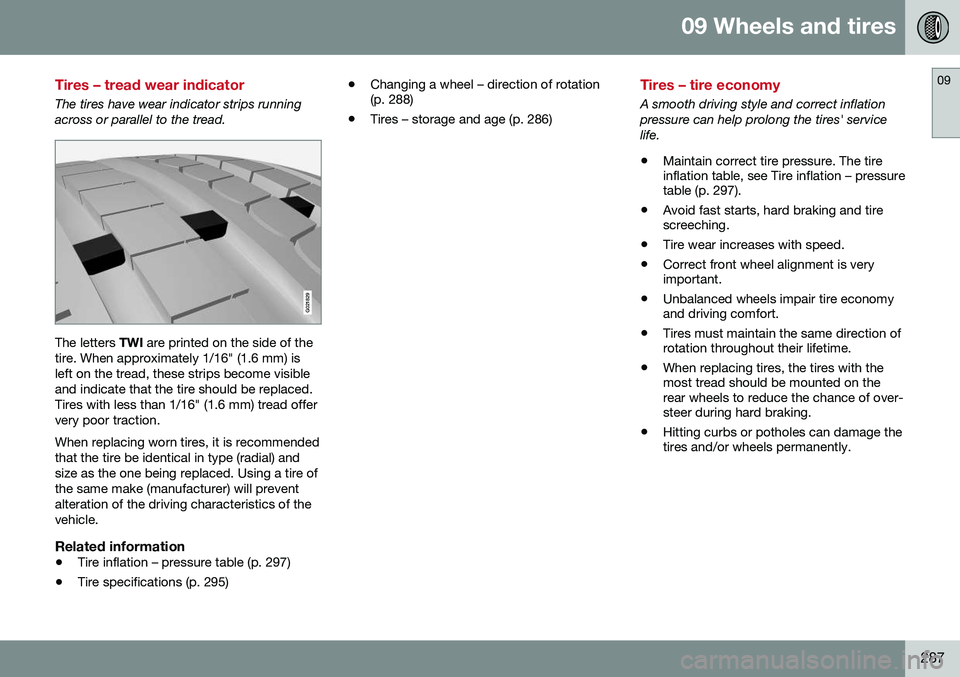
The letters TWI are printed on the side of the
tire. When approximately 1/16" (1.6 mm) is left on the tread, these strips become visibleand indicate that the tire should be replaced.Tires with less than 1/16" (1.6 mm) tread offervery poor traction. When replacing worn tires, it is recommended that the tire be identical in type (radial) andsize as the one being replaced. Using a tire ofthe same make (manufacturer) will preventalteration of the driving characteristics of thevehicle.
Related information
• Tire inflation – pressure table (p. 297)
• Tire specifications (p. 295) •
Changing a wheel – direction of rotation (p. 288)
• Tires – storage and age (p. 286)
Tires – tire economy
A smooth driving style and correct inflation pressure can help prolong the tires' servicelife. • Maintain correct tire pressure. The tire inflation table, see Tire inflation – pressuretable (p. 297).
• Avoid fast starts, hard braking and tirescreeching.
• Tire wear increases with speed.
• Correct front wheel alignment is veryimportant.
• Unbalanced wheels impair tire economyand driving comfort.
• Tires must maintain the same direction ofrotation throughout their lifetime.
• When replacing tires, the tires with themost tread should be mounted on therear wheels to reduce the chance of over-steer during hard braking.
• Hitting curbs or potholes can damage thetires and/or wheels permanently.
Page 290 of 392
09 Wheels and tires
09
288* Option/accessory, for more information, see Introduction.
Changing a wheel – direction of rotation
Incorrectly mounted tires impair the car's braking properties and ability to force asiderain, snow and slush.
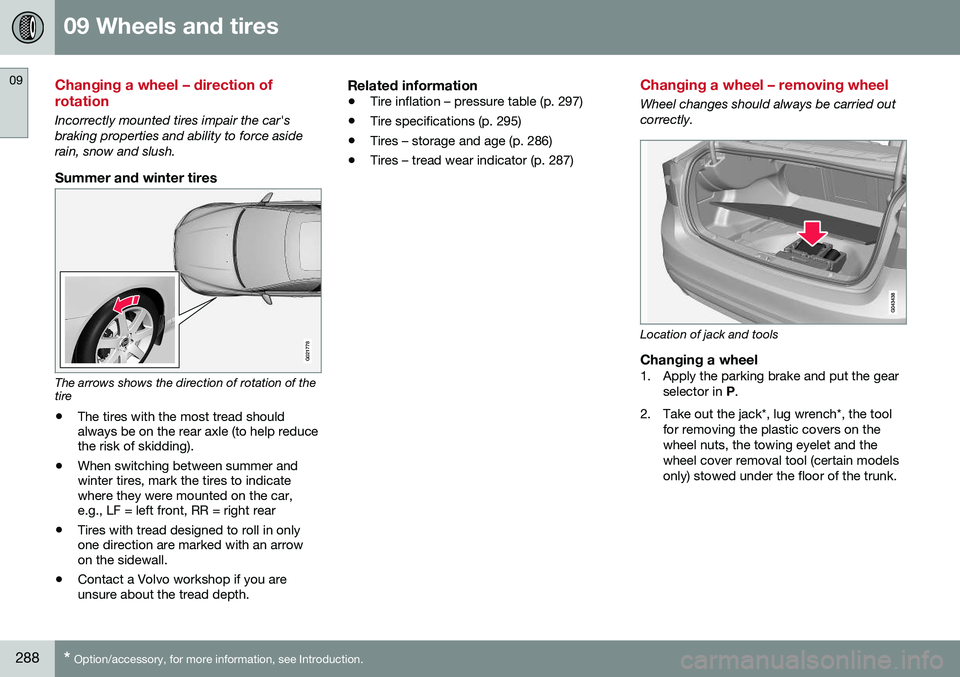
Summer and winter tires
G021778
The arrows shows the direction of rotation of the tire
• The tires with the most tread should always be on the rear axle (to help reducethe risk of skidding).
• When switching between summer andwinter tires, mark the tires to indicatewhere they were mounted on the car,e.g., LF = left front, RR = right rear
• Tires with tread designed to roll in onlyone direction are marked with an arrowon the sidewall.
• Contact a Volvo workshop if you areunsure about the tread depth.
Related information
•
Tire inflation – pressure table (p. 297)
• Tire specifications (p. 295)
• Tires – storage and age (p. 286)
• Tires – tread wear indicator (p. 287)
Changing a wheel – removing wheel
Wheel changes should always be carried out correctly.
Location of jack and tools
Changing a wheel1. Apply the parking brake and put the gear
selector in P.
2. Take out the jack*, lug wrench*, the tool for removing the plastic covers on the wheel nuts, the towing eyelet and thewheel cover removal tool (certain modelsonly) stowed under the floor of the trunk.
Page 291 of 392
09 Wheels and tires
09
}}
289
3.
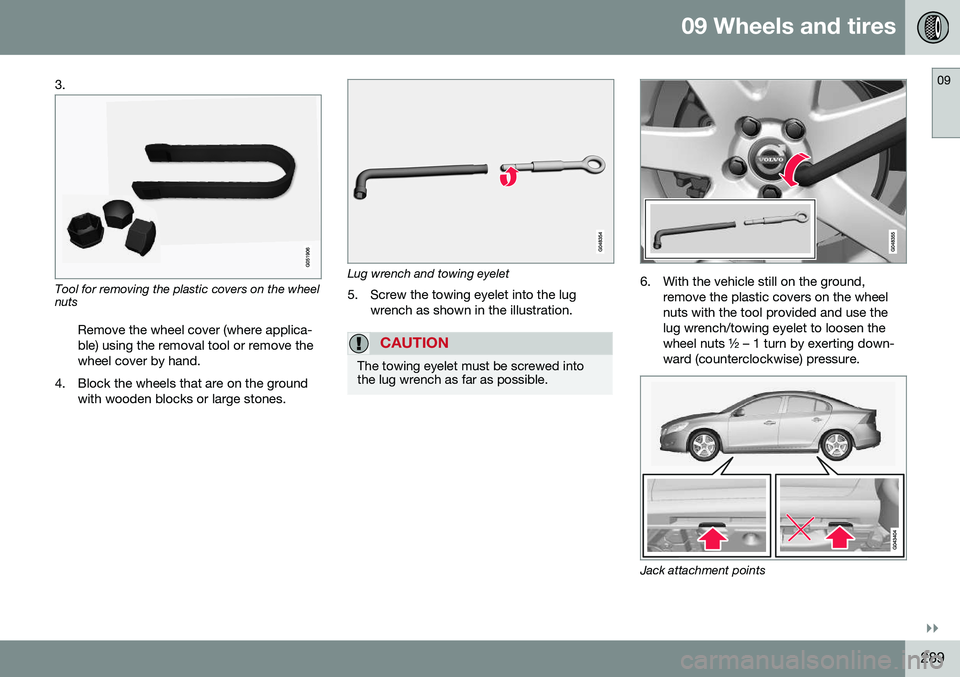
Tool for removing the plastic covers on the wheel nuts
Remove the wheel cover (where applica- ble) using the removal tool or remove thewheel cover by hand.
4. Block the wheels that are on the ground with wooden blocks or large stones.Lug wrench and towing eyelet
5. Screw the towing eyelet into the lug wrench as shown in the illustration.
CAUTION
The towing eyelet must be screwed into the lug wrench as far as possible.
6. With the vehicle still on the ground,remove the plastic covers on the wheel nuts with the tool provided and use thelug wrench/towing eyelet to loosen thewheel nuts ½ – 1 turn by exerting down-ward (counterclockwise) pressure.
Jack attachment points
Page 293 of 392
09 Wheels and tires
09
* Option/accessory, for more information, see Introduction.291
Changing a wheel – spare wheel
Wheel changes should always be carried out correctly.
Spare tireA spare tire can be purchased for your vehi-cle as an accessory. Follow the instructionsincluded with the spare tire regarding use andstowing in the vehicle. See also Changing awheel – removing wheel (p. 288) for additionalinformation.
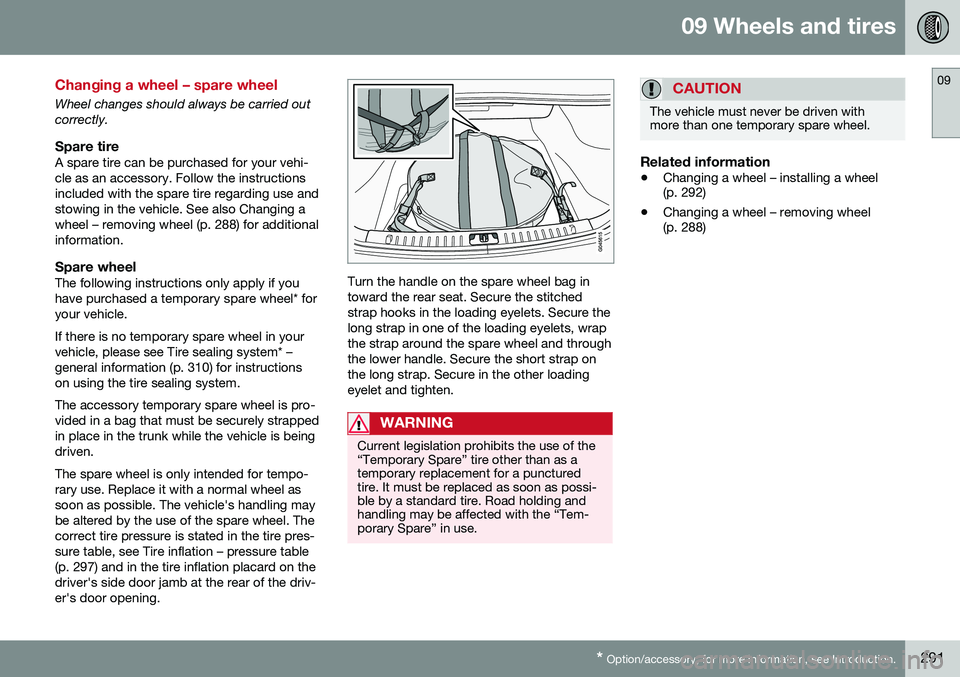
Spare wheelThe following instructions only apply if youhave purchased a temporary spare wheel* foryour vehicle. If there is no temporary spare wheel in your vehicle, please see Tire sealing system* –general information (p. 310) for instructionson using the tire sealing system. The accessory temporary spare wheel is pro- vided in a bag that must be securely strappedin place in the trunk while the vehicle is beingdriven. The spare wheel is only intended for tempo- rary use. Replace it with a normal wheel assoon as possible. The vehicle's handling maybe altered by the use of the spare wheel. Thecorrect tire pressure is stated in the tire pres-sure table, see Tire inflation – pressure table(p. 297) and in the tire inflation placard on thedriver's side door jamb at the rear of the driv-er's door opening.Turn the handle on the spare wheel bag in toward the rear seat. Secure the stitchedstrap hooks in the loading eyelets. Secure the long strap in one of the loading eyelets, wrapthe strap around the spare wheel and throughthe lower handle. Secure the short strap onthe long strap. Secure in the other loadingeyelet and tighten.
WARNING
Current legislation prohibits the use of the “Temporary Spare” tire other than as atemporary replacement for a puncturedtire. It must be replaced as soon as possi-ble by a standard tire. Road holding andhandling may be affected with the “Tem-porary Spare” in use.
CAUTION
The vehicle must never be driven with more than one temporary spare wheel.
Related information
• Changing a wheel – installing a wheel (p. 292)
• Changing a wheel – removing wheel(p. 288)
Page 295 of 392
09 Wheels and tires
09
}}
293
Related information
•Changing a wheel – spare wheel (p. 291)
• Changing a wheel – removing wheel (p. 288)
Tire inflation – general information
Check tire inflation pressure regularly.
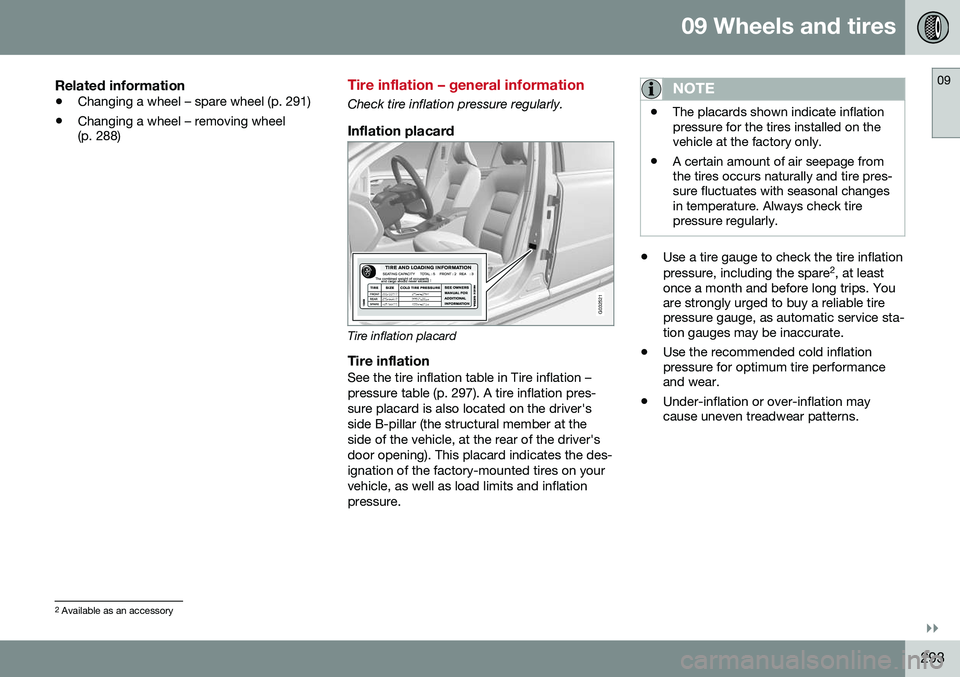
Inflation placard
G032521
Tire inflation placard
Tire inflationSee the tire inflation table in Tire inflation – pressure table (p. 297). A tire inflation pres-sure placard is also located on the driver'sside B-pillar (the structural member at theside of the vehicle, at the rear of the driver'sdoor opening). This placard indicates the des-ignation of the factory-mounted tires on yourvehicle, as well as load limits and inflationpressure.
NOTE
• The placards shown indicate inflation pressure for the tires installed on thevehicle at the factory only.
• A certain amount of air seepage fromthe tires occurs naturally and tire pres-sure fluctuates with seasonal changesin temperature. Always check tirepressure regularly.
•
Use a tire gauge to check the tire inflation pressure, including the spare 2
, at least
once a month and before long trips. You are strongly urged to buy a reliable tirepressure gauge, as automatic service sta-tion gauges may be inaccurate.
• Use the recommended cold inflationpressure for optimum tire performanceand wear.
• Under-inflation or over-inflation maycause uneven treadwear patterns.
2
Available as an accessory
Page 296 of 392
||
09 Wheels and tires
09
294
WARNING
•Under-inflation is the most common cause of tire failure and may result insevere tire cracking, tread separation,or "blow-out," with unexpected loss ofvehicle control and increased risk ofinjury.
• Under-inflated tires reduce the loadcarrying capacity of your vehicle.
When weather temperature changes occur, tire inflation pressures also change. A 10-degree temperature drop causes a corres-ponding drop of 1 psi (7 kPa) in inflation pres-sure. Check your tire pressures frequentlyand adjust them to the proper pressure,which can be found on the vehicle's tire infor-mation placard or certification label.
Related information
•
Tire specifications (p. 295)
• Tires – storage and age (p. 286)
• Tires – tread wear indicator (p. 287)
• Tire inflation – pressure table (p. 297)
Tire inflation – checking pressure
Inflation pressure should be checked when the tires are cold.
Cold tiresThe tires are considered to be cold when they have the same temperature as thesurrounding (ambient) air. This temperature is normally reached after the vehicle has been parked for at least 3 hours. After driving a distance of approximately 1 mile (1.6 km), the tires are considered to behot. If you have to drive farther than this dis-tance to pump your tire(s), check and recordthe tire pressure first and add the appropriateair pressure when you get to the pump. If checking tire pressure when the tire is hot, never "bleed" or reduce air pressure. Thetires are hot from driving and it is normal forpressures to increase above recommendedcold pressures. A hot tire at or below recom-mended cold inflation pressure could be sig-nificantly under-inflated.
To check inflation pressure:1. Remove the cap from the valve on one
tire, then firmly press the tire gauge onto the valve.
2. Add air to reach the recommended air pressure. 3. Replace the valve cap.
CAUTION
•
After inflating the tires, always reinstall the valve cap to help avoid damage tothe valve from dirt, gravel, etc.
• Use plastic valve caps only. Metal capscould corrode and become difficult toremove.
4. Visually inspect the tires to make sure
there are no nails or other objects embedded that could puncture the tireand cause an air leak.
5. Check the sidewalls to make sure there are no gouges, cuts, bulges or otherirregularities.
6. Repeat this procedure for each tire, including the spare 3
.
NOTE
• If you overfill the tire, release air by pushing on the metal stem in the cen-ter of the valve. Then recheck thepressure with your tire gauge.
• Some spare tires (available as anaccessory) require higher inflationpressure than the other tires. Consultthe tire inflation pressure table, see
3
Available as an accessory
Page 297 of 392
09 Wheels and tires
09
}}
295
Tire inflation – pressure table (p. 297) or see the inflation pressure placard.
Related information
•Tire specifications (p. 295)
• Tire inflation – pressure table (p. 297)
• Tires – storage and age (p. 286)
• Tires – tread wear indicator (p. 287)
Tire specifications
The following information can be found on a tire's sidewall.
Tire ratings
Speed ratingsThe speed ratings in the table translate as fol- low:
Speed ratings
M81 mph (130 km/h)
Q100 mph (160 km/h)
T118 mph (190 km/h)
H130 mph (210 km/h)
V149 mph (240 km/h)
W168 mph (270 km/h)
Y186 mph (300 km/h)
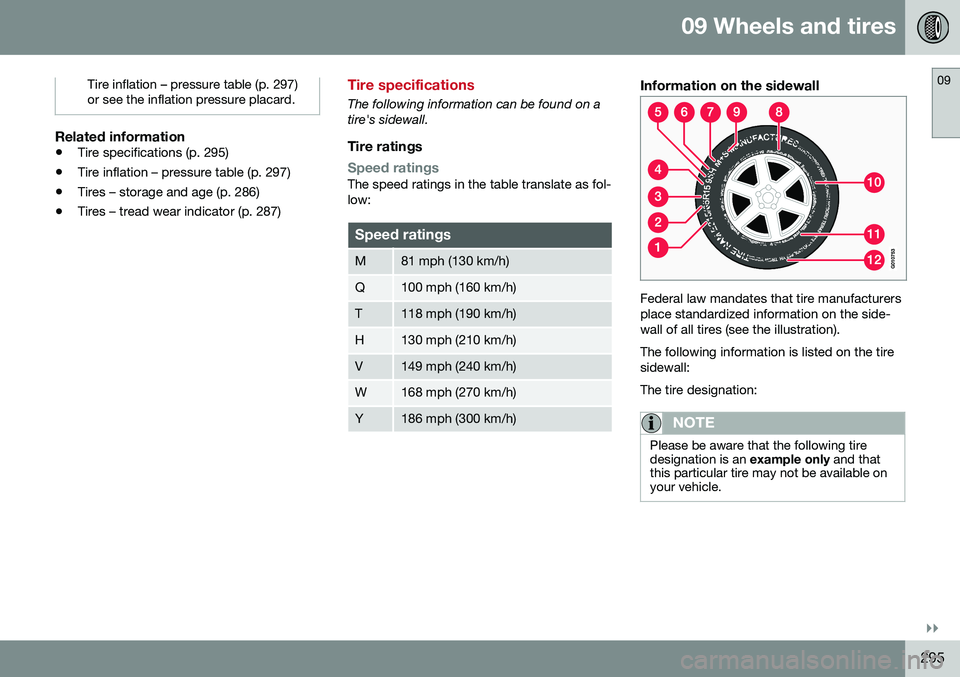
Information on the sidewall
Federal law mandates that tire manufacturers place standardized information on the side-wall of all tires (see the illustration). The following information is listed on the tire sidewall: The tire designation:
NOTE
Please be aware that the following tire designation is an
example only and that
this particular tire may not be available onyour vehicle.