warning sign VOLVO S60 2016 Owner´s Manual
[x] Cancel search | Manufacturer: VOLVO, Model Year: 2016, Model line: S60, Model: VOLVO S60 2016Pages: 392, PDF Size: 10.04 MB
Page 43 of 392
02 Safety
02
}}
41
Related information
•Supplemental Restraint System (SRS) (p. 31)
• Front airbags (p. 33)
• Inflatable Curtain (IC) (p. 41)
Inflatable Curtain (IC)
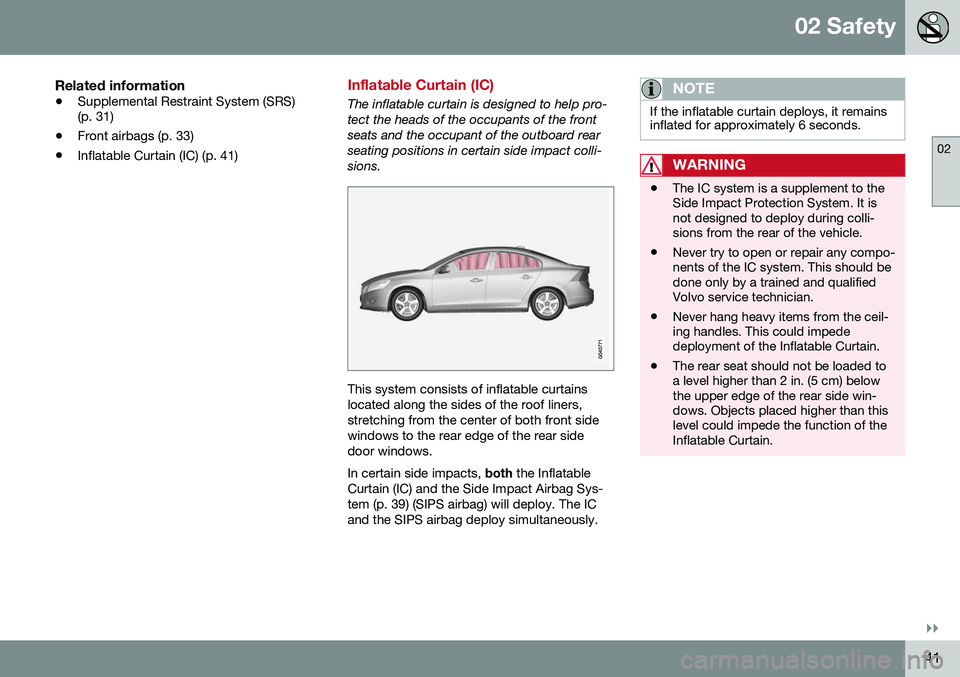
The inflatable curtain is designed to help pro- tect the heads of the occupants of the frontseats and the occupant of the outboard rearseating positions in certain side impact colli-sions.
This system consists of inflatable curtains located along the sides of the roof liners,stretching from the center of both front sidewindows to the rear edge of the rear sidedoor windows. In certain side impacts,
both the Inflatable
Curtain (IC) and the Side Impact Airbag Sys- tem (p. 39) (SIPS airbag) will deploy. The ICand the SIPS airbag deploy simultaneously.
NOTE
If the inflatable curtain deploys, it remains inflated for approximately 6 seconds.
WARNING
• The IC system is a supplement to the Side Impact Protection System. It isnot designed to deploy during colli-sions from the rear of the vehicle.
• Never try to open or repair any compo-nents of the IC system. This should bedone only by a trained and qualifiedVolvo service technician.
• Never hang heavy items from the ceil-ing handles. This could impededeployment of the Inflatable Curtain.
• The rear seat should not be loaded toa level higher than 2 in. (5 cm) belowthe upper edge of the rear side win-dows. Objects placed higher than thislevel could impede the function of theInflatable Curtain.
Page 44 of 392
||
02 Safety
02
42
WARNING
In order for the IC to provide its best pro- tection, both front seat occupants andboth outboard rear seat occupants shouldsit in an upright position with the seat beltproperly fastened; adults using the seatbelt and children using the proper childrestraint system. Only adults should sit inthe front seats. Children must never beallowed in the front passenger seat, Childsafety (p. 46) for guidelines. Failure tofollow these instructions can result in injuryto the vehicle occupants in an accident.
Related information
•Supplemental Restraint System (SRS) (p. 31)
• Front airbags (p. 33)
• Child safety (p. 46)
Whiplash Protection System (WHIPS)
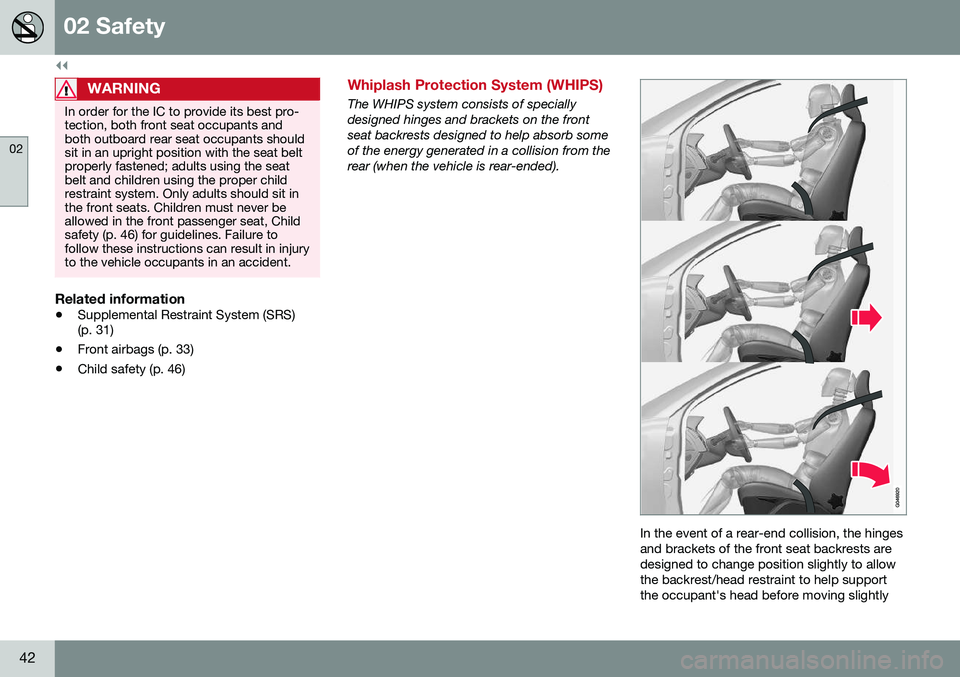
The WHIPS system consists of specially designed hinges and brackets on the frontseat backrests designed to help absorb someof the energy generated in a collision from therear (when the vehicle is rear-ended).
In the event of a rear-end collision, the hinges and brackets of the front seat backrests aredesigned to change position slightly to allowthe backrest/head restraint to help supportthe occupant's head before moving slightly
Page 45 of 392
02 Safety
02
}}
43
rearward. This movement helps absorb some of the forces that could result in whiplash.
WARNING
•
The WHIPS system is designed to supplement the other safety systemsin your vehicle. For this system tofunction properly, the three-point seatbelt must be worn. Please be awarethat no system can prevent all possibleinjuries that may occur in an accident.
• The WHIPS system is designed tofunction in certain collisions from therear, depending on the crash severity,angle and speed.
WARNING
•
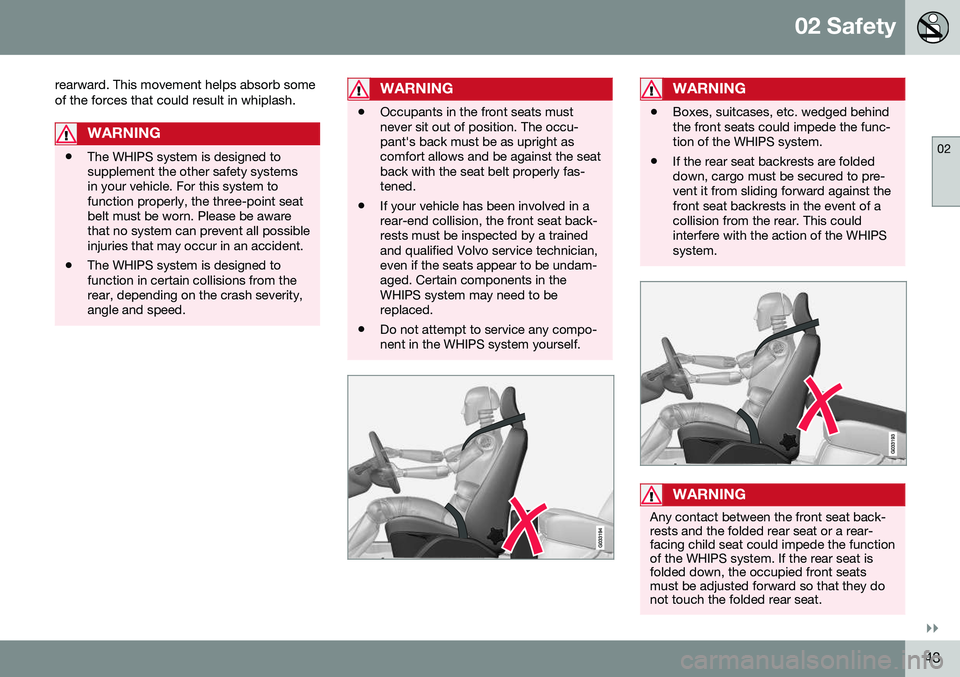
Occupants in the front seats must never sit out of position. The occu-pant's back must be as upright ascomfort allows and be against the seatback with the seat belt properly fas-tened.
• If your vehicle has been involved in arear-end collision, the front seat back-rests must be inspected by a trainedand qualified Volvo service technician,even if the seats appear to be undam-aged. Certain components in theWHIPS system may need to bereplaced.
• Do not attempt to service any compo-nent in the WHIPS system yourself.
WARNING
•Boxes, suitcases, etc. wedged behind the front seats could impede the func-tion of the WHIPS system.
• If the rear seat backrests are foldeddown, cargo must be secured to pre-vent it from sliding forward against thefront seat backrests in the event of acollision from the rear. This couldinterfere with the action of the WHIPSsystem.
WARNING
Any contact between the front seat back- rests and the folded rear seat or a rear-facing child seat could impede the functionof the WHIPS system. If the rear seat isfolded down, the occupied front seatsmust be adjusted forward so that they donot touch the folded rear seat.
Page 47 of 392
02 Safety
02
45
WARNING
•Never attempt to repair the vehicle yourself or to reset the electrical sys-tem after the vehicle has displayed
Safety mode See manual. This could
result in injury or improper system function.
• Restoring the vehicle to normal operat-ing status should only be done by atrained and qualified Volvo servicetechnician.
• After
Safety mode See manual has
been displayed, if you detect the odor of fuel vapor, or see any signs of fuelleakage, do not attempt to start thevehicle. Leave the vehicle immediately.
Related information
• Crash mode – starting the vehicle (p. 45)
• Crash mode – moving the vehicle(p. 45)
Crash mode – starting the vehicle
If Crash mode has been set Crash mode (p. 44)) and damage to the vehicle isminor and there is no fuel leakage, you mayattempt to start the engine. To do so:
1. Remove the remote key from the ignition
slot and open the driver's door. If a mes- sage is displayed that the ignition is on,press the start button.
2. Close the driver's door and reinsert the remote key in the ignition slot.
3. Try to start the vehicle.
WARNING
If the message Safety mode See manualis still displayed, the vehicle should not be driven and must be towed. Concealedfaults may make the vehicle difficult tocontrol.
Related information
• Crash mode – general information (p. 44)
• Crash mode – moving the vehicle (p. 45)
Crash mode – moving the vehicle
If the message Normal mode appears after
an attempt has been made to start the engine, Starting the vehicle after a crash (p. 45), thevehicle may be moved carefully from its pres-ent position, if for example, it is blocking traf-fic. It should, however, not be moved fartherthan is absolutely necessary.
WARNING
Even if the vehicle appears to be drivable after Crash mode has been set, it shouldnot be driven or towed (pulled by anothervehicle). There may be concealed damagethat could make it difficult or impossible tocontrol. The vehicle should be transportedon a flatbed tow truck to a trained andqualified Volvo service technician forinspection/repairs.
Related information
• Crash mode – general information (p. 44)
Page 49 of 392
02 Safety
02
}}
47
WARNING
•Do not use child safety seats or child booster cushions/backrests in thefront passenger's seat. We also rec-ommend that children under 4 feet7 inches (140 cm) in height who haveoutgrown these devices sit in the rearseat with the seat belt fastened.
• Keep vehicle doors and trunk lockedand keep remote controls out of achild’s reach. Unsupervised childrencould lock themselves in an opentrunk and risk injury. Children shouldbe taught not to play in vehicles.
• On hot days, the temperature in thevehicle interior can rise very quickly.Exposure to these high temperaturesfor even a short period of time cancause heat-related injury or death.Small children are particularly at risk.
Child seat should always be registered. See Child restraints (p. 47) for more information.
Volvo's recommendationsWhy does Volvo believe that no child shouldsit in the front seat of a car? It's quite simplereally. A front airbag (p. 33) is a very powerfuldevice designed, by law, to help protect anadult. Because of the size of the airbag and its speed of inflation, a child should never beplaced in the front seat, even if he or she is properly belted or strapped into a child safetyseat. Volvo has been an innovator in safetyfor over seventy-five years, and we'll continueto do our part. But we need your help. Pleaseremember to put your children in the backseat, and buckle them up.
Volvo has some very specific
recommendations:
• Always wear your seat belt (p. 28).
• Airbags are a SUPPLEMENTAL safety device which, when used with a three-point seat belt can help reduce seriousinjuries during certain types of accidents.Volvo recommends that you do not dis-connect the airbag system in your vehi-cle.
• Volvo strongly recommends that every-one in the vehicle be properly restrained.
• Volvo recommends that ALL occupants(adults and children) shorter than 4 feet7 inches (140 cm) be seated in the backseat of any vehicle with a front passengerside airbag.
• Drive safely!
Related information
• Infant seats (p. 49)
• Convertible seats (p. 51)
• Booster cushions (p. 54)
• Child safety locks (p. 57)
• Top tether anchors (p. 56)
Child restraints
Suitable child restraints should always be used when children travel in the vehicle.
Child restraint systems
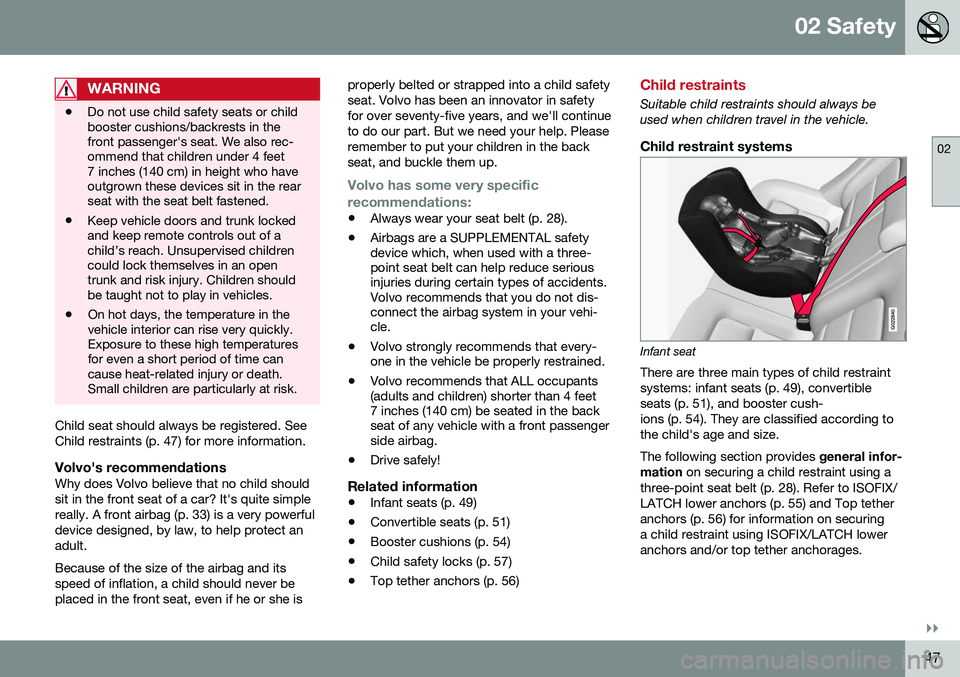
G022840
Infant seat
There are three main types of child restraint systems: infant seats (p. 49), convertibleseats (p. 51), and booster cush-ions (p. 54). They are classified according tothe child's age and size. The following section provides general infor-
mation on securing a child restraint using a
three-point seat belt (p. 28). Refer to ISOFIX/ LATCH lower anchors (p. 55) and Top tetheranchors (p. 56) for information on securinga child restraint using ISOFIX/LATCH loweranchors and/or top tether anchorages.
Page 58 of 392
||
02 Safety
02
56
Related information
•Child safety (p. 46)
• Infant seats (p. 49)
• Convertible seats (p. 51)
Top tether anchors
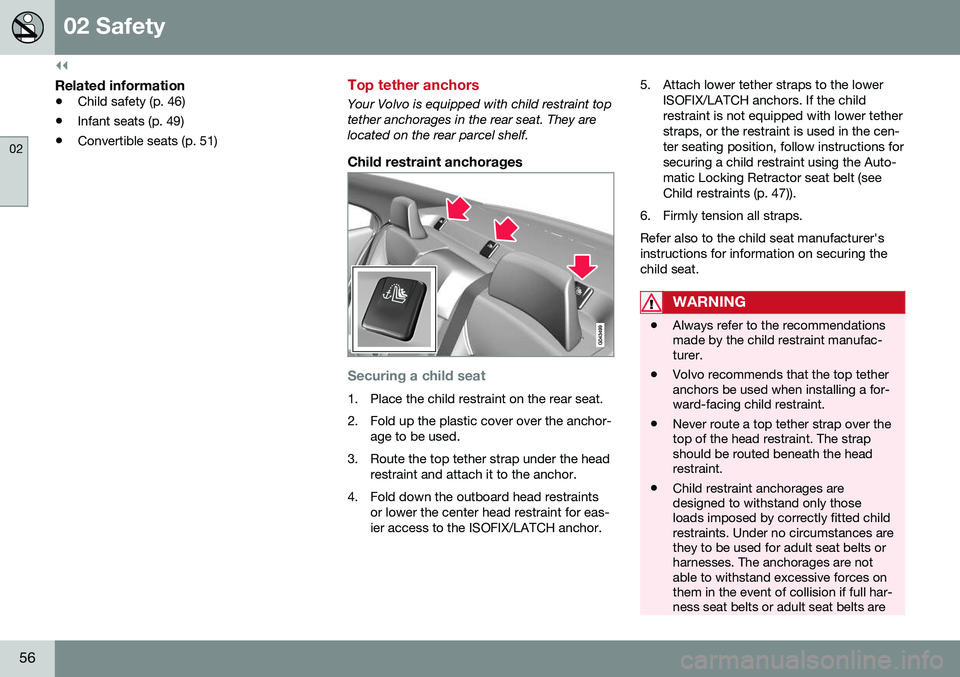
Your Volvo is equipped with child restraint top tether anchorages in the rear seat. They arelocated on the rear parcel shelf.
Child restraint anchorages
Securing a child seat
1. Place the child restraint on the rear seat.
2. Fold up the plastic cover over the anchor-
age to be used.
3. Route the top tether strap under the head restraint and attach it to the anchor.
4. Fold down the outboard head restraints or lower the center head restraint for eas- ier access to the ISOFIX/LATCH anchor. 5. Attach lower tether straps to the lower
ISOFIX/LATCH anchors. If the childrestraint is not equipped with lower tetherstraps, or the restraint is used in the cen-ter seating position, follow instructions forsecuring a child restraint using the Auto-matic Locking Retractor seat belt (seeChild restraints (p. 47)).
6. Firmly tension all straps. Refer also to the child seat manufacturer's instructions for information on securing thechild seat.
WARNING
• Always refer to the recommendations made by the child restraint manufac-turer.
• Volvo recommends that the top tetheranchors be used when installing a for-ward-facing child restraint.
• Never route a top tether strap over thetop of the head restraint. The strapshould be routed beneath the headrestraint.
• Child restraint anchorages aredesigned to withstand only thoseloads imposed by correctly fitted childrestraints. Under no circumstances arethey to be used for adult seat belts orharnesses. The anchorages are notable to withstand excessive forces onthem in the event of collision if full har-ness seat belts or adult seat belts are
Page 63 of 392
03 Instruments and controls
03
* Option/accessory, for more information, see Introduction.61
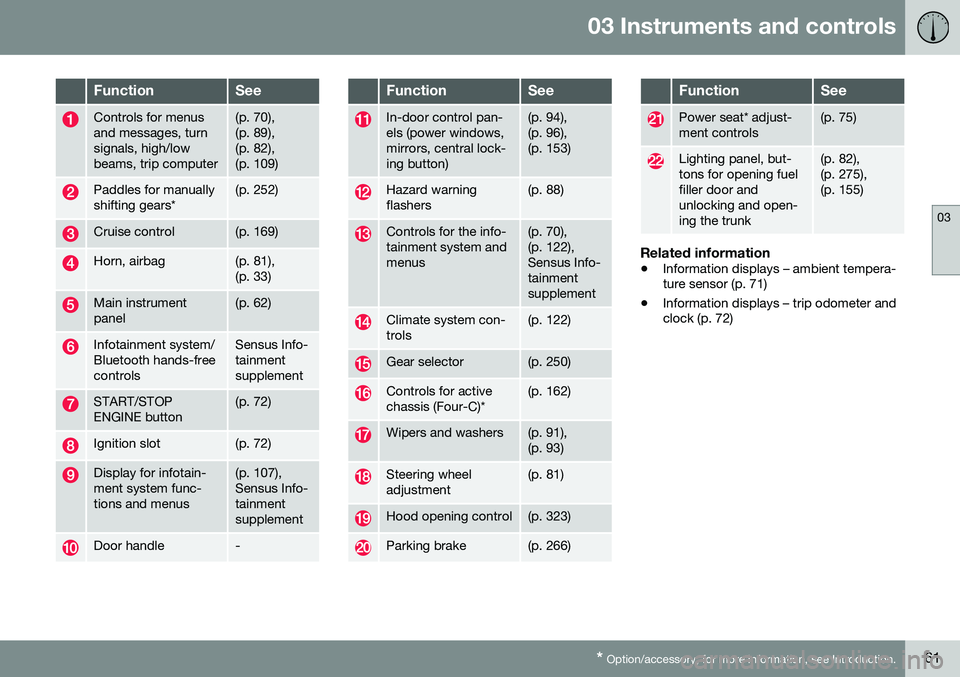
FunctionSee
Controls for menus and messages, turnsignals, high/lowbeams, trip computer(p. 70), (p. 89),(p. 82),(p. 109)
Paddles for manually shifting gears*(p. 252)
Cruise control(p. 169)
Horn, airbag(p. 81), (p. 33)
Main instrument panel(p. 62)
Infotainment system/ Bluetooth hands-freecontrolsSensus Info- tainmentsupplement
START/STOP ENGINE button(p. 72)
Ignition slot(p. 72)
Display for infotain- ment system func-tions and menus(p. 107), Sensus Info-tainmentsupplement
Door handle-
FunctionSee
In-door control pan- els (power windows,mirrors, central lock-ing button)(p. 94), (p. 96),(p. 153)
Hazard warning flashers(p. 88)
Controls for the info- tainment system andmenus(p. 70), (p. 122),Sensus Info-tainmentsupplement
Climate system con- trols(p. 122)
Gear selector(p. 250)
Controls for active chassis (Four-C)*(p. 162)
Wipers and washers(p. 91), (p. 93)
Steering wheel adjustment(p. 81)
Hood opening control(p. 323)
Parking brake(p. 266)
FunctionSee
Power seat* adjust- ment controls(p. 75)
Lighting panel, but- tons for opening fuelfiller door andunlocking and open-ing the trunk(p. 82), (p. 275),(p. 155)
Related information
• Information displays – ambient tempera- ture sensor (p. 71)
• Information displays – trip odometer andclock (p. 72)
Page 69 of 392
03 Instruments and controls
03
}}
* Option/accessory, for more information, see Introduction.67
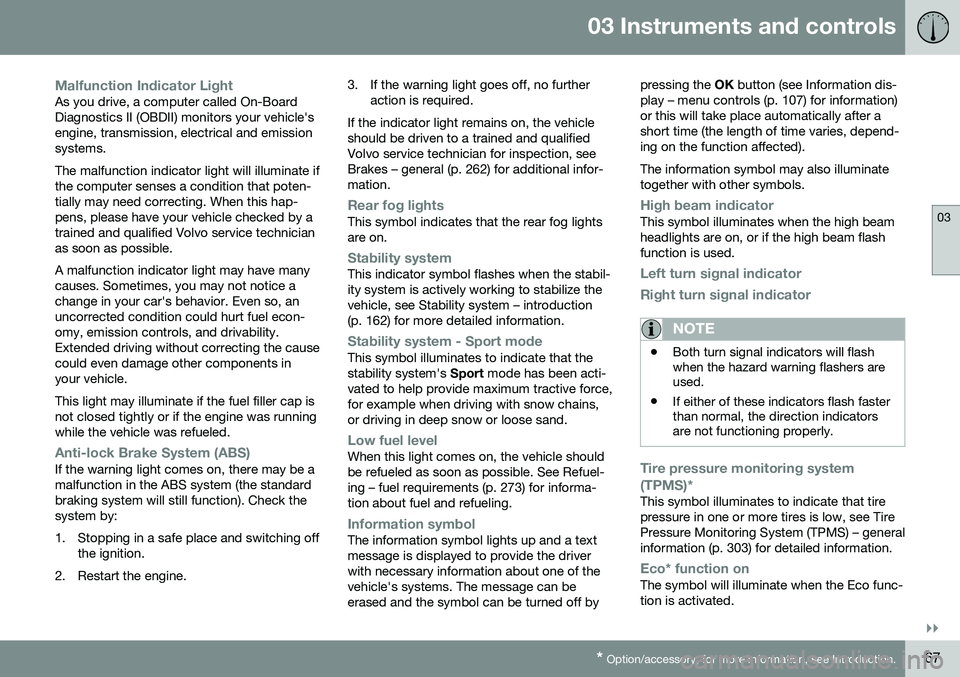
Malfunction Indicator LightAs you drive, a computer called On-Board Diagnostics II (OBDII) monitors your vehicle'sengine, transmission, electrical and emissionsystems. The malfunction indicator light will illuminate if the computer senses a condition that poten-tially may need correcting. When this hap-pens, please have your vehicle checked by atrained and qualified Volvo service technicianas soon as possible. A malfunction indicator light may have many causes. Sometimes, you may not notice achange in your car's behavior. Even so, anuncorrected condition could hurt fuel econ-omy, emission controls, and drivability.Extended driving without correcting the causecould even damage other components inyour vehicle. This light may illuminate if the fuel filler cap is not closed tightly or if the engine was runningwhile the vehicle was refueled.
Anti-lock Brake System (ABS)If the warning light comes on, there may be a malfunction in the ABS system (the standardbraking system will still function). Check thesystem by:
1. Stopping in a safe place and switching off
the ignition.
2. Restart the engine. 3. If the warning light goes off, no further
action is required.
If the indicator light remains on, the vehicle should be driven to a trained and qualifiedVolvo service technician for inspection, seeBrakes – general (p. 262) for additional infor-mation.
Rear fog lightsThis symbol indicates that the rear fog lights are on.
Stability systemThis indicator symbol flashes when the stabil- ity system is actively working to stabilize thevehicle, see Stability system – introduction(p. 162) for more detailed information.
Stability system - Sport modeThis symbol illuminates to indicate that the stability system's Sport mode has been acti-
vated to help provide maximum tractive force,for example when driving with snow chains,or driving in deep snow or loose sand.
Low fuel levelWhen this light comes on, the vehicle should be refueled as soon as possible. See Refuel-ing – fuel requirements (p. 273) for informa-tion about fuel and refueling.
Information symbolThe information symbol lights up and a text message is displayed to provide the driverwith necessary information about one of thevehicle's systems. The message can beerased and the symbol can be turned off by pressing the
OK button (see Information dis-
play – menu controls (p. 107) for information)or this will take place automatically after ashort time (the length of time varies, depend-ing on the function affected). The information symbol may also illuminate together with other symbols.
High beam indicatorThis symbol illuminates when the high beam headlights are on, or if the high beam flashfunction is used.
Left turn signal indicator
Right turn signal indicator
NOTE
• Both turn signal indicators will flash when the hazard warning flashers areused.
• If either of these indicators flash fasterthan normal, the direction indicatorsare not functioning properly.
Tire pressure monitoring system (TPMS)*
This symbol illuminates to indicate that tire pressure in one or more tires is low, see TirePressure Monitoring System (TPMS) – generalinformation (p. 303) for detailed information.
Eco* function onThe symbol will illuminate when the Eco func- tion is activated.
Page 71 of 392
03 Instruments and controls
03
}}
69
Generator not chargingThis symbol comes on during driving if a fault has occurred in the electrical system. Contactan authorized Volvo workshop.
Engine temperatureEngine overheating can result from low oil or coolant levels, towing or hard driving at highheat and altitude, or mechanical malfunction.Engine overheating will be signaled with textand a red warning triangle in the middle of theinstrument display. The exact text will dependon the degree of overheating. It may range from
High engine temp Reduce speed toHigh engine temp Stop engine. If appropri-
ate, other messages, such as Coolant level
low, Stop safely will also be displayed. If
your engine does overheat so that you must stop the engine, always allow the engine tocool before attempting to check oil and cool-ant levels. See Engine compartment – coolant (p. 327) for more information.
Fault in brake systemIf this symbol lights, the brake fluid level may be too low. Stop the vehicle in a safe placeand check the level in the brake fluid reser-voir, see Engine compartment – brake fluid(p. 328). If the level in the reservoir is belowMIN , the vehicle should be transported to an
authorized Volvo workshop to have the brakesystem checked. If the
and symbols come on
at the same time, there may be a fault in the brake force distribution system.
1. Stop the vehicle in a safe place and turn off the engine.
2. Restart the engine.
• If both symbols extinguish, continue driv- ing.
• If the symbols remain on, check the levelin the brake fluid reservoir, see Enginecompartment – brake fluid (p. 328). If thebrake fluid level is normal but the sym-bols are still lit, the vehicle can be driven,with great care, to an authorized Volvoworkshop to have the brake systemchecked.
• If the level in the reservoir is below
MIN,
the vehicle should be transported to anauthorized Volvo workshop to have thebrake system checked.WARNING
• If the fluid level is below the
MIN mark
in the reservoir or if a warning mes- sage is displayed in the text window:DO NOT DRIVE . Have the vehicle
towed to a trained and qualified Volvoservice technician and have the brakesystem inspected.
• If the
and symbols
are on at the same time, there is a risk of reduced vehicle stability.
Warning symbolThe red warning symbol lights up to indicate a problem related to safety and/or drivability.A message will also appear in the instrumentpanel. The symbol remains visible until thefault has been rectified but the text messagecan be cleared with the OK button, see Infor-
mation display – menu controls (p. 107). Thewarning symbol can also come on in conjunc-tion with other symbols. Action:
1. Stop in a safe place. Do not drive the vehicle further.
2. Read the information on the display. Implement the action in accordance with the message in the display. Clear themessage using OK.
Page 90 of 392
||
03 Instruments and controls
03
88
NOTE
•The rear fog lights are considerably brighter than the normal taillights andshould be used only when conditionssuch as fog, rain, snow, smoke or dustreduce visibility for other vehicles toless than 500 ft. (150 meters).
• Condensation may form temporarily onthe inside of the lenses of exteriorlights such as headlights, fog lights, ortaillights. This is normal and the lightsare designed to withstand moisture.Normally, condensation will dissipateafter the lights have been on for ashort time.
Related information
•
Lighting panel (p. 82)
Hazard warning flashers
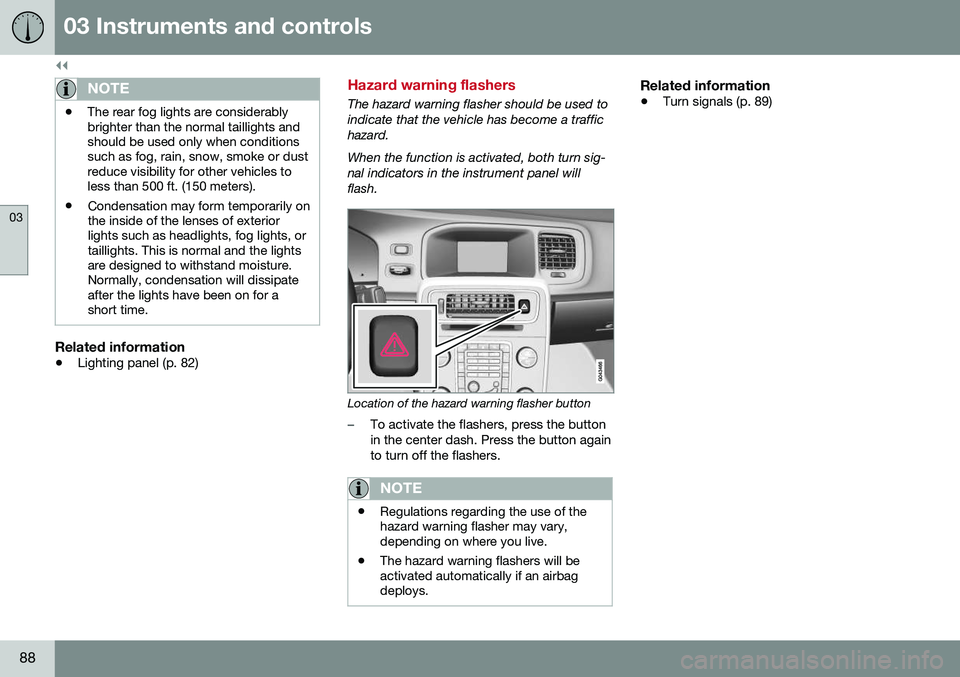
The hazard warning flasher should be used to indicate that the vehicle has become a traffichazard. When the function is activated, both turn sig- nal indicators in the instrument panel willflash.
Location of the hazard warning flasher button
–To activate the flashers, press the button in the center dash. Press the button againto turn off the flashers.
NOTE
•Regulations regarding the use of the hazard warning flasher may vary,depending on where you live.
• The hazard warning flashers will beactivated automatically if an airbagdeploys.
Related information
•
Turn signals (p. 89)