ECU VOLVO S60 2016 Owner´s Manual
[x] Cancel search | Manufacturer: VOLVO, Model Year: 2016, Model line: S60, Model: VOLVO S60 2016Pages: 392, PDF Size: 10.04 MB
Page 335 of 392
10 Maintenance and servicing
10
333
Bulbs – low beam, Halogen
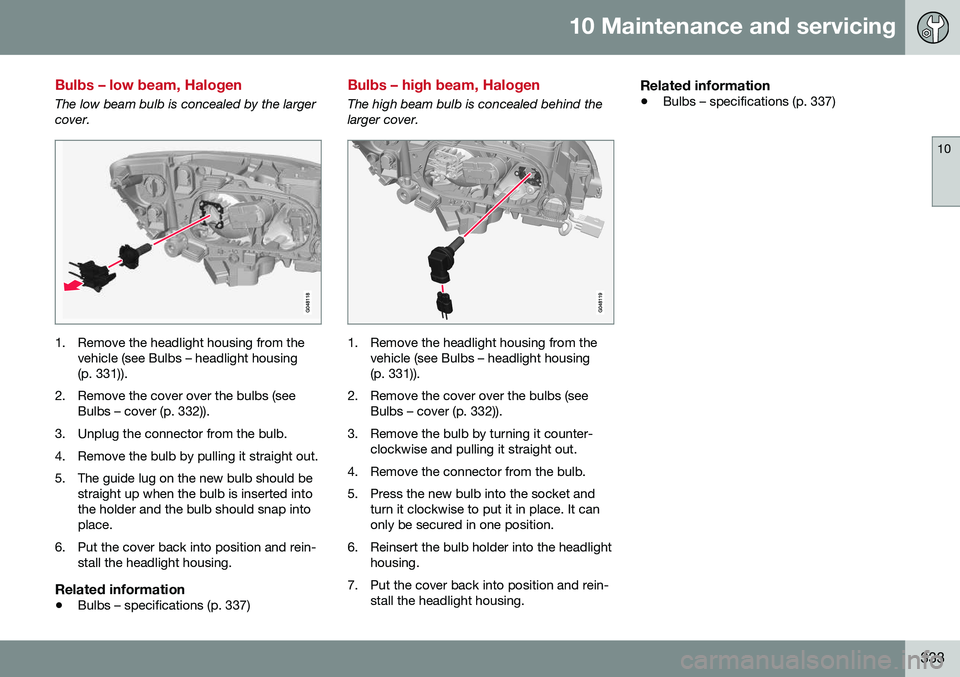
The low beam bulb is concealed by the larger cover.
1. Remove the headlight housing from thevehicle (see Bulbs – headlight housing (p. 331)).
2. Remove the cover over the bulbs (see Bulbs – cover (p. 332)).
3. Unplug the connector from the bulb.
4. Remove the bulb by pulling it straight out.
5. The guide lug on the new bulb should be straight up when the bulb is inserted into the holder and the bulb should snap intoplace.
6. Put the cover back into position and rein- stall the headlight housing.
Related information
• Bulbs – specifications (p. 337)
Bulbs – high beam, Halogen
The high beam bulb is concealed behind the larger cover.
1. Remove the headlight housing from the
vehicle (see Bulbs – headlight housing (p. 331)).
2. Remove the cover over the bulbs (see Bulbs – cover (p. 332)).
3. Remove the bulb by turning it counter- clockwise and pulling it straight out.
4. Remove the connector from the bulb.
5. Press the new bulb into the socket and turn it clockwise to put it in place. It can only be secured in one position.
6. Reinsert the bulb holder into the headlight housing.
7. Put the cover back into position and rein- stall the headlight housing.
Related information
• Bulbs – specifications (p. 337)
Page 336 of 392
10 Maintenance and servicing
10
334
Bulbs – extra high beam
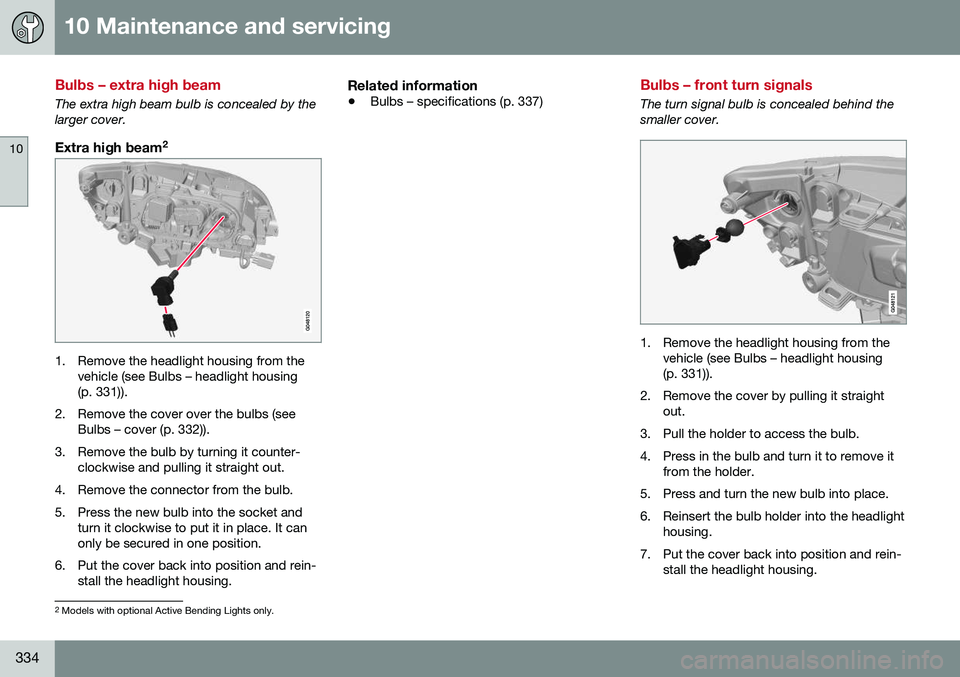
The extra high beam bulb is concealed by the larger cover.
Extra high beam2
1. Remove the headlight housing from the
vehicle (see Bulbs – headlight housing (p. 331)).
2. Remove the cover over the bulbs (see Bulbs – cover (p. 332)).
3. Remove the bulb by turning it counter- clockwise and pulling it straight out.
4. Remove the connector from the bulb.
5. Press the new bulb into the socket and turn it clockwise to put it in place. It can only be secured in one position.
6. Put the cover back into position and rein- stall the headlight housing.
Related information
• Bulbs – specifications (p. 337)
Bulbs – front turn signals
The turn signal bulb is concealed behind the smaller cover.
1. Remove the headlight housing from the
vehicle (see Bulbs – headlight housing (p. 331)).
2. Remove the cover by pulling it straight out.
3. Pull the holder to access the bulb.
4. Press in the bulb and turn it to remove it from the holder.
5. Press and turn the new bulb into place.
6. Reinsert the bulb holder into the headlight housing.
7. Put the cover back into position and rein- stall the headlight housing.
2Models with optional Active Bending Lights only.
Page 342 of 392
||
10 Maintenance and servicing
10
340
With the wipers in the service position, fold out the wiper arm from the wind-shield. Press the button on the wiperblade attachment and pull the wiperblade straight out, parallel with the wiperarm.
Slide in the new wiper blade until it clicks into place.
Check that the blade is securely in place.
4. Press the wipers back against the wind- shield.
To return the wipers from the service position to the normal position, fold the wipers backagainst the windshield and press the START/
STOP ENGINE button briefly to put the igni-
tion in mode I (or start the engine).
CleaningKeeping the windshield and wiper bladesclean helps improve visibility and prolongsthe service life of the wiper blades. Clean thewiper blades with a stiff-bristle brush andlukewarm soap solution or car washing deter-gent.
Related information
• Engine compartment – washer fluid (p. 340)
• Wiper blades – service position (p. 338)
Engine compartment – washer fluid
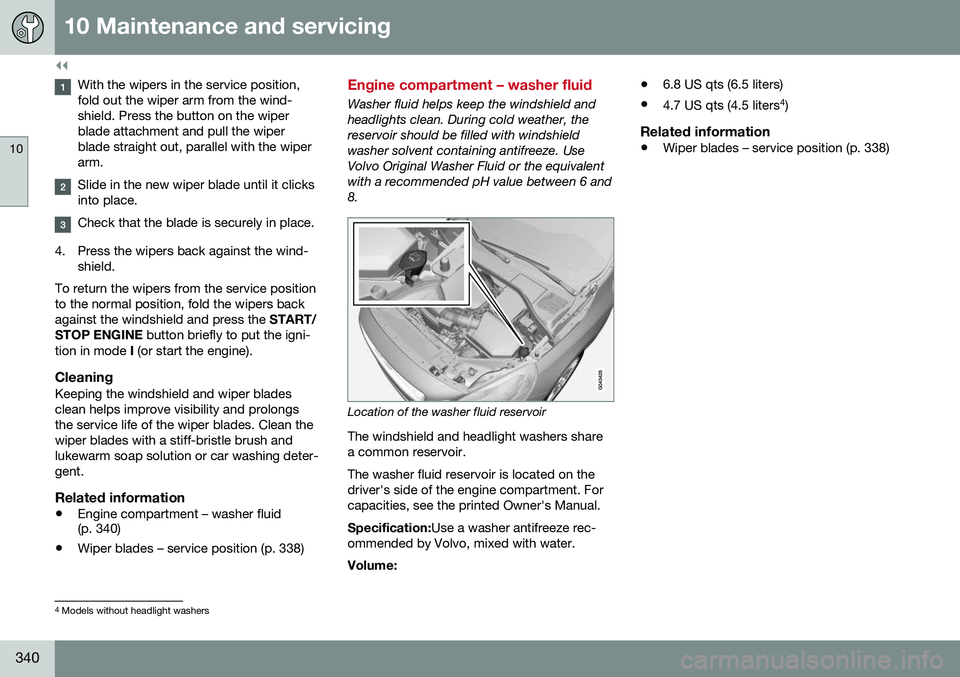
Washer fluid helps keep the windshield and headlights clean. During cold weather, thereservoir should be filled with windshieldwasher solvent containing antifreeze. UseVolvo Original Washer Fluid or the equivalentwith a recommended pH value between 6 and8.
Location of the washer fluid reservoir
The windshield and headlight washers share a common reservoir. The washer fluid reservoir is located on the driver's side of the engine compartment. Forcapacities, see the printed Owner's Manual. Specification: Use a washer antifreeze rec-
ommended by Volvo, mixed with water. Volume: •
6.8 US qts (6.5 liters)
• 4.7 US qts (4.5 liters 4
)
Related information
• Wiper blades – service position (p. 338)
4
Models without headlight washers
Page 344 of 392
||
10 Maintenance and servicing
10
342
CAUTION
The infotainment system's energy-saving feature may not function correctly or at all,and/or a message may be displayed if abattery charger or jumper cables are notconnected properly.
• The negative terminal on the battery must
never be used to connect a
jumper cable or a battery charger.Only the ground point on the chassismay be used.
See Jump starting (p. 249) for an illustra- tion and additional information.
WARNING
• Never expose the battery to open flame or electric spark.
• Do not smoke near the battery.
• Battery fluid contains sulfuric acid. Donot allow battery fluid to contact eyes,skin, fabrics or painted surfaces. Ifcontact occurs, flush the affected areaimmediately with water. Obtain medi-cal help immediately if eyes are affec-ted.
NOTE
The life of the battery is shortened if it becomes discharged repeatedly.
Related information
•
Battery – changing (p. 343)
• Battery – maintenance (p. 342)
• Battery – symbols (p. 341)
Battery – maintenance
Proper battery maintenance can help prolong its service life.
Maintenance
• Use a screw driver to open the caps or cover and a flashlight to inspect the level.
• If necessary, add distilled water. The levelshould never be above the indicator.
• The fluid level should be checked if thebattery has been recharged.
• After inspection, be sure the cap overeach battery cell or the cover is securelyin place.
• Check that the battery cables are cor-rectly connected and properly tightened.
• Never disconnect the battery when theengine is running, or when the key is inthe ignition. This could damage the vehi-cle's electrical system.
• The battery should be disconnected fromthe vehicle when a battery charger isused directly on the battery.
• To help keep the battery in good condi-tion, the vehicle should be driven for atleast 15 minutes a week or connected toa charger with an automatic chargingfunction.
• If the battery is fully discharged a numberof times, this may shorten its service life.Keeping the battery fully charged helpsprolong its service life.
Page 346 of 392
||
10 Maintenance and servicing
10
344* Option/accessory, for more information, see Introduction.
RemovalSwitch off the ignition, remove the remote key from the ignition slot and wait at least5 minutes before disconnecting the battery sothat all information in the vehicle's electricalsystem can be stored in the control modules.
Open the clips on the front cover and remove the cover.
Release the rubber molding so that the rear cover is free.
Remove the rear cover by pulling it away.
Detach the black negative cable.
Detach the red positive cable
Detach the ventilation hose from the
battery
Loosen the screw holding the battery
clamp.
Move the battery to the side and lift it up.
WARNING
PROPOSITION 65 WARNING! Battery posts, terminals, and related accessories contain lead and lead com-pounds, chemicals known to the state ofCalifornia to cause cancer and reproduc-tive harm. Wash hands after handling.
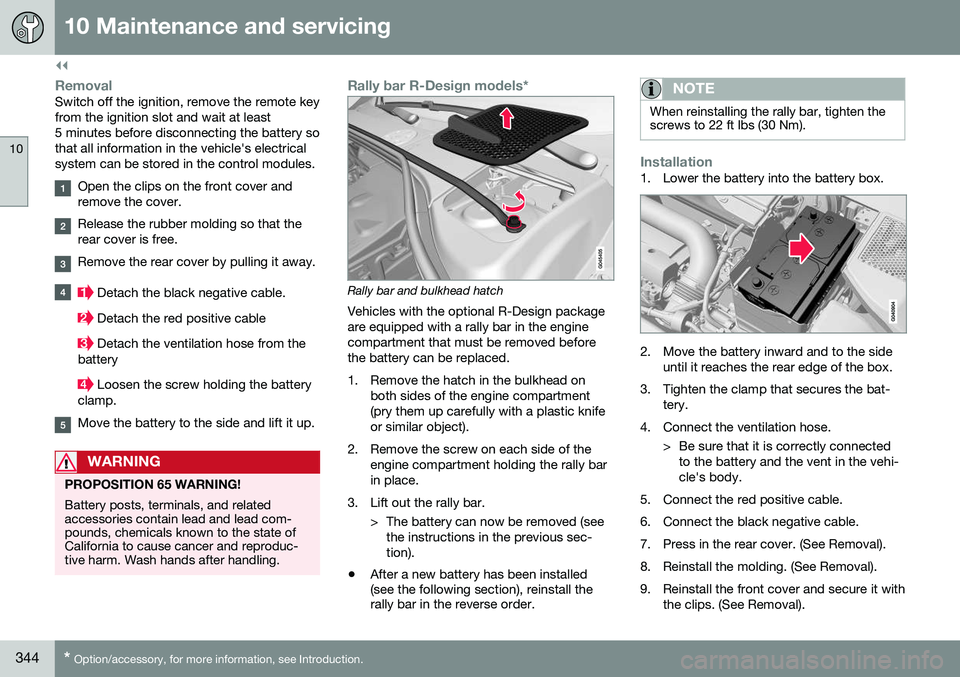
Rally bar R-Design models*
Rally bar and bulkhead hatch
Vehicles with the optional R-Design package are equipped with a rally bar in the enginecompartment that must be removed beforethe battery can be replaced.
1. Remove the hatch in the bulkhead on both sides of the engine compartment (pry them up carefully with a plastic knifeor similar object).
2. Remove the screw on each side of the engine compartment holding the rally barin place.
3. Lift out the rally bar. > The battery can now be removed (seethe instructions in the previous sec-tion).
• After a new battery has been installed (see the following section), reinstall therally bar in the reverse order.
NOTE
When reinstalling the rally bar, tighten the screws to 22 ft lbs (30 Nm).
Installation1. Lower the battery into the battery box.
2. Move the battery inward and to the side
until it reaches the rear edge of the box.
3. Tighten the clamp that secures the bat- tery.
4. Connect the ventilation hose. > Be sure that it is correctly connectedto the battery and the vent in the vehi- cle's body.
5. Connect the red positive cable.
6. Connect the black negative cable.
7. Press in the rear cover. (See Removal).
8. Reinstall the molding. (See Removal).
9. Reinstall the front cover and secure it with the clips. (See Removal).
Page 359 of 392
10 Maintenance and servicing
10
}}
357
Automatic car wash
The vehicle should be washed at regular inter- vals since dirt, dust, insects and tar spotsadhere to the paint and may cause damage.To help prevent corrosion, it is particularlyimportant to wash the car frequently in thewintertime.• We do NOT recommend washing your car in an automatic wash during the firstfew months (because the paint will nothave hardened sufficiently).
• An automatic wash is a simple and quickway to clean your car, but it is worthremembering that it may not be as thor-ough as when you yourself go over thecar with sponge and water. Keeping theunderbody clean is most important, espe-cially in the winter. Some automaticwashers do not have facilities for washingthe underbody.
NOTE
Condensation may form temporarily on the inside of the lenses of exterior lights suchas headlights, fog lights, or taillights. Thisis normal and the lights are designed towithstand moisture. Normally, condensa-tion will dissipate after the lights have beenon for a short time.
CAUTION
• Before driving into an automatic car wash, turn off the optional rain sensorto avoid damaging the windshield wip-ers.
• Make sure that side view mirrors, aux-iliary lamps, etc, are secure, and thatany antenna(s) are retracted orremoved. Otherwise there is risk of themachine dislodging them.
• Chromed wheels:
Clean chrome-
plated wheels using the same deter-gents used for the body of the vehicle.Aggressive wheel-cleaning agents canpermanently stain chrome-platedwheels.
WARNING
• When the vehicle is driven immediately after being washed, apply the brakes,including the parking brake, severaltimes in order to remove any moisturefrom the brake linings.
• Engine cleaning agents should not beused when the engine is warm. Thisconstitutes a fire risk.
Related information
•
Polishing and waxing (p. 357)
• Cleaning the interior (p. 358)
• Washing the car (p. 356)
Polishing and waxing
Normally, polishing is not required during the first year after delivery, however, waxing maybe beneficial.
• Before applying polish or wax the vehicle must be washed and dried. Tar spots canbe removed with kerosene or tar remover.Difficult spots may require a fine rubbingcompound.
• After polishing use liquid or paste wax.
• Several commercially available productscontain both polish and wax.
• Waxing alone does not substitute for pol-ishing a dull surface.
• A wide range of polymer-based waxescan be purchased today. These waxesare easy to use and produce a long-last-ing, high-gloss finish that protects thebodywork against oxidation, road dirt andfading.
• Do not polish or wax your vehicle in directsunlight (the surface of the vehicle shouldnot be warmer than 113 °F (45 °C).
Page 387 of 392
12 Index
12
385
locking the vehicle.............................. 142
replacing the battery........................... 147
unlocking the vehicle.......................... 142
Reporting safety defects............................ 27
Roadside Assistance................................. 24
Road sign information (RSI)..................... 167
Roof loads............................................... 136
S
Safety, occupant........................................ 26
Safety defects, reporting........................... 27
Safety mode.............................................. 44Seat belt reminder................................................ 30
Seat belts Automatic locking retractor/Emer-
gency locking retractor......................... 47
buckling................................................ 29
maintenance......................................... 29
pretensioners........................................ 28
reminder................................................ 30
reminder warning light.......................... 68
securing child restraint systems.... 49,51, 54
unbuckling............................................ 29 use during pregnancy........................... 31
using..................................................... 28
Seats, front.......................................... 74, 75
Sensus..................................................... 106Service connected service booking................ 321
Shiftlock..................................................... 14 override............................................... 254
Side door mirrors................................. 96, 97
Side impact airbags................................... 39
Sign information (RSI).............................. 167
Snow chains............................................ 301
Snow tires........................................ 301, 302
Spare tire................................................. 291
Spin control..................................... 162, 163
SRS............................................................ 31
Stability system....................... 162, 163, 165 Corner Traction Control (CTC)............ 163
Engine Drag Control (EDC)................. 163
indicator light........................................ 67
Start/Stop (engine function)..... 255, 256, 257, 258, 259
Starting the engine.................................. 245 remote start........................................ 247
with keyless drive............................... 245 Starting the vehicle
after a crash (crash mode).............. 44, 45
Start inhibitor (immobilizer)...................... 141 Steering wheel adjusting............................................... 81
heated................................................... 82
horn....................................................... 81
keypad.................................................. 81
Steering wheel paddles............................. 81
Stone chips, touching up......................... 360
Storage spaces........................................ 131
Studded tires................................... 301, 302
Sunroof (moonroof).......................... 100, 101
Sun shade............................................ 94, 96
Supplemental restraint system.................. 31 warning light......................................... 68
Symbols, overview................................... 376
T
Tailgate wiper/washer........................................ 94
Taillights, changing bulbs........................ 335 Temperature sensor ambient................................................. 71
Temporary spare tire............................... 291