center console VOLVO S60 2017 Owner´s Manual
[x] Cancel search | Manufacturer: VOLVO, Model Year: 2017, Model line: S60, Model: VOLVO S60 2017Pages: 398, PDF Size: 9.46 MB
Page 199 of 398
DRIVER SUPPORT
}}
197
City Safety – operation
Using City Safety™
NOTE
The City Safety™ function is activated auto-
matically each time the engine has been switched off and restarted.
On and OffIn certain situations, it may be desirable to switch City Safety ™ off, such as when driving in close
quarters where leaves, branches, etc. may obscure the hood and windshield. When the engine is running, City Safety ™ can be
switched off as follows: Press My Car in the center console control panel
and go to
SettingsCar settingsDriver
support systems
City Safety. Select Off.
If the engine is switched off, City Safety ™ will
reactivate when the engine is restarted.
WARNING
The laser sensor emits light when the ignition is in mode II or higher, even if City Safety ™
has been switched off.
To switch City Safety ™ on again: •
Follow the same procedure as for switching City Safety
™ off but select
On.
Related information
• City Safety – introduction (p. 195)
• City Safety – function (p. 196)
• City Safety – limitations (p. 197)
• City Safety – troubleshooting (p. 198)
• City Safety – symbols and messages (p. 200)
• City Safety – Laser sensor (p. 201)
• My Car – introduction (p. 71)
City Safety – limitations
Limitations
WARNING
The laser sensor has certain limitations and its function may be reduced (or it may notfunction at all) in conditions such as heavyrain or snowfall, or by dense fog or thick,blowing dust or snow. Condensation, dirt, iceor snow on the windshield may also interferewith the sensor
Page 207 of 398
DRIVER SUPPORT
}}
* Option/accessory, for more information, see Introduction.205
Collision warning* – operation
Settings are made by pressing MY CAR on the
center console control panel and using the menus displayed.
Activating/deactivating both warning
signals
To switch the system's audible and visual sig-
nals on or off at the same time, press MY CAR
on the center console control panel and go to
SettingsCar settingsDriver support
systems
Collision Warning. If Pedestrian
and Cyclist Detection with Full Auto Brake is on, the system will perform a self-test each time theengine is started by briefly illuminating the warn-ing light. See My Car – introduction (p. 71) for adescription of the menu system. When the engine is switched on, the system set- ting that was being used when it was switchedoff will be the default setting.
NOTE
The auto-brake and pedestrian/cyclist detec- tion features are always on, even if the audi-ble and visual warning signals have beendeactivated.
Activating/deactivating the audible warning signal only
The audible warning signal can be activated/ deactivated by pressing MY CAR on the center
console control panel and going to
Settings
Car settingsDriver support systemsWarning sound if risk of collision.
Setting a warning distanceThis setting determines the distance at which the visual and audible warnings are triggered. Select
Long, Normal or Short by pressing MY CAR on
the center console control panel and going to
SettingsCar settingsDriver support
systems
Collision WarningWarning
distance.
The warning distance determines the level of sensitivity used by the system. The warning dis- tance
Long provides an earlier warning. Begin by
using Long and if the system gives too many
warnings, try changing to Normal.
WARNING
• The setting Short should only be used in
situations where traffic is light and mov- ing at low speeds.
• Pedestrian and Cyclist Detection with FullAuto Brake alerts the driver to the risk ofa collision but this function cannot reducethe driver
Page 221 of 398
DRIVER SUPPORT
}}
219
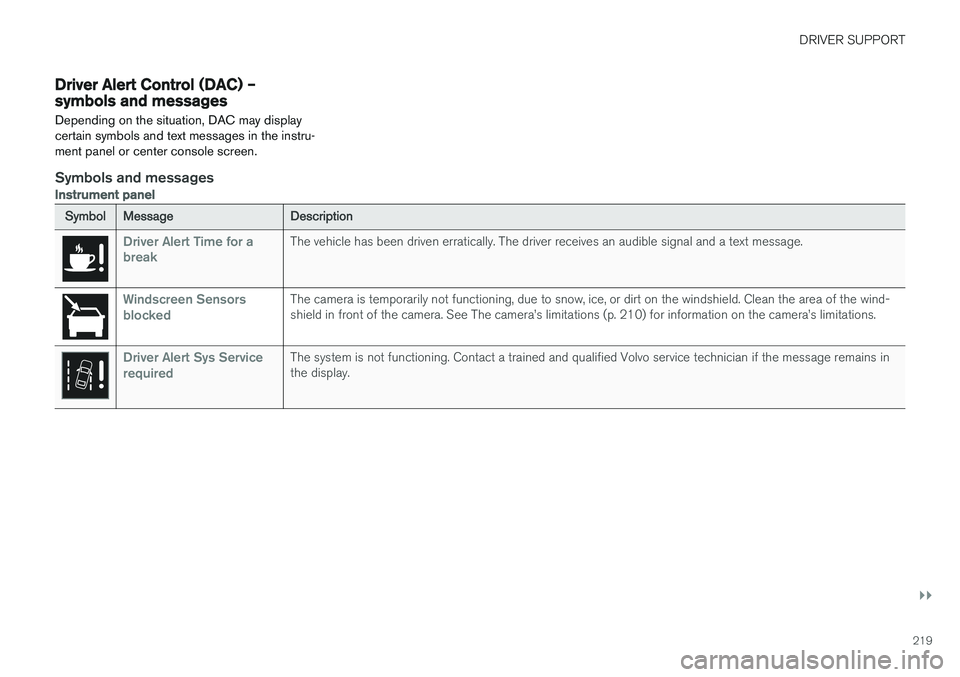
Driver Alert Control (DAC) – symbols and messages Depending on the situation, DAC may display certain symbols and text messages in the instru-ment panel or center console screen.
Symbols and messages
Instrument panel
SymbolMessageDescription
Driver Alert Time for a breakThe vehicle has been driven erratically. The driver receives an audible signal and a text message.
Windscreen Sensors blockedThe camera is temporarily not functioning, due to snow, ice, or dirt on the windshield. Clean the area of the wind- shield in front of the camera. See The camera
Page 222 of 398
||
DRIVER SUPPORT
220
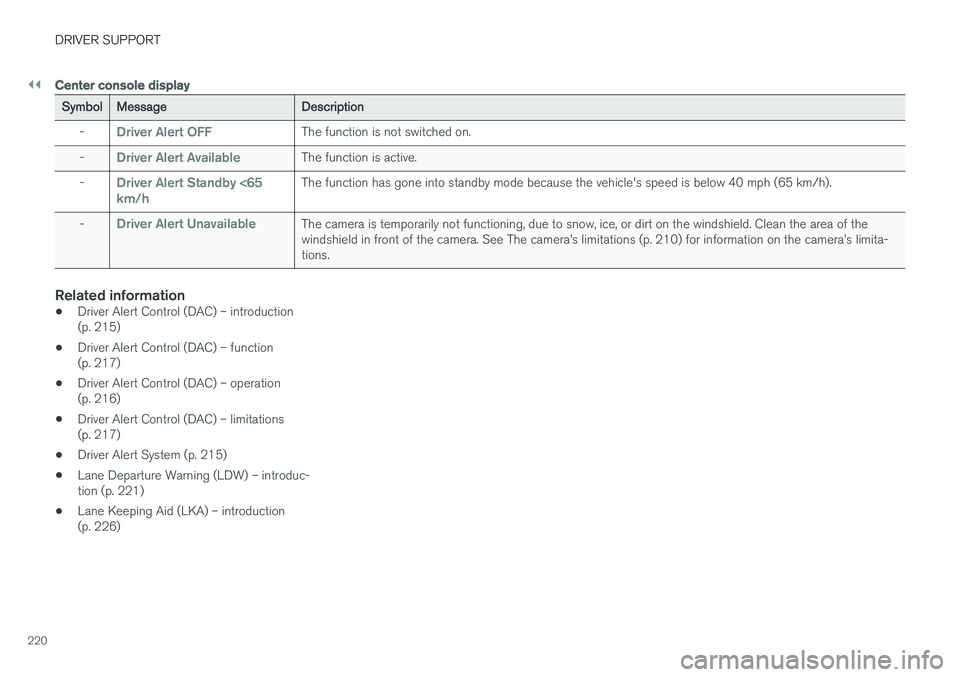
Center console display
SymbolMessageDescription
-Driver Alert OFFThe function is not switched on.
-Driver Alert AvailableThe function is active.
-Driver Alert Standby <65 km/hThe function has gone into standby mode because the vehicle's speed is below 40 mph (65 km/h).
-Driver Alert UnavailableThe camera is temporarily not functioning, due to snow, ice, or dirt on the windshield. Clean the area of the windshield in front of the camera. See The camera
Page 223 of 398
DRIVER SUPPORT
221
Lane Departure Warning (LDW) – introductionThe LDW function is designed to help reduce the risk of accidents in situations where the vehi-cle unintentionally leaves its lane and there is arisk of driving off the road or into the oppositelane.
Lane Departure Warning (LDW) 9Your vehicle may be equipped with Lane Departure Warning (LDW) or Lane KeepingAid (LKA), depending on your choice ofengine.
If you are uncertain as to which of these
optional systems is in your vehicle:
• Press the
MY CAR button on the center
console to open the menu system. Scroll to
SettingsDriver support system. The
system in your vehicle (Lane Departure
Warning or Lane Keeping Aid) will be dis-
played there.
If your vehicle is equipped with Lane Keeping Aid (LKA), see Lane Keeping Aid (LKA) – introduc-tion (p. 226) for detailed information.
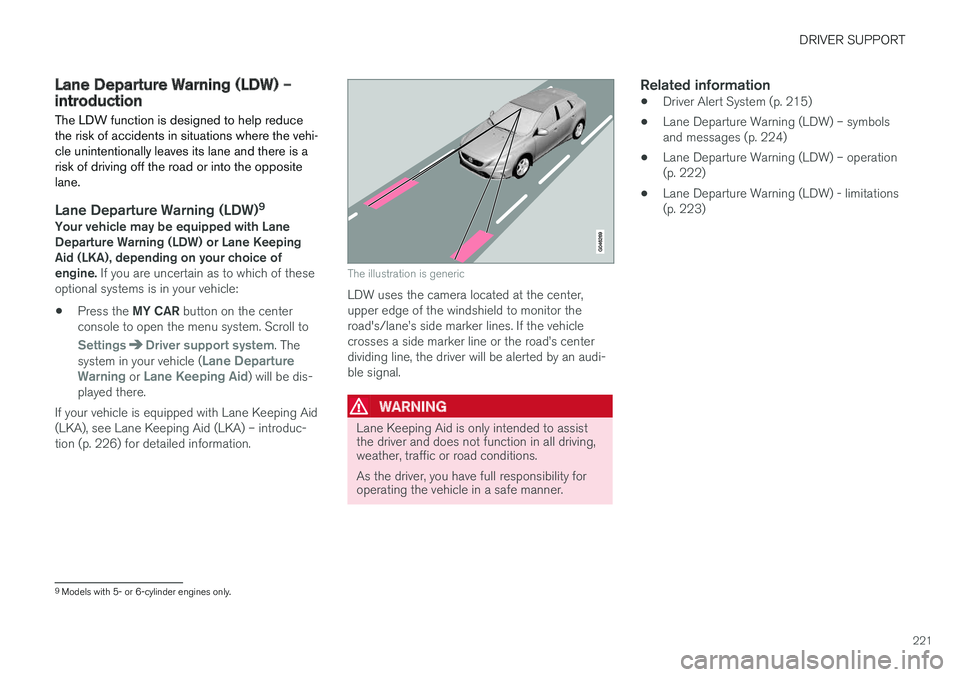
The illustration is generic
LDW uses the camera located at the center, upper edge of the windshield to monitor theroad's/lane
Page 224 of 398
DRIVER SUPPORT
222
Lane Departure Warning (LDW) – operation
Operation and function
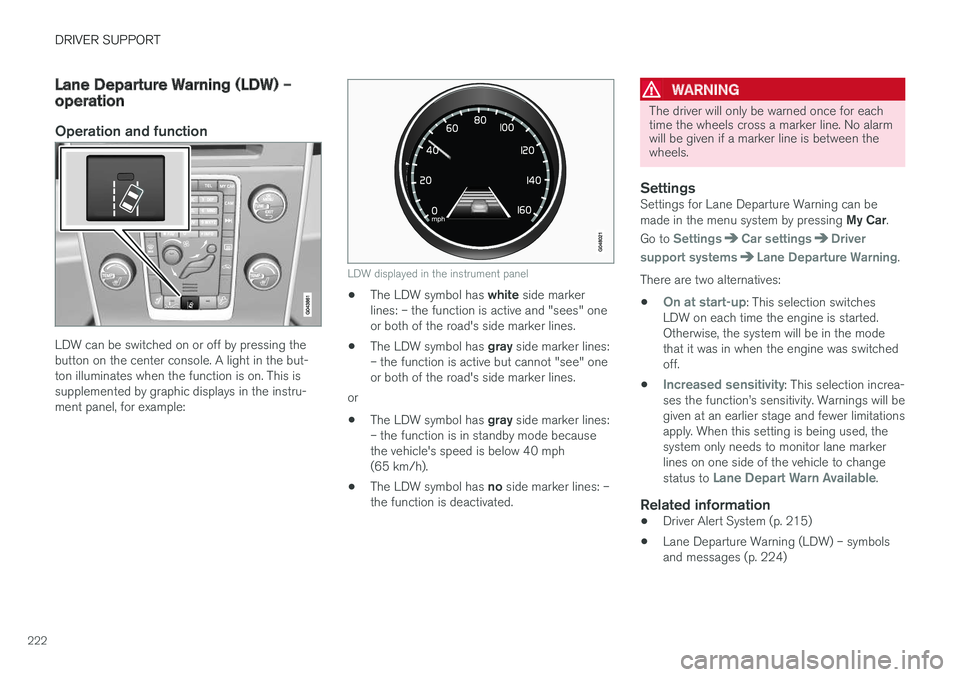
LDW can be switched on or off by pressing the button on the center console. A light in the but-ton illuminates when the function is on. This issupplemented by graphic displays in the instru-ment panel, for example:
LDW displayed in the instrument panel
•The LDW symbol has
white side marker
lines: – the function is active and "sees" one or both of the road's side marker lines.
• The LDW symbol has
gray side marker lines:
– the function is active but cannot "see" oneor both of the road's side marker lines.
or
• The LDW symbol has
gray side marker lines:
– the function is in standby mode becausethe vehicle's speed is below 40 mph(65 km/h).
• The LDW symbol has
no side marker lines: –
the function is deactivated.
WARNING
The driver will only be warned once for each time the wheels cross a marker line. No alarmwill be given if a marker line is between thewheels.
SettingsSettings for Lane Departure Warning can be made in the menu system by pressing My Car.
Go to
SettingsCar settingsDriver
support systems
Lane Departure Warning.
There are two alternatives:
•
On at start-up: This selection switches
LDW on each time the engine is started. Otherwise, the system will be in the modethat it was in when the engine was switchedoff.
•
Increased sensitivity: This selection increa-
ses the function
Page 228 of 398
DRIVER SUPPORT
226
Lane Keeping Aid (LKA) – introductionThe LKA function is designed to help reduce the risk of accidents in situations where the vehicleunintentionally leaves its lane and there is a riskof driving off the road or into the opposite lane.
LDW or LKAYour vehicle may be equipped with Lane Departure Warning (LDW) or Lane KeepingAid (LKA), depending on your choice ofengine. If you are uncertain as to which of these
optional systems is in your vehicle:
• Press the
MY CAR button on the center
console to open the menu system. Scroll to
SettingsDriver support system. The
system in your vehicle (Lane Departure
Warning or Lane Keeping Aid) will be dis-
played there.
If your vehicle is equipped with Lane Departure Warning (LDW), see Lane Departure Warning(LDW) – introduction (p. 221) for detailed infor-mation.
LKA functionThe LKA function is primarily intended for use onhighways or other major roads with clearlymarked side marker and center lines.
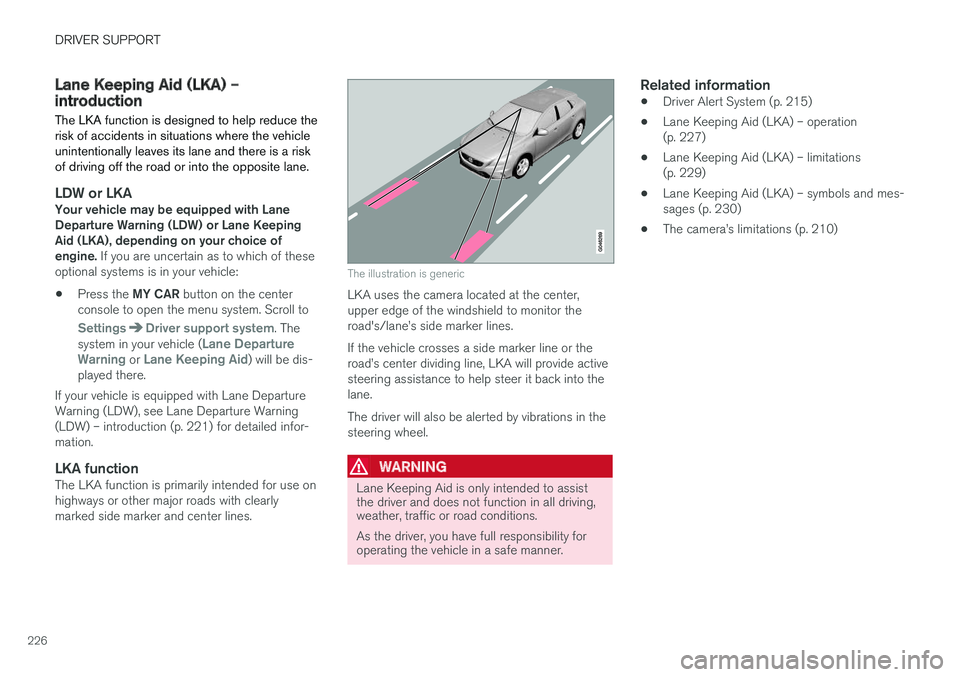
The illustration is generic
LKA uses the camera located at the center, upper edge of the windshield to monitor theroad's/lane
Page 229 of 398
DRIVER SUPPORT
}}
227
Lane Keeping Aid (LKA) – operation
LKA is active at speeds above 40 mph (65 km/h) on highways or other major roads with clearlymarked side/lane marker and center lines. Onnarrow roads where the distance between side/lane marker lines is less than approximately8.5 feet ( 2.6 meters), LKA will be temporarilydeactivated.
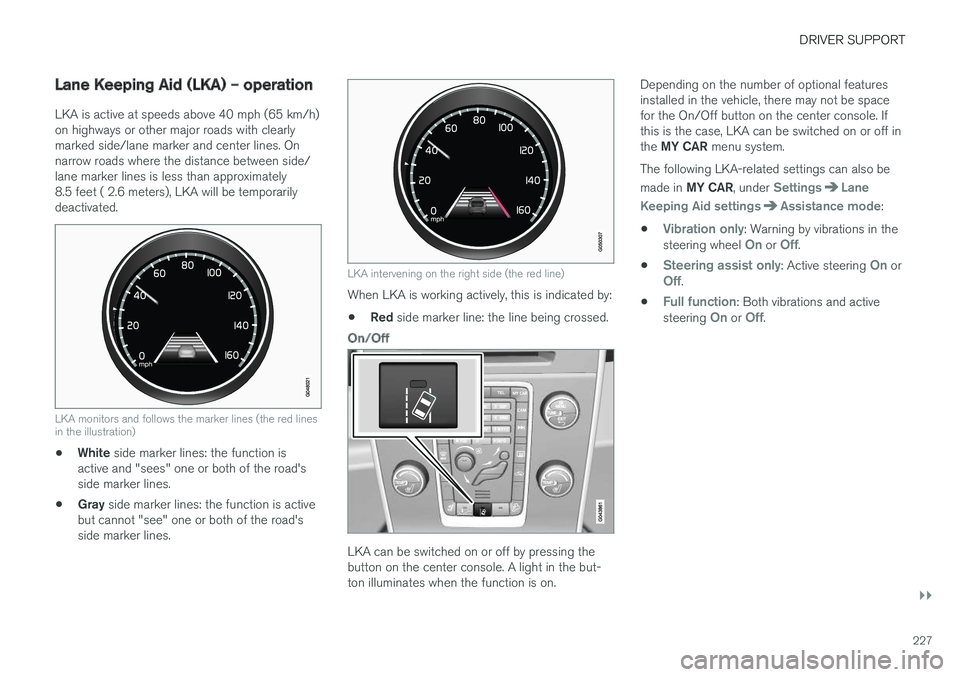
LKA monitors and follows the marker lines (the red lines in the illustration)
•White
side marker lines: the function is
active and "sees" one or both of the road's side marker lines.
• Gray
side marker lines: the function is active
but cannot "see" one or both of the road'sside marker lines.
LKA intervening on the right side (the red line)
When LKA is working actively, this is indicated by:
• Red
side marker line: the line being crossed.
On/Off
LKA can be switched on or off by pressing the button on the center console. A light in the but-ton illuminates when the function is on. Depending on the number of optional featuresinstalled in the vehicle, there may not be spacefor the On/Off button on the center console. Ifthis is the case, LKA can be switched on or off in the
MY CAR menu system.
The following LKA-related settings can also be made in MY CAR , under
SettingsLane
Keeping Aid settings
Assistance mode:
•
Vibration only: Warning by vibrations in the
steering wheel On or Off.
•
Steering assist only: Active steering On orOff.
•
Full function: Both vibrations and active
steering On or Off.
Page 235 of 398
DRIVER SUPPORT
}}
* Option/accessory, for more information, see Introduction.233
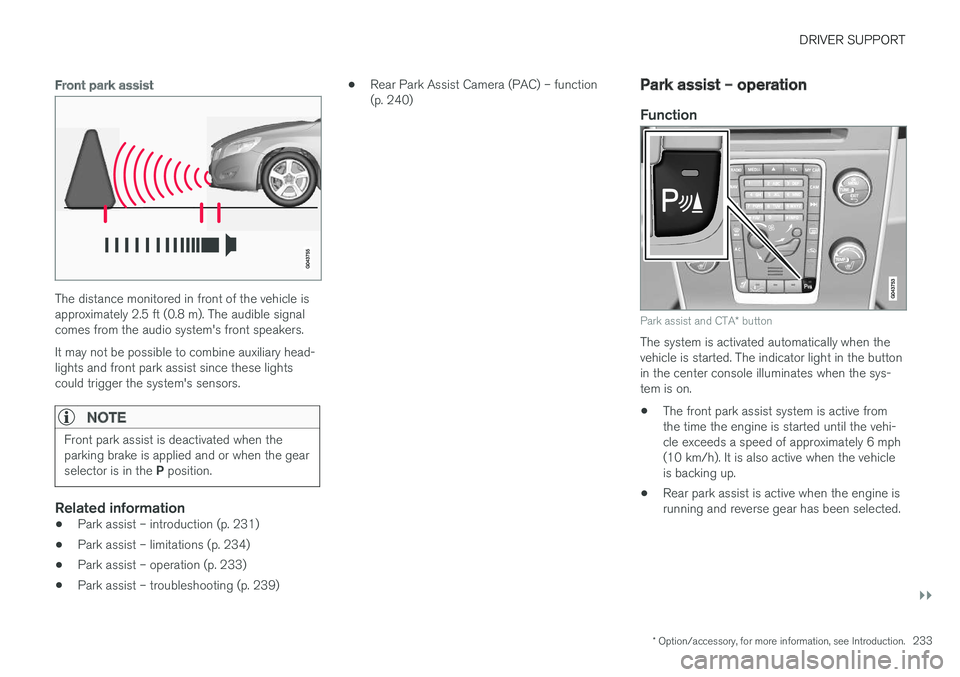
Front park assist
The distance monitored in front of the vehicle is approximately 2.5 ft (0.8 m). The audible signalcomes from the audio system's front speakers. It may not be possible to combine auxiliary head- lights and front park assist since these lightscould trigger the system's sensors.
NOTE
Front park assist is deactivated when the parking brake is applied and or when the gear selector is in the P position.
Related information
• Park assist – introduction (p. 231)
• Park assist – limitations (p. 234)
• Park assist – operation (p. 233)
• Park assist – troubleshooting (p. 239) •
Rear Park Assist Camera (PAC) – function (p. 240)
Park assist – operation
Function
Park assist and CTA
* button
The system is activated automatically when the vehicle is started. The indicator light in the buttonin the center console illuminates when the sys-tem is on. • The front park assist system is active from the time the engine is started until the vehi-cle exceeds a speed of approximately 6 mph(10 km/h). It is also active when the vehicleis backing up.
• Rear park assist is active when the engine isrunning and reverse gear has been selected.
Page 236 of 398
||
DRIVER SUPPORT
234
Activating/deactivating
The system is activated automatically when the vehicle is started.
–Press the Park assist button on the center console to temporarily deactivate the sys-tem(s).
> The indicator light in the button will go outwhen the system has been deactivated.
Park assist will be automatically reactivated the next time the engine is started, or if the button ispressed (the indicator light in the button will illu-minate).
NOTE
Park assist is disengaged automatically when the parking brake is applied.
Related information
• Park assist – introduction (p. 231)
• Park assist – limitations (p. 234)
• Park assist – function (p. 231)
• Park assist – troubleshooting (p. 239)
• Rear Park Assist Camera (PAC) – function (p. 240)
Park assist – limitations
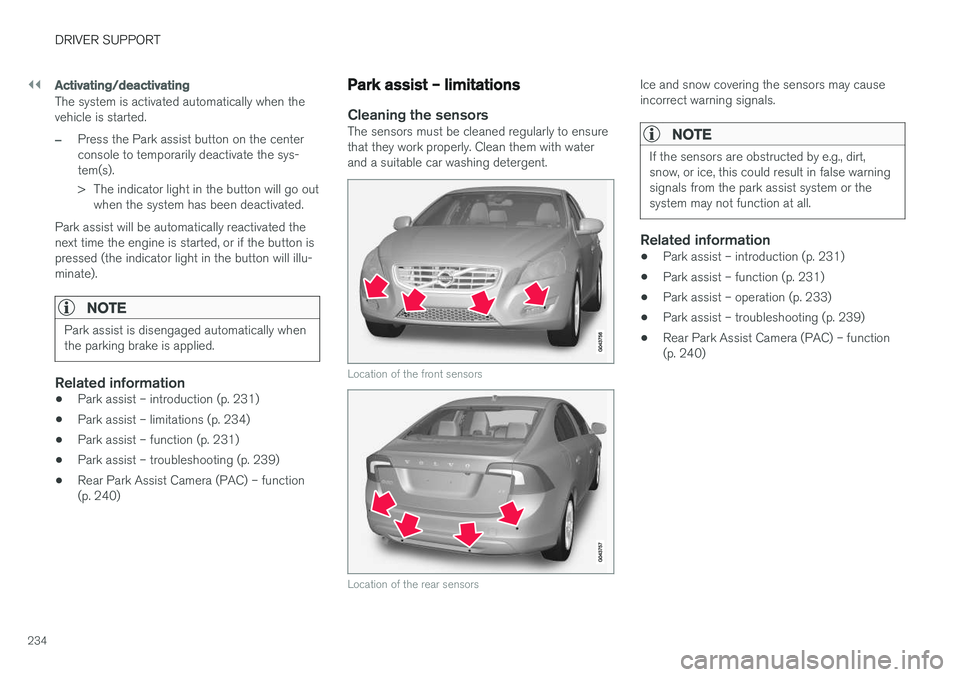
Cleaning the sensorsThe sensors must be cleaned regularly to ensure that they work properly. Clean them with waterand a suitable car washing detergent.
Location of the front sensors
Location of the rear sensors
Ice and snow covering the sensors may cause incorrect warning signals.
NOTE
If the sensors are obstructed by e.g., dirt, snow, or ice, this could result in false warningsignals from the park assist system or thesystem may not function at all.
Related information
•Park assist – introduction (p. 231)
• Park assist – function (p. 231)
• Park assist – operation (p. 233)
• Park assist – troubleshooting (p. 239)
• Rear Park Assist Camera (PAC) – function (p. 240)