ECO mode VOLVO S60 2018 Owner´s Manual
[x] Cancel search | Manufacturer: VOLVO, Model Year: 2018, Model line: S60, Model: VOLVO S60 2018Pages: 396, PDF Size: 9.4 MB
Page 314 of 396
WHEELS AND TIRES
* Option/accessory.
312
Tire Pressure Monitoring System (TPMS) – recalibrating
The Tire Pressure Monitoring System (TPMS) uses a reference value in order to determine iftire pressure is too low.
Recalibrating TPMS (Canadian models
only) *
In certain cases, it may be necessary to recali- brate TPMS to conform to Volvo's recommendedtire inflation pressures (see the tire inflation decalon the driver's door opening), for example, ifhigher inflation pressure is necessary whentransporting heavy loads. Always inflate the tires to Volvo's recommended tire pressure before recalibrating TPMS. Recalibrating TPMS is done in the vehicle's menu system. To do so:
1. Switch off the engine.
2. Inflate the tires to the desired pressure and
put the ignition in mode I or II (see Ignition
modes (p. 74) for additional information).
3. Press the MY CAR key in the center console
control panel and select
SettingsCar
settings
Tire pressure.
4. Press OK/MENU , select
Calibrate tire
pressure and press OK/MENU again. 5. Drive the vehicle at a speed above 20 mph
(30 km/h) continuously for at least 10 minutes.
> Calibration is done automatically once ini-tiated by the driver and the system does not provide confirmation when calibrationis completed.
After adjusting inflation pressure, repeat steps1-5 above.
Related information
• Tire Pressure Monitoring System (TPMS) –general information (p. 310)
• Tire Pressure Monitoring System (TPMS) –messages (p. 313)
• Tire Pressure Monitoring System (TPMS) –activating/deactivating (p. 312)
• Tire Pressure Monitoring System (TPMS) –changing wheels (p. 311)
• My Car – introduction (p. 71)
Tire Pressure Monitoring System (TPMS) – activating/deactivating
Activating/deactivating TPMS
(Canadian models only)
1. Switch off the engine. 2. Put the ignition in mode I or II (see Ignition
modes (p. 74) for additional information).
3. Press the MY CAR key in the center console
control panel and select
SettingsCar
settings
Tire pressure
4. Select Tire monitoring and press OK/
MENU to turn the system on or off.
Related information
•Tire Pressure Monitoring System (TPMS) – general information (p. 310)
Page 327 of 396
MAINTENANCE AND SERVICING
}}
* Option/accessory.325
Onboard Diagnostic System OBD II is part of your vehicle's computerized engine management system. It stores diagnosticinformation about your vehicle's emission con-trols. It can light the Check Engine light (MIL) if itdetects an emission control "fault." A "fault" is acomponent or system that is not performingwithin an expected range. A fault may be perma-nent or temporary. OBD II will store a messageabout any fault.
Emission inspection readiness
How do states use OBD II for emission inspections?
Many states connect a computer directly to a vehicle's OBD II system. The inspector can thenread "faults." In some states, this type of inspec-tion has replaced the tailpipe emission test.
How can my vehicle fail OBD II emission inspection?
Your vehicle can fail OBD II emission inspection for any of the following reasons.
• If your Check Engine (MIL) light is lit, yourvehicle may fail inspection.
• If your vehicle's Check Engine light was lit,but went out without any action on your part,OBD II will still have a recorded fault. Yourvehicle may pass or fail, depending on theinspection practices in your area.
• If you had recent service that required dis-connecting the battery, OBD II diagnostic information may be incomplete and "notready" for inspection. A vehicle that is notready may fail inspection.
How can I prepare for my next OBD II
emission inspection?
• If your Check Engine (MIL) light is lit – or was lit but went out without service, have yourvehicle diagnosed and, if necessary, servicedby a qualified Volvo technician.
• If you recently had service for a lit CheckEngine light, or if you had service thatrequired disconnecting the battery, a periodof driving is necessary to bring the OBD IIsystem to "ready" for inspection. Two half-hour trips of mixed stop-and-go/highwaydriving are typically needed to allow OBD II toreach readiness. Your Volvo retailer can pro-vide you with more information on planning atrip.
• Maintain your vehicle in accordance with yourvehicle's maintenance schedule.
Booking service and repairs
Connected Service Booking (CSB) makes set- ting up a time for service, maintenance and/orrepairs directly from the vehicle quick and con-venient.
Prerequisites
• The owner (primary driver) must have a valid Volvo ID. See Volvo ID (p. 20) for additionalinformation.
• The vehicle must be connected to the Inter- net using a paired Bluetooth ®
cell phone.
See your Sensus Infotainment supplement for information on pairing a cell phone. On models equipped with Volvo On Call (VOC) *,
you can connect to the Internet using your separate VOC data plan. Refer to your sepa-rate Volvo On Call manual.
• By default, the retailer where you purchasedyour vehicle will be your preferred (primary)retailer/Volvo authorized workshop who willperform service and repairs on your vehicle.To change the preferred retailer, go to DealerLocator at volvocars.com and select aretailer, click on Service Scheduler and bookan appointment at the new preferred retailer.
• In order to be guided through the on-screen steps, the menu alternative
Display
notifications must be activated.
Page 346 of 396
MAINTENANCE AND SERVICING
344
Engine compartment – washer fluid
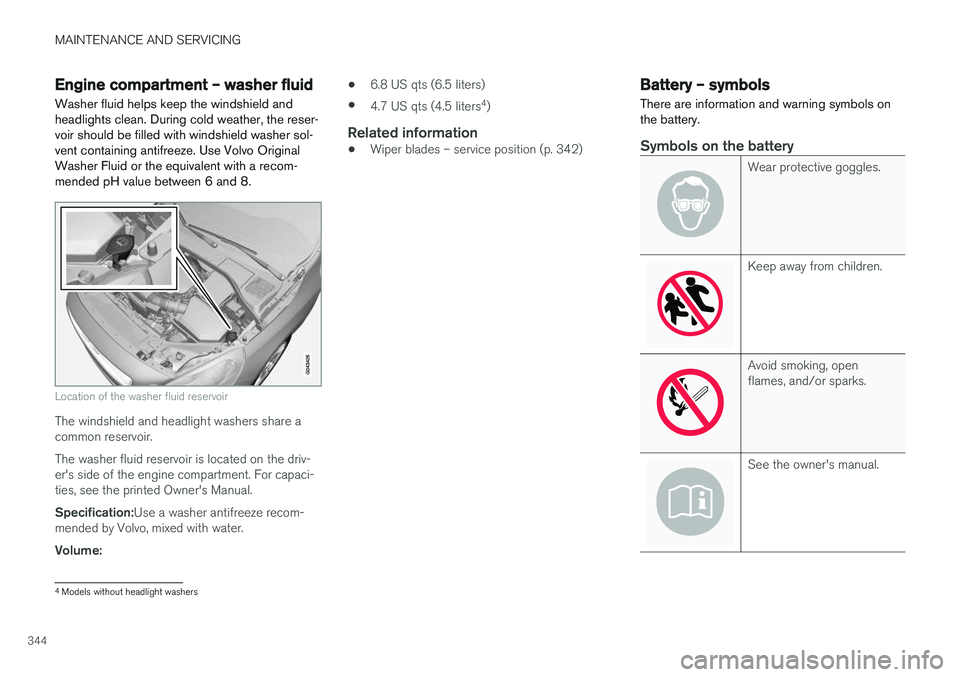
Washer fluid helps keep the windshield and headlights clean. During cold weather, the reser-voir should be filled with windshield washer sol-vent containing antifreeze. Use Volvo OriginalWasher Fluid or the equivalent with a recom-mended pH value between 6 and 8.
Location of the washer fluid reservoir
The windshield and headlight washers share a common reservoir. The washer fluid reservoir is located on the driv- er's side of the engine compartment. For capaci-ties, see the printed Owner's Manual. Specification: Use a washer antifreeze recom-
mended by Volvo, mixed with water.Volume: •
6.8 US qts (6.5 liters)
• 4.7 US qts (4.5 liters 4
)
Related information
• Wiper blades – service position (p. 342)
Battery – symbols
There are information and warning symbols on the battery.
Symbols on the battery
Wear protective goggles.
Keep away from children.
Avoid smoking, open flames, and/or sparks.
See the owner's manual.
4 Models without headlight washers
Page 365 of 396
MAINTENANCE AND SERVICING
}}
363
Cleaning the seat beltsClean only with lukewarm water and a mild soap solution.
Cleaning floor matsThe floor mats should be vacuumed or brushedclean regularly, especially during winter whenthey should be taken out for drying. Spots on tex-tile mats can be removed with a mild detergent.For best protection in winter, Volvo recommendsthe use of Volvo rubber floor mats. Consult yourVolvo retailer.
Spots on interior plastic, metal, or wood
surfaces
Cleaning interior plastic components should bedone with a cleaning agent specially designed forthis purpose. Consult your Volvo retailer.
CAUTION
• Do not use cleaning agents with high alcohol content such as washer fluid toclean instrument panel glass.
• Never spray cleaning agents or waterdirectly onto components with electricalbuttons or controls. Clean components ofthis type by applying the cleaning agent/water sparingly to a cloth and wiping thecomponents so that no liquid penetratesinto these components.
Related information
•Washing the vehicle (p. 359)
Touching up paintwork
Paint damage requires immediate attention to avoid rusting. Make it a habit to check the finishregularly, for instance washing the vehicle.Touch-up if necessary.
Paint repairs require special equipment and skill. Contact your Volvo retailer for any extensive dam-age. Minor scratches can be repaired by using Volvo touch-up paint.
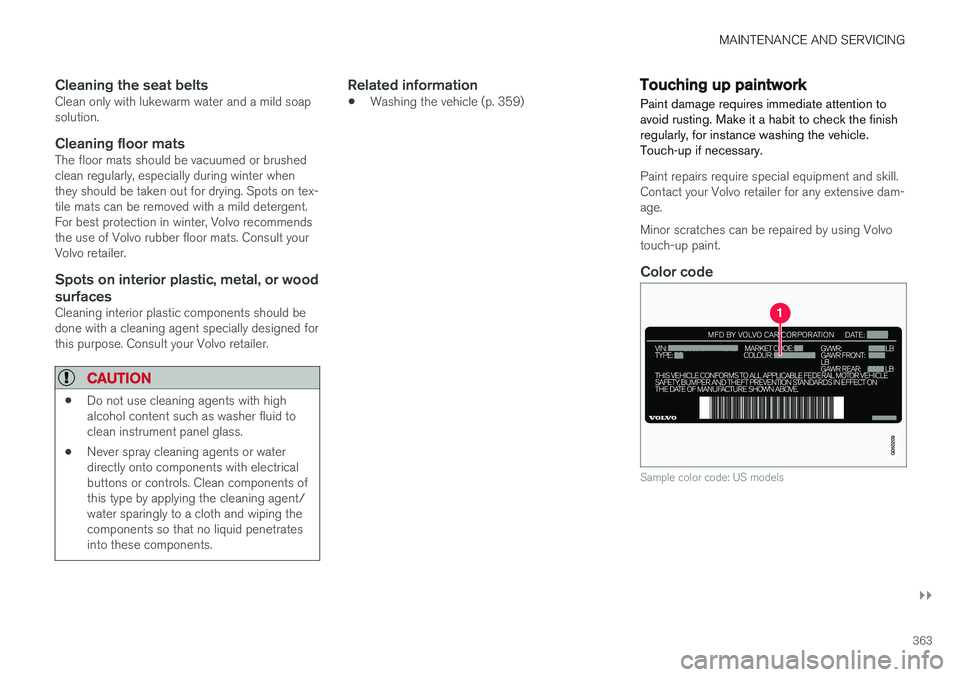
Color code
Sample color code: US models
Page 370 of 396
||
SPECIFICATIONS
368
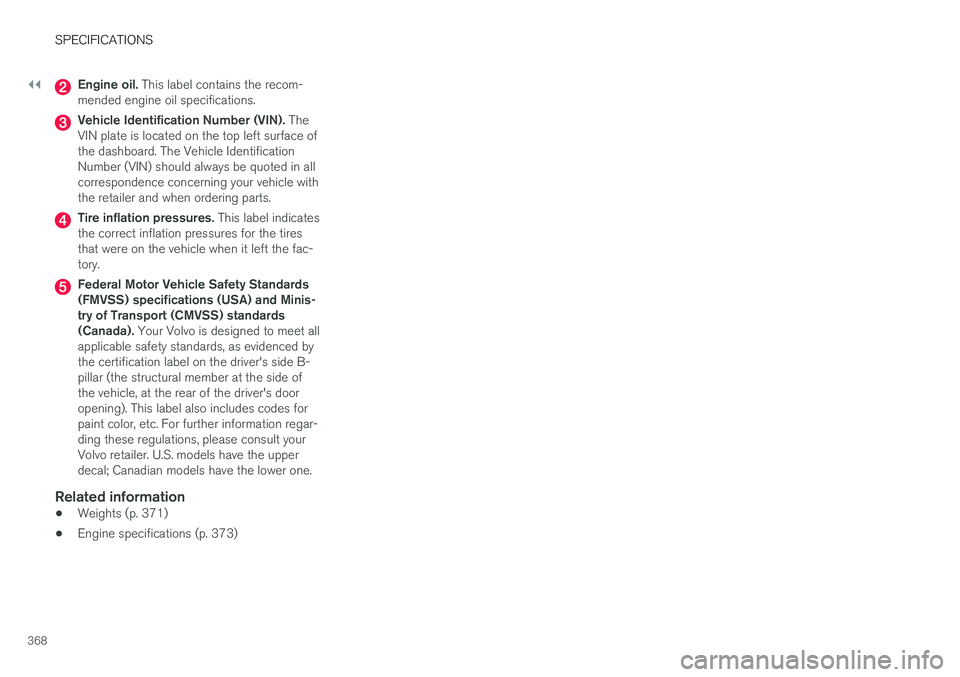
Engine oil. This label contains the recom-
mended engine oil specifications.
Vehicle Identification Number (VIN). The
VIN plate is located on the top left surface of the dashboard. The Vehicle IdentificationNumber (VIN) should always be quoted in allcorrespondence concerning your vehicle withthe retailer and when ordering parts.
Tire inflation pressures. This label indicates
the correct inflation pressures for the tires that were on the vehicle when it left the fac-tory.
Federal Motor Vehicle Safety Standards (FMVSS) specifications (USA) and Minis-try of Transport (CMVSS) standards(Canada). Your Volvo is designed to meet all
applicable safety standards, as evidenced bythe certification label on the driver's side B-pillar (the structural member at the side ofthe vehicle, at the rear of the driver's dooropening). This label also includes codes forpaint color, etc. For further information regar-ding these regulations, please consult yourVolvo retailer. U.S. models have the upperdecal; Canadian models have the lower one.
Related information
• Weights (p. 371)
• Engine specifications (p. 373)
Page 377 of 396
SPECIFICATIONS
375
Oil volume
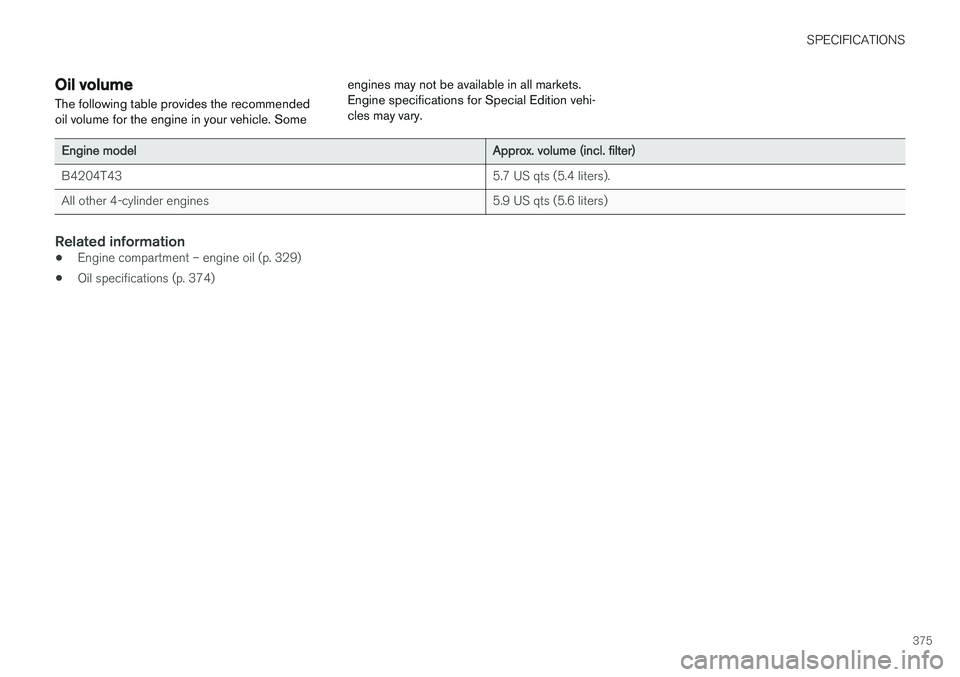
The following table provides the recommended oil volume for the engine in your vehicle. Some engines may not be available in all markets.Engine specifications for Special Edition vehi-cles may vary.
Engine model
Approx. volume (incl. filter)
B4204T43 5.7 US qts (5.4 liters).
All other 4-cylinder engines 5.9 US qts (5.6 liters)
Related information
•Engine compartment – engine oil (p. 329)
• Oil specifications (p. 374)
Page 380 of 396
SPECIFICATIONS
378
Tire inflation – pressure table
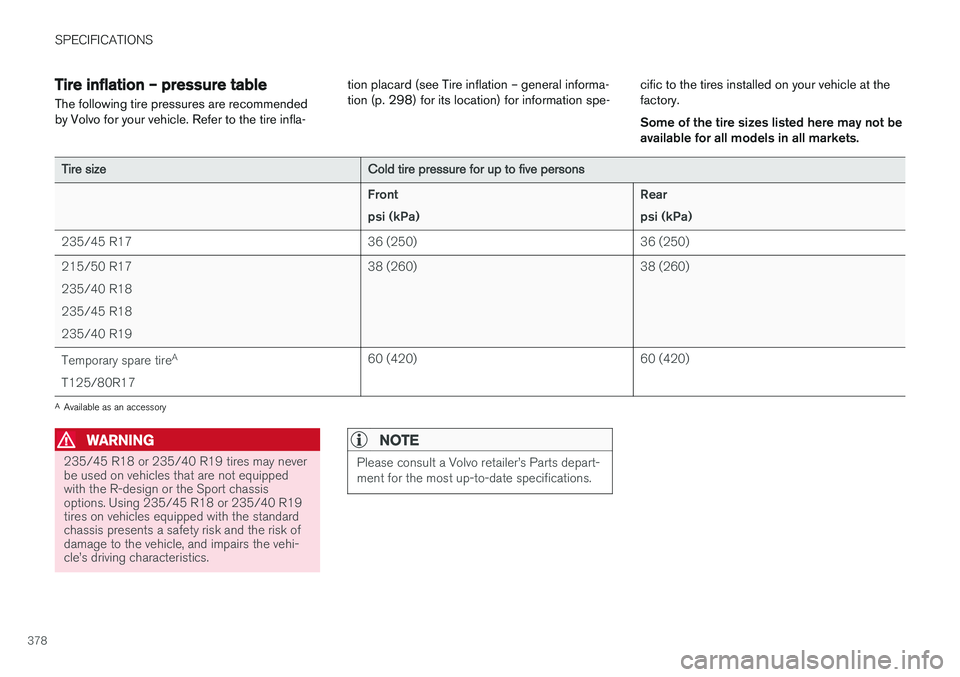
The following tire pressures are recommended by Volvo for your vehicle. Refer to the tire infla- tion placard (see Tire inflation – general informa-tion (p. 298) for its location) for information spe-
cific to the tires installed on your vehicle at thefactory. Some of the tire sizes listed here may not be available for all models in all markets.
Tire size
Cold tire pressure for up to five persons Front psi (kPa)Rearpsi (kPa)
235/45 R17 36 (250)36 (250)
215/50 R17235/40 R18235/45 R18235/40 R19 38 (260)
38 (260)
Temporary spare tire A
T125/80R17 60 (420)
60 (420)
A
Available as an accessory
WARNING
235/45 R18 or 235/40 R19 tires may never be used on vehicles that are not equippedwith the R-design or the Sport chassisoptions. Using 235/45 R18 or 235/40 R19tires on vehicles equipped with the standardchassis presents a safety risk and the risk ofdamage to the vehicle, and impairs the vehi-cle