run flat VOLVO S60 CROSS COUNTRY 2016 Owner´s Manual
[x] Cancel search | Manufacturer: VOLVO, Model Year: 2016, Model line: S60 CROSS COUNTRY, Model: VOLVO S60 CROSS COUNTRY 2016Pages: 392, PDF Size: 10.06 MB
Page 304 of 392
09 Wheels and tires
09
302
Snow tires/studded tires5
Owners who live in or regularly commute through areas with sustained periods of snowor icy driving conditions are strongly advisedto fit suitable winter tires to help retain thehighest degree of traction.
Tires for winter use:
•
It is important to install winter tires on all four wheels to help retain traction duringcornering, braking, and accelerating. Fail-ure to do so could reduce traction to anunsafe level or adversely affect handling.
• Do not mix tires of different design as thiscould also negatively affect overall tireroad grip.
• Winter tires wear more quickly on dryroads in warm weather. They should beremoved when the winter driving seasonhas ended.
• Studded tires should be run-in 300 – 600 miles (500 – 1000 km) during whichthe vehicle should be driven as smoothlyas possible to give the studs the opportu-nity to seat properly in the tires. The tiresshould have the same rotational directionthroughout their entire lifetime.
NOTE
Please consult state or provincial regula- tions restricting the use of studded wintertires before installing such tires.
Tire pressure monitoring - introduction
Volvo provides two different systems to moni- tor tire pressure: Tire Pressure MonitoringSystem (TPMS) or Tire Monitor.
Determining which tire monitoring system is in your vehicle
To see which system is installed in your vehi- cle, press the
MY CAR button on the center
console. Go to
SettingsCar settings.
• If your vehicle has a menu called
Tire
monitoring, see Tire Monitor - introduc-
tion (p. 307).
• If your vehicle has a menu called
Tire
pressure, see Tire Pressure Monitoring
System (TPMS) – general information (p. 303).
Introduction
Each tire, including the spare 6
(if provided),
should be checked monthly when cold and inflated to the inflation pressure recom-mended by the vehicle manufacturer on thevehicle placard or tire inflation pressure label.(If your vehicle has tires of a different sizethan the size indicated on the vehicle placardor tire inflation pressure label, you shoulddetermine the proper tire inflation pressure forthose tires.) As an added safety feature, your vehicle has been equipped with a tire pressure monitor-ing system that illuminates a low tire pressure telltale (
) when one or more of your tires
is significantly under-inflated. Accordingly, when the low tire pressure telltale illuminates,you should stop and check your tires as soonas possible, and inflate them to the properpressure. Driving on a significantly under-inflated tire causes the tire to overheat and can lead totire failure. Under-inflation also reduces fuelefficiency and tire tread life, and may affectthe vehicle's handling and stopping ability.Please note that a tire pressure monitoringsystem is not a substitute for proper tiremaintenance, and it is the driver's responsi-bility to maintain correct tire pressure, even ifunder-inflation has not reached the level to
5 Where permitted
Page 312 of 392
||
09 Wheels and tires
09
310
Related information
•Tire Monitor – messages (p. 309)
• Tire inflation – checking pressure (p. 294)
• Tire inflation – pressure table (p. 297)
Self-supporting run flat tires (SST)
Self-supporting run flat tires are available as optional equipment on certain models. The vehicle must be equipped with one of the tire pressure monitoring systems if tires ofthis type are installed. Tires of this type have specially reinforced sidewalls that make it possible to continuedriving to a limited extent even though the tirehas lost some or all of its inflation pressure.These tires are mounted on special rims (nor-mal tires can also be mounted on these rims). If an SST tire loses inflation pressure, the yel- low TPMS symbol illuminates in the instru-ment panel and a text message is also dis-played. If this happens, reduce speed to notmore than 50 mph (80 km/h). The tire shouldbe replaced as soon as possible.WARNING
•SST tires should only be mounted by service technicians who are familiarwith tires of this type.
• SST tires may only be mounted onvehicles equipped with a tire pressuremonitoring system.
• Do not drive faster than 50 mph(80 km/h) if the monitoring system indi-cates that a tire has lost inflation pres-sure.
• Do not drive farther than 50 miles(80 km) before replacing a damagedSST tire.
• Drive carefully and avoid e.g., hardbraking or fast turns.
• SST tires must be replaced if they aredamaged. A tire of this type cannot berepaired.
Related information
•
Tire pressure monitoring - introduction (p. 302)
Page 313 of 392
09 Wheels and tires
09
}}
* Option/accessory, for more information, see Introduction.311
Tire sealing system* – general information
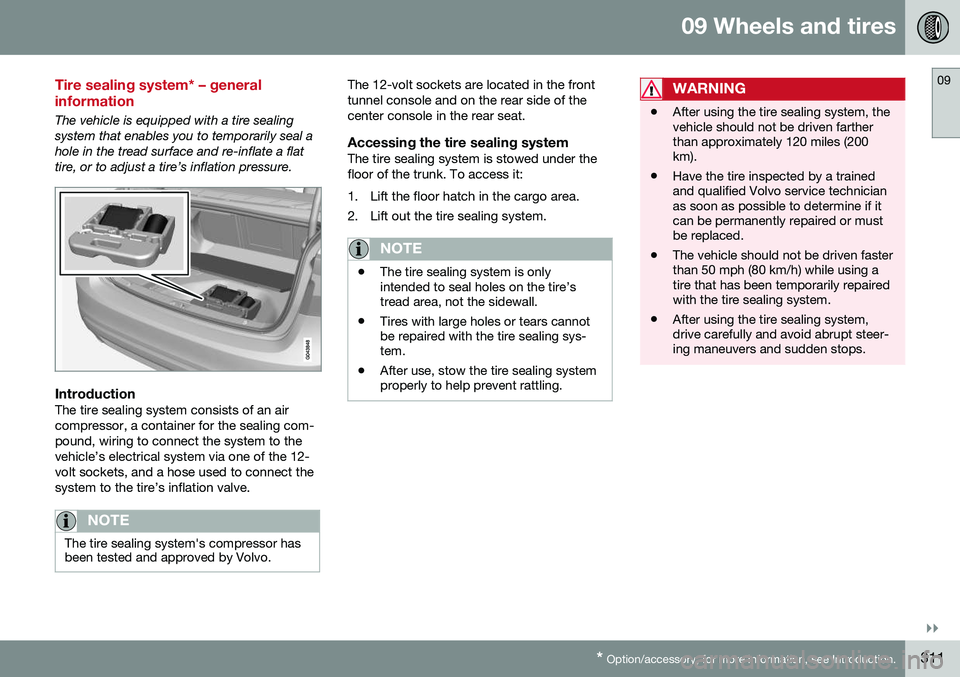
The vehicle is equipped with a tire sealing system that enables you to temporarily seal ahole in the tread surface and re-inflate a flattire, or to adjust a tire’s inflation pressure.
IntroductionThe tire sealing system consists of an air compressor, a container for the sealing com-pound, wiring to connect the system to thevehicle’s electrical system via one of the 12-volt sockets, and a hose used to connect thesystem to the tire’s inflation valve.
NOTE
The tire sealing system's compressor has been tested and approved by Volvo.
The 12-volt sockets are located in the front tunnel console and on the rear side of thecenter console in the rear seat.
Accessing the tire sealing systemThe tire sealing system is stowed under thefloor of the trunk. To access it:
1. Lift the floor hatch in the cargo area.
2. Lift out the tire sealing system.
NOTE
• The tire sealing system is only intended to seal holes on the tire’stread area, not the sidewall.
• Tires with large holes or tears cannotbe repaired with the tire sealing sys-tem.
• After use, stow the tire sealing systemproperly to help prevent rattling.
WARNING
• After using the tire sealing system, the vehicle should not be driven fartherthan approximately 120 miles (200km).
• Have the tire inspected by a trainedand qualified Volvo service technicianas soon as possible to determine if itcan be permanently repaired or mustbe replaced.
• The vehicle should not be driven fasterthan 50 mph (80 km/h) while using atire that has been temporarily repairedwith the tire sealing system.
• After using the tire sealing system,drive carefully and avoid abrupt steer-ing maneuvers and sudden stops.
Page 316 of 392
||
09 Wheels and tires
09
314
WARNING
The bottle is equipped with a catch to keep it securely in place and help preventsealing compound leakage. Once in place,the bottle cannot be unscrewed. This mustbe done by a trained and qualified Volvoservice technician.
5. Remove the valve cap from the tire’sinflation valve and screw the tire sealing system’s hose connector onto the valveas tightly as possible by hand.
6. Connect the electrical wire to the nearest 12-volt socket in the vehicle.
NOTE
Be sure that none of the other 12-volt sockets is being used while the compres-sor is in operation.
7. Start the vehicle’s engine.
WARNING
The vehicle´s engine should be running when the tire sealing system is used toavoid battery drain. Therefore, be sure thevehicle is parked in a well ventilated place,or outdoors, before using the system.
8. Start the tire sealing system’s compres-sor by pressing the on/off switch to posi- tion I.
WARNING
• Never stand next to the tire being infla- ted when the compressor is in opera-tion.
• If cracks, bubbles, etc. form on the tire,switch off the compressor immediately.
• If there is visible damage to the sidewallor the rim, the tire cannot be repaired.The vehicle should not be driven if thisoccurs. Contact a towing service orVolvo On Call Roadside Assistance ifapplicable.
NOTE
The air pressure gauge will temporarily show an increase in pressure to approxi-mately 88 psi (6 bar) while the sealingcompound is being pumped into the tire.The pressure should return to a normallevel after approximately 30 seconds.
9. Within seven minutes, inflate the tire to
between 22—44 psi (1.8—3.0 bar). Switch off the compressor briefly to get aclear reading from the pressure gauge.
Page 318 of 392
09 Wheels and tires
09
316* Option/accessory, for more information, see Introduction.
Tire sealing system* – inflating tires
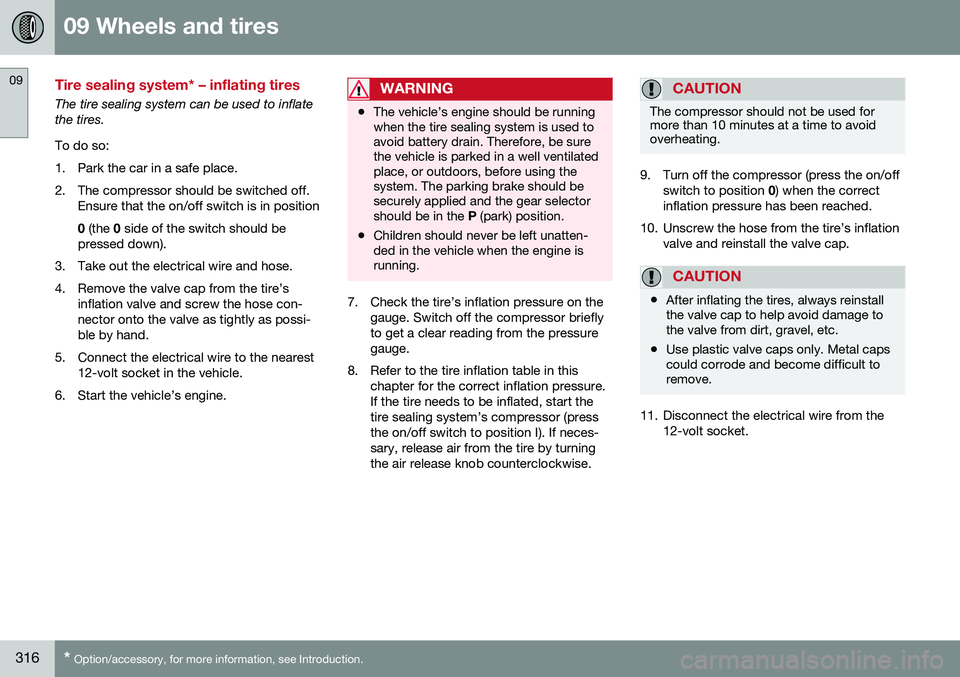
The tire sealing system can be used to inflate the tires. To do so:
1. Park the car in a safe place.
2. The compressor should be switched off.
Ensure that the on/off switch is in position0 (the 0 side of the switch should be
pressed down).
3. Take out the electrical wire and hose.
4. Remove the valve cap from the tire’s inflation valve and screw the hose con- nector onto the valve as tightly as possi-ble by hand.
5. Connect the electrical wire to the nearest 12-volt socket in the vehicle.
6. Start the vehicle’s engine.WARNING
• The vehicle’s engine should be running when the tire sealing system is used toavoid battery drain. Therefore, be surethe vehicle is parked in a well ventilatedplace, or outdoors, before using thesystem. The parking brake should besecurely applied and the gear selectorshould be in the
P (park) position.
• Children should never be left unatten-ded in the vehicle when the engine isrunning.
7. Check the tire’s inflation pressure on the
gauge. Switch off the compressor briefly to get a clear reading from the pressuregauge.
8. Refer to the tire inflation table in this chapter for the correct inflation pressure.If the tire needs to be inflated, start thetire sealing system’s compressor (pressthe on/off switch to position I). If neces-sary, release air from the tire by turningthe air release knob counterclockwise.
CAUTION
The compressor should not be used for more than 10 minutes at a time to avoidoverheating.
9. Turn off the compressor (press the on/off switch to position 0) when the correct
inflation pressure has been reached.
10. Unscrew the hose from the tire’s inflation valve and reinstall the valve cap.
CAUTION
•After inflating the tires, always reinstall the valve cap to help avoid damage tothe valve from dirt, gravel, etc.
• Use plastic valve caps only. Metal capscould corrode and become difficult toremove.
11. Disconnect the electrical wire from the
12-volt socket.
Page 382 of 392
12 Index
12
380
A
ABS (anti-lock brake system).................. 264
Accessory installation warning.................. 23
Active chassis system............................. 162
Active high beams..................................... 84Active yaw control........................... 162, 163
Adaptive brake lights............................... 265
Adaptive cruise control.................... 172, 173Airbags disconnecting the front passenger’s
side....................................................... 36
front...................................................... 33
inflatable curtain................................... 41
side impact........................................... 39
Air conditioning................................ 124, 125
Air distribution.................................. 121, 126
Air distribution table................................. 128
Air vents................................................... 121
Alarm................................ 157, 158, 159, 160
All Wheel Drive......................................... 262
Ambient temperature sensor..................... 71
Anti-freeze....................................... 272, 328Anti-lock brake system warning light......................................... 67
Anti-lock Brake System (ABS)................. 264 Approach lighting.............................. 91, 142
Auto-dim rearview mirror........................... 98
Automatic locking retractor....................... 47Automatic transmission
Eco (driving function).......................... 260
Geartronic........................................... 252
general description..................... 250, 252
oil........................................................ 373
shiftlock override................................ 254
Axle weight.............................................. 298
B
Battery maintenance............................... 343, 344
remote key, replacing......................... 147
replacing............................................. 344
specifications...................................... 375
start/stop............................................ 375
warning symbols................................. 342
Blind Spot Information System (BLIS)..... 238 Cross Traffic Alert (CTA)..................... 240
Booster cushions....................................... 54
Brake lights.............................................. 265Brake system ABS..................................................... 264
Brake pad inspection.......................... 263 checking fluid level............................. 329
emergency brake assistance.............. 265
fluid..................................................... 373
general information............................. 262
Bulbs headlights........... 331, 332, 333, 334, 335
introduction......................................... 331
license plate lights.............................. 337
specifications...................................... 338
taillight................................................ 336
trunk lighting....................................... 338
C
Camera, Park Assist................................ 234
Capacity weight....................................... 298
Catalytic converter................................... 277
Central locking system, introduction 139, 140, 143, 146
Chains...................................................... 301
Check Engine warning light....................... 67Child restraints recalls and registration......................... 47
Child restraint systems.............................. 47 booster cushions.................................. 54
convertible seats.................................. 51
infant seats........................................... 49
Page 384 of 392
12 Index
12
382
Start/Stop........... 255, 256, 257, 258, 259
starting................................................ 245
switching off............................... 247, 248
Engine compartment overview................ 325
Engine Drag Control (EDC)...................... 163
Engine oil................................................. 371 checking............................................. 326
low pressure warning light.................... 68
volumes.............................................. 372
Engine remote start (ERS)........................ 247
Environment............................................... 22
F
Federal Clean Air Act............................... 319 Flat tires repairing with tire sealing system....... 311
Floor mats cleaning.............................................. 360
placing correctly................................. 245
Fluid specifications.......................... 373, 374
Fog lights................................................... 67 rear........................................................ 87
Four C (active chassis system)................ 162
Front airbags.............................................. 33 disconnecting passenger’s side airbag 36 Front park assist.............................. 225, 233
Front seats................................................. 74
heated................................................. 123
Fuel filler cap........................................... 276
Fuel filler door, opening................... 275, 276
Fuel level warning light.............................. 67
Fuel requirements............................ 273, 274
Fuel tank volume..................................... 374
Fuses....................................... 346, 347, 354
G
Garage door opener HomeLink ®
Wireless Control
System........................................ 102, 103
Gasoline requirements............................. 274
Gas tank volume...................................... 374
Gauges...................................................... 62
Geartronic................................................ 252
Geartronic automatic transmission.......... 252
Generator warning light............................. 69
Glossary of tire terminology..................... 299
Grocery bag holder.................................. 137
Gross vehicle weight............................... 298
H
Hazard warning flashers............................ 88 Headlights Active Bending Lights........................... 85
active high beams................................. 84
changing bulbs........... 332, 333, 334, 335
daytime running lights.......................... 82
high/low beams.................................... 83
high beam flash.................................... 83
tunnel detection.................................... 85
Headlight washers..................................... 93
Head restraints, rear seat.......................... 78
Heated front seats................................... 123
Heated oxygen sensors........................... 277
Heated rear seats.................................... 123
Heated steering wheel............................... 82
Heated windshield............................. 98, 125
High beams................................................ 83 active.................................................... 84
Hill Start Assist (HSA).............................. 250
Hoisting the vehicle................................. 321 HomeLink ®
Wireless Control
System............................................. 102, 103
Home safe lighting..................................... 91
Hood, opening/closing............................ 324
Page 388 of 392
12 Index
12
386
Three-way catalytic converter................. 277Tire designations..................................... 295
Tire inflation pressure.............................. 297
Tire Monitor............................. 307, 308, 309
Tire Pressure Monitoring System.... 303, 306 indicator light........................................ 67
Tires......................................................... 285 age...................................................... 286
changing from summer to winter........ 288
glossary of terms................................ 299
improving economy............................ 287
inflation pressure........................ 293, 294
inflation pressure table....................... 297
rotation............................................... 285
Self-supporting run flat tires (SST)..... 310
snow........................................... 301, 302
spare................................................... 291
specifications...................................... 295
speed ratings...................................... 295
storing................................................. 286
studded....................................... 301, 302
tire pressure monitoring system......... 303
tire sealing system.............................. 311
tread wear indicator............................ 287
uniform tire quality grading................. 300
Tire sealing system.................................. 311 Top tether anchors (child restraint sys-
tems).......................................................... 56 Touching up paint.................................... 361
Towing a trailer................................ 279, 280
Towing the vehicle................... 281, 282, 283
Traction control................................ 162, 163
Trailer towing................................... 279, 280Transmission
general description..................... 250, 252
Hill Start Assist................................... 250
oil........................................................ 373
shiftlock override................................ 254
Tread wear indicator................................ 287
Trip computer.......................................... 109
Trip odometers.......................................... 72
Trips, long distance................................. 271Trunk changing bulbs................................... 338
opening manually............................... 156
Tunnel detection........................................ 85
Turn signals............................................... 89 changing bulbs................................... 335
indicator lights...................................... 67
U
Uniform Tire Quality Grading................... 300
Unlocking the vehicle...... 142, 152, 153, 155
V
Valet locking............................................ 145
Vanity mirror............................................ 134changing bulbs................................... 338
Vehicle Event Data..................................... 18
Vehicle information.................................... 20
Vehicle loading........................ 135, 137, 298 roof loads............................................ 136
Vehicle maintenance................................ 319 performed by the owner..................... 320
Vehicle weights........................................ 369
Volvo and the environment........................ 22
Volvo ID..................................................... 21
Volvo maintenance.................................. 319
Volvo On Call Roadside Assistance.......... 24
Volvo programs......................................... 24
Volvo Sensus........................................... 106
W
Warning flashers, hazard........................... 88
Warning lights................................ 62, 64, 68
Warning symbol......................................... 69
Warning system, collision........ 197, 199, 205