cooling VOLVO S60 TWIN ENGINE 2019 User Guide
[x] Cancel search | Manufacturer: VOLVO, Model Year: 2019, Model line: S60 TWIN ENGINE, Model: VOLVO S60 TWIN ENGINE 2019Pages: 645, PDF Size: 13.96 MB
Page 372 of 645

||
DRIVER SUPPORT
370
The driver should be aware of the following limi-tations for Park Assist Pilot:
The parking sequence is cancelled
A parking sequence will be cancelled if:
The driver moves the steering wheel
The vehicle's speed exceeds 7 km/h(4 mph)
The driver taps Cancel in the center display
When the anti-lock brakes or the Electronicstability control are engaged - e.g. when awheel loses grip on a slippery road
When speed-dependent power steeringwheel resistance is working at reducedpower – e.g. during cooling due to overheat-ing.
A message in the center display will explain whythe parking sequence was cancelled.
CAUTION
Under certain circumstances, the functionmay not be able to find parking spaces – onereason may be that the sensors are disruptedby external sound sources that emit the sameultrasonic frequencies that the system workswith.
Examples of such sources include horns, wettires on asphalt, pneumatic brakes, exhaustnoise from motorcycles, etc.
NOTE
Dirt, ice and snow covering the sensorsreduce their function and can make measure-ment impossible.
Driver responsibility
The driver should keep in mind that the functionis a parking aid ‒ not an infallible fully automaticsystem. The driver must always be prepared totake control and cancel a parking sequence ifnecessary.
There are a number of things to keep in mindwhen parking, including:
The driver is always responsible for determin-ing if the space suggested by the function issuitable for parking.
Do not use the function when using snowchains or a temporary spare tire.
Do not use the function if there are anyobjects protruding from the vehicle.
Heavy rain or snowfall may inhibit PAP's abil-ity to accurately measure a parking space.
While searching and measuring the parkingspace, the function may be unable to detectobjects located far into the space.
PAP may not suggest parking spaces onnarrow streets if it does not detect sufficientspace for maneuvering the vehicle.
Use approved tires96 inflated to the correcttire pressure because this affects the func-tion's ability to provide parking assistance.
The function is based on the way the vehi-cles are parked behind and in front of yourparking space. If they are, for example,parked too close to the curb, there is a riskthat your vehicle's tires or wheel rims couldbe damaged by the curb during the parkingprocedure.
96"Approved tires" refers to tires of the same type and make as the vehicle's original, factory-installed tires.
Page 384 of 645

||
HYBRID INFORMATION
382
2. The charging cable handle will lock intoplace and charging will begin within5 seconds. When charging starts, the greenLED light in the charging socket will begin toflash. The approximate remaining chargingtime or the charging status will be displayedin the instrument panel.
Charging may be temporarily interrupted ifthe vehicle is unlocked:
and a door is open ‒ charging will restartwithin a few minutes.
if no door is opened ‒ the vehicle willautomatically relock. Charging will resumeafter 1 minute.
CAUTION
Never detach the charging cable from the120/240 V outlet (AC, alternating current)while charging is in progress – the120/240 V outlet could be damaged in suchcircumstances. Always interrupt charging firstand then disconnect the charging cable – firstfrom the vehicle's charging socket and thenfrom the 120/240 V outlet.
During charging, condensation from the air con-ditioning may form under the vehicle. This is nor-mal and is caused by the hybrid battery cooling.
Related information
Charging the hybrid battery (p. 375)
Opening and closing the charging socketcover (p. 380)
Charging status in the vehicle's chargingsocket (p. 382)
Charging status in the instrument panel(p. 384)
Charging status in the charging cable'scharging module (p. 383)
Stopping hybrid battery charging (p. 386)
Charging status in the vehicle'scharging socket
The charging status is indicated by an LED lightin the charging socket.
Location of the LED indicator light in the vehicle'scharging socket.
The LED indicator light shows the current chargestatus during charging. If the LED indicator lightis not illuminated, check to make sure the cableis securely connected in the wall outlet and in theoutlet in the vehicle. A white, red or yellow lightilluminates when the passenger compartmentlighting is activated and will remain illuminated fora short time after the passenger compartmentlighting has gone out.
Page 415 of 645

STARTING AND DRIVING
}}
413
Hybrid
This is the default mode in which the electricmotor and combustion engine work together.
The vehicle starts in Hybrid mode. The controlsystem uses both the electric motor and the gas-oline engine - separately or in tandem - and cal-culates optimal utilization with regard to perform-ance, fuel consumption and comfort. Drivingcapacity on the electric motor alone is deter-mined by factors such as the hybrid battery'scharge level, the need for heat or cooling in thepassenger compartment, etc.
If there is sufficient charge in the battery, it ispossible to drive solely on electric power. Whenthe accelerator pedal is pressed, only the electricmotor will be activated until the battery reaches acertain charge level. Above this level, the currentin the battery cannot supply the power requestedby the accelerator pedal and the combustionengine will start.
When the hybrid battery's charge level is low, thecombustion engine will start more frequently tosave the remaining current in the battery. Chargethe hybrid battery from a 120-240 volt outletusing a charging cable, or activate Charge inFunction view to reset the option of only usingthe electric motor.
This drive mode is designed for low energy con-sumption with an optimized mix between theelectric motor and gasoline engine, without com-promising on climate comfort or driving experi-
ence. When faster acceleration is requested bythe driver, the electric driveline will be utilized tohelp provide maximum additional power.
The vehicle also monitors the driving conditionsand automatically engages all-wheel drive if nec-essary. All-wheel drive and extra electric powerare always available regardless of the battery'scharging status.
Information in the instrument panel
When driving in Hybrid mode, a hybrid gauge willbe displayed in the instrument panel. The gaugewill indicate the amount of electrical currentrequired when the driver depresses the accelera-tor pedal. The marker between the lightning andthe drop shows how much current is available.
The instrument panel gauge when both the electricmotor and the combustion engine are being used.
The instrument panel also shows howmuch current is being restored to thebattery (regenerated) during light brak-ing.
Pure
Uses the electric motor only, with the lowestpossible energy consumption and carbondioxide emissions.
This drive mode maximizes the use of the hybridbattery. Certain climate system functions arereduced to provide the longest distance usingonly electricity.
Pure mode is available when the hybrid battery issufficiently charged. Even in Pure mode, thecombustion engine will start if the charge level inthe battery gets too low. The combustion enginewill also start
if the vehicle's speed goes above 125 km/h(78 mph)
if the driver requests more power than theelectric motor can provide
if factors such as cold weather affect thesystem or components.
Page 432 of 645

||
STARTING AND DRIVING
430
Use of Additives
With the exception of gas line antifreeze duringwinter months, do not add solvents, thickeners, orother store-bought additives to your vehicle'sfuel, cooling, or lubricating systems. Overuse maydamage your engine, and some of these additivescontain organically volatile chemicals. Do notneedlessly expose yourself to these chemicals.
WARNING
Never carry a cell phone that is switched onwhile refueling your vehicle. If the phone rings,this may cause a spark that could ignite gaso-line fumes, resulting in fire and injury.
WARNING
Carbon monoxide is a poisonous, colorless,and odorless gas. It is present in all exhaustgases. If you ever smell exhaust fumes insidethe vehicle, make sure the passenger com-partment is ventilated, and immediately returnthe vehicle to a trained and qualified Volvoservice technician for correction.
Demanding driving
In demanding driving conditions, such as whentowing a trailer or driving in hot weather or forprolonged periods at high altitudes, it may be agood idea to switch to a higher-octane fuel
(AKI10 91 or higher) or to switch to another
brand of gasoline in order to fully utilize the vehi-cle's engine capacity and optimize traction.
Related information
Fuel (p. 428)
Emission controls (p. 430)
Emission controls
Three-way catalytic converter
Keep your engine properly tuned. Certainengine malfunctions, particularly involving theelectrical, fuel or distributor ignition systems,may cause unusually high three-way catalyticconverter temperatures. Do not continue tooperate your vehicle if you detect enginemisfire, noticeable loss of power or otherunusual operating conditions, such as engineoverheating or backfiring. A properly tunedengine will help avoid malfunctions thatcould damage the three-way catalytic con-verter.
Do not park your vehicle over combustiblematerials, such as grass or leaves, which cancome into contact with the hot exhaust sys-tem and cause such materials to ignite undercertain wind and weather conditions.
Excessive starter cranking (in excess of oneminute), or an intermittently firing or floodedengine can cause three-way catalytic con-verter or exhaust system overheating.
Remember that tampering or unauthorizedmodifications to the engine, the Engine Con-trol Module, or the vehicle may be illegal andcan cause three-way catalytic converter orexhaust system overheating. This includes:altering fuel injection settings or compo-nents, altering emission system components
10AKI (Anti Knock Index) is an average value of RON (Research Octane Number) and MON (Motor Octane Number) - (RON)+(MON)/2
Page 433 of 645
STARTING AND DRIVING
}}
431
or location or removing components, and/orrepeated use of leaded fuel.
NOTE
Unleaded fuel is required for vehicles withthree-way catalytic converters.
Heated oxygen sensors
The heated oxygen sensors monitor the oxygencontent of the exhaust gases. Readings are fedinto a control module that continuously monitorsengine functions and controls fuel injection. Theratio of fuel to air into the engine is continuouslyadjusted for efficient combustion to help reduceharmful emissions.
Related information
Octane rating (p. 429)
Fuel (p. 428)
Overheating of engine andtransmission
In certain driving conditions, such as driving inmountainous areas or hot weather, there is a riskof the engine or transmission overheating, espe-cially when carrying heavy loads.
Engine power may be temporarily limited.
Remove any auxiliary lights mounted in frontof the grille when driving in hot weather.
If the temperature in the engine's coolingsystem becomes too high, a warning symbolwill appear in the instrument panel along withthe message Engine temperature Hightemperature Stop safely. Pull over to asafe location and let the engine idle for a fewminutes to cool down.
If the message Engine temperature Hightemperature Turn off engine or Enginecoolant Level low, turn off engine is dis-played, stop the vehicle and turn off theengine.
If the transmission begins to overheat, analternative gear shifting program will beselected. An integrated protective functionwill also be activated, the warning symbol willilluminate and the message Transmissionwarm Reduce speed to lowertemperature or Transmission hot Stopsafely, wait for cooling will be displayed inthe instrument panel. Follow the recommen-dations given by reducing speed or stopping
the vehicle safely and letting the engine idlefor a few minutes to let the transmissioncool.
If the vehicle begins to overheat, the air con-ditioning may be temporarily switched off.
After a prolonged period of driving indemanding conditions, do not turn off theengine immediately after stopping.
NOTE
It is normal for the engine's cooling fan tooperate for a short time after the engine isswitched off.
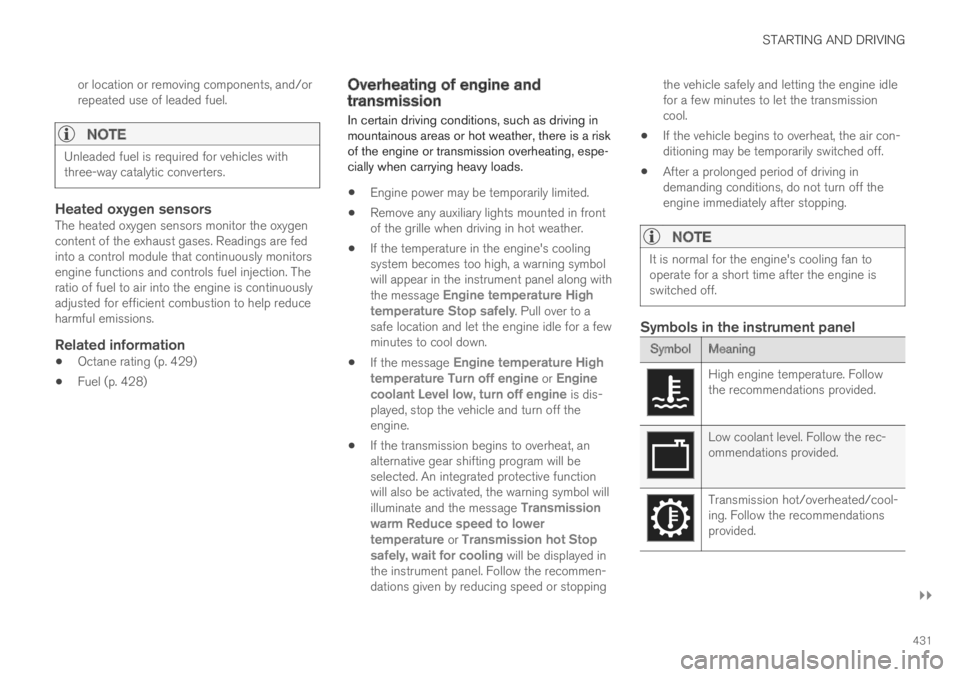
Symbols in the instrument panel
SymbolMeaning
High engine temperature. Followthe recommendations provided.
Low coolant level. Follow the rec-ommendations provided.
Transmission hot/overheated/cool-ing. Follow the recommendationsprovided.
Page 552 of 645

||
LOADING, STORAGE AND PASSENGER COMPARTMENT
* Option/accessory.550
The illustration is generic – the design may vary.
To lock the glove compartment:
Insert the key into the lock on the glove com-partment.
Turn the key 90 degrees clockwise.
Remove the key from the lock.
–To unlock, perform the above steps inreverse.
Using the glove box as a cooled area *
The glove compartment can be used to cool e.g.drinks or food. Cooling is possible when the cli-mate system is active (i.e. when the ignition is inmode II or when the engine is running).
The illustration is generic – the design may vary.
Activate cooling
Deactivate cooling
–Activate or deactivate cooling by moving thecontrol as far as possible toward the passen-ger compartment/glove compartment.
Related information
Passenger compartment interior (p. 544)
Private Locking (p. 253)
Sun visors
In the ceiling in front of the driver's and frontpassenger's seats, there are sun visors that canbe lowered and angled to the side as necessary.
The illustration is generic – the design may vary.
The mirror lighting* comes on automatically whenthe visor is lifted up.
The mirror frame has a holder for e.g. cards ortickets.
Related information
Passenger compartment interior (p. 544)
Page 570 of 645
MAINTENANCE AND SERVICE
568
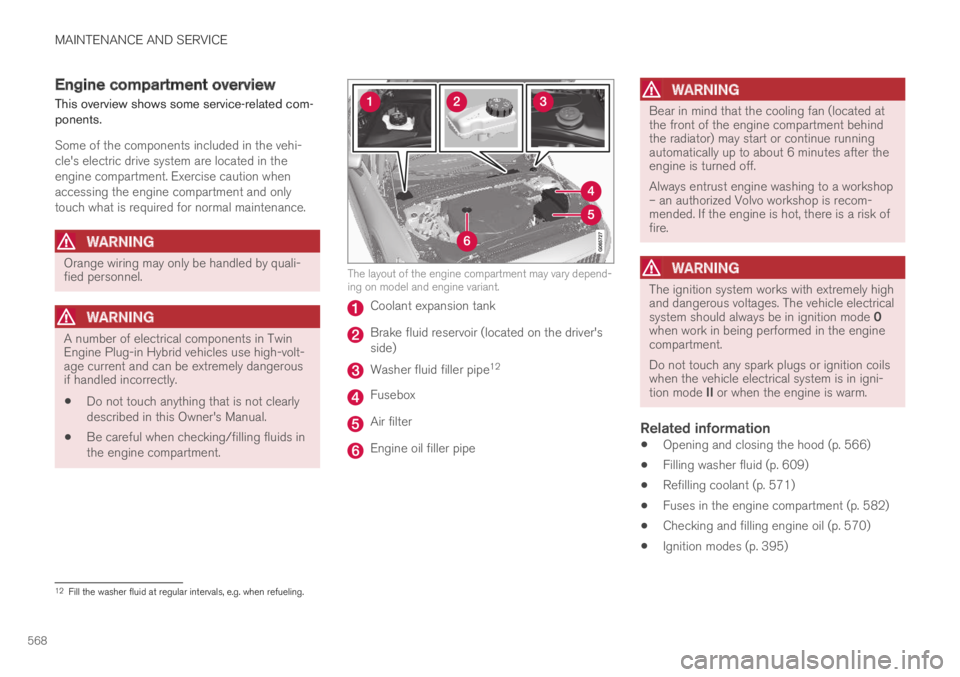
Engine compartment overview
This overview shows some service-related com-ponents.
Some of the components included in the vehi-cle's electric drive system are located in theengine compartment. Exercise caution whenaccessing the engine compartment and onlytouch what is required for normal maintenance.
WARNING
Orange wiring may only be handled by quali-fied personnel.
WARNING
A number of electrical components in TwinEngine Plug-in Hybrid vehicles use high-volt-age current and can be extremely dangerousif handled incorrectly.
Do not touch anything that is not clearlydescribed in this Owner's Manual.
Be careful when checking/filling fluids inthe engine compartment.
The layout of the engine compartment may vary depend-ing on model and engine variant.
Coolant expansion tank
Brake fluid reservoir (located on the driver'sside)
Washer fluid filler pipe12
Fusebox
Air filter
Engine oil filler pipe
WARNING
Bear in mind that the cooling fan (located atthe front of the engine compartment behindthe radiator) may start or continue runningautomatically up to about 6 minutes after theengine is turned off.
Always entrust engine washing to a workshop– an authorized Volvo workshop is recom-mended. If the engine is hot, there is a risk offire.
WARNING
The ignition system works with extremely highand dangerous voltages. The vehicle electricalsystem should always be in ignition mode 0when work in being performed in the enginecompartment.
Do not touch any spark plugs or ignition coilswhen the vehicle electrical system is in igni-tion mode II or when the engine is warm.
Related information
Opening and closing the hood (p. 566)
Filling washer fluid (p. 609)
Refilling coolant (p. 571)
Fuses in the engine compartment (p. 582)
Checking and filling engine oil (p. 570)
Ignition modes (p. 395)
12Fill the washer fluid at regular intervals, e.g. when refueling.
Page 573 of 645
MAINTENANCE AND SERVICE
}}
571
NOTE
If the conditions for measuring oil level arenot properly fulfilled (time after engine shut-down, vehicle inclination, ambient tempera-ture, etc.) the message No value availablewill be shown in the center display. This doesnot mean that anything is wrong in the vehi-cle systems.
Related information
Engine oil (p. 569)
Engine oil specifications (p. 620)
Ignition modes (p. 395)
Vehicle status (p. 560)
Refilling coolant
Coolant helps keep the combustion engine atthe right operating temperature. The heat trans-ferred from the engine to the coolant can beused to warm the passenger compartment.
When refilling coolant, follow the instructions onthe package. Never fill the cooling system withonly water. The risk of freezing is increased withtoo low or too high amounts of coolant.
If there is coolant under the vehicle, smoke fromthe cooling system, or if more than 2 liters (about2 quarts) of coolant has been added to the sys-tem, there could be something wrong with thecooling system and starting the vehicle coulddamage the engine. Call a tow truck and do notattempt to start the engine.
WARNING
The coolant may be very hot. Never unscrewthe cap when the coolant is hot. If coolantmust be filled, unscrew the expansion tankcap slowly to relieve overpressure.
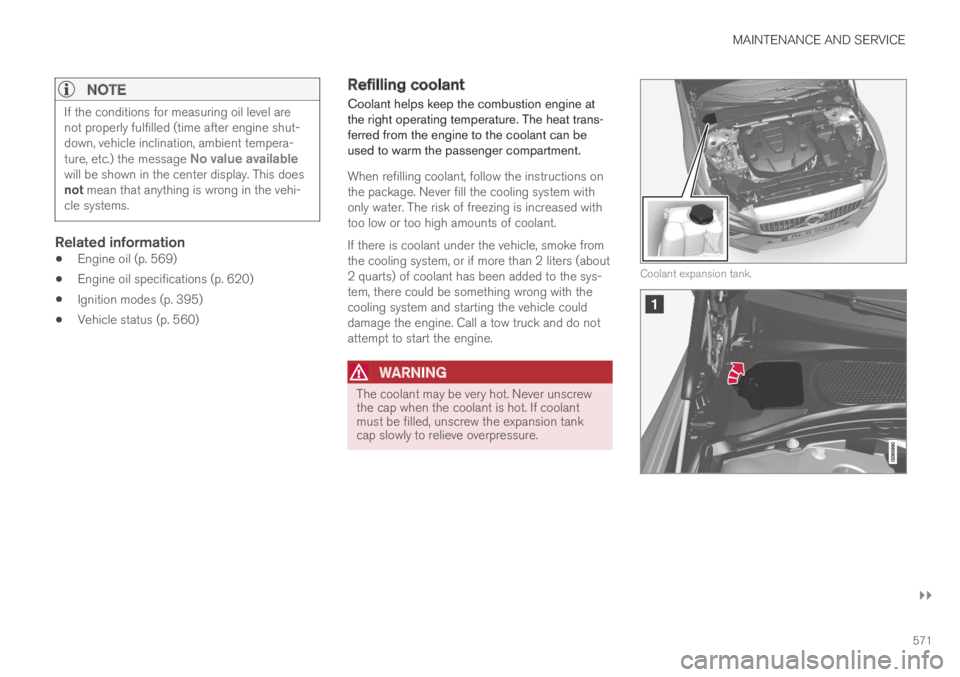
Coolant expansion tank.
Page 574 of 645
||
MAINTENANCE AND SERVICE
572
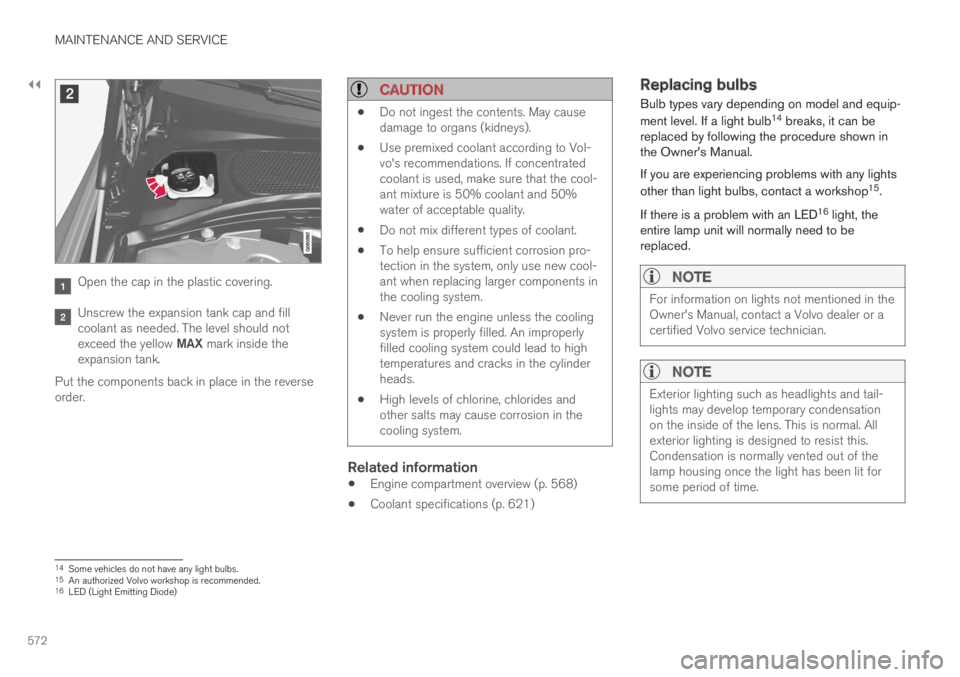
Open the cap in the plastic covering.
Unscrew the expansion tank cap and fillcoolant as needed. The level should notexceed the yellow MAX mark inside theexpansion tank.
Put the components back in place in the reverseorder.
CAUTION
Do not ingest the contents. May causedamage to organs (kidneys).
Use premixed coolant according to Vol-vo's recommendations. If concentratedcoolant is used, make sure that the cool-ant mixture is 50% coolant and 50%water of acceptable quality.
Do not mix different types of coolant.
To help ensure sufficient corrosion pro-tection in the system, only use new cool-ant when replacing larger components inthe cooling system.
Never run the engine unless the coolingsystem is properly filled. An improperlyfilled cooling system could lead to hightemperatures and cracks in the cylinderheads.
High levels of chlorine, chlorides andother salts may cause corrosion in thecooling system.
Related information
Engine compartment overview (p. 568)
Coolant specifications (p. 621)
Replacing bulbs
Bulb types vary depending on model and equip-
ment level. If a light bulb14 breaks, it can bereplaced by following the procedure shown inthe Owner's Manual.
If you are experiencing problems with any lights
other than light bulbs, contact a workshop15.
If there is a problem with an LED16 light, theentire lamp unit will normally need to bereplaced.
NOTE
For information on lights not mentioned in theOwner's Manual, contact a Volvo dealer or acertified Volvo service technician.
NOTE
Exterior lighting such as headlights and tail-lights may develop temporary condensationon the inside of the lens. This is normal. Allexterior lighting is designed to resist this.Condensation is normally vented out of thelamp housing once the light has been lit forsome period of time.
14Some vehicles do not have any light bulbs.15An authorized Volvo workshop is recommended.16LED (Light Emitting Diode)
Page 580 of 645

MAINTENANCE AND SERVICE
578
Hybrid battery
The vehicle's electric motor is powered by arechargeable, maintenance-free, lithium-ionhybrid battery.
NOTE
The vehicle cannot be started if the hybridbattery is discharged.
NOTE
If both the starter battery and the hybrid bat-tery are discharged, both batteries must becharged. In such cases, it is not possible tocharge only the hybrid battery first.
The starter battery must have a certain levelof charge for it to be possible to charge thehybrid battery.
WARNING
Hybrid battery replacement may only be per-formed by a workshop – an authorized Volvoworkshop is recommended.
Coolant
The hybrid battery's cooling system has its ownexpansion tank.
CAUTION
Filling the hybrid battery coolant should onlybe performed by a workshop – an authorizedVolvo workshop is recommended.
Specifications for hybrid battery
Type: Lithium-ion
Power reserve: 10.4 kWh.
NOTE
The capacity of the hybrid battery decreaseswith age and use, which could result inincreased use of the combustion engine,leading to higher fuel consumption andreduced electric motor range.
Related information
Battery symbols (p. 579)
Start battery (p. 574)
Charging the hybrid battery (p. 375)
Battery recycling (p. 579)