service VOLVO S60 TWIN ENGINE 2019 Workshop Manual
[x] Cancel search | Manufacturer: VOLVO, Model Year: 2019, Model line: S60 TWIN ENGINE, Model: VOLVO S60 TWIN ENGINE 2019Pages: 645, PDF Size: 13.96 MB
Page 382 of 645
HYBRID INFORMATION
380
Charging cable temperaturemonitoring
To help ensure the vehicle's hybrid battery is reli-ably charged each time it is connected, chargingis stopped if the temperature in the chargingcable becomes too high and reaches a criticallimit.
CAUTION
If charging is often inadvertently interrupted,have the charging cable and the vehicle'scharging system inspected by a trained andqualified Volvo service technician.
Related information
Charge cable (p. 377)
Opening and closing the chargingsocket cover
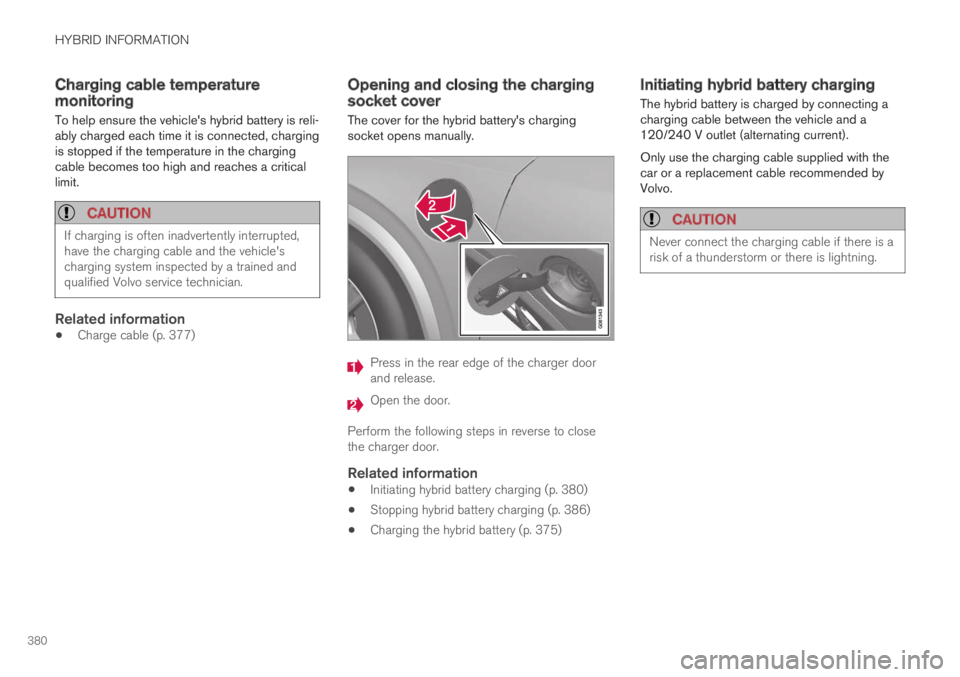
The cover for the hybrid battery's chargingsocket opens manually.
Press in the rear edge of the charger doorand release.
Open the door.
Perform the following steps in reverse to closethe charger door.
Related information
Initiating hybrid battery charging (p. 380)
Stopping hybrid battery charging (p. 386)
Charging the hybrid battery (p. 375)
Initiating hybrid battery charging
The hybrid battery is charged by connecting acharging cable between the vehicle and a120/240 V outlet (alternating current).
Only use the charging cable supplied with thecar or a replacement cable recommended byVolvo.
CAUTION
Never connect the charging cable if there is arisk of a thunderstorm or there is lightning.
Page 383 of 645
HYBRID INFORMATION
}}
381
WARNING
The charging cable must be groundedwhen in use. It is equipped with a cordwith a grounding conductor and agrounding plug. The plug must beinserted into an appropriate outlet that isproperly installed and grounded inaccordance with all local codes and ordi-nances and is not damaged in any way.
Children should be supervised when inthe vicinity of the charging cable when itis plugged in.
High voltage is present in your electricmeter housing and power distributionservice panel. Contact with high voltagecan cause death or serious personalinjury.
Do not use the charging cable if it isdamaged in any way. A damaged or mal-functioning charging cable may only berepaired by a workshop – an authorizedVolvo workshop is recommended.
Always position the charging cable sothat it will not be driven over, stepped on,tripped over or otherwise damaged, orcause personal injury.
Disconnect the charger from the wall out-let before cleaning it.
Never connect the charging cable to anextension cord or a multiple plug socket.
Also, refer to the manufacturer's instructionsfor using the charging cable and its compo-nents.
CAUTION
Make sure that the 120/240 V outlet (AC,alternating current) has a power capacity suf-ficient for charging electric vehicles. If you areuncertain of the capacity, have the outletchecked by a licensed electrician.
Take out the charging cable from the storagecompartment on the right side of the trunk. Notethat the ignition must be switched off completelybefore charging.
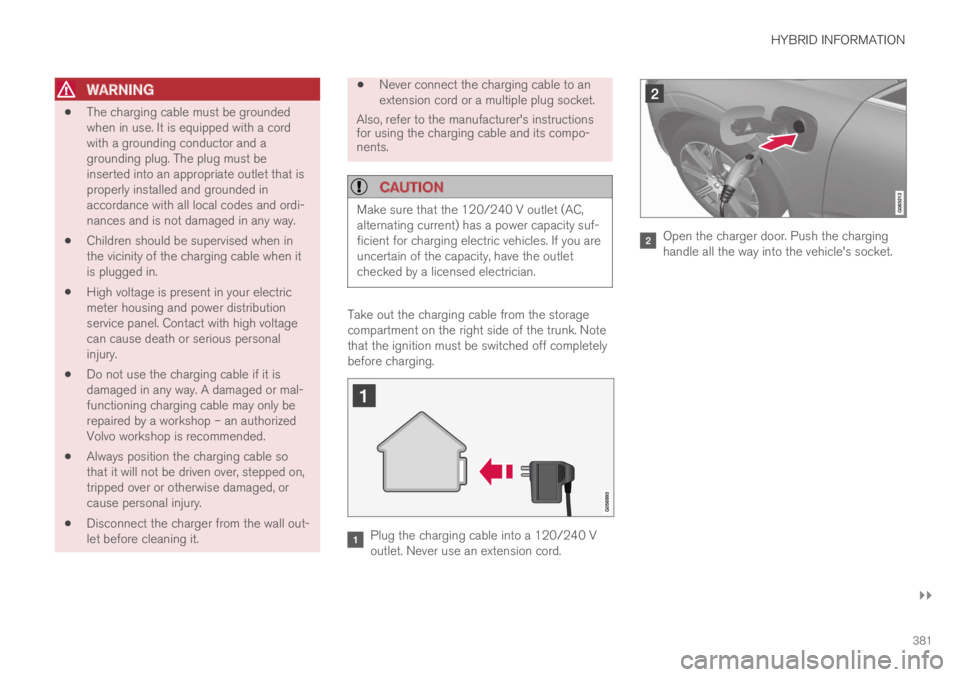
Plug the charging cable into a 120/240 Voutlet. Never use an extension cord.
Open the charger door. Push the charginghandle all the way into the vehicle's socket.
Page 385 of 645

HYBRID INFORMATION
383
LED indicatorlight's colorMeaning
WhiteCourtesy light.
YellowWait modeA – waiting forcharging to start.
Flashing greenCharging is in progressB.
GreenCharging completedC.
RedMalfunction.
AE.g. after a door has been opened or if the charging cable han-dle is not locked in place.BThe more slowly the light flashes, the closer the battery is tobeing fully charged.CThe light will go out after a short time.
Related information
Charging the hybrid battery (p. 375)
Charging status in the instrument panel(p. 384)
Charging status in the charging cable'scharging module (p. 383)
Stopping hybrid battery charging (p. 386)
Charging status in the chargingcable's charging module
The red and blue lights in the charging moduleindicate the status of ongoing and completedcharging.
Charge module: 1. Red warning light, 2. Blue status indi-cator
When the charge module is initially plugged intoa wall outlet, the red warning light will flash onceto indicate that a startup safety check has beenperformed. When the safety check has beencompleted, the blue status indicator will glowsteadily and the red warning light will be off. Thecharger is now ready to be used. If the red warn-ing light continues to flash or glows steadily, afault has been detected and the charger will notdeliver power to the vehicle. Contact a Volvoretailer or a certified Volvo service technician.
When the charging cable is connected to thevehicle's charging socket, the blue light will flashonce.
Charging cable connected to the vehicle's charg-ing socket:
Indicatorlight's colorMeaning
FlashingblueCharging is in progress. Thelight flashes about once everyother second
Solid blueCharging completed. This willalso be indicated in the instru-ment panel
Related information
Charging the hybrid battery (p. 375)
Charging status in the vehicle's chargingsocket (p. 382)
Charging status in the instrument panel(p. 384)
Stopping hybrid battery charging (p. 386)
Page 389 of 645

HYBRID INFORMATION
}}
387
Twin Engine symbols and messagesin the instrument panel
A number of symbols and messages relating tothe Twin Engine may be displayed in the instru-
ment panel. They may also appear in combina-tion with general indicator and warning symbolsand disappear when the necessary action hasbeen taken.
SymbolMessageMeaning
12 V Battery
Charging fault, service urgent. Driveto workshop
Battery fault. Contact a workshopA to have the battery checked as soon as possible.
12 V Battery
Charging fault Stop safely
Battery fault. Stop the vehicle as soon as possible and contact a workshopA to have the batterychecked.
12 V Battery
Fuse failure Service required
Battery fault. Contact a workshopA to have the system checked as soon as possible.
Hybrid battery
Overheated, stop safely
The hybrid battery's temperature seems to be rising at an abnormal rate. Stop the vehicle and turn
off the engine. Wait at least 5 minutes before driving. Call a workshopA or inspect the vehicle tomake sure everything seems normal before continuing to drive.
Reduced performance
Max vehicle speed limited
The hybrid battery's charge level is too low for driving at high speeds. Charge the battery as soon aspossible.
Hybrid system
Harsh behavior at low speed, vehicleok to use
The hybrid system is not functioning properly. Contact a workshopA to have the system checked assoon as possible.
Page 390 of 645

||
HYBRID INFORMATION
388
SymbolMessageMeaning
Hybrid system failure
Service required
The hybrid system is not functioning. Contact a workshopA to have the system checked as soon aspossible.
Charge cable
Remove before start
Displayed when the driver attempts to start the vehicle with the charging cable still connected.Remove the charging cable and close the charger cover.
Charge cable
Removed? Turn and hold start knob7s
Displayed when the driver again attempts to start the vehicle with the charging cable connected.Disconnect the charging cable or verify that the cable is completely disconnected and the chargercover is closed.
AAn authorized Volvo workshop is recommended.
Related information
Initiating hybrid battery charging (p. 380)
Stopping hybrid battery charging (p. 386)
Charging the hybrid battery (p. 375)
Warning symbols in the instrument panel(p. 95)
Indicator symbols in the instrument panel(p. 92)
Hybrid gauge (p. 85)
Hybrid battery gauge (p. 86)
Page 400 of 645

||
STARTING AND DRIVING
398
SymbolMeaning
A
B
Steady glow for 2 seconds afterthe engine is started: Automaticfunction check.
Steady glow for more than 2 sec-onds: Fault in the ABS system. Thevehicle's regular brake system isstill working, but without the ABSfunction.
If the message Brake pedal Cha-racteristics changed Servicerequired is displayed, the "Brake-by-wire" system is not functioningproperly. Greater pressure will berequired to brake the vehicle.
AIn Canada.BIn the US.
WARNING
If the warning symbols for both brake faultand ABS fault are lit simultaneously, theremay be a fault in the brake system.
If the brake fluid reservoir level is normalwhen this occurs, drive carefully to thenearest workshop to have the brake sys-tem checked - an authorized Volvo work-shop is recommended.
If the brake fluid has fallen below the MINlevel in the brake fluid reservoir, the vehi-cle should not be driven until the brakefluid has been filled. The reason for thebrake fluid loss must be checked.
Related information
Brake Assist System (p. 398)
Auto-hold brakes (p. 403)
Hill Start Assist (p. 405)
Braking on wet roads (p. 399)
Braking on salted roads (p. 399)
Maintenance of the brake system (p. 399)
Brake lights (p. 159)
Brake Assist System
The brake enhancing system, (BAS3), helpsincrease braking force and can thereby reducebraking distance.
The system monitors the driver's braking habitsand increases braking force when necessary.Braking force can be increased up to the point atwhich the ABS intervenes. The function is deacti-vated when pressure on the brake pedal isdecreased.
Related information
Brakes (p. 397)
3Brake Assist System
Page 401 of 645

STARTING AND DRIVING
399
Braking on wet roads
Prolonged driving in heavy rain without brakingmay cause braking effect to be slightly delayedthe first time the brakes are applied.
This may also occur after washing the vehicle. Itwill then be necessary to apply greater pressureto the brake pedal. You should therefore maintaina greater distance to the vehicle ahead.
Firmly apply the brakes after washing the vehicleor driving on wet roads. This helps warm up thebrake discs, enabling them to dry more quicklyand protecting them against corrosion. Considerthe current traffic situation when braking.
Related information
Brakes (p. 397)
Braking on salted roads (p. 399)
Braking on salted roads
When driving on salted roads, a layer of salt mayform on the brake discs and brake pads.
This could increase stopping distance. Maintainan extra large safety distance to the vehicleahead. Make sure to also:
Apply the brakes from time to time to helpremove salt. Make sure braking does notpose a risk to any other road users.
Gently apply the brakes when you have fin-ished driving and before driving again.
Related information
Brakes (p. 397)
Braking on wet roads (p. 399)
Maintenance of the brake system
Regularly check the brake system componentsfor wear.
To keep the vehicle as safe and reliable as possi-ble, follow the Volvo service schedule specified inthe Warranty and Maintenance Records Informa-tion booklet. New and replaced brake pads andbrake discs do not provide optimal braking effectuntil they are "broken in" by driving a few hun-dred kilometers (miles). Compensate for thereduced braking effect by applying greater pres-sure to the brake pedal. Volvo recommends onlyusing brake pads approved for your Volvo.
CAUTION
The brake system's components should beregularly checked for wear.
Contact a workshop for advice on how to dothis or let a workshop perform the inspection- an authorized Volvo workshop is recom-mended.
Related information
Brakes (p. 397)
Page 405 of 645
STARTING AND DRIVING
}}
403
Symbols in the instrument panel
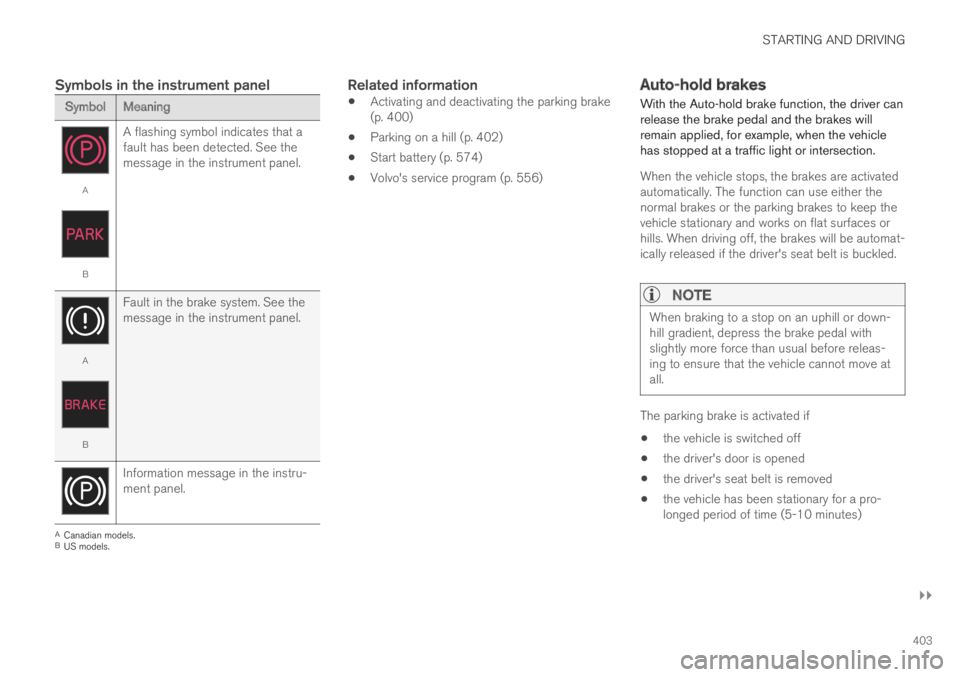
SymbolMeaning
A
B
A flashing symbol indicates that afault has been detected. See themessage in the instrument panel.
A
B
Fault in the brake system. See themessage in the instrument panel.
Information message in the instru-ment panel.
ACanadian models.BUS models.
Related information
Activating and deactivating the parking brake(p. 400)
Parking on a hill (p. 402)
Start battery (p. 574)
Volvo's service program (p. 556)
Auto-hold brakes
With the Auto-hold brake function, the driver canrelease the brake pedal and the brakes willremain applied, for example, when the vehiclehas stopped at a traffic light or intersection.
When the vehicle stops, the brakes are activatedautomatically. The function can use either thenormal brakes or the parking brakes to keep thevehicle stationary and works on flat surfaces orhills. When driving off, the brakes will be automat-ically released if the driver's seat belt is buckled.
NOTE
When braking to a stop on an uphill or down-hill gradient, depress the brake pedal withslightly more force than usual before releas-ing to ensure that the vehicle cannot move atall.
The parking brake is activated if
the vehicle is switched off
the driver's door is opened
the driver's seat belt is removed
the vehicle has been stationary for a pro-longed period of time (5-10 minutes)
Page 421 of 645
STARTING AND DRIVING
* Option/accessory.419
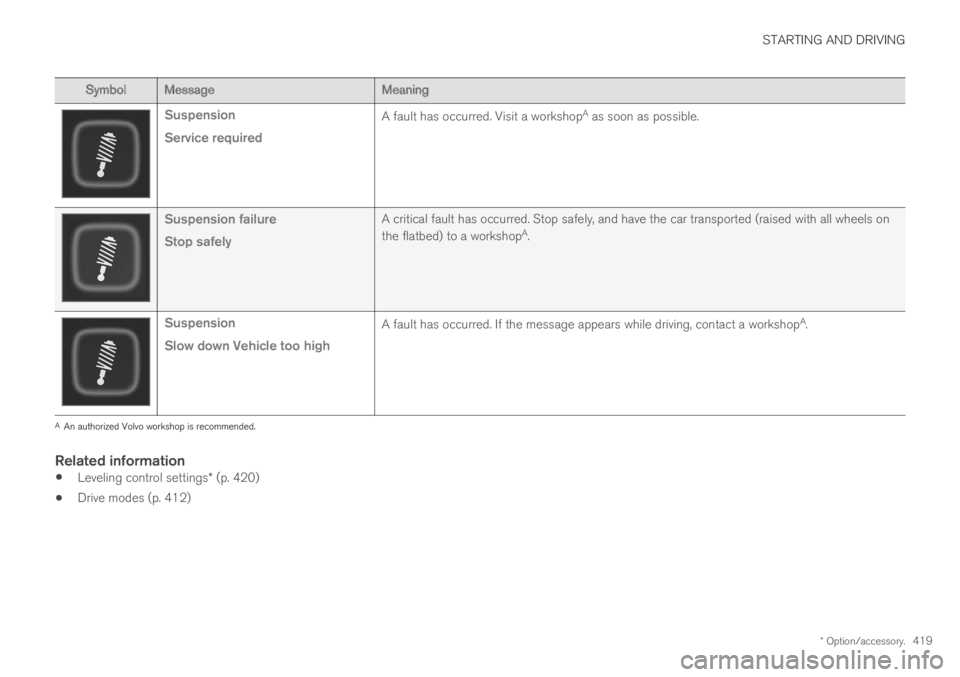
SymbolMessageMeaning
Suspension
Service required
A fault has occurred. Visit a workshopA as soon as possible.
Suspension failure
Stop safely
A critical fault has occurred. Stop safely, and have the car transported (raised with all wheels on
the flatbed) to a workshopA.
Suspension
Slow down Vehicle too high
A fault has occurred. If the message appears while driving, contact a workshopA.
AAn authorized Volvo workshop is recommended.
Related information
Leveling control settings* (p. 420)
Drive modes (p. 412)
Page 428 of 645

||
STARTING AND DRIVING
426
1. Press the button on the dashboard.
>Pressure equalization in the fuel tank cau-ses a slight delay before the fuel fillerdoor opens. Fuel tank Fuel lid isopening will be displayed in the instru-ment panel, followed by Fuel tank Readyfor refueling.
NOTE
Refueling must be done within approximately15 minutes of opening the fuel filler door.After this time, the valve opened by pushingthe button for opening the fuel filler door willclose and it will no longer be possible torefuel without the pump's nozzle switching off.
If the valve is closed before refueling is com-plete - press the button again and wait untilthe driver display shows the message Fueltank Ready for refueling.
2. After refueling, press the fuel filler doorlightly to close it.
Related information
Refueling (p. 426)
Refueling
The fuel tank is equipped with a fuel filling sys-tem without a cover.
Refueling the vehicle at a service
station
It is important to insert the pump's nozzle past both ofthe two flaps in the fuel filler pipe before beginning fuel-ing.