weight VOLVO S80 2007 Owners Manual
[x] Cancel search | Manufacturer: VOLVO, Model Year: 2007, Model line: S80, Model: VOLVO S80 2007Pages: 251, PDF Size: 5.7 MB
Page 6 of 251
harmful substances (CO, HC, NOx) from the exhaust pipe by approximately 95-99% and the search to eliminate the
remaining emissions continues. Volvo is the only automobile manufacturer to offer CFC-free retrofit kits for the air
conditioning system of all models as far back as the 1975 model 240. Advanced electronic engine controls and cleaner
fuels are bringing us closer to our goal. After Volvo vehicles and parts have fulfilled their use, recycling is the next
critical step in completing the life cycle. The metal content is about 75% of the total weight of a vehicle, which makes
the vehicle among the most recycled industrial products. In order to have efficient and well controlled recycling, all
Volvo variants have printed dismantling manuals, indicating the weight and material of individual components. For
Volvo, all homogeneous plastic parts weighing more than 3.4 oz. (100 grams) are marked with international symbols
that indicate how the component is to be sorted for recycling. In addition to continuous environmental refinement of
conventional gasoline-powered internal combustion engines, Volvo is actively looking at advanced technology
alternative-fuel vehicles.
When you drive a Volvo, you become our partner in the work to lessen the car's impact on the environment. To reduce
your vehicle's environmental impact, you can:
Maintain proper air pressure in your tires. Tests have shown decreased fuel economy with improperly inflated tires.
Follow the recommended maintenance schedule in your Warranty and Service Records Information booklet.
Drive at a constant speed whenever possible.
See a trained and qualified Volvo service technician as soon as possible for inspection if the check engine
(malfunction indicator) light illuminates, or stays on after the vehicle has started.
Properly dispose of any vehicle-related waste such as used motor oil, used batteries, brake pads, etc.
When cleaning your vehicle, please use genuine Volvo car care products. All Volvo car care products are
formulated to be environmentally friendly.
WARNING
PROPOSITION 65 WARNING!
Engine exhaust, some of its constituents, and certain vehicle components contain or emit chemicals known to the
state of California to cause cancer, and birth defects or other reproductive harm. In addition, certain fluids contained
in vehicles and certain products of component wear contain or emit chemicals known to the State of California to
cause cancer, and birth defects or other reproductive harm.
Contents | Top of Page
ProCarManuals.com
Page 9 of 251
immediately inform Transport Canada in addition to notifying Volvo Cars of Canada Corp.
To contact Transport Canada, call (800) 333- 0510, or (613) 993-9851 if you are calling from the Ottawa region.
14 01 Safety
Safety in the passenger compartment
Seat belts
Using seat belts
Volvo, the inventor of the three-point seat belt, urges you and all occupants of your vehicle to wear seat belts and
ensure that children are properly restrained, using an infant, convertible, or booster seat determined by age, weight and
height.
Volvo also believes no child should sit in the front seat of a vehicle.
Most states and provinces make it mandatory for occupants of a vehicle to use seat belts.
Seat belt tensioners
All seat belts are equipped with tensioners that reduce slack in the belts. These tensioners are triggered in situations
where the front airbags deploy. The front seat belts also include a tension reducing device which, in the event of a
collision, limits the peak forces exerted by the seat belt on the occupant.
Buckling a seat belt
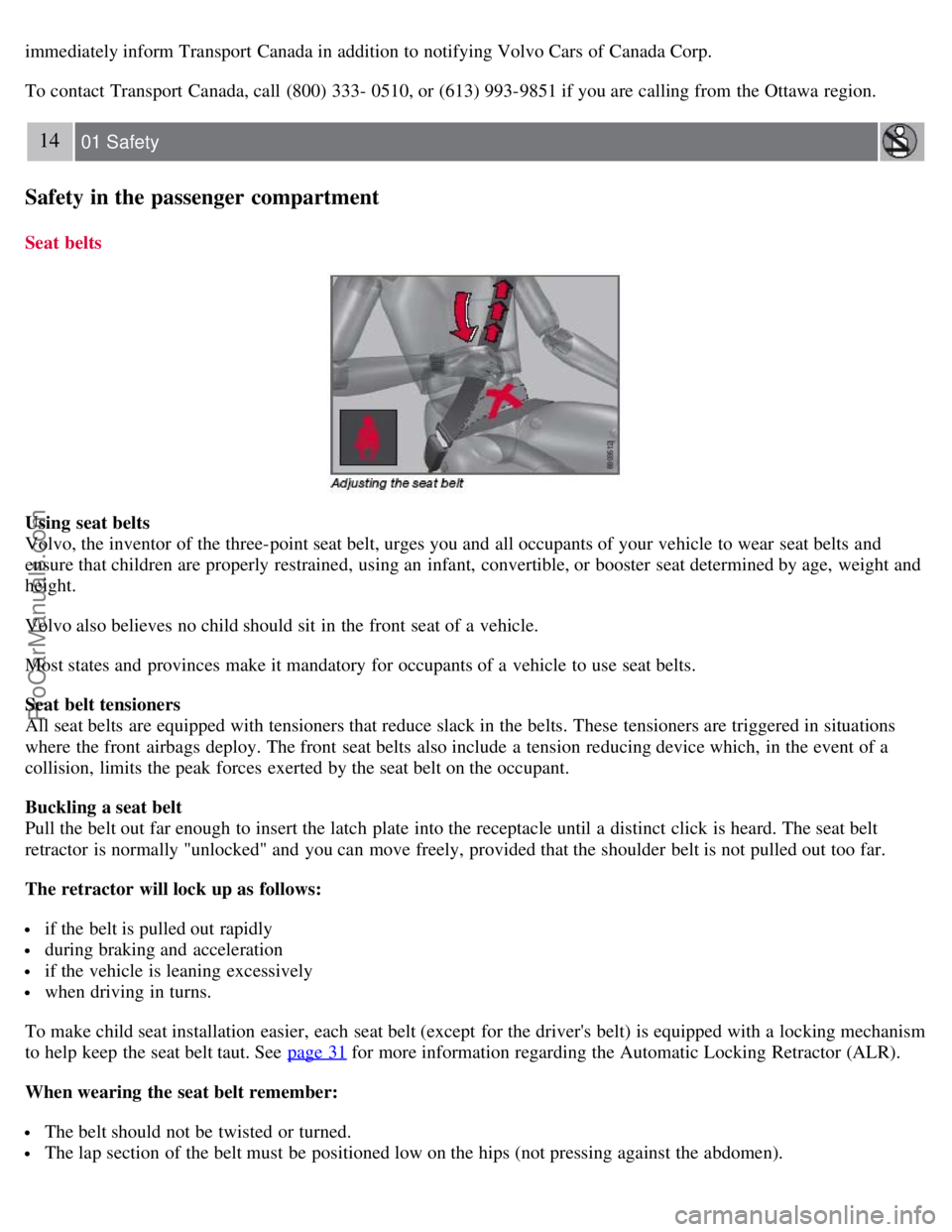
Pull the belt out far enough to insert the latch plate into the receptacle until a distinct click is heard. The seat belt
retractor is normally "unlocked" and you can move freely, provided that the shoulder belt is not pulled out too far.
The retractor will lock up as follows:
if the belt is pulled out rapidly
during braking and acceleration
if the vehicle is leaning excessively
when driving in turns.
To make child seat installation easier, each seat belt (except for the driver's belt) is equipped with a locking mechanism
to help keep the seat belt taut. See page 31
for more information regarding the Automatic Locking Retractor (ALR).
When wearing the seat belt remember:
The belt should not be twisted or turned.
The lap section of the belt must be positioned low on the hips (not pressing against the abdomen).
ProCarManuals.com
Page 11 of 251
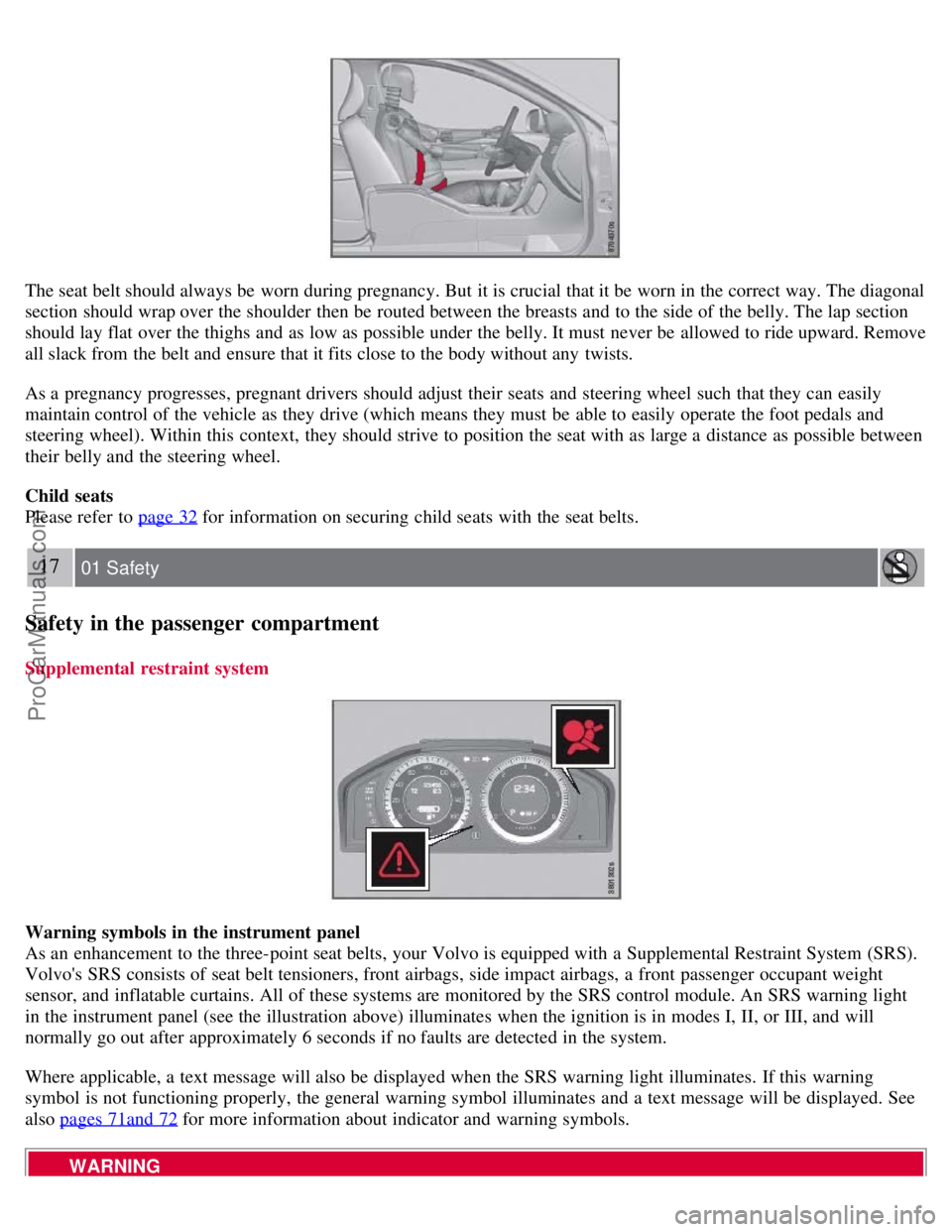
The seat belt should always be worn during pregnancy. But it is crucial that it be worn in the correct way. The diagonal
section should wrap over the shoulder then be routed between the breasts and to the side of the belly. The lap section
should lay flat over the thighs and as low as possible under the belly. It must never be allowed to ride upward. Remove
all slack from the belt and ensure that it fits close to the body without any twists.
As a pregnancy progresses, pregnant drivers should adjust their seats and steering wheel such that they can easily
maintain control of the vehicle as they drive (which means they must be able to easily operate the foot pedals and
steering wheel). Within this context, they should strive to position the seat with as large a distance as possible between
their belly and the steering wheel.
Child seats
Please refer to page 32
for information on securing child seats with the seat belts.
17 01 Safety
Safety in the passenger compartment
Supplemental restraint system
Warning symbols in the instrument panel
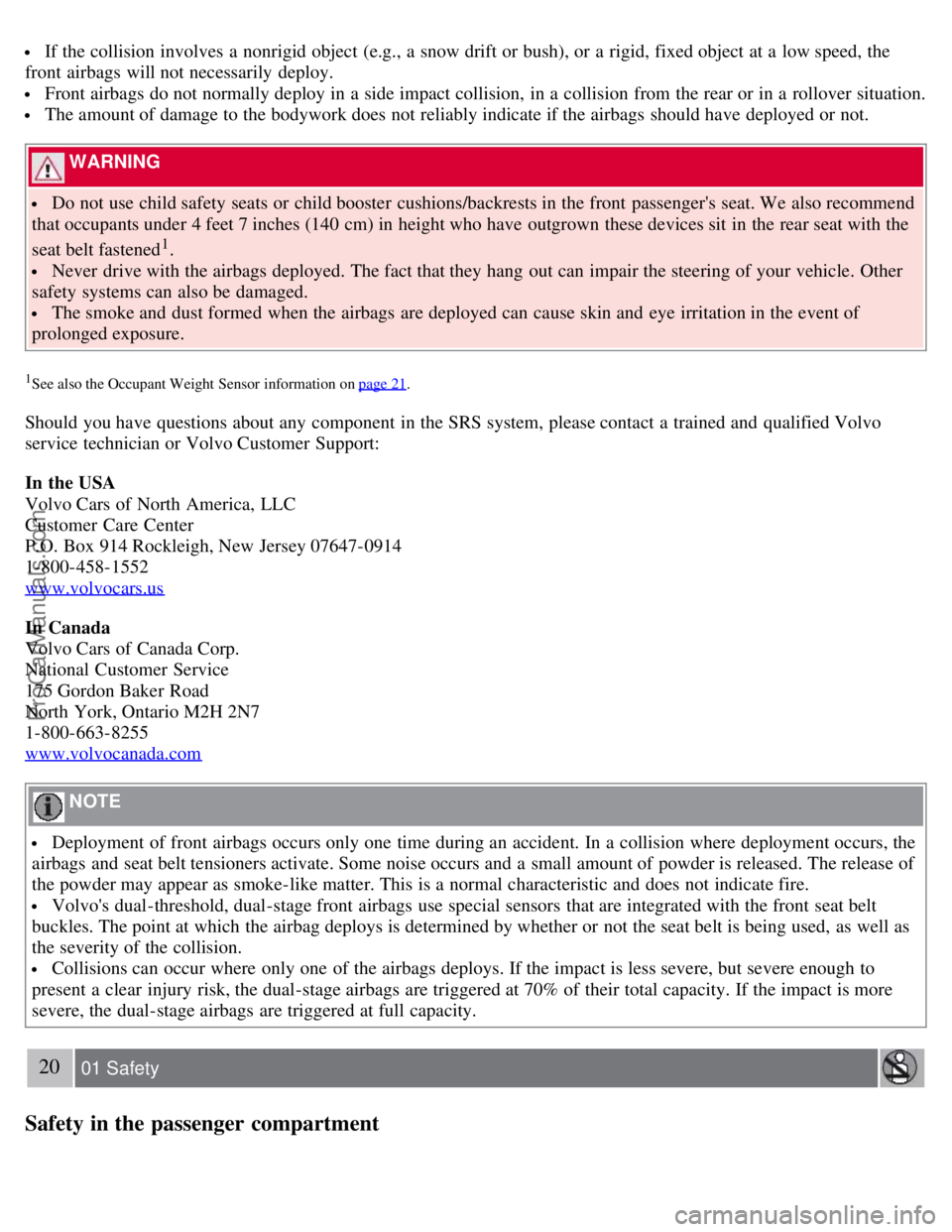
As an enhancement to the three-point seat belts, your Volvo is equipped with a Supplemental Restraint System (SRS).
Volvo's SRS consists of seat belt tensioners, front airbags, side impact airbags, a front passenger occupant weight
sensor, and inflatable curtains. All of these systems are monitored by the SRS control module. An SRS warning light
in the instrument panel (see the illustration above) illuminates when the ignition is in modes I, II, or III, and will
normally go out after approximately 6 seconds if no faults are detected in the system.
Where applicable, a text message will also be displayed when the SRS warning light illuminates. If this warning
symbol is not functioning properly, the general warning symbol illuminates and a text message will be displayed. See
also pages 71and 72
for more information about indicator and warning symbols.
WARNING
ProCarManuals.com
Page 14 of 251
If the collision involves a nonrigid object (e.g., a snow drift or bush), or a rigid, fixed object at a low speed, the
front airbags will not necessarily deploy.
Front airbags do not normally deploy in a side impact collision, in a collision from the rear or in a rollover situation.
The amount of damage to the bodywork does not reliably indicate if the airbags should have deployed or not.
WARNING
Do not use child safety seats or child booster cushions/backrests in the front passenger's seat. We also recommend
that occupants under 4 feet 7 inches (140 cm) in height who have outgrown these devices sit in the rear seat with the
seat belt fastened
1.
Never drive with the airbags deployed. The fact that they hang out can impair the steering of your vehicle. Other
safety systems can also be damaged.
The smoke and dust formed when the airbags are deployed can cause skin and eye irritation in the event of
prolonged exposure.
1See also the Occupant Weight Sensor information on page 21.
Should you have questions about any component in the SRS system, please contact a trained and qualified Volvo
service technician or Volvo Customer Support:
In the USA
Volvo Cars of North America, LLC
Customer Care Center
P.O. Box 914 Rockleigh, New Jersey 07647-0914
1-800-458-1552
www.volvocars.us
In Canada
Volvo Cars of Canada Corp.
National Customer Service
175 Gordon Baker Road
North York, Ontario M2H 2N7
1-800-663-8255
www.volvocanada.com
NOTE
Deployment of front airbags occurs only one time during an accident. In a collision where deployment occurs, the
airbags and seat belt tensioners activate. Some noise occurs and a small amount of powder is released. The release of
the powder may appear as smoke-like matter. This is a normal characteristic and does not indicate fire.
Volvo's dual-threshold, dual-stage front airbags use special sensors that are integrated with the front seat belt
buckles. The point at which the airbag deploys is determined by whether or not the seat belt is being used, as well as
the severity of the collision.
Collisions can occur where only one of the airbags deploys. If the impact is less severe, but severe enough to
present a clear injury risk, the dual-stage airbags are triggered at 70% of their total capacity. If the impact is more
severe, the dual-stage airbags are triggered at full capacity.
20 01 Safety
Safety in the passenger compartment
ProCarManuals.com
Page 16 of 251
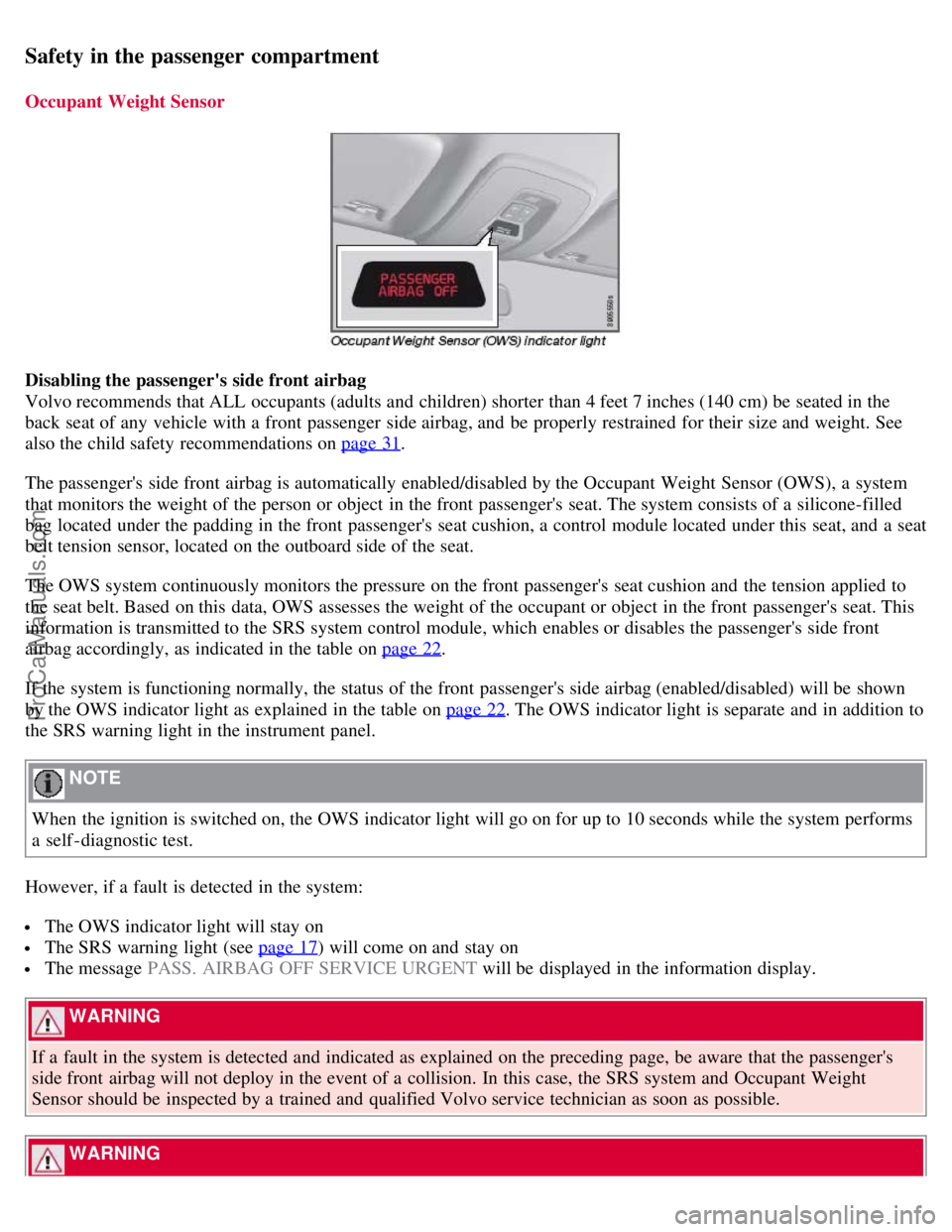
Safety in the passenger compartment
Occupant Weight Sensor
Disabling the passenger's side front airbag
Volvo recommends that ALL occupants (adults and children) shorter than 4 feet 7 inches (140 cm) be seated in the
back seat of any vehicle with a front passenger side airbag, and be properly restrained for their size and weight. See
also the child safety recommendations on page 31
.
The passenger's side front airbag is automatically enabled/disabled by the Occupant Weight Sensor (OWS), a system
that monitors the weight of the person or object in the front passenger's seat. The system consists of a silicone-filled
bag located under the padding in the front passenger's seat cushion, a control module located under this seat, and a seat
belt tension sensor, located on the outboard side of the seat.
The OWS system continuously monitors the pressure on the front passenger's seat cushion and the tension applied to
the seat belt. Based on this data, OWS assesses the weight of the occupant or object in the front passenger's seat. This
information is transmitted to the SRS system control module, which enables or disables the passenger's side front
airbag accordingly, as indicated in the table on page 22
.
If the system is functioning normally, the status of the front passenger's side airbag (enabled/disabled) will be shown
by the OWS indicator light as explained in the table on page 22
. The OWS indicator light is separate and in addition to
the SRS warning light in the instrument panel.
NOTE
When the ignition is switched on, the OWS indicator light will go on for up to 10 seconds while the system performs
a self -diagnostic test.
However, if a fault is detected in the system:
The OWS indicator light will stay on
The SRS warning light (see page 17) will come on and stay on
The message PASS. AIRBAG OFF SERVICE URGENT will be displayed in the information display.
WARNING
If a fault in the system is detected and indicated as explained on the preceding page, be aware that the passenger's
side front airbag will not deploy in the event of a collision. In this case, the SRS system and Occupant Weight
Sensor should be inspected by a trained and qualified Volvo service technician as soon as possible.
WARNING
ProCarManuals.com
Page 18 of 251
1-800-458-1552
In Canada
Volvo Cars of Canada Corp.
National Customer Service
175 Gordon Baker Road
North York, Ontario M2H 2N7
1-800-663-8255
23 01 Safety
Safety in the passenger compartment
WARNING
No objects that add to the total weight on the seat should be placed on the front passenger's seat. If a child is
seated in the front passenger's seat with any additional weight, this extra weight could cause the OWS system to
enable the airbag, which might cause it to deploy in the event of a collision, thereby injuring the child.
The seat belt should never be wrapped around an object on the front passenger's seat. This could interfere with the
OWS system's function.
The front passenger's seat belt should never be used in a way that exerts more pressure on the passenger than
normal. This could increase the pressure exerted on the weight sensor by a child, and could result in the airbag being
enabled, which might cause it to deploy in the event of a collision, thereby injuring the child.
WARNING
Keep the following points in mind with respect to the OWS system. Failure to follow these instructions could
adversely affect the system's function and result in serious injury to the occupant of the front passenger's seat:
The full weight of the front seat passenger should always be on the seat cushion. The passenger should never lift
him/herself off the seat cushion using the armrest in the door or the center console, by pressing the feet on the floor,
by sitting on the edge of the seat cushion, or by pressing against the backrest in a way that reduces pressure on the
seat cushion. This could cause OWS to disable the front, passenger's side airbag.
Do not place any type of object on the front passenger's seat in such a way that jamming, pressing, or squeezing
occurs between the object and the front seat, other than as a direct result of the correct use of the ALR/ELR seat belt
(see page 31
).
No objects should be placed under the front passenger's seat. This could interfere with the OWS system's function.
24 01 Safety
Safety in the passenger compartment
Side impact protection (SIPS) airbags
ProCarManuals.com
Page 24 of 251
29 01 Safety
Child safety
Children should be seated safely
Volvo recommends the proper use of restraint systems for all occupants including children. Remember that, regardless
of age and size, a child should always be properly restrained in a vehicle.
Your vehicle is also equipped with ISOFIX/LATCH attachments, which make it more convenient to install child seats.
Some restraint systems for children are designed to be secured in the vehicle by lap belts or the lap portion of a lap-
shoulder belt. Such child restraint systems can help protect children in vehicles in the event of an accident only if they
are used properly. However, children could be endangered in a crash if the child restraints are not properly secured in
the vehicle. Failure to follow the installation instructions for your child restraint can result in your child striking the
vehicle's interior in a sudden stop.
Holding a child in your arms is NOT a suitable substitute for a child restraint system. In an accident, a child held in a
person's arms can be crushed between the vehicle's interior and an unrestrained person. The child could also be injured
by striking the interior, or by being ejected from the vehicle during a sudden maneuver or impact. The same can also
happen if the infant or child rides unrestrained on the seat. Other occupants should also be properly restrained to help
reduce the chance of injuring or increasing the injury of a child.
All states and provinces have legislation governing how and where children should be carried in a vehicle. Find out
the regulations existing in your state or province. Recent accident statistics have shown that children are safer in rear
seating positions than front seating positions when properly restrained. A child restraint system can help protect a child
in a vehicle. Here's what to look for when selecting a child restraint system:
It should have a label certifying that it meets applicable Federal Motor Vehicle Safety Standards (FMVSS 213) - or in
Canada, CMVSS 213.
Make sure the child restraint system is approved for the child's height, weight and development - the label required by
the standard or regulation, or instructions for infant restraints, typically provide this information.
In using any child restraint system, we urge you to carefully look over the instructions that are provided with the
restraint. Be sure you understand them and can use the device properly and safely in this vehicle. A misused child
restraint system can result in increased injuries for both the infant or child and other occupants in the vehicle.
When a child has outgrown the child safety seat, you should use the rear seat with the standard seat belt fastened. The
best way to help protect the child here is to place the child on a cushion so that the seat belt is properly located on the
hips (see the illustration on page 39
). Legislation in your state or province may mandate the use of a child seat or
cushion in combination with the seat belt, depending on the child's age and/or size. Please check local regulations.
A specially designed and tested booster cushion (not available in Canada) can be obtained from your Volvo retailer for
children weighing 33 - 80 lb. (15 - 36 kg) and 38-54 inches (97 - 137 cm) in height.
30 01 Safety
Child safety
WARNING
ProCarManuals.com
Page 26 of 251
Drive safely!
32 01 Safety
Child restraint systems
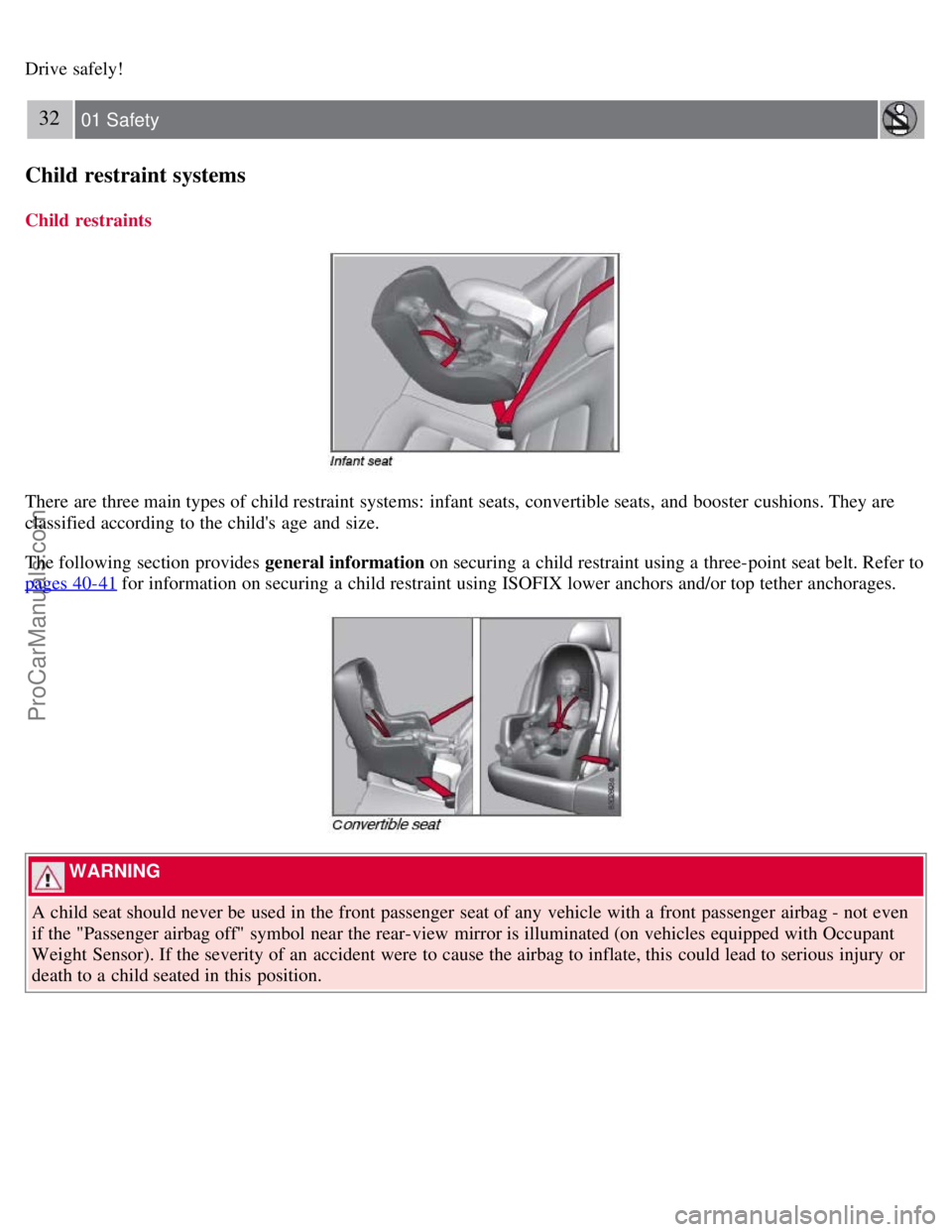
Child restraints
There are three main types of child restraint systems: infant seats, convertible seats, and booster cushions. They are
classified according to the child's age and size.
The following section provides general information on securing a child restraint using a three-point seat belt. Refer to
pages 40-41
for information on securing a child restraint using ISOFIX lower anchors and/or top tether anchorages.
WARNING
A child seat should never be used in the front passenger seat of any vehicle with a front passenger airbag - not even
if the "Passenger airbag off" symbol near the rear-view mirror is illuminated (on vehicles equipped with Occupant
Weight Sensor). If the severity of an accident were to cause the airbag to inflate, this could lead to serious injury or
death to a child seated in this position.
ProCarManuals.com
Page 27 of 251
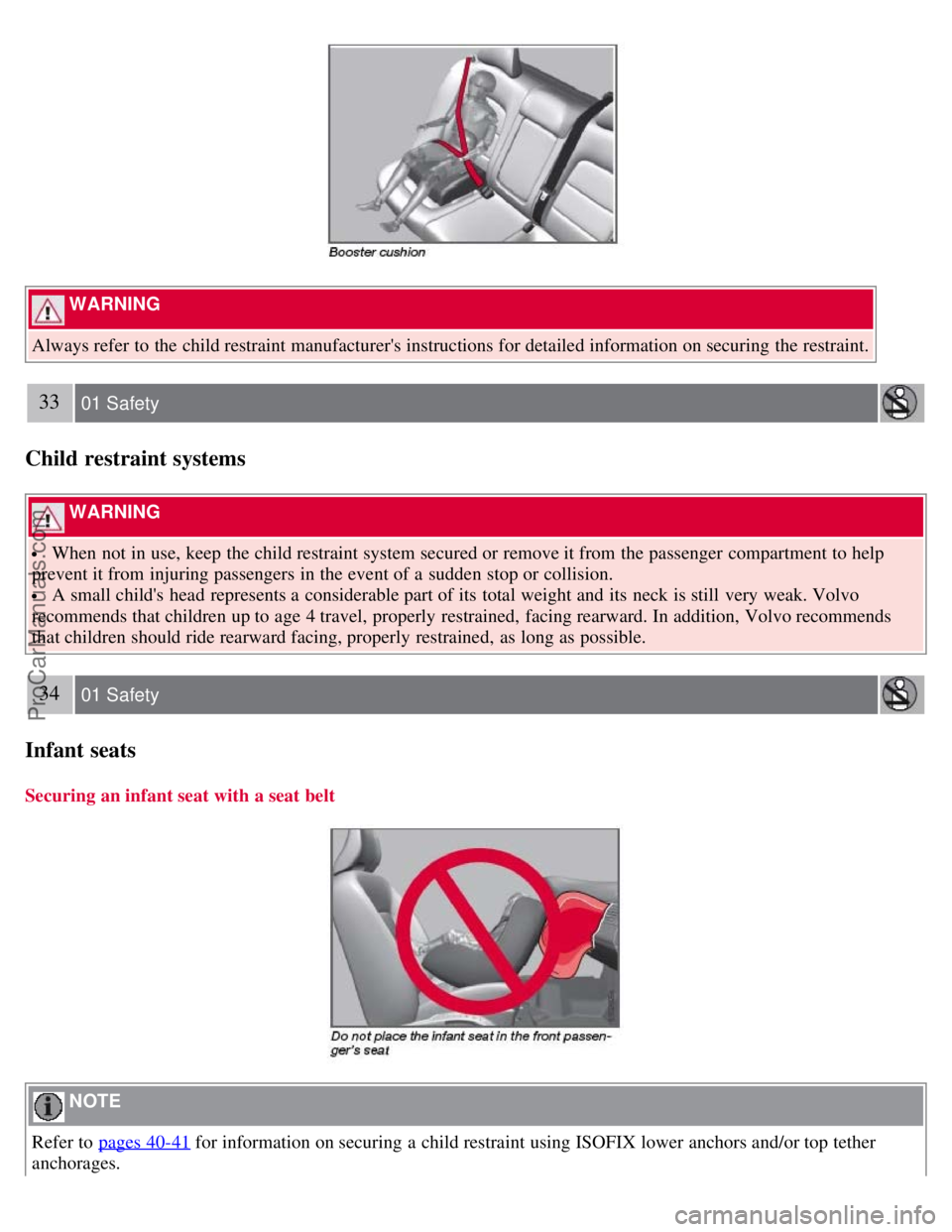
WARNING
Always refer to the child restraint manufacturer's instructions for detailed information on securing the restraint.
33 01 Safety
Child restraint systems
WARNING
When not in use, keep the child restraint system secured or remove it from the passenger compartment to help
prevent it from injuring passengers in the event of a sudden stop or collision.
A small child's head represents a considerable part of its total weight and its neck is still very weak. Volvo
recommends that children up to age 4 travel, properly restrained, facing rearward. In addition, Volvo recommends
that children should ride rearward facing, properly restrained, as long as possible.
34 01 Safety
Infant seats
Securing an infant seat with a seat belt
NOTE
Refer to pages 40-41
for information on securing a child restraint using ISOFIX lower anchors and/or top tether
anchorages.
ProCarManuals.com
Page 28 of 251
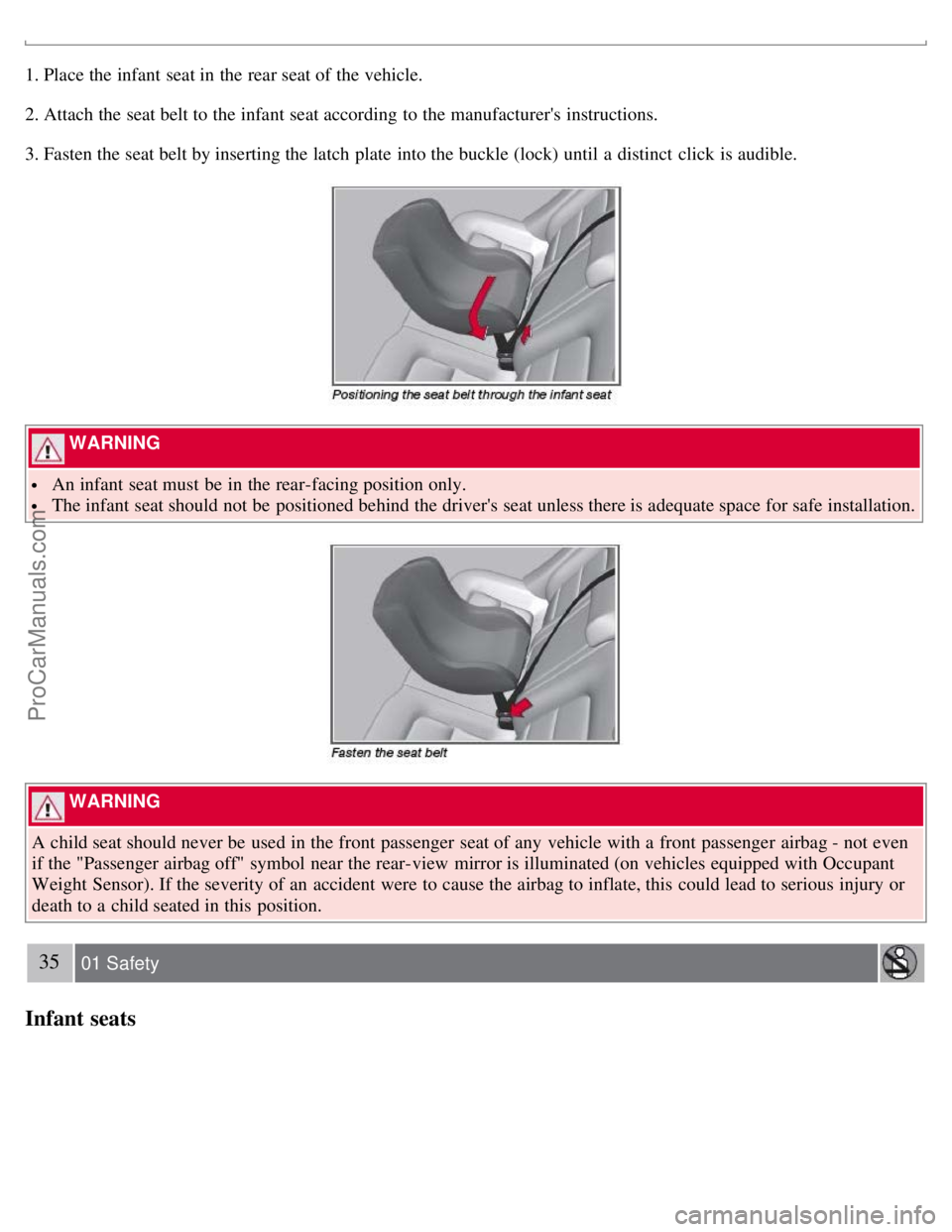
1. Place the infant seat in the rear seat of the vehicle.
2. Attach the seat belt to the infant seat according to the manufacturer's instructions.
3. Fasten the seat belt by inserting the latch plate into the buckle (lock) until a distinct click is audible.
WARNING
An infant seat must be in the rear-facing position only.
The infant seat should not be positioned behind the driver's seat unless there is adequate space for safe installation.
WARNING
A child seat should never be used in the front passenger seat of any vehicle with a front passenger airbag - not even
if the "Passenger airbag off" symbol near the rear-view mirror is illuminated (on vehicles equipped with Occupant
Weight Sensor). If the severity of an accident were to cause the airbag to inflate, this could lead to serious injury or
death to a child seated in this position.
35 01 Safety
Infant seats
ProCarManuals.com