towing VOLVO S80 2011 Owner´s Manual
[x] Cancel search | Manufacturer: VOLVO, Model Year: 2011, Model line: S80, Model: VOLVO S80 2011Pages: 312, PDF Size: 4.4 MB
Page 216 of 312
05 During your trip
Towing a trailer
05
216
Introduction
Volvo recommends the use of Volvo trailer
hitches that are specially designed for the vehi-
cle.
NOTE
See page 291 for the maximum trailer and
tongue weights recommended by Volvo.
•Observe the legal requirements of the
state/province in which the vehicles are
•All Volvo models are equipped with
energy-absorbing shock-mounted bump-
ers. Trailer hitch installation should not
interfere with the proper operation of this
bumper system.
Trailer towing does not normally present any
particular problems, but take into considera-
tion:
•Increase tire pressure to recommended full
pressure. See the tire inflation tables
beginning on page 227.
•When your vehicle is new, avoid towing
heavy trailers during the first 620 miles
(1,000 km).
•Maximum speed when towing a trailer:
50 mph (80 km/h).
•Engine and transmission are subject to
increased loads. Therefore, engine coolant
temperature should be closely watchedwhen driving in hot climates or hilly terrain.
Use a lower gear and turn off the air con-
ditioner if the temperature gauge needle
enters the red range.
•If the automatic transmission begins to
overheat, a message will be displayed in
the text window.
•Avoid overload and other abusive opera-
tion.
•Hauling a trailer affects handling, durabil-
ity, and economy.
•It is necessary to balance trailer brakes
with the towing vehicle brakes to provide a
safe stop (check and observe state/local
regulations).
•Do not connect the trailer's brake system
directly to the vehicle's brake system.
•More frequent vehicle maintenance is
required.
•Remove the ball and drawbar assembly
when the hitch is not being used.
•Volvo recommends the use of synthetic
engine oil when towing a trailer over long
distances or in mountainous areas.
WARNING
•Bumper-attached trailer hitches must
not be used on Volvos, nor should
safety chains be attached to the
bumper.
•Trailer hitches attaching to the vehicle
rear axle must not be used.
•Never connect a trailer's hydraulic
brake system directly to the vehicle
brake system, nor a trailer's lighting
system directly to the vehicle lighting
system. Consult your nearest author-
ized Volvo retailer for correct installa-
tion.
•When towing a trailer, the trailer's safety
wire must be correctly fastened to the
hole or hook provided in the trailer hitch
on the vehicle. The safety wire should
never be fastened to or wound around
the drawbar ball.
Page 217 of 312
05 During your trip
Towing a trailer
05
217
NOTE
•When parking the vehicle with a trailer
on a hill, apply the parking brake before
putting the gear selector in P. Always
follow the trailer manufacturer's recom-
mendations for wheel chocking.
•When starting on a hill, put the gear
selector in D before releasing the park-
ing brake. See also page 118 for more
detailed information about starting off
on a hill while towing a trailer.
•If you use the manual (Geartronic) shift
positions while towing a trailer, make
sure the gear you select does not put
too much strain on the engine (using too
high a gear).
•The drawbar assembly/trailer hitch may
be rated for trailers heavier than the
vehicle is designed to tow. Please
adhere to Volvo's recommended trailer
weights.
•Avoid driving with a trailer on inclines of
more than 15 %.
Trailer cableAn adapter is required if the vehicle's trailer
hitch has a 13-pin connector and the trailer has
7 pins. Use an adapter cable approved by
Volvo. Make sure the cable does not drag on
the ground.
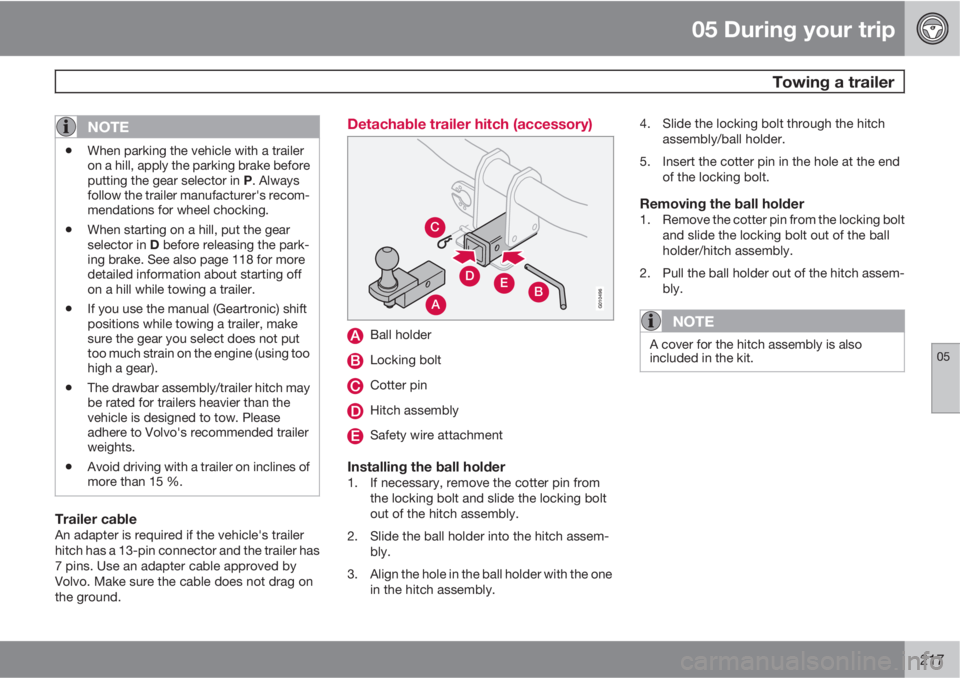
Detachable trailer hitch (accessory)
A
C
EDBG010496
Ball holder
Locking bolt
Cotter pin
Hitch assembly
Safety wire attachment
Installing the ball holder1. If necessary, remove the cotter pin from
the locking bolt and slide the locking bolt
out of the hitch assembly.
2. Slide the ball holder into the hitch assem-
bly.
3. Align the hole in the ball holder with the one
in the hitch assembly.4. Slide the locking bolt through the hitch
assembly/ball holder.
5. Insert the cotter pin in the hole at the end
of the locking bolt.
Removing the ball holder1. Remove the cotter pin from the locking bolt
and slide the locking bolt out of the ball
holder/hitch assembly.
2. Pull the ball holder out of the hitch assem-
bly.
NOTE
A cover for the hitch assembly is also
included in the kit.
Page 218 of 312
05 During your trip
Emergency towing
05
218
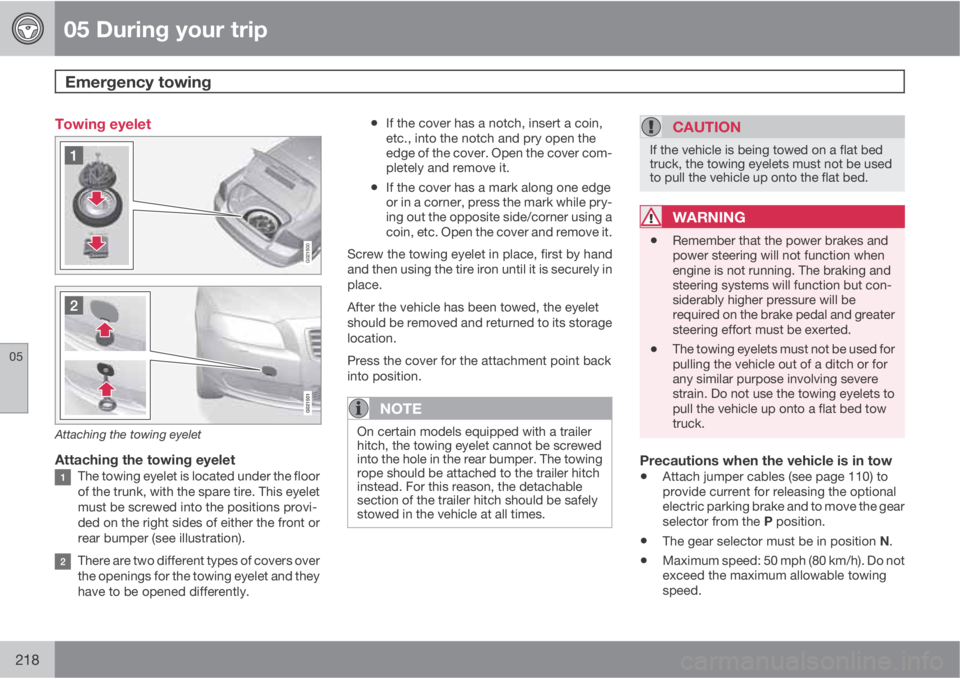
Towing eyelet
G021500
Attaching the towing eyelet
Attaching the towing eyeletThe towing eyelet is located under the floor
of the trunk, with the spare tire. This eyelet
must be screwed into the positions provi-
ded on the right sides of either the front or
rear bumper (see illustration).
There are two different types of covers over
the openings for the towing eyelet and they
have to be opened differently.
•If the cover has a notch, insert a coin,
etc., into the notch and pry open the
edge of the cover. Open the cover com-
pletely and remove it.
•If the cover has a mark along one edge
or in a corner, press the mark while pry-
ing out the opposite side/corner using a
coin, etc. Open the cover and remove it.
Screw the towing eyelet in place, first by hand
and then using the tire iron until it is securely in
place.
After the vehicle has been towed, the eyelet
should be removed and returned to its storage
location.
Press the cover for the attachment point back
into position.
NOTE
On certain models equipped with a trailer
hitch, the towing eyelet cannot be screwed
into the hole in the rear bumper. The towing
rope should be attached to the trailer hitch
instead. For this reason, the detachable
section of the trailer hitch should be safely
stowed in the vehicle at all times.
CAUTION
If the vehicle is being towed on a flat bed
truck, the towing eyelets must not be used
to pull the vehicle up onto the flat bed.
WARNING
•Remember that the power brakes and
power steering will not function when
engine is not running. The braking and
steering systems will function but con-
siderably higher pressure will be
required on the brake pedal and greater
steering effort must be exerted.
•The towing eyelets must not be used for
pulling the vehicle out of a ditch or for
any similar purpose involving severe
strain. Do not use the towing eyelets to
pull the vehicle up onto a flat bed tow
truck.
Precautions when the vehicle is in tow
•Attach jumper cables (see page 110) to
provide current for releasing the optional
electric parking brake and to move the gear
selector from the P position.
•The gear selector must be in position N.
•Maximum speed: 50 mph (80 km/h). Do not
exceed the maximum allowable towing
speed.
Page 219 of 312
05 During your trip
Emergency towing
05
219
•Maximum distance with front wheels on
ground: 50 miles (80 km).
•While the vehicle is being towed, try to
keep the tow rope taut at all times.
•The vehicle should only be towed in the
forward direction.
WARNING
The ignition key should always be fully
inserted in the ignition slot when the vehicle
is being towed to help prevent the steering
wheel from locking.
On vehicles with the optional keyless drive,
the remote key must be in the passenger
compartment and the driver's door must be
closed.
NOTE
During towing, ignition mode II should be
used so that the lighting can be switched on.
CAUTION
Vehicles with AWD (All Wheel Drive) with the
front wheels off the ground should not be
towed at speeds above 50 mph (70 km/h) or
for distances longer than 30 miles (50 km).
CAUTION
•Please check with state and local
authorities before attempting this type
of towing, as vehicles being towed are
subject to regulations regarding maxi-
mum towing speed, length and type of
towing device, lighting, etc.
•If the vehicle's battery is dead, do not
attempt to start the vehicle by pushing
or pulling it as this will damage the
three-way catalytic converter(s). The
engine must be jump started using an
auxiliary battery (see page 110).
•If the vehicle is being towed on a flat bed
truck, the towing eyelets must not be
used to pull the vehicle up onto the flat
bed or to secure the vehicle on the flat
bed. Consult the tow truck operator.
Towing vehicles with front wheel drive/
All Wheel Drive
Volvo recommends the use of flat bed equip-
ment.
•If wheel lift equipment must be used,
please use extreme caution to help avoid
damage to the vehicle. In this case, the
vehicle should be towed with the rear
wheels on the ground if at all possible.
•If it is absolutely necessary to tow the vehi-
cle with the front wheels on the ground,please refer to the towing information on
page 218.
CAUTION
•Sling-type equipment applied at the
front will damage radiator and air con-
ditioning lines.
•It is equally important not to use sling-
type equipment at the rear or apply lift-
ing equipment inside the rear wheels;
serious damage to the rear axle may
result.
•If the vehicle is being towed on a flat bed
truck, the towing eyelets must not be
used to secure the vehicle on the flat
bed. Consult the tow truck operator.
Page 232 of 312
06 Wheels and tires
Vehicle loading
06
232
Loads
Properly loading your vehicle will provide maxi-
mum return of vehicle design performance.
Before loading your vehicle, familiarize yourself
with the following terms for determining your
vehicle's weight ratings, with or without a
trailer, from the vehicle's Federal/Canadian
Motor Vehicle Safety Standards (FMVSS/
CMVSS) label, and the vehicle's tire informa-
tion placard:
Curb weightThe weight of the vehicle including a full tank
of fuel and all standard equipment. It does not
include passengers, cargo, or optional equip-
ment.
Capacity weightAll weight added to the curb weight, including
cargo and optional equipment. When towing,
trailer hitch tongue load is also part of cargo
weight.
NOTE
For trailer towing information, please refer to
the section "Towing a trailer" on page 216.
Permissible axle weightThe maximum allowable weight that can be
carried by a single axle (front or rear). These
numbers are shown on the Federal/Canadian
Motor Vehicle Safety Standards (FMVSS/
CMVSS) label. The total load on each axle must
never exceed its maximum permissible weight.
Gross vehicle weight (GVW)The vehicle's curb weight + cargo + passen-
gers.
NOTE
•The location of the various labels in your
vehicle can be found on page 288.
•A table listing important weight limits for
your vehicle can be found on page
291.
Steps for Determining Correct Load
Limit
1. Locate the statement "the combined
weight of occupants and cargo should
never exceed XXX pounds" on your vehi-
cle's placard.2. Determine the combined weight of the
driver and passengers that will be riding in
your vehicle.
3. Subtract the combined weight of the driver
and passengers from XXX kilograms or
XXX pounds.
4. The resulting figure equals the available
amount of cargo and luggage load
capacity. For example, if the "XXX" amount
equals 1400 lbs. and there will be five
150 lb. passengers in your vehicle, the
amount of available cargo and luggage
load capacity is 650 lbs. (1400 – 750
(5 × 150) = 650 lbs.)
5. Determine the combined weight of luggage
and cargo being loaded on the vehicle.
That weight may not safely exceed the
available cargo and luggage load capacity
calculated in Step 4.
6. If your vehicle will be towing a trailer, load
from your trailer will be transferred to your
vehicle. Consult this manual1 to determine
how this reduces the available cargo and
luggage load capacity of your vehicle.
1216.
Page 240 of 312
06 Wheels and tires
Tire Sealing System
06
240
WARNING
•Never stand next to the tire being inflated
when the compressor is in operation.
•If cracks, bubbles, etc. form on the tire,
switch off the compressor immediately.
•If there is visible damage to the sidewall
or the rim, the tire cannot be repaired.
The vehicle should not be driven if this
occurs. Contact a towing service or
Volvo On Call Roadside Assistance if
applicable.
NOTE
The air pressure gauge will temporarily
show an increase in pressure to approxi-
mately 88 psi (6 bar) while the sealing com-
pound is being pumped into the tire. The
pressure should return to a normal level
after approximately 30 seconds.
10. Within seven minutes, inflate the tire to
between 22—44 psi (1.8—3.0 bar). Switch
off the compressor briefly to get a clear
reading from the pressure gauge.
CAUTION
The compressor should not be used for
more than 10 minutes at a time to avoid
overheating.
WARNING
If the pressure remains below 22 psi
(1.8 bar) after approximately seven minutes,
turn off the compressor. In this case, the
hole is too large to be sealed and the vehicle
should not be driven.
11. Switch off the compressor and disconnect
the electrical wire from the 12-volt socket.
12. Unscrew the hose from the tire’s inflation
valve and reinstall the valve cap.
13. Immediately drive the vehicle for approxi-
mately 2 miles (3 km) at a maximum speed
of 50 mph (80 km/h) to distribute the seal-
ing compound in the tire.
CAUTION
If your vehicle is equipped with the Tire
Pressure Monitoring System (TPMS), the
use of the sealing compound may lead to
incorrect tire pressure readings or in rare
cases, damage to the tire pressure sensor.
Use the tire sealing system to check and
adjust the damaged tire's inflation pressure.
NOTE
•Safely stow the tire sealing system in a
convenient place as it will soon be used
again to check the tire’s inflation pres-
sure.
•The empty bottle of sealing compound
cannot be removed from the bottle
holder. Consult a trained and qualified
Volvo service technician to have the
bottle removed and properly disposed
of.
Page 304 of 312
09 Index
09
304
Electronic Climate Control.......128, 130, 131
air distribution table............................ 132
Interior Air Quality System.................. 131
ventilated seats................................... 129
Emergency locking retractor...................... 37
Emergency starting.................................. 110
Emergency towing...........................218, 219
Emission inspection readiness................ 253
Engine
overheating........................................... 75
specifications...................................... 293
starting................................................ 108
switching off....................................... 110
Engine compartment overview................255
Engine oil
checking............................................. 256
low pressure warning light.............. 73, 74
specifications...................................... 295
volumes.............................................. 296
Environment............................................... 12
Eyelets for anchoring loads..................... 213F
Federal Clean Air Act............................... 252
Fluid specifications.................................. 296
Fog lights
front/rear............................................... 91
Four C (active chassis system)................158
Front airbags.............................................. 22
disconnecting passenger’s side air-
bag.................................................. 26, 27
Front fog lights........................................... 91
Front park assist.............................. 184, 186
Front seats..................................... 80, 82, 86
heated................................................. 129
lumbar support (S80 Executive only).... 86
massage function (S80 Executive only) 86
moving passenger's seat (S80 Execu-
tive only)................................................ 87
Fuel filler cap........................................... 211
Fuel filler door, opening........................... 210
Fuel level warning light.............................. 73
Fuel requirements............................ 208, 209
Fuel tank volume.....................................296
Fuses............................... 272, 273, 276, 280
G
Gasoline requirements............................. 209
Gas tank volume...................................... 296
Gauges...................................................... 71
Geartronic................................................ 113
Geartronic automatic transmission.. 112, 113
Generator warning light............................. 74
Glossary of tire terminology..................... 231
Grocery bag holder.................................. 214
Gross vehicle weight...............................232
H
Hazard warning flashers............................ 91
HD digital radio........................................ 139
Headlights
Active Bending Lights........................... 90
changing bulbs...........................261, 262
high/low beams.................................... 89
high beam flash.................................... 89
Headlight washers..................................... 96
Head restraints, rear seat.......................... 83
Heated front seats................................... 129
Page 308 of 312
09 Index
09
308
Stability system...............................156, 157
indicator light........................................ 73
Starting the engine..................................108
with keyless drive...............................108
Starting the vehicle
after a crash (crash mode)....................35
Start inhibitor (immobilizer)........................ 53
Steering wheel
adjusting............................................... 88
horn....................................................... 88
keypad.................................. 88, 122, 134
Stone chips, touching up......................... 284
Storage spaces........................................ 196
Studded tires........................................... 235
Sunroof (moonroof).................................. 103
Sun shade.................................................. 99
Supplemental restraint system.................. 21
warning light......................................... 74
Symbols, overview................................... 298
T
Temporary spare tire............................... 236
Three-way catalytic converter................. 211Tire designations.....................................229
Tire Pressure Monitoring System....246, 247
indicator light........................................ 73
Tires.........................................................222
age...................................................... 222
changing from summer to winter........ 223
glossary of terms................................ 231
improving economy............................ 222
inflation pressure................................ 225
inflation pressure tables.............227, 228
load ratings......................................... 226
rotation............................................... 223
snow...................................................235
spare................................................... 236
specifications...................................... 226
speed ratings...................................... 226
storing................................................. 223
studded............................................... 235
tire pressure monitoring system......... 246
tread wear indicator............................ 224
uniform tire quality grading................. 234
Top tether anchors (child restraint sys-
tems).......................................................... 46
Touching up paint.................................... 284
Towing a trailer................................216, 217
trailer hitch.......................................... 217
Towing the vehicle........................... 218, 219Traction control........................................ 156
Trailer towing...................................216, 217
trailer hitch.......................................... 217
Transmission
general description.....................112, 113
oil........................................................ 296
shiftlock override................................ 113
Tread wear indicator................................ 224
Trip computer.......................................... 154
Trip odometers.......................................... 76
Trips, long distance................................. 205
Trunk
changing bulbs................................... 265
driving with it open.............................204
Turn signals............................................... 92
changing bulbs................................... 263
indicator lights...................................... 73
U
Uniform Tire Quality Grading...................234
Unlocking the vehicle..........................54, 63
Upholstery care....................................... 283