ECO mode VOLVO S80 2015 Owner´s Manual
[x] Cancel search | Manufacturer: VOLVO, Model Year: 2015, Model line: S80, Model: VOLVO S80 2015Pages: 392, PDF Size: 10.66 MB
Page 297 of 392
08 Wheels and tires
General information
08
}}
295
process. The temporary spare
1
should also
be replaced at 6-year intervals, even if it has never been used. A tire's age can be determined by the DOT stamp on the sidewall (see the illustration). A tire with e.g., visible cracks or discoloration should be replaced immediately.
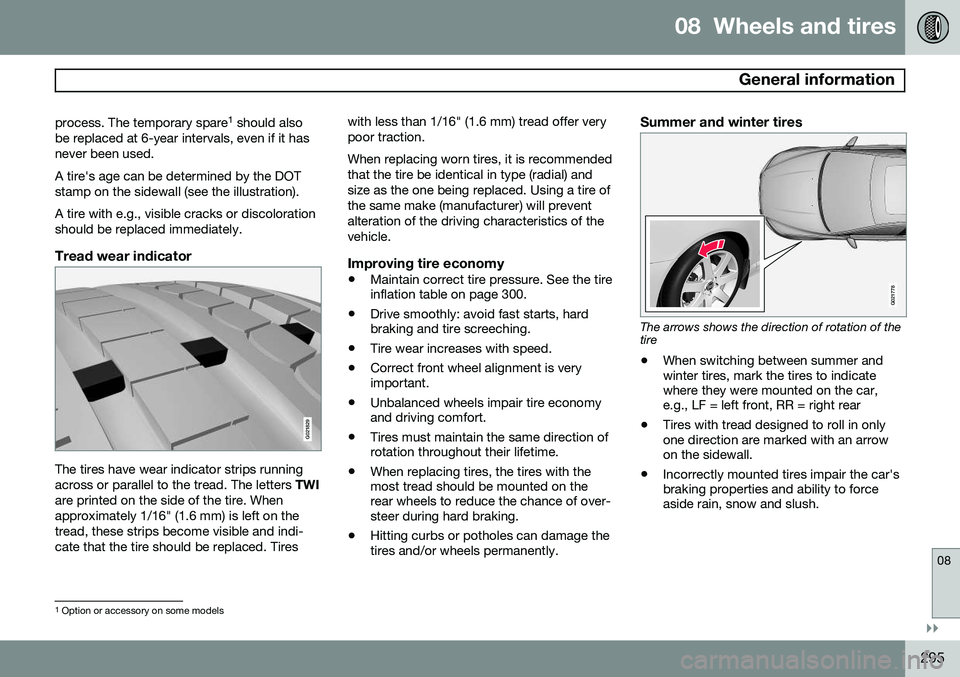
Tread wear indicator
G021829
The tires have wear indicator strips running across or parallel to the tread. The letters TWI
are printed on the side of the tire. Whenapproximately 1/16" (1.6 mm) is left on thetread, these strips become visible and indi-cate that the tire should be replaced. Tires with less than 1/16" (1.6 mm) tread offer verypoor traction. When replacing worn tires, it is recommended that the tire be identical in type (radial) andsize as the one being replaced. Using a tire ofthe same make (manufacturer) will preventalteration of the driving characteristics of thevehicle.
Improving tire economy
•
Maintain correct tire pressure. See the tire inflation table on page 300.
• Drive smoothly: avoid fast starts, hardbraking and tire screeching.
• Tire wear increases with speed.
• Correct front wheel alignment is veryimportant.
• Unbalanced wheels impair tire economyand driving comfort.
• Tires must maintain the same direction ofrotation throughout their lifetime.
• When replacing tires, the tires with themost tread should be mounted on therear wheels to reduce the chance of over-steer during hard braking.
• Hitting curbs or potholes can damage thetires and/or wheels permanently.
Summer and winter tires
G021778
The arrows shows the direction of rotation of the tire
• When switching between summer and winter tires, mark the tires to indicatewhere they were mounted on the car,e.g., LF = left front, RR = right rear
• Tires with tread designed to roll in onlyone direction are marked with an arrowon the sidewall.
• Incorrectly mounted tires impair the car'sbraking properties and ability to forceaside rain, snow and slush.
1
Option or accessory on some models
Page 310 of 392
08 Wheels and tires
Temporary Spare
08
308
Spare tire
The spare tire in your vehicle1
is called a
"Temporary Spare". Recommended tire pressure (see the placard on the B-pillar or on the fuel filler door) shouldbe maintained irrespective of which positionon the vehicle the temporary spare tire isused on. In the event of damage to this tire, a new one can be purchased from your Volvo retailer.
WARNING
Current legislation prohibits the use of the "Temporary Spare" tire other than as atemporary replacement for a puncturedtire. It must be replaced as soon as possi-ble by a standard tire. Road holding andhandling may be affected with the "Tem-porary Spare" in use. Do not exceed50 mph (80 km/h).
CAUTION
The vehicle must not be driven with wheels of different dimensions or with a spare tireother than the one that came with the vehi-cle. The use of different size wheels canseriously damage your car's transmission.
1 Not on models equipped with the Tire sealing system.
Page 320 of 392
08 Wheels and tires
Tire Pressure Monitoring System (TPMS)
08
318
Introduction
NOTE
USA – FCC ID: KR5S122780002 This device complies with part 15 of the FCC rules. Operation is subject to the fol-lowing conditions: (1) This device may notcause harmful interference, and (2) thisdevice must accept any interferencereceived, including interference that maycause undesired operation.
The tire pressure monitoring system1
uses
sensors mounted in the tire valves to check inflation pressure levels. When the vehicle ismoving at a speed of approximately 20 mph(30 km/h) or faster, these sensors transmitinflation pressure data to a receiver located inthe vehicle. When low inflation pressure is detected or if a sensor is not functioning properly, TPMS will light up the tire pressure warning light (
)
(also referred to as a telltale) in the instrument panel and will display one of the following messages in the text window:
Tire pressure
low or
Tire needs air now.
NOTE
If a fault occurs in TPMS, the tire pressure warning light will flash for approximately 1 minute and
Tire press. syst Service
required will be displayed.
Each tire, including the spare (if provided), should be checked monthly when cold andinflated to the inflation pressure recom-mended by the vehicle manufacturer on thevehicle placard or tire inflation pressure label.(If your vehicle has tires of a different sizethan the size indicated on the vehicle placardor tire inflation pressure label, you shoulddetermine the proper tire inflation pressure forthose tires.) As an added safety feature, your vehicle has been equipped with a tire pressure monitor-ing system (TPMS) that illuminates a low tirepressure telltale when one or more of yourtires is significantly under-inflated. Accord-ingly, when the low tire pressure telltale illu-minates, you should stop and check yourtires as soon as possible, and inflate them tothe proper pressure. Driving on a significantlyunder-inflated tire causes the tire to overheatand can lead to tire failure. Under-inflationalso reduces fuel efficiency and tire tread life, and may affect the vehicle's handling andstopping ability. Please note that the TPMS is not a substitute for proper tire maintenance, and it is the driv-er's responsibility to maintain correct tirepressure, even if under-inflation has notreached the level to trigger illumination of theTPMS low tire pressure telltale. Your vehicle has also been equipped with a TPMS malfunction indicator to indicate whenthe system is not operating properly. TheTPMS malfunction indicator is combined withthe low tire pressure telltale. When the sys-tem detects a malfunction, the telltale willflash for approximately one minute and thenremain continuously illuminated. Thissequence will continue upon subsequentvehicle start-ups as long as the malfunctionexists. When the malfunction indicator is illu-minated, the system may not be able todetect or signal low tire pressure as intended.TPMS malfunctions may occur for a variety ofreasons, including the installation of replace-ment or alternate tires or wheels on the vehi-cle that prevent the TPMS from functioningproperly. Always check the TPMS malfunc-tion telltale after replacing one or more tiresor wheels on your vehicle to ensure that thereplacement or alternate tires and wheels
1
Not available in all markets or in all models.
Page 322 of 392
08 Wheels and tires
Tire Pressure Monitoring System (TPMS)
08
320* Option/accessory, for more information, see Introduction.
NOTE
• If you change to tires with a different recommended inflation pressure, theTPMS system must be recalibrated tothese tires. On U.S. models, this mustbe done by a trained and qualifiedVolvo service technician. On Canadianmodels, see the following section"Recalibrating TPMS."
• If a tire is changed, or if the TPMS sen-sor is moved to another wheel, thesensor's seal, nut, and valve coreshould be replaced.
• When installing TPMS sensors, thevehicle must be parked for at least15 minutes with the ignition off. If thevehicle is driven within 15 minutes, aTPMS error message will be displayed.
Recalibrating TPMS (Canadian models only)*
In certain cases, it may be necessary to reca- librate TPMS to conform to Volvo's recom-mended tire inflation pressures (see the infla-tion pressure table on page 300), for exam-ple, if higher inflation pressure is necessarywhen transporting heavy loads, etc. This is done in the vehicle's menu system. See page 201 for a description of the menusystem. To recalibrate:
1. Switch off the engine.
2. Inflate the tires to the desired pressure
and put the ignition in mode I or II (see
page 85 for additional information).
3. Press the MY CAR key in the center con-
sole control panel and select
Settings
Car settingsTyre pressure
4. Press OK/MENU , select Calibrate tyre
pressure and press OK/MENU again.
5. Drive the vehicle at a speed above 25 mph (40 km/h) continuously for at least 10 minutes.
> When the calibration message is nolonger displayed, TPMS has been recalibrated to the new inflation pres-sure.
Activating/deactivating TPMS
(Canadian models only)*
1. Switch off the engine.
2. Put the ignition in mode I or II (see page
85 for additional information).
3. Press the MY CAR key in the center con-
sole control panel and select
Settings
Car settingsTyre pressure
4. Select Tyre pressure system and press
OK/MENU to turn the system on or off.
Self-supporting run flat tires (SST)*
Self-supporting run flat tires are available as optional equipment. The vehicle must beequipped with the Tire Pressure MonitoringSystem (TPMS) if tires of this type are instal-led. Tires of this type have specially reinforced sidewalls that make it possible to continuedriving to a limited extent even though the tirehas lost some or all of its inflation pressure.These tires are mounted on special rims (nor-mal tires can also be mounted on these rims). If an SST tire loses inflation pressure, the yel- low TPMS symbol illuminates in the instru-ment panel and a text message is also dis-played. If this happens, reduce speed to notmore than 50 mph (80 km/h). The tire shouldbe replaced as soon as possible. Drive carefully; it may be difficult to determine which tire is damaged. To find the damagedtire, check the inflation pressure in all fourtires.
Page 343 of 392
09 Maintenance and specifications
Wiper blades and washer fluid09
}}
341
Wiper blades
Service position
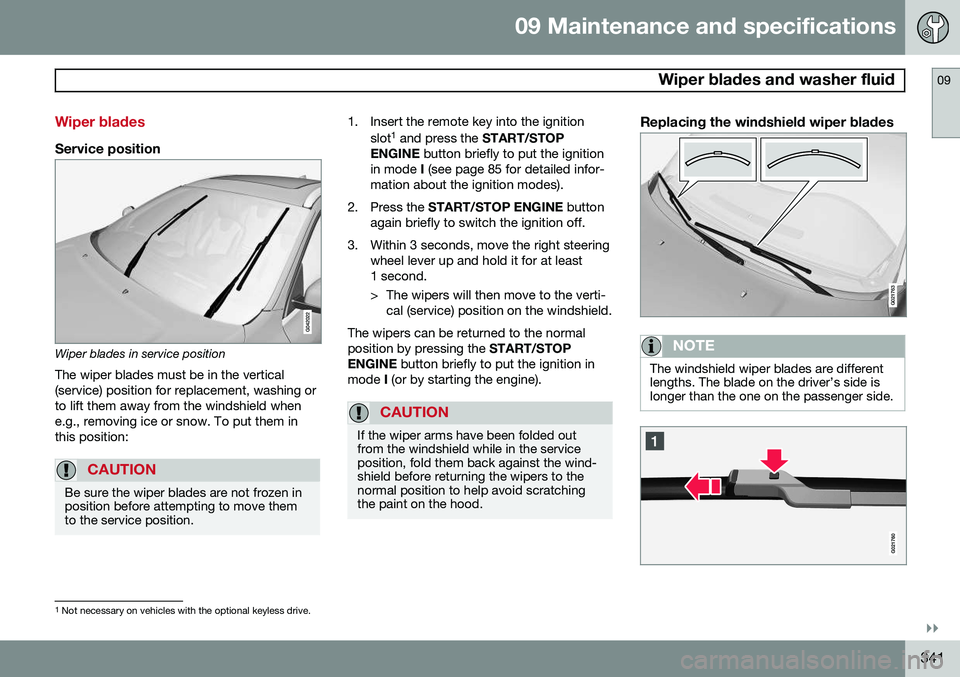
Wiper blades in service positionThe wiper blades must be in the vertical (service) position for replacement, washing orto lift them away from the windshield whene.g., removing ice or snow. To put them inthis position:
CAUTION
Be sure the wiper blades are not frozen in position before attempting to move themto the service position.
1. Insert the remote key into the ignition slot1
and press the START/STOP
ENGINE button briefly to put the ignition
in mode I (see page 85 for detailed infor-
mation about the ignition modes).
2. Press the START/STOP ENGINE button
again briefly to switch the ignition off.
3. Within 3 seconds, move the right steering wheel lever up and hold it for at least 1 second.
> The wipers will then move to the verti-cal (service) position on the windshield.
The wipers can be returned to the normal position by pressing the START/STOP
ENGINE button briefly to put the ignition in
mode I (or by starting the engine).
CAUTION
If the wiper arms have been folded out from the windshield while in the serviceposition, fold them back against the wind-shield before returning the wipers to thenormal position to help avoid scratchingthe paint on the hood.
Replacing the windshield wiper blades
G021763
NOTE
The windshield wiper blades are different lengths. The blade on the driver’s side islonger than the one on the passenger side.
1
Not necessary on vehicles with the optional keyless drive.
Page 363 of 392

09 Maintenance and specifications
Vehicle care09
}}
361
If there are stains on the steering wheel: Type 1
(ink, wine, coffee, milk, sweat or
blood)
–Use a soft cloth or sponge. Wipe the wheel with a solution with 5% ammonia.For blood stains, mix approx. 1 cup (2 dl)of water and one ounce (25g) of salt andwipe the stain.
Type 2 (fat, oil, sauces, or chocolate)
1. Same procedure as for type I stains.
2. Finish by rubbing the wheel with absorb- ent paper or a towel.
Type 3 (dry soil or dust)
1. Remove the soil/dust with a soft brush.
2. Same procedure as for type I stains.
CAUTION
Sharp objects, such as rings, could dam- age the leather on the steering wheel.
Cleaning the seat beltsClean only with lukewarm water and a mild soap solution.
Cleaning floor matsThe floor mats should be vacuumed orbrushed clean regularly, especially duringwinter when they should be taken out for dry- ing. Spots on textile mats can be removedwith a mild detergent. For best protection inwinter, Volvo recommends the use of Volvorubber floor mats. Consult your Volvo retailer.
Spots on interior plastic, metal, or wood surfaces
Cleaning interior plastic components should be done with a cleaning agent speciallydesigned for this purpose. Consult your Volvoretailer.
Touching up paintwork
Paint damage requires immediate attention to avoid rusting. Make it a habit to check the fin-ish regularly, for instance washing the vehicle.Touch-up if necessary. Paint repairs require special equipment and skill. Contact your Volvo retailer for anyextensive damage. Minor scratches can be repaired by using Volvo touch-up paint.
Color code
Sample color code: US models
Sample color code: Canadian models
Make sure you have the right color. See page 366 for the location of this label (label number4 in the illustration).
Page 373 of 392
10 Specifications
Specifications
10
}}
371
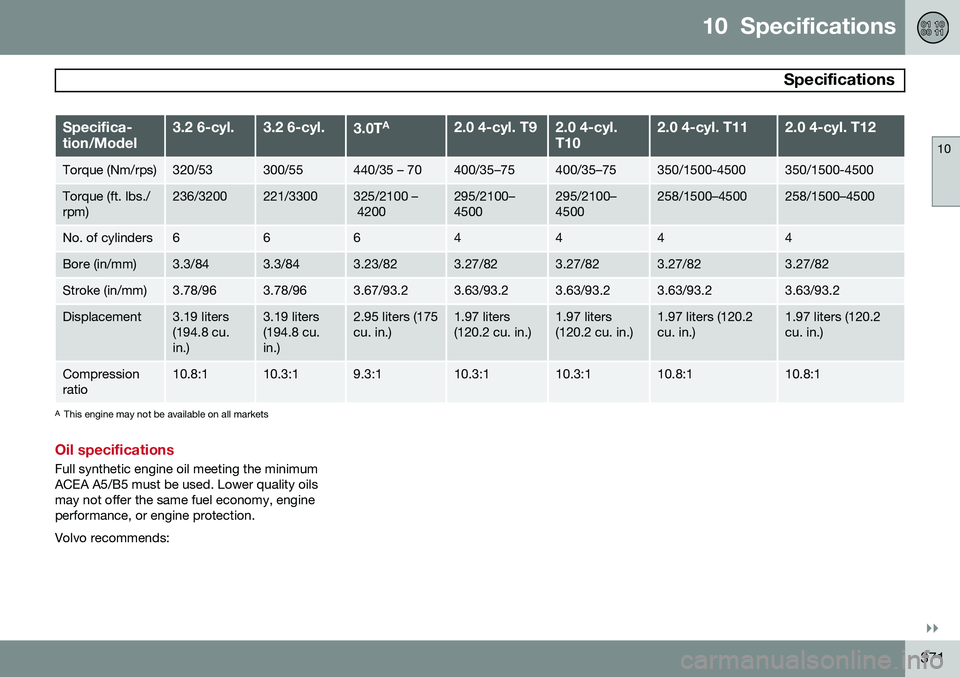
Specifica- tion/Model3.2 6-cyl.3.2 6-cyl.3.0TA2.0 4-cyl. T92.0 4-cyl. T102.0 4-cyl. T112.0 4-cyl. T12
Torque (Nm/rps)320/53300/55440/35 – 70400/35–75400/35–75350/1500-4500350/1500-4500
Torque (ft. lbs./ rpm)236/3200221/3300325/2100 – 4200295/2100– 4500295/2100– 4500258/1500–4500258/1500–4500
No. of cylinders6664444
Bore (in/mm)3.3/843.3/843.23/823.27/823.27/823.27/823.27/82
Stroke (in/mm)3.78/963.78/963.67/93.23.63/93.23.63/93.23.63/93.23.63/93.2
Displacement3.19 liters (194.8 cu.in.)3.19 liters (194.8 cu.in.)2.95 liters (175 cu. in.)1.97 liters (120.2 cu. in.)1.97 liters (120.2 cu. in.)1.97 liters (120.2 cu. in.)1.97 liters (120.2 cu. in.)
Compression ratio10.8:110.3:19.3:110.3:110.3:110.8:110.8:1
A
This engine may not be available on all markets
Oil specifications
Full synthetic engine oil meeting the minimum ACEA A5/B5 must be used. Lower quality oilsmay not offer the same fuel economy, engineperformance, or engine protection. Volvo recommends:
Page 374 of 392
10 Specifications
Specifications
10
372
Refer to the warranty and Service Records information booklet for information on oilchange intervals and oil type requirements.
NOTE
This vehicle comes from the factory with synthetic oil.
Oil additives must not be used.
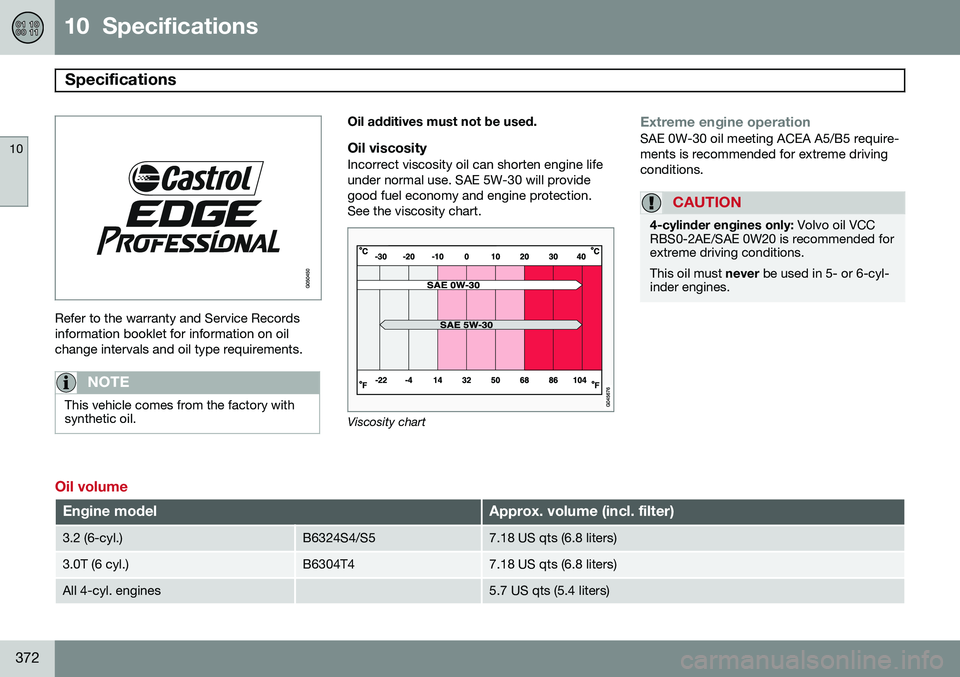
Oil viscosityIncorrect viscosity oil can shorten engine life under normal use. SAE 5W-30 will providegood fuel economy and engine protection.See the viscosity chart.
Viscosity chart
Extreme engine operationSAE 0W-30 oil meeting ACEA A5/B5 require- ments is recommended for extreme drivingconditions.
CAUTION
4-cylinder engines only: Volvo oil VCC
RBS0-2AE/SAE 0W20 is recommended for extreme driving conditions. This oil must never be used in 5- or 6-cyl-
inder engines.
Oil volume
Engine modelApprox. volume (incl. filter)
3.2 (6-cyl.)B6324S4/S57.18 US qts (6.8 liters)
3.0T (6 cyl.)B6304T47.18 US qts (6.8 liters)
All 4-cyl. engines5.7 US qts (5.4 liters)
Page 375 of 392
10 Specifications
Specifications
10
}}
373
Other fluids and lubricants
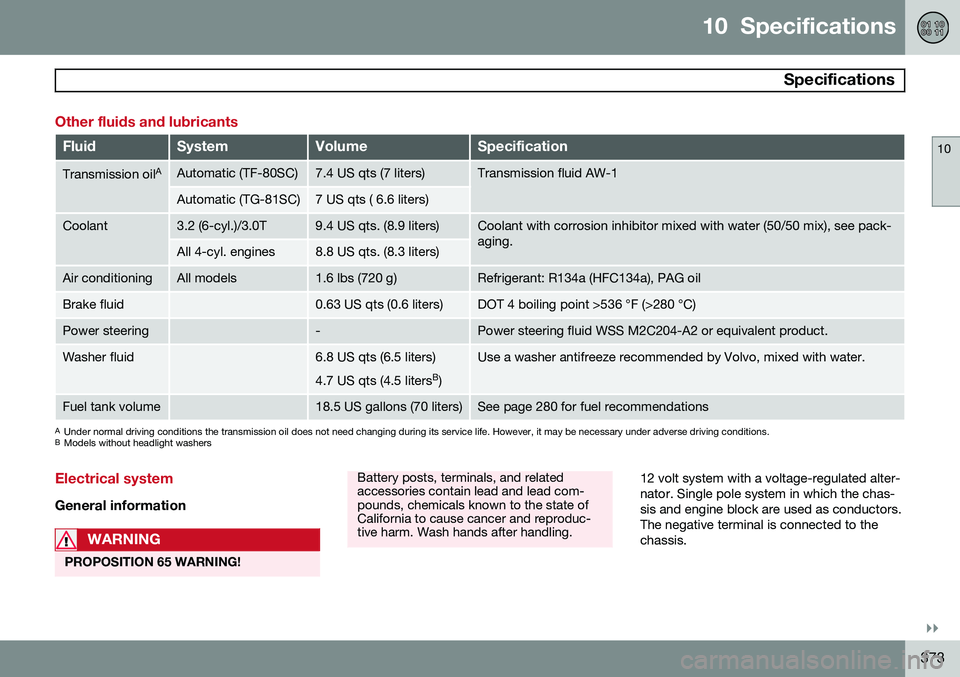
FluidSystemVolumeSpecification
Transmission oilAAutomatic (TF-80SC)7.4 US qts (7 liters)Transmission fluid AW-1
Automatic (TG-81SC)7 US qts ( 6.6 liters)
Coolant3.2 (6-cyl.)/3.0T9.4 US qts. (8.9 liters)Coolant with corrosion inhibitor mixed with water (50/50 mix), see pack- aging.
All 4-cyl. engines8.8 US qts. (8.3 liters)
Air conditioningAll models1.6 lbs (720 g)Refrigerant: R134a (HFC134a), PAG oil
Brake fluid0.63 US qts (0.6 liters)DOT 4 boiling point >536 °F (>280 °C)
Power steering-Power steering fluid WSS M2C204-A2 or equivalent product.
Washer fluid6.8 US qts (6.5 liters) 4.7 US qts (4.5 liters B
)Use a washer antifreeze recommended by Volvo, mixed with water.
Fuel tank volume18.5 US gallons (70 liters)See page 280 for fuel recommendations
A Under normal driving conditions the transmission oil does not need changing during its service life. However, it may be necessary under adverse driving conditions.
B Models without headlight washers
Electrical system
General information
WARNING
PROPOSITION 65 WARNING!
Battery posts, terminals, and related accessories contain lead and lead com-pounds, chemicals known to the state ofCalifornia to cause cancer and reproduc-tive harm. Wash hands after handling.12 volt system with a voltage-regulated alter- nator. Single pole system in which the chas-sis and engine block are used as conductors.The negative terminal is connected to thechassis.
Page 388 of 392
11 Index
11
386
S
Safety, occupant........................................ 16
Safety defects, reporting........................... 17Seat beltreminder................................................ 19
Seat belts Automatic locking retractor/Emer-
gency locking retractor......................... 38
buckling................................................ 18
maintenance......................................... 18
pretensioners........................................ 18
reminder................................................ 18
reminder warning light.......................... 80
securing child restraint systems 42,44, 47
unbuckling............................................ 18
use during pregnancy........................... 20
using..................................................... 18
Seats, front.......................................... 86, 87
Sensus..................................................... 198
Shiftlock....................................................... 9 override............................................... 124
Side door mirrors..................................... 106
Side impact airbags................................... 30
Side marker lights, changing bulbs......... 337 Sign information (RSI).............................. 146SiriusXM
™ satellite radio......................... 246
Snow chains............................................ 307
Snow tires................................................ 307
Spare tire................................................. 308
Spin control............................................. 144
SRS............................................................ 21
Stability system............................... 144, 145 indicator light........................................ 79
Start/Stop (engine function)..................... 131
Starting the engine.................................. 116 remote start........................................ 118
with keyless drive............................... 116
Starting the vehicle after a crash (crash mode).................... 35
Start inhibitor (immobilizer)........................ 56 Steering wheel adjusting............................................... 92
heated................................................... 93
horn....................................................... 92
keypad.................................. 92, 201, 233
Steering wheel paddles............................. 92
Stone chips, touching up......................... 361
Storage spaces........................................ 225 Studded tires........................................... 307
Sunroof (moonroof).................................. 111
Sun shade........................................ 104, 105
Supplemental restraint system.................. 21
warning light......................................... 80
Symbols, overview................................... 375
T
Temperature sensor ambient................................................. 81
Temporary spare tire............................... 308
Three-way catalytic converter................. 282
Tire designations..................................... 301
Tire inflation pressure.............................. 300
Tire Pressure Monitoring System.... 318, 319 indicator light........................................ 79
Tires......................................................... 294 age...................................................... 294
changing from summer to winter........ 295
glossary of terms................................ 303
improving economy............................ 295
inflation pressure................................ 297
inflation pressure table....................... 300
load ratings......................................... 299