lock VOLVO S80 2016 Owner´s Manual
[x] Cancel search | Manufacturer: VOLVO, Model Year: 2016, Model line: S80, Model: VOLVO S80 2016Pages: 380, PDF Size: 9.45 MB
Page 281 of 380
09 Wheels and tires
09
279
Changing a wheel – spare wheel
Wheel changes should always be carried out correctly.
Spare tire
The spare tire in your vehicle2
is called a
"Temporary Spare". Recommended tire pressure (see the placard on the B-pillar or on the fuel filler door) shouldbe maintained irrespective of which positionon the vehicle the temporary spare tire isused on. In the event of damage to this tire, a new one can be purchased from your Volvo retailer.
WARNING
Current legislation prohibits the use of the "Temporary Spare" tire other than as atemporary replacement for a puncturedtire. It must be replaced as soon as possi-ble by a standard tire. Road holding andhandling may be affected with the "Tem-porary Spare" in use. Do not exceed50 mph (80 km/h).
CAUTION
The vehicle must not be driven with wheels of different dimensions or with a spare tireother than the one that came with the vehi-cle. The use of different size wheels canseriously damage your car's transmission.
Spare wheelThe spare wheel is only intended for tempo- rary use. Replace it with a normal wheel assoon as possible. The car's handling may bealtered by the use of the spare wheel. Thecorrect tire pressure for the spare wheel isstated in the tire pressure table, see Tire infla-tion – pressure table (p. 285) and in the tireinflation placard on the driver's side doorjamb at the rear of the driver's door opening.
WARNING
Current legislation prohibits the use of the “Temporary Spare” tire other than as atemporary replacement for a puncturedtire. It must be replaced as soon as possi-ble by a standard tire. Road holding andhandling may be affected with the “Tem-porary Spare” in use.
CAUTION
The vehicle must never be driven with more than one temporary spare wheel.
The spare wheel is located in the spare wheel well with the rim side down. There are twofoam blocks, one under the spare wheel andone over/inside. The upper one contains alltools. The same bolt runs through to secure the spare wheel and the foam blocks.
Related information
• Changing a wheel – installing a wheel (p. 280)
• Changing a wheel – removing wheel(p. 276)
2
Not on models equipped with the Tire sealing system.
Page 282 of 380
09 Wheels and tires
09
280
Changing a wheel – accessing the spare wheel
The following procedure explains how to access the spare wheel (where applicable).
1. Open the floor hatch.
2. Undo the retaining bolt.
3. Lift out the foam block.
4. Lift out the spare wheel.The other two blocks can remain in the spare wheel well.
After useThe foam block and spare wheel must be replaced in the reverse order. Note the arrowon the upper foam block. It should point for-ward.
Changing a wheel – installing a wheel
It is important to re-install wheels properly.
Re-installing the wheel1. Clean the contact surfaces on the wheeland hub.
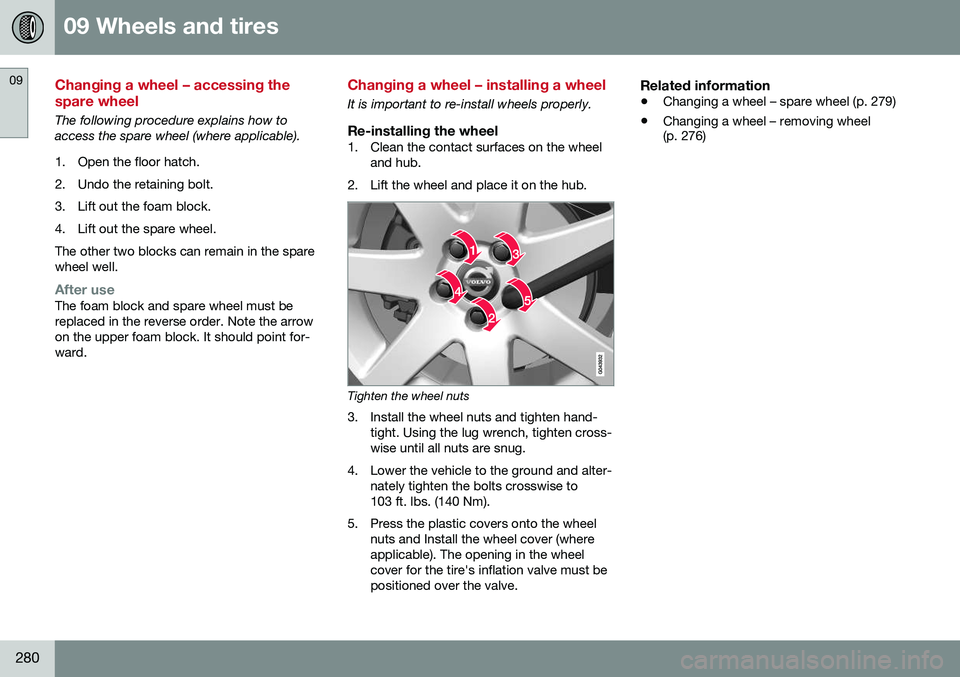
2. Lift the wheel and place it on the hub.
Tighten the wheel nuts
3. Install the wheel nuts and tighten hand- tight. Using the lug wrench, tighten cross- wise until all nuts are snug.
4. Lower the vehicle to the ground and alter- nately tighten the bolts crosswise to103 ft. lbs. (140 Nm).
5. Press the plastic covers onto the wheel nuts and Install the wheel cover (whereapplicable). The opening in the wheelcover for the tire's inflation valve must bepositioned over the valve.
Related information
• Changing a wheel – spare wheel (p. 279)
• Changing a wheel – removing wheel (p. 276)
Page 291 of 380
09 Wheels and tires
09
289
WARNING
The temperature grade for this tire is established for a tire that is properly infla-ted and not overloaded. Excessive speed,under-inflation, or excessive loading, eitherseparately or in combination, can causeheat buildup and tire failure.
Snow chains
Snow chains can be used on your Volvo with the following restrictions:
• Snow chains should be installed on front wheels only. Use only Volvo approvedsnow chains.
• If accessory, aftermarket or "custom"tires and wheels are installed and are of asize different than the original tires andwheels, chains in some cases CANNOTbe used. Sufficient clearances betweenchains and brakes, suspension and bodycomponents must be maintained.
• Some strap-on type chains will interferewith brake components and thereforeCANNOT be used.
• All Wheel Drive models
: Snow chains
should only be installed on the frontwheels.
• Certain size tires may not allow theassembly of snow chains/traction devi-ces.
Consult your Volvo retailer for additional snow chain information.CAUTION
• Check local regulations regarding the use of snow chains before installing.
• Use single-sided snow chains only.
• Always follow the chain manufactur-er's installation instructions carefully.Install chains as tightly as possible andretighten periodically.
• Never exceed the chain manufactur-er's specified maximum speed limit.(Under no circumstances should youexceed 31 mph (50 km/h).
• Avoid bumps, holes or sharp turnswhen driving with snow chains.
• The handling of the vehicle can beadversely affected when driving withchains. Avoid fast or sharp turns aswell as locked wheel braking.
Page 305 of 380
09 Wheels and tires
09
* Option/accessory, for more information, see Introduction.303
CAUTION
The compressor should not be used for more than 10 minutes at a time to avoidoverheating.
WARNING
If the pressure remains below 22 psi (1.8 bar) after approximately sevenminutes, turn off the compressor. In thiscase, the hole is too large to be sealed andthe vehicle should not be driven.
10. Switch off the compressor and discon-
nect the electrical wire from the 12-volt socket.
11. Unscrew the hose from the tire’s inflation valve and reinstall the valve cap.
CAUTION
•After inflating the tires, always reinstall the valve cap to help avoid damage tothe valve from dirt, gravel, etc.
• Use plastic valve caps only. Metal capscould corrode and become difficult toremove.
12. Immediately drive the vehicle for approxi-
mately 2 miles (3 km) at a maximum speed of 50 mph (80 km/h) to distributethe sealing compound in the tire.
CAUTION
If your vehicle is equipped with the Tire Pressure Monitoring System (TPMS), theuse of the sealing compound may lead toincorrect tire pressure readings or in rarecases, damage to the tire pressure sensor.Use the tire sealing system to check andadjust the damaged tire's inflation pres-sure.
NOTE
•Safely stow the tire sealing system in a convenient place as it will soon beused again to check the tire’s inflationpressure.
• The empty bottle of sealing compoundcannot be removed from the bottleholder. Consult a trained and qualifiedVolvo service technician to have thebottle removed and properly disposedof.
WARNING
If heavy vibrations, unsteady steering behavior, or noises should occur whiledriving, reduce speed and park the vehiclein a safe place. Recheck the tire forbumps, cracks, or other visible damage,and recheck its inflation pressure. If thepressure is below 19 psi (1.3 bar), do notcontinue driving. Have the vehicle towedto a trained and qualified Volvo servicetechnician.
Tire sealing system – checking inflation pressure
The tire sealing system can also be used to check the tires' inflation pressure.
Stage 2: Checking inflation pressure1. Connect the tire sealing system as
described in stage 1, see Tire sealing
system* – sealing hole (p. 301).
2. Refer to the inflation pressure table in this chapter for the correct inflation pressure.If the tire needs to be inflated, start thetire sealing system’s compressor. If nec-essary, release air from the tire by turningthe air release knob counterclockwise.
CAUTION
The compressor should not be used for more than 10 minutes at a time to avoidoverheating.
WARNING
If you interrupt your trip for more than 1 hour, check the inflation pressure in thedamaged tire again before continuing.
Page 306 of 380
09 Wheels and tires
09
304* Option/accessory, for more information, see Introduction.
Tire sealing system* – inflating tires
The tire sealing system can be used to inflate the tires. To do so:
1. Park the car in a safe place.
2. The compressor should be switched off.
Ensure that the on/off switch is in position0 (the 0 side of the switch should be
pressed down).
3. Take out the electrical wire and hose.
4. Remove the valve cap from the tire’s inflation valve and screw the hose con- nector onto the valve as tightly as possi-ble by hand.
5. Connect the electrical wire to the nearest 12-volt socket in the vehicle.
6. Start the vehicle’s engine.WARNING
• The vehicle’s engine should be running when the tire sealing system is used toavoid battery drain. Therefore, be surethe vehicle is parked in a well ventilatedplace, or outdoors, before using thesystem. The parking brake should besecurely applied and the gear selectorshould be in the
P (park) position.
• Children should never be left unatten-ded in the vehicle when the engine isrunning.
7. Check the tire’s inflation pressure on the
gauge. Switch off the compressor briefly to get a clear reading from the pressuregauge.
8. Refer to the tire inflation table in this chapter for the correct inflation pressure.If the tire needs to be inflated, start thetire sealing system’s compressor (pressthe on/off switch to position I). If neces-sary, release air from the tire by turningthe air release knob counterclockwise.
CAUTION
The compressor should not be used for more than 10 minutes at a time to avoidoverheating.
9. Turn off the compressor (press the on/off switch to position 0) when the correct
inflation pressure has been reached.
10. Unscrew the hose from the tire’s inflation valve and reinstall the valve cap.
CAUTION
•After inflating the tires, always reinstall the valve cap to help avoid damage tothe valve from dirt, gravel, etc.
• Use plastic valve caps only. Metal capscould corrode and become difficult toremove.
11. Disconnect the electrical wire from the
12-volt socket.
Page 314 of 380
||
10 Maintenance and servicing
10
312
where any retailer can access or search for this information using your vehicle's VIN num-ber. This number can be found in your war-ranty booklet or on the dashboard at thelower left corner of the windshield.
–Select Maintenance & repairSend
vehicle data.
Booking information and vehicle dataWhen you opt to book service from your vehi- cle, booking information and vehicle data willbe transmitted. Vehicle data consists of anumber of parameters in the following areas:
• Service requirements
• Function status
• Fluid levels
• Odometer reading (mileage)
• Vehicle Identification Number (VIN)
• The vehicle's software version
Related information
•Volvo ID (p. 21)
Maintenance – opening/closing hood
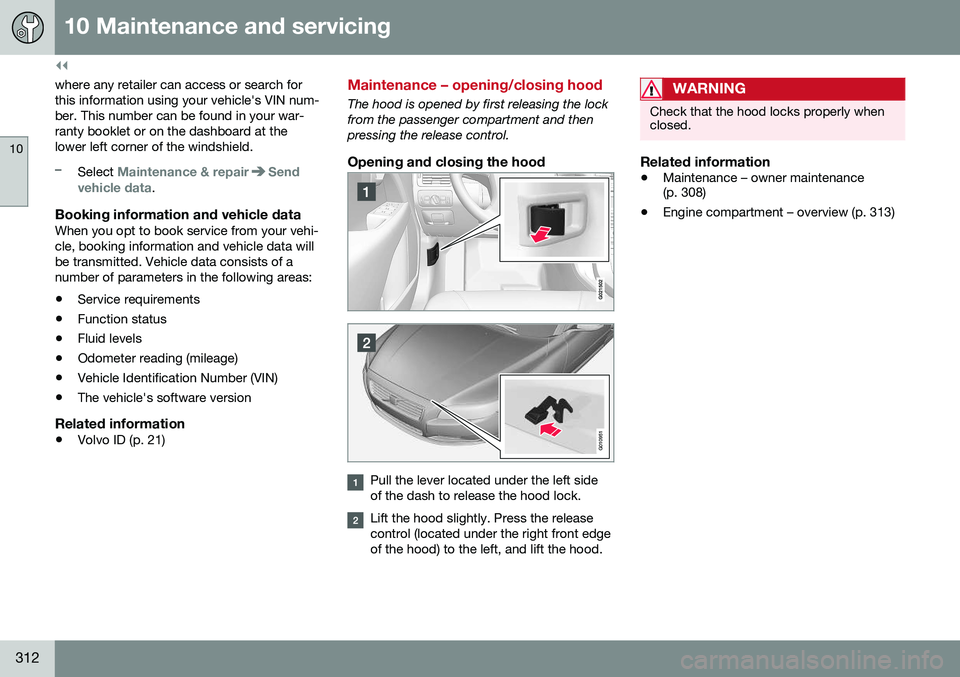
The hood is opened by first releasing the lock from the passenger compartment and thenpressing the release control.
Opening and closing the hood
G010951
Pull the lever located under the left side of the dash to release the hood lock.
Lift the hood slightly. Press the release control (located under the right front edgeof the hood) to the left, and lift the hood.
WARNING
Check that the hood locks properly when closed.
Related information
•Maintenance – owner maintenance (p. 308)
• Engine compartment – overview (p. 313)
Page 322 of 380
||
10 Maintenance and servicing
10
320* Option/accessory, for more information, see Introduction.
CAUTION
Never touch the glass of bulbs with your fingers. Grease and oils from your fingersvaporize in the heat and will leave adeposit on the reflector, which will damageit.
WARNING
• The engine should not be running when changing bulbs.
• If the engine has been running justprior to replacing bulbs in the head-light housing, please keep in mind thatcomponents in the engine compart-ment will be hot.
WARNING
•
Active Bending Lights* – due to the high voltage used by these headlights,these bulbs should only be replacedby a trained and qualified Volvo serv-ice technician.
• Turn off the lights and remove theremote key from the ignition beforechanging any bulbs.
Related information
•
Bulbs – headlight housing (p. 320)
• Bulbs – taillight housing (p. 324)
• Bulbs – vanity mirror lighting (p. 326)
• Bulbs – license plate lighting (p. 325)
Bulbs – headlight housing
The entire headlight housing must be lifted out when replacing all front bulbs.
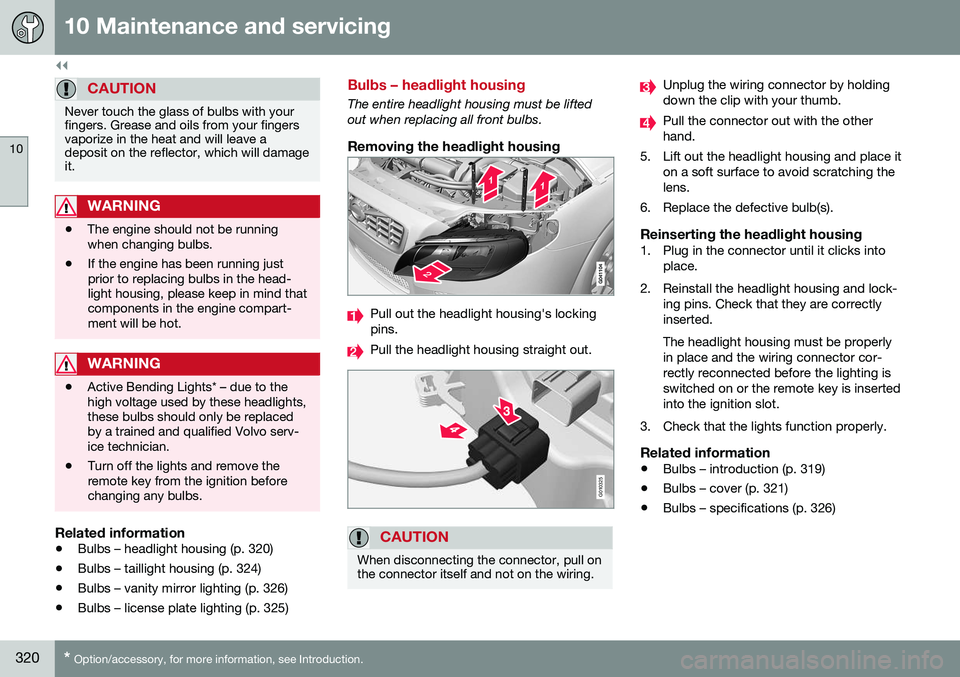
Removing the headlight housing
Pull out the headlight housing's locking pins.
Pull the headlight housing straight out.
G010325
CAUTION
When disconnecting the connector, pull on the connector itself and not on the wiring.
Unplug the wiring connector by holding down the clip with your thumb.
Pull the connector out with the other hand.
5. Lift out the headlight housing and place it on a soft surface to avoid scratching thelens.
6. Replace the defective bulb(s).
Reinserting the headlight housing1. Plug in the connector until it clicks into place.
2. Reinstall the headlight housing and lock- ing pins. Check that they are correctlyinserted. The headlight housing must be properly in place and the wiring connector cor-rectly reconnected before the lighting isswitched on or the remote key is insertedinto the ignition slot.
3. Check that the lights function properly.
Related information
• Bulbs – introduction (p. 319)
• Bulbs – cover (p. 321)
• Bulbs – specifications (p. 326)
Page 324 of 380
10 Maintenance and servicing
10
322
Bulbs – high beam, Halogen
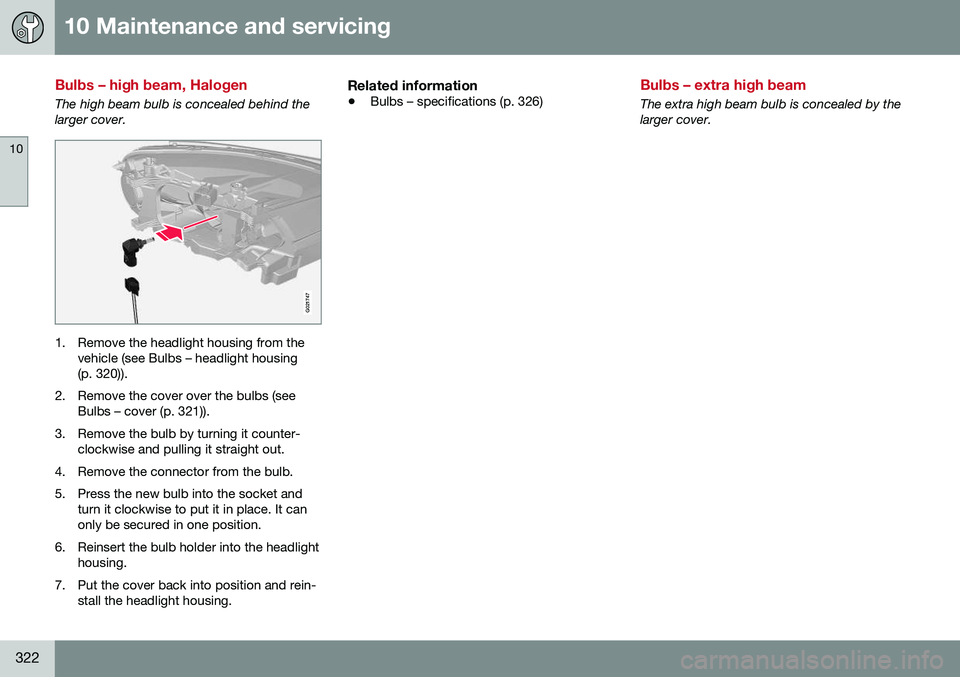
The high beam bulb is concealed behind the larger cover.
G021747
1. Remove the headlight housing from thevehicle (see Bulbs – headlight housing (p. 320)).
2. Remove the cover over the bulbs (see Bulbs – cover (p. 321)).
3. Remove the bulb by turning it counter- clockwise and pulling it straight out.
4. Remove the connector from the bulb.
5. Press the new bulb into the socket and turn it clockwise to put it in place. It can only be secured in one position.
6. Reinsert the bulb holder into the headlight housing.
7. Put the cover back into position and rein- stall the headlight housing.
Related information
• Bulbs – specifications (p. 326)
Bulbs – extra high beam
The extra high beam bulb is concealed by the larger cover.
Page 326 of 380
||
10 Maintenance and servicing
10
324
7. Reinstall the headlight housing.
Related information
•Bulbs – specifications (p. 326)
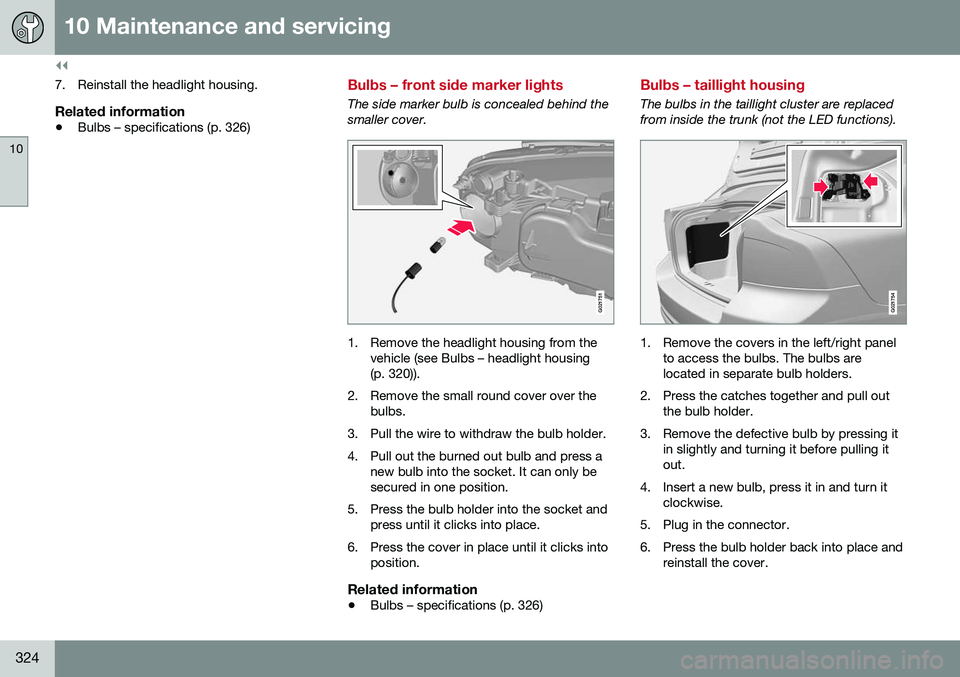
Bulbs – front side marker lights
The side marker bulb is concealed behind the smaller cover.
G021751
1. Remove the headlight housing from the
vehicle (see Bulbs – headlight housing (p. 320)).
2. Remove the small round cover over the bulbs.
3. Pull the wire to withdraw the bulb holder.
4. Pull out the burned out bulb and press a new bulb into the socket. It can only be secured in one position.
5. Press the bulb holder into the socket and press until it clicks into place.
6. Press the cover in place until it clicks into position.
Related information
• Bulbs – specifications (p. 326)
Bulbs – taillight housing
The bulbs in the taillight cluster are replaced from inside the trunk (not the LED functions).
G021754
1. Remove the covers in the left/right panel
to access the bulbs. The bulbs are located in separate bulb holders.
2. Press the catches together and pull out the bulb holder.
3. Remove the defective bulb by pressing it in slightly and turning it before pulling itout.
4. Insert a new bulb, press it in and turn it clockwise.
5. Plug in the connector.
6. Press the bulb holder back into place and reinstall the cover.
Page 341 of 380
10 Maintenance and servicing
10
}}
* Option/accessory, for more information, see Introduction.339
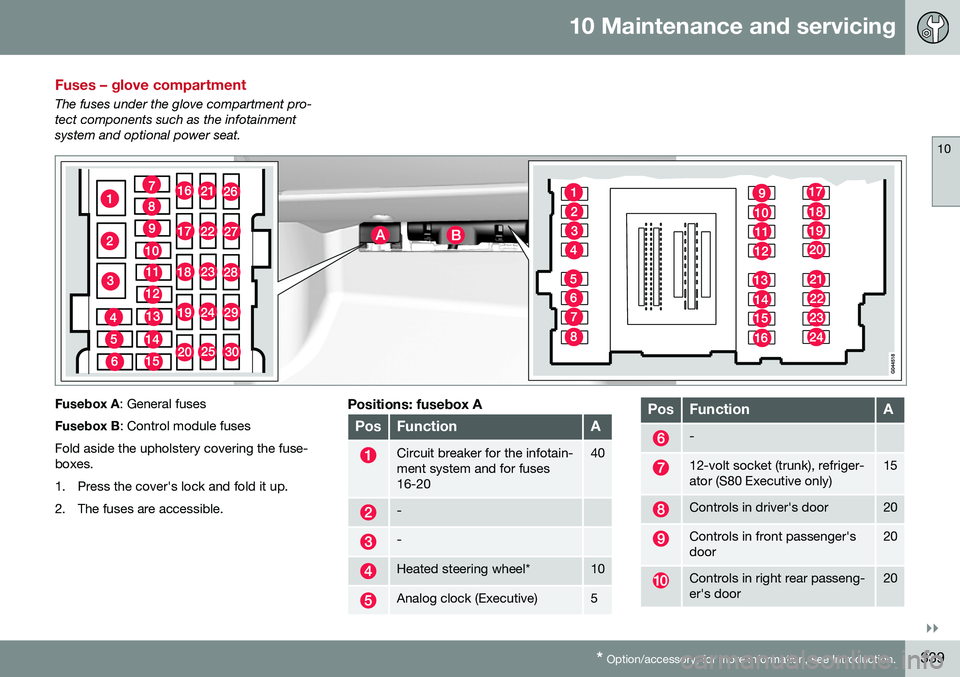
Fuses – glove compartment
The fuses under the glove compartment pro- tect components such as the infotainmentsystem and optional power seat.
Fusebox A : General fuses
Fusebox B : Control module fuses
Fold aside the upholstery covering the fuse- boxes.
1. Press the cover's lock and fold it up.
2. The fuses are accessible.Positions: fusebox A
PosFunctionA
Circuit breaker for the infotain- ment system and for fuses16-2040
-
-
Heated steering wheel*10
Analog clock (Executive)5
PosFunctionA
-
12-volt socket (trunk), refriger- ator (S80 Executive only)15
Controls in driver's door20
Controls in front passenger's door20
Controls in right rear passeng- er's door20